A Reliability Optimization Algorithm for
Wireless Sensor Network
https://doi.org/10.3991/ijoe.v14i06.8704
Qiuming Zhang!!"
China University of Geosciences, Hubei, China [email protected]
Jing Luo
Wuhan Vocational College of Software and Engineering, Hubei, China
Abstract—Aiming at the reliability optimization algorithm based on wire-less sensor network, a data fusion algorithm based on extreme learning machine for wireless sensor network was proposed according to the temporal spatial cor-relation in data collection process. After analyzing the principles, design ideas and implementation steps of extreme learning machine algorithm, the perfor-mance and results were compared with traditional BP algorithm, LEACH algo-rithm and RBF algoalgo-rithm in simulation environment. The simulation results showed that the data fusion optimization algorithm based on the limit learning machine for wireless sensor network was reliable. It improved the efficiency of fusion and the comprehensive reliability of the network. Thus, it can prolong the life cycle and reduce the total energy consumption of the network.
Keywords—wireless sensor network, optimization algorithm, extreme learning machine
1
Introduction
influ-ential technologies in the twenty-first Century and one of the top 10 technologies to change the world.
2
State of the art
In the face of complex industrial application environment, wireless sensor net-works will be disturbed by the external environment in the process of data collection and data transmission. In addition, there are dynamic changes in the topology of the mobile network, which leads to the failure of the network. He, D. et al. [1] studied reliable wireless sensor network modeling and planning based on variable-length multi-objective optimization genetic algorithm. Sharawi, M. et al. [2] used the flower pollination optimization algorithm for global optimization of wireless sensor network life. Hoang, D. C. et al. [3] implemented an energy-efficient wireless sensor network clustering protocol based on a harmonious search algorithm in real time. Kim, J. Y. et al. [4] studied the cluster ant colony optimization algorithm for wireless sensor net-works in dense environments. If the data collected by the sensor nodes cannot be passed to Sink effectively and quickly, it will affect the normal work, stability and reliability of the network. Attea, B. A. et al. [5] studied the reliability life of wireless sensor networks with multiple target disjoint sets. Karaboga, D. et al. [6] pointed out that according to the statistics at home and abroad, most of the existing WSN research focuses on routing protocol (29%), MAC protocol (19%), location algorithm (17%) and energy efficiency (30%). Only about 5% of the research is related to reliability. Ma, T. et al. [7] proposed a reliable information fusion algorithm based on wireless sensor networks. At present, there are few studies on the reliability and optimization algorithms of wireless sensor. This situation seriously restricts the development of the reliability technology of the Internet of things, mobile networks and wireless sensor networks. Iqbal, M. et al. [8] studied a multi-objective example of wireless sensor network optimization. Rajaram, M. L. et al. [9] analyzed the wireless sensor network simulation framework. Abdulhalim, M. F. and Attea, B. A. [10] studied the multi-layer genetic algorithm coverage problem for the maximum separation of reliable sets in wireless sensor networks. To sum up, it is urgent to study the optimization algo-rithm of the reliability of wireless sensor networks. At present, the most important research work is to improve the reliability of mobile wireless sensor network node hardware devices, wireless communication links, data multi hop self-organization transmission and network operation, so as to ensure the long-term and stable work of the network. The research results will provide theory basis and technology guidance for the wireless sensor network reliability optimization design of nuclear radiation environment safety monitoring system, modern logistics warehousing environmental monitoring system, wearable medical monitoring system, large-scale agricultural mobile wireless sensor network and forest fire warning system.
ma-chine for wireless sensor network was proposed according to the temporal spatial correlation in data collection process. The method improved the efficiency of fusion and the comprehensive reliability of the network. Thus, it prolongs the life cycle and reduces the total energy consumption of the network.
3
Method
3.1 Data fusion optimization algorithm for wireless sensor networks— extreme learning machine
After analyzing the network energy consumption and network operation under dif-ferent data fusion algorithms, a new data fusion method based on extreme learning machine for wireless sensor networks is proposed. The algorithm uses the extreme learning machine to learn, and the weights and thresholds of the neural network are obtained after optimization. The original data collected by the node are extracted, and the fusion processing is carried out. After that, the cluster head sends the fused data to the moving Sink. In this process, the data fusion in the network eliminates the trans-mission of redundant data and improves the accuracy of data fusion. The data fusion method proposed in this paper greatly reduces the feature dimension of the data, pro-longs the network survival time, improves the efficiency of data fusion and the relia-bility of data transmission.
According to the different structure and function of the single hidden layer feed-forward neural network, the extreme learning machine algorithms can be divided into three kinds: fixed extreme learning machine, incremental extreme learning machine and mixed extreme learning machine. According to their network structure, the three different classifications are mainly based on the number of nodes, the input layer and the number of the input layer nodes. Fixed extreme learning machine means that the number of hidden layer nodes of the neural network has been determined, and the output weights of all hidden layer neurons can be obtained by one calculation. The main feature of incremental extreme learning machine is that every time it is trained it will get an implicit layer of neuron weight. In the next training, neural network first obtains a new hidden layer neuron coefficient based on the last acquired weights and threshold network parameters. After training and learning, the new neuron weights are obtained by analysis and calculation. This iterative update can solve the "over satura-tion" phenomenon. The number of neurons in the hidden layer is acquired by experi-ence and is difficult to determine. Mixed extreme learning machine is between the fixed and incremental extreme learning machines, and can also get better training speed. Compared with BP neural network, RBF neural network and support vector machine (SVM), it has the following advantages:
once calculated and does not need to modify the network weight. Therefore, the learn-ing speed of the extreme learnlearn-ing machine is fast and the time is short.
Second, less parameter setting and algorithm implementation. This method is suit-able for a variety of hidden layer mapping functions. The extreme learning machine algorithm only needs to set up one parameter of the network structure. The algorithm is simple and easy to be realized.
Third, good generalization ability. The extreme learning machine method does not cause the "over fitting" phenomenon to the training sample. In order to avoid the local optimal solution, its input weights and thresholds are obtained in a random way. The-se values have been calculated before the training data The-set is obtained and are inde-pendent of the training data.
Fourth, the hidden layer mapping function of extreme learning machine is much more than the traditional BP network gradient method. It can change the hidden layer mapping function, and does not need to change any algorithm. It only needs to change the hidden layer mapping function.
Although the extreme learning machine method has many advantages compared with the traditional machine learning algorithm, there are some disadvantages as well.
First, the input weights and the hidden layer thresholds of the ELM are generated randomly. If the inappropriate parameters are selected, it has a great impact on the generalization ability of the learning machine.
Second, when the training sample is not balanced or the number of training sam-ples is small, the generalization performance of the algorithm is not ideal. Because of the characteristics of ELM's theory, generalization and training speed, many scholars have tried to use ELM algorithm to solve various problems of pattern recognition and classification in reality. In face recognition, text classification, medical diagnosis, image classification and other applications, the algorithm and model based on ELM have shown superior performance, which is superior to the traditional machine learn-ing method and achieves satisfactory results.
3.2 The basic principle of the extreme learning machine method
The general network parameters of extreme learning machine algorithm include the input layer, the hidden layer and the number of nodes in the output layer, and the network weights and thresholds. It is assumed that the parameter m, M and n are the numbers of nodes in the network input layer, the hidden layer and the output layer. g
xis an activation function of the neurons of the hidden layer. bi is the threshold.
Assuming that there are N different samples such as (xiti) and 1!i!N. in the
formu-la, the number of nodes in the input layer is xi[xi1xi2…xim]T
!
Rm. Thenum-ber of nodes in the output layer is ti[ti1ti2…tin]T
!
Rn.The network model of the extreme learning machine can be expressed in mathe-matical expressions as:
!
=
=
=
+
•
"
!
In the formula,
!
=
!
!
!
!
represents the input weight vector between the connection network input layer and the i-th hidden layer node.
!
!
!
!
=
!
represents the output weight vector connecting the i-th hidden layer node and the network input layer node.=
!
represents the network output value.
The cost function E of the extreme learning machine is expressed as:
!
="
=
#
(2)In the formula,
=
!
=
!
"i and bi are network inputweights and hidden layer node thresholds, respectively. According to the extreme learning machine method pointed by Professor Huang in Singapore Nanyang Tech-nology University, the training goal of extreme learning machine network is to find optimal S and " to ensure that the error between the output value of the neural net-work and the corresponding actual value is minimal. The mathematical expression is min (E(S,")).
3.3 Design of reliability algorithm for data transmission in Wireless Sensor Networks
Because of the limited performance of the sensor nodes and the disturbance of the external environment, a single sensor node can only obtain local limited and uncertain information. In order to eliminate the influence of the external environment and the uncertainty of collected information, data fusion technology combines, analyzes, processes and integrates monitoring information from different sources, information modes and expression ways from multiple sensing nodes, and extracts more precise comprehensive information. Thus, it is convenient for users to understand the overall situation correctly and provide the basis for the correct decision. Data fusion technol-ogy has become an important means for wireless sensor networks to save energy, improve work efficiency and data transmission reliability and prolong network life-time. In order to simplify the network simulation calculation, the information of the node and topology of the wireless sensor network is assumed.
node then converts the data of the received multiple sensor data in the network, and then sends the output data to the Sink node.
Monitoring area
A single sensor node collects
data
Output the merged
data Data
Fusion Send to Sink
Data collected by multiple sensor
nodes Routing
transmission Data
preprocessing
Fig. 1. Mobile wireless sensor network data fusion process
3.4 Algorithm design idea
Combining the spatiotemporal correlation of data collection, the data fusion meth-od is applied to the fusion of cluster heads and intra cluster nmeth-odes in the wireless sen-sor network. A new method of artificial intelligence extreme learning machine is introduced on the basis of routing clustering algorithm, and a data fusion method based on extreme learning machine is proposed. The collected data are analyzed and processed synthetically, and the data with poor reliability, invalid and redundant are deleted to improve the accuracy and accuracy of the data. It solves the problem of data fusion efficiency, network life cycle and data transmission reliability. At the same time, the amount of data transmission and the energy consumption of the net-work are reduced and the net-work efficiency of the netnet-work is improved.
The extreme learning method data fusion (ELMDF) algorithm is developed on the basis of classic clustering LEACH algorithm for mobile wireless sensor networks. The classic clustering LEACH routing protocol first clusters all nodes in the detection area and then assigns random values between 0 and 1. If the value is less than a threshold, then the node becomes a cluster head. The cluster head and the nodes of the family members form a stable cluster structure. The cluster member nodes preprocess the collected data and then transmit them to the cluster heads. The cluster head com-bines the collected data and then removes redundant and useless information, and then forward it to the Sink. The ELMDF method is to use the extreme learning machine method to deal with the data between the cluster members and the cluster heads.
3.5 Algorithm implementation
performed. In order to reduce the energy consumption of common nodes and prolong the lifetime of the network, the training of the data fusion model based on the extreme learning machine is completed within the Sink node of the mobile sensor network. The Sink node constructs the extreme learning machine network structure according to the received information, and collects samples that are matched with the members' information in the cluster head database to train the network. After the training is completed, the relevant information of the related data fusion model is obtained. After that, the Sink node sends network parameters (the number of hidden layer nodes, network weights and thresholds) in the data fusion model to the corresponding cluster head nodes. The cluster head is used to fuse and extract the data from the members of the cluster according to the trained data fusion model. At the same time, redundant and useless information are deleted, and the data after the fusion is temporarily stored. When the mobile Sink reaches the cluster head communication range, it is forwarded to the Sink.
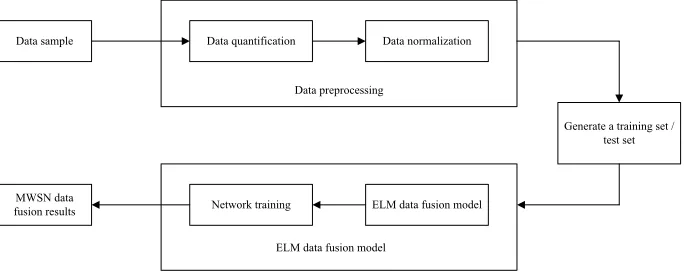
Data fusion steps of wireless sensor networks based on extreme learning machines: First, the optimal data fusion model based on the extreme learning machine method is constructed. Then, the fusion model is applied to the cluster structure of wireless sensor network, which improves the accuracy of the network fusion, reduces the data transmission and prolongs the network life. The flow chart of the ELMDF based wire-less sensor network data fusion algorithm is shown in figure 2.
Data sample Data quantification Data normalization
Data preprocessing
Generate a training set / test set
MWSN data
fusion results Network training ELM data fusion model
ELM data fusion model
Fig. 2. Wireless sensor network data fusion process based on extreme learning machine
The implementation steps of the wireless sensor network data fusion based on the extreme learning machine are as follows:
Step 1: The parameters of the model are initialized, such as the security verification of the node, the initialization of the network, the location of the node and the number of the ELM hidden layer nodes;
Step 2: The data fusion model is initialized under the constraints of the input weight and threshold;
Step 4: The cluster head is selected from the common node and the cluster head perception area is established;
Step 5: The cluster head sends the cluster head member node information table to the Sink node;
Step 6: The Sink node constructs the ELM data fusion model and trains the sample data to obtain the network parameters of the extreme learning machine (weights and thresholds);
Step 7: If the terminating condition of the network training is not reached, it will continue to execute;
Step 8: The Sink node sends the trained ELM network structure parameters to the corresponding nodes.
Step 9: The cluster head node combines the received information with the trained ELM network structure, and then sends the fusion data to the Sink node;
Step 10: The network reliability data transmission based on data fusion ends at this time.
4
Results
In order to prove the optimization performance of the algorithm, the ELM algo-rithm is mainly compared with the traditional BP, LEACH and RBF algoalgo-rithms. By comparing the data fusion efficiency, the total network energy consumption and the network life cycle, it is proved that the data fusion algorithm based on extreme learn-ing machine in mobile wireless sensor network is a more optimized algorithm.
4.1 Simulation environment setting
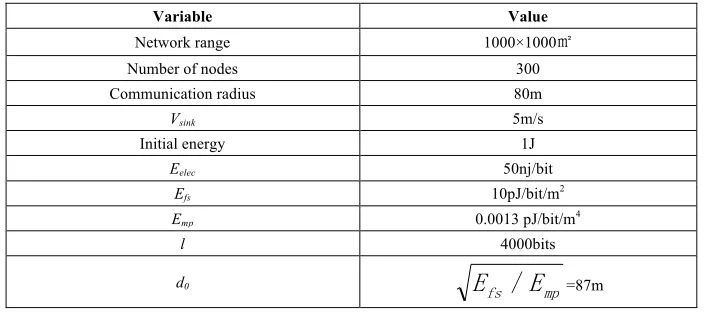
Table 1. Simulation environment parameter settings
Variable Value Network range 1000#1000
Number of nodes 300 Communication radius 80m
Vsink 5m/s
Initial energy 1J
Eelec 50nj/bit
Efs 10pJ/bit/m2
Emp 0.0013 pJ/bit/m4
l 4000bits
d0
=87mIn order to better illustrate the superiority of the algorithm, the LEACH algorithm, BP neural network, RBF neural network and extreme learning machine algorithm are compared.
LEACH algorithm: data fusion algorithm for mobile wireless sensor networks based on clustering;
BP neural network: data fusion algorithm for mobile wireless sensor network based on BP neural network;
RBF neural network: data fusion algorithm for mobile wireless sensor network based on RBF neural network;
Extreme learning machine algorithm: data fusion algorithm for mobile wireless sensor network based on extreme learning machine
4.2 Comparison of data fusion efficiency
The efficiency of data fusion shows the fusion performance of the data fusion algo-rithm. When the efficiency is high, the network data transmission, the energy con-sumption and the packet loss rate are less. At the same time, the network life and reliability are high. Therefore, the efficiency of data fusion is one of the important performance evaluations of this paper. The data fusion rate is calculated as follows: assuming that sensor node i forward the perceived data to the sensor node j. Accord-ing to the time and spatial correlation of data acquisition, the formula of data correla-tion coefficient is:
=
!
"
(3)!
reflects the degree of correlation between the data, and the data related system!
is inversely proportional to the distance between the sensor nodes. The calculation formula is as follows:[
]
=
+
!
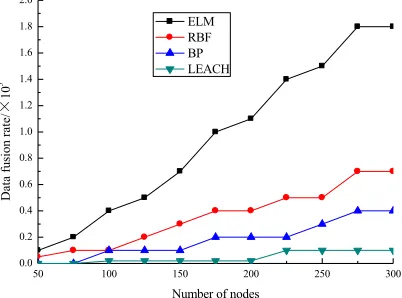
(4)Data fusion rate is made up of two parts. Part of the data fusion is transmitted from sensor nodes and other nodes around them. The other part is the fusion of the original data collected by the upstream node and the data collected by the cluster head itself. Figure 3 is a comparison diagram of the data fusion efficiency of the four algorithms.
50 100 150 200 250 300
0.0 0.2 0.4 0.6 0.8 1.0 1.2 1.4 1.6 1.8 2.0
Dat
a
fu
si
on
rat
e/
10
5
Number of nodes ELM RBF BP LEACH
Fig. 3. Comparison of data fusion efficiency
As shown in figure 3, with the increase of the number of network nodes, the data fusion rate of LEACH routing protocol, BP neural network and RBF neural network data fusion algorithm is increasing. The algorithm proposed in this paper has the larg-est increase range, showing a straight-line upward trend. The reason is that with the increase of the number of sensor nodes, a lot of neighbor nodes will be added between nodes. The number of neighbor nodes of the data collected by the perceptive node increases, and the probability of data fusion also increases. Compared with the data fusion rate of ELM and LEACH, BP neural network and RBF neural network, the calculation results are 94.4%, 79.1% and 64.6% respectively.
4.3 Comparison of total energy consumption in network
0 50 100 150 200 250 300 350 400 450 500 0
50 100 150 200 250 300
Net
wo
rk
energ
y con
su
mp
tio
n
Number of rounds LEACH
BP RBF ELM
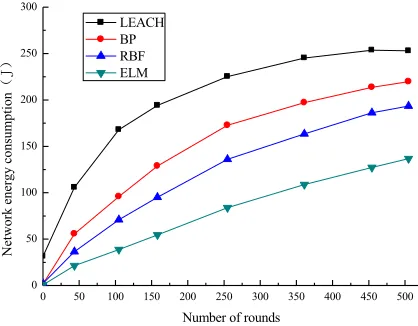
Fig. 4. Comparison of total network energy consumption
As shown in figure 4, with the increase of the round number, the network energy consumption of the four algorithms is increasing gradually. However, the growth of the LEACH algorithm is the largest, and the algorithm proposed in this paper has the smallest increase. In addition, the energy consumption of the LEACH routing proto-col is the largest and the BP neural network is larger. The RBF neural network is smaller, and the extreme learning machine algorithm is the smallest. With 400 round numbers as reference, the algorithm is compared with BP neural network and RBF neural network in the LEACH protocol and the accuracy of the algorithm is increased by 32.8%, 22.8% and 12.8% respectively. In the process of data transmission, the LEACH algorithm has no data fusion. As time goes on, energy consumption increases sharply. BP neural network, RBF neural network and extreme learning machine algo-rithm use data fusion to reduce the amount of data transmission and the energy con-sumption of nodes. From the comparison of the network energy concon-sumption of the three algorithms, it shows that the proposed algorithm has the advantages of low net-work parameters setting and high learning rate, which reduces the energy consump-tion of the network.
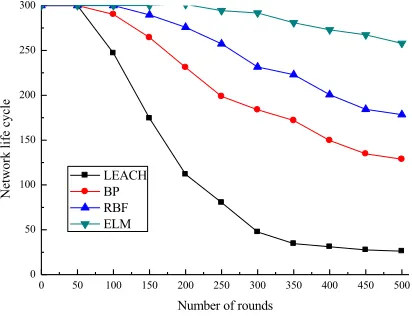
4.4 Network life cycle comparison
0 50 100 150 200 250 300 350 400 450 500 0
50 100 150 200 250 300
Net
wo
rk
li
fe
cy
cl
e
Number of rounds LEACH
BP RBF ELM
Fig. 5. Network life cycle
As shown in figure 5, in the LEACH protocol, the death time of 50% sensor nodes is in 178th round. In the data fusion of BP neural network, the death time of 50% sensor nodes is 402nd round. When the RBF neural network algorithm runs 500
rounds, the death rate of the node is 43.3%, and the algorithm proposed in this paper is 16.7%. The algorithm proposed in this paper takes into account the residual energy and the distance to the sink node in the wireless sensor network, and transfers the sensing data of each node to the sink node through the family header node. The ener-gy consumption of the network is small. In the case of 500 rounds, the network life cycle is compared to the LEACH protocol. The BP neural network algorithm and the RBF neural network algorithm are improved by 87.3%, 38.3% and 26.2% respective-ly.
5
Conclusions
How to efficiently and quickly integrate data, improve the efficiency of fusion and resource utilization, and reduce network energy consumption, data fusion is one of the key technologies for wireless sensor networks. In the process of redundant data transmission, too much energy will be consumed. It is necessary to shorten the life-time of the network and improve the reliability of data transmission. Through this study, the following conclusions are drawn.
(1) According to the temporal and spatial correlation in data collection process of wireless sensor network, a data fusion algorithm based on extreme learning machine in wireless sensor network is proposed.
(2) The generalization performance of the extreme learning machine is used. The adjustable parameters are relatively small, and the learning ability is strong. The char-acteristics of the original data are extracted and the data fusion is carried out.
6
References
[1]He, D., Mujica, G., Portilla, J., & Riesgo, T. Modelling and planning reliable wireless sen-sor networks based on multi-objective optimization genetic algorithm with changeable length. Journal of Heuristics, 2015, vol. 21(2), pp. 257-300. https://doi.org/10.1007/ s10732-014-9261-2
[2]Sharawi, M., Emary, E., Saroit, I. A., & El-Mahdy, H. Flower pollination optimization al-gorithm for wireless sensor network lifetime global optimization. International Journal of Soft Computing and Engineering, 2014, vol. 4(3), pp. 54-59.
[3]Hoang, D. C., Yadav, P., Kumar, R., & Panda, S. K. Real-time implementation of a har-mony search algorithm-based clustering protocol for energy-efficient wireless sensor net-works. IEEE transactions on industrial informatics, 2014, vol. 10(1), pp. 774-783.
https://doi.org/10.1109/TII.2013.2273739
[4]Kim, J. Y., Sharma, T., Kumar, B., Tomar, G. S., Berry, K., & Lee, W. H. Intercluster ant colony optimization algorithm for wireless sensor network in dense environment. Interna-tional Journal of distributed sensor networks, 2014, vol. 10(4), pp. 457402.
https://doi.org/10.1155/2014/457402
[5]Attea, B. A., Khalil, E. A., Özdemir, S., & Yıldız, O. A multi-objective disjoint set covers for reliable lifetime maximization of wireless sensor networks. Wireless Personal
Commu-nications an International Journal, 2015, vol. 81(2), pp. 819-838.
https://doi.org/10.1007/s11277-014-2159-3
[6]Karaboga, D., Gorkemli, B., Ozturk, C., & Karaboga, N. A comprehensive survey: artifi-cial bee colony (ABC) algorithm and applications. Artifiartifi-cial Intelligence Review, 2014, vol. 42(1), 21-57. https://doi.org/10.1007/s10462-012-9328-0
[7]Ma, T., Liu, Y., Fu, J., & Jing, Y. A reliable information fusion algorithm for reputation based wireless sensor networks. International Journal of Future Generation Communica-tion & Networking, 2015, vol. 8(1), pp. 114-118.
[8]Iqbal, M., Naeem, M., Anpalagan, A., Ahmed, A., & Azam, M. Wireless sensor network optimization: multi-objective paradigm. Sensors, 2015, vol. 15(7), pp. 17572-17620.
https://doi.org/10.3390/s150717572
[9]Rajaram, M. L., Kougianos, E., Mohanty, S. P., & Choppali, U. Wireless sensor network simulation frameworks: A tutorial review: MATLAB/Simulink bests the rest. IEEE
Con-sumer Electronics Magazine, 2016, vol. 5(2), pp. 63-69. https://doi.org/10.1109/
MCE.2016.2519051
[10]Abdulhalim, M. F., & Attea, B. A. Multi-layer genetic algorithm for maximum disjoint re-liable set covers problem in wireless sensor networks. Wireless Personal Communications, 2015, vol. 80(1), pp. 203-227. https://doi.org/10.1007/s11277-014-2004-8
7
Authors
Qiuming Zhang is with China University of Geosciences, Hubei, China.
Jing Luo is with the Practice training centre, Wuhan Vocational College of Soft-ware and Engineering, Hubei, China.