Research Article
© 2018 Pinar Sali. This is an open access article licensed under the Creative Commons Attribution-NonCommercial-NoDerivs License (http://creativecommons.org/licenses/by-nc-nd/3.0/).
A Quest into Recasts as a Type of Corrective
Feedback in Foreign Language Classrooms
1Assist. Prof. Dr. Pinar Sali
Uludag University Faculty of Education Department of English Language Teaching
Bursa, Turkey
Doi: 10.2478/ajis-2018-0018
Abstract
The present study was undertaken to investigate how EFL teachers utilise corrective feedback in their classrooms. To this end, an analytic model consisting of various corrective feedback moves was applied to a small amount of data consisting of 12 lesson-hour classroom interaction with a purpose of documenting the frequencies and distribution of corrective feedback, in particular, of recasts in relation to other corrective feedback types and of specific types of recasts. Data were gathered from first-year speaking classes at an ELT department in a large state university in Turkey. The findings indicated that recasts were the most frequently employed corrective feedback strategy by the teachers. A closer examination of those recasts further revealed incorporative declarative recasts as the most preferred type of recasting. Overall, what these findings suggest is that recasts might serve important communicative functions by helping EFL teachers provide input in an authentic and supportive manner and by building on learner output.
Keywords: Corrective feedback; recasts; foreign language; error correction
1. Introduction
In keeping with the Interaction Hypothesis, Long (1996, p.414) postulates that ‘environmental contributions to acquisition are mediated by selective attention and the learners’ developing L2 capacity, and that these resources are brought together most usefully, although not exclusively, during negotiation of meaning’. In view of this, the assumption is that negotiation of meaning may provide language learners with opportunities of negative evidence and may in turn promote language development (Gass, 2017; Long, 1996; Yi & Sun, 2013).
It seems true that corrective feedback (CF hereafter) is of pedagogical significance in the sense that it might aid in the formulation of interactive patterns in language classrooms and make language classrooms richer in terms of linguistic input. In other words, it might enhance opportunities for negotiation of meaning and form, which would, in turn, speed up classroom dynamics by increasing learning opportunities for learners and teaching occasions for teachers (Ellis, Loewen, & Erlam, 2006; Sheen & Ellis, 2011). As Lyster (1998) also notes, CF provides clues to learners as to their use of nontarget forms and allows them to actively confront their errors in ways that may lead to revisions of their hypothesis about the language they are being learned. Thus, CF, as one of the indispensable tools of negotiated interaction, is a crucial aspect of classroom life and deserves attention as a subject of concern in the domain of ELT.
As being one of the specific types of CF, recasts have also attracted attention in second language learning research (Nassaji, 2017). A generally-held view in the SLA field is that recasts not only offer implicit negative evidence, but also provide positive evidence and that they make this positive evidence especially salient (Leeman, 2003). In first language acquisition, recasts are depicted as utterances that rephrase a child’s utterance by changing one or more sentence components ... while still referring to its central meanings. In second language acquisition, the term has a more specific meaning: ‘an implicit CF move that reformulates or expands an ill-formed or incomplete utterance in an unobstrusive way’ (Panova & Lyster, 2002, p.582). Recasts have been investigated in terms of their corrective potential in native speaker-nonnative speaker dyads (Philp, 2003; Mackey, Gass & McDonough, 2003; Leeman, 2003), and in teacher-student interaction in second language classrooms (Lyster & Ranta, 1997; Lyster, 1998; Panova & Lyster, 2002; Lyster & Mori, 2006; Rassaei, 2014; Nassaji, 2017).
However, although there is a substantial body of research on the role of CF and recasts, the main context of this research was frequently the field of second language acquisition, and little is known as to the use of CF and particularly recasts in foreign language classrooms. As a highly complex social activity (Sheen & Ellis, 2011), the ways CF are utilised might significantly differ from each other in different instructional settings. As also revealed by several studies, language teachers’ CF strategies might be influenced by contextual factors (Mori, 2002; Sheen, 2004).
Sparked off by this, the present study sets off to answer the following questions:
1. What are the different types of CF and their distribution in foreign language classrooms? 2. What is the distribution of recasts in relation to other types of CF in foreign language
classrooms?
3. What are specific types of recasts and their distribution in foreign language classrooms? The answers to these questions could be of significance to better make sense of how interactive patterns are established through CF in EFL classrooms, which, in turn, might contribute to the development of EFL teachers’ CF strategies.
2. Methodology
In the present study, a descriptive-exploratory research paradigm was adopted due to the nature of the issue under scrutiny, and the exploration was achieved mainly through qualitative research mode. The present study was qualitative in that it employed qualitative means of instrumentation which yielded mainly qualitative data. Although the nature of the study led the researcher, to a large extent, to take a qualitative inquiry into the research phenomenon, quantitative research elements accompanied this qualitative inquiry in the description of the qualitative data: Data elicited through the observations were described and presented in the form of percentages and tables.
2.1 Setting
Thepresent study was conducted at an ELT Department of a university in Turkey. Data presented in the study were gathered from four first year speaking classes at the given department and from the two teachers of these given four classes (two classes per teacher). In the light of a piloting study conducted within the research setting before the actual data collection procedures, it was decided that speaking classes would be an appropriate context for data collection purposes that would provide rich data in terms of oral errors and types of CF. In terms of classroom activities (which are an important aspect of the classroom context), it was observed that the two given teachers (From now on, the teachers will be labelled as Teacher A and Teacher B) organised their pedagogical practices around three different activities: student presentation, vocabulary study, and coursebook study.
2.2 Participants
had ten years of teaching experience including 3 years at the secondary level teaching English. She had an MA degree in ELT. Teacher B was also female and had five years of teaching experience including 1 year at the high school level. She had an MA degree as well.
2.3 Instrumentation
As being one of the most prominent tools of classroom-oriented research, observation provides the researcher with an opportunity to delve into what is happening in classrooms and allows him/her to have a close contact with classroom events. Thus, for the purposes of the present study, observation seemed to be the most appropriate research tool to explore what was happening in ELT speaking classes in terms of CF.
The videorecorded observations of the two teachers’ classes yielded 12 lesson-hour classroom interaction. The teachers were observed for one week in the light of the analytic model of CF developed by Lyster and Ranta (1997). The lessons were videorecorded rather than audiotaped to be able to capture the whole aspects of classroom interaction and to obtain elaborate and high quality data.
The teachers were not informed about the focus of the observation. They were just told that the researcher was interested in classroom happenings.
2.4 Data analysis
The raw data obtained by means of videorecorded observations comprised 12 hours of classroom interaction and were transcribed on the basis of Allwright’s transcription conventions for classroom discourse (Allwright & Bailey, 1991).
It was a demanding task to identify and quantify the errors and the corresponding moves of CF in that it required the researcher to move back and forth between the analysis to ensure consistency in the analysis. Within the scope of the present study, CF was defined as utterances that indicate to the learner that his or her output is erroneous in some way (Nassaji & Kartchava, 2017), error as any deviance from the target language forms and oral error as any error committed by language learners in oral classroom discourse. Thus, each deviance from the target language forms was counted to be an error. Following Lyster and Ranta (1997), errors committed were classified as either phonological, lexical, grammatical. Two additional error categories were also included in the analysis: Content errors and discourse errors. Furthermore, some instances of CF entailed multiple coding of CF moves, which implied that some errors were reacted by more than one type of CF.
For the analysis of the specific types of recasts, four functional categories of recasts were utilised (Lyster, 1998): Isolated declarative recasts, isolated interrogative recasts, incorporated declarative recasts, incorporated interrogative recasts. Since the data were analysed only by the researcher, there was a need to ensure rater reliability. To ensure interreliability, the researcher asked another researcher to analyse the most representative CF sequences and recast types chosen from the data. As for intrarater reliability, the researcher reanalysed a small portion of data after a certain time had elapsed from the actual analysis.
Data were then quantitatively represented through the calculation of frequencies of CF types and through the description of these in the form of percentages.
3. Findings and Discussion
Before proceeding into the report and discussion of findings gleaning from the study, it should be noted that the findings were presented by referring to Teacher A and Teacher B separately to provide an elaborate account into the findings.
3.1 What are the different types of CF and their distribution in foreign language classrooms?
A detailed analysis of the observation data indicated that there was little scope for CF both in Teacher A and Teacher B’s classes. The most salient picture emerged in the teachers’ classes was that most of the time they were inclined to ignore the students’ erroneous utterances. This finding seems to echo those in Doughty (1994) and Nystrom (1983). Doughty’s study conducted in a classroom of adult French foreign language learning indicated that the teacher only treated 43% of erroneous learner utterances. Nystrom study, on the other hand, revealed an extreme case of a teacher who ignored all students’ errors.
The tables below display frequencies and percentages of errors ignored and corrected in both teachers’ classes.
Table 1. Frequencies and percentages of CF in Teacher A’s classes
f %
Ignore 597 83,85
CF 115 16,15
Total no. of learner errors 712
Table 2. Frequencies and percentages of CF in Teacher B’s classes
f %
Ignore 271 79,94
CF 68 20,06
Total no. of learner errors 339
Both teachers’ noncorrective attitude towards their learners’ oral errors could be linked to their overriding concern for fluency in their classes rather than a concern for accuracy. The challenging nature of the speaking lesson might be another reason that has prompted the given teachers to ignore their students’ errors. Speaking in the target language has always caused a stir in foreign language learners’ affective worlds, because they generally fear committing errors and think that they will lose face. Presumably, the teachers took such affective challenges into consideration and did not wish to discourage the students’ efforts of interaction.
Now, let’s shift our focus to various types of CF and their distribution in both teachers’ classes.
3.1.1 Teacher A
Teacher A’s preferences for CF types are displayed in Table 3. As also visualised in Table 3, the largest category of CF emerged in the data was ‘recasts’ (32,17%).
Table 3. Distribution of feedback types in Teacher A’s classes
f %
Explicit correction 28 24,35
Recasts 37 32,17
Clarification requests 6 5,22
Metalinguistic feedback 21 18,26
Elicitation 13 11,30
Repetition 10 8,70
Total no. of CF 115
Table 4. Recasts in Teacher A’s classes
1 M1: ... when the life will be end is not our /duti/ ... 2 T: I believe it is the ‘duty’ of God ... If we just concern
the person who has got the disease we make a mistake ...
This category was followed by explicit correction (24,35%) and metalinguistic feedback (18,26%). Along with recasts as implicit tools of providing the learner with the correct form, Teacher A was also inclined to provide the correct forms via explicit attempts of treatment in feedback sessions. Although these sessions were not a regular component of her lessons, they seemed to serve the purpose of increasing learners’ awareness on the gap between what they produced and what they should have produced. The following sequences exemplify how Teacher A employs these two types of CF.
Table 5. Explicit correction in Teacher A’s classes
1 M3: Are we going to listen cassette?
2 T: You mean ‘tape’! . . .
Table 6. Metalinguistic feedback in Teacher A’s classes
1 T: ... Could you please correct? ‘His situation is very confused’. [The teacher writes the erroneous utterance on the board.]
2 SS: Confused, confusing ...
3 T: Confusing because it becomes adjective it’s not a verb ...
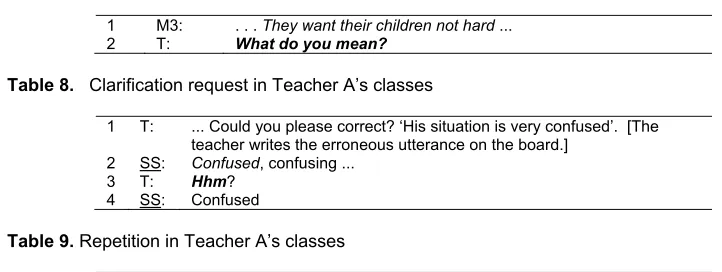
The other feedback types were distributed in descending order as follows: Elicitation (11,30%), Repetition (8,70%), and Clarification requests (5,22%). Below are provided sample sequences exemplifying how these three types of CF are utilised in Teacher A’s classes.
Table 7. Elicitation in Teacher A’s classes
1 M3: . . . They want their children not hard ... 2 T: What do you mean?
Table 8. Clarification request in Teacher A’s classes
1 T: ... Could you please correct? ‘His situation is very confused’. [The teacher writes the erroneous utterance on the board.]
2 SS: Confused, confusing ... 3 T: Hhm?
4 SS: Confused
Table 9. Repetition in Teacher A’s classes
1 F8: ... volume is the most important thing for – up to me
2 T: for you
3.1.2 Teacher B
Table 10. Distribution of feedback types in Teacher B’s classes
f %
Explicit correction 6 8,82
Recasts 50 73,53
Clarification requests 1 1,47
Metalinguistic feedback 3 4,41
Elicitation 4 5,88
Repetition 4 5,88
Total no. of CF 68
The following episode exemplifies the use of recasts in Teacher B’s classes.
Table 11. Recasts in Teacher B’s classes
1 F6: He search for extra materials for the lesson.
2 T: Hhm! Okay! ‘searches’ for supplementary materials. Ha! He does a lot of extra work ...
The other types of CF in Teacher B’s classes were distributed as follows: Explicit correction (8,82%), Elicitation (5,88%) and Repetition (5,58%), Metalinguistic feedback (4,41), and Clarification requests (1,47%). This strand of finding seems to suggest that Teacher B was most of the time inclined to provide her learners with correct target language forms through implicit modelling of these forms.
As stated earlier, recasts are implicit CF moves that reformulate or expand an ill-formed or incomplete utterance of a learner. An overall look at both teachers’ classes seems to indicate that the teachers are predisposed to employ these implicit moves of error treatment to enable their learners to discover the discrepancy between their output and the realities of the target language. Similar findings were obtained in studies by Lyster and Ranta (1997) and Panova and Lyster (2002). What Lyster and Ranta, for example, found in their database consisting of 13.8 hours of classroom observation was that the recast (55% of the total number of the other teacher feedback tpes) was the largest category across the four teachers observed in their study. The study by Panova and Lyster generated similar results and indicated that of all the seven feedback types employed by the teacher, recasts were the predominant corrective technique.
The nature of the speaking classes might have predisposed the teachers in the present study to provide additional linguistic input through implicit reformulations. As mentioned in the previous lines, speaking in the target language is not only a challenging task for language learners but also a painstaking experience. This challenge implies an affective burden for the learner and might inhibit his/her efforts of participating in classroom interaction. There is thus great likelihood that the teachers considered implicit reformulations to be less threatening for their learners than explicit means of correction.
3.2 What is the distribution of recasts in relation to other types of CF in foreign language classrooms?
3.2.1 Teacher A
A look at Teacher A’s classes indicated that recasts constituted an important component of her repertoire of CF. As indicated in the table below, recasts in her classes accounted for 32% of the total number of other types of CF. What this implies is that, when compared to Teacher B, Teacher A has a wide repertoire of CF that she relies on to resolve interactional ambiguities taking place in her classrooms.
Table 12. Distribution of recasts in relation to other feedback types in Teacher A’s classes
f %
Other types of CF 78 67,83
3.2.2 Teacher B
A glimpse into Teacher B’s classes indicated that recasts occupy the largest space in this teacher’s repertoire of error treatment. As shown in the table, recasts in her classes accounted for 73% of the total number of other types of CF. The teacher’s strong preference for recasts could be explained on the grounds that since recasts are implicit reformulations of an erroneous learner utterance, the teacher views recasts as an appropriate and non-threatening strategy for providing examplars of the target language.
Table 13. Distribution of recasts in relation to other feedback types in Teacher B’s classes
f %
Other types of CF 18 26,47
Recasts 50 73,53
3.3 What are specific types of recasts and their distribution in foreign language classrooms?
The functional properties of recasts emerged in data were analysed on the basis of four major categories of recast revealed in Lyster’s study (1998). These categories were:
a) An isolated declarative recast which provides confirmation of a learner’ message by correctly reformulating all or part of the utterance with falling intonation and no additional meaning.
b) An isolated interrogative recast which seeks confirmation of the learner’s message by correctly reformulating all or part of the utterance with falling intonation and no additional meaning.
c) An incorporated declarative recast which provides additional information by incorporating the correct reformulation of all or part of a learner’s utterance into longer statement. d) An incorporated interrogative recast which seeks additional information by incorporating
the correct reformulation of all or part of a learner’s utterance into a question.
3.3.1 Teacher A
An indepth look at the nature of recasts in Teacher A’s classes revealed incorporated declarative recasts to be the largest category (59,46), as indicated in Table 17. This was followed by isolated declarative recasts (35,14%) and incorporated interrogative recasts (5,41). Isolated interrogative recasts did not appear in Teacher A’s classes. Below are provided episodes of CF illustrating the use of these specific recast types:
Table 14. Incorporated declarative recasts in Teacher A’s classes
1 T: Rumour. Okay. What does it mean? 2 F5: General talking.
3 T: Yes. It’s a kind of gossip. Yes. It’s a kind of gossip but you learn from the public ...
Table 15. Isolated declarative recasts in Teacher A’s classes
1 T: What’s wrong with your eyes? 2 M1: It’s always bloodly-uhm-bloodly. 3 T: full of bloods.
Table 16. Incorporated interrogative recasts in Teacher A’s classes
1 SS: /lavyır/
Table 17. Frequencies and percentages of four types of recasts in Teacher A’s classes
f %
Isolated declarative recast 13 35,14
Isolated interrogative recast 0 0,00
Incorporated declarative recast 22 59,46
Incorporated interrogative recast 2 5,41
Total no. of recasts 37
3.3.2 Teacher B
An analysis of the specific types of recasts in Teacher B’s classes indicated that incorporated declarative recasts were the leading category (58%). The other prominent type of recast was isolated declarative recasts (34%). Isolated interrogative recasts seemed to occupy little space (8%), whereas no case of incorporated interrogative recast was encountered in the data. The following sequences extracted from the data exemplify the teacher’s use of three specific types of recasts.
Table 18. Incorporated declarative recasts in Teacher B’s classes
1 T: What is the reason? Are they ordinary people? ... [They are talking about stuntmen.]
2 F3: I think they have a strong feeling that control the brain and the muscles ... they cannot put this I think.
3 T: I mean they cannot resist their feeling. I mean there is a feeling that they cannot resist ...
Table 19. Isolated declarative recasts in Teacher B’s classes
1 M4: In my opinion, they made this only for aids, not for the fame ... I think their aims was only aid.
2 T: Hhm, just helping people.
Table 20. Isolated interrogative recasts in Teacher B’s classes
1 M4: When people watched television closely, their harms may be /demeıdzt/ because television discriminated –uhm- harm light to eyes.
2 T: Their harms can be damaged?
Table 21. Frequencies and percentages of four types of recasts in Teacher B’s classes
f %
Isolated declarative recast 17 34,00
Isolated interrogative recast 4 8,00
Incorporated declarative recast 29 58,00
Incorporated interrogative recast 0 0,00
Total no. of recasts 50
Further, such an effort would probably be a great contribution to the construction of language learning contexts endowed with increased opportunities of negotiated interaction by allowing language learners to generate more output. This finding, however, does not seem to run parallel to what has been found in Lyster’s study (1998). In his investigation into different pragmatic functions of recasts in immersion classrooms at the primary level, he found that isolated declarative recasts were the major category emerged in the data. Such a difference between the present study and Lyster’s study could be linked to the instructional setting in which the two studies have been conducted. Data for the former study were from speaking classes in an EFL setting, whereas in the the latter one in an immersion setting.
4. Implications
The present study offers important information for language teachers. The information flowing from such a study seems to be of relevance for language teachers in the sense that it would provide them with introspective insights into their pedagogical acts regarding the strategies of CF that they employ in their classrooms, and this introspection would presumably enable them to reconsider their pedagogical strategies of feedback. Furthermore, the study draws attention to the need for language teachers to have a range of CF strategies at their disposal to be able to account for various cognitive, linguistic and contextual variables in their classrooms. Given the dominant existence of recasts as an implicit type of CF in both teachers’ classes, it might well be argued that, rather than putting overemphasis on one type of feedback, language teachers need to adopt a balanced approach in their employment of different types of CF to better help their learners notice problematic aspects in their output. As also noted by Lyster, Saito and Sato (2013), ‘the most effective teachers are likely to be those who are willing and able to orchestrate, in accordance with their students’ language abilities and content familiarity, a wide range of CF types that fit the instructional context’ (p.30).
5. Suggestions for Further Research
The present study took a descriptive-exploratory inquiry into the research issue under scrutiny and attempted to give a description of what is taking place in EFL classrooms in terms of CF. To gain a precise understanding on what lies behind their behaviours of CF, further studies might undertake research into language teachers’ introspective evaluations of their own practices of CF. Some other studies could concentrate on how language learners perceive different types of feedback that they have been given.
6. Limitations
One of the limitations of the present study is concerned with the number of the participants involved in the study. Since this is a case study which has focused on two EFL teachers’ and their practices of CF, no claim could be made to its generalisability. A second limitation is that, due to constraints on time, the study could not adopt a more longitudinal focus. Thus, it might well be speculated that, with a more longitudinal focus, more elaborate information would have been obtained about the research phenomenon.
7. Concluding Remarks
utterance into longer statements. This clearly indicated that both teachers invested efforts in elaborating on their learners’ problematic utterances by expanding them linguistically and semantically. What such an effort mirrored was that the teachers were in pursuit of providing their learners with enriched opportutinities of input to help them to better notice the discrepancy between their unique output and the desired output.
Although recasts are sometimes recognised as ineffective tools that might not always help learners focus their attention on form and meaning (Goo and Mackey, 2013) and although recent research casts some doubt on their efficacy when compared to other CF types (Rassaei, 2014), the present study appears to indicate that recasts might serve important communicative functions by helping language teachers to provide the input in an authentic and supportive manner and by building on learner output.
References
Allwright, D. & Bailey, K. (1991). Focus on the language classroom. New York: Cambridge University Press. Doughty, C. (1994). Finetuning of feedback by competent speakers to language learners.
Georgetown University Round Table on Languages and Linguistics: Educational linguistics, crosscultural communication, and global interdependence, 96-108.
Ellis, R., Loewen, S., & Erlam, R. (2006). Implicit and explicit CF and the acquisition of L2 grammar. Studies in Second Language Acquisition, 28 (2), 339-368.
Gass, S. M. (2017). Input, interaction, and the second language learner. Routledge.
Goo, J., & Mackey, A. (2013). The case against the case against recasts. Studies in Second Language Acquisition, 35 (1), 127-165.
Dulay, H. (1982). Language two. New York: Oxford University Press.
Leeman, J. (2003). Recasts and second language development: Beyond negative evidence. Studies in Second Language Acquisition, 25, 37-63.
Long, M. H. (1996). The role of linguistic environment in second language acquisition. In W. Ritchie and T. K. Bhatia (Eds.), Handbook of second language acquisition (pp. 413-468). San Diego: Academic Press. Lyster, R. & Ranta, L. (1997). Corrective feedback and learner uptake: negotiation of form in communicative classrooms. Studies in Second Language Acquisition, 19, 37-66.
Lyster, R. (1998). Recasts, repetition, and ambiguity in L2 classroom discourse. Studies in Second Language Acquisition, 20, 51-81.
Lyster, R., & Mori, H. (2006). Interactional feedback and instructional counterbalance. Studies in Second Language Acquisition, 28 (2), 269-300.
Lyster, R., Saito, K., & Sato, M. (2013). Oral corrective feedback in second language classrooms. Language Teaching, 46 (1), 1-40.
Mackey, A., Oliver, R., & Leeman, J. (2003). Interactional input and the incorporation of feedback: An exploration of NS–NNS and NNS–NNS adult and child dyads. Language Learning, 53 (1), 35-66.
Nassaji, H. (2017). The effectiveness of extensive versus intensive recasts for learning L2 grammar. The Modern Language Journal, 101 (2), 353-368.
Nassaji, H., & Kartchava, E. (Eds.). (2017). Corrective feedback in second language teaching and earning:research, theory, applications, implications (Vol. 66). Taylor & Francis.
Nystrom, N. (1983). ‘Teacher-student interaction in bilingual classrooms: four approaches to error feedback’ in H. W. Seliger and M.H. Long (Eds.) USA: Newbury.
Panova, I. & Lyster, R. (2002). Patterns of CF and uptake in an adult ESL classroom. Tesol Quarterly,36 (4), 573-595.
Philp, J. (2003). Constraints on noticing the gap: nonnative speakers’ noticing of recasts in NS-NNS interaction. Studies in Second Language Acquisition, 25, 99-126.
Rassaei, E. (2014). Scaffolded feedback, recasts, and L2 development: A sociocultural perspective. The Modern Language Journal, 98 (1), 417-431.
Sali, P. (2000). A study on the treatment of oral errors in ELT classes. Unpublished M.A. Thesis. Uludag University, The Institute of Social Sciences, Bursa, Turkey.
Seliger, H. W., & Long, M. H. (1983) (Eds.). Classroom-oriented research on second language acquisition.
Rowley, Mass.: Newbury House.
Sheen, Y., & Ellis, R. (2011). Corrective feedback in language teaching. Handbook of Research in Second Language Teaching and Learning, 2, 593-610.