176
C H A P T E R S E V E N
Handling Difficult
Customer Encounters
From the Frontline
Interview
Christy Street is the manager of Davinco, Inc. (Shady Brook Cinemas), in Columbia, Tennessee. She is the person external customers contact with problems or compli-ments. She also interacts, and resolves issues, with internal customers (employees).
1
What is your perspective on the impor-tance of customers in your industry?In my view, without external customers, our company would not be in business, so it is always very important to explain to employees the importance of taking care of these customers and making sure their experience at our business is as enjoyable as possible.
Addi-tionally, I believe that internal customers are very important as well. Without them, I could not complete some of the tasks the organization strives to reach. It is very important to recognize and reward our internal customers for jobs well done. After all, they are the ones that make a difference in our business.
2
How do you define “difficult” customers? Why?A difficult customer in my mind is a person who tries to provoke you to react in an uncontrollable manner. The important thing to remember—always have control of the situation!
3
What is the most common types of difficult customer situations that you and your staff encounter? How do you typically handle them?The most common types of difficult customer situations at our business would be problems with customers disturbing others in an audi-torium. Our business is a 12-plex movie theater and for some reason, customers want to talk on cell phones or talk loud enough to disturb others while watching a movie. We try to improve these disturbances by making announcements before each movie starts asking our guests to turn of all cell
CHRISTYSTREET, Manager,
177
management consultant
Chapter Learning Objectives
• Exhibit confidence when involved in difficult customer interactions.
• Develop better relationships with internal customers.
• Use the six-step Problem-Solving Model in handling difficult customer situations.
After completing this chapter, you will be able to:
• Recognize a variety of difficult personality types.
• Use the Emotion-Reducing Model to help keep difficult situations from escalating.
• Determine appropriate strategies for dealing with various types of customers.
phones and pagers. We also go in each auditorium numerous times throughout the night to check for other disturbances. Sometimes parents bring young children to see a movie. The child can be a disturbance by crying or running around the auditorium. When this happens we ask the parent to take the child to the lobby area so other customers can enjoy the movie. Very seldom, we will get a complaint that the popcorn is too salty. Of course in this situation we pop a batch of popcorn with no salt. This usually solves the problem.
4
What type of training do you feel is needed by service personnel to help them better deal with difficult customer situations in today’s service-oriented world?Give your employees examples of situations that arise from time to time and ask how they would handle them. Have discussions on ways to please the customer in these difficult situations. Make sure you have videos or DVDs available that employees can watch during slow periods. This will enhance their knowledge of customer service and enhance their confidence when dealing with difficult customer situations.
5
What advice can you give to someone who wants to get into a customer service occupation?Read lots of literature on customer service, always be in control of your emotions and the situation, have lots of patience, and stay calm. In short, be prepared to handle any type of situation.
Critical Thinking
178 Part Two Skills for Success
Quick Preview
Before reviewing the chapter content, respond to the following questions by plac-ing a “T” for true or an “F” for false on the rules. Use any questions you miss as a checklist of material to which you will pay particular attention as you read through the chapter. For those you get right, congratulate yourself, but review the sections they address in order to learn additional details about the topic.
1. An important realization that will assist you in better serving cus-tomers is to acknowledge that they all have needs and expectations. 2. Customer needs are driven by internal motivators and can be broken
down into five categories.
3. Behavioral style preferences do not affect customer needs or satisfac-tion levels.
4. An upset customer is usually annoyed with a specific person rather than the organization or system.
5. An effective strategy for dealing with angry customers is to let them know exactly what your company policy is.
6. When you cannot comply with the demands of an angry customer, you should try to negotiate an alternative solution.
7. In some cases, indecisive customers truly do not know what they need or want.
8. Demanding customers often act in a domineering manner because they are very self-confident. This is a function of behavioral style.
9. Rude customers need to be controlled or “put in their place” to prevent a repetition of the behavior.
10. Some service providers have difficulty handling talkative customers. 11. Adopting a “good neighbor policy” can help in dealings with internal
customers.
12. As part of trying to help solve a customer problem, you should assess its seriousness.
Answers to Quick Preview can be found at the end of the chapter.
1 Difficult Customers
Concept: Successful service will ultimately be delivered through effective communication skills, positive attitude, patience, and a willingness to help the customer.
You may think of difficult customercontacts as those in which you have to deal with negative, rude, angry, complaining, or aggressive people. These are just a few of the types of potentially difficult interactions. From time to time, you will also be called upon to help customers who can be described in one or more of the follow-ing ways:
Lack knowledge about your product, service, or policies. Dissatisfied with your service or products.
Internal customers with special requests.
Speak English as a second language (discussed on website <http://www.mhhe.com/Lucas05>).
Elderly and need extra assistance (discussed on website <http://www.mhhe.com/Lucas05>).
Have a disability (discussed on website <http://www.mhhe.com/Lucas05>).
Each of the above categories can be difficult to handle, depending on your knowledge, experience, and abilities. A key to successfully serving all type of cus-tomers is to treat each person as an individual. Avoid stereotyping people accord-ing to their behavior. Do not mentally categorize people (put them into groups) according to the way they speak or act or look—and then treat everyone in a “group” the same way. If you stereotype people, you will likely damage the customer-provider relationship.
Ultimately, you will deliver successful service through your effective communi-cation skills, positive attitude, patience, and willingness to help the customer. Your ability to focus on the situation or problem and not on the person will be a very im-portant factor in your success. Making the distinction between the person and the problem is especially important when you are faced with difficult situations in the service environment. Although you may not understand or approve of a person’s behavior, he or she is still your customer. Try to make the interaction a positive one, and if necessary ask for assistance from a coworker or refer the problem to an ap-propriate level in your operational chain of command.
Many difficult situations you will deal with as a service provider will be caused by your customer’s needs, wants, and expectations. You will read about service challenges in this chapter, along with their causes and some strategies for effec-tively dealing with them.
Handling difficult customers will be one of your biggest challenges, so be prepared. How would you deal with an unhappy customer?
2 Why People Buy
Concept: Understanding the drive behind customers’ needs, wants, and emotional reactions will help you know why people buy. You will be able to give better customer service once you understand the customer better.
180 Part Two Skills for Success
Needsare things that a customer feels compelled to address or believes are nec-essary. Needs are an individual matter and arise from internal sources or motiva-tions that vary from one customer to the next according to their situation and background. Wantsare desired objects or experiences that a customer would like to have. They are not necessary, yet often bring personal appreciation, value, or sat-isfaction.
You will be helped in serving your customers if you understand that all people have needs. Since each person’s needs are different, no two customers are going to like the same thing or buy the same product or service for the same reason. There-fore, although some of the basic customer service techniques discussed in earlier chapters will help you in determining and addressing customer needs, there will be times when these techniques will not help you at all. Customer diversity, which you will read about in Chapter 8, along with customer expectations and the vari-ous circumstances in which you and your customers find yourselves, also affects your success. Depending on the customer, situation, emotions, and other factors, you will find that some customer contacts are challenging or difficult. These situa-tions are not hopeless if you plan ahead and mentally prepare yourself for them.
You should understand, too, that needs alone do not cause customers to make purchases. Research has shown that emotion often influences buying decisions. A classic example of this was demonstrated when the Coca-Cola Company decided to introduce the “New Coke.” Company executives had become concerned about sales. They were losing ground to their major competitors, Pepsi and 7UP, and also to their own Diet Coke. Also, they had seen the price of sugar rise and were look-ing for ways to reduce costs and increase revenue. They decided that they would introduce a new product and gradually take the original Coca-Cola off the market. The decision was affected also by the fact that Pepsi and Diet Coke had a smoother, sweeter taste than Coca-Cola.
Before making such an important decision, Coca-Cola managers did all the right things. They experimented to find just the right combination of ingredients, and they market-tested their product through blind taste tests (in which con-sumers were blindfolded and asked to sample various products including the original Coke, Pepsi, and Diet Coke). During the tests, consumers overwhelm-ingly selected the “New Coke” as their product of choice. Coca-Cola then put to-gether fancy advertisements and an advertising campaign to introduce the product with great fanfare.
The Basis of Customer Needs
To address customer needs, you must first understand the origin of needs and why people buy different products. As psychologist Dr. Abraham Maslowonce stated, “The human being is a wanting animal and rarely reaches a state of complete sat-isfaction except for a short time. As one desire is satisfied, another pops up to take its place. When this is satisfied, still another comes to the foreground and so on. It is characteristic of human beings throughout their whole lives that they are practi-cally always desiring something.”1
Figure 7.1 illustrates Maslow’sHierarchy of Needs Theorythat also applies to cus-tomers’ needs. Needs are often derived from internal motivators or things that make us happy and satisfy us. A classic study on human motivation conducted by Maslow after World War II might help you understand human needs. Although his work focused on the needs of employees in the workplace, it has application in many other environments.
In his research, Maslow found that people have specific needs starting at the ba-sic or physiologicallevel, at which they need items that will sustain life (e.g., food, shelter, clothing, water, and air). Once people have satisfied their basic needs, they can move up the hierarchy to other needs, such as the second level, safetyor secu-rity.At that level, people focus on products and services that will help them feel protected (e.g., insurance, firearms, security devices, and fault-free electrical or me-chanical products). The third level identified by Maslow was social,which concerns the need to feel accepted or loved. Products or services that can help people fulfill their social needs can go a long way toward making them feel successful (e.g., flowers, gifts, or other items that demonstrate love, affection, and caring). Any-thing that makes people feel as if they belong to a group or subculturewill help ful-fill this need. The fourth level of need is that of esteemor ego.Items that can help customers feel better about themselves (self-esteem), project status or prestige, or gain the respect of others are important (e.g., clothing, cars, furniture, jewelry, body adornments, or grooming products).
The highest level on Maslow’s hierarchy is self-actualizationor, in the words of a U.S. Army recruiting slogan, “Be all you can be.” Anything that can help customers attain their highest potential addresses this final need category (e.g., educational software, professional development seminars, or tools that enhance effectiveness and efficiency).
To relate this theory to reasons why customers become dissatisfied and difficult to deal with, think about a situation like the following: A customer goes into a con-venience store on the way home from work. He has a very stressful job. He earns minimum wage, and his wife is unemployed. Recently, he had to quit taking classes at a local college, where he was trying to get an associate degree in order to qualify for a higher-paying job, because he had to take a second job to help support the family. He has two sick toddlers at home and has stopped in at the store to get cough medicine. He specifically chose this store because he had seen a flyer in the morning paper indicating that cough syrup was on sale. When he checked the shelf, the product was out of stock. The customer is not happy!
A knowledge of Maslow’s work can help you determine your customer’s level of need. Try completing Worksheet 7.1 (see website <http://www.mhhe.com/ lucas05>) to see how well you can guess which level of need is being demonstrated.
Self-Actualization
Esteem
Social
Safety
Physiological
FIGURE 7.1
Maslow’s Hierarchy of Needs Theory
182 Part Two Skills for Success
Customer Expectations
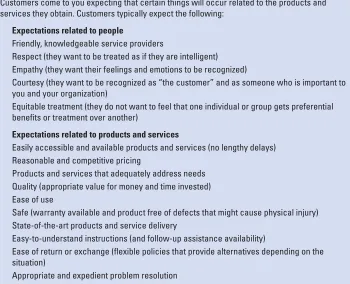
As you have read in earlier chapters, today’s customers are more discerning, bet-ter educated, have access to more up-to-date and accurate information, and are of-ten more demanding than in the past. They have certain expectationsabout your products and services, and the way that you will provide them. Figure 7.2 shows some common expectations customers might have of a service organization. Fail-ure to fulfill some or all of these expectations can lead to dissatisfaction and in some cases confrontation and/or loss of business.
FIGURE 7.2
Typical Customer Expectations
Customers come to you expecting that certain things will occur related to the products and services they obtain. Customers typically expect the following:
Expectations related to people
Friendly, knowledgeable service providers
Respect (they want to be treated as if they are intelligent) Empathy (they want their feelings and emotions to be recognized)
Courtesy (they want to be recognized as “the customer” and as someone who is important to you and your organization)
Equitable treatment (they do not want to feel that one individual or group gets preferential benefits or treatment over another)
Expectations related to products and services
Easily accessible and available products and services (no lengthy delays) Reasonable and competitive pricing
Products and services that adequately address needs Quality (appropriate value for money and time invested) Ease of use
Safe (warranty available and product free of defects that might cause physical injury) State-of-the-art products and service delivery
Easy-to-understand instructions (and follow-up assistance availability)
Ease of return or exchange (flexible policies that provide alternatives depending on the situation)
Appropriate and expedient problem resolution
3 The Role of Behavioral Style
Concept: Behavioral preferences have a major impact on the interactions of people. The more you know about style tendencies, the better you will understand your customers.
As you read in Chapter 6, behavioral style preferences play a major part in how people interact. Styles also affect the types of things people want and value. For ex-ample, people with high expressive tendencies will probably buy more colorful and people-oriented items than will people who have high decisive tendencies.
behavioral style preference and are upset, irrational, or confrontational. Keep in mind that everyone possesses all four behavioral styles discussed in Chapter 6 and can display various types of behavior from time to time. Therefore, carefully ob-serve your customer’s behavior and use the information you learned about each style as an indicator of the type of person with whom you are dealing. Do not use such information as the definitive answer for resolving the situation. Human be-ings are complex and react to stimuli in various ways—so adapt your approach as necessary. In addition, learn to deal with your emotions so that you can prevent or resolve heated emotional situations.
Handling Emotions With the Emotion-Reducing Model
It is important to remember when dealing with people who are behaving emo-tionally (e.g., irritated, angry, upset, crying, or raising their voice) that they are typ-ically upset with the structure, process, organization, or other factors over which you and/or they have no control. They are usually not upset with you (unless you have provoked them by exhibiting poor customer service skills or attitude).
Before you can get your customer to calm down, listen, and address the situa-tion, you must first deal with her or his emotional state. Once you do this, you can proceed to use problem-solving strategies (discussed later in this chapter) to assist in solving the problem. Until you reduce the customer’s emotional level, he or she will probably not listen to you or be receptive to what you are saying or your at-tempts to assist. In some cases, she or he may even become irritated because you seem nonempathetic or uncaring.
To help calm the customer down, you must send customer-focused verbal and nonverbal messages. You need to demonstrate patience and use all the positive communication skills you read about in Chapters 3 to 5. Most important among those skills are the ability and the willingness to listen calmly to what the customer has to say without interrupting or interjecting your views. This lesson is taught to many law enforcement officers to help them deal with crisis situations such as do-mestic disturbances. If your customer perceives that you are not attuned to his or her emotional needs or thinks that you are not working in his or her best interest, you become part of the problem, rather than part of the solution.
Keep in mind that a customer generally wants to be respected and acknowledged as an individual and as being important. As you interact with the customer, you can soften the situation and reduce emotion by providing customer-focused re-sponses. Simple customer-focused messages can put you on a friendly (human) level while at the same time helping to calm the emotion.
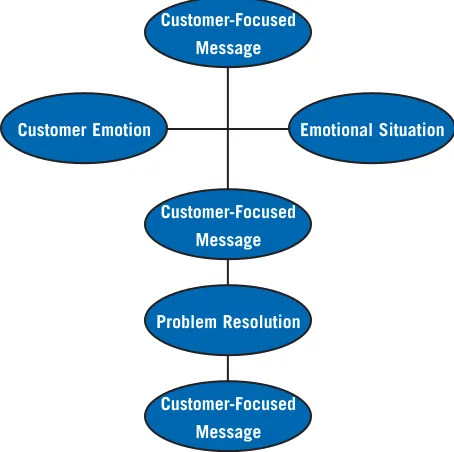
Here’s how the Emotion-Reducing Modelworks: Assume a customer has a prob-lem. As the customer approaches (or when you answer the telephone), greet him or her with “Good morning (or afternoon),” a smile, and open body language
To help employees better recognize typical customer needs and expectations, some service supervisors spend time brain-storming what is important to their organization’s customers.
They then help employees relate existing organizational prod-ucts, services, policies, and procedures available to cus-tomers they assist.
184 Part Two Skills for Success
and gesturing (customer-focused message). Then, as the customer explains the problems (emotion), you can offer statements such as, “I see,” “I can appreciate your concern, frustration, or anger,” or “I understand how that can feel (cus-tomer-focused).” Such statements can help you connect psychologically with the customer. Continue to use positive reinforcement and communication through-out your interaction. Once the problem has been defined and resolved (problem resolution), take one more opportunity at the end of your interaction to send a customer-focused message by smiling and thanking the customer for allowing you to assist. Also, one last apology may be appropriate for inconvenience, frus-tration, mistreatment, and so on (customer-focused). Figure 7.3 provides a visual model of this process.
Customer-Focused Message
Customer-Focused Message
Problem Resolution
Customer-Focused Message
Customer Emotion Emotional Situation
FIGURE 7.3
Emotion-Reducing Model
4 Working With Difficult Customers
Concept: You will need to be calm and professional when dealing with difficult customers.
Most customers have a specific type of product or service in mind when they make contact with your organization. They are also willing to let you help them if you do so in a positive, pleasant, and professional manner. There are others who, be-cause of their outlook on life, attitude, personal habits, or background, may be-cause you frustration and require additional effort. You should expect to encounter diffi-cult people and try to serve them to the best of your ability. With difficult customers, you should remain calm and professional.
Angry Customers
• Be positive.Tell the customer what you can do, rather than what you cannot do. If you say, “Our policy won’t permit us to give you a refund,” you can expect an angry response. On the other hand, you might offer, “What I can do is issue a store credit that may be used at any of our 12 branch stores in the city.”
Note:Before dealing with customers, check with your supervisor to find out what your policies are and what level of authority you have in making decisions. This relates to empowerment discussed earlier in the book.
By having this information before a customer encounter, you will have the tools and knowledge necessary to handle your customers effectively and professionally.
• Acknowledge the customer’s feelings or anger. You cannot and should not try to
deny the customer’s anger. Doing so could result in a serious confrontation. In-stead of saying, “You really don’t have to be upset,” try, “I can see you’re upset. I want to help solve this problem, so could you please help me understand what’s happened?”
By taking this approach, you’ve acknowledged the customer’s feelings, demon-strated a willingness to assist, and asked the customer to participate in solving the problem.
• Reassure.Reassure the customer. Indicate that you understand why he or she is
angry and that you will work to solve the problems. Statements such as these can help ease the frustration of your customers: “I’m going to do my best to help resolve this quickly,” “I can assure you that this will be resolved by Monday,” “You can rest assured that I am going to make this a priority.”
• Remain objective.As mentioned earlier, becoming part of the problem is not the answer. Even if the customer raises his or her voice or uses profanity, remain calm. This may be difficult, but it will help keep the situation from escalating. If necessary, count to ten in your head and take a deep breath before responding. Remember, angry customers are usually angry at the organization, product, or service that you represent, not at you.If they do not settle down, calmly but as-sertively explain that although you want to assist, you cannot do so until they help by providing information. If possible, suggest moving to a private area away from other customers and ask for help from a supervisor or team leader, if appropriate.
• Determine the cause.Through a combination of asking questions, listening, feed-back, and analyzing the information you receive, try to determine the cause of the problem. The customer may simply have misunderstood what was said. In such an instance, a clarification may be all that is required. Try something like, “There seems to be some confusion. May I explain?” or possibly, “It appears that I was unclear. May I explain?”
“right” or “wrong” makes no difference in situations like these. You will build stronger customer relationships when you make this kind of concession, be-cause you are bringing in money you might not have received if the customer got upset. Moreover, the customer is now satisfied, may tell others, and will likely return.
In cases such as this, inform your supervisor of the problems caused by the omis-sion of expiration dates in ads.
• Reduce frustrations.Don’t say or do anything that will create further tension. For instance, don’t transfer a caller to another extension if the customer told you he or she has already been transferred several times, interrupt to serve another cus-tomer (especially for a telephone caller—unless your organization’s policy re-quires that you do so), or put the person on hold repeatedly to handle other customers or tasks not related to serving the original customer.
• Negotiate a solution.Elicit ideas from the customer on how to solve the problem. If the customer’s suggestions are realistic and feasible, implement them. Or ne-gotiate an alternative. By using customers’ suggestions, you are likely to gain their agreement. Also, if something goes wrong later, they may be less likely to complain again since it was their idea in the first place.
• Conduct a follow-up.Don’t assume that the organization’s system will work as
designed. If there is a breakdown, the customer has your name and may com-plain to your supervisor. Or, the customer may not comcom-plain but instead go to a competitor. Either way, you lose.
Once an agreed-upon solution has been implemented, take the time to follow up to ensure that all went well. This may involve personally calling the accounting de-partment to ensure that proper credits were made, delivering an order or materi-als or shipping them yourself, or calling or writing the customer after a period of time to make sure the customer is satisfied and to offer future assistance. Whatever it takes, do it to ensure customer satisfaction. As a rule of thumb, underpromise and overdeliver.
Dissatisfied Customers
Occasionally, you will encounter customers who are dissatisfiedor unhappy when you meet them. Possibly they have been improperly served by you or one of your peers, or by a competitor in the past. Even if you were not personally involved in their previous experience, you represent the organization or you may be consid-ered “just like that last service employee.” Unfair as this may be, you have to try to make these customers happy. To do so, try the following strategies:
• Listen.Take the time to listen actively, as discussed in Chapter 5. Often, when peo-ple are upset, all they want to know is that you’re willing to attend to their concerns.
Work It Out 7.1
Dealing With Angry CustomersWork with a partner. Discuss situations in which you had to deal with an angry person. Think about what made the person angry and what seemed to reduce tension. Make a list of these factors and be prepared to share your list with the class.
Use the results of this discussion to develop strategies to help calm angry people in the future.
• Remain positive. Even though angry customers drain your energy, don’t get drawn into mirroring their anger or agreeing with their putdowns of your com-pany, competitors, peers, products, or services. This only fuels the fire. If ap-propriate, smile and interject positive comments into the conversation as you listen, and try to determine an effective course of action.
Keep in mind what you read about the power of positive wordingin Chapter 3. Fig-ure 7.4 shows some examples of negative wording and some possible alternatives.
• Smile, give your name, and offer assistance.Sometimes a typically cheerful greeting is not possible because a customer verbally attacks first (e.g., you pick up a ring-ing phone or a customer walks up as you are servring-ing another customer or look-ing down or away). In such instances, listen to what the customer is saylook-ing, use positive nonverbal cues (e.g., nodding, open or nonthreatening body posture, and possibly smiling) and inject paralanguage (e.g., Uh-huh, Hmmmm, Ahhhh, or other vocalizations). By demonstrating positive nonverbal behaviors, you may be able to psychologically “bond” with the customer. People usually do not attack a “friend,” someone they know, or someone who is trying to assist them. This is why many law enforcement officers are trained to introduce themselves and to use a person’s name.
• Don’t make excuses.Typically, customers are not interested in why they did not get the product or service they wanted or thought they paid for; they just want the problem solved (in their favor). Look for ways to correct a mistake rather than cover it up.
Remember: if you get defensive, you become part of the problem and not part of the solution.
• Be compassionate.Try to remain warm, compassionate, empathetic while you are
trying to uncover the cause of the problem. You can then attempt to service the customer properly and promptly. An approach often used by service and sales professionals to help defuse a customer’s emotion when he or she is upset or frustrated (not really angry) is known as the “feel, felt, found” strategy.When us-ing it, the service provider might state somethus-ing like: “I know how you feelMs. Winston. Others have said they feltthe same way when they experienced this problem. However, we have found that by making a small adjustment to the ________ that the problem is quickly resolved.” In effect, what this strategy does is empathize with the customer, shows he or she is not alone in the way he or she feels and shows there is a solution. Many times this strategy can begin by using statements such as:
FIGURE 7.4
Positive Wording When faced with a customer encounter that isn’t going well, remain positive in language. This
will help you avoid escalating the situation.
Negative Words or Phrases Positive Alternatives
Problem Situation, issue, concern, challenge
No What I (or) we can do is . . .
Cannot What I (or) we can do is . . .
It’s not my job (or my fault) Although I do not normally handle that, I’m happy to assist you.
I see.
I can relate to that.
I understand what you’re saying. I can appreciate your point.
I know how you feel. (Use caution with this statement if someone is very emotional. This type of comment could increase the customer’s anger and escalate the situation).
• Ask open-ended questions.By using specific open-ended questions, you can obtain the information you need to serve the customer. For example, “Mr. Washington, can you explain exactly what you expected from our service contract?”
• Verify information.To prevent misunderstandings or the possibility of escalating an uncomfortable situation, be sure that you received the correct message. Too often, we believe we understand the meaning of a message, only to find out later that we misinterpreted it. Test your interpretation of a customer’s message by stating it in your own words. For example, “Mr. Rasheed, if I heard you cor-rectly, you were told by the clerk who sold you this table that it would be as-sembled upon delivery, but the driver refused to do so. Is that correct?”
• Take appropriate action.After you have gathered all pertinent information you need to make a decision, work with the customer to satisfy his or her needs.
Indecisive Customers
You will encounter people who cannot or will not make a decision. They some-times spend hours vacillating. In some cases, indecisive customers truly do not know what they want or need, as when they are looking for a gift for a special oc-casion. Sometimes such customers are afraid that they will choose incorrectly. In these situations, use all your communication skills. Otherwise, indecisive cus-tomers will occupy large amounts of your time and detract from your ability to do your job effectively or to assist other customers.
Be aware, however, that some people really arejust looking as they check out sales, kill time between appointments, relax, or they may be lonely and want to be around others. Strategies for dealing with an indecisive person are given in the fol-lowing sections.
• Be patient.Keep in mind that, although indecisive people can be frustrating
(especially if you have a high D behavioral style preference), they are still cus-tomers. Greet such customers just as you would any other customer and of-fer assistance. If the customer refuses your help or wants to browse, that’s fine, but indicate where you will be and watch for the customer to signal for assistance.
Work It Out 7.2
Identifying DissatisfiersTake a few minutes to think about your organization or one with which you are familiar. Look for fac-tors that might contribute to customer dissatisfaction. Make a list of them, and then list some strate-gies for eliminating or reducing them. As an alternative, you might want to work with someone else and compare lists.
• Ask open-ended questions.Just as you would do with a dissatisfied customer, try to get as much background information as possible. The more data you can gather, the better you can evaluate the situation, determine needs, and assist in the solution of any problems.
• Listen actively.Focus on verbal and nonverbal messages for clues to determine
emotions, concerns, and interests.
• Suggest other options.Offer alternatives that will help in decision making and re-duce the customer’s anxiety. For example, “Ms. Sylvester, if you find that the color of the fabric doesn’t match your wallpaper, you have 30 days to return it.” This approach shows that you are informed and trying to assist, and it may help the person make up his or her mind. Suggesting a warranty or exchange possi-bility may make the customer more secure in the decision-making process.
• Guide decision making.By assertively, not aggressively, offering suggestions or ideas, you can help customers make a decision. Note that you are helping them, not making the decision for them. If you push your preferences on them, they may be dissatisfied and return the item. Then you, or someone else, will have to deal with an unhappy customer.
Demanding or Domineering Customers
Customers can be demandingor domineering for a number of reasons. Many times, domineering behavior is part of a personality style, as discussed in Chapter 6. In other instances, it could be a reaction to past customer service encounters. A demanding
Indecisive people can be frustrating as you try to serve their needs. What steps would you take to help a customer make a decision?
Work It Out 7.3
Helping an Indecisive CustomerThink about a recent time when you were indecisive about purchasing a product or service, and then respond to the following questions:
1. What caused your indecisiveness?
2. What ultimately helped you to make a decision?
3. How can you use your own strategies to help satisfy an indecisive customer?
190 Part Two Skills for Success
customer may feel a need to be or stay in control, especially if he or she has felt out of control in the past. Often, such people are insecure. Some strategies for effectively handling demanding customers are discussed in the following sections:
• Be professional.Don’t raise your voice or retaliate verbally. Children engage in name-calling, which often escalates into shoving matches. Unfortunately, some adults “regress” to childish behavior. Your customer may revert to negative be-havior learned in the past. Both you and the customer lose when this happens.
• Respect the customer.Showing respect does not mean that you must
accommo-date your customer’s every wish. It means that you should make positive eye contact (but not glare), remain calm, use the customer’s name, apologize when appropriate and/or necessary, and let the customer know that he or she is im-portant to you and your organization. Work positively toward a resolution of the problem.
• Be firm and fair and focus on the customer’s needs.As you read in Chapter 3, as-sertive behavior is an appropriate response to a domineering or demanding per-son; aggression is not. Also, remember the importance of treating each customer as an individual.
• Tell the customer what you can do.Don’t focus on negatives or what can’t be done when dealing with your customers. Stick with what is possible and what you are willing to do. Be flexible and willing to listen to requests. If something sug-gested is possible and will help solve the problem, compliment the person on his or her idea (e.g., “Mr. Hollister, that’s a good suggestion, and one that I think will work”), and then try to make it happen. Doing this will show that you are receptive to new ideas, are truly working to meet the customer’s needs and ex-pectations, and value the customer’s opinion. Also, remember that if you can psychologically partner with a customer, he or she is less likely to attack. You do need to make sure that your willingness to assist and comply is not seen as giv-ing in or backgiv-ing down. If it is, the customer may make additional demands or return in the future with similar demands. To avoid this, you could add to the earlier statement by saying something like, “Mr. Hollister, that’s a good sugges-tion, and although we cannot do this in every instance, I think that your sug-gestion is one that will work at this time.” This puts the customer on alert that although he or she may get his or her way this time, it will not necessarily hap-pen in the future. Another strategy is to make a counteroffer.
If you are thoroughly familiar with your organization’s policies and procedures and your limits of authority, you will be prepared to negotiate with demanding customers. If they want something you cannot provide, you might offer an alter-native that will satisfy them. Remember that your goal is customer satisfaction.
Work It Out 7.4
Handling the Demanding CustomerRude or Inconsiderate Customers
Some people seem to go out of their way to be of-fensive or to get attention. Although they seem confident and self-assured outwardly, they are often insecure and defensive. Some behaviors they might exhibit are raising the voice, demand-ing to speak to a supervisor, usdemand-ing profanity, cut-ting in front of someone else in a line, being verbally abrupt (snapping back at you) even though you’re trying to assist, calling you by your last name, which they see on your name tag (e.g., “Listen, Smith”), ignoring what you say, or otherwise going out of the way to be offensive or in control. Try the following strategies for dealing with rudeor inconsiderate customers:
• Remain professional.Just because the customer
is exhibiting inappropriate behavior does not justify your reacting in kind. Remain calm, assertive, and in control of the situ-ation. For example, if you are waiting on a customer and a rude person barges in or cuts off your conversation, pause, make direct eye contact, smile, and firmly say, “I’ll be with you as soon as I finish with this customer, sir or madam.” If he or she insists, repeat your comment and let the person know that the faster you serve the current customer, the faster you can get to the person waiting. Also, maintaining decorum may help win over the person or at least keep him or her in check.
• Don’t resort to retaliation.Retaliation will only infuriate this type of customer, especially if you have embarrassed him or her in the presence of others. Re-member that such people are still customers, and if they or someone else per-ceives your actions as inappropriate, you could lose more than just the battle at hand.
Talkative Customers
Some people phone or approach you and then spend excessive amounts of time discussing irrelevant matters such as personal experiences, family, friends, school-ing, accomplishments, other customer service situations, and the weather. The fol-lowing tips might help when dealing with talkative customers:
Before you can deal with a customer’s business needs, you must first address the customer’s emotional issues and try to calm him or her. What would you do to calm such customers?
Work It Out 7.5
Responding to Rudeness• Remain warm and cordial, but focused.Recognize that this person’s personality style is probably mainly expressive and that his or her natural inclination is to connect with others. You can smile, acknowledge comments, and carry on a brief conversation as you are serving this customer. For example, if the person comments that your last name is spelled exactly like his or her great aunt’s and then asks where your family is from, you could respond with “That’s interest-ing. My family is from . . . but I don’t believe we have any relatives outside that area.” You have responded but possibly cut off the next question. Anything less would probably be viewed as rude by the customer. Anything more could invite additional discussion. Your next statement should then be business-related (e.g., “Is there anything else I can assist you with today?”).
• Ask specific open-ended questions.These types of questions can assist in determin-ing needs and addressdetermin-ing customer concerns.
• Use closed-ended questions to control.Once you have determined the customer’s needs, switch to closed-ended questions to better control the situation and limit the opportunity for the customer to continue talking.
• Manage the conversation.Keep in mind that if you spend a lot of time with one customer, other customers may be neglected. You can manage a customer en-counter through questioning and through statements that let the customer know your objective is to serve customers. You might say, “I know you said you have a lot of shopping to do, so I won’t keep you any longer. Thanks for coming in. Please let me know if I can assist in the future.” Imply that you are ending the interaction to benefit the customer.
5 Working With Internal Customers (Coworkers)
Concept: Relationships with your internal customers are important. You should meet your commitments and build a professional reputation.
As we discussed in earlier chapters, you have to deal with internal as well as external customers.Although your interactions with internal customersmay not be difficult, they can often be more sensitive than your dealings with outsiders.
After all, you see peers and coworkers regularly, and because of your job, office politics, and protocol, your interactions with them are ongoing. Therefore, extend all the same courtesies to internal customers that you do to external ones—in some cases, more so. Some suggestions that might help you enhance your interactions with internal customers are given in the following sections.
Stay Connected
Since relationships within the organization are so important, go out of your way to make contact with internal customers periodically. You can do this by
Work It Out 7.6
Building Your SkillsGo on a field trip to a variety of businesses or stores (possibly a mall). As you visit these establish-ments, play the role of a customer and engage customer service professionals in lengthy conversa-tion. Take note of the techniques they use to regain control of the conversaconversa-tion. Chances are, most, especially the more experienced, will allow you to talk and will respond to you rather than risk being rude. Remember the effective techniques described and jot them down.
dropping by their work area to say hello, sending an e-mail, or leaving a voice mail message. This helps keep the door to communication open so that if ser-vice does break down someday, you will have a better chance of hearing about it and solving the problem amiably. You might describe your coworkers as your “normal” internal customers, but do not forget the importance of your rela-tionships with the cleaning crew (they service your office and work area), se-curity force (they protect you, your organization, and your vehicle), and the information technology people (they maintain computer equipment). All these groups and many others within the organization add value and can be a big help to you.
Meet All Commitments
Too often, service providers forget the importance of internal customers. Because of familiarity, they sometimes become lax and tend to not give the attention to in-ternal customers that they would give to exin-ternal customers. This can be a big mistake. For example, if you depend on someone else to obtain or send products or services to external customers, that relationship is as crucial as the ones you have with external customers. Don’t forget that if you depend on internal sup-pliers for materials, products, or information, these people can negatively affect your ability to serve external customers by delaying or withholding the items you need. Such actions might be unintentional or intentional, depending on your relationship.
To prevent, or at least reduce, the possibility of such breakdowns, honor all commitments you make to internal customers. If you promise to do something, do your best to deliver, and in the agreed-upon time. If you can’t do something, say so when your customer asks. If something comes up that prevents you from fulfilling your commitment, let the internal customer know of the change in a timely manner. Remember, it is better to underpromise and overdeliver than vice versa. If you beat a deadline, they will probably be pleasantly surprised and appreciative.
Don’t Sit on Your Emotions
Some people hold on to anger, frustration, and other negative emotions rather than getting their feelings out into the open and dealing with them. Not only is this po-tentially damaging to your health, for it might cause stress-related illnesses, but it can also destroy working relationships. Whenever something goes wrong or you are troubled by something, go to the person and, using the feedback skills you learned in Chapter 3, talk about the situation. Failure to do so can result in dis-gruntled internal customers, damage to the customer-supplier relationship, and damage to your reputation. Don’t forget that you will continue to rely on your cus-tomer in the future, so you cannot afford a relationship problem.
Creating an environment where employees learn to recognize and treat peers and coworkers as customers can go a long way toward enhancing the service environment. When em-ployees learn the importance of building rapport and personal
relationships with their internal customers, the quality of work life improves and everyone benefits. Service can also become exceptional.
194 Part Two Skills for Success
Build a Professional Reputation
Through your words and actions, go out of your way to let your customer and your boss know that you have a positive, can-do, customer-focused attitude. Let them know that you will do whatever it takes to create an environment in which inter-nal and exterinter-nal customers are important. Also, regularly demonstrate your com-mitment to proactive service. This means gathering information, products, and other tools before coming into contact with a customer so that you are prepared to deal with a variety of situations and people. It also means doing the unexpected for customers and providing service that makes them excited about doing business with you and your organization.
Adopt a Good-Neighbor Policy
Take a proactive approach to building internal relationships so that you can head off negative situations. If your internal customers are in your department, act in a manner that preserves sound working relationships. You can accomplish this in part by avoiding the following negative work habits:
• Avoid gathering of friends and loud conversation in your work space.This can be es-pecially annoying if the office setup consists of cubicles as sound travels easily. Respect your coworkers’ right to work in a professional environment. If you must hold meetings or gatherings, go to the cafeteria or some other place away from the work area.
• Maintain sound grooming and hygiene habits.Demonstrate professionalism in your dress and grooming. Avoid excessive amounts of colognes and perfumes.
• Don’t overdo call forwarding.Sometimes you must be away from your work space.
Company policy may require that you forward your calls. Do not overdo forward-ing your calls. Your coworkers may be inconvenienced and resentful if you do.
• Avoid unloading personal problems. Everyone has personal problems now and
then. Do not bring personal problems to the workplace and burden coworkers with them. If you have personal problems and need assistance, go to your su-pervisor or team leader or human resources department and ask for some sug-gestions. If you get a reputation for often having personal problems—and bringing them to the workplace—your career could suffer.
• Avoid office politics and gossip.Your purpose in the workplace is to serve the cus-tomer and do your job. If you have time to spread gossip and network often with others, you should approach your supervisor or team leader about the job op-portunities in which you can learn new skills. This can increase your effective-ness and marketability in the workplace.
• Pitch in to help.If you have spare time and your coworkers need assistance with a project, volunteer to help out. They may do the same at some point in the fu-ture when you are feeling overwhelmed with a project or assignment.
• Be truthful. One of the fastest ways for you to suffer a damaged relationship, or lose the trust and confidence of your coworkers and customers, is to be caught in a lie. Regard your word as your bond.
6 The Problem-Solving Process
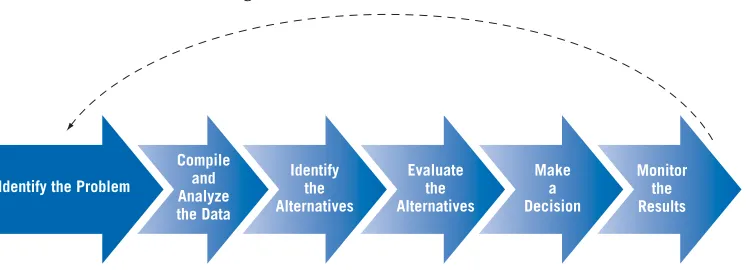
When customers have a complaint or a problem to be solved, they want solutions, not excuses. To ensure that you address customer needs effectively in these situa-tions, you need to be effective at problem solving. Figure 7.5 shows a concise six-step Problem-Solving Model.
Before you being to solve a customer’s problem, consider the fact that he or she may not really want you to “solve the problem.” In some cases, a person simply wants to vent frustration or be heard. This is where the empathetic listening you have read about will come in handy. In many cases, your customer will often have a solution in mind when he or she calls or comes in. Your role may be to simply listen and offer to facilitate the implementation of the suggested solution. In some situations, you may have to “plant a seed” by asking an open-ended question that suggests a solution. If the customer picks up on your “seed” and nourishes it, you end up with an outcome for which he or she feels ownership. For example, as-sume that a customer wants a product that you do not have in stock. Instead of saying, “I’m sorry, that item is out of stock,” you could ask a question such as, “How do you think ________ would work as an alternative?” You have now sub-tly made a suggestion without saying, “You could use ________ instead. It does the same thing.”
If you jointly solve a problem, the customer feels ownership—that he or she has made the decision. This customer is likely to be a satisfied customer. The following sections describe some key actions involved in this process.
Step 1: Identify the Problem
Before you can decide on a course of action, you must first know the nature and scope of the problem you are facing. Often, a customer may not know how to ex-plain his or her problem well, especially if he or she speaks English as a second lan-guage or has a communication-related disability. In such cases, it is up to you to do a little detective work and ask questions or review available information.
Begin your journey into problem solving by apologizing for any inconvenience you or your organization has caused. The customer probably wants someone to be responsible. A simple “I’m sorry you were inconvenienced. How may I assist you?” coupled with some of the other techniques covered in this book can go a long way toward mending the relationship. Take responsibility for the problem, even if you didn’t actually cause it. Remember that, in the customer’s eyes, you represent the organization. Therefore, you are “chosen” to be responsible. Don’t point fingers at other employees, policies, or procedures. It is also important to let the customer know that you are sincerely regretful that the problem has occurred and will do whatever possible to quickly and effectively solve it.
Monitor the Results Make
a Decision Evaluate
the Alternatives Identify
the Alternatives Identify the Problem
Compile and Analyze the Data
196 Part Two Skills for Success
To learn as much about the problem as you can, start by speaking directly to the customer, when possible. Collect any documentation or other background infor-mation available.
Ask Questions
Ask specific questions so that you can gather the information you need to help identify and solve a customer’s problem. The only way to get the information you want is to ask the right questions. You might use a variety of question types. Here are some examples.
• Open-ended. As discussed in Chapter 5, open-ended questions are good for
defining issues, clarifying, gathering information, and getting involvement. When asking open-ended questions, phrase them in a manner that allows the customer to respond as he or she feels necessary. You are not making a decision or forcing a response, as you can do with other types of questions; you are pro-viding a vehicle for sharing information. Help focus the customer’s response by asking specific open-ended questions. Note the difference between the sample questions that follow.
Nonspecific:“How do you like this new product?”
Specific:“What uses can you see for this new product?”
Although the first question may yield a useful response, you have not asked for a specific, focused piece of information. On the other hand, the second question will get the same bit of information but will also lead the customer to think of specific applications. You have thereby created a need (in the customer’s mind) and she or he may now buy your product or service.
• Closed-ended questions.As you also saw in Chapter 5, closed-ended questions are sometimes valuable for getting a quick response, gaining minimal involvement, controlling the conversation, verifying information, and clarifying or confirm-ing points. For example:
Mr. Ho, didn’t you say that your son would be the primary user of this product? (yes or no)
Mrs. Lacata, how many times have you used our services? (a specific number) Ms. Hyland, do you prefer the blue or yellow one? (a choice between two items)
An important aspect of asking questions is to find out the customer’s true con-cerns and solve his or her problems. For example, a customer may call and say that he or she wants to return a television set because it doesn’t work. By asking questions, you may be able to help the person solve the problem without the added expense of shipping or having a service technician call on the customer. You may ask for background information about the television set and then ask some specific questions about the problem. Questions such as the following might be appropriate:
What model is it? What, exactly, is wrong?
Does it have an antenna attached? Is there a remote control?
Have you checked to see that the power cord is firmly attached? Have you tried using a different electrical outlet?
Step 2: Compile and Analyze the Data
To be able to effectively determine a course of action, you need as much informa-tion as possible and a thorough understanding of what you are dealing with. To get that data requires active listening and a little investigative work. You may need to collect information from a variety of sources, such as sales receipts, correspon-dence, the customer, public records, the manufacturer, and files.
In gathering data, you should also do a quick assessment of how serious the problem is. You may hear about one instance of a defective product, or you may hear about a pattern of inefficient service.
Once you have collected information through questioning and from other sources, spend some time reviewing what you have found. If time permits and you think it necessary or helpful (e.g., the customer is not present or on the telephone), ask for the opinions of others (e.g., coworkers, team leader or supervisor, technical experts). Ultimately, what you are trying to do is determine the choices available to you that will help satisfy the customer and solve the problems.
Step 3: Identify Alternatives
Let customers know that you are willing to work with them to find an acceptable solution to the problem. Tell them what you can do, gain their agreement, and then set about taking action.
Since you are new to the situation when a customer notifies you of a problem or their dissatisfaction, you have an objective perspective. Use this perspective as a ba-sis on which to offer suggestions or viewpoints that the customer may not see or has overlooked. Also, make sure that you consider various possibilities and alternatives when thinking about potential solutions. Look out for the best interests of your cus-tomer and your organization. To do this, be willing to listen to the cuscus-tomer’s sug-gestions and to think creatively. Perhaps you will come up with ideas other than the ones that you and your organization typically use. Don’t sacrifice customer satis-faction for convenience. If necessary, seek approval from higher authority to use cre-ative solutions (e.g., to make a special purchase of an alterncre-ative item for the customer, or to give a refund even though the time frame for refunds has expired).
Step 4: Evaluate Alternatives
Once you have collected all the facts, examine your alternatives or options. Be care-ful not to let cost be the deciding factor. A little extra time and money spent to solve a problem could save a customer and prevent recurring problems. Consider the following factors in this evaluation process:
What is the most efficient way to solve this problem?
Which are the most effective options for solving this problem? Which options are the most cost-effective?
Will the options being considered solve the problem and satisfy the customer?
Step 5: Make a Decision
http://www.southwest.com
“The mission of Southwest Airlines is dedication to the high-est quality of Customer Service delivered with a sense of warmth, friendliness, individual price, and Company Spirit.” The company mission statement says a lot about the South-west culture. As a result, after 30 years of passenger service, the airline is the fourth largest in the United States, flying more than 64 million passengers a year out of 59 airports.
The approach to business and customers is what makes Southwest a popular airlines with passengers. In 1988, 1992, 1993, 1994, 1995, and 1996, the airline won the coveted industry Triple Crown—Best On-Time Record, Best Baggage Handling, and Fewest Customer Complaints. It was the first airline to
ac-complish this feat. They have since spearheaded other customer-focused initiatives by being the first airline to award frequent flyer points for number of trips flown with them instead of based on miles. Southwest also pioneered senior discounts, Fun Fares, Fun Packs, a same-day air freight delivery service, ticketless travel, and many other unique programs. The airline’s emphasis is not just on travel, but on making the journey fun.
The result of doing business that is attuned to customer needs and preferences has been a growth to over 33,000 em-ployees, 375 aircraft, and net income of over $240 million in 2002. That year was the 30th consecutive year that the com-pany posted a profit in an industry where competitors have struggled and disappeared.
S E R V I C E I N A C T I O N
Southwest Airlines
C H A P T E R 7
198 Part Two Skills for Success
Step 6: Monitor the Results
Once you make a decision, monitor the impact or results. Do not assume your cus-tomer is satisfied, especially if any negotiation occurred between the two of you.
You can monitor the situation with a follow-up call, asking if he or she needs anything else when you see him or her, or sending a written follow-up (e.g., thank-you letter with query concerning satisfaction, service survey, or e-mail).
If you determine that your customer is not satisfied or additional needs are pres-ent, go back to step 1 and start over.
Chapter Summary
Dealing with various types of people can be frustrating, but it can also be very sat-isfying. Many times, you will have to deal with a variety of external and internal customers, including those who are angry, indecisive, dissatisfied, demanding, domineering, rude, or talkative. Your goal in all your efforts should be to work har-moniously with all customers. Whenever you can address customer needs in a va-riety of situations and find acceptable solutions, you, the customer, and the organization win. To assist customers effectively doesn’t take magic; all it takes is a positive attitude, preparation, and a sincere desire to help others. If you use the techniques outlined in this chapter, and others in this book, you’re on your way to providing stellar customer service and satisfying customer needs.
Key Terms
and Concepts
angry customers customer expectations demanding or domineering customers difficult customers dissatisfied customers Emotion-Reducing Model external customersfeel, felt, found strategy Hierarchy of Needs
Theory indecisive customers internal customers Maslow, Abraham needs positive wording Problem-Solving Model rude or inconsiderate
customers subculture
Chapter
Review
Questions
1. What are the five levels of needs identified in Maslow’s hierarchy of needs, and how do they affect customer service?
2. What causes customers to become dissatisfied?
3. What tactics can you use to deal with angry customers?
4. What can you do to assist indecisive people in coming to a decision? 5. Why might some customers feel they have to demand things from others? 6. How can you effectively deal with rude or inconsiderate customers?
7. What are some steps to help regain control of a conversation with a talkative customer without causing offense?
8. What strategies can you use to build strong relationships with coworkers? 9. List the strategies for effective problem solving.
Search It Out
Search the Internet for Information on Problem Solving
Log onto the Internet and locate information on providing customer service to irate customers. Also look for information on the following topics:
Conflict resolution Problem solving
Handling stressful situations
Be prepared to share what you find with your classmates at the next scheduled class.
Note:A listing of additional research on specific URLs is provided on the Customer Service website at <http://www.mhhe.com/lucas05>.
1. T 2. T 3. F 4. F
5. F 6. T 7. T 8. T
9. F 10. T 11. T 12. T
Quick
Preview
Answers
Role-Playing Difficult Customer Situations
Work with a partner and role-play one or more of the following scenarios. Each of you should choose at least one scenario in which you will play the service provider role. The other person will play the customer. In each instance, discuss what type of difficult customer you are dealing with and how such an encounter might go. At the end of each role-play, both persons should answer the following questions and discuss ideas for improvement:
200 Part Two Skills for Success
Questions
1. How well was service provided?
2. Were any negative or unclear messages, verbal or nonverbal, communicated? If so, discuss.
3. How can you incorporate the improvements you have identified into a real cus-tomer service encounter?
4. What open-ended questions were used to discover customer needs? What oth-ers could have been used?
Scenario 1:Terry Welch entered your shoe store over 30 minutes ago and seems
to be having trouble deciding the style and color of shoes he wants.
Scenario 2:Chris Dulaney is back in your lawn mower repair shop. This is the third time in less than two weeks that she has been in for repairs on a riding mower. Chris is getting upset because the problem stems from a defective carburetor that has been repaired on each previous visit. She is beginning to raise her voice, and her frustration is becoming evident.
Scenario 3:You are a telephone service representative for a large retail catalog distribution center. You’ve been at work for about an hour when you receive a call from Pat Mason, who immediately starts making demands (e.g., “I’ve only got a few minutes for you to tell me how to order.” “Look, I’ve read all the articles about the scams telemarketers pull. I’ll tell you what I want, and you tell me how much it will cost.” “Listen, what I want you to do is take my order and get me the products within the next two days. I need them for a conference.”
Scenario 4:You are a cashier in the express lane at a supermarket. As you are ringing up a customer’s order, a second customer approaches, squeezes past several people in line and says, “I’m in a hurry. All I have is a quart of milk. Can you just tell me how much it costs, and I’ll leave the money right here on the register.”
Scenario 5:You are a very busy switchboard operator for ComTech, a large corporation. A vendor whom you recognize from previous encounters has just called to speak with your purchasing manager. As in previous calls, the vendor starts a friendly conversation about the weather, how things are going, and other topics not related to business.
Face to Face
Handling a Dissatisfied Customer at Newsome Furniture and Appliances
Background
Newsome Furniture and Appliances is a small family-owned store that has been in operation for 47 years in Billings, Montana. The store employs 16 employees in two locations. Most customers are local residents, but there is a steady flow of cus-tomers from nearby smaller towns and cities. Most cuscus-tomers shop at Newsome’s store that is located in a large shopping mall outside of Billings.
Of the frontline employees (sales, customer service, and credit staff), most have been with the company at least five years. No formal classroom training on effective customer service techniques is offered to the staff. However, each em-ployee is encouraged to attend one professional development workshop or community college course each year. Mr. Newsome pays 75 percent of the cost of such courses. You were hired as a customer service assistant eight months ago after you graduated from high school. You report to the customer service su-pervisor, Ginny Hall. In school, you took a couple of business courses and have read numerous books on sales and customer service. You hope for career ad-vancement in this field.
On Saturday morning Mr. and Mrs. Wyland Sommers came into your store. Both are senior citizens and longtime Billings residents. They have made numer-ous purchases at Newsome’s over the past 18 years.
The Sommers bought a sofa bed last week, and it was delivered on Friday. The sofa had been a floor model, and the price had been reduced by 50 percent. The tag on the sofa said “as is” because there was a large tear in the mattress cover.
Your Role
When Mr. and Mrs. Sommers came into the store, they proceeded directly to the customer service department. As they approached, you smiled, said good morn-ing, and offered to assist them. The following conversation occurred:
Mr. Sommers [without acknowledging
your greeting]: Where’s Ginny?
You [smiling]: Ginny’s off today, sir. May I help you? Mr. Sommers: Where’s Tom Newsome?
You [still smiling]: He had to go to our other store. Can I help you? Mrs. Sommers: We bought a sofa bed here, and when they delivered
it, I found a big hole in the mattress. My son and his wife will be here on Wednesday. I can’t have them sleep on that old thing. I’d be too embarrassed. Mr. Sommers: I can’t believe you’d sell something like that to a loyal
customer. Do you have any idea how much money we’ve spent in this store over the past 18 years? You: Eighteen years is a long time to shop at a store. We
appreciate your business. I’m terribly sorry that the sofa was damaged, I can’t believe our warehouse would ship a damaged piece of furniture. Mr. Sommers
[raising his voice]: Well they sure did! I just told you they did! Don’t you believe me?
You: I’m sorry sir. I didn’t mean that you weren’t telling the truth. I meant that I was surprised that we’d do that. Do you have your sales receipt? I’ll see if I can’t help work this out.
202 Part Two Skills for Success
You: Yes, ma’am. I’m sure we can fix the problem. Mr. Sommers: I don’t want anything fixed. I want a new sofa
before Wednesday. The last time I bought something here, you people messed up the order too. I guess I should have learned my lesson then.
You: I apologize for any inconvenience we’ve caused. I can assure you we’ll get this worked out. If you’ll just give me your receipt, I’ll get started.
Mr. Sommers: I’ll have to go see if it’s in the pickup. Hold on. Ma, you wait here.
You [Mr. Sommers has returned
with the receipt]: I think I understand why your sofa has a damaged mattress. The sofa was a floor model discounted 50 percent and sold as is.
Mrs. Sommers
[voice raised]: What do you mean, “as is”? We paid a lot of money for that sofa!
You: Yes, ma’am, I see you did. What I mean is that because the sofa had some damage, we reduced the price significantly to sell it.
Mr. Sommers: Well nobody told us the thing was damaged. I want to talk to Tom right now. You call him at the other store!
You: I think I have an idea. We have another sofa exactly like yours that is on sale. Since you saved 50 percent off your sofa, if we could exchange mattresses for say, 50 extra dollars, you’d still be saving hundreds off the original price. You could have the mattress by Monday, and your daughter-in-law would never know. What do you think?
Mr. Sommers: Well, I don’t know. I didn’t want to spend any more money.
Mrs. Sommers: Lou, that young salesman did say that we were getting a really special price because of some minor damage.
Mr. Sommers: Yeah, I guess maybe he might have mentioned the damage. We just didn’t know the hole would be as big as it is.
You: I am truly sorry for any misunderstanding, and I wouldn’t want Mrs. Sommers to be embarrassed. That’s why I suggested the exchange. What do you think, folks?
Mr. Sommers: Okay. But you better have it there by Monday at the latest.
You [smiling]: Yes, sir. You’ll have it by 3 P.M., or I’ll deliver it
To help better prepare yourself to deal with difficult customer service situations, respond to the following statements. On the basis of any “no” responses, seek out resources (e.g., ma-terials, training programs, and people) that can help broaden
your knowledge on these topics. If you answered “yes” to all the questions, congratulate yourself, then work to share your knowledge with others in your workplace. This can ultimately help improve employee morale and service to customers.
P L A N N I N G T O S E R V E
C H A P T E R 7
1. I approach what I believe to be a difficult customer with a positive attitude and believe that
I can turn the situation around. Yes No
2. In dealing with customers, I seek to determine their tru