within the family It harbors at least seven plasmids and produces three shapes of parasporal crystals including oval, bipyramidal and rice. SDS-PAGE analysis of spore-crystal suspension of this strain reveals six major protein bands, which implies the presence of multiple parasporal crystal genes. Bioassay of this strain reveals that it shows specific activity against nematodes and human cancer cells. In this study, we report the whole genomic shotgun sequences of Sbt003. The high-quality draft of the genome is 6,175,670 bp long (including chromosome and plasmids) with 6,372 protein-coding and 80 RNA genes.
Introduction
other three species constitute th
group", a nontaxonomic term, within the genus
were classified as separate species mainly based
on their distinct phenotypes, although extensive
genomic studies on strains of these species using
different techniques have suggested that they
form a single species [2-5]. Strain Sbt003 belongs
to the species
the species produces one or more parasporal
crys-tal proteins showing specific activity against
cer-tain larvae from various orders of insects [6]. The
specific role and the abundant number of genes
encoding of insecticidal crystal proteins of this
species have attracted much attention from both
academic and industrial researchers. Dozens of
dozens more are on their way. In this study, we
present a summary classification and a set of
fea-tures fo
description of the genomic sequencing and
anno-tation.
Classification and features
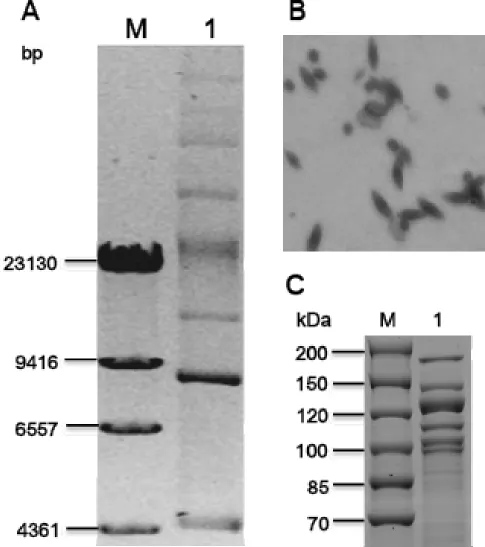
strain Sbt003 harbors at least 7
plasmids and produces three different shapes of
parasporal crystals including oval, bipyramidal
and rice (Figure 1A, Figure 1B and Table 1).
SDS-PAGE analysis of spore-crystal suspension of this
strain reveals six major protein bands of 168.8,
148.5, 133.5, 117.2, 107.9 and 103.1 kDa, which
implies the presence of multiple parasporal
crys-tal genes (Figure 1C).
A representative genomic 16S rDNA sequence of
strain Sbt003 was searched against GenBank
da-tabase using BLAST [21]. Sequences showing
more than 97% identity to the 16S rDNA of
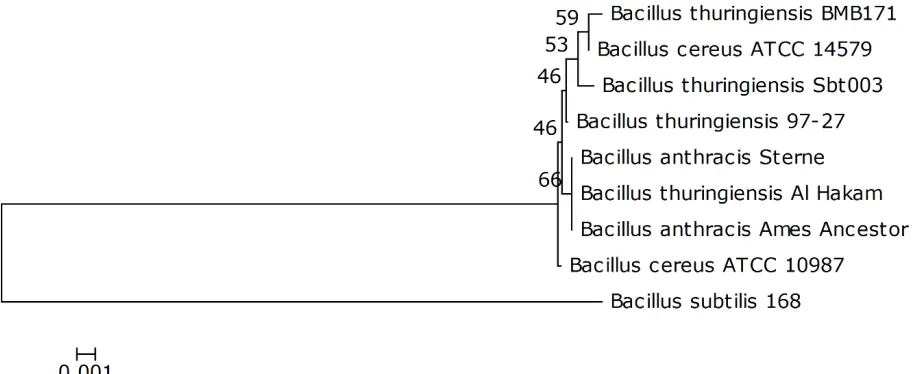
Sbt003 were selected for phylogentic analysis, and
a 16S rDNA sequence from
sequences were aligned with ClustalW algorithm.
The tree was reconstructed using neighbor joining
with the Kimura 2-parameter substitution model.
The phylogenetic tree was assessed by
bootstrap-ping 1,000 times, and the consensus tree is shown
in Figure 2.
Genome sequencing and annotation
Genome project history
Species Type strain HD73
Gram stain Gram-positive NAS
Cell shape Rod-shaped IDA
Motility Motile NAS
Sporulation Spore-forming IDA
Temperature range Room temperature NAS
Optimum temperature 28°C IDS
Carbon source Organic carbon source NAS Energy source Organic carbon source NAS
MIGS-6 Habitat Soil IDA
MIGS-6.3 Salinity Salt tolerant NAS
MIGS-22 Oxygen Aerobic NAS
MIGS-14 Pathogenicity Avirulent NAS
MIGS-4 Geographic location Hubei, China IDA
MIGS-4.1 Latitude 29-31N
MIGS-4.2 Longitude 111-114E
MIGS-4.3 Depth 5-10cm
MIGS-4.4 Altitude About 35m
MIGS-5 Sample collection time 2000 IDA
Figure 2. Neighbor-joining phylogenetic tree generated using MEGA 4 based on 16S rRNA sequences. The strains and their corresponding GenBank accession numbers (and, when applicable, draft sequence coordinates) for 16S rDNA sequences are:
Akonkukian str. 97-27 (AE017355.1): 9337-10763; B,
10643; C, str. 168 (NC_000964): 9839-11263; D,
10761; E
Growth conditions and DNA isolation
broth for 6 hours at 28°C. DNA was isolated by
in-cubating the cells with lysozyme (10 mg/mL) in 2
mL TE (50 mM Tris base, 10 mM EDTA, 20%
su-crose, pH8.0) at 4°C for 6 hours. 4 mL 2% SDS was
added and the mixture was incubated at 55°C for
30 min; 2 mL 5M NaCl were added, and the mixture
was incubated at 4°C for 10 min. DNA was purified
by organic extraction and ethanol precipitation.
Genome sequencing and assembly
The genome of
quenced using Illumina Hiseq 2,000 platform (with
a combination of a 100-bp paired-end reads
se-quencing from a 500-bp genomic library and a
90-bp mate-paired reads sequencing from a 2-kb
ge-nomic library). Reads with average quality scores
below Q30 or having more than 3 unidentified
nu-cleotides were eliminated. Using SOAPdenovo 1.05
version, 22,295,588 paired-end reads (achieving
~325 fold coverage [2.01 Gb]) and 11,166,312
ma-te-paired reads (achieving ~ 163 fold coverage
[1.00 Gb]) were assembled de novo [22]. The
as-sembly is considered a high-guality draft and
con-sists of 104 contigs arranged in 61 scaffolds with a
total size of 6,175,670 bp. According to
bioinformatic analysis, we identified two large
plasmids belonging to ori44-type and repB-type
plasmids, respectively. The former plasmid has two
ori44-type replicons. We propose it represents a
fusion of two plasmids and its estimated size is
about 200 kb. The latter plasmid has an expected
size of at least 90 kb, according to the sequence of
contig0027, which is typical of repB-type plasmids
(80 ~ 90 kb). In addition, we identified five other
plasmids from the plasmid pattern (see Figure 1A).
The expected sizes of the smaller three are 13 kb,
8kb and 4kb, respectively, while the sizes of the
larger two can't be deduced either from the
plas-mid pattern or by bioinformatic analysis.
Genome annotation
MIGS-32 Gene calling method Glimmer and GeneMark GenBank Data of Release Pending
NCBI project ID 175950
Project relevance Biotechnological
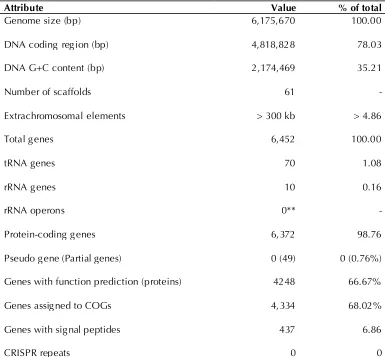
Table 3. Genome Statistics
Attribute Value % of total
Genome size (bp) 6,175,670 100.00
DNA coding region (bp) 4,818,828 78.03
DNA G+C content (bp) 2,174,469 35.21
Number of scaffolds 61 -
Extrachromosomal elements > 300 kb > 4.86
Total genes 6,452 100.00
tRNA genes 70 1.08
rRNA genes 10 0.16
rRNA operons 0** -
Protein-coding genes 6,372 98.76
Pseudo gene (Partial genes) 0 (49) 0 (0.76%)
Genes with function prediction (proteins) 4248 66.67%
Genes assigned to COGs 4,334 68.02%
Genes with signal peptides 437 6.86
CRISPR repeats 0 0
Genome Properties
The high-quality draft assembly of the genome
consists of 104 contigs in 61 scaffolds, with an
overall 35.21% G+C content. Of the 6,452 genes
predicted, 6,372 were protein-coding genes, and
80 RNAs were also identified. The majority of the
protein-coding genes (66.67%) were assigned a
putative function while the remaining ones were
annotated as hypothetical proteins (Table 3). The
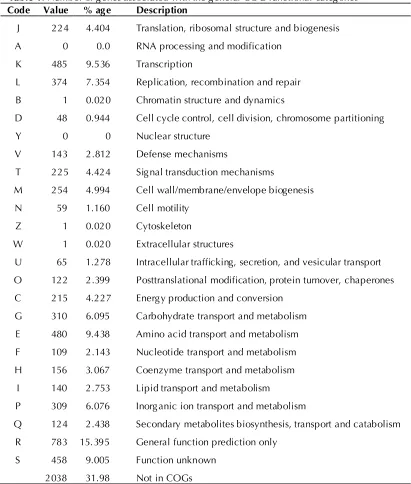
distribution of genes into COGs functional
catego-ries is presented in Table 4.
The whole genomic sequence and the coding
se-quence of Sbt003 were analyzed by
BtToxin_scanner [29], and eight potential crystal
protein sequences were identified. Among these,
four were considered to be full-length (locus tags:
C797_02099, C797_12066, C797_12568 and
C797_27783) while the others were considered to
be truncated (Locus tags: C797_02094,
C797_12046, C797_12061, C797_18417).
Table 4. Number of genes associated with the general COG functional categories Code Value % age Description
J 224 4.404 Translation, ribosomal structure and biogenesis A 0 0.0 RNA processing and modification
K 485 9.536 Transcription
L 374 7.354 Replication, recombination and repair B 1 0.020 Chromatin structure and dynamics
D 48 0.944 Cell cycle control, cell division, chromosome partitioning Y 0 0 Nuclear structure
V 143 2.812 Defense mechanisms
T 225 4.424 Signal transduction mechanisms
M 254 4.994 Cell wall/membrane/envelope biogenesis N 59 1.160 Cell motility
Z 1 0.020 Cytoskeleton
W 1 0.020 Extracellular structures
U 65 1.278 Intracellular trafficking, secretion, and vesicular transport O 122 2.399 Posttranslational modification, protein turnover, chaperones C 215 4.227 Energy production and conversion
G 310 6.095 Carbohydrate transport and metabolism E 480 9.438 Amino acid transport and metabolism F 109 2.143 Nucleotide transport and metabolism H 156 3.067 Coenzyme transport and metabolism
I 140 2.753 Lipid transport and metabolism
P 309 6.076 Inorganic ion transport and metabolism
Q 124 2.438 Secondary metabolites biosynthesis, transport and catabolism R 783 15.395 General function prediction only
2. Helgason E, Caugant DA, Lecadet MM, Chen Y, Mahillon J, Lovgren A, Hegna I, Kvaloy K, Kolsto AB. Genetic diversity o
Curr
Microbiol 1998; 37:80-87 3. Helgason E, Okstad OA, Caugant DA, Johansen
HA, Fouet A, Mock M, Hegna I, Kolsto AB
evidence. Appl Environ Microbiol 2000; 66 :2627-2630
4. Ticknor LO, Kolsto AB, Hill KK, Keim P, Laker MT, Tonks M, Jackson PJ. Fluorescent amplified fragment length polymorphism analysis of Nor-wegia soil isolates. Appl Environ Microbiol 2001;
67:4863-4873
5. Helgason E, Tourasse NJ, Meisal R, Caugant DA, Kolsto AB. Multilocus sequence typing scheme
for bacteria of theAppl
En-viron Microbiol 2004; 70:191-201
6. Schnepf E, Crickmore N, Van Rie J, Lereclus D, Baum J, Feitelson J, Zeigler DR, Dean DH Microbiol Mol Biol Rev 1998; 62:775-806
7. Field D, Garrity G, Gray T, Morrison N, Selengut J, Sterk P, Tatusova T, Thomson N, Allen M, Angiuoli SV, et al. Towards a richer description of our complete collection of genomes and
metagenomes "Minimum Information about a Genome Sequence " (MIGS) specification. Nat
Acad Sci USA 1990; 87:4576-4579 9. Gibbons NE, Murray RGE. Proposals Concerning
the Higher Taxa oInt J Syst Bacteriol 1978; 28:1-6.
10. Garrity GM, Holt JG. The Road Map to the
Man-ual. In: Garrity GM, Boone DR, Castenholz RW (eds), Bergey's Manual of Systematic Bacteriolo-gy, Second Edition, Volume 1, Springer, New York, 2001, p. 119-169.
11. Murray RGE. The Higher Taxa, or, a Place for Everything...? In: Holt JG (ed), Bergey's Manual of Systematic Bacteriology, First Edition, Volume 1, The Williams and Wilkins Co., Baltimore, 1984, p. 31-34.
12. List of new names and new combinations previ-ously effectively, but not validly, published. List no. 132. Int J Syst Evol Microbiol 2010; 60 :469-472 13. Ludwig W, Schleifer KH, Whitman WB. Class I.
Krieg NR, Ludwig W, Rainey FA, Schleifer KH, Whitman WB (eds), Bergey's Manual of Systemat-ic Bacteriology, Second Edition, Volume 3, Springer-Verlag, New York, 2009, p. 19-20. 14. Skerman VBD, McGowan V, Sneath PHA.
Ap-proved Lists of Bacterial Names. Int J Syst Bacteriol 1980; 30:225-420.
15. Prévot AR. In: Hauderoy P, Ehringer G, Guillot G,
Magrou. J., Prévot AR, Rosset D, Urbain A (eds), Dictionnaire des Bactéries Pathogènes, Second Edition, Masson et Cie, Paris, 1953, p. 1-692. 16. Fischer A. Untersuchungen über bakterien.
17. Cohn F. Untersuchungen über Bakterien. Beitr Biol Pflanz 1872; 1:127-224.
18. Gibson T, Gordon RE. Genus 1872, 174; Nom. gen. cons. Nomencl. Comm. In-tern. Soc. Microbiol. 1937, 28; Opin. A. Jud. Comm. 1955, 39. In: Buchanan RE, Gibbons NE (eds), Bergey's Manual of Determinative Bacteri-ology, Eighth Edition, The Williams and Wilkins Co., Baltimore, 1974, p. 529-550.
19. Berliner E. Über die Schlaffsucht der
Mehlmottenraupe (Ephestia kuhniella Zell) und ihren Errege Zeitschrift für angewandte Entomologie Berlin 1915; 2:29-56.
20. Ashburner M, Ball CA, Blake JA, Botstein D, But-ler H, Cherry JM, Davis AP, Dolinski K, Dwight SS, Eppig JT, et al. Gene ontology: tool for the unification of biology. The Gene Ontology Con-sortium. Nat Genet 2000; 25:25-29
21. Altschul SF, Gish W, Miller W, Myers EW, Lipman DJ. Basic local alignment search tool. J Mol Biol 1990; 215:403-410
22. Li R, Zhu H, Ruan J, Qian W, Fang X, Shi Z, Li Y, Li S, Shan G, Kristiansen K, et al. De novo assem-bly of human genomes with massively parallel short read sequencing. Genome Res 2010;
20:265-272
23. Besemer J, Lomsadze A, Borodovsky M.
GeneMarkS: a self-training method for prediction of gene starts in microbial genomes. Implications for finding sequence motifs in regulatory regions.
Nucleic Acids Res 2001; 29:2607-2618
24. Delcher AL, Harmon D, Kasif S, White O, Salzberg SL. Improved microbial gene identifica-tion with GLIMMER. Nucleic Acids Res 1999;
27:4636-4641
25. Lukashin AV, Borodovsky M. GeneMark.hmm:
new solutions for gene finding. Nucleic Acids Res 1998; 26:1107-1115
26. Griffiths-Jones S, Bateman A, Marshall M, Khanna A, Eddy SR. Rfam: an RNA family database. Nu-cleic Acids Res 2003; 31:439-441
27. Eddy SR. A memory-efficient dynamic program-ming algorithm for optimal alignment of a se-quence to an RNA secondary structure. BMC Bio-informatics 2002; 3:18
28. Lowe TM, Eddy SR. tRNAscan-SE: a program for
improved detection of transfer RNA genes in ge-nomic sequence. Nucleic Acids Res 1997;
25:955-964
29. Ye W, Zhu L, Liu Y, Crickmore N, Peng D, Ruan L, Sun M. Mining new crystal protein genes from mid-enriched genome sequencing and a compu-tational pipeline. Appl Environ Microbiol 2012;
78:4795-4801
![Table 1. Classification and general features of B. thuringiensis Sbt003 according to the MIGS recommendations [7]](https://thumb-us.123doks.com/thumbv2/123dok_us/692436.2067304/3.612.114.504.79.671/table-classification-general-features-thuringiensis-according-migs-recommendations.webp)