8/4/2018 Slide Copyright: Nazmus Sakib 2
Database System Concept
(CSE 3103)
Lecture 28
RAID
•
RAID: Redundant Arrays of Independent Disks
• disk organization techniques that manage a large numbers of disks, providing a view of a single disk of
• high capacityand high speed by using multiple disks in parallel,
• high reliabilityby storing data redundantly, so that data can be recovered even if a disk fails
•
The chance that some disk out of a set of
N
disks will fail is much higher
than the chance that a specific single disk will fail.
• E.g., a system with 100 disks, each with MTTF of 100,000 hours (approx. 11 years), will have a system MTTF of 1000 hours (approx. 41 days)
• Techniques for using redundancy to avoid data loss are critical with large numbers of disks
•
Originally a cost-effective alternative to large, expensive disks
• I in RAID originally stood for ``inexpensive’’
• Today RAIDs are used for their higher reliability and bandwidth.
Improvement of Reliability via Redundancy
•
Redundancy
– store extra information that can be used to rebuild
information lost in a disk failure
•
E.g.,
Mirroring
(or
shadowing
)
• Duplicate every disk. Logical disk consists of two physical disks.
• Every write is carried out on both disks
• Reads can take place from either disk
• If one disk in a pair fails, data still available in the other
• Data loss would occur only if a disk fails, and its mirror disk also fails before the system is repaired
• Probability of combined event is very small
• Except for dependent failure modes such as fire or building collapse or electrical power surges
•
Mean time to data loss
depends on mean time to failure,
and
mean time to repair
• E.g. MTTF of 100,000 hours, mean time to repair of 10 hours gives mean time to data loss of 500*106 hours (or 57,000 years) for a mirrored pair of disks (ignoring
Improvement in Performance via Parallelism
•
Two main goals of parallelism in a disk system:
1. Load balance multiple small accesses to increase throughput 2. Parallelize large accesses to reduce response time.
•
Improve transfer rate by striping data across multiple disks.
•
Bit-level striping
– split the bits of each byte across multiple disks
• In an array of eight disks, write bit i of each byte to disk i.
• Each access can read data at eight times the rate of a single disk.
• But seek/access time worse than for a single disk
• Bit level striping is not used much any more
•
Block-level striping
– with
n
disks, block
i
of a file goes to disk (
i
mod
n
) + 1
• Requests for different blocks can run in parallel if the blocks reside on different disks
RAID Levels
•
Schemes to provide redundancy at lower cost by using disk striping
combined with parity bits
• Different RAID organizations, or RAID levels, have differing cost, performance and reliability characteristics
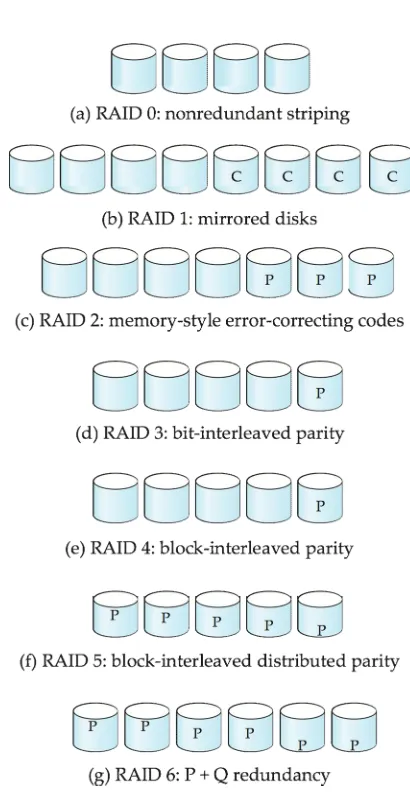
RAID Level 1: Mirrored disks with block striping Offers best write performance.
Popular for applications such as storing log files in a database system.
RAID Level 0: Block striping; non-redundant.
RAID Levels (Cont.)
•
RAID Level 2
:
Memory-Style Error-Correcting-Codes
(ECC) with bit striping.
•
RAID Level 3
:
Bit-Interleaved Parity
• a single parity bit is enough for error correction, not just detection, since we know which disk has failed
• When writing data, corresponding parity bits must also be computed and written to a parity bit disk
RAID Levels (Cont.)
•
RAID Level 3
(Cont.)
• Faster data transfer than with a single disk, but fewer I/Os per second since every disk has to participate in every I/O.
• Subsumes Level 2 (provides all its benefits, at lower cost).
•
RAID Level 4
:
Block-Interleaved Parity
; uses block-level striping, and keeps a parity
block on a separate disk for corresponding blocks from
N
other disks.
• When writing data block, corresponding block of parity bits must also be computed and written to parity disk
RAID Levels (Cont.)
•
RAID Level 4
(Cont.)
• Provides higher I/O rates for independent block reads than Level 3
• block read goes to a single disk, so blocks stored on different disks can be read in parallel
• Provides high transfer rates for reads of multiple blocks than no-striping
• Before writing a block, parity data must be computed
• Can be done by using old parity block, old value of current block and new value of current block (2 block reads + 2 block writes)
• Or by recomputing the parity value using the new values of blocks corresponding to the parity block
• More efficient for writing large amounts of data sequentially
RAID Levels (Cont.)
•
RAID Level 5
:
Block-Interleaved Distributed Parity
; partitions data and parity
among all
N
+ 1 disks, rather than storing data in
N
disks and parity in 1 disk.
RAID Levels (Cont.)
•
RAID Level 5
(Cont.)
• Higher I/O rates than Level 4.
• Block writes occur in parallel if the blocks and their parity blocks are on different disks.
• Subsumes Level 4: provides same benefits, but avoids bottleneck of parity disk.
•
RAID Level 6
: P+Q Redundancy
scheme; similar to Level 5, but stores extra
redundant information to guard against multiple disk failures.
Choice of RAID Level
•
Factors in choosing RAID level
• Monetary cost
• Performance: Number of I/O operations per second, and bandwidth during normal operation
• Performance during failure
• Performance during rebuild of failed disk
• Including time taken to rebuild failed disk
•
RAID 0 is used only when data safety is not important
• E.g. data can be recovered quickly from other sources
•
Level 2 and 4 never used since they are subsumed by 3 and 5
•
Level 3 is not used anymore since bit-striping forces single block reads to
access all disks, wasting disk arm movement, which block striping (level 5)
avoids
Choice of RAID Level (Cont.)
•
Level 1 provides much better write performance than level 5
• Level 5 requires at least 2 block reads and 2 block writes to write a single block, whereas Level 1 only requires 2 block writes
• Level 1 preferred for high update environments such as log disks
•
Level 1 had higher storage cost than level 5
• disk drive capacities increasing rapidly (50%/year) whereas disk access times have decreased much less (x 3 in 10 years)
• I/O requirements have increased greatly, e.g. for Web servers
• When enough disks have been bought to satisfy required rate of I/O, they often have spare storage capacity
• so there is often no extra monetary cost for Level 1!
•
Level 5 is preferred for applications with low update rate,
and large amounts of data
Hardware Issues
•
Software RAID
: RAID implementations done entirely in software, with
no special hardware support
•
Hardware RAID
: RAID implementations with special hardware
• Use non-volatile RAM to record writes that are being executed
• Beware: power failure during write can result in corrupted disk
• E.g. failure after writing one block but before writing the second in a mirrored system
• Such corrupted data must be detected when power is restored • Recovery from corruption is similar to recovery from failed disk
• NV-RAM helps to efficiently detected potentially corrupted blocks