Optimization compressive strength biomass pellet from compost
using Taguchi method
GhafourAbsalan, Mohammad HosseinKianmehr
*,AkbarArabhosseini
andShahriarKouravand
(Department of Agrotechnology, College of Abouraihan, University of Tehran, Tehran, Iran)
Abstract:Compression of pellets is important to prevent deterioration in quality for long term storage and the moisture content of pellets must be less than"20%" . In this research the quality of compost pellets was studied after drying at air temperatures of 50°C, 60°C and 70°C and air velocities of 0.5, 1, and 1.5 m/s, for the samples with particle sizes of 1.18 and 2mm (meshes of 16 and 10) and pellet diameters of 6 and 8 mm. The Taguchi quality engineering method was used to investigate the effects of the parameters on compressive strength of pellet. The orthogonal array, signal-to-noise (S/N) ratio and analysis of variance (ANOVA) were employed to analyze the effect of the parameters on compressive strength. The optimal performance for the compressive strength of pellet was obtained at first level of factor A, i.e. the particle size of 1.18 mm, air temperature of 70"°C" and air velocity of 1 m/s.Confirmation tests verified that the Taguchi method was successful in evaluation of compressive strength of pellet.
Keywords:Compost, CS of pellet,optimization, Taguchi.
Citation: Absalan, Gh., M. H. Kianmehr, A. Arabhosseini, and Sh. Kouravand. 2015. Optimization compressive strength biomass pellet from compost using Taguchi method. AgricEngInt: CIGR Journal, 17(1):166-172
1 Introduction
1Every day a huge amount of organic wastes generate
by the municipal, agricultural and agro-industrial
activities and removal of the wastes causes energetic,
economic and environmental problems (Castaldi and
Melis, 2002). The wastes produced by food industry
plants, animal manures, sewage sludge and compost can
be used to replenish organic matter which is useful for
soil structure and fertility improvement(Saison et al.,
2006; Businelli et al., 2007). In recent years, composting
has become an interesting topic of the social demand for
waste treatment technology and for organic agricultural
products. Composting is a relevant method for waste
treatment as a high level efficient method for waste
disposal which enables recycling of organic matter
(Greenway and Song, 2002). Biomass materials, such as
Received date: 2014-12-11 Accepted date: 2015-1-30 *Corresponding author:Mohammad HosseinKianmehr,
Department of Agrotechnology, College of Abouraihan, University of Tehran, Tehran, Iran. Email: [email protected].
manures and farmyard compost from urban waste have
high moisture content and high volume and are also
non-uniform materials, which cause limitation in usage of
such materials. The possible compaction of these
composted solids into pellets further homogenizes and
dehydrates their organic matter enhancing. Its uniformity
and fertilizing properties as well as densification, such as
pelleting, is a solution for these problems which increase
bulk density, improve storability, reduce transportation
costs and make these materials easier to handle. In such
conditions, the pellets become better suited and extremely
cost effective to transport over long distances. Some of
other benefits of compost pellets are suitability for
implanting or scattering with high precision, no dust and
no pollution for environment, possibility to distribute in
parallel with planting and ability of adding chemical
materials for increasing the quality of pellets
(Lopez-Ridaura et al., 2009; Alemi et al., 2010; Zafari
Deterioration of pellets during storage period is
important in order to keep quality of the compost. More
molds generate on the surface of compost pellets than
ordinary compost with the same moisture content. It is
advised to reduce the moisture content of the pellets to
15% or less, because deterioration by condensation is
caused even at 20% moisture content (Hara, 2001).For
success of the drying process, the quality of the densified
products must meet the consumer requirements and
market standards. The effectiveness of the inter-particle
bonds, created during the densification process, has been
measured in terms of strength. Recently, several studies
have been undertaken onprocess parameters and biomass
properties on the mechanical quality of pellets produced
with biomass material (Tabil and Sokhansanj, 1966; Mani
et al., 2003; Tumuluru, 2014; Zafari and Kianmehr, 2014;
Elio Romano et al., 2014). There is no report in the
literature on the influence of drying parameters on
compression strength of pellets from composted.The
objective of this study was to investigate the effects of
particle size, diameter of pellet, drying air temperature
and drying air velocity on compression strength of
compost pellets, using Taguchi method.
2 Materials and methods
2.1 Materials
Compost was obtained from composting laboratory in
College of Abouraihan, University of Tehran and
prepared for experiments. The compost was produced by
turned windrow composting method using organic
matters or biodegradable wastes, such as urban waste,
animal manure and crop residues. Turned windrow
composting is a method for production of compost in
windrows using mechanical aeration that represents a low
technology and medium labour approach and produces
uniform compost.Physical and chemical properties of
compost, used in the experiment, are shown in Table 1.
The samples were screened through two sieves with sizes
of 2 and 1.18 mm(meshes of 10 and 16, the American
standard).
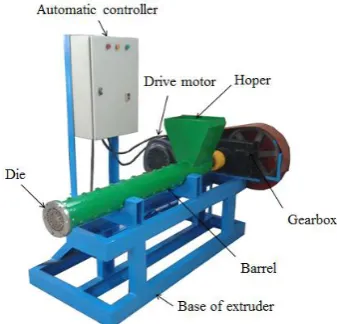
A laboratory scale pellet extruder was used to
manufacture the pellets in this study. Single screw
extruder is a pelleting machine that has a barrel into
which the raw material is forced by a screw (Figure 1).
Figure 1single screw extruder used for producing pellets
Pellets were dried under controlled conditions in
laboratory scale in order to focus on the pelleting process
(production and drying). Moistened pellets were placed in
sealed plastic bagsand kept in a cold store at 4°C for at
least 48 h to distribute the moisture evenly through the
samples. About 30g of sample was dried at
104°C ± 1°Cand the samples were weighed every 48 h.
The samples were dried until the mass change was less
than 0.01 g between the two weighing intervals (Doymaz,
2005). Initial moisture content of compost pellet was
54.18%. The drying experiments were performed at air
temperatures of 50°C, 60°C and 70°C and air velocities
of 0.5, 1 and 1.5 m/s . The drying experiments were
performed by using a laboratory scale batch dryer, Table 1Physical and chemical properties of compost
Apparent Bulk Density, g/cm3
Actual Bulk Density, g/cm3
Repose Angle, degree
Porosity , %
Ratio
Hasner N, % P, % K, % pH CEC EC
developed at the Department of Agrotechnology, College
of Abouraihan, University of Tehran.
2.2 Methods
Compression Strength(CS) (crushing resistance or
hardness) is the maximum crushing load that a pellet can
withstand before cracking or breaking. The tensile
strength of the densified products may be determined
using the diametrical compression test. The tensile
strength is related to the adhesion forces between
particles at all contact points in the agglomerate (Pietsch,
2002; Tabil, 1966). Diametrical compression test is
pre-dominantly used for testing tablets in the
pharmaceutical industry (Tabil, 1966). Compression
strength test simulates the compressive stress due to
weight of the upper pellets on the lower pellets during
storage in bins or silos as well as crushing of pellets in a
screw conveyor. Compressive strength is an important
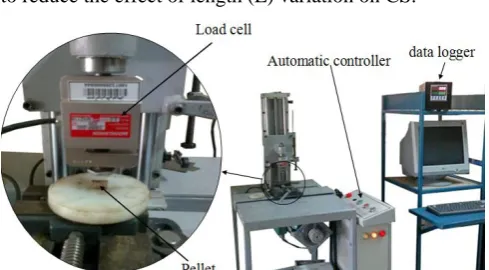
factor in storage and transportation. The CS of pellets was
determined by biological material devise test (BMT)
(Figure 2). A pellet was placed between two horizontal
plates and was compressed radically (Rhén et al., 2005;
Zafari and Kianmehr, 2014). A data logger was used for
registering of force (F). An increasing load with a
constant rate was applied until the test specimen failed by
braking. Pellets with equal length (20±1 mm) were used
to reduce the effect of length (L) variation on CS.
Figure 2The laboratory equipment and operating principle
of pellets strength test
In this study, the Taguchi quality engineering method
was used to optimize the parameter combination and
obtain the maximum CS of pellet. The goal of the
Taguchi method is increasing the number of levels and
decreasing the cost and time or number of experiments.
Therefore, experiments were designed through the use of
this method (Zhang et al., 2006).
Some controllable factors that can affect CS of pellet
are diameter of pellet, particle size, air temperature and
air velocity.These factors were selectedand used as
control factors at two or three levels for
experiments(Table2).
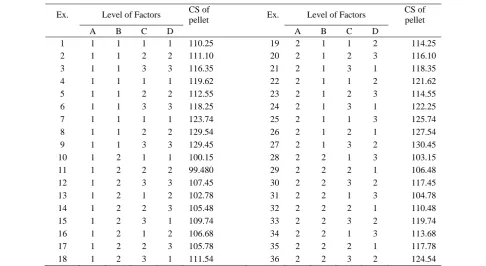
Based on the Taguchi method, aL36(22×32) orthogonal
array table with 36 rows was prepared for the control
factors (Table 3). The rowscorrespond to the number of
experiments that need to be performed. Table 2Input factors and their levels used in the experiments
Parameter Symbol Level1 Level2 Level3
Diameter of pellet A 6(mm)a 8(mm) -
Particle size (mesh) B 16 (1.18 mm) 10(2mm)a -
Air temperature C 50 °Ca 60 °C 70 °C
Air velocity D 0.5 (m/s)a 1 (m/s) 1.5 (m/s)
In Taguchi method, a loss function is used to put the
cost of deviation from the target into the perspective.
There are three categories of loss function based on the
quality characteristics of the response; lower the better
(LB), nominal the best (NB) and higher the better (HB).
In this paper, the higher CS of pellet is the indication of
better performance. Hence, the definition of the loss
function for N repeated experiments is Equation 1:
LHB=
1 N
1 ym2 N
m=1
(1)
The loss function is further transformed into a
signal-to-noise (S/N) ratio which provides a measure of
the impact ofnoise factors on performance.TheS/N ratio
of N repeated experiments, for CS of pellet output, can be
expressed as Equation 2:
η=-10log(LHB) (2)
3 Resultsand discussion
A response table was generated to show the signal to
noise (S/N) ratio for CS of pellets (Table 4). The response
table shows the average S/N ratio for each factor level.
For instance, the average S/N for A1 is calculated by
averaging S/N ratio for the experiments No. 1 through No.
36, where the level of factor A is at level 1 (Taguchi,
2004).
Table 4Signal to Noise Values for CS of Pellets
Parameters S/N by factor level
Level 1 Level 2 Level 3
A 40.75 41.53 -
B 41.68 40.61 -
C 40.97 41.01 41.45
D 41.16 41.18 41.09
The optimal level of the parameters and the better
performance were indicated by greater values of S/Nratio.
As can be seen from Table 4, the optimal parametersto
achieve the maximum CS of pellet was obtained at
second level of factor A(8mm),first level of factor B
(1.18 mm),third level of air temperature (70°C)and
second level of air velocity (1 m/s).Verification
experiment was done for the same optimum conditions
and maximum CS of pellet was obtained as 130.45 N.
Figure 3 shows the effect of parameters on the CS of
pellet.
Table 3 Design matrix and the results for CS of Pellet
Ex. Level of Factors CS of
pellet Ex. Level of Factors
CS of pellet
A B C D A B C D
1 1 1 1 1 110.25 19 2 1 1 2 114.25
2 1 1 2 2 111.10 20 2 1 2 3 116.10
3 1 1 3 3 116.35 21 2 1 3 1 118.35
4 1 1 1 1 119.62 22 2 1 1 2 121.62
5 1 1 2 2 112.55 23 2 1 2 3 114.55
6 1 1 3 3 118.25 24 2 1 3 1 122.25
7 1 1 1 1 123.74 25 2 1 1 3 125.74
8 1 1 2 2 129.54 26 2 1 2 1 127.54
9 1 1 3 3 129.45 27 2 1 3 2 130.45
10 1 2 1 1 100.15 28 2 2 1 3 103.15
11 1 2 2 2 99.480 29 2 2 2 1 106.48
12 1 2 3 3 107.45 30 2 2 3 2 117.45
13 1 2 1 2 102.78 31 2 2 1 3 104.78
14 1 2 2 3 105.48 32 2 2 2 1 110.48
15 1 2 3 1 109.74 33 2 2 3 2 119.74
16 1 2 1 2 106.68 34 2 2 1 3 113.68
17 1 2 2 3 105.78 35 2 2 2 1 117.78
3.1Analysis of variance
Analysis of variance (ANOVA) was used to study the
relative importance of the input parameters and
determination of the optimal combinations of input
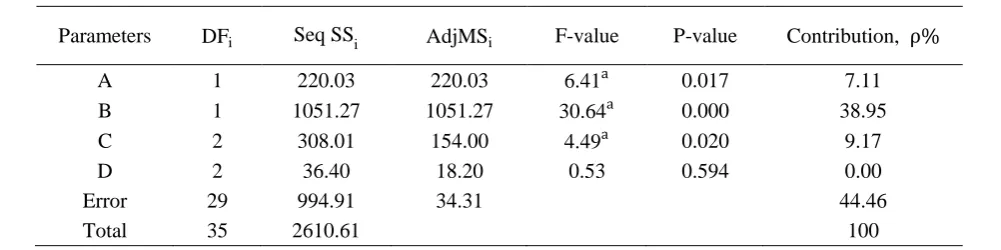
parameters. The results of ANOVA for the CS of pellet at
90% confidence level (risk α=0.1) are presented in Table
5.In ANOVA table, Fvalue for factor iis defined as
Equation 3:
Fvalue=
Adj MSi
AdjMSE (3)
WhereAdjMSi is adjusted mean sum of squares for factor
Iand Adj MSEis adjusted mean sum of squares for error.
The greater Fvalue shows that the variation of the
parameter has a larger impact on the output performance
characteristics. The degree of significance of the
computed Fvalue can be determined by looking up
F-tables. Also, the percentage contribution ρis defined as
Equation 4:
ρ % =Adj SSi-DFi×Adj MSE
SST ×100 (4)
WhereSST,Adj SSi and DFi are the total sum of square,
adjusted sum of squares factor i and degree of freedom
for factor i, respectively. A small variation will have a
large influence on the output of the factors which have
high percent contribution (Yang and Tarng, 1998; Choi
and Kang, 2010). Referring to Table 5, controllable
factors can be ranked as: B, C and A. Thus, the most
significant factor affecting the CS was the particle size
(38.95%), the secondranking factor was
temperature(9.17%) and third ranking factor was
diameter of pellet (7.11%).
3.2Verification
The drawn results during the Taguchi analysis are
verified in next step. The response of the
optimalparameters is also predicted. The predicted S/N
ratio for the optimal combination of parameters is
Equation 5:
Figure 3The effect of parameters on CS of pellet
Note: a
At least 90% confidence,Seq SSi- Sequential sums of squares, P-probability that exceeds the confidence.
Table 5ANOVA test results for CS of Pellet
Parameters DFi Seq SSi AdjMSi F-value P-value Contribution, ρ%
A 1 220.03 220.03 6.41a 0.017 7.11
B 1 1051.27 1051.27 30.64a 0.000 38.95
C 2 308.01 154.00 4.49a 0.020 9.17
D 2 36.40 18.20 0.53 0.594 0.00
Error 29 994.91 34.31 44.46
η=ηm+ ηi-ηm
p
i=1
(5)
Whereη i is the mean of S/N ratio at the optimum control
factor settingsηmis total mean of S/N ratio and p
represents the number of control factors.
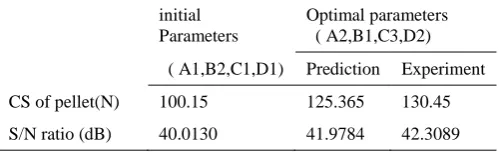
Table 6 shows the results of the confirmation
experiment for CS of pellet.Increase of the S/N ratio from
the initial parameters (A1,B2,C1,D1) to the optimal
parameters (A2,B1,C3,D2) was 2.3 dB, which means that
the CS of pellet is improved1.3 times.
Table 6Results of the confirmation experiment for CS of pellet
initial Parameters
Optimal parameters ( A2,B1,C3,D2) ( A1,B2,C1,D1) Prediction Experiment CS of pellet(N) 100.15 125.365 130.45 S/N ratio (dB) 40.0130 41.9784 42.3089
4 Conclusions
In this paper, optimization of the compression strength
of compost pelletusingTaguchimethod is presented. The
Taguchi method with analysisof S/N ratio was used to
obtain the optimal conditions. The process starts with
identifying the control factors and their levels and then
setting up the orthogonal arrays for experiments. A L36
orthogonal arrays table was constructed for the
controllable factors.The S/N ratios were calculated and
optimal parameters combination for the CS of pelletis
determined. After conducting the Analysis of variance,
the particle size was determined as the most important
factor affecting CS of pellet and theeffect of air velocity
was not statisticallysignificant. The experimental results
confirm the validity of the used Taguchi method to
improve the CS of pellet. Maximum CS of pellet was
observed as 130.45 N.Using the optimum settings as
compared with the initial, the S/N ratio improves by 2.3
dB, which corresponds to an increase of 1.3 times in the
CS of pellet.
References
Alemi, H.,M.H.Kianmehr, andE.Borghae.2010.Effect of pellet processing of fertilizer slow-release nitrogen in soil.
Asian Journal of Plant Sciences, 9(2):74–80.
Anonymous ASAE Standards. 1998. S269.4 Cubes, Pellets and Crumbles-Definitions and Methods for Determining Density, Durability and Moisture Content ASAE DEC96. Standard S358.2 Moisture Measurement-forages.ASAE, St. Joseph, MI.
Businelli, M., R. Calandra, M.Pagliai, D.Businelli, G.Gigliotti, O.Grasselli,D.Said-Pullicino, and A. Leccese. 2007. Transformation of a landfill covering amended with municipal waste compost, Perugia, Italy. Journal of Environmental Quality, 36: 254–261.
Burr, A.H., and J.B.Cheathan.1997.Mechanical Analysis and Design, PHI India Pvt. Ltd.
Castaldi, P.,and P.Melis.2002. Composting of Posidoniaoceanica and its use in Agriculture.Microbiology of Composting. Springer-Verlag, 425–434.
Choi, J.E. Ko. G.D., and K.J. Kang.2010. Taguchi method-based sensitivity study of design parameters representing specific strength of wire-woven bulk Kagome under compression, Composite Structures.
Doymaz, I. 2005. Influence of pretreatment solution on the drying of sour-cherry.Journal of Food Engineering, 78: 591–6. Greenway, G.M.,and Q.J. Song. 2002.Heavy metal speciation in the
composting process.Journal of Environmental Monitoring, 4: 300–305.
Hara, M. 2001. Fertilizer pellets made from composted livestock manure. Food and Fertilizer Technology Center. Mani, S., L.G. Tabil, and S.Sokhansanj.2003.An overview of
compaction of biomass grinds.Powder Handling Processing, 15(3), 160-168.
Pietsch, W. 2002. Agglomeration processes phenomena, technologies, equipment. Weinheim: Wiley-VCH. Rout, B.K., and R.K.Mittal.2006.Tolerance design of robot
parameters using Taguchi method. Mechanical Systems and Signal Processing, 20: 1832–1852.
Ross, P.J. 1996. Taguchi Techniques for Quality Engineering, 2nd ed., McGraw-Hill, New York, USA.
Ridaura, L. S.,H.V.D.Werf, and J.M.Paillat.2009.Environmental evaluation of transfer and treatment of excess pig slurry by life cycle assessment. Journal of Environmental Management, 90(2):1296–1304.
Rhén, C.,G.R. Sjöström, M. and I.Wästerlund.2005.Effects of raw material moisture content, densification pressure and tem-perature on some properties of Norway spruce pellets.Fuel Process Technolgy, 87: 11–16.
resilience of the soil microbial community following compost amendment: effects of compost level and compost-borne microbial community.environmental microbiology, 8: 247–257.
Tabil, L. G., and S. Sokhansanj. 1996. Process conditions affecting the physical quality of alfalfa pellets. Transactions of the ASAE, 12(3):345-350.
Taguchi, G.,and S. Wu. Y. Chowdhury.2004.Taguchi’s Quality Engineering Handbook, John Wiley.
Tumuluru,J.S. 2014. Effect of process variables on the density and durability of the pellets made from high moisture corn stover. Biosystems Engineering, 119: 44-57.
Yang, W.H., and Y.S. Tarng. 1998. Design optimization of cutting parameters for turning operations based on the Taguchi method.Journal of Materials Processing Technology, 84:122–129.
ZafariA.,andM.H.Kianmehr. 2013. Application of densification process in organic waste management. Waste Management Research, 31(7):684–691.
Zafari, A., andM.H.Kianmehr. 2013. Factors affecting mechanical properties of biomass pellet from compost.
Environmental Technology, 35(4): 478–486.