Complete this sentence.
When an atom gains electrons, it will take
on a _________ charge. When it loses
electrons, it will take on a __________
charge.
Bellwork
Chemistry 1
Chapter 22 &23
Oxidation Reduction Reactions
Oxidation-reduction reactions- chemical
changes that occur when electrons are transferred between reactants.
Oxidation
Modern definition - loss of electrons Examples
4Fe + 3O2 2Fe2O3 (rusting of iron) C + O2 CO2 (burning of carbon)
C2H5OH + 3O2 2CO2 + 3H2O (burning of
ethanol)
Reduction
Modern definition - gain of electrons 2Fe2O3 + 3C 4Fe + CO2 Oxidation and reduction always occur
simultaneously. One process cannot occur without the other.
Oxidation
Is
Loss
Reduction
Is
Gain
LEO (Lose Electrons-Oxidation) the lion goes
GER (Gain Electrons-Reduction)
Question
When K becomes K
+, it ______ an
Formation of Ions
Ex. 2Na + S Na2S
Sodium goes from the neutral atom to the 1+
Oxidation Numbers
An easy way to determine what element is
oxidized and which element is reduced in a reaction is to assign each element an
oxidation number.
Oxidation numbers give the charge on each
Question
Lead loses four electrons. It take
on a charge of ___. Does this
Rules for assigning oxidation
numbers:
(Remember when there is one element left,
don’t look at the rules anymore!)
•Sum of the oxidation #’s = overall charge of compound
•Free elements = 0
•Alkali metals (Li, Na, K, Rb, Cs)= +1 •Hydrogen = +1
•Group 2, Cd, & Zn = +2 •Oxygen = -2
•Group 7A (F, Cl, Br, I) = -1
EXAMPLE:
Give the oxidation states of each element in the following molecules:
+1 -1
(+1) + (-1) = 0
HCl
P
2O
5+5 -2
(2x) + (-2 x 5) = 0 X = +5
H
2O
-2 +1
O
20
Free elements are always 0
MnO
+4 -2 2 x + 2(-2) = 0 x = +4Na
2SO
4-2 +6
x + 4(-2) + 2(+1) = 0 x = +6
NH
4++1
-3 x + 4(+1) = 1
x = -3
AlPO
4Ca(OH)
2-2
-2 +1 +3 +5
+2
+3 + x + 4(-2) = 0 x = +5
1(+2) + 2(x) + 2(+1) = 0
x = -2
TiO
2-2 +4
Bellwork
Friday, May 12
th Write the oxidation numbers for each of the
following.
K2CrO4 LiMnO4
H2SO4 SO3
Oxidizing agent- The substance in a redox
reaction that accepts electrons (the
substance that was reduced). Whereas only an element can be reduced, the entire
compound is called the oxidizing agent.
Reducing agent- The substance in a redox
reaction that donates electrons (the
substance that was oxidized). Whereas only an element can be oxidized, the entire
compound is called the reducing agent.
REDOX Reaction Examples
Identify the element oxidized, the element
reduced, the oxidizing agent and the reducing agent for each of the following:
MnO
+4 -2 2+ 4HCl
+1 -1
MnCl
+2 -1 2+ Cl
0 2+ 2H
+1 -22O
Mn
Cl
+4
+2
Gained 2 e
-Oxidized
If it was Reduced, then the reactant that contains Mn acts as the “Oxidizing Agent”. (MnO2)
-1
0
Lost 1 e
-Reduced
Identify the element oxidized, the element
reduced, the oxidizing agent and the reducing agent for each of the following:
Cu + HNO0 +1 -2 3 Cu(NO+2 -2 3)2 + NO-22 + H+1 -22O
Cu
N
0
+2
Lost 2 e
-Oxidized
+5
+4 Gained 1 e
-Reduced
+5 +5 +4
If it was Reduced, then the reactant that contains N acts as the “Oxidizing Agent”. (HNO3)
Let’s Practice! Write the oxidation numbers of the elements and then indicate which substance was oxidized, which was reduced and which are the oxidizing a reducing agents.
2Mg + O2 2MgO AgNO3 + Cu CuNO3 +
Ag
Oxidized: Oxidized:
Reduced: Reduced:
Ox. Agent: Ox. Agent:
Red. Agent: Red. Agent:
Let’s Practice! Write the oxidation numbers of the elements and then indicate which substance was oxidized, which was reduced and which are the oxidizing a reducing agents.
CH4 + O2 CO + 2H2O 2Fe2O3 + 3C 4Fe + CO2
Oxidized: Oxidized:
Reduced: Reduced:
Ox. Agent: Ox. Agent:
Red. Agent: Red. Agent:
C O
O2 CH4
C Fe
Bellwork
Monday, April 15
th Write the oxidation states of the following substances.
Determine which substance is oxidized, which is reduced, and the oxidizing and reducing agents.
2HNO
3+ 6HI
2NO + 3I
2+ 4H
2O
Oxidized: Reduced:
Electrochemistry
The interconversions of chemical
and electrical energy that involve
the transfer of electrons.
This process occurs in a device
The Activity Series and
Redox
We will utilize the activity series of metals
shown to the left to determine reactivity in
single replacement redox reactions. Electrons are lost by the more active metals and gained by the less active metals. The higher a metal is on the activity series, the easier it is
oxidized.
The simplified order from most reactive to
least reactive:
group I&II metals plus Al, the transition metals,
H
"jewelry metals” (Cu, Hg, Ag, Au).
Let’s Practice!
Circle the more active metal!
Fe / Cu
Ca / Ag
Au / H
H / Na
Batteries
Electrochemical cells that
convert chemical energy into electrical energy are called voltaic cells.
The energy is produced by
spontaneous redox reactions.
Voltaic cells can be separated
into two half cells.
A half cell consists of a metal
Batteries
We write half reactions to show what happens
in each part of the cell.
Example Write the half reactions that
occur in the Fe2+/Ni2+ cell.
Oxidation Fe Fe2+ + 2e
- Reduction Ni2+ + 2e- Ni
Diagram of voltaic cell for the
reaction of zinc and copper
.
Diagram of voltaic cell for the reaction of
zinc and copper.
Oxidized: Zn Zn2+ + 2e
- Reduced: Cu2+ + 2e- Cu
Direction of electron flow
Solution of Solution of
From anode to cathode
anode
cathode
Zinc ions
EXAMPLE:
Predict what will happen if an iron nail is dipped
into a solution of CuSO4. Write the balanced
equation and the two half-reactions (reduction and oxidation reactions).
Iron is above copper on the activity series, so the reaction
does occur and iron is oxidized:
Fe(s) + CuSO4(aq) FeSO4(aq) + Cu(s) Oxidation: Fe Fe2+ + 2e
Half-Cells
The half cells are connected by a salt bridge. A
salt bridge is a tube containing a solution of ions.
Ions pass through the salt bridge to keep the
charges balanced.
Electrons pass through an external wire. The metal rods in voltaic cells are called
electrodes.
Oxidation occurs at the anode and reduction
occurs at the cathode. (An Ox and Red Cat)
The direction of electron flow is from the anode to
Calculating the Charge of a Battery
The potential charge of a battery can be
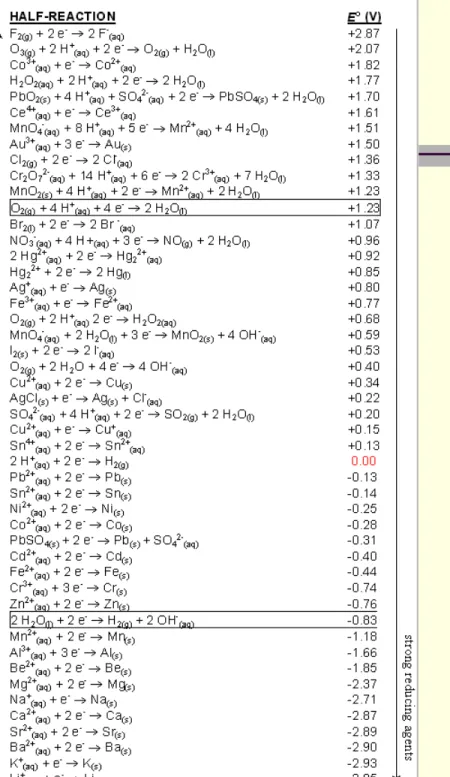
calculated with a set of values from a table of reduction potentials.
To do this, write the oxidation and reduction
half reactions.
Look up the cell potentials from the data
table.
Flip the sign of the cell potential for oxidation.
Example A common battery is
made with nickel and cadmium.
What is the cell potential of this
battery? (E
0Cd
= -0.40V, E
0Ni=
-0.25V)
Oxidation Cd Cd2+ + 2e- E0 = 0.40V
Reduction Ni2+ + 2e- Ni + E0 = -0.25V
Total = E0 =