La conexión entre aprendizaje autónomo y la tutoría entre pares como apoyo a
estudiantes de inglés como lengua extranjera
Aleida Ariza Ariza
**2John Jairo Viáfara González
***Universidad Pedagógica y Tecnológica de Colombia (
uptc), Colombia
In this article we share the findings on the exploration of undergraduate EFL (English as a Foreign Language) student-teachers’ professional preparation and autonomous practices. Participants were tutees who attended tutorial sessions with peers in higher semesters. In this context, tutoring was based on a model we designed. As the model was implemented, they collected information by means of multiple qualitative research instruments. Results indicate that tutees’ learning process was strongly influenced by their personality and attitudes. Similarly, tutees expanded their views in regard to the English language, its learning, and their communicative competence. Finally, we pinpoint some considerations for others interested in adopting this pedagogical strategy.
Key words: Peer tutoring, university tutoring, autonomous learning, independent work
En este artículo compartimos hallazgos relacionados con la preparación profesional y las prácticas autónomas de estudiantes de inglés en un programa de licenciatura. Los participantes tutorados asistían a sesiones tutoriales con compañeros en semestres superiores. En este contexto, la tutoría se basó en un modelo que diseñamos. Durante la implementación del modelo se recogió información a través de múltiples instrumentos cualitativos de investigación. Los resultados revelan que el proceso de aprendizaje de los tutorados se vio fuertemente influenciado por su personalidad y sus actitudes. Asimismo, los tutorados ampliaron sus puntos de vista sobre la lengua inglesa, su aprendizaje y su competencia comunicativa. Finalmente, señalamos algunas consideraciones para los interesados en adoptar esta estrategia pedagógica
Palabras clave: Tutoría entre compañeros, tutoría a nivel universitario, aprendizaje autónomo, trabajo independiente
* This article reports on a study sponsored by the din (Research Department) at uptc. sgi 266 cdp 5456. ** E-mail:[email protected]
*** E-mail: [email protected]
Address: Avenida Central del Norte. Tunja - Boyacá, Colombia.
Introduction
The initial idea to undertake this research process is rooted in various issues. To begin with, our students who were enrolled in the Modern Languages Program at a public university evidenced limitations in their English proficiency. A second concern referred to national educational policies at the tertiary level based on decree 2566, issued in 2003 by The Colombian Ministry of Education (MEN), which suggested the adoption of the credit system. A credit was defined in relation to the time students devoted for their independent work. Thus, this policy led universities such as ours to open supportive spaces which fostered students’ autonomous work by means of tutoring. In this sense, it was expected that students could become more efficient in managing their academic time and optimize their learning process. In our university, professors started to provide this tutoring to their students. Unfortunately, we lacked clear guidelines to support learners by means of this strategy. Hence, our study aimed at understanding the relationship among tutoring, tutees’ professional development and their autonomous practices.
Bearing the previous considerations in mind, we embarked on an action-research journey. First, a diagnostic stage to locate the sources of prob-lematic situations was conducted for about one academic term. By means of an initial survey ap-plied to first and second semester students as well as professors in the language courses, the analysis of tutoring experiences as debutant professors, and the revision of the existent documents the university had produced about tutorials, we estab-lished the concepts this population had about au-tonomy and tutoring. The information collected in the diagnostic stage revealed that participants perceived tutorials as personalized spaces to get support through feedback. With regard to
stu-dents’ perceptions about autonomy, we discovered that they conceived autonomy as an independent practice carried out in their free time guided by their initiative to make decisions. Additionally, self-confidence and responsibility emerged as key features in facing personal limitations. The most remarkable hindrances behind tutorial develop-ment were that both professors and students had limited time for these meetings and only a few students attended tutorials due to their lack of confidence with educators.
As a consequence of the former evidence, we were encouraged to plan tentative tutorial sessions. Initially we decided that peer-tutoring would be the most suitable type of support for participants. We also decided to form an emerging research group with student-tutors of higher semesters. Over a period of four weeks tutorial sessions were held and explored. Information from tutors’ journals, interviews with tutors and tutees, audio and video recordings of sessions and tutorial description formats guided us to propose a three-component peer-tutoring model, suitable for the context of our research. This model is composed of the basic principles to conduct tutoring sessions, the tutoring cycle and the ideal tutor’s profile.
tutees’ autonomous practices revealed along their participation in the tutorial meetings.
In the forthcoming sections, besides providing more details about the investigation process we undertook during the first phase, we will discuss the main pillars underlying this project from both theory and research experiences. Moreover, we will include a description of the research design we implemented to answer the question, which constituted the second stage of this study. Additionally, we will reveal the findings followed by our conclusions and pedagogical implications.
Defining and Exploring
Peer Tutoring
and Autonomy Fields
This literature review looks at several concepts related to peer-tutoring and autonomy. Starting from these considerations, the principles of these two approaches will be discussed. Finally, relevant research experiences in regard to the areas being studied will be commented on.
Peer-Tutoring Principles in the University Context
Revising literature in the field, several con-cepts such as tutoring, peer learning and tandem can be useful to define peer-tutoring. In general tutoring implies supporting and monitoring stu-dents constantly so that they can achieve their in-tegral preparation during their studies. Within the previous framework, Álvarez (2004) define tutor-ing as guidtutor-ing and advistutor-ing pupils. Peer tutortutor-ing emerges as a specific category of tutoring in which two students, a tutor and a tutee, are involved. The
tutor does not necessarily have to be an expert or a teacher in the target area since it is expected that his guidance will lead the tutee to find answers and solutions by himself (Topping, 2002).
Peer-tutoring bears certain similarities with peer-learning (Sampson & Cohen, 2001) and tandem (Stickler 2006); these approaches refer to the support that peers offer their equals in order to achieve learning goals. Thus, several social and psychological factors around these experiences are alike. However, in tandem and peer-learning, peers mutually support each other’s knowledge building, whereas peer-tutoring implies one of the two becoming a permanent guide.
Peer-tutoring in the context of our study refers to a personalized extra-class space where a student guides another one in order to support him or her in his or her integral preparation (Viáfara & Ariza, 2008a). Taking into account students’ status in peer-tutoring, Gaustad (1993) has distinguished between peer-tutoring –in which peers are of similar age and academic status– and the ones in which the tutor might be older or more competent in the target area than the tutee.
Academic and Social Implications of Peer Tutoring: Gauging
Research Experiences
Studies in relation to peer-tutoring have revealed valuable information in the last years. Álvarez & González (2005) determined that peer-tutoring reduces the distance between participants since they are both students. This positive environment stimulates learning because they perceive each other as being part of the same group. In addition, as Mynard & Almarzouqui (2006) state, cooperation fosters a safe atmosphere where asking questions, solving doubts and discussing topics become easier. In regard to academic benefits, peer-tutoring favors at risk students because it promotes the practice of specific communicative and social skills. Luca, Cowan & Clarkson (2003) highlight the role of peer-tutoring as a stimulator of critical thinking and, in general, cognitive processes. Moreover, this type of experiences increases university program retention (Torres, 2002; Packham & Miller, 2002). Embracing learning strategies and study skills has also been pinpointed by Beasley (1997) and Mynard & Almarzouqui (2006) as gains in this kind of experience. All the same, these spaces foster participants’ leadership and make both tutors and tutees more competent in regard to their instructional potentiality (Álvarez & González, 2005). Likewise, Torres (2002) underlines how peer-tutoring allows tutees to become more prepared when participating in classes and handling extra academic issues.
Conversely, investigators have detected some hindrances in peer-tutoring. The lack of admin-istrative support and logistics problems regard-ing flexibility in schedules as well as spaces have a negative impact on tutees’ attendance to ses-sions (Álvarez, 2002). On the other hand, tutees’ dependence on tutors and some tutors’ lack of
preparation may cause a mismatch between their expectations about tutorial development (Mynard & Almarzouqui 2006; Beasley, 1997).
Autonomy as a Corner Stone in Peer Tutoring: Concepts and Conditions
Peer-tutoring experiences imply that tutees gradually move from being supported by someone with higher expertise to become their own tutors. Thus, as Suárez (2002) mentions, there is a connection between tutoring and autonomous learning. Expanding on the previous idea, autonomy is a concept that has been explored from many different perspectives. From philosophical and psychological perspectives, it means becoming responsible members of a social group, whereas in the political field, autonomy implies freedom from external control. At the educational level, there may be a risk of implementing autonomous approaches which favor a particular function of instruction. Coleman (1996) emphasizes the threat of implementing autonomous hegemonies that deny individuals the possibility to develop their own meanings of education and their autonomous practices. As posed by Riley (1988, p. 20), “learning is a social process and varies according to the nature of the society a learner is part of”. Autonomous practices are highly determined by the cultural patterns of a specific social group.
In the same spirit, autonomy can be understood as “the capacity students have for detachment, critical reflection, decision making and independent action” (Little, 1991, p. 4). Low (1996) and Dickinson (1995) refer to autonomy as the ability and attitude learners apply to take charge of their own education. To our understanding, being autonomous implies optimizing a viewpoint towards knowledge con-struction to decide what to learn, when and where learning should be developed, materials to be used and ways to assess one’s process.
Little (2006) and Vieira (2002) mention some attitudes and conditions which favored autonomy as one’s willingness to look individually and collec-tively at educational contexts from a critical per-spective. This position may shift from negotiation to confrontation of authority. The previous implies that pondering our actions is essential to know oneself and to understand one’s role in education showing tolerance with uncertainty and ambigu-ity. Moreover, another condition which affects autonomous practices might be the existence of suitable environments for students to master the language through its use.
The previous conditions can be considered when moving to the practical implication of autonomy in educational settings. To begin with, when trying to create autonomous learning environments, Scharle and Szabó (2000) and Vieira (2002) proposed an awareness that raises dynamics which may include attentiveness in learning how to learn and the social nature of language to foster communicative competence development. Another stage is fueled by learners’ changing attitude towards their process, their roles and the factors involved in it. As a result, learners might face the challenge of transferring roles within class settings.
Revising Research on Autonomous Practices and Profiles
Among recent research reports in this area, Luna & Sánchez (2005) identified four learners’ autonomous profiles. The first one includes students who depend on others’ initiative about what and how to work. A second one refers to students who reveal certain attitudes of taking charge of their own learning outside the educational context. In third place students showing initial reflection towards autonomous learning are described. Finally, they mentioned students who, by means of a high determination to take decisions, seek to reach their objectives.
Within the context of ALEX, a language learn-ing program based on a self-access center at Uni-versidad Nacional, Lagos & Ruiz (2007) explored some of the principal factors that affected the ex-ercise of autonomy in this learning community. Among these factors, they revealed participants’ conception of autonomy and their previous experi-ences. Shortcomings such as the lack of programs to foster autonomous learning, limitations in logis-tics support and participants’ attitudes were detect-ed in the exercise and development of autonomy.
participants’ learning through experience and permanent evaluation processes.
Studying the literature and what researchers have previously shared in the field enlightened us in the observation of what happened when the peer-tutoring model was implemented in our setting. Bearing the previous in mind, we will continue with sharing how peer-tutoring took place while it was investigated.
A New Action Research Cycle:
Examining Peer-tutoring and
Autonomous Learning
As we stated in the introduction, by means of a first action research cycle, we studied our context to propose a tutorial model (Viáfara & Ariza, 2008a). The second stage of our research, which is described in this article, focused on studying what features of first semester Modern Languages students’ professional development emerged as they took part in an autonomous-learning based peer-tutoring model.
Study Scenario
Our Program, Modern Languages, prepares students for the teaching of English at secondary levels. It includes seven five hour-weekly English language courses, called Communicative Projects, to support pre-service teachers’ foreign language communicative competence. The methodologies implemented to guide students’ learning are basi-cally the Communicative Approach and Project Work. Since class time is reduced, students are expected to work independently to achieve the aims of courses. Students also take grammar and phonetics classes. A course of Applied Linguistics, three courses of Didactics as well as the Teaching
Practicum, which constitute the pedagogical block, are expected to foster reflection and research.
The program syllabus is supported by tutoring which aims at preparing students in their courses and is generally offered by teachers in their regular working schedule. These professors generally help students individually providing two tutoring hours a week per course. Students attend these sessions to get support on specific tasks, in homework revision and sometimes to be evaluated.
Based on the experience gained during the diagnosis and piloting stages in 2006, during 2007 first and second semester students were invited to participate in the project. We agreed to continue offering tutorials to several former participants from third and fourth semesters. We expanded tutorial time from one hour to two hours weekly for former tutees. Finally, sixth semester students enlarged the group of tutors.
In relation to tutors, we continued a rigorous selection process to ensure that they had an integral profile to undertake their role. They submitted curricula vitae and had an interview. Once the group was formed, the main researchers focused on organizing participants in pairs (tutor-tutee) based on their time availability and spaces accessibility.
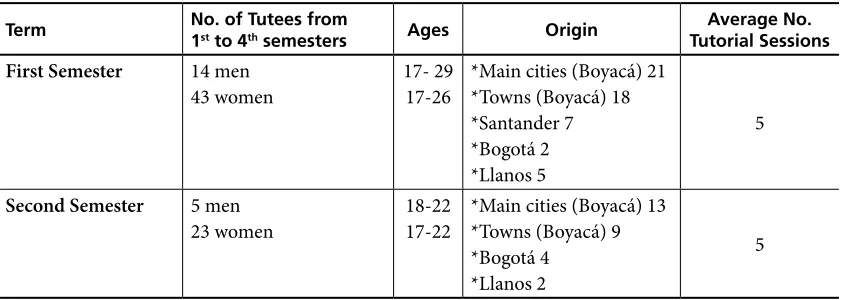
Along the first and second semesters in 2007, the tutorials were implemented in the Modern Languages Program. Tables No. 1 and 2 summarize relevant information about the tutors and tutees that participated in the process.
Tutors’ Preparation
and Implementation of the Model
peer-tutoring session sought to support tutees in their English proficiency level. Along with this academic objective, students might get support in aspects concerning their integral preparation as future EFL
teachers. The last principle was focused on empow-ering tutees as learners by means of strategies in learning how to learn.
The second component of the model is conceived as a cycle (See Figure 1). It describes the ideal process that might orient tutorial sessions development. A tutorial session is nourished from tutees’ immediate needs or their pre-established plans for long term improvement. During the sessions, tutors and tutees may explore and practice specific language aspects while feedback is constantly provided. The tutorial session is expected to encourage tutees’ independent work. A new cycle will start when self and peer evaluation
provides information that would reorient the tutoring process.
The profile of the tutor emerges as the last component in the tutorial model. As it supports a pre-service teacher preparation program, the tutor needs to display values, among them responsibility and respect as well as good communication skills, in order to keep a harmonious relation with the tutees. Likewise, being enthusiastic about the foreign language and its teaching becomes essential. Additionally tutors’ skills in providing information about material sources and learning strategies support tutees’ autonomous learning.
As evidenced in the center of Figure 1, we incorporated different tools within a reflective approach to guide tutors in handling the model. The richness of reflection through investigation strengthened the tutors’ learning when they Table 1. Tutors’ biographical information and tutorial session average
Term No. of Tutors from 6th to 10th semesters Ages No. of tutees per Tutor
Average No. Tutorial Sessions
First Semester 7 men11 women 21-24 21-24 3 5
Second Semester 7 men12 women 21-25 22-25 3 5
Table 2. Tutees’ biographical information and tutorial session average
Term No. of Tutees from 1st to 4th semesters Ages Origin
Average No. Tutorial Sessions
First Semester 14 men
43 women 17- 2917-26 *Main cities (Boyacá) 21*Towns (Boyacá) 18 *Santander 7
*Bogotá 2 *Llanos 5
5
Second Semester 5 men
23 women 18-2217-22 *Main cities (Boyacá) 13*Towns (Boyacá) 9 *Bogotá 4
*Llanos 2
reported research findings, shared journals and attended academic events. We provided opportunities for real tutorial session video analysis and tutorial simulations which informed newcomers about real situations of interest. Problem solving tasks involved critical incident
analysis in which expert tutors’ experiences coached newcomers. Additionally, reading about important theoretical principles underpinning tutoring and autonomy was central to lead participants in developing skills to connect theory and practice.
Research Framework
In 2007 we simultaneously implemented the peer-tutoring model and conducted our inves-tigation. Qualitative research under an action paradigm was the base for our study. “The aim of qualitative approaches is to offer descriptions, in-terpretations and clarifications of naturalistic so-cial contexts” (Burns, 1999, p. 22). On the other hand, action research is conceived as “on-the-spot procedure designed to deal with a concrete prob-lem located in an immediate situation” (Cohen & Manion, 1994, p. 192). Thus, the starting point of this cyclical methodology is a diagnostic stage which leads to the planning and implementation of various strategies. While the action is in progress, constant reflection fueled by observation and other research techniques takes place. Finally exploring the impact of strategies should guide investigators to start a new cycle.
Framed by this qualitative paradigm, primary and secondary instruments were used to collect evidence and achieve the objectives our study sought. By means of semi-structured interviews conducted at the end of each term, we elicited participants’ views about their experiences in the tutoring program. We guided the interviews on a pre-established set of questions (See Appendix 1a, 1b). The two main researchers, with the help of some tutors, conducted 48 interviews for tutees and 24 for tutors along 2007.
Secondly, tutors’ journals provided substantial information since they described tutees’ attitudes, concerns, and actions during the tutorials. When tutors became members of the research group, we guided them in what a journal was and how to keep it in relation to our research focus. We all agreed on writing one entry after every tutorial session or once a week. Thirteen journals were
analyzed by the end of the first semester and 12 in the second term.
Finally, tutorial sessions were audio and video recorded. We aimed at observing how participants behaved while they were engaged in the tutoring model. We agreed on a specific schedule to record the sessions, depending on logistics. During the first semester in 2007, 33 sessions were audio or video recorded, while in the second term 10 sessions were registered.
As a result of this first stage, 25 outstanding issues were identified as we related information by means of comparison and contrast. A second stage was guided by our research objectives which enlightened us to reduce and classify the patterns detected. This cycle continued until we established three main categories with their corresponding sub-categories which are fully discussed in the coming section.
An Autonomous
Learning-Based Peer Tutoring Model:
A Springboard for Students’
Professional Preparation
Initially our research project’s main focus was examining the relationship among peer tutoring, autonomous work and tutees’ English proficiency level; however, as we dug deeper into the phenomenon, we realized that other issues were interwoven. Thus, we expanded the scope of our study to include three dimensions which we identified as a core for tutees’ integral preparation as future EFL teachers. The first feature is tightly connected to language learning and has been denominated, “Gaining Experiential Knowledge in Reaching and Envisaging Language Learning Goals”. The second issue involves socio-affective factors discussed under the heading of “Brick by Brick: Building up Confidence”. Lastly, a core principle in autonomous learning, decision-making guides the discussion under the title, “From Engaging to Acting: Shapes of Tutees’ Willingness to Undertake Their Learning”.
Gaining Experiential Knowledge in Reaching and Envisaging Language Learning Goals
This first trait correlates with our intention to determine the role that the peer tutoring model had in tutees’ academic profile. In this line, data revealed that the primary drive for tutees to become involved in tutoring was to fulfill their language needs. They succeeded in broadening their gains in relation to their empowerment as learners as also reported by Beasley (1997), Mynard & Almarzouqui (2006), and Velandia (2007). Additionally, tutees reflected upon themselves as future tutors or teachers which matches Álvarez & González (2005), who highlight the instructional potentiality participants can gain from tutoring.
A Sharing Enterprise in Valuing Tutees’ Learning Styles
Along peer tutoring, tutors became aware of tutees’ styles and showed concern about helping them identify these preferences. Thus, they counted on valuable information to support learners in their language improvement as much as to provide them with guidelines for sessions development. Tutees acknowledged this effort of their tutors and they considered that their individual characteristics were respected.
He was sensible about the fact that I was starting, then, step by step, he avoided forcing me to start at once. Step by step he provided suitable explanations to me.
(I Te1 1-2007).
Several participants mentioned how taking into consideration tutees’ learning styles contributed both to their skill development and comfort; D, a tutor, expresses:
We start with their interest or what they perceive as prior need and then various activities considering the communicative abilities were developed. The aim was that the tutee himself looked for possible solutions to what he needed… The tutoring helped pupils to discover the way they learn – from the parts to the whole- for example (I Tu2 1-2007).
Planning Strategies to suit Tutees’ Needs
The previous consideration of tutees’ pre-sumable learning preferences led participants to explore their needs as a diagnostic stage in plan-ning the tutorial spaces. In regard to reported limitations, language aspects and their incidence in tutees’ performance in classes appeared. These shortcomings originated from pupils’ eagerness to tackle many language aspects simultaneously, their high school fossilization and low proficiency since they lacked opportunities for language use in classrooms. Needs were explored when tutors and tutees reflected during their examination of previous knowledge, their learning process. They also reflected on themselves as persons. Addi-tionally, they engaged in self and peer evaluation which provided feedback and fostered their self-monitoring. The following excerpt from a tutorial session audio-recording evidences the dynamics described above:
Tu: and what have you done to improve your
pronunciation? Do you remember about the tips we mentioned two weeks ago?
Te: xxx I have read
Tu: Do you have the piece of reading with you? (Sound indicated that the tutee handed the document to the tutor)
2 I Tu stands for Tutors’ interviews.
Tu: Have you identified any difficult words for you to pronounce?
Te: No.
Tu: Ok, we are going to make the list of the possible words that are difficult for you to pronounce. I do not know how feasible it may be for you to get a voice recorder so that you can read and record yourself, and then you listen back and realize about your own mistakes. (tas3 1 2007)
Identifying tutees’ needs preceded proposing a working agenda. This agenda involved a good amount of real life topics and situations and was sometimes set by tutors or by the two of them. Organizing this plan implied using various sources, techniques and strategies for learning such as videos, games, grammar exercises, detailed explanations, skill-based work, homework and dictation. This selection responded to tutees’ styles and proficiency levels. The previous route flowed into the tutees, achieving a range of goals. In relation to their immediate needs, tutors and tutees informed that tuteesr clarified doubts and corrected many of their problems.
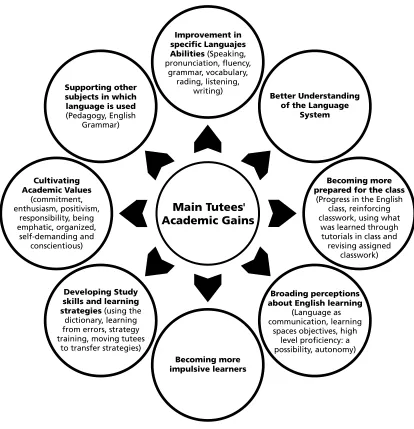
Figure 2 below summarizes specific findings in relation to tutees’ main academic gains as they participated in tutorial sessions. A first area of the profits involved issues concerning language proficiency and understanding how English works, as the following sample reveals. “When I was listening to her, I almost couldn’t believe she was talking so fluent and with very few mistakes, I think she is making progress” (J4 Tu 1 2007).
Closely connected with the previous gain, participants reported how incorporating certain study skills and strategies made them better not only at communicating through the language, but also at changing their learning styles for more
favorable ones as evidenced in the following excerpt when a tutor was asked about her tutees’ gains: “They gained not only in fluency but in taking risks in using English for communicating; to feel more secure so they feel they are able to communicate” (I Tu II 2007). In the same line, another aspect was identified regarding the changing nature of tutees’ beliefs. They realized that language learning is more than translating,
grammar practice or memorization. In these sessions language was used for real purposes while the classroom was regarded as a space to be provided with input. Likewise, in the excerpt below, tutees reflected on the connection between tutorials and autonomy “… To be aware of one’s willingness to reach a goal by one’s own means” (I Te 1 2007).
This autonomous trait was also perceived in tutees’ transferring of their abilities to other classes taught in English as the following tutor revealed in an interview: “Along the process my tutees told me that when they had to work on readings in English classes with their professors and they came across those words we studied during tutorials, they tried to remember how I told them to pronounce them”. They also shaped their attitudes and behaviors in order to build up character in facing learning and life in general as expressed by a tutee: “looking at the tutors’ proficiency to speak, I wonder when I would reach the same level… you know, and one realizes that what we do in classes and tutoring is not enough; one has to be self-demanding to achieve one’s goals” (I Te 1 2007). Though the general perception of tutees in regard to tutorial sessions was positive, tensions of a different nature emerged. To begin with, there were cases in which tutees questioned tutors’ knowledge of the language and procedure as well as the selection of relevant issues in the sessions as they claimed they trusted teachers more.
Sometimes I felt that he did not respect me… it seems to me that he did not believe what I was explaining. One day he said to me that he did not come to the tutorial sessions because he has a dictionary in his house. (J Tu 2 2007)
The previous was not the only mismatch between tutors and pupils’ expectations; others referred to aspects concerning the logistics such as tutees inviting another peer to the session or the extent to which a tutor had to support them in their duties.
Brick by Brick: Building up Confidence
Though tutees’ main objectives ran towards English language practice and development
and the socio-affective dimension that tutoring nourished became a pillar in what they gained. Specifically, confidence was identified as the core building block around which several issues and opportunities were shared so that they grew as learners and future teachers. Similar findings have been reported by Álvarez & González, 2005; Mynard & Almarzouqui, 2006 and Packham & Miller, 2002.
In spite of the fact that tutors were simultane-ously teachers and learning peers, being partners prevailed while working together. The previous considerations implied that the relation between the two actors in tutoring was less tense than with professors and more open to multiple options as to how tutors and tutees became acquainted. When tutorials started, feelings of uneasiness were com-mon since tutees thought their tutors would judge them because of their limitations. However, they came across a working dynamic in which formal assessment was not used. The previous circum-stances fostered a non-threatening atmosphere free from criticism and full of encouragement.
One learns to express oneself in English, to put all that fear aside, it is like one always thinks that what one is going to say is wrong, but one finds the words as the tutor helps. I was very nervous at the beginning because I thought my tutor was going to think I did not know anything, but little by little she gave me confidence. (I Te 1 2007)
communicating. In the following evidence, this participants’ tutor commented about his progress:
[…] for example xxx last semester B was my tutee and he was very shy, he barely spoke to me, and I think it was because of the friendship we built that now he is more open during tutorials. He speaks more, he also has more friends, last semester I realized he was lonelier, now he is around more people. Tutoring seems to help participants to be more aware of themselves as persons who can relate to others and achieve their goals. (I Tu 2-2007)
Student-tutors allowed a closer relationship with their pupils by accepting and promoting tutees’ free expression and being receptive to their common origin as in the next sample:
I asked her some personal questions such as where are you from? What do you do in your free time?... She tried to answer, however I corrected some of her statements, it was nice when she told me she was from Ráquira. ‘Oh! Ráquira’, I told her. I spoke about this town, because once I was there… Here we shared personal experiences and beliefs, it was interesting to go beyond learning and teaching and getting to know the goals, dreams or expectations that each one of the tutees has. There is mutual learning. (J 1 2007)
Thus, little by little, in many cases, friendship bonds were bridged; they identified with each other since they were members of the same program and, in some cases, from the same geographical region. In spite of the strong identification among participants, some tensions were perceived due to personality clashes. For instance, while some tutees expected their tutors to be more open and share intimate issues with them, their guide may have kept reserved and limited her/his counseling to academic matters.
In addition to the previous considerations, tutees usually shared with tutors their concerns regarding various components of the program. They wanted to know about the curriculum, the
university services, and the dynamics of certain courses. This interest generated constant reflection on the suitability of the program and their performance in their studies. Situations in which students considered staying in the program despite their difficulties were discussed in the sessions.
Tutees also expressed that this experience made them aware of the roles they could perform as future teachers or tutors since they analyzed how their tutors acted as guides. An issue to remark on at this point relates to tutees’ expectations in regard to tutors’ language knowledge and skills. They soon discovered that their guides might also have had some gaps in their competence to handle the language; however, their tutors’ eagerness to become more prepared made pupils build a realistic image of what a teacher is. This implies they viewed their tutors as models to be followed. Their admiration for what the former ones did exemplified some of the qualities they could attain and the social commitment they would have to face when becoming teachers.
One realizes about the mechanisms to develop a topic, the resources and strategies to make a class appealing. (I Te 1 2007) (The tutorial sessions) motivated me to continue learning. When I saw my peers in this kind of class, I questioned myself about how I would perform as a teacher in the future. (I Te 1 2007)
From Engaging to Acting: Shapes of Tutees’ Willingness to Undertake Their Learning
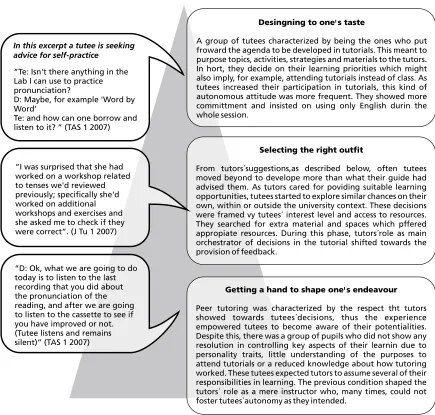
autonomous work is the core of this section. As this kind of tutoring was a novelty for students, we shaped the main findings into a metaphor based on the process one follows in deciding which new suit one wants to wear.
Trying on a New Garment
Tutees’ possibilities to exercise their autonomy revealed various issues. These facets had as their main pillar tutees’ personality and learning factors. Initially, pupils’ shyness, fear and lack of motivation restricted their autonomy.
[…] Towards the second half of the term, tutees’ level of independence was more notorious. There was self-reflection and self-evaluation. In the case of A G, there was more dependence as she was very timid (I Tu 1 2007).
When pupils were asked about the relationship between peer tutoring and autonomy, different expressions connected to motivation were men-tioned, among them: “to be willing to do some-thing, to have more interest in a subject, and desire to develop something one wants” (I Te 1-2 2007).
Becoming aware of what learning means, one’s process and the possibilities to achieve a successful performance was another dimension of students trying to wear that new garment. Participants acknowledged the importance of attending tutorials as a step towards becoming agents of their own learning. Likewise, diagnosing their weaknesses and strengths, knowing about the development of tutorials and the means tutors suggested them to work with, were stages in tutees’ journey towards autonomy.
Tailoring the Experience to Meet One’s Needs and Objectives
As has been mentioned previously, one of the starting points in our tutoring cycle involved tutee’s identification of their own learning objectives through their personal improvement plans. Data collected revealed that some pupils did not decide on their goals, but that these were set by tutors or born from immediate needs. On the contrary, a good number of tutees clearly expressed their aims to work on specific concerns from the beginning or progressively along their participation.
I had a tutorial session with N, her main goal for that tutorial was to learn the auxiliary ‘do’ specially to make questions. I was very motivated; I could see that she wanted to learn by herself. (J Tu 1 2007)
'
'
In this excerpt a tutee is seeking advice for self-practice
Figure 3. From engaging to acting: shapes of tutees' willingness to undertake learning
Conclusions
Along their participation in peer tutoring, first semester EFL student-teachers worked in an environment which provided them conditions to assume more positive attitudes towards their preparation. Pupils started to gain a more favorable view of their future roles as teachers; they regarded their guides as models to learn from. Not only were
tutors’ actions as language instructors analyzed by tutees, but they also paid attention to the values they bestowed thus tutees reflected upon important qualities for teaching. Likewise, tutees also gained information about their program and how they could function in it.
Student-tutors’ respect and interest in characterizing their pupils as learners and providing them with knowledge about strategies and resources guided these first semester students to understand and work on their strengths as well as limitations. The highest amount of information collected in our research accounted for tutees’ partial or total achievement of learning objectives they had set by themselves or with their tutors during the sessions. Additionally, tutees understood better how English works and how the nature of language bears implications in regard to its learning. Several misconceptions tutees held about language learn-ing were initially reshaped due to their reflection on tutorial spaces. Peer tutoring, as a practice op-portunity space, supported tutees’ proficiency and their preparation since they transferred attitudes, skills, and knowledge from tutoring to the various classes taught in English.
Tensions were also experienced when tutees did not have a clear picture about the tutorial dynamics or the role they wanted to play in them. Conflicts arose around the kind of support they would receive, the logistics of tutorials and/or the relevance of using the target language. In some cases tutees’ questioned their tutors’ qualifications to guide them.
From proposing an agenda for reaching their objectives to evaluating their process, tutees always had the first chance to put their needs forward; that is why, as it will be inferred from the coming lines, several of the issues described up to now are factors which shaped tutees’ autonomous learning. Progressing from a basic to a higher autonomous level, tutees moved along what can be compared to a pyramidal road. To begin with, some pupils depended excessively on their tutors and though they seemed to gain awareness about their process, most of their decisions in regard to their learning were made by their tutors.
A second level included tutees’ gradual acceptance of their tutor’s initial support which moved them ahead into expanding what they could do by themselves. The tutorial spaces exhibited examples or models with which they discovered different options to follow later on their own. These situations involved tutees’ understanding of why and how they had decided to work in certain aspects or in a specific way.
Finally, we identified a third group of pupils characterized by their strong initiative to decide what to do and how to develop their tasks. They sought, elaborated and took materials of their preference to tutorials. They usually agreed with their tutors in having additional tutorial spaces.
Pedagogical Implications
and Further Research
Though the tutoring model has been shared and studied with tutors along various semesters, in some aspects there is still a gap between the theory behind it and the extent to which tutors follow its principles. In this sense, tutors can have a more solid component in their preparation to reflect upon crucial issues such as the attitudes which do or do not favor independence in tutees and the importance of being coherent with their role as a model. Being this a two-way road to build, we have also planned to include an initial meeting with tutees so they become more aware of the tutorial model principles and their commitment.
English. The constant request that tutees made for materials confirmed the need we have for more suitable resources to support their autonomous learning. Along the implementation of the tutor-ing model, we have worked in prepartutor-ing many of the resources in our language laboratory to be used by tutors and tutees in our program (Viáfara & Ariza, 2008b).
The results of this study have determined that tutors had an impact in guiding tutees to consider their decisions about dropping out of the program. Bearing the previous finding in mind and that our university, as many others in our country, has looked for possibilities to retain students, we have planned to work more closely with specialized welfare departments in our university so that they can consolidate relevant orientation policies.
Since tracing in detail how tutorials impacted tutees’ perfomance in classes emerged as a limitation in our study, structuring a peer tutoring model which bears a stronger link with program courses can be the focus for further study. This can initially imply analyzing in depth the connections between tutoring and language competence identified in this study, so that specific courses of action can be taken in the planning of English related subjects.
A fruitful area for further inquiry would be to determine how other variables interacted with tutoring in coaching students’ exercise of their autonomy. The specific scope of our study, which sought to explore tutees’ evidence of autonomous practices in tutoring, illuminated us exclusively to describe the tutees’ autonomous profile and work in these spaces.
References
Álvarez, P. (2002). La función tutorial en la universidad. Madrid: eos.
Álvarez, G. M. (2004). Manual de tutoría universitaria. Barcelona: Octaedro.
Álvarez, P., & González, M. (2005). La Tutoría entre iguales y la orientación universitaria. Educar, 36, 107-128. Ariza, A. (2008). Unveiling students’ understanding
of autonomy: Puzzling out a path beyond the efl classroom. profile Issues in Teachers’ Professional Development, 10, 47-73.
Beasley, C. J. (1997). Students as teachers: The benefits of peer tutoring. Curtin University of Technology. Retrieved on January 30, 2008 from Web site: http:// lsn.curtin.edu.au/tlf/tlf1997/beasley.html
Burns, A. (1999). Action research. Cambridge: Cambridge University Press.
Cohen, L., & Manion, L. (1994). Research methods in education. London: Routledge.
Coleman, H. (1996). Autonomy and ideology in the English language classroom. In H. Coleman (Ed.), Society and the language classroom. Cambridge: Cambridge University Press.
Colombia. Ministerio de Educación Nacional. [men]. (2003). Decreto 2566. Ministerio de Educación Nacional. Recuperado 15 de febrero, 2007 de www.mineducacion. gov.co/1621/articles-104846_archivo_pdf.pdf
Dickinson, L. (1995). Self-instruction in language learning. Cambridge: Cambridge University Press.
Gaustad, J. (1993). Peer and cross-aged tutoring. eric Digest, No. 79, Retrieved September 12, 2008 from Web site: http://eric.uoregon.edu/publications/digest/ digest079.htm
Holec, H. (1981). Autonomy in foreign language learning. Oxford: Oxford University Press.
research. (pp. 209-219). California: Sage Publications, Inc.
Lagos, Y., & Ruiz, Y. (2007). La autonomía en el aprendizaje y en la enseñanza de lenguas extranjeras: una mirada desde el contexto de la educación superior. Matices en Lenguas Extranjeras, 1, Retrieved on November 15, 2007 from Web site: http://www.revistamatices.unal. edu.co/matesop06.html
Little, D. (1991). Learner autonomy: Definitions, issues and problems. Dublin: Authentik Language Learning Resources Ltd.
Little, D. (2006). El aprendizaje de lenguas en tándem y la autonomía del estudiante. In Sánchez, A., & Hölscher, M. (Eds), El aprendizaje autónomo de lenguas en tándem (pp. 29-49). Universidad de Oviedo.
Low, H. (1996). Encouraging learner independence. how A Colombian Journal for Teachers of English, 4, 39-41. Luca, J., Cowan, E., & Clarkson, B. (2003). Promoting
students’ learning through peer tutoring. Retrieved on January 30, 2008 from Web site: http://www. eric.edu.gov/ERICDocs/data/ericdocs2sql/content_ storage_01/0000019b/80/1b/1a.pdf
Luna, C., & Sánchez, D. (2005). Profiles of autonomy in the field of foreign languages. profile Issues in Teachers’ Professional Development,6, 133-140.
Merriam, S. (1988). Case study research in education. A qualitative approach. California: Jossey-Bass Publishers.
Mynard, J., & Almarzouqi, I. (2006). Investigating peer-tutoring. ELT Journal,60(1), 13-22.
Packham, G., & Miller, C. (2002). Peer-assisted student support: a new approach to learning. Journal of Further and Higher Education, 24, 55-65.
Riley, P. (1988) The ethnography of autonomy. In A. Brookes, & P. Grundy (Eds), Individualization and autonomy in language learning. (pp. 13-34). Hong Kong: Modern English Publications in Association with the British Council.
Sampson, J., & Cohen, R. (2001). Implementing and managing peer learning. In D. Boud, et al. (Eds.), Peer
Learning in Higher Education (pp.50-66). London: Kogan Page.
Scharle, A., & Szabó, A. (2000). Learner autonomy. A guide to developing learner responsibility. Cambridge: Cambridge University Press.
Suárez, P. (2002). Orientación y práctica tutorial. Documento del programa de ciencias sociales. Tunja: uptc.
Stickler, U. (2006). Asesoramiento tándem centrado en la ayuda al estudiante. In A. Sánchez & M. Hölscher (Eds.), El aprendizaje autónomo de lenguas en tándem (pp. 115-123). Universidad de Oviedo.
Topping, K. (2002). Tutores y tutorías. Bogotá: Cooperativa Editorial Magisterio.
Torres, M. (2002). Las experiencias del estudiante tutor en la división de ingenierías. In A. Díaz, & B. Pinzón (Eds.), Excelencia académica y formación integral: Memorias del congreso internacional intercambio de experiencias en programas universitarios de tutorías (pp.35-46). Bogotá: Centro Editorial Universidad del Rosario.
Velandia. D. (2007). Tutorial plan to support the English speaking skill of an Inga student of an initial teacher education program. profile Issues in Teachers’ Professional Development, 8, 121-130.
Viáfara, J., & Ariza, A. (2008a). Un modelo tutorial entre compañeros como apoyo al aprendizaje autónomo del inglés. Íkala, Revista de Lenguaje y Cultura, 13(19), 173-209.
Viáfara, J., & Ariza, A. (2008b). Independent material design principles: Main implications from a research project on peer-tutoring in the modern languages program at the uptc. Paper presented in asocopi Congress 2008.
autonomy (pp. 1-11). Braga: Centro de Investigaciones en Educación Universidad de Minho.
Vieira, F. (2002b). Looking back and ahead. In F. Vieira et al. (Eds.), Pedagogy for Autonomy and English Learning. Proceedings of the First Conference of the Working
group- pedagogy for autonomy (pp. 131-135). Braga: Centro de Investigaciones en Educación Universidad de Minho.
About the Authors
Aleida Ariza Ariza, B.Ed in Philology and Languages, English–Spanish from Universidad Nacional de Colombia,