Facoltà di Scienze Matematiche, Fisiche e Naturali Dipartimento di Fisica
Tesi di Dottorato di Ricerca in Fisica
Ph.D. Thesis in Physics
Development of Free Energy calculation
methods for the study of monosaccharides
conformation in computer simulations
Supervisors: Ph.D. candidate:
Prof. Francesco Pederiva Emmanuel Autieri
Dr. Marcello Sega
Contents
Introduction ix
1 Monosaccharides 1
1.1 Carbohydrates . . . 2
1.2 Monosaccharides . . . 4
1.3 Conformational analysis of aldopyranoses . . . 12
1.3.1 Experimental measurements of puckering properties . . . 13
1.3.2 Towards a microscopic description: computer simulations 16 2 Simulation Techniques 19 2.1 Simulations and statistical mechanics . . . 20
2.1.1 Molecular Dynamics . . . 21
2.2 Free energy calculations and accelerated MD . . . 27
2.2.1 Rare events and the need for acceleration . . . 30
2.2.2 Metadynamics: basic concepts . . . 32
2.2.3 The choice of Collective Variables . . . 35
2.2.4 Example of a metadynamics simulation . . . 35
3 Puckering Coordinates and Free Energy reconstruction 39 3.1 Puckering: historical development and the Strauss-Pickett coor-dinates . . . 40
3.2 The general Cremer-Pople coordinate set . . . 42
3.2.1 Mean plane and molecular axes denitions . . . 42
3.2.2 Generalized puckering coordinates . . . 44
3.2.3 Cremer-Pople coordinate inversion . . . 46
3.3 Other denitions beyond Cremer-Pople . . . 46
3.4 Derivation of Cremer-Pople coordinates for six-membered rings . 48 3.4.1 Original Cremer-Pople coordinate representation . . . 48
3.4.2 Alternative representation: the puckering sphere . . . . 49
3.5 Puckering properties with metadynamics . . . 51
4 Metadynamics for six-membered rings 55 4.1 Toy-models for metadynamics and puckering coordinates . . . 56
4.1.1 Accessible regions in puckering space . . . 56
4.1.2 Ring simmetries and Cremer-Pople representation . . . . 59
4.1.3 Reconstruction patterns and free energy proles . . . 60
4.1.4 Side chain eect on free energy landscapes reconstruction 63 4.2 Improving standard metadynamics . . . 70
4.2.1 Well-tempered Metadynamics . . . 70
4.2.2 Umbrella Sampling renement . . . 71
4.3 Spherical coordinates and metadynamics . . . 74
4.3.1 Periodicity at poles . . . 76
4.3.2 Alternative spherical angles . . . 77
5 Alternative reaction coordinates for puckering 85 5.1 Spherical Cremer-Pople against Cartesian Cremer-Pople repre-sentation . . . 86
5.1.1 Simulation methods . . . 86
5.1.2 Direction of the meta-forces . . . 87
5.1.3 Simulation results . . . 88
5.2 Spherical Cremer-Pople against Strauss-Pickett representation . . 92
5.2.1 Simulation details . . . 93
5.2.2 The state-counting problem . . . 95
5.2.3 Collective variable choice and convergence . . . 98
6 Simulating α/β-d-pyranosides with the gromos force eld 101 6.1 The sugar puckering problem in classical force elds . . . 102
6.2 d-aldopyranoses: simulations and force eld details . . . 102
6.3 Puckering free energy of β-d-glucose . . . 104
6.4 d-Aldopyranoses with the G45a4 parameter set . . . 108
6.4.1 Equilibrium and out-of-equilibrium simulations . . . 110
6.5 Rening the force eld: the 45a4-aspg parameter set . . . 111
6.5.1 Parametrization procedure . . . 111
6.5.2 Free energy landscape with the new 45a4-aspg parameter set . . . 115
7 Conclusions and further work 121
A Cremer-Pople coordinates Denitions and gradients 125
B Cremer-Pople coordinates Re-numbering of ring atoms 133
C Cremer-Pople coordinate inversion 139
List of Figures
1.1 Example of constitution for simple monosaccharides. . . 5
1.2 Chiral centers for monosaccharides . . . 6
1.3 Pictorial view of stereoisomers. . . 7
1.4 Rotamers denition . . . 8
1.5 Schematic form for aldopyranose ideal conformers . . . 9
1.6 Schematic form for aldofuranose ideal conformers . . . 9
1.7 Ring substituents orientation. . . 10
1.8 Possible aldopyranoses . . . 12
2.1 Interaction terms in force elds . . . 23
2.2 Pictorial view of metastable systems . . . 31
2.3 History-dependent potential concept . . . 33
3.1 Denition of anglesαi andβi . . . 41
3.2 Dierent notion of reference plane . . . 47
3.3 The Cremer-Pople coordinates and the puckering sphere. . . 50
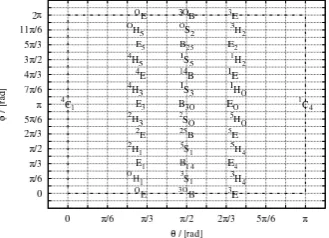
3.4 Ideal conformers on the puckering sphere. . . 51
4.1 Hierarchical construction of hexopyranoses . . . 56
4.2 Toy-model N.1 . . . 57
4.3 Toy-model N.1: visited conformations . . . 58
4.4 Toy-model N.1 revisited: visited conformations . . . 58
4.5 Toy-model N.2 . . . 59
4.6 Toy-model N.2: visited conformations . . . 60
4.7 All-atoms models . . . 61
4.8 All-atoms models: convergence pattern . . . 62
4.9 All-atoms models: free energy landscapes . . . 63
4.10 Test model: xylose (β-d-Xylopyranose) . . . 63
4.11 Test model: convergence pattern . . . 65
4.12 Test model revisited: convergence pattern . . . 66
4.13 Production model: glucose (β-d-Glucopyranose) . . . 66
4.14 Production model: convergence pattern . . . 68
4.15 Test-models: free energy landscapes . . . 69
4.16 Toy-model N.1: free energy landscapes (detail) . . . 75
4.17 Periodicity at poles . . . 76
4.18 Alternative spherical maps . . . 79
4.19 Free energy landscapes in alternative spherical coordinates . . . . 81
4.20 Free energy landscape from weighted average . . . 82
5.1 Glucuronic acid model . . . 86
5.2 Probability density ρ(Q). . . 89
5.3 Free energy with the spherical CP representation . . . 90
5.4 Free energy with the Cartesian CP representation . . . 91
5.5 Artifacts from Cartesian coordinates . . . 92
5.6 Glucopyranose model . . . 93
5.7 Counting schemes on the(θφ)-plane . . . 96
5.8 SP free energy surface. . . 97
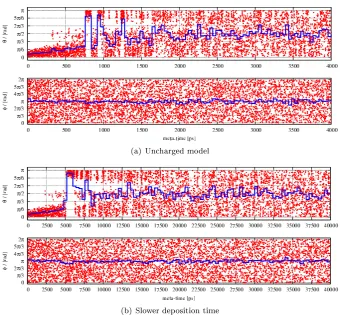
5.9 Time evolution of population P(4C 1) . . . 99
5.10 Filling equivalent eciency. . . 100
6.1 Sugar models . . . 103
6.2 β-d-glucose free energy landscape . . . 105
6.3 Contribution from equilibrium sampling after metadynamics . . . 106
6.4 Population percentages forβ-d-glucose conformers . . . 107
6.5 Inverted chair free energy dierence with G45a4 FF . . . 109
6.6 Equilibrium populations . . . 112
6.7 Inverted chair free energy dierence with 45a4-aspg FF . . . 116
6.8 Comparison of conformer populations . . . 117
6.9 Free energy landscape of β-d-aldopyranoses . . . 119
6.10 Free energy landscape of α-d-aldopyranoses . . . 120
C.1 Ring partition . . . 140
C.2 Atoms coordinates . . . 141
C.3 Pposition and rotation angles . . . 142
List of Tables
1.1 Short glossary for isomers . . . 7 1.2 Calculated free energies for d-aldoheopyranoses . . . 14 1.3 NMR coupling constant . . . 15
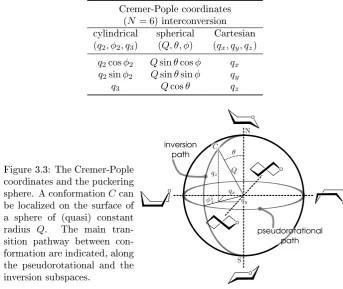
3.1 Standard Cremer-Pople puckering coordinate set (summary). . . 50
4.1 All-atoms model: free energies and conformer populations . . . . 64 4.2 Extended Cremer-Pople puckering coordinate sets (summary). . . 82 4.3 Transformations between spherical Cremer-Pople sets . . . 83
5.1 Free energy from dierent CP set . . . 91 5.2 Standard conformers in the SP representation . . . 93
6.1 Free energy and populations of dierent conformers using the G45a4 parameter set. . . 110 6.2 FF parameters . . . 114 6.3 Free energy and populations of dierent conformers using the
45a4-aspg parameter set. . . 117
A.1 Weights for Cremer-Pople denitions . . . 126 A.2 Redundant weights . . . 126
Introduction
Jauchzet, frohlocket! auf, preiset die Tage, Rühmet, was heute der Höchste getan! Lasset das Zagen, verbannet die Klage, Stimmet voll Jauchzen und Fröhlichkeit an! Dienet dem Höchsten mit herrlichen Chören, Lasst uns den Namen des Herrschers verehren!
J.S.Bach Weihnachts-Oratorium (BWV 248I), 1.Coro
Cyclic and heterocyclic compounds are ubiquitous in nature, and occupy a place of particular relevance in many chemical and biological processes. Car-bohydrates, for example, are one of the fundamental building blocks of the biochemical activity and structure of the cell, including energy transport, cell recognition and signaling. Since cyclic molecules appear most of the time in non-planar, puckered conformations, knowing their structural and conforma-tional properties is a task of primary interest. This thesis is devoted to the study of the conformation of monosacchrides in six-membered ring form. The main goal is to develop and apply new computational tools to investigate con-formational properties and to improve the description of carbohydrates in the framework of molecular dynamics simulations.
My interest in computer simulations of carbohydrates developed within the framework of a scientic collaboration on bio-polymeric gels1. One of the sub-jects of the research project was indeed the study of a polysaccharide derived from hyaluronic acid (HYA), a biopolimer composed by two repeated units (glu-curonic acid and N-acetil-glucoseamine). Experimentally, a suitable function-alization can mutate the native hyaluronic acid into an hydrogel (HYADD4, see Ref. [55]). This, together with the biocompatibility of the molecule, makes this system a valid candidate for applications in medicine, for example in the treatment of ostheoarticular pathologies as a substitute of the synovial uid in unhealthy joints. For the aforementioned system, as for many others, computer simulation are extremely valuable, as they can complement the information on structure and dynamics of the system gathered in the course of experiments. However, for this specic problem modeling the system within the molecular dynamics framework presented troublesome aspects. The most important issue was that the force eld chosen (the gromos 45a4 parameter set [112]) failed in 1Part of the present work was supported by a PRIN grant from the Italian Ministry of Public Education, University and Scientic Research (PRIN 2007 project: Proprietà siche di biomatrici nanostrutturate a base polimerica, A.Deriu, F.Pederiva, G.Paradossi).
reproducing the conformational preferences of the sugar constituents, with the appearance of unphysical conformations [36].
Starting from this evidence, we soon realized that this problem turns to be a known, but often overlooked one, in computer simulations of carbohydrates. In the past, several approaches have been proposed, which were however circum-venting the problem, rather than providing a solution to it [76, 31, 150]. Indeed, we found that until recent times, pragmatic approaches were somehow supported by a general lack of experimental evidences on conformational data for sugars. This lack stems from the fact that the conformational analysis of monosaccha-rides, and in particular of hexopyranose sugars like glucose, is a dicult task both from the experimental and from the theoretical point of view. On the experimental side, the characterization of the ring conformational preference is complicated by the extremely low occurrence of the second-most populated con-former, with only few remarkable exceptions (like altrose [10] and idose [163]). From the perspective of computer simulations, this conformational behavior, dominated by few structures, generates a severe bottleneck: the non-ergodicity of the system by any practical means. This aspect explains the interest in free energy calculations, since metastabilities are strictly linked to specic free energy features. When free energy dierences between conformers (and the barriers in between) are rather large, as it appears to be for monosaccharides, standard computational approaches like molecular dynamics are ineective. Methods ex-ist, such as umbrella sampling [175, 17] or metadynamics [100, 99, 14], that allow to accelerate the sampling of dierent conformations by adding bias forces. In general, accelerated sampling methods are based on the choice of a (usually low) number of collective variables (CVs). The choice of CVs is of particular importance for the proper reconstruction of free energy landscapes: their num-ber should be small in order to speed up the sampling consistently, and they should represent every slow degree of freedom of the system. Otherwise, the es-timate of the prole could be severely biased [99]. In the eld of conformational analysis, suitable CVs have to be considered to describe non-planar, puckered conformations of cyclic structures. The problem of an intuitive description of puckered ring conformers dates back to the work of Sachse [154], but it is only in 1975 that an exhaustive, mathematically correct description of a generalN -membered ring puckering has been proposed [41]. The description of Cremer and Pople has from time to time been questioned because of some conicts with the standard stereochemical interpretation of puckering [191] and for some di-culties in comparing with NMR experimental results [19, 64]. Nevertheless, the approach of Cremer and Pople has become the most widely employed way to describe puckered conformers. The calculation of puckering free energy land-scapes, and the determination of conformer populations has been the subject of a series of recent computer simulation investigations [24, 159, 66, 166, 13], with the aid of the aforementioned accelerated dynamics methods.
structures with non-planar conformations, are presented. In particular, we in-dicate how to exploit the capabilities of the metadynamics algorithm applied to the investigation of puckered ring conformers. The present work is organized as follows:
Chapter 1: the general classication and the structural features of monosac-charides are discussed. The theoretical and experimental frameworks rele-vant for conformational analysis studies are also presented in this Chapter; Chapter 2: simulation techniques for free energy calculation are presented,
with particular emphasis on metadynamics;
Chapter 3: the puckering problem is addressed from the point of view of the reduced coordinate sets necessary to describe it (Staruss-Pickett dihedrals and Cremer-Pople representations);
Chapter 4: the calculation of the free energy of simple systems is employed to show the general features of metadynamics in the constext of puckering free energy landscape reconstruction for six-membered rings;
Chapter 5: dierent parametrizations of puckered structures are explored to assess their respective advantages as collective variables for metadynamics; Chapter 6: a systematic evaluation of the accuracy of the gromos 45a4 Force Field in describing ring puckering is presented, and a modication of the parametrization is proposed to obtain agreement with theoretical and ex-perimental data;
Chapter 1
Monosaccharides
That's the time you must keep on trying Smile, what's the use of crying?
You'll nd that life is still worthwhile If you just smile
Charlie Chaplin Smile
In this Chapter a general overview on carbohydrates is given, and a detailed description of monosaccharide structural complexity is addressed. Conforma-tional analysis of monosaccharides is presented with respect to theoretical and experimental developments in the eld. Eventually, some basic notions of how computational techniques can help in exploring the subject are given.
Contents
1.1 Carbohydrates . . . 2 1.2 Monosaccharides . . . 4 1.3 Conformational analysis of aldopyranoses . . . 12 1.3.1 Experimental measurements of puckering properties 13 1.3.2 Towards a microscopic description: computer
sim-ulations . . . 16
1.1 Carbohydrates
Biological molecules, or biomolecules, are compounds mainly produced in liv-ing organisms and specically involved in life processes. Biomolecules composi-tion, structure, properties, reactions, and preparation are the subject of dierent scientic disciplines, like biochemistry (the study of the chemistry of life pro-cesses), organic chemistry (the study of carbon-based compounds), molecular biophysics (the study of biological systems with methods from physical science), molecular biology (the study of molecular basis of biological activity), and bioin-formatics (application of inbioin-formatics to biology), to name a few.
Life processes are mainly realized in cells as a result of the interplay of two main classes of molecules: a) large polymeric molecules (proteins, protein com-plexes, nucleic acids, . . . ) referred to as biological macromolecules, and b) low-molecular-weight molecules (glucose, glycerol, . . . ) referred to as metabolites. Biomolecules are present in both these classes, and also inorganic molecules par-ticipate to this interplay. Nevertheless, evolution has set specic characteristics on macromolecules in order to allow simple chemical reactions on metabolites to realize complex life processes and functions like movement, reproduction, sensitivity and growth.
The most abundant component in biomolecules is carbon, that with its elec-tronic conguration can make four covalent bonds. In this way carbon is able to form a very large variety of compounds, the greatest variety with respect to any other chemical element. Moreover, the possibility of stable C−C cova-lent bonds (a peculiar characteristic1in nature) permits biochemistry to benet of the main foundations of organic chemistry: repetitive carbon-carbon stable covalent bonds allows the formation of complex macromolecules with linear, branched, cyclic or cage-like structures. Furthermore, in biomolecules a large variety of functional groups (like alcohols, carboxylic acids, carboxamides, thi-ols, thiolethers, . . . ) is present, increasing dramatically the chemical reactivity and thus broadening the spectrum of biomolecules functions.
Understanding biomolecules capabilities is more complex than the same issue with inorganic molecules. This is because there is not only the problem of detect-ing their composition, but it is also important to know their three-dimensional structure. In inorganic chemistry, once a formula for a generic substance is given, the structure can often be inferred immediately. This is because most of the time there is only one compound with a given formula (e.g. Na2SO4). However, this is not the case with organic chemistry, and thus also with biochemistry, even with small molecules. As an example, ethyl alcohol and dimethil ether have the same formula (C2H6O) but they are very dierent molecules: at room temperature the former is liquid while the latter is a gas. Another example is the chemical formula C6H12O6that refers simultaneously to glucose and to other 31 compounds. These 32 molecules have physico-chemical properties substantially dierent (for example, the sweetness of the compound), and the dierences only relies in the specic structure arrangement (in Section 1.2 this stereoisomery problem will be extensively discussed for monosaccharides). Furthermore, with
1Beside carbon, silicon is the only other element that can form strong repetitive covalent bonds. However, Si−Si structures oxidize rapidly into silica (SiO2) in an oxygen-rich
very large objects, like hemoglobin or chromosomes, the number of monomers is so high that the three-dimensional structure is extremely complicated. This is because the nal structure is the result of many interactions (covalent and hydrogen bonds, Van der Waals interaction, dipolar interaction with solvents, . . . ) that simultaneously occur. Also, the specic order in which interactions are established is important, because the more a molecule is large and specic the more is important its pathway of formation. This very high level of structural complexity can be considered responsible for biomolecules ability in perform specic actions in life processes.
The standard subdivision of macromolecules identies four main classes: proteins, nucleic acids, lipids and carbohydrates. Proteins are extremely ver-satile macromolecules, and this provide them to be ubiquitous in living or-ganisms: they are found as catalysts (enzymes), transport and store vectors (hemoglobin), mechanical support materials (histones), movement mediators (myosin), to give only few examples. Proteins are linear polymers built on monomeric unit called amino acids. There are only 20 dierent amino acids in natural proteins. The amino acid sequence of a protein determines its properties and its three-dimensional structure: from the primary structure (the bare amino acid sequence) to the secondary structure (locally folded segments) and eventu-ally to the tertiary and quaternary structure (the global, compact, asymmetric structure). Nucleic acids (like DNA and RNA) are the main macromolecules involved in the storage and transmission of genetic information. They are very long linear polymers, made from a limited set of monomers called nucleotides. DNA has most of the time the form of a double helix, where two strands pairs each other by means of hydrogen bonds. The base pairing mechanism allows the transcription of genetic information from DNA to RNA for the subsequent translation into proteins by ribosomes. Lipids are water-insoluble biomolecules that are highly soluble in organic solvents. The key constituents of lipids are fatty acids, namely hydrocarbon chains of various lengths. In combination with other molecules fatty acids span the variety of lipids: fats, oils and waxes, sterols, phospholipid and glycolipid, to name a few. This wide range of mole-cules encompass various biological functions. They can be highly concentrated energy storage molecules and are involved in signal transmission and transduc-tion. Moreover, they are the major component of biological membranes.
Carbohydrates costitute most of the organic matter on Earth. This is because of their simple composition (as the name suggests, they are made basically by carbon, oxygen and hydrogen) and their extensive role in all form of life. They are energy stores, fuels and metabolic intermediate; they are found in the back-bone of nucleic acids and in cell walls of bacteria and plants (the polysaccharide cellulose is one of the most abundant organic compound in the biosphere); they can interact and link with other macromolecules to form a wide range of gly-coconjugates which are determinant for cell-cell communication and interaction between cells and other elements in their environment. In addition, carbohy-drates have several industrial applications: starch in manifacture of goods and pastas; gums in food processing; mono and oligo-saccharides as sweeteners (sug-ars); cotton and linen in clothing fabrics; wood in furniture and wood pulp in paper industry; fermentors to make alcoholic beverages; antibiotics in pharma-ceutical products.
structural diversity. Carbohydrates basic unit are monosaccharides, and will be extensively described in Section 1.2. Here we want to stress that their gen-eral empirical formula2 (C−H
2O)n collects a quite large number of dierent isomers for a givenn, due to the presence of several chiral carbon atoms. More-over, the presence of multiple functional groups (aldehyde and ketone groups, and multiple hydroxyl side chains) allows a large number of possible pair link-ages between monosaccharides (by means of glycosidic bonds). Thus, the sheer number of possible oligosaccharides depends not only by an higher number of monomers (dierent monosaccharides are larger in number than amino acids), but also by a more versatile connectivity to linear or branched polymers (e.g. given 4 monomers, many more dierent oligosaccharides can be formed from 4 monosaccharides than polypeptides from 4 amino acids).
Finally, the most popular carbohydrates are polysaccharides, namely, long homopolymers (or eteropolymers with few dierent monomers) where the same linkage scheme is repeated along very long chains. The presence of hydroxyl groups permit at this level the formation of bers (like in cellulose) or sec-ondary structures as helices (like in starch), dierent three-dimensional struc-tures related only to the dierent linkages scheme in polymerization and not to a dierent composition.
All this intricacy and diversity, making carbohydrates information-rich mol-ecules [98], has the biological role of successfully performing many life processes. For example, the diverse carbohydrate structures displayed on cell surfaces are well suited to serve as sites of specic interaction between cells and their envi-ronment (e.g. in blood group recognition).
1.2 Monosaccharides
Monosaccharides are the building blocks of carbohydrates. Hence, the general characteristics of the latter naturally depends on the structural properties of the former. With the term structure we may refer simultaneously to three aspects (see Chapters 2 and 3 of Ref. [146]):
(i) constitution, namely the nature of atoms and their type of bonds in the compound;
(ii) conguration, that describes the spatial arrangement of atoms and cannot be changed without breaking and reforming a chemical bond. In carbohy-drate chemistry this refers naturally to the specic conguration at chiral carbons;
(iii) conformation, that deals again with spatial arrangement, but can be solely changed by means of rotation around chemical bonds.
Each of these aspects contributes to the complexity of carbohydrates in various ways. In principle this three-level description is applicable to monomers of all biomolecules. However, we will show that for monosaccharides this distinction is much more important than for other biomolecules.
In the following a brief summary of nomenclature and classication of car-bohydrates will be given with respect to the three eld of description indi-cated above (for a much more complete classication, including monosaccharides derivatives, oligo- and poly-saccharides, see Refs. [119, 146]).
Constitution
Monosaccharides are aldehydes and ketones with multiple hydroxyl groups, with the general formula Cn(H2O)n. These functional groups are attached to each carbon of the unbranched skeleton of the acyclic molecule. The position of the carbonyl group (C−−O) determines their classication as aldoses (the carbonyl group is at one end oh the chain) or ketoses (the carbonyl group is in any other position than the ends of the chain).
OH O OH
OH
OH OH O OH OH OH
3
1 2 4 5 6 1 2 3 4 5
O H
Figure 1.1: Example of constitution for simple monosaccharides. Rotated Fisher projection of glucose (an aldohexose, left) and ribulose (a ketopentose, right) are shown. Standard monosaccharides atom numbering scheme is presented, where the carbon of the carbonyl group gets the lowest possible number. Aliphatic hydrogens are omitted for simplicity.
Depending on the number of atoms, monosaccharides are further classied as triose, tetrose, pentose, hexose, etc. The combination of these two information (the number of carbon atoms and the position of the carbonyl group) simply classies the constitution of monosaccharides. For example, in Fig. 1.1 two monosaccharides are shown along with their classication3: the aldo-hexose glucose (six carbon atoms and an aldehyde group) and the keto-pentose ribulose (ve carbon atoms and a ketone group).
Conguration: the stereoisomery problem
As can be inferred from Fig. 1.1, monosaccharides have multiple asymmetric centers in carbon atoms with an hydroxyl group, due to the two possible ab-solute orientations of the −OH substituent. Dierent congurations at chiral carbons leads to dierent stereoisomers4. The actual number of stereocenters depends basically on three factors: (a) the total number of carbon atoms, (b) the position of the carbonyl group, and (c) the possible ring closure. In the acyclic forms of the CnH2nOn monosaccharide, chiral carbons are only non-terminal atoms with hydroxyl group (n−2 possible stereocenters). This automatically gives one stereocenter less for ketoses, which has a non-terminal carbonyl group.
3Hyphens, here used for clarity, could be omitted.
Giving the atom numbering of Fig. 1.2, the highest-numbered asymmetric car-bon is known as the congurational carcar-bon and is useful for further classication. Cyclic forms appear when the carbonyl group reacts with an hydroxyl group to form an intramolecular hemiacetal or hemiketal for aldehydes or ketones, respec-tively. Due to ring closure, the carbon atom of the carbonyl group becomes a new asymmetric center, which is known as the anomeric carbon. Summarizing, there are2mstereoisomers with
m=n−2−j+k , j= (
0 for aldoses 1 for ketoses , k=
(
0 for acyclic form 1 for cyclic form (1.1)
(nis the total number of carbon atoms, see Fig. 1.2 for an explicit example).
H C
1 C2 C3 C4 C5 CH6 2 OH
O OH H OH OH
H OH H H
C
3 C4 C5 CH6 2 OH
H OH OH
C 2 O C H2 1 O H
OH H H
2
C
1 C2 C3 C4 C5 CH OH6
OH H OH
O
H H
O
H OH H H
2
C
2 C3 C4 C5 CH OH6
CH2OH
1
O
H
H OH
O
OH H H
Figure 1.2: Chiral centers for monosaccharides. Rotated Fisher projection of glucose (an aldohexose, top) and fructose (a ketohexose, bottom) are presented to exemplify the counting of Eq. (1.1). In cyclic forms, the chirality at the anomeric carbons (starred) is left undened (curly bond). Atoms involved in the intramolecular hemiacetal/hemiketal are colored (green and blue). The chirality at C5 (the congurational carbon) refers to the orientation of either the hydroxyl (blue) in acyclic chains or the hydroxymethil (red) in cyclic chains.
studies of Haworth and coworkers [70], show the preference in furanoyd rings for aldopentoses and in pyranoid rings for aldohexoses. In Table 1.1 and Fig. 1.3 some classication of mutual relationship between isomers, and relative group descriptors, are presented.
Table 1.1: Short glossary for isomers. The valuemfrom Eq. (1.1) is the number of stereocenters. For a complete classication see Ref. [119].
Two isomers§ are. . . . . . if they are. . . notes
enantiomers mirror images 2m−1 possible pairs
diastereoisomers not mirror images d and l series† (two series with
2m−1 isomers)
epimers only dierent at one
stereocenter indicated as CX epimers
anomers only dierent at the
anomeric carbon
α and β series† (two series with
2m−1 isomers)
tautomers only dierent in
ring form pyranose and furanose sugars
‡
(see Fig. 1.3)
§the term isomer(s) here is used instead of stereoisomers for brevity
† descriptors d/l and α/β can be used as prexes in combination with the constitution descriptors described in Section 1.2 (e.g.α-d-aldopentose,β-l-ketohexose)
‡suxes -furanose and -pyranose are often used instead of number descriptors to lighten classications when no ambiguity occurs (e.g. aldo-pyranose instead of aldo-hexo-pyranose)
pyranose ring
O
α/β D/L
furanose ring
O
α/β D/L
Figure 1.3: Pictorial view of stereoisomers. Simplied Haworth projection of the two main ring forms, with diastereoisomers and anomers descriptors. Ab-solute conguration at the congurational carbon (for d/l series) and relative conguration at the anomeric carbon (forα/βseries) distinguish dierent sugar series.
Conformation: the puckering problem
hindrance allows/imposes peculiar spatial arrangements to minimize, or if pos-sible eliminate, strain eects:
• ring substituent orientations corresponding to (local) minima, with respect to steric hindrance, are preferred as (meta)stable rotamers;
• ring forms corresponding to (local) minima, with respect to chain strains, are preferred as (meta)stable conformers.
We want to stress again that interconversions between rotamers/conformers occur only by means of rotation around torsion angles, and this means by over-coming rotational/conformational free energy barriers, respectively.
The characterization of rotamers is quite simple, because steric hindrance prevents eclipsed orientation towards staggered one. Typically, three orienta-tions are possible, the so-called gauche+ , gauche− and trans (g+, g− and t,
respectively) orientations, as shown in Fig. 1.4. It has to be mentioned, however,
Figure 1.4: Rotamers denition. Eclipsed orientations (left) are local maxima of interaction energy, thus staggered orientation (center) occur. The Neumann projection (right) have exact tetrahedral substituents (apparent bond angles θ0 = 120◦). Atom R1 is the reference for gauche+, gauche−and anti (or trans) orientations.
that strong rotameric preferences are generally present only for large exocyclic groups (e.g. the hydroxymethil group −CH2OH of glucopyranosides). More-over, such torsional transitions are generally thermally activated, thus, very often, a distribution of rotamers is observed, namely the presence of more than one state in exchange equilirium.
Concerning conformers, it is possible to calculate theoretically a set of ideal conformations for a genericN-membered ring structure. In ideal structures, the spatial orientation for (almost) all substituent at every carbon atom follows an exact tetrahedral arrangement. Thus, bond and angular strains are theoretically minimized. For pyranose rings there are 38 ideal conformers (see Ref. [158, 47, 119]), divided into possible stable and strainless conformers (rigid chairs, exible boats and skew-boats) and transition state conformers (half-chairs, envelopes). In Fig. 1.5 schematical representations and nomenclature of ideal conformers of aldohexoses in pyranose form (herafter referred as aldopyranoses) are shown. For ve-membered rings there are 20 ideal conformers (see again Ref. [158, 47, 119]), shown in Fig. 1.6. There is less variability for furanoses because there are only two possible groups of ideal structures, divided into stable (envelope) and metastable (twist) forms. The interconversion between ring forms here is simpler, because both twist and envelope conformers are exible.
1
2 3 4
5 6
(a) Atom numbering for aldopyranoses. In the standard numeration atom 6 is the ring oxygen. The denition of the up side of the ring is showed.
(b) Chair conformers. Atomsiandi+ 3are at opposite side of ring reference plane. 2 conformers are the chair4C
1(right) and the inverted chair 1C
4 (left).
(c) Boat conformers. Atomsiandi+3are on the same side of ring reference plane (6 con-formers: 3OB, B
14,25B, B3O,14B, B25).
(d) Skew-boat conformers. Atomsiandi+ 2 are at opposite side of ring reference plane (6 conformers:3S
1,5S1,2SO,1S3,1S5,OS2).
(e) Half-chair conformers. Atomsiandi+ 1 are at opposite side of ring reference plane (12 conformers: OH
1,2H1,2H3,4H3,4H5, OH
5;3H4,5H4,5HO,1HO,1H2,3H2).
(f) Envelope conformers. Atomi is
out-of-plane (12 conformers: OE,E
1,2E,E3,4E, E5;3E,E4,5E,EO,1E,E2).
Figure 1.5: Schematic form for aldopyranose ideal conformers. Names of the 38 ideal structure are listed according to IUPAC recommendation [47]. Reference ring planes are showed as shaded regions. Alternative names could sometimes occur, due to dierent use of reference plane atoms and out-of-plane atom de-scriptors (e.g. 2C
5 ≡4C1,3S5 ≡ OS2). Conformer descriptors can be used as
suxes to monosaccharide name (e.g. β-d-aldo-pyranose-4C 1). 1 2 3 4 5
(a) Atom numbering for ald-ofuranoses. In the standard numeration atom 5 is the ring oxygen. The denition of the up side of the ring is showed.
(b) Envelope conformers. Atomiis out of ring reference
plane (10 conformers: OE, E1,2E,E3,4E,EO,1E,E2, 3E,E
4).
(c) Twist conformers. Atoms
i and i + 1 are at opposite side of ring reference plane (10 conformers: OT
1, 2T1, 2T3, 4T
3,4TO,1TO,1T2,3T2,3T4, OT
4).
denitions already discussed, ring conformations are inuenced by the dynamic equilibrium with the surrounding solvent. Thus, sugar rings oscillate between distorted forms around an ideal conformer, by means of small changes in molec-ular geometry. Transitions between conformer families need the crossing of free energy barriers, with transition state intermediates (like half-chairs and envelopes for six-membered rings).
The eective conformer stability depends not only in the ring shape but also in ring substituents orientation. Indeed, conformations like the one showed in Fig. 1.5 for aldopyranoses are suitable also for simpler six-membered ring without eteroatoms, like cyclohexane (C6H12). However, for cyclohexane all ring substituents are equivalent (all H atoms), while for monosaccharides this is not the case (they can be either −H, −OH or −CH2OH groups for non-substituted monosaccharides). If exocyclic substituents are not geometrically or chemically equivalent, then their orientations play a role in the relative (in)stability of ring conformers. For ideal structures, two groups of orientation are possible: axial (nearly perpendicular to the average plane of the ring) and equatorial (nearly parallel to the average plane of the ring) substituents6. The actual position of an exocyclic group depends on the specic stereoisomer (for examples of this correspondence see Figs. 1.7 and 1.8), thus dierent stereoisomers exhibit dierent preferences in ring conformers. In Fig. 1.7 it can be seen clearly that the source of these conformational preferences are the possible sterical hindrance that occur if ring substituents emerge on the same side of the ring (e.g. the so-called 1,3-diaxial groups). However, also solvation eects are important at this stage, because hydroxyl group can form hydrogen bonds and so the weak interaction with the solvent can change the intrinsic stability of the conformer.
O U* U D U D U D D D* U 1 5
4 3 2
O R R R R R R R R R R 4 5 1 2 3 ax eq ax ax ax ax eq eq eq eq O O R R R R R R R R R R 4 5 1 2 3
Figure 1.7: Ring substituents orientation. Haworth projection (conguration at chiral carbons) and Haworth conformational formulae (chair conformer) are shown. Except for the anomeric carbon, U is for up and D is for down residues with respect to the ring plane in Haworth projection. In the conformational view, the indicated mean ring axis gives the notion of axial (ax) and equatorial (eq) substituents in the chair form. Correspondences [U,D?]↔ax, [D,U?]↔eq between the representation hold (taken from Tab. 1.7 in [146]). When inter-change of mirror image conformers occurs (like the showed chair and inverted chair), the position of substituents changes from axial to equatorial and vice versa.
The conformational variability described so far is quite dierent from the congurational one. The latter is in some sense a static property, related only on
the specic characteristic of the composition and on stereoisomery. The former is much more a dynamic aspect, because concerns not only the structure itself but also the intra/inter-molecular interactions (substituent hyndrance, equilib-rium with solvents, . . . ). Indeed, while we can keep the conguration xed, conformations can only be regarded as average forms, namely percentages of preferred conformation.
From monosaccharides to carbohydrates
Monosaccharides derivatives, oligo- and poly-saccharides increase the complex-ity already explored within monosaccharides by means of a great variabilcomplex-ity in modication and polymerization schemes.
When one or more hydroxyl groups are substituted, monosaccharides deriva-tives are formed. The presence of dierent groups yields to dierent active molecules, that are important both in biological activities and in industrial ap-plications. To give only few examples, deoxyribose (2-deoxy-d-ribose) is part of the backbone of DNA; fucose (6-deoxygalactose) occurs in some glycoproteins and glycolipids; ascorbic acid (vitamin C) is a biological oxidation-reduction agent; GlcN and GalN (2-deoxy-2-amino-glucoseamine and 2-deoxy-2amino-galactoseamine, respectively) are constituents of a class of antibiotics; GlcNAc, GalNAc (N-acetyl-glucoseamine and N-acetyl-galactoseamine, respectively) and sialic acids serves as recognition markers in glycoconjugates. As it can be seen, monosaccharide derivatives further expand the number of possible monomers for complex structures.
When the anomeric carbon reacts, glycosides and di- and ologi-saccharides occur with the formation of glycosidic bonds. The number of possible connec-tion schemes is quite large due to the presence of a great number of hydroxyl groups and of their specic axial or equatorial orientations. When the degree of polymerization increases, the number of possible linkages grows dramatically, with linear or branched connections. To give an example, 20 dierent monosac-charides (like glucose, mannose, fructose,. . . ) gives ∼ 9×10⁶ trisaccharides, while with 20 amino acids only∼8×10³ tripeptides are in principle possible (for similar calculation see Ref. [98]).
1.3 Conformational analysis of aldopyranoses
The story of conformational analysis of six-membered rings dates back to 1890. In the work of Sachse and coworkers [154, 155] puckered forms like rigid chairs and exible boats for cyclohexane structure were proposed. In 1926, Sponsler and Dore [167], recognized (for the rst time) the sole chair structure in glu-copyranose, using this puckered form to interpret X-ray data on cellulose. The work of Haworth [70] on the contrary, pointed out the possible presence of two kind of stable strainless structures in pyranoses (2 chairs and 6 boats, which will be from now denoted as conformers). The importance of conformations was stressed further on when major eects in reactivity, recognized in Isbell studies of oxidation of free sugars by bromine [79, 80, 81], were attributed to structural7 dierences. By these studies, the presence of two dierent anomers (denoted as αandβ), and the nature of their dierence in exocyclic group orientation, was proposed.
Starting from these ndings, a number of theoretical and experimental in-vestigations have been devised, both in solution and in solid state, to describe conformation of monosaccharides. Theoretical interpretation of conformer sta-bility focused rstly on steric relations between exocyclic groups, and this is understandable if we consider, for example, the orientation of ring substituents of aldopyranoses, showed syntetically in Fig. 1.8. Since each stereoisomer has its
O
ax
eq
ax
ax
ax
ax
eq
eq
eq
eq
configurational carbon (C5)
anomeric carbon (C1)
–OH
group C2 C3 C4 Glc eq eq eq Gal eq eq ax Man ax eq eq All eq ax eq Tal ax eq ax Gul eq ax ax Alt ax ax eq Ido ax ax ax
Ster
eo
isomer
s
Figure 1.8: Possible aldopyranoses. A total number of 25 = 32 stereoisomers can be constructed for C6H12O6, chosing the chirality at each stereocenter. The
4C
1 conformation (left) and common names for dierent stereoisomers (right)
are shown.
own pattern of substituents orientation, the known dierences in conformational preferences could be related to substituents interactions. To quantify this eect, the main idea was to assign, in the chair conformer for pyranosides, instability factors to mutual substituent specic orientations. Various authors proposed dierent contributions to instability:
• the Hassel-Ottar (H-O) eect [69] accounts the instability driven by hy-droxyl and hydroxymethil groups in axial orientation (an example of 1,3 diaxial interaction);
• the∆2eect [147, 148] accounts the instability from an axial group at C2
and an equatorial group at C1;
• generic axial hydroxyl groups (or axial hydroxymethil group not involved in the H-O eect) even without any interaction with other substituents accounts a slight instability [88];
• simple syn-diaxial (1,3-diaxial) eect accounts the instability due to the interaction of a pair of hydroxyl groups in axial orientation;
• the anomeric eect accounts, in the chair conformation, the axial pref-erence of the hydroxyl group at the anomeric carbon C1 due to the in-teraction with the ring oxygen O5 and the substituent at vicinal carbon C2 (rst discussed by Edward [48], it was named the anomeric eect by Lemieux and Chu [106] and can include partially the∆2eect).
All these eects were most of the time considered to be additive, and var-ious combinations of instability factors were included in dierent theoretical schemes [69, 147, 148, 88]. However, these rst attemps were designed to give only conformational preferences (e.g. 4C
1,1C4or4C1⇔1C4situations), because
arbitary units of instability were used for the aforementioned eects.
A signicant advance in the eld was the semi-empirical study of Angyal [5]. In contrast with previous studies, Angyal assigned energy values in kcal/mol (and not in arbitrary units) to instability factors in order to collect free energy estimates for all the hexo- and pento-pyranoses. He derived free energy val-ues mainly from the equilibrium of cyclitols with their borate complexes (for generic instability eects) and from equilibrium data of d-glucopyranose and d-mannopyranose in acqueus solution (for the anomeric eect). In the same direction, a dierent approach explored for the rst time by Rao and coworkers, was the use of classical potential functions. Their rst estimates of non-bonded interaction energies was done using ideal geometries [173]. Further renement were subsequently done by minimizing the conformational energy with slight tilting of ring substituents [145], and using a more general procedure of confor-mational search using the Strauss-Pickett spherical coordinates8 to explore all possible pyranose conformations [84].
To the best of our knowledge, the theoretical free energy estimates for aldo-hexopyranoses of Angyal [5] and of Vijayalakshmi and Rao [183] (both reported in Table 1.2) are the only theoretical quantitative free energy estimates at dis-posal. Their data are in very good agreement with each other, even considering the approximations used in both schemes. Moreover, these proposed estimates also somehow agree with experimental ndings that will be discussed in the next Section.
1.3.1 Experimental measurements of puckering properties
To measure ring puckering, experimental techniques sensible to ring shapes and/or ring substituents orientation are needed.
An example is complex formation, like the reaction of copper-ammonia com-plex (cuprammonium) with hydroxyl group. Comcom-plexes can be formed only if
Table 1.2: Calculated free energies for d-aldohexopyranoses. Data taken from Tab. 3.5 in [146] (Original data from Angyal [5] and Vijayalakshmi and Rao [183]). Energies are converted from the original units (kcal/mol) tokJ/mol, to simplify comparisons with data in this work.
Glc Gal Man All Tal Gul Alt Ido
β-Anomer
Angyal 24.89 21.97 19.66 12.97 16.74 10.04 8.37 5.44 Vijayalakshmi
and Rao
24.98 15.48 16.19 15.48 13.64 11.97 8.87 3.77
α-Anomer
Angyal 17.36 14.43 12.76 6.07 9.83 3.14 0.84 −2.09 Vijayalakshmi
and Rao
18.62 10.96 10.46 11.46 8.12 5.94 4.44 −0.08
†energy dierence between1C
4and4C1 conformer for each d-aldohexopyranoside
hydroxyl groups are suitably located in the compound. Since the substituents orientation diers between conformers (in the case of chairs, the orientation diers drastically with ax↔eq exchange), this method was used by Reeves and coworkers to determine relative orientations of neighboring hydroxyls [148, 149]. It should be noted that this method is suitable for systems with a dened pre-ferred conformation, but it is unable to give good results in cases of conforma-tional equilibrium (e.g. 4C
1⇔1C4 exchange equilibrium).
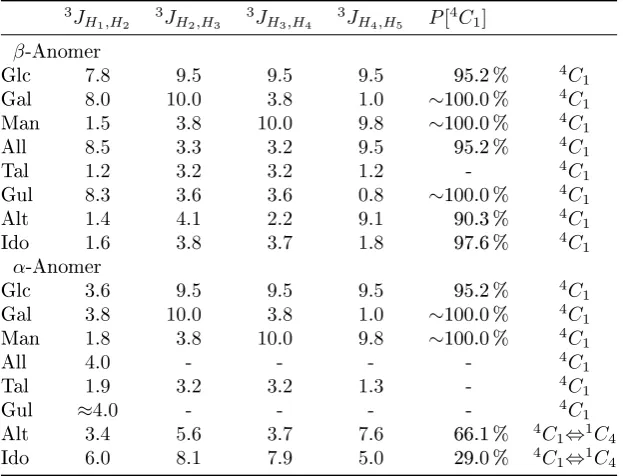
A powerful technique for conformational analysis is the Nuclear Magnetic Resonance Spectroscopy (NMR). NMR is generally known to be very useful for detecting the structure of biopolymers in solution. Its reliability for conforma-tional analysis of carbohydrates was rstly indicated by Lemieux and cowork-ers [106]. They showed that dierences in proton signals occur when specic orientations of ring substituents are present. In particular, vicinal coupling con-stants 3J
HH, that are a measure of the spin-spin coupling between 1H atoms separated by three bonds, appears to be 2÷3 time higher for axax oriented residues than for axeq or eqeq substituents. This peculiarity greatly helps the complete atom assignment for NMR spectra of monosaccharides. In fact, NMR spectroscopy was able to distinguishα/βand pyranose/furanose dynamic equi-librium (see Table 1.4 in Ref. [146]), stating the preference for pyranose form for aldohexoses. Moreover, with Karplus-type relationships [85, 86, 63, 4] it is possible to connectJ-coupling data with the valuesφof torsional angles around bonds connecting the atoms. These relationships permit on one hand (φvalues fromJ ones) to have structural information on measured (mean) structures; on the other hand (J values from φ ones) expected coupling constants of specic ring arrangements can be calculated and compared with experimental data.
-coupling signal will be the mean between the signalsJXof a purely single-state system. The simple relation
3J
HH =PA3JHHA +PB3JHHB , PA+PB= 1 (1.2) estimates the molar fractionPX (i.e., the conformer population) from a single coupling constant9, provided the limiting coupling constantJXof a system with the single conformation X (population presented in Table 1.3 are calculated in this way). Eventually, by Boltzmann inversion we have
PX= e−βFX ⇒ F
A−FB= ∆FAB=−kTlnPPA
B (1.4)
and free energy dierences between two conformers A and B can be evaluated. In Table 1.3 this simple evaluation is reported. Eq. (1.3) was used against the
Table 1.3: NMR coupling constants. Vicinal coupling constants for the com-plete d-aldopyranoses are given. In addition, populations of4C
1 conformer are
compared to preferred conformation taken from Ref. [6]. ValuesP[4C
1]are
cal-culated from Eq. (1.2), usingJ4C1 = 9.8 Hzand J1C4 = 3.6 Hzas limit values.
P[1C4] = 100%−P[4C1]. PopulationP ∼5%are within the errors in NMR.
3J
H1,H2
3J
H2,H3
3J
H3,H4
3J
H4,H5 P[
4C 1] β-Anomer
Glc 7.8 9.5 9.5 9.5 95.2 % 4C
1
Gal 8.0 10.0 3.8 1.0 ∼100.0 % 4C
1
Man 1.5 3.8 10.0 9.8 ∼100.0 % 4C
1
All 8.5 3.3 3.2 9.5 95.2 % 4C
1
Tal 1.2 3.2 3.2 1.2 - 4C
1
Gul 8.3 3.6 3.6 0.8 ∼100.0 % 4C
1
Alt 1.4 4.1 2.2 9.1 90.3 % 4C
1
Ido 1.6 3.8 3.7 1.8 97.6 % 4C1
α-Anomer
Glc 3.6 9.5 9.5 9.5 95.2 % 4C1
Gal 3.8 10.0 3.8 1.0 ∼100.0 % 4C
1
Man 1.8 3.8 10.0 9.8 ∼100.0 % 4C
1
All 4.0 - - - - 4C
1
Tal 1.9 3.2 3.2 1.3 - 4C
1
Gul ≈4.0 - - - - 4C
1
Alt 3.4 5.6 3.7 7.6 66.1 % 4C
1⇔1C4
Ido 6.0 8.1 7.9 5.0 29.0 % 4C
1⇔1C4
Data are taken from Tab. 3.6 in [146] (see also reference within), except data for Altrose that are taken from Autieri et al. [10].3JH,H values are inHz,P[4C
1]values are in%.
9For a three-state system, the relation between coupling constants and populations reads
3JHH=P
3J
H,H values that are axax or eqeq in the4C1conformer according to Fig. 1.8.
As it can be seen, the available estimated populations are in agreement with the theoretical estimation reported in Table 1.2. Thus, coupling constants proved to be sensitive of conguration, conformation and nature of substituents of the molecule (see for example Ref. [160]).
Since NMR gives important information on properties in solution, from this technique only average properties on conformations in dynamic equilibrium with solvent are available. On the contrary, X-ray crystallography can in principle give the atomic spatial arrangement of a single static structure. However, this technique needs samples with well-formed crystal structures. In general, given an aqueous solution only one of the four possible isomers (α/βanomer and pyra-nose/furanose form) crystallizes, but the nal conformation is not necessarily the predominant one, especially for compounds which do not exhibit conforma-tional preferences. For most of the aldopyranoses, the crystal structure data available conrm the 4C
1 preference, or a 4C1⇔1C4 equilibrium, in the same
direction of data obtained with other experimental techniques. Crystal struc-ture data are anyhow important, because they provide standard dimensions for pyranoses (bond lengths, bond angles, substituents angles) for modeling higher carbohydrates.
The techniques shown above seem to be able to distinguish only between the chair and the inverted chair structures. As discussed in Section 1.2, this is under-standable because chairs are rigid structures while boats and skews are exible ones. Thus, exible structures very rapidly exchange in solution and very hardly crystallize. However, circumstantial experimental evidences (coupling constant that suggests three-state systems with intermediate skews [108, 78, 128], or high-resolution 3D crystallographic structures on monosaccharide derivative (Glc-NAc) that present occurrences of exible conformers [35, 77, 118, 188]) show that for some monosaccharides also exible conformers can play a role. In this perspective, experimental techniques like Atomic Force Microscope spec-troscopy (AFM), able to detect to some extent exible conformers, are of great interest. Marszalek and co-workers used rstly AFM pulling technique to esti-mate glucose boats free energy on carboxymethil amilose [116, 107] and then to measure glucose skew-boats in dextran, cellulose and postulan [103, 115, 192]. Dierently from NMR, here polymer structures were used, and the elongation process can produce or not non-chair conformers along the polymer in direct relation with the linkage scheme of the polymer itself. Thus, by subtracting free energy dierences of dierent processes, the free energy contribution of the sole conformational transition can be evaluate (e.g., skew-boat free energy was estimated to about25 kJ/molover the chair conformer [192]).
1.3.2 Towards a microscopic description: computer
simu-lations
eld based) methods.
Ab Initio methods
Ab Initio quantum chemical methods attempt to solve Schrödinger equation, taking into account electron densities with the aim of obtaining information on the electron structures of molecules, liquids, or solids, typically under the Born-Oppenheimer approximation. Molecular orbitals are considered as linear combination of a (limited set of) atomic orbitals. Since ab initio methods are based on rst principles, they can be in general applied for any kind of system. However, for even relatively small systems like sugars, a very large number of integrals have to be evaluated, to take into account the interaction between elec-trons. Hence, the computational cost of such calculations is astronomical. For these reasons, ab initio predictions on puckered structures of monosaccharides are relatively scarce.
Some reports in the eld [184, 185, 58, 59, 144] show simple calculations on small model systems for the purpose of geometry optimization, torsional barrier estimation and evaluation of the gauche and the (exo)anomeric eect. Even with the growing computational power of recent times, we are aware only of few works for a complete conformational analysis of monosaccharides: a Car-Parrinello metadynamics10of glucose in vacuum [24] (unfortunately, non-optimal collective variables were used in this study [159]); a Møller-Plesset perturbation approach with inclusion of solvation free energies contributions [16]; a density functional theory calculation at the B3LYP/6-311++G** level [7]; a systematic investi-gation at the B3LYP/6-311++G** level of all epimers of glucose, but only for potential energies [157].
Unfortunately, it is not clear how compare dierent ab initio predictions on monosaccharides (consider, for example, the case of the very dierent estimates of Appell (29.18 kJ/mol) and of Barrows (57 kJ/mol) for the free energy of the
β-d-glucose-1C4 conformer). Since, to the best of our knowledge, no attempt
was done in calculations on benchmark systems, like d-altrose and d-idose, in our opinion is dicult to assess the condence of these estimates.
Empirical (force eld based) methods
Empirical methods aim is to solve Newton equations of motion with a empir-ical potential energy function to represent molecular energy terms. The kind of potential energy terms, and their parameters, are globally called, the force eld (FF). Force elds are generally assumed to be additive11and transferable (namely, the same atom types interact roughly in the same way for suciently similar molecules). Such approaches have a computational cost sensibly lower than ab initio calculation, giving access to larger systems (e.g. fully hydrated with explicit water simulations of monosaccharides are available, rather than calculation of a single molecule in gas phase).
A FF has intrinsic approximations, because functional forms of potential 10Metadynamics is an accelerated dynamics method that will be discussed extensively in Chapter 2.
energy terms only eectively reproduce real interactions, and typically molecule topologies are xed, thus no chemical reaction can be studied directly. In addi-tion, the reliability of a FF calculation is limited by the way the FF itself is built. However, within these limitations the success of these methods is provided by their great accuracy, as they are able to reproduce several experimental acces-sible properties within measurement sensibility. This ability also benets from constant algorithmic improvement and growing computational power. To push further the prediction accuracy, it is clear that the actual parametrization of each force eld is subject to continuous renement. Indeed, all new accessible data, including structural and thermodynamical properties, and also quantum chem-ical indication concerning electrostatic potentials of specic functional groups, permits the extension of FF range of reliability.
Chapter 2
Simulation Techniques
But note that the computer as such oers us no understanding, only numbers.
D.Frenkel & B.Smit Understanding Molecular Simulation
In this Chapter the connection between simulation and statistical mechanics is explored. The aim is to introduce free energy methods suitable for conforma-tional analysis. Since most of the time systems of interest exhibit metastabilities, the recent metadynamics algorithm is presented as a tool to perform free energy reconstructions in the presence of rare events.
Contents
2.1 Simulations and statistical mechanics . . . 20 2.1.1 Molecular Dynamics . . . 21 2.2 Free energy calculations and accelerated MD . . . 27 2.2.1 Rare events and the need for acceleration . . . 30 2.2.2 Metadynamics: basic concepts . . . 32 2.2.3 The choice of Collective Variables . . . 35 2.2.4 Example of a metadynamics simulation . . . 35
2.1 Simulations and statistical mechanics
Computer simulations are nowadays a very used and useful tool for scientic re-search. The advantages of the so-called computer experiments are numerous: it is possible to take measurements in extreme conditions (e.g. systems at very high temperature, pressure and/or density); properties of materials that have not yet been made can be predicted; simulations could be compared with ex-periments (and thus the computer model could be validated) and with theories (providing tools specically designed to test theories). By and large, computer investigations are nowadays an essential link between experimental and theo-retical work.
Computer simulations of many-particle systems have an intimate connection with statistical mechanics. In simulations, indeed, we have at disposal micro-scopical properties (e.g. atomic positions and velocities), and the equivalent of experimental measurements are represented by statistical averages over micro-scopical congurations. Two crucial points in computer simulations are:
1. the identication (and, then, the proper simulation) of the appropriate statistical ensemble;
2. the issue of ergodicity, i.e. whether a simulation is able to collect a suitable statistics for the desired observable.
Concerning statistical (thermodynamic) ensembles, a simple way to describe them is as prescriptions that induce specic counting schemes in the phase space
r≡(r1, . . . ,rN)∈ D ⊂R3N p≡(p1, . . . ,pN)∈R3N
⇒ (r, p)∈ D ×R3N (2.1)
of theN-particle system. In other words, physical characteristics of a system are translated in weighting prescriptions for the points(q, p)of the phase space D ×R3N. Within a statistical ensemble, the calculation of the mean value h·i
µ of an observableA(r, p)is espressed as the statistical average
hA(r, p)iµ= Z
D×R3N
A(r, p)µ(drdp)≡Eµ[A] (2.2)
(sometimes indicated as the expectation valueEµ[·] ofA) where
µ(drdp) =ρ(r, p)drdp , with
Z
D×R3N
µ(drdp) = 1 , (2.3)
is a probability measure, sometimes indicated by its probability densityρ(r, p). The integral showed in Eq. (2.3) indicates thatµ(drdp) is normalized to 1 on the whole phase spaceD ×R3N.
from the probability measure µ(drdp), that is to sample congurations in the phase space with the correct probability provided by the physics of the system. After the sampling, the approximation
hA(r, p)iµ' 1
M
M X
n=1
A(rn, pn) (2.4)
estimates the mean value of a given observableA.
Once the correct thermodynamic ensemble is identied, a simulation able to perform the requested sampling has to be addressed. The total duration1 τ of the sampling, that is the numberM =τ /∆tof sampled points at∆tdistance, is connected to the second issue previously indicated: the ergodicity condition is fullled when almost all the phase space is sampled, according to the probability measure µ(drdp), within the interval τ. Looking to Eq. (2.4) ergodicity is not obvious, because the only clear information is that the larger is the numberM of sampled points, the longer is the trajectory {(rn, pn)}
n=1,...,M in the phase space. The approximation of Eq. (2.4) resembles indeed a time average
hA(t)iτ = 1
τ
τ Z
0
A(r(t), p(t))dt (2.5)
as if we are following the solution {(r(t), p(t))} of some kind of equations of motion in the phase space. The ergodic hypothesis
lim
τ→+∞hA(t)iτ =hA(r, p)iµ (2.6)
assumes that the time averages of Eq. (2.5) on very long trajectories and the ensemble averages of Eq. (2.2) converges (at least in the thermodynamic limit). To make use of this hypothesis, the intervalτ has then to be suciently long to ensure that almost all the phase space is explored. In other words, to have a proper sampling we need to ensure that the system could explore in principle all the (relevant) regions of the phase space.
It should be stressed that, although in most cases a large number M of points is sucient to make this hypothesis work, there are also situations in which ergodicity is questionable. We refer to systems that are non ergodic in practice (e.g. glasses, meta-stable phases, . . . ) or even in principle (e.g. nearly harmonic solids).
2.1.1 Molecular Dynamics
Molecular Dynamics (MD) is a quite old simulation technique. Its capabilities had evolved a lot, spanning a wide range of applications, from the rst reported simulation on hard sphere packing (in 1956 by Alder and Wainwright [25] at Livermore) to a recent application on protein folding in explicit water (in 2010 by Shaw et al. [162]).
1With the word duration we do not necessarly refer to a real time variable in the simu-lation. The actual interpretation for distances∆tbetween sampled points and for the total
MD simulations are based on calculating the time evolution of a physical system by integrating Newton's equations of motion
(
mi¨ri(t) =−∇riV(r(t))
(ri(0),r˙i(0)) = (r0
i,r˙
0
i)
, i= 1, . . . , N (2.7)
providing a suitable integration scheme and an interaction potential function V(r). The numerical solution of Eq. (2.7) can be summarized in a two step process: the calculation of forces and the update of positions and velocities (or momenta) according to these forces.
The denition of the potentialV(r)is crucial in the construction of a well-dened molecular simulation. In an atomistic framework where there are no orbitals at disposal, suitable functions has to be chosen to represent the interac-tion between atoms. The empirical potential in such a framework usually takes the form
V(r) =Vbonded(r) +Vnon-bonded(r) +Vlong-range(r) (2.8) where the specic form of these functions, together with the complete set of parameters for them, are globally called a force eld (FF).
In the above formula, the three terms in the force eld account for dierent eective interactions, listed below:
• Vbonded terms mimic the interaction between covalently bonded atoms. The behavior of covalent bonds is reproduced by a sum of contributions
Vbonded(r) = N X
ij
Vbond(rij) + N X
ijk
Vangle(θijk)+
+ N X
ijkl
Vtorsion(φijkl) + N X
ijkl
Vimproper(ξijkl) (2.9)
with 2-, 3- and 4-body interaction terms (for a pictorial view see Fig. 2.1):
(i) 2-body terms are used for modeling bond stretching between atoms ij, typically with harmonic terms
Vbond(rij) = 1 2k
b
ij(rij−r0ij)
2 (2.10)
(ii) 3-body terms are used for modeling bond angle bending between atomsijk, typically with harmonic terms
Vangle(θijk) = 1 2k
a
ijk(θijk−θijk0 )
2 (2.11)
(iii) 4-body terms are used for modeling rotation around bonds, typically with sinusoidal terms
Vtorsion(φijkl) = 1 2k
d ijkl
1 + cos nφijkl−φ0ijkl
(iv) 4-body terms are also used to conne geometries (e.g. to impose pla-nar or tetrahedral congurations). Typically is done with harmonic terms
Vimproper(ξijkl) = 1 2k
i
ijkl(ξijkl−ξijkl0 )
2 (2.13)
• Vnon-bondedterms mimic Van der Waals interactions, typically by means of the Lennard-Jones potential
VLJ(rij) =εij "
σij
rij 12
−
σ ij
rij 6#
,
(
εij = √
εiiεjj
σij =12(σii+σjj)
(2.14)
where the indicated combination rules compute the interaction parameters between dierent speciesi andj from individual parameters;
• Vlong-rangeinteractions are Coulomb interactions
VC(rij) = 1 4πε0
δQiδQj
εrrij (2.15)
between partial chargesδQiandδQj(even if the system is globally neutral, partial charges are present to mimic displacement in electronic densities) at distance rij, withεr the relative dielectric constant.
(a) Bonded potentials (b) Non-bonded potentials
Figure 2.1: Interaction terms in force elds
At each dynamical step the MD engine should perform the calculation of forces
Fi=−∇riV(r) (2.16)
for each particle i= 1, . . . , N, to permit the successive update of position and velocities. The whole FF is evaluated, using the proper parameters and the necessary prescriptions to handle interactions (e.g. lists of neighbors, cuto dis-tances, proper algorithm for long range electrostatics,. . . ). For further informa-tions on the subject the reader is reminded to the literature (like in Ref. [56, 1], or for an example of explicit implementation see [20, 111]).
Direct integration and the microcanonical ensemble
An integration scheme for Eq. (2.7) could start from the Taylor expansion
ri(t+ ∆t) =ri(t) + ˙ri(t)∆t+1
2¨ri(t)(∆t)
of the new position ri(t+ ∆t) about the current position ri(t). With appro-priate algebraic manipulations it is possible to calculate updated positions and velocities at the time-step t+ ∆t with the desired level of approximation. As an example, we will show briey the so-called leap-frog scheme [73]. First, from the forcesFi=−∇riV(r)new velocities
˙
ri(t+∆2t) = ˙ri(t−∆2t) + ∆t
Fi
mi
+O (∆t)3 (2.18)
are calculated at (half) time-step position. Second, from the velocities new positions
ri(t+ ∆t) =ri(t) + ˙ri(t+∆2t)∆t+O (∆t)3 (2.19) at (full) time-step are calculated (for more details on this algorithm and for comparison with respect to other implementation see [22]).
To circumvent the natural nite size of the simulation box, besides this in-tegration scheme periodic boundary conditions (pbc) are often used. With pbc, when a dynamic step pushes a particle out through one side of the simula-tion box, then the particle is re-posisimula-tioned on the opposite side. In this way the spurious nite-size eect from the boundaries of the simulation box can be avoided, and properties of bulk systems can be described. Connected to the use of pbc, distances in force calculation have to be computed using the so-called the minimum image convention. Moreover, in order to avoid self-interactions with periodic copies, the simulation box and the interaction cuto distance has to be commensurable.
Letting a simulation routine to integrate Eq. (2.7), the points of the trajec-tory {(r(ti), p(ti))}i=0,...,M are naturally eligible as regular sampled congura-tion from the microcanonical ensemble: trajectory points, indeed, are sampled within a system with constant energy up to machine precision, if the integra-tion scheme is simplectic (see Refs. [56, 105]). The microcanonical probability measure is presented in Panel 2.1
The microcanonical probability measure is dened as
µnve(drdp) = δH(r,p)−E(drdp)
Znve , Znve= Z
S(E)
δH(r,p)−E(drdp) (2.20)
where S(E) =
(r, p)∈ D ×R3NH(r, p) =E is the hypersurface at
con-stant energy E. The normalization Znve is the microcanonical partition
function. The measure δH(r,p)−E(drdp) is intuitively the standard
mea-sure drdp on D ×R3N projected onto the hypersurface S(E). Formally, δH(r,p)−E(drdp)is constructed as the Lesbegue measure for the setN∆E(E) =
(r, p)∈ D ×R3NE≤H(r, p)≤E+ ∆E , in the limit∆E →0, by means
of
Z
S(E)
A(r, p)δH(r,p)−E(drdp) = lim ∆E→0
1 ∆E
Z
N∆E(E)
A(r, p)drdp (2.21)
withAa test observable.
It is worth spending a few words on algorithm stability. It is known that integration schemes, like the leap-frog algorithm, could in principle suer of numerical instabilities or dependences on the initial conditions. It is for example the case of the so-called Lyapunov instability, for which two trajectories with very close initial conditions could undergo in an exponential divergence in short times. If the full trajectory is needed from the simulation, then this kind of instability is not desirable because a very dierent dynamic description could emerge even from very close initial conditions. However, this problem aects the dynamical description, while it does not aect the single points of an arbitrary trajectory to be regularly sampled from the microcanonical distribution. Thus, if the fo