Journal of Mathematics and Informatics Vol. 12, 2018, 63-77
ISSN: 2349-0632 (P), 2349-0640 (online) Published 19 March 2018
www.researchmathsci.org
DOI: http://dx.doi.org/10.22457/jmi.v12a7
Journal of
Optimization of Biclustering Algorithm Based on Greedy
Randomized Adaptive Search Procedure
Chun-de Yang1, Ling Zhao1, Kun-xian Shu2 and Ling Wang2 1
School of science, Chongqing University of Posts and Telecommunications Chongqing – 400065, Chongqing, China. E-mail: [email protected]
2
Chongqing Key Laboratory of Big Data for Bio Intelligence
Chongqing University of Posts and Telecommunications, Chongqing – 400065 Chongqing, China. E-mail: [email protected]
Received 1 March 2018; accepted 18 March 2018
Abstract. The biclustering algorithm based on greedy randomized adaptive search procedure (GRASP) has two main steps, firstly, bicluster seeds are generated by K-means clustering; secondly, the greedy randomized adaptive search procedure is used to expand these bicluster seeds so that to get some better biclusters. However, K-means clustering assumes that each gene belongs to only one cluster, which is not biologically valid, because some genes may not belong to only one category, and K-means clustering requires multiple runs to determine the number of "clusters," all of which will affect the identification of bicluster seeds. This paper optimizes GRASP-based bIclustering algorithm. In this paper, the single column vector clustering is used to generate biclusters seed, and then the bicluster seeds are added more rows and columns to generate the final biclusters. Experiment shows that this algorithm can generate a large number of biclusters with coexpression level, and the algorithm also finds more biclusters.
Keywords: biclustering algorithm, greedy randomized adaptive search procedure, mean squared residuals
AMS Mathematics Subject Classification (2010): 90C72
1. Introduction
The biclustering algorithm proposed by Hartigan [1] is clustering based on the rows and columns of gene expression matrices simultaneously. The biclustering algorithm is a new clustering method, it is to find local similarity in gene expression matrix [2,3,4,5]. Cheng et al. [6] proposed the well-known CC algorithm, and the biclustering algorithm is applied to gene expression data for the first time, the CC algorithm can quickly get the user specified number of biclustering, But the flaw is obvious, substitution of random numbers will change the original data, which leads to inaccurate results and and Can not find overlapping biclustering. CC algorithm has been improved by Dharan et al. [7,8]. They proposed a biclustering algorithm based on greedy random adaptive search procedure (GRASP) to find better biclustering. The algorithm consists of two main steps: Firstly, high quality bicluster seeds are generated by K-means clustering, secondly, these seeds are grown by the greedy random adaptive search procedure. Although GRASP-based biclustering algorithm can find overlapping bicluster, however, the final result of biclusters and the number of biclusters are largely dependent on the bicluster seeds. These bicluster seeds are respectively clustered in the rows and columns of the gene expression matrix, and then they are combined to generate different bicluster seeds.
In this paper, a single column vector clustering method is used to produce high quality bicluster seeds. This method can generate more bicluster seeds, and use the greedy randomized adaptive search procedure to expand these seeds. In this paper, we use the mean square residue to evaluate the effect of the obtained biclusters, and compare it with the Dharan et al. [7,8] proposed Biclustering algorithm, and the validity of the algorithm is verified. The results show that the algorithm in this paper can produce better biclusters.
2. Biclustering algorithm 2.1. The definition of bicluster
Definition 1. SetAas the gene expression matrix, and the gene expression matrix is the expression value of a group of genes under some experimental conditions.G={ ,g g1 2,⋯,gn}andC={ ,c c1 2,⋯,cm}respectively represent gene set
and conditional set. aijis an element in the gene expression matrixA, which indicates
the expression value of the ith gene under the j th condition. Bicluster is a subset of genes that have some similar pattern of expression under certain experimental conditions or under all experimental conditions. The Bicluster is a submatrix of gene expression matrix, which can be expressed asAIJ, whereI⊆GandJ ⊆C.
In order to measure the effect of bicluster, Cheng et al. [6] defined the average squared residue(Hscore)as a bicluster for quantitative analysis. The mean squared residue formula is as follows:
2 ,
( )
( , )
| | | |
ij Ij iJ IJ i I j J
a a a a
Hscore I J
I J ∈ ∈
− − +
=
⋅
∑
where | | ij i I ij a a I ∈
=
∑
is the average of the j th column,| | ij j J iJ a a J ∈ =
∑
is the average of theith
row, ,
| | | |
ij i I j J IJ a a I J ∈ ∈ = ⋅
∑
is the average of AIJ. If ∃ >δ 0, it satisfies Hscore I J( , )≤
δ
, sothat the biclusterAIJis defined asδ −bicluster . Whereδ is the maximum acceptable mean squared residue, theδ must be estimated in advance, and each data set has a different
δ
value.2.2.Analysis of biclustering algorithm based on greedy randomized adaptive search procedure
Cheng et al. [6] have proved that the search for biclustering problem is NP-hard, and its operation time is increasing exponentially. The GRASP-based biclustering algorithm is a heuristic method [9,10,11], which requires much less computation than the exhaustive search method, and
δ
-biclustercan be found in a reasonable time . Finding a bicluster is an optimization problem [12,13], the purpose of which is to find a bicluster with the largest capacity but theHscore smaller one. The GRASP-based biclustering algorithm has two main steps. First of all, high quality bicluster seeds generated by K-means clustering; Secondly, more genes and experimental conditions are added to these seeds by the GRASP to expand the bicluster seeds until the average square residue (Hscore of ) each bicluster reaches a predetermined thresholdδ
, and it is different for every dataset. Dharan et al. [7,8] have used K-means algorithm to generated bicluster seeds. during seed generation, the rows and columns of gene expression matrix are K-means clustered respectively. The gene expression matrix is divided intoPgene clusters andQcondition clusters, if each gene cluster contains too many genes, each gene cluster is further divided into subclusters, they obtainedX gene clusters andQ condition clusters. By combining these gene and condition clusters, X ×Q disjoint submatrices is obtained, theHscore values of the entireX ×Q submatrices are calculated, and the submatrices withHscore value less than the threshold are selected as the bicluster seeds. A bicluster seed is actually a small bicluster whoseHscorevalue is less than the threshold δ, but genes and experimental conditions including in bicluster is not the largest.Table 1: Algorithm of greedy randomized search procedure
Algorithm GRASP (Seed) Solution=seed;
While <termination condition not met> do
Solution ← Greedy_Randomized_ Construction (Current); Solution ← Local_Search (Solution);
Current ← Solution; End
The GRASP-based biclustering algorithm generates high quality bicluster seeds by the K-means clustering method, so the bicluster seeds play a decisive role in the final result of bicluster. It is well known that the K-means clustering algorithm is easy to operate, but it has its limitations. K-means Clustering assumes that each gene belongs to only one cluster, which is not true in biological sense, because some genes may not belong not to only one category, but also belong to several categories. The K-means clustering method specifies the number of "clusters" in advance, and each gene belongs to the best "cluster", but it is not always meaningful. And how to determine the number of "cluster", which will affect the determination of the bicluster seeds, and then affect the final bicluster result.
3. Optimization of selection method for bicluster seeds and expansion of bicluster seeds
3.1. Optimization of selection method for bicluster seeds
In this paper, the biclustering algorithm uses a single column vector clustering to generate the bicluster seeds; the bicluster seeds are extended through GRASP. The single column vector clustering is similar to individual dimension clustering (CLIC) [17] method. CLIC [17] is an effective clustering method that has been tested on larger microarray datasets. CLIC [17] clustering is more effective than traditional K-means clustering methods. The single column vector clustering is a class of genes with similar expressions under each condition, and more bicluster seeds can be found, each run found that the bicluster seeds are the same.
Firstly, a column vector is sorted according to the expression value from small to large, and the standard deviationsd_allof all gene expression values in the vector is calculated. In this paper, the same class of genes with the same clustering index value to replace its expression value. The index value of the gene in each cluster isKI KI( ∈Z+).
The index value set of all clusters isKKI, The number of genes accumulated in each
cluster set is count. InitiallyKKI is an empty collection, andcount=0. The geneiis
placed in a cluster set and the standard deviationsd K( KI count, )of the set is calculated, if
, , 1
( KI count) ( KI count )
, , 1 ( KI count) ( KI count )
sd K >sd K − orsd K( KI count, )>sd_all are satisfied, A new cluster is generated and its index value is KI =KI+1 , at the same time, the cluster indexKI =KI+1is assigned to the genei. Repeat this step until all the genes in the column vector are divided into a small cluster. Secondly, the above steps are repeated inm column vectors to obtain m column vectors with clustering index values, and them column vectors are reordered according to the original gene order to obtain newm column vectors, n m× matrix that is recombined by them cluster index vectors. Pseudocode for Single column vector clustering is shown in Table 2.
Table 2: The single column vector clustering
Input: n m× Gene Expression Matrix Output: n m× Index matrix
The following processes are performed on m column vectors respectively:
Step 1. The genes in each column are sorted from small to large, gene set
fromG={ ,g g1 2,⋯,gn}toG'={ ,g g1' 2',⋯,gn'}.
Step 2. Initially, set the gene indexi=1and set the cluster index from 1 toKI .
Step 3. Calculate the standard deviation of all gene expression values for one
condition, set it assd _all .
Step 4. When the clustered index isKI and setKKI =NULL. LetKKIbe the gene in the cluster.
a. Set the number of genes accumulated in the cluster set, count=0. b. KKI =KKI ∪{ }gi'
c. The cluster indexKI is used to replace the expression value of the gene in the cluster set.
Step 5. If clusterKKI!=NULL, do: a. Set
count
=
count
+
1
. b. Seti= +i 1.c. SetKKI =KKI ∪{ }gi' .
d. When the number of genes in the cluster is count , the standard deviationsd K( KI count, )is calculated.
e. Whilesd K( KI count, )≤sd K( KI count, −1)andsd K( KI count, )≤sd_all, do:
i. Set
i i
= +
1
.ii. SetKKI =KKI ∪{ }gi' .
iii. The cluster indexKIis used to replace the expression value of the gene in the cluster set.
f. If sd K( KI count, )>sd K( KI count, −1)orsd K( KI count, )>sd_all, do.
iii. The cluster indexKI is used to replace the expression value of the gene in the cluster set.
iv. Setcount=0.
Step 6. Repeat step 4 to step 5 untili= =n.
Step 7. Each column of genes has a column index
vector{1,1, 2, 2,⋯,KI−2,KI−1,KI},The index vectors are arranged in the
order of the original geneG={ ,g g1 2,⋯,gn}.
Step 8. Them column index vectors are recombined into a n m× matrix.
Bicluster seeds are determined from then m× index matrix(as shown in Table 3). Genes of the bicluster seeds in each condition are labeled with the same cluster index. These genes in another condition can be labeled with either different or the same kinds of cluster indexes. If genes in the same conditions are labeled with the same cluster index, it means that these genes with the same cluster index have similar expression patterns under this condition; If genes in other conditions are labeled with the same kind of cluster index, it means that these genes expression patterns are similar in the original condition and other conditions. In other words, genes show similar expression patterns over these conditions. These bicluster seeds are more relevant than the bicluster seeds selected by K-means cluster, because genes with similar expression under each condition are subdivided into many clusters, the number of bicluster seeds is found sufficiently large and comprehensive. Moreover, the same bicluster seeds can be determined even if the algorithm is run multiple times.
Table 3: Determination of bicluster seeds
Determination of bicluster seeds In then m× index matrix executing:
Step 1. Initialization, let bicluster seed setS =N ULL
Step 2.Under each condition, fors=1,⋯,KI , do:
a. Under each condition when the clustering indexK I iss , letg K( s)
for rows of genes.
b.Set the conditions for biclusters seed setCS=NULL. c. Under condition j=1,⋯,m, do:
i. When the gene is ag K( s)row and the condition is thejth column,
letg K( s j, )for the set of genes.
ii. If the gene has the same clustering index ing K( s j, ), the
setCS=CS∪{ }cj .
iii.If the elementsCS>2in the setC S . The bicluster seeds set consists of
g K
(
s)
andC S3.2. Expansion of bicluster seeds based on greedy randomized adaptive search procedure
In this paper, a greedy randomized adaptive search procedure [18,19,20] is used to expand the bicluster seeds, which includes the construction phase [21,22] and the local search. First, the candidate setC1(G1) is initialized, the candidate setC1(G1)is composed of all elements (except the elements in the bicluster seeds), second, expand bicluster seeds. Each iteration according to the greedy function
g
to evaluate each candidate in thecandidate setC1(G1),which is used as the basis for entry into the restricted candidate list(RCL).A randomly selected element from theRCLis added to a bicluster seed to calculate theHscoreof the bicluster seed. If theHscoreis still below the threshold, then the element belongs to this bicluster seed, Update the candidate setC1(G1)and reevaluate
each element in the candidate setC1(G1). Each iteration of the candidate setC1(G1) elements and greedy function values should be updated promptly to reflect their changes, which is the embodiment of the self-adaption function in the algorithm. The greedy function [7,8] in this paper is:
g= ∈{s C G1( 1) |Hscore S( ∪ ≤s) Smin+
α
(Smax −Smin)} (2) withSmin =min{Hscore S( ∪s) |∀ ∈s C G1( 1)}max max{ ( ) | 1( 1)}
S = Hscore S∪s ∀ ∈s C G ,C1is condition candidate set, G1is gene
candidate set, αis the parameter to buildRCL (
α
∈[0,⋯,1]), RCL consists of greedy functions from the candidate set to choose some high quality elements. The size of theRCL is an important factor affecting GRASP performance, the choice of αaffects the size of theRCL , and the quality of the elements in the RCL largely depends on the parameterα.At present, many studies [23,24] have proved that fixedαvalues can not get high quality feasible solutions. On the contrary, when the parameterα changes within a certain range during the iteration, a higher quality solution [11,24] can be obtained, and the algorithm has higher flexibility. In this algorithm, adaptive method is used to adjustα . Differentαvalues are used in different iterations, and aα value is selected from discrete setR={ ,
α α
1 2,⋯,α
m}every iteration. The average square residue ofbiclustering obtained from previous iterations is used as a guide forαselection.piis a
probability related to the selection of
α
i,i∈(1,⋯, )m , which initially makes allpiequalto1
m, and periodically reestimates the selection probabilitypiaccording to the value of the feasible solution during the iteration. LetAibe theHscoreaverage of the biclusters
1 i i m
i i
q p
q = =
∑
(3)
where i 1 , ( 1, , )
i
q i m
A
= = ⋯ . Therefore, in the next iteration, αis reselected according
to the updated probabilitypiin order to produce a better bicluster. The algorithm of this paper is the same as the method of selectingαon GRASP-based biclustering algorithm, where
α
∈[0.25,⋯, 0.60].Usually, the quality of the bicluster obtained during the construction phase is not high, so the local search can improve the result of the biclusters and obtain a higher quality of biclusters. The basic idea of local search is to iteratively search for the optimal solution in the neighborhood of the existing solution, the optimal solution can be used to replace the current solution. LetSbe the current solution, letS'be the local solution to the adjacent solution, ifHscore S( )' <Hscore S( ), then use the adjacent solutionS'to replace the current solutionS.
4. Simulation and analysis of experimental results
4 44
4.1.Dataset used
The biclustering algorithm in this paper is implemented in R software, and tested on Yeast Saccharomyces Cerevisiae cell cycle expression dataset. The data is stemmed from [25] and is based on Tavazoie et al. [26]. The data set contains 2884 genes and 17 experimental conditions (experimental conditions are time points), and there are 34 missing values in the data set, and -1 is a missing value. All expressions are integers in the range of 0 to 595. The value of
δ
is the maximum allowable dissimilarity between the genes and the conditions, while the higherδ
indicates the decrease homogeneity. Therefore, the thresholdδ
=200used in this paper is the same as theδ
value in the GRASP-based biclustering algorithm.4 44
4.2. Comparison of results between this algorithm and GRASP-based biclustering algorithm
In this paper, the method of seed selection based on GRASP-based biclustering algorithm [7,8] is optimized, that is, how to obtain high quality bicluster seeds. In this paper, we carry out a single column vector clustering for each condition. It clustered the genes with very similar expression level under each condition, and similar genes are given the same clustering index. Finally, themcolumn index vector is merged into the matrix ofn m× , and the bicluster seeds are determined according to the genes of the same or different index in the merging matrix. The algorithm in this paper and GRASP-based biclustering algorithm [7,8] are adding more genes and conditions to a group of bicluster seeds to expand these seeds ,until theHscoreof the bicluster reaches a given threshold
δ
.demonstrated that the mean squared residuals can only find additive models and no other models can be found. The mean square residue(Hscore) is a better way to measure whether the result is close to the addition model [30], and it is also the usual measure of measurement at the present stage. The size of a biclusterS(bicluster contains the number of elements) is also a criterion for judging the quality of bicluster. Therefore, there are manyHscoreevolution forms, such asHscore Scan effectively measure the quality of
bicluster. The smaller the Hscore S value, the better the bicluster result. Multiple biclusters are found on the whole matrix, so it is also an important evaluation criterion to cover the comprehensiveness of the matrix elements and the overlap of the biclusters. It is found that overlapping biclusters should be considered in designing biclustering algorithms, it is also important that the bicluster results cover all the elements in the matrix, the biclustering algorithm in this paper can find overlapping biclusters and cover some elements in the matrix.
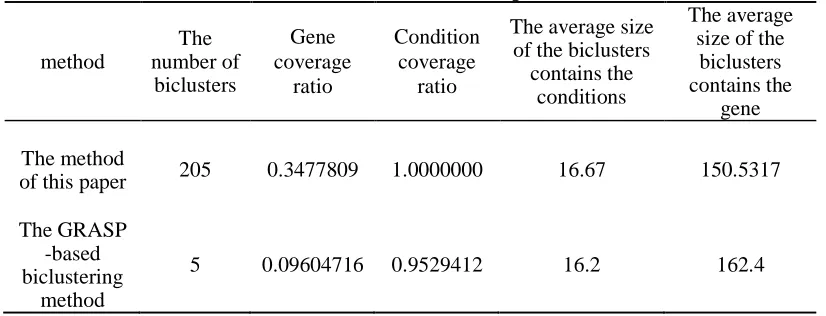
Table 4 summarizes the results of the algorithm in the yeast gene expression dataset. The algorithm in this paper can find 205 biclusters, which is far greater than the number of biclusters individuals found by the GRASP-based biclustering algorithm[7,8]. Therefore, the gene clusters with similar expression found by the algorithm in this paper is more comprehensive. In the biclusters discovered by the algorithm, on average, each bicluster contains 150.5317 genes, with an average of 16.67 experimental conditions per bicluster.
To verify the comprehensiveness of biclusters discovered by this algorithm, we calculate the coverage ratio of biclusters in the data matrix. If a gene or condition is contained in at least one bicluster, the gene or condition is covered by biclusters. Check the 2884 17× data matrix, the 205 biclusters found in this paper covers 34.77809% of the genes and all the conditions in the data set, however, the GRASP-based biclustering algorithm[7,8] not only found fewer biclusters, but also found that the biclusters only covered 9.604716% of the genes and 95.29412% of the condition in the data set. In this article, most of the conditions in the dataset are contained in at least one bicluster.
Table 4: Bicluster results comparison
method
The number of
biclusters
Gene coverage
ratio
Condition coverage
ratio
The average size of the biclusters
contains the conditions
The average size of the
biclusters contains the
gene
The method
of this paper 205 0.3477809 1.0000000 16.67 150.5317
The GRASP -based biclustering
method
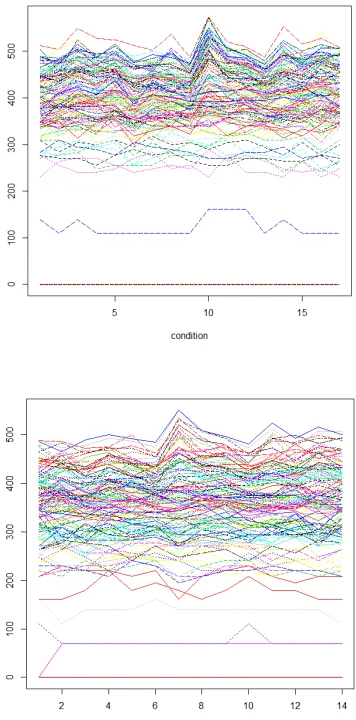
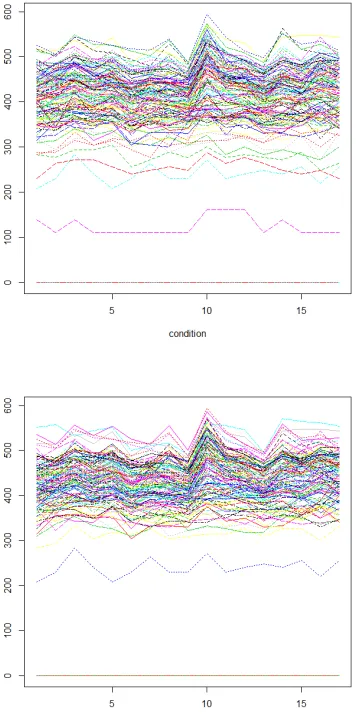
As shown in the table 4, the GRASP-based biclustering algorithm[7,8] finds less number of biclusters, and genes contained in some biclusters found in this paper are slightly less than the genes contained in the biclusters found in the GRASP-based biclustering algorithm[7,8]. Although the algorithm of this paper found more biclusters, but these biclusters covered only one-third of the genes in the data matrix. Analysis of reasons: First, the algorithm starts with clustering all the genes under each condition, which itself is data coverage instead of partitioning. The discovered bicluster seeds is not duplicated. Second, through the growth of the bicluster seeds, we get the final biclusters. If a gene or condition may belong to several biclusters, almost every bicluster will have overlapping parts, so the coverage ratio of the whole dataset is low. In addition, we can only find the bicluster of the additive model, so this is one of the reasons why the gene coverage ratio is low. Two biclusters in this paper will be depicted in Figure 1.
Figure 2: The 204th, 14th, 42th, and 194th seed generated biclusters
4 44
4.3. GO function enrichment analysis
which indicated that the biclusters found in this paper had almost no false discovery rate. In addition, the p-values obtained by the bicluster GO analysis found in this paper are very small, which shows that the proposed algorithm has high accuracy. The biclusters found in this paper are more abundant in functional terms than biclusters found in GO BP, GO MF, GO CC and GRASP-based biclustering algorithms [7,8].
5. Conclusion
In this paper, the bicluster seeds are crucial to the bicluster results. So it is very important to find suitable and comprehensive bicluster seeds. A single column vector clustering is used to obtain bicluster seeds to solve the problem of finding biclusters. This method is more stable than K-means clustering and does not require multiple runs to determine the bicluster seeds. The experimental results also show that the proposed algorithm is superior to the GRASP-based biclustering algorithm.
This article focuses on the bicluster expression level. In this paper, a single column vector clustering method is used to generate the bicluster seeds, and the bicluster seeds are added with rows and columns to generate the final biclusters. With the discovery of the biclusters drew mapping, the biclusters result are compared with the biclusters result of Dharan et al. [7,8]. Experimental result shows that the algorithm finds more biclusters, and computing time is also acceptable. However, it also explains a problem, although the algorithm in this paper finds more biclusters, it means that some genes and conditions in these biclusters are highly overlapped. At the same time, we can only find the additive model bicluster. In future studies, further consideration may be given to discovering the bicluster of other models so that a more efficient biclustering algorithm can be obtained.
REFERENCES
1. J.A.Hartigan, Direct clustering of a data matrix, Journal of the American Statistical Association, 67 (1972) 123-129.
2. M.Charrad and M.B.Ahmed, Simultaneous clustering: a survey, International Conference on Pattern Recognition and Machine Intelligence, 6744 (2011) 370-375. 3. H.A.Majd, A.R.Baghestani, S.M.Tabatabaei, S.Shahsavari, M.R.Tavirani and
M.Hamidpour, Biclustering algorithm in gene expression data: A review article, 12 (2015) 3864-3871.
4. B.Pontes, R.Giráldez and J.S.Aguilar-Ruiz, Biclustering on expression data: A review, Journal of Biomedical Informatics, 57 (2015) 163-180.
5. S.Roy, D.K.Bhattacharyya and J.K.Kalita, Analysis of gene expression patterns using biclustering, Humana Press, (2015) 91-103.
6. Y.Cheng and G.M.Church, Biclustering of expression data, Proceedings International Conference on Intelligent Systems for Molecular Biology, 8 (2000) 93-103.
7. S.Dharan and A.S.Nair, Biclustering of gene expression data using greedy randomized adaptive search procedure, TENCON 2008 - 2008 IEEE Region 10 Conference, 10 (2008) 1-5.
8. S.Dharan and A.S.Nair, Biclustering of gene expression data using reactive greedy randomized adaptive search procedure, BMC Bioinformatics, 10 (2009) 1-10.
10. R.Figueiredo, P.G.Silva and M.Poss, Transmission expansion planning with re-design - a greedy randomized adaptive search procedure, Energy Systems, 1 (2013) 113-139. 11. M.Prais and C.C.Ribeiro, Reactive GRASP: an application to a matrix decomposition problem in TDMA traffic Assignment, Informs Journal on Computing, 12 (2000) 164-176.
12. A.Layeb, A new greedy randomized adaptive search procedure for solving the maximum satisfiability, International Journal of Operational Research, 17 (2013) 1-17.
13. A.Layeb, A.Boudra, W.Korichi and S.Chikhi, A new greedy randomized adaptive search procedure for multiobjective RNA structural alignment, International Journal in Foundations of Computer Science & Technolog, 3 (2013) 1-14.
14. S.Mancini, A greedy randomized adaptive search for the surveillance patrol vehicle routing problem, Recent Developments in Metaheuristics, 11 (2018) 305-317.
15. C.Faycal, M.E. Riffi and B. Ahiod, Hybrid genetic algorithm and greedy randomized adaptive search procedure for solving a nurse scheduling problem, American Journal of Cardiology, 104 (2015) 55D–56D.
16. S.Das and S.M.Idicula. Application of greedy randomized adaptive search procedure to the biclustering of gene expression data, International Journal of Computer Applications, 2 (2011) 6-13.
17. T.Yun, T.Hwang, K.Cha and G.S.Yi, CLIC: clustering analysis of large microarray datasets with individual dimension-based clustering, Nucleic Acids Research, 38 (2010) W246.
18. H.Akrout, B.Jarboui, A.Rebaï and P.Siarry, New greedy randomized adaptive search procedure based on differential evolution algorithm for solving no-wait flowshop scheduling problem, International Conference on Advanced Logistics and Transport, (2013) 327-334.
19. H.Lei and K.Qin, Greedy randomized adaptive search procedure for analog test point selection, Analog Integrated Circuits & Signal Processing, 79 (2014) 371-83.
20. V.C.Yepes, C.Torres-Machi, A.Chamorro and E.Pellicer, Optimal pavement maintenance programs based on a hybrid greedy randomized adaptive search procedure algorithm, Statyba, 22 (2016) 540-550.
21. A.H.Yin, T.Q.Zhou, J.W.Ding, Q.J.Zhao and Z.P.Lv, Greedy randomized adaptive search procedure with path-relinking for the vertexp-center problem, Journal of Computer Science and Technology, 32 (2017) 1319-1334.
22. H.Mokhtari and A.Salmasnia, Fitting the three-parameter weibull distribution by using greedy randomized adaptive search procedure, International Journal of Engineering, 30 (2017) 425-432.
23. T.Gevezes and L.Pitsoulis, A greedy randomized adaptive search procedure with path relinking for the shortest superstring problem, Journal of Combinatorial Optimization, 29 (2015) 859-883.
24. M.G.C.Resende, Greedy randomized adaptive search procedures (GRASP), Journal of Global Optimization, 6 (1999) 109-133.
25. Yeast Saccharomyces cerevisiae cell cycle expression dataset, http://arep.med.harvard.edu/biclustering.
determination of genetic network architecture, Nature Genetic, 22 (1999) 281-285. 27. D.Yan and J.Wang, Biclustering of gene expression data based on related genes and
conditions extraction, Pattern Recognition, 46 (2013) 1170-1182.
28. J.S.Aguilarruiz, Shifting and scaling patterns from gene expression data, Bioinformatics, 21 (2005) 3840-3845.
29. D.Bozdağ, A.S.Kumar and U.V.Catalyurek, Comparative analysis of biclustering algorithms, In Proceedings of the First ACM International Conference on Bioinformatics and Computational Biology, 8 (2010) 265-274.
30. B.Pontes, R.Girldez and J.S.Aguilarruiz, Quality measures for gene expression biclusters, Plos One, 10 (2015) e0115497.
31. J.A.Nepomuceno, A.Troncoso and I.A.Nepomuceno-Chamorro, Integrating biological knowledge based on functional annotations for biclustering of gene expression data, Computer Methods & Programs in Biomedicine, 119 (2015) 163-180.