A Study on the Bleaching Properties of Locally Sourced Clay
(Upkor Clay) For the Processing of Palm Oil
BY
1
OLI S.C.,
2KAMALU C.I.O., *
3OBIJIAKU J.C.,
4OPEBIYI S.O.,
5OGHOME
P.,
6NKWOCHA A.C.
Department of Chemical Engineering, Federal University of Technology, Owerri, Nigeria.
ABSTRACT : The bleaching properties of Ukpor Clay (a locally sourced clay) were studied and compared with that of imported bleaching earth for use in the bleaching of Crude Palm Oil. The effect of using the different bleaching earths on Free Fatty Acid and Peroxide value was evaluated. One factor at a time experiment was also used to determine the effect of Bleaching Temperature, Time and Adsorbent-to-Oil ratio and finally response surface methodology was used to study the effect of the three variables on bleaching on Palm Oil and determination of optimal bleaching conditions. It was observed that bleaching of Palm Oil increased the Free Fatty Acid content but reduced the Peroxide. It was also observed that FFA for the bleached palm oil reduces with increase in bleaching temperature, for both the imported bleaching earth and Ukpor clay, with the imported bleaching earth having a lower FFA value, about 1% below that of Ukpor clay, in all cases. The Bleaching efficiency increases with increase in temperature for both imported bleaching earth and Ukpor clay with the bleaching efficiencies of the imported bleaching earth and that of Ukpor clay being approximately equal at temperatures above 120OC. The bleaching efficiency also increases with increase in bleaching time or adsorbent-to-oil ratio for both imported bleaching earth and Ukpor clay. The three variables significantly affect bleaching efficiency at 95% confidence, with a good interaction among the variables. The optimum conditions for bleaching of crude palm oil using Ukpor clay are a temperature of 180OC for a time of 135mins and at an Adsorbent-to-Oil ratio of 0.05, at which it has a bleaching efficiency 80.50%. These results can be used to effectively exploit our locally sourced bleaching earth, especially in view of the contributions in this work and under the observed optimum conditions, for the processing or bleaching of palm oil.
Key Words: Ukpor clay, imported bleaching earth, crude palm oil, bleaching properties, optimum conditions.
I. INTRODUCTION
The term bleaching refers to the treatment that is given to remove colour-producing substances and to further purify the fat or oil. Oils and fats are bleached in order to remove undesired colourants. This is because these colourants can negatively affect the taste of the oil and limit use and marketability. In addition to that, some particles or pigments that promote deterioration of oil quality, mainly due to their pro-oxidative properties that promotes oxidation, are also removed during bleaching process (Cheah and Siew, 1999).Adsorption using bleaching earths is most frequently used to removecoloured pigments in palm oil.
Ukpor clay deposit is one of the largest clay deposits in Anambra State, Nigeria, with an estimated reserve of about 12 million tones. Preliminary studies have revealed that the clay can be used for house-hold utensils. Investigations have shown that it is however possible to extend its use. This clay has high surface
activity and has shown excellent results on the bleaching of palm oil (Abane, 2000).
The study so far, in this area notwithstanding, the optimal conditions for palm oil bleaching using this local clay (adsorbent) and its comparison with imported bleaching earth is yet to be fully explored. This is the subject of this research work.
Bleaching is a process of selective removal of pigments and impurities by the physical and chemical interactions of an adsorbent with an oil or fat to improve its quality. The high cost involved in the importation of bleaching earths in the processing of palm oils necessitated the need to exploit our locally sourced bleaching earth and compare its bleaching properties with the imported bleaching earth.
To compare the bleaching properties of locally sourced bleaching earth with the imported bleaching earth.
To statistically model bleaching efficiency of the locally sourced bleaching earth (Ukpor Clay) using surface response methodology.
To determine optimal conditions for palm oil bleaching using the local bleaching earth (UkporClay).
The result of this study will increase available knowledge in the field of Palm Oil bleaching, especially using local clays like Ukpor Clay.It will provide the needed data for industries to go into large scale Palm oil bleaching using the optimum conditions so determined.Application of the findings will encourage economic boost, reduce importation and create new opportunities for use of our locally sourced clay.
The scope of this research work covers the study of palm oil bleaching using Ukpor Clay, with temperature, time and adsorbent-to-palm oil ratio as variables and its optimization using surface response methodology.
II. LITERATURE REVIEW
2.1Bleaching Process Theory
“Bleaching” process is always being misunderstood as just a mere process of decolourization of oil & fats. In facts, “bleaching” is a process of selective removal of pigments and impurities by the physical and chemical (chemisorptions) interaction of an adsorbent with an oil or fats to improve its quality. This process refers to the art of removing not only the colour pigment, but also dirt, trace metals and various organic impurities that promote oxidation. Another term that can be used to describe bleaching process is purification process of vegetable oil.
Effective adsorption requires a large surface and practically high specific surface area. The channels by which molecules reach this surface must be negotiable by the molecules concerned. Mathematically, bleaching or purification process follows thefreundlich adsorption isotherm (Howes et al, 1991).
Adsorption isotherm is the equilibrium relationships between the concentration in the fluid phase and the concentration in the adsorbent particles at a given temperature. For the cases involving liquids the
concentration is often expressed in mass units such as parts per million (PPM).
For adsorption from liquids, freundlich isotherm is applicable. Bleaching of palm oil falls under type of isotherms as the bleaching process are involving liquids (oils). The equation for freundlich isotherm for bleaching process can be illustrated as;
𝑋
𝑀= 𝑘𝐶
𝑁
(2.1)
Where X is quantity of substance adsorbed, M is quantity of adsorbent, C is quantity of residual substance dissolved, K and N are constants unrelated to the amounts of solute and adsorbent .
2.2Mechanisms of Bleaching Process
During bleaching or purification, the palm oil is brought into contact with a surface- active adsorbent, and then the undesired particles or other components are selectively retained on the pore surface.Gradually, the concentration of undesired particles on the available active surface of the adsorbent and the concentration remaining in the oil come into balance, sothat further exchange is negligible (Khedok and Lim, 1982).
In general, bleaching earth is a decolourising agent, which will change the tint of any coloured oil to lighter shade by changing the basic colour units in oil, without altering the chemical properties of the oil. Bleaching earths are normally used in the bleaching of palm oils. Bleaching earth works based on its character of adsorption and ion exchange. The adsorption process is influenced by some factors as follows:
a. Particle size b. Adsorbent polarity c. Surface area
d. Pore volume
e. Pore size
While some of these earths are naturally bleaching, some have to be treated with mineral acids. This activation result in the replacement of some of the aluminum ions by hydrogen ions from the acid, which further results in the creation of net negative charges on the clay lattice structure and creates the cation adsorption properties of the acid-activated bleaching earths clay (Hymore, 1996).
2.3Types of Adsorbents
as acid activated bleaching earth, natural bleaching earth, synthetic silicates, activated carbon and synthetic resins.
a. Acid Activated Clays
These include Kaolin which contains Kaolinite (Al2o3
2Sio2 2H20) and usually oxides of ion, magnesium,
calcium and alkaline metals.
Others are bentonites of other clays. Generally, they show essentially no adsorptive ability unless when activated by treatment with minerals acids, usually sulphuric acid or hydrochloric acid.
b. Natural clays
Natural bleaching clays are naturally active. They are excellent adsorbents as they are able;
i to decrease the levels of chlorophyll and colour bodies
ii. to minimizes free fatty acid increase during bleaching.
They are chiefly magnesium- Aluminum Silicates in the form of the minerals attapulgiteand montmorillonites (Khedok and Lim, 1982; Lim, 1982).
The clay is heated and dried during which it develops a porous structure. It is then ground and screened. c. Activated Carbon
It includes Carbon material mostly derived from charcoal for all three variations of the name “activated”. It is sometimes substituted by “active”. By any name, it is a material with an exceptionally high surface area. Just one gram of activated carbon has a surface area of approximately 500m2, typically determined by nitrogen gas adsorption, and includes a large amount of micro porosity. The bleaching action seems to be due to the large adsorbent surface of carbon. This large surface held in a small volume, would influence the surface tension of the compounds with which they come into contact, thus causing adsorption. There are a large number of commercial grades of activated carbon that are used for adsorbing gases and vapours,odours and colouring materials (Hamicton, 1995).
d. Synthetic Silicate
Synthetic Silicates are now commonly used in palm oil bleaching. Although synthetic silicates have a moderate capacity for pigment removal, small amounts of it are used in combination with bleaching clay.
Silica had the capability of enhancing the earth‟s ability to remove colour bodies, phosphorus and other minor components that affect the colour stability of the oil (Bernardini, 1988).
2.4Types of Bleaching Methods
There are three major types of bleaching methods that can be used in edible oil industry.
1. Heat bleaching: some pigments such as carotenes become colourless if heated sufficiently. However this will leave pigments molecules in the oil quality. If this oil come into contact with air coloured degradation products such as Chroman-5, 6-quinones from y- tocopherol present, may be formed. These are very difficult to remove (Ceriani and Meirelles, 2006).
2. Chemical oxidation: Some pigments for example carotenoids are made colourless or less coloured by oxidation. But such oxidation invariably affects the glycerides and destroys natural antioxidants. Consequently, it is never used for edible oil but restricted to oils for technical purposes such as soap-making.
3. Adsorption: Adsorption is the collection of a substance into the surface of an adsorbent solid. It is the common method used for bleaching edible oil. It is a removal process where certain particles are bound to an adsorbent particle surface. Bleaching agents normally possess a large surface that has a more or less specific affinity for pigment-type molecules, thus removing them from oil without damaging the oil itself.
2.5Ukpor Clay
Ukpor clay deposit is one of the largest clay deposits in AnambraState, Nigeria, with an estimated reserve of about 12 million tones. Preliminary studies have revealed that the clay can be used for house hold utensils.
Investigation have shown that it is however possible to extend its use through a more synthetic characteristics of its properties by determining the chemical composition of the clay, its mineralogical composition and its particle size distribution. This clay has high surface activity and has shown excellent results on the bleaching of palm oil (Abane, 2000).
2.6Properties of Natural Ukpor Clay
and do not lose activity even after prolonged storage, A typical Ukpor clay has disordered kaolinite minerals hence the ultimate clay crystal carries a net negative charge. This charge results from anion adsorption into the surface or from the unbalanced lattice. The clay particle is a very complex anion (Abane, 2000).
2.7Palm Oil
Palm oil is derived from the fleshy part or the mesocarp of the fruit of the palm species (Elareisguineensis).
Palm oil has a wide range of applications; about 80% are used of food applications while the rest is feed stock for a number of non-food applications. Among the food uses, bleached and refined olein is used mainly as cooking and frying oils.
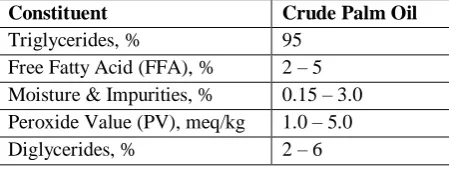
Crude palm oil commonly consists of desirable triglycerides, unsaponifiable matter together with small amounts of impurities. Most of these impurities contribute undesirable effects to the oil, for instance color, flavour, odour, instability and foaming. These impurities should be removed by a purification step in order to produce good quality refined oil with minimal possible oil loss or damage to the oil.
Table 2.1: Typical Composition of Crude Palm Oil Constituent Crude Palm Oil
Triglycerides, % 95
Free Fatty Acid (FFA), % 2 – 5 Moisture & Impurities, % 0.15 – 3.0 Peroxide Value (PV), meq/kg 1.0 – 5.0
Diglycerides, % 2 – 6
III. RESEARCH METHODOLOGY
3.1 Materials
3.1.1 Raw Material Collection
The local clay used for the experiments was collected from Ukpor, a Town in AnambraState, Nigeria. The clay sample was collected in a well labeled nylon sack and delivered to the chemical analyst for the preliminary and main laboratory tests.
The crude palm oil was obtained from a market in Anambra State. The imported bleaching earth (Fullmonth 7000c) was made by Laporte Chemicals Warrington Cheshire, England, and was obtained from Envoy Oil Industries Ltd, Onitsha- Anambra State, Nigeria.
3.1.2 Equipment/Apparatus
Magnetic Stirring Machine, Analytical Weighing Balance (Model: Adventurer Pro A35, Make: OHAUS), Electrothermal Oven (Model: HG 9023A), (Make: B.BRANC, scientific and instrumental company, England), Electromechanical centrifuging machine(Model: D453), (Make: Searchtech), Heating mantle (Model: ZDHW-250), (Make: PEC Medical, USA), Lovibondtintometer,Viscometer (Model: HI 2211), (Make: SearchTech), Bunsen burner, Resort stand, pH Meter (Model: HI 2211), (Make: Hanna), 250ml and 500ml conical flasks, 100ml, 250ml and 500ml beakers, Measuring cylinders, 50ml volumetric flask, Separating funnels, Sieve plate,Burette, Pipettes, Specific gravity bottle, Glass funnel, Stirring rod, Spatula, Filter papers.
3.1.3 Reagents
Analytical grade Ethanol (95%), 0.1N aqueous sodium hydroxide solution, Aceticacid,
Chloroform,Di-ethyl ether,Hydrochloric
acid,Potassium hydroxide,Potassium iodide, Sodium thiosulfate,Starch powder, Phenolphthalein indicator solution, Distilled Water, Deionized Water.
3.2 Method
3.2.1 Preparation of Clay Sample (Ukpor)
The clay sample was oven dried at a temperature of 100oC for 24hrs. It was manually crushed to small sizes and sieved to 100 mesh.
3.2.2 Activation of Clay Sample
The clay sample was activated by the method of acid activation. 50g of sieved clay sample was mixed with 250ml of 3M HCl and heated to 105oC for 30mins.
3.2.3 Bleaching Procedure
All bleaching processes were done under atmospheric condition. The bleaching experiments were carried out in clean dry beakers containing required amount of clay and palm oil.
percentage of pigments or particles removed was determined.
3.2.4 Determination of Amounts or Percentage of Pigments or Particles Removed Gravimetrically
Weight of palm oil = 45. 5g (100ml 0f palm oil) Weight of palm oil mixed with imported earth =46.5g Weight of palm oil mixed with local earth (Ukpor clay) =46.5g
Weight of filtrate = 44.48g (imported bleaching earth )
Weight of filtrate (Ukpor clay) = 44.69g
For imported bleaching earth (Montmorillonite)
Mass of pigment or particles removed = wt. of palm oil – wt. of filtrate
= (45.5-44.48) g = 1.02g
% of pigments or particles removed = 1.02 х 100
45 .5 =2.24%
For local earth (Ukpor clay)
Mass of pigments removed =wt. of palm oil – wt. of filtrate (Ukpor)
=(45.5-44.69)g =0.81g
% of pigments removed =0.81 х 10045 .5 = 1.78%
Using specific gravity (imported earth)
Amount of pigments removed (imported earth) = specific gravity of palm oil – specific gravity of filtrate
Amount of pigments
removed=0.9025-0.8800=0.0225
% of pigments removed = 0.0225х100= 2.25%
For local earth(Ukpor clay)
Amount of pigments removed = specific gravity of palm oil –specific gravity of bleached oil
Amount of pigments removed = 0.902 -0.8846=0.0179
% of pigments removed = 0.0179х100= 1.79%
Using 2,3 & 4 grams of imported and locally sourced earth increases the rate at which pigment or particles were removed. When the crude palm oil was heated at temperature of 1500c, refining started taking place i.e FFA began to go out.
3.2.5 Determination of the Effect of Adsorbent-to-Oil Ratio on Bleaching
Procedure: The colour value of the crude palm oil was measured using the Lovibondtintometer with a one inch cell and a value of 67.95 obtained. The bleached palm oil colourwas measured using Lovibondtintometer with a one inch cell at different bleaching earth (Adsorbent) to Oil ratios of 0.0043,
0.0057, 0.0070,0.0085 and 0.0113 for
imported(montmorillonite) and locally sourced earth (Ukpor) and results were obtained.The results were used to obtain the bleaching efficiency using the colour value of the crude palm oil as base value.
3.2.6 Determination of the Effect of Bleaching Temperature on Palm Oil Colour
Procedure: The bleached palm oil colour was measured using lovibondtintometer at different bleaching temperature of 700C,950C,1100C, 1150C , 1200C, 1250C, 1270C and 1500Cfor local earth
(Ukpor) and imported bleaching earth
(montmorillonite) and results were obtained. The results were used to obtain the bleaching efficiency.
3.2.7 Determination of the Effect of Bleaching Time on Palm Oil Colour
Procedure: The bleached palm oil colour was measured with tintometer at different bleaching time of 1hr, 2hrs, 3hrs, 4hrs, 5hrs, 6hrs, 7hrs, and results were obtained. The results were used to obtain the bleaching efficiency.
3.2.8 Response Surface Experimental Study
The experimental procedure was repeated for a response surface experimental study. A full factorial experimental design was used with the three variables; Bleaching Temperature, Bleaching Time and Adsorbent-to-Oil ratio.
The bleaching temperature is the constant temperature in degree centigrade at which the bleaching process was carried out. The bleaching time is the length of time, in minutes, that the palm oil was bleached. The adsorbent-to-oil ratio is the ratio of the amount of adsorbent used in grams, to the quantity of oil bleached in milliliters.
Table3.1: Experimental Design Variables (Actual Values)
Variable Lower Bound Center Point Upper Bound
Bleaching Temperature (OC) 70 125 180
Bleaching Time (min) 30 135 240
The results obtained from measurement of colour values for the twenty seven experimental runs and the computed bleaching efficiency were tabulated as presented in result table 4.15.
3.2.9 Determination of the Effect of Bleaching Temperature on Free Fatty Acid
Procedure: The free fatty acid of bleached palm oil was determined for the different palm oil samples bleached at the different bleaching temperatures of 1500C, 1800C,2000C,2200C,2350Cand 2500C.
Free fatty acid content of the palm oil and bleached oil was determined by titration method. 2.7g of the crude palm oil was weighed into a clean 250ml conical flask and 50ml of neutralized 95% v/v of ethanol was added. Three drops of phenolphthalein was then added and heated for about three minutes. While it is still hot, titration was carried out with 0.1N solution of NaoH and shacked vigorously to end point where the colour changes to the first permanent colour. The colour persisted for 30 seconds. The same analysis was carried out for the bleached palm oil (filtrate) using the locally sourced bleaching earth and imported bleaching earth.
For free fatty acid content of crude palm oil, the result can be expressed as:
𝐹𝐹𝐴 =25.6 𝑥 𝑉 𝑥 𝑁
𝑊 (3.1)
Where V is Volume of standard NaOH solution used in ml, N is normality of standard NaoH solution used and W is Weight of oil used.
For FFA content of bleached oil using imported bleaching earth and that of locally sourced (Ukpor) as 3.57% and 3.91% respectively. See Appendix A.
3.2.10 Procedure for the Peroxide Value Determination
2.10g of the crude palm oil sample was measured into a (250ml) conical flask. 30ml of aceticacid - chloroform (3:2) was added and swirled to dissolve. 1ml of saturated solution of water was added and allowed to stay in the dark for three minutes. After staying, 1ml of freshly prepared starch solution was added. If there is no colouration, it means the peroxide value is Nil, but if there is any colouration (black), the solution is titrated against 0.01N sodium thiosulphate (Na2 S2 So4)solution shaking vigorously to end point. Where the black colour
disappears, carry out a blank test. The blank titration must not exceed 0.1ml of the 0.01N Sodium thiosulphate solution.
The peroxide is a measure of those substances in a sample expresses in terms of milli equivalent of active oxygen per kilogram which oxidize potassium iodide under conditions of test.
The result can be expressed as;
𝑃𝑉 =(𝑆−𝐵) 𝑥 𝑁 𝑥 1000
𝑊 (3.2)
Where S = Volume in ml of sodium thiosulphate solution of normality N used
B = Volume in ml of sodium thiosulphate solution of normality N used for the blank test N = Normality of sodium thiosulphate solution
W = Weight in grams of the oil
Based on experiment, S = 0.2ml
B = 0.1ml N = 0.01 W = 2.20g
𝑃𝑉 = 0.2 − 0.1 𝑥 0.01 𝑥 1000
2.10 = 0.48 𝑀𝑒𝑞/𝑘𝑔
The peroxide value of bleached palm oil for both locally sourced earth and imported earth were Nil.
3.2.11 Atomic Absorption Spectrophotometer (AAS)
An FS 240 varian Atomic Absorption
Spectrophotometer (AAS) using Nitrous oxide oxidant gas, Acetylene gas, Air oxidant gas, Distilled water, and conical flask. The Reagent used is
absorbed by the atomized element in the flame. Since metals have their own characteristic absorption wavelength, a source lamp composed of that element is used, making the method relatively free from spectral or radiational interferences. The amount of energy of the characteristic wavelength absorbed in the flame is proportional to the concentration of the element in the sample. The procedure involves the sample being thoroughly diluted, mixed by shaking, and 100ml of it being transferred into a glass beaker of 250ml volume. The sample is aspirated into the oxidizing air-acetylene flame or nitrous oxide acetylene flame. When the aqueous sample is aspirated, the sensitivity for 1% absorption is observed.
3.2.12 X-Ray Fluorescence (XRF)
Mini Pal is a compact Energy dispersive X-ray spectrometer designed for the elemental analysis of a wide range of samples. The system is controlled by a PC running the dedicated Mini pal analytical software. The Mini pal 4 version in use is PW 4030 X-ray Spectrometer, which is an energy dispersive microprocessor controlled analytical instrument designed for the detection and measurement of elements in a sample (solids, powders and liquids), from sodium to uranium. The sample for analysis is weighed and grounded in an agate mortar and a binder (PVC dissolved in Toulene) is added to the sample, carefully mixed, and pressed in a hydraulic press into a pellet.
The pellet is loaded in the sample chamber of the spectrometer and voltage (30KV maximum) and a current (1mA maximum) is applied to produce the X-rays to excite the sample for a preset time (10mins in this case). The spectrum from the sample is now analyzed to determine the concentration of the elements in the sample and percentage composition.
3.2.13 X-Ray Diffraction (XRD)
It is also known as x-ray diffractometer. XRD is a popular technique used for the analysis if the structural properties and the identification of minerals in solid state and material science, is needed. A brucket D 5005 power X-ray diffraction with Ni-filtered, Cu,Kx-radiation was used to record
diffraction spectra, prior to the measurement, each sample was prepared using a standard method for powdered sample preparation. The sample was dried in the over at 100oC. About 1g of each sample was ground to fine powder and homogenized as much as
possible, then loaded into the poly-methyl mete-acrylate sample holder. The powder was gently pressed into the cavity using a glass slide, while the glass was gently lifted off to reveal the sample surface. Each diffraction spectrum recorded with condition 2 angle of between 5o and 50o, Cu-target, 35Kv, 35mA and scan speed of 0.3 degree/0.02 second.
Typically, the data was expressed in the plot between intensity of diffraction peaks and 2angle. The positions of diffraction peaks were compared with a reference data base and the identifications of compounds calculated.
3.2.14 Fourier Transform Infra-Red (FTIR)
An FTIR-8400S Fourier Transform Infrared Spectrophotometer, made by SHIMADZU is a powerful tool for identifying types of chemical bonds (functional group) in a molecule by producing an intra-red absorption spectrum that is like a molecular “finger print”.
The FTIR instrument is computerized and faster than the older dispersive instruments. The solid samples are dissolved in a methylene chloride solvent, and the solution placed onto the plate. This is called a cast film, and is frequently used for polymer identification. Solution is then analyzed in a liquid cell. This is a small container made from NaCl (or other IR-transparent material) which is filled with liquid, such as the extract for EPA 418.1 analysis. This creates a longer path for the sample, which leads to increased sensitivity. Sampling methods include making a null of a powder with hydrocarbon oil (Nujol) or pyrolyzing insoluble polymer and using the distilled pyrolyzate to cast a film.
3.2.15 Scanning Electron Microscope (SEM)
IV. RESULTS AND DISCUSSION
4.1 Result Presentation
The results of the experiments and the instrumental analysis of the bleaching earth and palm oil samples are here-in outlined below: in tables 4.1 – 4.15 and Figures 4.1 – 4.9.
Table 4.1: Result for the FFA and Peroxide Values of Crude and Bleached Palm Oil
Parameter
Crude Palm Oil
Bleached Palm Oil using imported bleaching earth
Bleached Palm Oil using locally sourced earth (Ukpor)
Free Fatty Acid Content,
FFA (%) 3.20% 3.57% 3.91%
Peroxide Value, PV
(Meq/kg) 0.48 Nil Nil
Table 4.2: Result for the AAS characterization of Ukpor Clay
Element Symbol Al Fe Na K Mn Ca Ni Mg Cu Zn
Concentration in Ukpor Clay (ppm)
14.35 48
16.23 06
11.50 33
0.10 76
0.22 75
0.87 70
0.09 27
0.11 35
0.01 86
0.01 79
Table 4.3: Result for the XRF analysis of Ukpor Clay
Chemical
Component SiO2 Fe2O3 AL203 TiO2 CaO MnO V2O5 Cr2O3 ZnO NiO CuO LOI
Composition in Ukpor Clay
(%) 55.80 5.11 15.70 5.88 0.18 0.061 0.24 0.089 0.01 0.026 0.039 4.14
Table 4.4: Result for the FTIR spectrum of raw Ukpor Clay
Wave No (cm-1) Peak Area (cm-2) Bond Source Mineral
3412.39 299.07 H-O-H Stretching Kaolinite
3109.02 346.98 O-H bending Montmorillonite
1562.48 2.08 H-O-H bending Kaolinite
1463.52 135.06 Si-O-Si Quartz
1233.36 49.45 Si-O-Si Stretching Smectite
947.69 43.80 Al-O-Si Stretching Illite
762.13 25.92 Si-O-Al Stretching Quartz/Illite
Table 4.5: Result for the FTIR spectrum of UHC
Wave No (cm-1) Peak Area (cm-2) Bond Source Mineral
3842.80 19.52 H-Al-OH Stretching Kaolinite
3678.27 77.13 Al-O-H Stretching Kaolinite
3614.77 5.37 Al-O-H Stretching Illite
3455.60 9.52 Al-O-H Stretching vibration Kaolinite
3402.24 115.01 H-Al-OH vibration Kaolinite
3276.31 1.81 Si-O-Si Montmorillonite
1765.65 4.86 O-H Scissoring
1607.58 72.01 H-O-H bending Kaolin
1184.33 51.95 Si-O stretching Smectite
Montmorillonite
861.22 128.37 Si-O-Al bending Illite and Quartz
761.17 5.54 Si-O Quartz
Table 4.6: Analysis of Variance Table
Source Sum Square df Mean Square f Prob>f
Bleaching Temperature (0C) 472.62 2 236.309 28.82 0
Bleaching Time (mins) 224.58 2 112.29 13.7 0.0002
Adsorbent-to-Oil Ratio (g/ml) 392.18 2 196.09 23.92 0
Error 163.98 20 8.199
Total 1253.36 26
Table 4.7: Response Surface Model Coefficients and Model Statistics
Variables Coefficients Std Error T-stat P-value F-stat
Constant 32.9284 0.042022 783.6 3.4626e-40 SSE= 0.0042056
Temp (OC) 0.4177 0.00056245 742.59 8.636e-40 DFE = 17
Time (mins) 0.1462 0.00020206 723.42 1.347e-39 DFR = 9
Ads./Oil (g/ml) 299.8844 0.82491 363.54 1.6195e-34 SSR= 1253.4
Temp*Time -3.5772e-4 7.8622e-7 -454.99 3.5718e-36 F = 5.6293e5
Temp*Ads./Oil 1.4753 0.0027518 536.11 2.196e-37 P-VALUE = 0
Time*Ads./Oil 0.5915 0.0014414 410.39 2.063e-35
Temp^2 -0.0014 2.1227e-6 -682.38 3.6354e-39
Time^2 -3.9864e-4 5.8242e-7 -684.46 3.4524e-39
Ads./Oil^2 -6.6815e3 7.1346 -936.49 1.6731e-41
R2= 0.9999 Adj.R2 =0.9998
Table 4.8: Optimal Condition for bleaching of Ukpor Clay
Temperature (0C) Time (mins) Adsorbent-to-Oil Ratio (g/ml) Bleaching Efficiency (%)
154.5120 148.2246 0.0461 82.9394
Table 4.9: Result for the physico-chemical properties of imported earth (Fullmonth Clay)
Chemical Composition (%) Standard
SiO2 55.00 – 65.50
Al2O3 14.00 – 20.00
Fe2O3 3.50 – 8.50
CaO 0.50 – 3.50
MgO 2.50 – 4.50
Na20 0.20 – 1.50
K2O 0.50 – 1.50
SiO2 55.00 – 65.50
Al2O3 14.00 – 20.00
Physical Properties Standard
Loose Bulk Density (g/ml) 0.45 – 0.65 Free Moisture Content (%) 8.00 – 12.00
Acidity (% H2SO4) 0.30 max
Source: Envoy oil industries Ltd, G.M.O Road, Nkutaku, Onitsha Anambra State.
Sieve size used Range of Quantity Retained
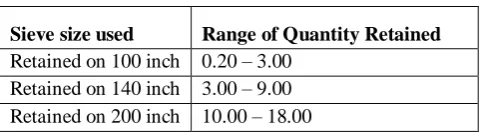
Retained on 100 inch 0.20 – 3.00 Retained on 140 inch 3.00 – 9.00 Retained on 200 inch 10.00 – 18.00
Table 4.11: Effect of bleaching temperature on bleaching efficiency
Temp. (0C)
Colour Value (Imported)
Colour Value (Ukpor)
Bleaching Efficiency (%), (Imported)
Bleaching Efficiency (%), (Ukpor)
70 25.0 26.0 63.2082 61.7366
95 24.0 25.2 64.6799 62.9139
110 23.2 24.8 65.8572 63.5026
115 23.0 23.5 66.1516 65.4157
120 22.0 22.0 67.6233 67.6233
125 20.0 21.4 70.5666 68.5063
127 19.4 19.5 71.4496 71.3024
150 18.0 18.0 73.5099 73.5099
Table 4.12: Effect of bleaching time on bleaching efficiency
Time (hrs)
Colour Value (Imported)
Colour Value (Ukpor)
Bleaching Efficiency (%), (Imported)
Bleaching Efficiency (%), (Ukpor)
1 26.00 26.00 61.7366 61.7366
2 25.20 25.50 62.9139 62.4724
3 24.01 24.80 64.6652 63.5026
4 23.10 23.50 66.0044 65.4157
5 22.00 22.10 67.6233 67.4761
6 21.50 21.80 68.3591 67.9176
7 21.00 20.10 69.0949 70.4194
Table 4.13: Effect of bleaching adsorbent-to oil ratio on bleaching efficiency
Adsorbe nt-to-Oil Ratio (g/ml)
Colour Value (Imported)
Colour Value (Ukpor)
Bleaching Efficiency (%), (Imported)
Bleaching Efficiency (%), (Ukpor)
0.0043 13.00 14.10 80.8683 79.2494
0.0057 12.04 13.10 82.2811 80.7211
0.0070 11.10 12.05 83.6645 82.2664
0.0085 10.50 11.20 84.5475 83.5173
0.0113 9.20 10.00 86.4606 85.2833
Table 4.14: Effect of bleaching temperature on FFA
Temperature (0C) 150 180 200 220 235 250
FFA of Bleached Oil (Imported) 9.50 8.01 6.00 5.00 4.10 3.50
FFA of Bleached Oil (Ukpor) 9.80 8.50 6.90 5.60 4.80 4.00
Table 4.15: Response Surface Experimental Result
Bleaching Temp (0C)
Bleaching Time (mins)
Adsorbent-to-oil Ratio (g/ml)
Colour Value
Bleaching Efficiency (%)
70 30 0.05 25.35 62.69
70 30 0.08 34.50 49.23
70 135 0.02 19.60 71.16
70 135 0.05 19.30 71.60
70 135 0.08 27.15 60.04
70 240 0.02 20.80 69.39
70 240 0.05 19.20 71.74
70 240 0.08 25.80 62.03
125 30 0.02 18.65 72.55
125 30 0.05 17.95 73.58
125 30 0.08 25.40 62.62
125 135 0.02 15.25 77.56
125 135 0.05 13.30 80.43
125 135 0.08 19.50 71.30
125 240 0.02 17.85 73.73
125 240 0.05 14.60 78.51
125 240 0.08 19.55 71.23
180 30 0.02 18.85 72.26
180 30 0.05 16.50 75.72
180 30 0.08 22.30 67.18
180 135 0.02 16.85 75.20
180 135 0.05 13.25 80.50
180 135 0.08 17.80 73.80
180 240 0.02 20.85 69.32
180 240 0.05 15.95 76.53
180 240 0.08 19.25 71.67
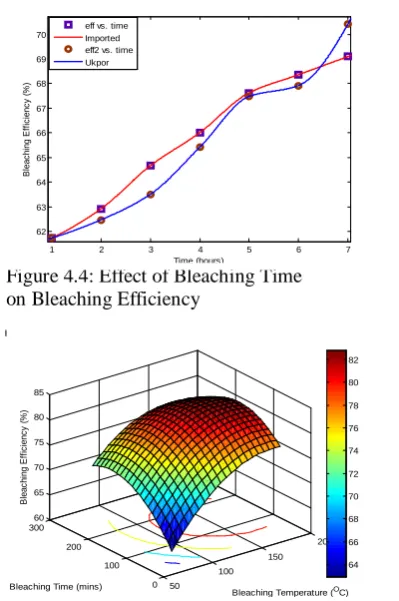
Figure 4.3: Effect of Bleaching Temperature Figure 4.4: Effect of Bleaching Time
on Bleaching Efficiency on Bleaching Efficiency
Figure 4.5: Effect of Adsorbent-to-Oil Ratio Figure 4.6: Surface Plot of Bleaching Temp.
on Bleaching Efficiency and Time vs. Bleaching Efficiency
Figure 4.7: Surface Plot of Bleaching Time Figure 4.8: Surface Plot of Bleaching Temp. and Adsorbent-to-Oil Ratio vs. Efficiency and Adsorbent-to-Oil Ratio vs. Efficiency
Figure 4.9: Plot of Free Fatty Acid versus Bleaching Temperature
70 80 90 100 110 120 130 140 150 62 64 66 68 70 72
Temperature (OC)
B le a c h in g E ff ic ie n c y ( % )
eff vs. temp Imported eff2 vs. temp Ukpor
5 6 7 8 9 10 11
x 10-3 80 81 82 83 84 85 86
Adsorbent-to-Oil Ratio (g/ml)
B le a c h in g E ff ic ie n c y ( % )
eff vs. ads Imported eff2 vs. ads Ukpor 0 50 100 150 200 250 0.02 0.04 0.06 0.08 60 65 70 75 80 85
Bleaching Time (mins) X: 198
Y: 0.056 Z: 80.46
Adsorbent-to-Oil Ratio (g/ml)
B le a c h in g E ff ic ie n c y ( % ) 64 66 68 70 72 74 76 78 80
150 160 170 180 190 200 210 220 230 240 250 4 5 6 7 8 9
Temperature (OC)
F re e F a tt y A c id ( % )
import vs. temp FFA Plot (Imported) ukpor vs. temp FFA Plot (Ukpor)
1 2 3 4 5 6 7
62 63 64 65 66 67 68 69 70 Time (hours) B le a c h in g E ff ic ie n c y ( % )
eff vs. time Imported eff2 vs. time Ukpor 50 100 150 200 0 100 200 300 60 65 70 75 80 85
Bleaching Temperature (OC) Bleaching Time (mins)
B le a c h in g E ff ic ie n c y ( % ) 64 66 68 70 72 74 76 78 80 82 50 100 150 200 0.02 0.04 0.06 0.08 60 65 70 75 80 85
Bleaching Temperature (OC) X: 180
Y: 0.056 Z: 81.72
Adsorbent-to-Oil Ratio (g/ml)
4.2 Discussion
From table 4.1, the crude palm oil before bleaching was effected gave a free fatty acid value of 3.20%. This value increased after adsorption and bleaching had occurred. This is expected due to the acidity of the adsorbent (bleaching earth) and due to splitting or hydrolysis of palm oil triglyceride by heating. FFA is formed when the bound fatty acids in palm oil triglyceride are split either by chemical or enzymatic hydrolysis. The imported bleaching earth gave FFA of 3.57% while the locally sourced earth was 3.91% showing a slight difference of 0.34%. It indicates that the locally sourced bleaching earth compares favourably with the imported bleaching earth. Again from table 4.1, the peroxide value of crude palm oil was 0.48Meq/kg. This value shows that its peroxide value is acceptable and the oil sample is of good quality. The peroxide value for the bleached palm oil was Nil. It indicates that there was no colouration (no black colour).
Figure 4.9 shows the effect of bleaching temperature on Free Fatty Acid (FFA). It can be observed that FFA for the bleached palm oil reduces with increase in bleaching temperature, for both the imported bleaching earth and Ukpor clay, with the imported bleaching earth having a lower FFA value, about 1% below that of Ukpor clay, in all cases.
It can be observed from the plot on Figure 4.3 that Bleaching efficiency increases with increase in temperature for both imported bleaching earth and Ukpor clay. The rate of increase of the bleaching efficiency with increase in temperature is low at low temperatures (70 – 120OC) for the imported bleaching earth and Ukpor clay, but it is high beyond 120OC. The Bleaching efficiency of the Imported bleaching earth is higher that than that of Ukpor clay at low temperatures by a margin of about 2%, but beyond 120OC (especially from 130OC) the bleaching efficiencies of the imported bleaching earth and that of Ukpor clay are approximately equal.
It can be observed from Figure 4.4 that the bleaching efficiency also increases with increase in bleaching time for both imported bleaching earth and Ukpor clay. The bleaching efficiency is about the same for the two samples for bleaching times of 1hour and 6.4hours, but between 1hour and 6.4hours, the imported bleaching earth has greater bleaching efficiency than Ukpor clay, while, beyond 6.4hours bleaching time, Ukpor clays gives a bleaching efficiency above that of the imported bleaching earth. The maximum margin by which the imported
bleaching earth exceeds Ukpor clay in bleaching efficiency for bleaching times between 1hour and 6.4 hours is 1.5%.
It can be observed from Figure 4.5 that the bleaching efficiency also increases with increase in the ratio of adsorbent to crude palm oil used (dosage). This increase is almost linear, having approximately the same rate. The imported bleaching earth has a higher bleaching efficiency as the adsorbent-to-oil ratio is increased. It is consistently about 1% above Ukpor clay in the observed bleaching efficiencies for all adsorbent-to-oil ratios studied.
Table 4.6 contains the result for the analysis of variance. The results reveal that the three variables; Bleaching Temperature, Bleaching Time and Adsorbent-to-Oil ratio, are all significant in bleaching efficiency at 95% confidence, since they all have p-value less than 0.05, with Bleaching Temperature and Adsorbent-to-Oil ratio being the most significant in the study.
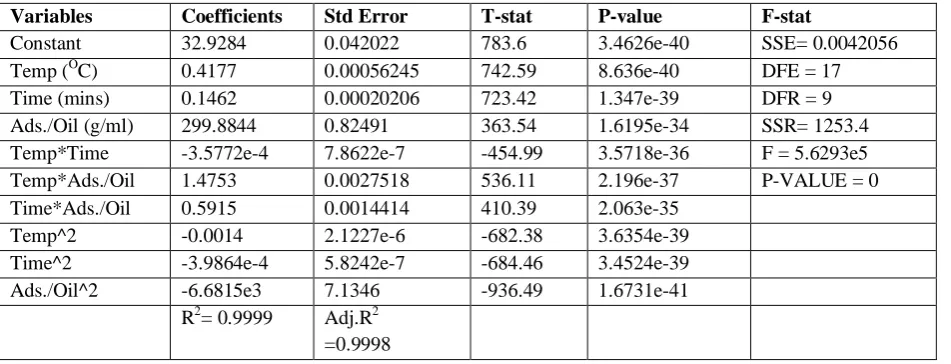
Table 4.7 contains results for model fit, accuracy and adequacy. The F-statistics shows that the model is adequate, based on a p-value of zero, and the model accuracy can be observed from the coefficient of determination (R2) which reveals that the model explains more than 99% of the variability observed in the experimental data. All coefficients and thus variables (main effects and interactions) are significant. This can be observed from the p-values, which is less than 0.05 for all variables, thus indicating a high level of interaction among all parameters.
The surface plots (Figure 4.6, Figure 4.7 and Figure 4.8) reveal increase in bleaching efficiency with increase in all three variables, with a good interaction among the variables. The contour lines also indicate the presence of a global optimum (maximum) value for the bleaching efficiency.
Table 4.8 gives the results of the response surface optimization, indicating that the optimum conditions for bleaching of crude palm oil using Ukpor clay are a temperature of 154.51200C for a time of 148.2246mins and at an Adsorbent-to-Oil ratio of 0.0461.
also observed. The biggest element in terms of composition in Ukpor clay was iron.
X-ray Flourescence (XRF) was performed to determine the chemical compositions of the minerals that are present in the clay. The results of the chemical analysis are presented in Table 4.3. It is seen that the clay gave a high silica oxide content (up to 56%) which indicates that they can be used as a source of silica for the production of floor tiles (Nwabanne and Ekwu, 2013). The other major oxides in the clay are Ferrous oxide and Alumina oxide though in varying compositions. There were also traces of other oxides such as calcium, zinc, nickel and copper among others in very small quantities. Ajemba and Onukwuli (2012) got similar results of chemical composition.
The X-ray diffraction shown in Figures 4.1 and 4.2 showed the various phases of the clay samples providing information on unit cell dimensions. The mineralogical phases of the clay sample showed that it consists of Fe2O3, Ni2SiO4 (liebenbergite), á-Si
O2(alpha silicon), Al2Si2O5(OH)4 (nacrite),
Al2Si2O5(OH)4 (Kaolinite). The graph of Ukpor clay
has many peaks showing that it is crystalline. The cystallinity property was also observed during the grinding operation of the clays. The peaks show the dominant mineral phases in Ukpor clay. Preeti and Singh (2007) got similar mineral compositions using clay from Katni district of Madhya Pradesh.
The chemical structure of the adsorbent is of vital importance in understanding the adsorption process. The FTIR technique is an important tool to identify the characteristic functional groups, which are instrumental in adsorption of aromatic compounds. FTIRstudies of these adsorbents helps in the identification of various forms of the minerals present in the clay. The coupled vibrations are appreciable due to the availability of various constituents (Preeti and Singh, 2007).
The results of the FTIR are shown in Tables 4.4. It is seen that there were strongly structural modification on the clay samples that were activated by the acid which is different from the raw clays as can be seen from the figures.
The Ukpor clay showedmuch changes in the transmission level of their peak values (about 2.0). The maximum adsorption band increases after activation for Ukpor clay. The activated clays brought out many adsorption bands that could not be observed in the natural clay especially in Ukpor clay.
The wave numbers 3410, 3520, and 1600 correspond to H-O-H stretching while those of 3270, 1386, 1320, and 1230 corresponds to Si-O-Si stretching and 3678, 3680, and 950 correspond to Al-O-H stretching. The results of these FTIR analyses confirm the presence of some minerals such as Kaolinite and Montmorillonite.Hence, the Ukpor clay is mainly Kaolinite and Montmorillonite. Ajemba and Onukwuli (2012) equally got similar results of the bond source.
Tables 4.3 show the result of SEM analysis. SEM analysis is used to show the morphology or texture, crystalline structure and surface topography of the adsorbent. The SEM analysis of some clays indicates coarse and loosely packs with some well-formed flakes and irregular and hexagonal edges (Kaolinites). Others may appear as plates of variable thickness and size with relatively well defined edges (Illites) or showing some elements of curling layers in the particles (Smectite) (Bajwa, 2002). Chlorites appeared as inter-relating platy particles with well-defined sub-angular borders. Vermiculite manifested that the reference clay micrographs in the form of aggregate of very small particles with curled edges. Although the preliminary study suggested that clay minerals could be characterized and identified by exploiting their morphological features (using as many as possible clay minerals as standards to cover a range of morphological features). The result showed that Ukpor clay was loosely packed. In terms of coarseness, Ukpor clay showed to be verycoarsed.
The response surface model equation can be given as: Bleaching Efficiency = 32.9284+ 0.4177* Temp+0.1462* Time+299.8844* Ads./Oil -3.5772e-4*Temp*Time+1.4753*Temp*Ads./Oil+0.5915*Tim e*Ads./Oil-0.0014*Temp^2-3.9864e-4*Time^2-6.6815e3*Ads./Oil^2
The response surface model obtained above was used to run a MATLAB 7.9 optimization code to obtain the bleaching temperature, bleaching time and adsorbent-to-oil ratio that give the maximum bleaching efficiency. The results obtained and the optimum bleaching efficiency predicted by the response surface model are given in Table 4.8.
V. CONCLUSION AND RECOMMENDATION
5.1 Conclusion
of its bleaching ability by a very small margin which is out stripped at high temperatures and for longer bleaching times. The optimum value of bleaching efficiency predicted by the response surface model (82.9394%) is well beyond the range of 75-80% given in literature as bleaching efficiency observed for some imported bleaching earths.
This research has helped broaden understanding on the suitability of a locally sourced clay (from Ukpor, Anambra State of Nigeria) for use in the bleaching of palm oil. As a matter of fact, the findings have revealed that the Upkor clay compare adequately with the imported bleaching earth, hence helping broaden knowledge and understanding in the possible substitution of imported bleaching earth with our local clay in the palm oil processing industry.
5.2 Recommendation
It is imperative to exploit our locally sourced bleaching earth, especially in view of the contributions in this work and under the observed optimum conditions, for the processing or bleaching of palm oil. It is cost effective and based on the experimental data analysis done; its performance can be compared favourably with the imported bleaching earth. In fact, it can serve as a substitute for imported earth in the processing of palm oil.
REFERENCES
[1.] Abane A. (2000). The effect of crude palm oil quality parameters (FFA, PV, AV and Color) on the refinery production efficiency.Journal American oil chemists‟ society. 41. pp 15 – 20.
[2.] Ajemba R.O. and Onukwuli O.D. (2012a). Determination of the optimum dissolution conditions of Ukpor clay in hydrochloric acid using Response Surface Methodology. Intl. Journal of Engr. Research & Applications.Vol. 2, No. 5.pp 732-742.
[3.] Ajemba R.O. and Onukwuli O.D.
(2012b).Kinetic model for Ukpor clay dissolution in hydrochloric acid solution.Journal of Emerging Trends in Engr. & Applied Sciences.Vol. 3, No. 3.pp 448-454.
[4.] Bajwa M.S. (2002). Soil Salinity and Alkalinity.In Fundamentals of Soil Science, Indian Society of Soil Science, Division of
Soil Science and Agricultural
Chemistry.IARI New Delhi. Pp. 291-308. [5.] Bernardini E. (1988). Vegetable oils and fats
processing (volume 11) interstampa Rome Inc.
[6.] Ceriani R. andMeirelles A.J.A.
(2006).Simulation of continious physical refiners for edible oil deacidification.Journal of Food Engineering. (76): 26-29.
[7.] Cheah K.Y. and Siew W.L.
(1999).Relationship between physical properties of bleaching earth and its bleaching efficiency on palm oil.
[8.] Hamicton R.S (1995).Development in oil and fats.Blackie Academic and Professional. [9.] Howes P.D., Soon T.C., Lim S.H., Shaw D.B. and Stemp P.P.K. (1991). Bleaching EarthTrends and developments in Bleaching (25-52).
[10.] Hymore F.K. (1996). Effects of some additives on the performance of acid-activated clay in the bleaching of palm oil. Applied clay science (10): 37-42
[11.] Khedok S.C. and Lim E.E. (1982). Mechanism of palm oil bleaching by montmorillonite clay Activated. Journal American oil chemists‟ society (59).pp 12-13
[12.] Lim E.E. (1982). „Mechanism of Palm Oil Bleaching by Montmorillonite Clay‟.Journal of American oil Chem. Soc. 59, 29 – 35.
[13.] Nwabanne J.T. and Ekwu F.C.
(2013).Experimantal design methodology applied to bleaching of palm oil using local clay. International Journal of Applied Science and Technology, 3(4), 69-77.
[14.] Preeti S.N. and Singh B.K.
(2007).Instrumental characterization of clay by XRD and FTIR, Indian Academy of
APPENDIX A Calculation of Free Fatty Acid Contents:
For Free Fatty Acid Content of Bleached Oil using Imported Bleaching Earth
The result can be expressed as:
𝐹𝐹𝐴 =25.6 𝑥 𝑉 𝑥 𝑁
𝑊
Based on experimental,
W = 2.60g
N = 0.098
V = 3.7ml
𝐹𝐹𝐴 =25.6 𝑥 3.7 𝑥 0.098
2.60 = 3.57%
Free Fatty Acid of bleached oil using imported earth = 3.57%
For Free Fatty Acid Content of Bleached Oil using Locally Sourced Bleaching Earth (Ukpor)
The result can also be expressed as:
𝐹𝐹𝐴 =25.6 𝑥 𝑉 𝑥 𝑁
𝑊
Based on experiment,
W = 2.50g
N = 0.098
V = 3.9ml
𝐹𝐹𝐴 =25.6 𝑥 3.9 𝑥 0.098
2.50 = 3.91%