Bridging the Gap: Architecture and Structural Engineering
A. Faridah
1, A. Abdullah Sani
2, and R. Ismail
11Fakulti Senibina, Perancangan dan Ukur
Universiti Teknologi MARA, 40450 Shah Alam, Selangor Darul Ehsan
2Jabatan Senibina, Fakulti Alambina
Universiti Teknologi Malaysia, 81300 UTM Skudai, Johor Darul Ta’zim
Abstract – Division of the responsibility for the design and construction of the built environment between architecture and engineering is a relatively modern development. Up until about 150 years ago, a single individual, the ‘Master builder’ performed the roles of Engineer and Architect for the design of a building or bridge. Today, Structural Engineers and Architects are educated completely independently. Although both play a major part in designing and building a nation's infrastructure, they are not encouraged to fully understand the work of each other. There is a dire need to Bridge the Gap between Engineers and Architects. This paper focuses on doing that at the tertiary education level. It does not propose a carefully formulated curriculum but endeavours to provoke creative thinking in the teaching of the two salient fields of the built environment.
1. Introduction
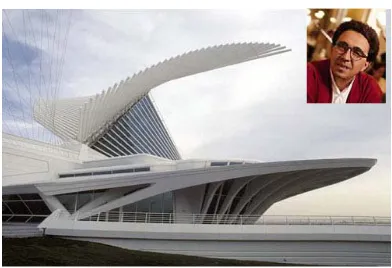
Architectural designs that do not follow conventional forms have often been dubbed Architect’s Dream but Engineer’s Nightmare. Architects, in their endeavours to create masterpieces, have been known to come up with building forms that test structural engineering to the limit. The last two decades have witnessed the proliferation of architectural works of astounding architectural and structural innovation by ‘MasterArchitects’ like Norman Foster (Fig.1), Nicholas Grimshaw (Fig.2), Frank Gehry (Fig.3), and Santiago Calatrava (Fig.4). [4], [7], [8], [2]
Figure 1: The Sage Music Centre, Gateshead, U.K., 2004. Architect: Foster & Partners, Engineer: Buro Happold
Figure 2: The Eden Project, Cornwall, U.K., 2001. Architect: Nicholas Grimshaw & Partners, Engineers:
Anthony Hunt Associates
Figure 3: The Guggenheim Museum, Bilboa, Spain, 1997. Architect: Frank Gehry Associates, Engineer: SOM
Architect Frank Gehry, Building, Engineer
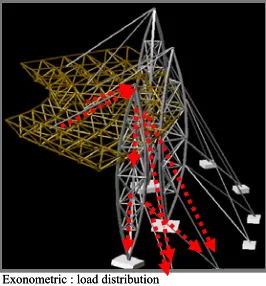
What do they all have in common? They all engage in multi-disciplinary approaches in design where there is always a tight collaboration between the architect and the engineer. In fact Calatrava, whose Ph.D. thesis is on the structure of the retractable space frame, which combines the varying disciplines of engineering, mathematics and architecture, is one who is termed the Engineer-Architect (Fig.5). [9]
Figure 5: Santiago Calatrava's Ph.D. thesis, the retractable space frame.
When an architect is one at the same time an engineer, then the nomenclature Architect’s Dream but Engineer’s Nightmare becomes Architect’s Dream and Engineer’s Serenade.
2. Segregation of Education
Division of the responsibility for the design and construction of the built environment between architecture and engineering is a relatively modern development. Up until about 150 years ago, a single individual, the ‘Master builder’ performed the roles of Engineer and Architect for the design of a building or bridge. Today, Structural Engineers and Architects are educated completely independently.[3] Although both play a major part in designing and building a nation's infrastructure, they are not encouraged to fully understand the work of each other.
Most buildings, because of the complexity of the project, are often designed by a multi-disciplinary team comprising of architects, structural engineers, landscape architects, planners, environmental scientists, services engineers, quantity surveyors etc. who work closely together to produce the complete design of a building. The work of each professional is inextricably linked to that of the fellow professionals and the greatest interaction takes place in aspects of structural engineering and architecture.
There is an urgent and dire need to bridge the gap between Engineers and Architects. Ideally, we are looking for:
• An Engineer with the understanding of and respect for architectural/aesthetic issues;
• An Architect with the ability to implement structural engineering knowledge in architectural designs;
• Managers of multi-disciplinary design teams, drawing on the undergraduate experience of working successfully in both disciplines;
• Or even an Engineer-Architect! [3]
3. Current Curriculum
In Malaysia, amongst the Institut Pengajian Tinggi Awam (IPTA), the universities offering courses in Architecture are Universiti Teknologi MARA (UiTM), Universiti Teknologi Malaysia (UTM), Universiti Sains Malaysia (USM), Universiti Malaya (UM), Universiti Putra Malaysia (UPM) and Universiti Kebangsaan Malaysia (UKM). The International Islamic University of Malaysia (IIUM) and several private colleges also offer architectural courses. The very same IPTA’s offer courses in Civil Engineering. This paper is concerned with Structural Engineering, and Structural Engineering is a key component of the Civil Engineering course at most universities. [11]
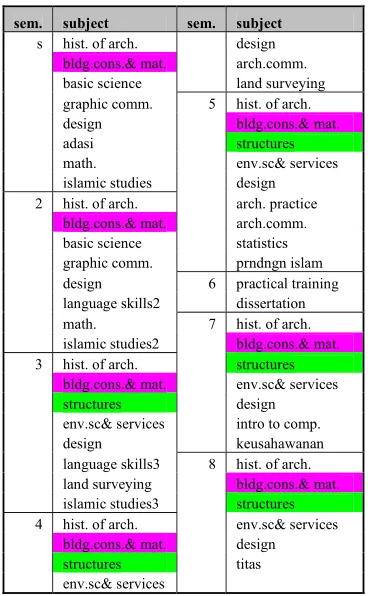
Let us take two universities where the courses in Architecture and Structural Engineering are both very well established, namely UiTM and UTM, and compare their syllabuses.
Table 1: Subjects for Diploma in Architecture at UiTM
sem. subject sem. subject s hist. of arch. design bldg.cons.& mat. arch.comm. basic science land surveying graphic comm. 5 hist. of arch. design bldg.cons.& mat. adasi structures math. env.sc& services islamic studies design
2 hist. of arch. arch. practice bldg.cons.& mat. arch.comm. basic science statistics graphic comm. prndngn islam design 6 practical training language skills2 dissertation math. 7 hist. of arch. islamic studies2 bldg.cons.& mat.
3 hist. of arch. structures bldg.cons.& mat. env.sc& services
structures design
env.sc& services intro to comp. design keusahawanan language skills3 8 hist. of arch. land surveying bldg.cons.& mat. islamic studies3 structures
4 hist. of arch. env.sc& services bldg.cons.& mat. design
structures titas
Table 2: Subjects for Bachelor of Architecture at UTM
sem. subject sem. subject 1 m'sian society english language 3 basic design 1 m'sian politics & structure 1 nationhood intro verbal prstn. 4 design 2 env.physic 1 timber & steel con. intro to hist. & structure 2 theory arch. hist.of sea arch.
2 basic design 2 english lang. 4 int. to bldg.const. islamic edu.2 bldg.services 1 5 conc. & brickwork intro to comp. bldg.services 2 expedition B design 3 islamic edu. 1 m'sia arch heritage
3 construction.prac. technocrat & dev. design 1 6 bldg services 2 art & craftwrkshp design 4 env.physic 2 landscape arch. hist. modern arch. religious edu.3
Table 3: Subjects for B.Sc. Civil Engineering at UiTM
sem. subject sem. subject 1 engr.mathematics 5 struc.analysis 2 engr.drawing mat.&struc.lab.2 computing struc.design 3 mech.of solid hydraulics 2 mat.&struc.lab.1 M&E engr.prac engr.survey lab.1 M&E engr.lab co-curriculum speech comm. 2 struc.analysis 1 diff. equation 2 struc.design 1 6 water & waste engr
engr.geology
civ.engr dsgn report
engr.geology lab advanced statistics mech.of fluids engr.economics
water resources
lab research method.
civil
engr.quantities third language 1 titas 1 geotechnicques 3 co-curriculum 7 struc.analysis 3
3 engr.mathematics2 hway&traff. engr
engr.material
hway&traff. engr lab
struc.design 2
water resources lab2
geotechnicques 1 final yr. project1
geotechnicques
lab1 engrs. in society hydraulics 1 finite elmnt methds titas 2 third lang. 2
4 numerical analysis struc. design 4
geotechnicques 2 8 const. mangment 2
engr.survey 2 final yr. project2
engr.survey lab.2 third lang. 3
tech. report
writing water & waste engr mech. of solid 2 civ.engr dsgn prj.2 mech. of fluid 2
Table 4: Subjects for B.Sc. Civil Engineering at UTM
From the syllabuses of the Architecture courses offered at UiTM (Table 1) and UTM (Table 2) it can be gleaned that students of Architecture are being taught Structural Engineering related subjects.
Figure 6:An example of Building Construction & Materials coursework for Semester1, Bachelor of Architecture at
UiTM (Lecturer: Assoc. Prof. Ar. Faridah Adnan) sem. subject sem. subject
1 basic mathematics civil engr.lab1 physics 1 engr. statistics basic chemistry 7 ULT elective physic lab 1 numerical method english hydraulics 2 malaysian society civil engr.material basic chemistry lab geology&rock mech
2 calculus civil engr.lab2 physic 2 co-curriculum physic lab.2 8 evaluation & contr.
english edu.
comm. geotechnics
titas 1 water&waste engr. it &data mngmnt hydrology co-curriculum RC design 2 mech.of statics 9 industrial training
3 titas 2 10 hway&traff.engr eng. prof. comm. structural analysis engr. maths. civil engr.lab3
engr.survey
dsgn of steel&timber mech. Of soil const. tech. mech.of dynamic principles of buss.
4 survey camp 11 env. management 5 islamic inst. prjct&const.mngmnt mech.of fluid elective
mech.ofstruc&mat. research method
comp.prog. civil engr.IT
civil engr.dwg. 12 prof.prjct prac.
derivation
equation final year prjct. 6 UHP elective civil engr.seminar M&E system engr. Economics
thery of struc. elective subject
RC design 1 elective subject
The subject Structures, which involves actual engineering calculations, is introduced very early in the course and it carries on until the final year at UiTM. The subjects of Building Construction and Materials are closely linked with Design. Here, the Architectural students are again exposed to Structural Engineering knowledge in terms of material strength, rules-of-thumb and broad analysis of structural distribution (Fig.6).
In contrast to the syllabuses of the Civil Engineering courses offered at UiTM (Table 3) and UTM (Table 4), all the subjects taught are purely engineering with no connection or link to Architecture. Thus upon graduation, the students have never been exposed formally in terms of architectural appreciation, be it in terms of architectural design or the practice of the architectural profession. This will certainly affect their performance at work when it comes to interacting with Architects in a project, especially since their structural design is inextricable from the design conceived by the Architect.
4. The Professional Architectural Practice
.
There are various services for which an Architect who is in professional practice may be engaged by a client. These are spelled out in the Lembaga Arkitek Malaysia (LAM) {Scale of Minimum Fees} Rules (1986). The Basic Services to be provided by an Architect are divided into four phases namely:
• Schematic Design Phase, • Design Development Phase, • Contract Documentation Phase, and
• Contract Implementation and Management Phase. Aside from the Basic Services are the Advisory Services and the Supplementary Services, which include brief formulation, site selection, feasibility studies, project planning, project management etc. [5].
In practice, Engineers are involved in the various stages of a project as spelled out above, though in some cases with less involvement than the Architect. As such Engineers need to understand and appreciate the partaking of Architects in a project, both from the design as well as the practice point of view. In Engineering there often is one correct or optimal answer to a set problem but in Architecture a multiplicity of solutions may exist; some solutions may be better than others but all may be valid. It is often hard for engineers to appreciate that there may be more than one acceptable solution to a problem, and that architects have to develop designs that are the most suitable in terms of function, by-laws, aesthetics, context, etc. for a project.
The Malaysian Structural Steel Association (MSSA) is planning for a series of talks entitled ‘Architecture in Steel’, to be conducted by Architects, for Engineers, in order enhanced the understanding and perception of Architecture amongst practising Engineers.
5. Current Attempts at Bridging the Gap
5.1 Architectural Design Thesis
In the final year of the Bachelor of Architecture course at most IPTA’s students undertake a Design Thesis project of certain size and complexity. The first semester focuses on client selection, site selection, brief formulation, feasibility study, and architectural design, which form the main emphasis. The second semester focuses on technical studies encompassing statutory regulation, structure, electrical services and mechanical services.
Figure 7: Automobile Museum of Malaysia in Sepang, by Mohd. Firdaus Zainol, Bachelor of Architecture, UiTM
(Supervisor: Assoc. Prof. Ar. Faridah Adnan)
Figure 8: Exploreum and Mediatheque, KL Sentral, by
Mohd. Khazani Omar, Bachelor of Architecture, UiTM (Supervisor: Assoc. Prof. Ar. Faridah Adnan)
5.2 Integrated Simulation Project In the Faculty of Architecture, Planning and Surveying (FSPU) of UiTM an Integrated Simulation Project (ISP) has been carried out for several semesters amongst students in three different departments, namely the Departments of Architecture, Quantity Surveying and Building. The Architecture students conceived the building design, the Quantity Surveying students did the cost estimate, and the Building students organised the construction schedule. The project can be extended to incorporate Civil Engineering students to prepare the structural design and calculations.
5.3 Student Open Ideas Competition
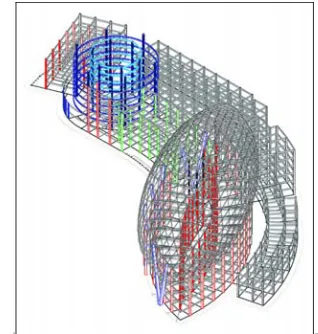
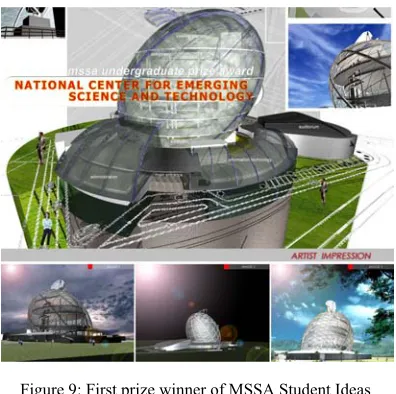
The MSSA has been organising the bi-annual Student Ideas Competition for Architecture and Civil Engineering students from the IPTA’s. The competition submission requires architectural design as well as engineering design and calculations (Fig.9). This is a highly commendable exercise for both sets of students to experience. It has been unfortunate that some schools do not participate, or are unable to participate, due to lack of cooperation between the two disciplines within the same university.
Figure 9: First prize winner of MSSA Student Ideas
Competition 2004 from UiTM. (Lecturer in charge: Assoc. Prof. Ar. Ong Suan Huah)
MSSA took the cue from the annual International Architectural Student Competition in the U.K. that is sponsored by Corus (formerly British Steel).
5.4 Integrated Structural Engineering and
Architecture Course
In 1995, the Department of Civil and Structural Engineering and the Department of Architecture at the University of Sheffield, U.K., introduced a four-year undergraduate masters degree in Structural Engineering and Architecture. It is an innovative
course that teaches engineering (alongside engineering students) and architecture (alongside architectural students) simultaneously. [3] The course is accredited by the Royal Institute of British Architects (RIBA) in addition to the Institution of Structural Engineers and the Institution of Civil Engineers. So the graduates can choose whether to become an Architect, an Engineer, or both. [11]
6. Design of Bridges
A bridge is a complex artefact, being structure and conduit combined. Bridges rise over natural or man-made disruptions to movement with the purpose to restore communication and community. A successful bridge design is not merely constituted by the strength of the structure but also by the form of the bridge and the visual experience of the users going across it at differing speeds.
Architects are now in the business of designing bridges. Santiago Calatrava is as famous for his bridges as he is for his zoomorphic architectural forms. This is exemplified in his Alamillo Bridge in Seville, Spain (Fig.11) and the Puerto Bridge in Ondarroa, also in Spain (1995). [8]
Figure 10: The Alamillo Bridge in Seville, Spain, 1992. Architect and Engineer: Santiago Calatrava. Norman Foster’s Millennium Bridge in London, England (Engineer: Ove Arup & Partners) and his Millau Viaduct at the Gorge du Tarn, France (Engineer: Chapelet-Defol-Mousseigne and Ove Arup & Partners) are seminal bridge structures of the new millennium (Fig.12). [4]
To this end it can be said that Architects are literally Bridging the Gap! In view of this the Department of Architecture at UiTM has included Bridge Design in its recent curriculum review exercise.
7. Continuing Professional Development
Architects always keep coming up with new trends and styles in, initially, building design, and now, in bridge design, as prompted by events and places. The National Stadium for the Beijing 2008 Olympics, designed by Herzog and De Meuron, is inspired by the bird’s nest (Fig.13). The National Swimming Centre for the same up-coming world event, by PTW Architects, portrays ‘bubble-ism’ as an innovative structural system (Fig.14). [1]
Figure 12: The National Stadium, Beijing 2008 Olympics. Architect: Herzog and De Meuron
Figure 13: The National Swimming Centre, Beijing 2008 Olympics. Architect: PTW Architects, Engineer: Ove Arup
As a consequent engineers have to be well equipped to design structures well beyond what they have been taught at university. Both Architects and Engineers should be decreed and prepared for a continued education. There is a great need for procedures to teach students to be aware that they have to cultivate knowledge not only as part of their school days but as part of their professional activity.
As of 2003 LAM has imposed the submission of Continuing Professional Development (CPD) points for renewal of registration for Architects and Professional Architects [6]. This is to be fully enforced
in 2005. The easiest way to collect the 10 mandatory points is by attending talks, seminars, conferences, and the like. It is very disheartening to meet friends, ex-colleagues and ex-students at these functions to find out that they are there chiefly to collect the CPD points, and not for the continued education. These gatherings should be seen as the platform for professionals to broaden our knowledge in architecture both locally and internationally, as well as to increase our exposure to current practice and technological trends.
8. Conclusion
There is clearly a dire need to Bridge the Gap between Architecture and Structural Engineering. In the teaching of Architecture, the architecture schools in Malaysia have come pretty close to building their half of that bridge. There is now a pressing need for the schools of Structural Engineering to start building on their half of that bridge.
References
[1] C. Bosse, “Bubble-ism: Architectures Of Foam,” in Proceedings of the Datum KL: 2004
International Conference, Kuala Lumpur, Malaysia, July 2004.
[2] F. Dal Co, K. W. Forster & H. Arnold, Frank O. Gehry: The Complete Works, The Monacelli Press, New York, 1998.
[3] J. B. Davison, O. Popovic and A. Tyas, “A New Degree Programme in Structural Engineering and Architecture,” in Proceedings of the International Conference on Engineering Education, 1998. [4] D. Jenkins, P. Baker, G. Forde, C. Davis,
(Editors), Foster: Catalogue 2001, Prestel, Munich, London, New York, 2001.
[5] Lembaga Arkitek Malaysia, Architects {Scale of Minimum Fees} Rules (1986), Lembaga Arkitek Malaysia, Kuala Lumpur: pp.1-15.
[6] Lembaga Arkitek Malaysia: General Circular No. 3/2004: Continuing Professional Development for Professional Architects and Registered Architects, Lembaga Arkitek Malaysia, Kuala Lumpur, pp 1-2.
[7] H. Pearman, Equilibrium: The Work of Nicholas Grimshaw & Partners, Phaidon, London, 2000. [8] A. Tzonis, Santiago Calatrava: The Poetics of
Movement, Thames & Hudson, London, 1999. [9] A. Tzonis (Editor), Santiago Calatrava’s Creative
Process Part1: Fundamentals, Birkhauser, Basel, 2001.
[10]Undergraduate Prospectus 2005, Structural Engineering and Architecture (MEng/StrAr), University of Sheffield.