BOEHMAN, JOSEPH. Affective, Continuance, and Normative Commitment among Student Affairs Professionals. (Under the direction of Duane Akroyd.)
Student affairs professionals generally describe a calling to their work, but attrition statistics indicate that there is a significant personal and professional cost associated with this calling. How do individuals become committed to student affairs, and why do they stay committed? The purpose of this study was to examine the impact of several factors on the development and maintenance of organizational commitment among student affairs
professionals. A conceptual framework which includes organizational politics, organizational support, organizational structure, job satisfaction, middle manager status, a work/non-work interaction construct, and three types of organizational commitment was proposed. Data was collected from a national survey of student affairs professionals via a web-based survey.
COMMITMENT AMONG STUDENT AFFAIRS PROFESSIONALS by
JOSEPH BOEHMAN
A dissertation submitted to the Graduate Faculty of North Carolina State University
in partial fulfillment of the requirements for the Degree of
Doctor of Education
Higher Education Administration Raleigh
2006
DEDICATION
This dissertation is dedicated to my father, Charles Boehman, who has taught me more about commitment than any course I have ever taken or any book or article I have ever read.
BIOGRAPHY
ACKNOWLEDGMENTS
I would like to thank the following individuals and groups for their support and help: My advisor, Duane Akroyd, provided patient guidance and a clear view at a critical point in my doctoral process. I will be forever grateful.
My committee members–Audrey Jaeger, Colleen Grochowski, and Larry Moneta– were generous in their feedback and support. I could not have asked for a stronger
committee. I would also like to thank Audrey additionally for allowing me to co-teach with her. You have ignited a passion for teaching at the graduate level, and I hope to someday follow in your footsteps.
The Department of Housing & Residential Education at the University of North Carolina at Chapel Hill, specifically Dr. Christopher Payne and Mr. Larry Hicks, supported my educational goals in numerous ways. I truly appreciate the level of organizational support I was given.
My “crack research team”–Rebecca Bryant, Kyle Hammett, Chris Horvat, Ralph
Isenrich, Brandi Kellam, Jennifer Le, Julian Miller, Martinique Murray, Michael Stewart, Heather Wensil, Shanelle Williams, and Tiffany Worthen–for their assistance in looking up over 1,200 email addresses!
Dr. Dean Bresciani and Dr. Marilee Bresciani encouraged me to begin my doctoral studies, and have supported my academic and professional development. I thank you for your guidance.
Dr. W. Ross Bryan served as my sounding board, colleague, and spiritual guru. Thank you for helping to keep my eyes on the prize!
Many friends and colleagues in the profession have provided encouragement in large and small ways. I thank you all.
My family has been a source of encouragement and support throughout this process, and I thank you for all you have done to help me throughout my education.
My father-in-law, Dr. John C. Phillips, Jr. provided unending support and
encouragement, and helped me appreciate the doctoral process from his perspective. I hope to pass on what you have taught me.
My mother-in-law, Sarah Phillips, assisted me in numerous ways, from listening to me when I was frustrated to providing baby-sitting duties so I could spend a rare evening with my wife. I cannot thank you enough.
My daughter Sydney, who will probably not remember her two and a half years as part of this process, but provided inspiration to work on this dissertation even when I would have rather been with her and her mother.
TABLE OF CONTENTS
Page
LIST OF TABLES………. ix
LIST OF FIGURES………... xi
INTRODUCTION………. 1
A Systemic View of Commitment………. 1
The Impact of Perception………... 3
The New Concept of Work and the Student Affairs Professional………. 4
Introduction of Variables in the Study………... 8
Organizational Commitment……… 9
Organizational Politics………. 9
Organizational Support……… 10
Organizational Structure……….. 10
Job Satisfaction……… 11
Statement of the Problem………... 11
Purpose of the Study……….. 15
Conceptual Framework……….. 16
Significance of the Study………... 17
Summary……… 19
REVIEW OF THE LITERATURE………... 21
Introduction……… 21
Organizational Commitment……….. 22
Commitment Defined………... 22
Evolution of the Two-Factor Conceptualization……….. 23
Three-Factor Models……… 24
Organizational Commitment and Organizational Culture………... 29
Summary……….. 30
Organizational Politics: How does it contribute to Commitment?... 31
Definition………. 32
General Political Behavior………. 33
Getting Along to Get Ahead……….. 34
Pay and Promotion………. 34
Systemic Organizational Politics………. 35
Empowerment in Organizational Politics……… 38
Summary……….. 41
Organizational Support: How does it contribute to Commitment?... 42
Definition………. 44
The Impact of Organizational Culture on Support……….. 44
Work/Non-Work Interaction……… 49
Summary……….. 55
Organizational Structure: How does it contribute to Commitment?... 55
Definition………. 57
Mechanistic Structures………. 59
TABLE OF CONTENTS CONTINUED
Page
Summary………... 62
Job Satisfaction: How does it contribute to Commitment?... 63
Definition………. 64
Politics, Support, and Structure and their Relationship to Satisfaction……... 67
The Connection between Satisfaction and Commitment………. 68
Summary……….. 71
Chapter Summary……….. 72
METHODOLOGY……… 74
Introduction………... 74
Research Design……… 74
Web-based Survey Instrument……….. 75
Population Sample………. 75
Instrumentation……….. 76
Affective, Continuance, and Normative Commitment Scales (ACS, CCS, NCS). 77 Validity and Reliability……… 77
Affective Commitment Scale (ACS)……….. 77
Continuance Commitment Scale (CCS)………. 78
Normative Commitment Scale (NCS)……….... 78
Perception of Organizational Politics Scale (POPS)……….. 79
Validity and Reliability……… 79
Survey of Perceived Organizational Support (SPOS)……… 80
Validity and Reliability……… 81
Organizational Structure Scale (OSS)……… 83
Validity and Reliability……… 83
Abridged Job In General (AJIG) Scale……….. 83
Validity and Reliability……… 87
Demographic Questions………. 88
Variables……… 89
Data Analysis………. 91
Data Collection……….. 92
RESULTS……….. 94
Introduction……… 94
Profile of the Respondents………. 94
Work/Non-Work Interaction Variables………... 95
Marital Status………. 95
Gender……… 98
Work Identity Factors……….. 101
Position Level……… 102
Institutional Type………... 104
Affiliation Factors……… 105
Racial/Ethnic Identification………... 105
Generational Affiliation………. 106
TABLE OF CONTENTS CONTINUED
Page
Analysis of Commitment among Student Affairs Professionals……… 110
Analysis of Research Question One: General Commitment Levels………… 110
Analysis of Research Question Two: Commitment by Position Level……... 113
Summary of Commitment Level………. 117
Analysis of Conceptual Framework……….. 119
Results of Research Question Three: Regression Analysis of Affective Commitment……… 119
Results of Research Question Four: Regression Analysis of Continuance Commitment……… 122
Results of Research Question Five: Regression Analysis of Normative Commitment……… 125
Summary of Conceptual Framework Analysis……… 128
Chapter Summary……….. 130
CONCLUSIONS, DISCUSSION, AND RECOMMENDATIONS………. 132
Introduction……… 132
Conclusions……….... 132
Commitment in General………... 132
Affective Commitment………... 132
Continuance Commitment……….. 134
Normative Commitment………. 135
General Commitment among Student Affairs Professionals……….. 136
Antecedents of Affective Commitment……… 139
Antecedents of Continuance Commitment……….. 141
Antecedents of Normative Commitment………. 142
Discussion……….. 143
Purpose of the Study Examined………... 144
Conceptual Framework Revisited……… 148
Discussion of Significance………... 149
Recommendations……….. 152
Limitations of the Study………... 152
Recommendations for Research………... 154
Recommendations for Practice………. 156
REFERENCES………... 161
APPENDICES……… 179
Appendix A: Institutional Review Board Approval………... 180
Appendix B: Text for Participant Solicitation Email………. 181
Appendix C: Survey Instrument………. 182
Appendix D: Additional Regression Analysis: Affective Commitment………… 187
Appendix E: Additional Regression Analysis: Continuance Commitment……... 188
LIST OF TABLES
Table Title Page
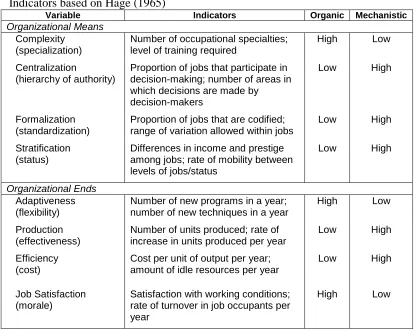
1 Characteristics of Organic and Mechanistic Organizations by Variable and
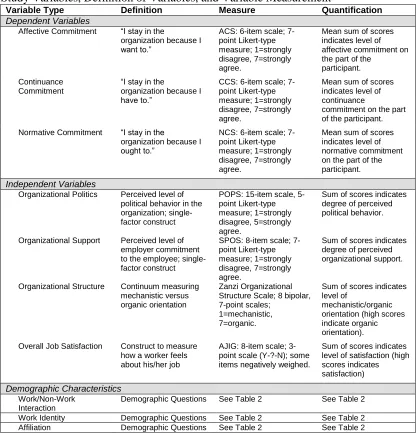
Indicators based on Hage (1965)………... 58 2 Demographic Characteristics Questions and Range of Responses………... 89 3 Study Variables, Definition of Variables, and Variable Measurement……….. 90 4 Distribution of Marital Status by Children under the Age of Eighteen in the
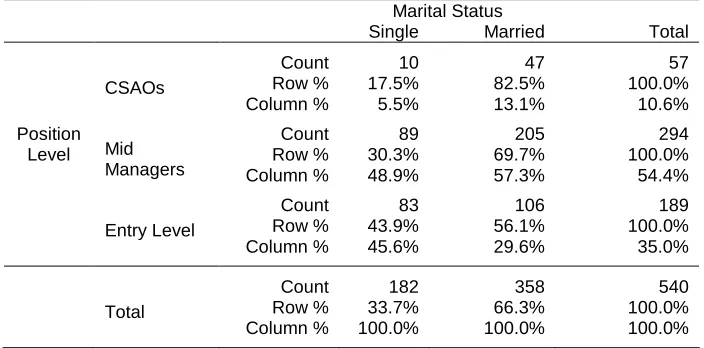
Household of Responding Student Affairs Professionals………... 95 5 Distribution of Marital Status by Position Level of Responding Student
Affairs Professionals……….. 96 6 Distribution of Children under the Age of Eighteen in the Household by
Position Level of Responding Student Affairs Professionals………... 97 7 Distribution of Gender by Marital Status of Responding Student Affairs
Professionals……….. 99 8 Distribution of Gender by Children under the Age of Eighteen in the
Household of Responding Student Affairs Professionals……….. 99 9 Distribution of Gender by Position Level of Responding Student Affairs
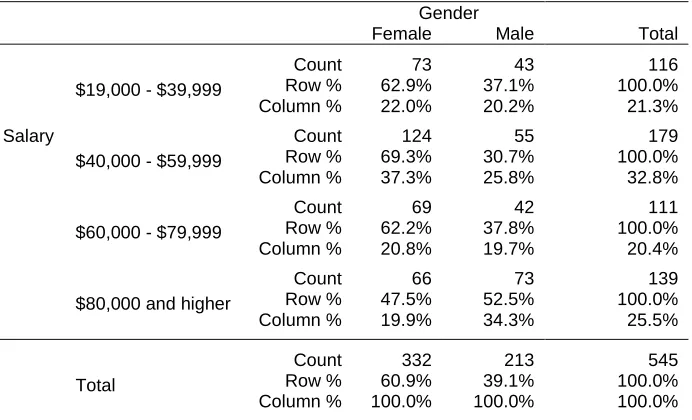
Professionals………... 100 10 Distribution of Gender by Salary of Responding Student Affairs
Professionals………... 101 11 Frequency Distribution of Responding Student Affairs Professionals by
Functional Area……….. 102 12 Distribution of Level by Education of Responding Student Affairs
Professionals……….. 104 13 Frequency Distribution of Responding Student Affairs Professionals by
Institutional Type………... 104 14 Frequency Distribution of Responding Student Affairs Professionals by
Racial/Ethnic Identification……… 105 15 Frequency Distribution of Responding Student Affairs Professionals by
Generational Affiliation………. 106 16 Distribution of Generational Affiliation by Marital Status of Responding
Student Affairs Professionals……… 107 17 Distribution of Generational Affiliation by Gender of Responding Student
Affairs Professionals………. 108 18 Distribution of Generational Affiliation by Position Level of Responding
Student Affairs Professionals……… 108 19 Distribution of Generational Affiliation by Education Level of Responding
Student Affairs Professionals………. 109 20 Mean Scores of Affective, Continuance, and Normative Commitment of
Responding Student Affairs Professionals………. 111 21 Pearson Correlation Statistics of Affective, Continuance, and Normative
Commitment for the Current Study and for Meta Analysis by Meyer and
LIST OF TABLES CONTINUED
Table Title Page
22 Mean Scores of Affective, Continuance, and Normative Commitment by
Position Level of Responding Student Affairs Professionals……… 114 23 Mean Differences and Effect Sizes of Position Level by Type of
Commitment of Responding Student Affairs Professionals……….. 114 24 Contrast Estimate Comparisons of Position Level by Type of Commitment of
Responding Student Affairs Professionals………. 117 25 Pearson Correlation Statistics of Affective Commitment on Support, Gender,
Children, Marital Status, Satisfaction, Politics, Mid Manager Status, and
Structure………. 121 26 Multiple Regression of Affective Commitment on Support, Satisfaction,
Politics, Marital Status, and Children……… 122 27 Pearson Correlation Statistics of Continuance Commitment on Politics, Mid
Manager Status, Support, Structure, Marital Status, Children, Gender, and
Satisfaction………. 124 28 Multiple Regression of Continuance Commitment on Politics, Support,
Satisfaction, and Gender………. 125 29 Pearson Correlation Statistics of Normative Commitment on Support, Marital
Status, Children, Gender, Satisfaction, Politics, Mid Manager Status, and
Structure………. 126 30 Multiple Regression of Normative Commitment on Support, Satisfaction,
Politics, and Gender………... 127 31 Results of t-tests and Correlations of Affective Commitment on Support,
Satisfaction, Politics,MaritalStatus,and Children……… 187 32 Collinearity Statistics of Affective Commitment on Support, Satisfaction,
Politics, Marital Status, and Children……… 187 33 Results of t-tests and Correlations of Continuance Commitment on Politics,
Support,Satisfaction,and Gender……….. 188 34 Collinearity Statistics of Continuance Commitment on Politics, Support,
Satisfaction,and Gender……… 188 35 Results of t-tests and Correlations of Normative Commitment on Support,
Satisfaction,Politics,and Gender……….. 189 36 Collinearity Statistics of Normative Commitment on Support, Satisfaction,
LIST OF FIGURES
Figure Title Page
1 Conceptual Framework for Study of Organizational Commitment among
Student Affairs Professionals……… 17 2 The three components of organizational commitment (affective,
continuance, normative) based on Allen and Meyer (1991)………. 28 3 Matrix of Positive and Negative Organizational Political Behavior based on
Morgan (1997)……….. 37 4 Comparison of Mean Scores of Affective, Continuance, and Normative
Commitment………. 137 5 Antecedents of Affective Commitment……… 140 6 Antecedents of Normative Commitment……….. 143 7 Revised Conceptual Framework for the Study of Organizational
A Systemic View of Commitment
Student affairs work has seen significant changes during the last 15 years. The expectations and demands of student consumers and their parents have led to an increase in services provided by student affairs professionals, while at the same time the appropriations for student affairs has remained at a very small percentage of the typical college or
university’soperating budget(Thelin,2003).Concurrently, student affairs professionals have
been challenged to demonstrate their ability to assist in student development and learning (Nuss, 2003). The ability to recruit and retain a cadre of committed professionals to meet these increased needs is an essential challenge for the profession.
The attrition of individuals who seem to be committed to the student affairs
profession is a persistent enigma among student affairs practitioners and researchers. Even though student affairs professionals report that they are generally satisfied with their jobs, attrition rates as high as 61% belie that perception of satisfaction (Lorden, 1998). It appears that individuals who are satisfied with their jobs are still leaving the profession, which has potential impact for the continued development of the profession through the loss of talented, experienced, and passionate student affairs practitioners.
The issue at the center of this problem is not job satisfaction, or organizational commitment, or even the level of attrition among student affairs professionals. The central issue of the problem of commitment among student affairs professionals is that the
profession is looking at the problem with what Wheatley (1999) would define as a
appropriate“part”isfixed,such asincreasing job satisfaction,then theorganization will
work smoothly again. This viewpoint is too simplistic for the problem.
In order to adequately address the issue of commitment among student affairs professionals, it is necessary to embrace a systems perspective. Commitment must be viewed in relation to other factors, and commitment itself must be examined as a multidimensional concept. Allen (2002) states that issues can be understood only by
examining “differentperspectivesheld in tension long enough to figureoutthewhole”
(p.156). A systems perspective allows for the flexibility in thinking that leads to
unconventional solutions to problems. Variables that are seemingly not connected to the problem may provide sufficient leverage to make a difference (Dörner, 1990).
This study proposes that student affairs research is limited when looking at the question of commitment among student affairs professionals. Research to date on satisfaction among student affairs professionals has not connected job satisfaction to commitment. The few studies on commitment among student affairs professionals have examined the degree that someone is committed to the profession, instead of how they
become committed or why they stay committed. This study will address the impact of several factors–organizational politics, organizational support, organizational structure, and overall job satisfaction–on organizational commitment among student affairs professionals.
The Impact of Perception
Our ability to effectively address concerns within an organization is limited by what we choose to see. We see problems–and solutions to those problems–through the lenses of our own education and experience. We tend to filter out what we see as distractions, even though they may lead us to greater understanding. Looking at situations using new lenses is difficult, as we have to continually challenge our old assumptions and beliefs.
Theconceptofperception can bedifficultto quantify,asitisasmuch a“feeling”asa
reality. Individuals are likely to be influenced to a greater degree by their perceptions rather than by objective reality (Spreitzer, 1996). How an individual perceives the level of politics in his/her organization, for example, may have a significant impact on their level of
commitment, regardless of the aggregate level of politics reported by the other members of the organization. In simple terms, perception creates reality. This point was made by
Wheatley (1999),who stated that“wecannotknow whatishappening to something ifweare
not looking at it, and stranger yet, nothingdoeshappen to it until we observe it”(p.61). Perception is also a reflection of what we want to see. Morgan (1997) observed that
“reality hasatendency to revealitselfin accordancewith theperspectivesthrough which itis
engaged.”Using thiscontext,an individualperceivesapolitically activeenvironmentif
A final aspect of perception is that a single perceived change in a dynamic can lead to multiple conclusions. For example, a politically active environment can be seen by some members as a sign of an invigorating, dynamic, and creative workplace. Other members of the same organization could see an increase in political activity as a sign of
miscommunication, a lack of trust, and the imminent downfall of the organization. A
perceived change in a given dynamic can easily be embraced by some, and attacked by others (Bolman and Deal, 1991).
It is important to understand that while these three aspects of perception–perception creates reality, the reflection of what we want to see, and the multiple conclusions created by perception–can be limiting to a study of organizational commitment, they can also provide a view into the true state of a profession. The attitudes, beliefs, and perceptions of the
individuals within an organization tell far more about the culture and long-term health of an organization than a mission statement, organizational chart, or a strategic plan.
The New Concept of Work and the Student Affairs Professional The concept of work is changing, in exciting and frightening ways. New
technologies allow for increased interaction, connectedness, access and depth of information, while creating the ability to work from home, in the coffee shop, or on the university quad. While the freedom offered by this level of flexibility can be seen as a positive outcome, several authors have posited that increased connectivity leads to increased connection to the workplace.Ritzer(2004)seesthis“controlthrough non-human technology” asaway for rational, bureaucratic systems to maintain the status quo in a changing world. Work is no longer contained to a 9-to-5, 40-hour workweek. In the corporate world, employees are
away from the office (Casey, 1995). In many organizations, including the population that is the focus of this study, the proliferation of cell phones, pagers, wireless laptop computers, and remote server access is seen more as a way to keep employees productive rather than as an attempt to promote a flexible workplace.
Change is a constant challenge for student affairs professionals. New technologies, a new generation of students, and other external pressures create a sense that the number of change events–events that require an organization to review its purpose and mission–is increasing (Howe & Strauss, 2000; Allen & Cherrey 2003). It also appears that the time between change events is decreasing, a phenomenon that Allen and Cherrey (2003) have described as living in permanent white water. Shrinking budgets, reduced staff, and increased expectations have placed enormous pressures on the student affairs profession to perform, and in effect, to do more with even less than they ever have.
This pressure creates a strain on student affairs professionals at work and at home.
Thereisaconstantchallengeto “balance”work and non-work interactions, something that
many student affairs professionals struggle to do (Belch & Strange, 1995). Work/non-work interaction refers to the extent that work activities conflicts with non-work activities,
including family life, social activities, and community involvement (Wallace, 1999). Studies have found the lack of work/non-work interaction, coupled with a stressful job and long hours, is a major contributor to attrition and decreased satisfaction among student affairs professionals (Blackhurst, Brandt, & Kalinowski, 1998b; Lorden 1998).
responsible for the coordination of resources, services, and programs on a college campus (Belch & Strange, 1995). Middle managers are also seen as the individuals within student affairs who have the greatest power and leverage to promote change (Allen & Cherrey, 2003). This responsibility comes with the challenge of promoting the policies of the divisional/departmental leadership while at the same time serving as an advocate for the students and entry level staff of the division/department, a task that may be in conflict more times than not. Westman (1992) posited that middle managers have a less positive view of stressful situations than top managers, suggesting that their position within the hierarchy allows for less autonomous control.
Where senior leaders of a division have a clear purpose of providing vision, direction, and leadership for a division, middle managers by definition manage and are managed at the same time. This duality creates a role conflict that is not seen in senior leaders or in entry level professionals. The experience, technical expertise, and institutional memory that middle managers possess places them in a leadership position, but the status of their position does not generally afford them the latitude and autonomy to make necessary changes
independently (Belch & Strange, 1995). For the purpose of this study, a middle manager is a professional that reports to a Chief Student Affairs Officer (CSAO) or other senior leader in the division (e.g. department dean or director), been employed for a minimum of five years in the profession, and supervises at least one professional staff member. Middle managers can
takeeithera“transitory” path –with the intention of moving to a senior position–or a
“professional”path, meaning that they may spend the rest of their career as a middle manager
Middlemanagersfacetheprospectofbeing in the “bottleneck”(Belch & Strange,
1995). Student affairs divisions on most college and university campuses are hierarchical, with a pyramidal structure that does not allow for rapid advancement from middle manager to CSAO. Even though there are potential opportunities at other campuses, the ratio of middle managers to CSAOs makes the prospect of finding promotions extremely difficult. A study by Borg (1991) indicated that mid-level student affairs professionals leave the
profession primarily due to a lack of rewarding outcomes such as promotions and salary increases. Middle managers who leave student affairs tend to look to the industry and commerce sector (e.g. management consulting firms) for the types of outcomes that they cannot receive in student affairs such as bonuses and rapid promotions (Borg, 1991).
In addition, middle managers find themselves at a point in their lives where
work/non-work interactions lead to difficult career choices. The typical middle manager has worked for many years more concerned about the workplace than for their personal lives. Since graduate school, and certainly during their first few years in the profession, they have placed social, family, and personal wellness second to the job. While this is seen in other professions, notably in the medical profession (Spickard, Gabbe, & Christensen, 2002), it is a major contributor to attrition among student affairs professionals (Lorden, 1998). Studies of women student affairs professionals have indicated that marital and parental status were key variables influencing job stress, a major factor of burnout (Blackhurst, Brandt, &
The conflict between self and work, as described by Casey (1995), Ritzer (2004), and others, is manifested in increased organizational pressure on the individual. The longer hours and increased demands, coupled with reduced staff, may be a major factor in professional burnout. Lorden (1998), Jones (2002), and others indicate that these factors may be associated with decreased organizational commitment among student affairs professionals. While Lorden does not see attrition among student affairs professionals as completely negative, its impact on the knowledge base of the profession may be a significant problem.
Among student affairs professionals, middle managers are a group particularly
vulnerable to attrition. Middle managers indicate that the increased stress and political nature of their jobs negatively influences job satisfaction (Jones, 2001), and they tend to leave the profession because of a lack of reward outcomes such as promotions and salary increases (Borg, 1991). Middle managers possess a large share of the knowledge capital of a student
affairsorganization.Knowledgeworkersaredefined asthosewho “arethebearersofthe
organization’sknowledge”through theuseofmentalmodels(Bloch, 2001). The years of
experience, technical expertise, and institutional memory of a middle manager can help an organization develop greater meaning and purpose, which could improve organizational commitment throughout the organization. If middle managers are leaving the profession, their knowledge, experience, and perspective are lost, allowing the organization to repeat costly mistakes.
Introduction of Variables in the Study
used in this study. While the review of the literature in chapter two will examine each of the variables in greater depth, it is important to develop a common frame of reference as the conceptual framework is developed.
Organizational Commitment
Organizational commitment has been generally defined as the degree that an individual in an organization accepts, internalizes, and views his or her role (Jans, 1989). The process of becoming committed to an organization involves internalizing the values and goals of the organization, a willingness to help the organization achieve its goals, and the desire to remain part of the organization (Hunt & Morgan, 1994; Jans, 1989; Mowday, Steers, & Porter, 1982).
The conceptualization that is being utilized in this study proposes that individuals may become committed to an organization for many reasons: a person may stay with an
organization becausetheorganization’svalues,mission,and goalsalign with theirown;
another person may stay with the same organization because leaving may impact their prestige, benefits, or social networks; yet another may be committed to the organization due to a sense of obligation. Each of these three commitments–affective, continuance, and normative–are independent types of commitment experienced at different levels by all individuals of an organization (Meyer & Allen, 1997).
Organizational Politics
Organizational politics is a variable that operates at a systemic and an interpersonal level. From a systemic point of view, organizational politics involves the acquisition and use of power to obtain resources (Pfeffer, 1981). At an interpersonal level, organizational
interests (Cropanzano, Kacmar, & Bozeman, 1995). For the purposes of this study, organizational politics is conceptualized in a manner that views the perceived level of
political activity present in an organization (Kacmar & Ferris, 1991). This construct looks at organizational politics through the development of coalitions that compete for resources for self-serving goals (Witt, 1995), the development of normative behaviors that creates a strong team at the expense of critical thinking (Janis, 1983), and the use of influence tactics to achieve promotions and increased status through political means (Ashford, Rothbard, Piderit, & Dutton, 1998).
Organizational Support
Organizational support is seen as commitment on the part of the organization toward
individualswithin theorganization,and ismanifested in an employee’ssenseofbelonging to
the organization (Shore & Shore, 1995; Brown & VanWagoner, 1999). If an employee perceives that the organization is supportive through praise, involvement in decision-making, or promotions, then there is likely to be a sense of obligation on the part of the employee to work harder for the organization (Eisenberger, Huntington, Hutchison, and Sowa, 1986; Shore & Shore, 1995; Wayne, Shore, & Liden, 1997). Organizational support is a product of organizational culture–the shared patterns of belief among members of an organization– and influences affective organizational commitment (Bolman & Deal, 1991; Morgan, 1997; Schein, 1985; Stinglhamber & Vandenberghe, 2003; Wheatley, 1999).
Organizational Structure
within an organization due to the emphasis on command and control and completion of
specifictasksrelated to theindividual’sjob.Organicstructurespromotea supportive
organizational climate through an emphasis on collaboration and team learning (Burns & Stalker, 1961). Organic structures are perceived to be best suited for the service domain or for entrepreneurial organizations, while mechanistic approaches are best utilized in
conditions of threat or competition (Hage, 1965). Job Satisfaction
Job satisfaction has beendefined asan “affectiveresponseto specificaspectsofthejob” (Williams& Hazer,1986),and asaworker’s“overallfeelingsaboutthejob”(Ironson,
Smith, Brannick, Gibson, & Paul, 1989). Although it is a widely-studied variable, there have been relatively few studies of job satisfaction among student affairs administrators (Kinicki, McKee-Ryan, Schriesheim, & Carson, 2002; Tarver, Canada, & Lim, 1999). There is evidence of a causal link between satisfaction and organizational commitment, but there is a debate as to the correct causal ordering of the variables (Brooke, et al., 1988; Farkas & Tetrick, 1989; Shore & Tetrick, 1991). The construct to be used in this study examines an
individual’sperception ofjob satisfaction utilizing aglobalview ofsatisfaction,providing an
“affectivejudgment”regarding theworkplace(Russell, Spitzmüller, Lin, Stanton, Smith, and
Ironson, 2004).
Statement of the Problem
Understanding whether a person is committed to an organization–as the
higher education faculty and administrators have used Porter and associates (1974)
conceptualization (Fjortoft, 1993; Niehoff, 1997). In effect, they are looking at the outcome without an understanding of the causes. Research by Meyer and Allen (1997) has shown that organizational commitment is a multi-dimensional construct, and ignoring the many possible reasons why individuals become committed to an organization leads to an
incomplete and unclear picture. Using this new conceptualization of commitment opens the door to new insights and possibilities for research on commitment among student affairs professionals.
There is strong evidence of a connection between organizational commitment and job satisfaction (Brooke, Russell, & Price, 1988; Coberly, 2004; Curry, Wakefield, Price, & Mueller, 1986; Farkas & Tetrick, 1989; Williams & Hazer, 1986). Several researchers have concluded that satisfaction leads to commitment (Coberly, 2004; Williams & Hazer, 1986; Yoon & Thye, 2002). Curry and associates (1986) have suggested that a study of either satisfaction or commitment which does not include both variables (in the correct causal order) may lead to erroneous inferences from the findings. Although there have been a number of studies on job satisfaction among student affairs professionals (Bailey, 1997; Blackhurst, 2000; Borg, 1991; Jones, 2002), none of these studies attempted to connect job satisfaction to organizational commitment. Furthermore, the few studies that have addressed organizational commitment among student affairs professionals (Blackhurst, Brandt, & Kalinowski, 1998a; 1998b; Fjortoft, 1993; Niehoff, 1997) have not examined job
Understanding the factors that influence organizational commitment among student affairs professionals is an imperative that has been overlooked. In addition, few if any studies have examined the organizational commitment factors of student affairs middle managers as a subset. While organizational commitment is a frequent topic of study (Blackhurst, Brandt, & Kalinkowski, 1998b; Hunt & Morgan, 1994; Jans, 1989; Mayer & Schoorman, 1998; Penley & Gould, 1988), much of the research examines organizational commitment from a macro point of view–being the entire organization. This point of view is simply too broad to provide useful information on any specific subset of the organization, including Chief Student Affairs Officers, middle managers, or entry level professionals. Even if one were to apply the lens of the entire organization to the subset of middle managers, the models that have been used in previous studies lack major components that would have specific bearing on the middle manager. For example, few studies examine work/non-work interaction, which Belch and Strange (1995) indicate is a major factor for middle managers.
There are also indications of several factors that may influence organizational
commitment. While there have been many studies that have addressed the individual impact of politics, support, and structure on commitment, there is very little research to examine the aggregate impact of these influences. Few studies have examined the impact of
Context plays an important role in the understanding of organizational commitment. Context is defined as underlying assumptions, myths, routines, and other artifacts that structure the actions of both the organization as a systemic entity and of the individuals within the organization (Gomez & Jones, 2000; Goss, Pascale, & Athos, 1998). Much of the organizational context is deeply ingrained, creating a hidden curriculum that is barely
detected as an organizational influence (Casey, 1995; Gomez & Jones, 2000). Goss, Pascale,
& Athos(1998)describecontextassomething that“alterswhatwesee,usually without our
being aware of it”(p.89). As individuals in the organization perform their work within the context of the hidden curriculum, the organizational context is reinforced (Gomez & Jones, 2000).
These deeply ingrained contextual elements help create the culture of an organization (Goss, Pascale, & Athos, 1998; Schein, 1985; Senge, 1990). As the review of the literature will demonstrate, organizational culture has a strong bearing on most of the variables in this study, particularly organizational commitment, support, and politics. Organizational context
–through the creation of culture–shapes individual perception (Goss, Pascale, & Athos,
1998). By extension, the perceived influence of politics, support, organizational structure and satisfaction on organizational commitment is largely a function of context.
Unfortunately, these deeply ingrained contextual elements have not been fully explored by the research to date. It will be important to develop a contextual framework that will explore student affairs middle managers in specific terms, examines the distinct features of the
Purpose of the Study
The purpose of this study is to examine the impact of organizational politics, organizational support, organizational structure, and job satisfaction on organizational commitment among student affairs professionals. This study hopes to contribute to the existing literature on organizational commitment, to add to the understanding of
organizational commitment among student affairs professionals, and to establish a baseline for study of organizational commitment among middle managers. This study will address the following five research questions:
Research Question 1: What are the levels of affective, continuance, and normative commitment among student affairs professionals in general?
Research Question 2: Do student affairs middle managers exhibit different levels of affective, continuance, and normative commitment to that of chief student affairs officers or entry-level student affairs professionals?
Research Question 3: What is the predictive value of organizational support,
work/non-work interaction, overall job satisfaction, organizational politics, middle manager status, and organizational structure on affective commitment?
Research Question 4: What is the predictive value of organizational politics, middle manager status, organizational support, organizational structure, work/non-work interaction, and job satisfaction on continuance commitment?
Research Question 5: What is the predictive value of organizational support,
Conceptual Framework
This study contends that several variables may be antecedents for organizational commitment. As Meyer and Allen (1997) point out, a person becomes committed to an
organization formany reasons,and itisthecombination oftheindividual’saffective,
continuance, and normative commitments that makes up a complete picture of commitment to the organization. The influence of the perceived level of organizational politics, the perceived level of organizational support, the structure of the organization, and the global
satisfaction oftheindividualmay haveadirectaffecton thatperson’soverall commitment.
This study will attempt to determine how and to what extent politics, support, structure, and satisfactioninfluencethe threetypesofcommitmentin Meyerand Allen’s(1997)
conceptualization.
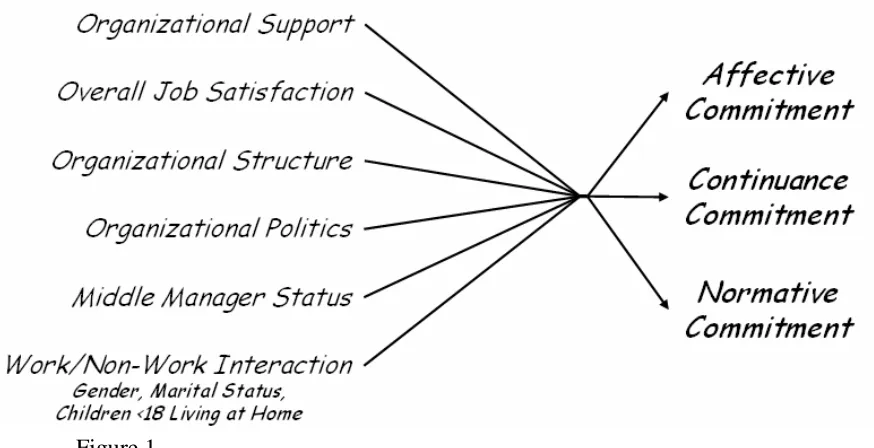
This study will examine the influence of two additional factors that have been identified in the literature as having a possible impact on organizational commitment. The factor of middle manager status is a construct of student affairs professionals who report to a Chief Student Affairs Officer or other senior administrator, have worked in the profession a
minimum of five years, and supervises at least one full-time student affairs professional. The work/non-work interaction factor is a construct that will explore the influence of gender, marital status, and dependent children under theageof18 living in therespondent’shome. Figure 1 illustrates the conceptual model to be used in the present study.
Burns and Stalker (1961), while the conceptualization of global job satisfaction proposed for this study will be the one developed by Ironson, Smith, Brannick, Gibson, and Paul (1989).
Figure 1
Conceptual Framework for Study of Organizational Commitment among Student Affairs Professionals
Significance of the Study
Student affairs professionals generally feel a sense of calling to their work, but attrition statistics suggest that there is a significant personal and professional cost associated with this calling. The impact of the profession on work/non-work interactions, along with increased pressures of student affairs work, may be negatively influencing commitment to the profession. Are there factors within the student affairs organizations themselves that are impacting attrition? The literature suggests that individuals become committed to
contribute to their level of commitment, is an important step in addressing the issue of attrition among student affairs professionals.
The literature also points to various factors that may contribute to affective,
continuance, and normative commitment. The perceived amount of organizational political behavior present in an organization may influence the level of commitment an individual feels to the organization. The level of support perceived by the individual on the part of the organization, reflected in ways such as work/non-work interaction and the social contract between the organization and the individual, may also affect commitment. The actual structure of the organization–whether mechanistic or organic–may influence an
individual’scommitmentto theorganization.
There are also questions regarding the relationship between job satisfaction and organizational commitment. Does satisfaction lead to commitment, and if so to what degree does satisfaction influence global commitment? This study hopes to provide a clear casual path from satisfaction to a greater understanding of organizational commitment among student affairs professionals.
In an era of rapid change, knowledge capital must be retained in order for the organization to remain productive and responsive to the needs of its stakeholders (Bloch, 2001). Although the typical student affairs professional represents a great deal of knowledge capital to the organization, their ability to be effective depends largely on their skill to
manage the political system that either overtly or covertly runs the organization. The student affairs professional must also have support from the organization in order to be effective. They must feel that they have a sense of control over their work, and they need to be in an organizational structure that takes advantage of their skills and abilities. Given the
knowledge capital that is lost if a student affairs professional leaves the field, the study that will lead to a greater understanding of why student affairs professionals become committed– and stay committed–to the organization seems necessary.
Summary
Commitmenthasgenerally been defined as“thecondition ofsomeonewho hasmade
a firm agreement with some otherparty connected to somefutureevent,”or“thestateone
arrivesathaving madeapledgeorpromise”(Brown,1996, p.233). For student affairs
professionals,thiscommitmentmay bebestdescribed asa“calling”.Benveniste(1987)
defines a calling by describing it as a sense of duty that separates professions from other
typesofwork.Studentaffairsprofessionalsseetheir“calling”aspromoting student
With reported attrition levels from 25% to 61%, it would seem that student affairs is an ailing profession, even though student affairs professionals indicate overall job
satisfaction (Jones, 2002; Lorden, 1998). Although student affairs professionals are satisfied with their jobs, something is causing them to leave the profession. Is it possible that there is
asignificantcostofthis“committed calling”? Isthereconflictbetween therhetoricofthe
calling (e.g. promoting student development) and the reality of the daily life of the
administrator, as suggested by Stamatakos (1978)? Even though student affairs professionals generally report high job satisfaction, it seems that hard work and low pay may be leading some to reconsider their decision to enter the profession (Lorden, 1998). If perception in fact creates reality, then an examination of the factors that contribute to student affairs
professionals’perception ofcommitmentmay givearealistic view of the state of student
REVIEW OF THE LITERATURE Introduction
As discussed in the previous chapter, student affairs professionals report that they are satisfied with their jobs, but attrition rates belie those reports (Lorden, 1998). New student affairs professionals enter the profession with idealistic goals of a calling, but learn that there is a conflict between the ideal and the day-to-day (Stamatakos, 1978). Although Lorden (1998) and others see attrition as useful to a degree, this author suggests that what is being lost through attrition is some of the best talent in the profession. Our structures, systems, and practices may be influencing commitment in a negative way for many, including middle managers who hold the promise for the future of the profession.
Meyer and Allen (1997) point out that commitment can have positive and negative aspects for both the employee and the organization. While the organization wants committed employees, there is a danger of employees being so committed to the status quo that the organization loses its competitive edge. For the employee, an over-commitment to an organization may lead to reduced time for outside activities and diminished marketability for jobs outside the organization (Meyer & Allen, 1997).
organizational structure on commitment. In addition, the connection between job satisfaction and commitment will be explored.
Organizational Commitment
There is a general agreement on the characteristics of an organizationally committed individual (Hunt & Morgan, 1994; Jans, 1989), but the method of determining those
characteristicshasundergoneaparadigm shiftduring the1990’s.Theold paradigm assumed
that commitment could be measured in a dualistic manner: one was either committed to the organization or not (Mowday, Steers, & Porter, 1982). Several researchers saw the
limitations of this paradigm and attempted to provide subtle changes to it (Angle & Perry, 1981; Mayer & Schoorman, 1998; Penley & Gould, 1988). Meyer and Allen (1997)
provided the shift of mind when they realized that there are many reasons why an individual may be committed to an organization. This section will define the conceptualization of organizational commitment to be used in this study by exploring the evolution of the
conceptualization of commitment over the past quarter century. This section will also review the connection between organizational commitment and organizational culture.
Commitment Defined
Organizational commitment has been defined as the extent that an individual accepts, internalizes, and views his or her role based on organizational values and goals (Jans, 1989). An individual becomes committed to an organization when (a) they internalize the goals and values of the organization, (b) they are willing to exert effort in the attainment of the
organization’sgoals,and (c)they haveastrong desireto remain in theorganization (Hunt&
organizationalcommitment(Hunt& Morgan,1994).Theinitial“gold standard”modelwas
developed by Porter, Steers, Mowday, and Boulian (1974), which conceptualized an
individual’sattachmentto theorganization in aglobalsense,and examined attitudinal
commitment,ortheconnection between theindividual’svaluesand thatoftheorganization
(Mowday, et al., 1982).
The conceptualization developed by Porter and associates (1974) utilized two factors; attitudinal commitment– thewaysin which employees’valuesmesh with thoseofthe organization–and behavioral commitment– thewaysin which an employeeis“locked in” to an organization (Mowday, et al., 1982). While the goal of their conceptualization was to establish casual connections for attitudinal commitment, causality could not be clearly established (Meyer & Allen, 1997). Mayer and Schoorman (1998) went so far as to describe this early conceptualization asa“unidimensionalconstruct”,arguing thatitdid notfully explain how an individual becomes committed to an organization.
Evolution of the Two-Factor Conceptualization
Hunt and Morgan (1994) posited that the measure of commitment should be a multidimensional construct to reflect both global commitment and commitment to
constituency-specific subgroups. They found that global organizational commitment was the key mediating construct to organizational outcomes, but that constituency-specific
commitmentsareimportantbecausethey “lead to,bring about,orresultin”global
commitment (Hunt & Morgan, 1994). They found that the constituency-specific
finding. Her study discovered that the factors predicting commitment to the department (constituency-specific) were different from the factors that predicted the global commitment to the university (Fjortoft, 1993).
A two-dimensional model of organizational commitment was suggested by several researchers, including Angle and Perry (1981) and Mayer and Schoorman (1998). Using Porter and associates (1974) conceptualization as a starting point, Angle and Perry (1981)
discovered two distinctdimensions,which they termed “valuecommitment”and
“commitmentto stay”.Valuecommitment was defined as an affective, positive connection
with the organization, while commitment to stay reflected the importance of the economic exchange between the employee and the organization (Angle & Perry, 1981). Mayer and
Schoorman (1998)redefined “commitmentto stay”as“continuancecommitment”,and
related theconnection between Angleand Perry’sconceptualization and March & Simon’s
(1958)conceptofemployees’decision to produce (valuecommitment)and to participate
(continuance commitment). This two-factor model was found to be predictive of important behavioral outcomes, and represented two clearly defined dimensions (Mayer & Schoorman, 1998). The study found that increasing one type of commitment would not necessarily affect both commitments (Mayer & Schoorman, 1998).
Three-Factor Models
Several researchers have developed models of commitment that utilize three factors (Penley & Gould, 1988; Jans, 1989; Meyer & Allen, 1997). Penley and Gould (1988)
Gould,1988).Thisreflectsthe“focuson people” posited by Petersand Waterman (1982),
who stated thatorganizationsperform bestwhen thereisintensecommunication,a“family
feeling”,open doorpolicies,fluidity and flexibility,and “nonpoliticalshiftsofresources”.
The conflict between instrumental commitment and affective attachment is described as an
individual’s“basicneed forsecurity versustheneed to stick out”(Peters& Waterman,
1982).
Penley & Gould (1988) built on the work of Angle & Perry (1981) in the development of their three-factor model. They utilized Etzioni’s(1975) model of
organizational involvement, which utilized instrumental and affective attachment, which is
similarto Angleand Perry’smodel(Penley & Gould,1988).Penley and Gould proposed
three dimensions of commitment: moral commitment, which is identification with the
organization’sgoals;calculativecommitment,which isseen astheexchangeof
organizational inducements for employee contribution; and alienative commitment, which is a consequence of a lack of control and a perceived absence of alternatives (Penley & Gould,
1988).Thefindingsfrom Penley and Gould’sstudy indicated thatcommitmentdoes in fact
emanatefrom severaldifferentsources,including theindividual’spersonality-based
predispositions,thesupervisor’sinfluence,and the organizationalculture(Penley & Gould,
1988).
Jans (1989) also believed that thePorterand associates’model was limited in its
scope.Heattempted to develop amodelthataddressed the“non-work”factorsthatinfluence
non-work factors had a significant impact on long-term organizational commitment (Jans, 1989).
Several attempts to reconceptualize organizational commitment explored utilizing multiple dimensions, including a two-dimensional model (Angle & Perry, 1981; Mayer & Schoorman, 1998), which highlights continuance and value commitments, and a three-dimensional model, which explores moral, calculative, and alienative commitments (Penley & Gould, 1988). Another three-dimensional construct explores career/life stage factors, work-family interaction, and career prospects/job involvement factors (Jans, 1989). Each of these studies attempted to find the best way to study why employees remain committed to an organization, but they utilized Porter and associates (1974) conceptualization as a starting point. While these reconceptualizations were improvements in comparison to the original
paradigm,noneofthem wereableto obtain acompletepictureofan individual’s
commitment to an organization. It became clear that a fresh perspective was needed. Meyer and Allen (1997) also realized that organizational commitment needed to be observed using a multiple-component model. Individuals become committed to
organizationsformany differentreasons.Somefind thattheorganization’smission,
commitment–form the basis of a new conceptualization of organizational commitment (Meyer & Allen, 1997).
Meyerand Allen’sreconceptualization oforganizationalcommitmenthasproduced a
model that seems to be a viable alternative to the conceptualization posited by Porter and associates (1974). With over 40 separate studies conducted using their three-construct
model,Meyer& Allen’sconceptualization is a widely accepted theoretical framework (Allen
& Meyer, 1996). Meyer and Allen (1997) have concluded that people become committed to organizations for a variety of reasons,thatitisa“multifaceted construct”and thatthebest approach is to attempt to understand the complexity of this commitment rather than trying to find the best single-dimension model to utilize. The driving force for the development of their model was the changing nature of work, which is requiring companies to find new ways
to “organize”,leading to moreadaptable,flexibleorganizationalforms.Thesenew
organizational forms will impact the types and strength of commitments between the organization and its employees (Meyer & Allen, 1997).
Meyerand Allen (1997)defineorganizationalcommitmentas“reflecting the
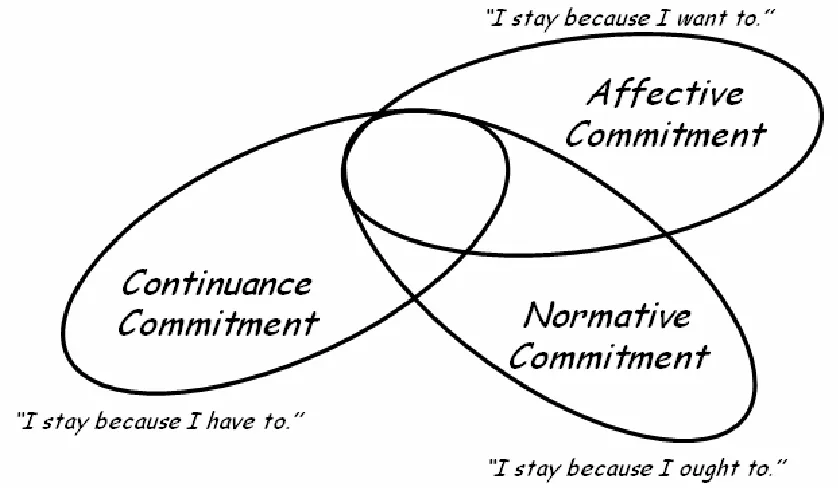
affective orientation toward the organization, a recognition of costs associated with leaving the organization, and a moral obligation to remain with the organization”(p.11). Their three components of commitment reflect this definition. Affective commitment refers to the
employee’s“emotionalattachmentto,identification with,and involvementin the
organization”(Meyer& Allen,1991, p.67). A person with high affective commitment
belongsto an organization becausethey wantto.Continuancecommitmentrefersto “an
awarenessofthecostsassociated with leaving theorganization,”such aslossofprestige,
levels of continuance commitment stays with an organization because they need to do so.
Normativecommitment“reflectsafeeling ofobligation to continueemployment”.
Individuals with high levels of normative commitment stay with an organization because
they feelitisthe“morally right”thing to do fortheorganization (Meyer & Allen, 1991,
p.67).
It is important to point out that Meyer and Allen do not see these three components as
separate“types”ofcommitment,butinterconnected in away thatreflectstheuniquenature
ofeach individual’slevelofcommitmentto an organization (Meyer& Allen,1997).The
model assumes that each individual will have some level of all three commitments. Figure 2
illustratesMeyerand Allen’sconceptualmodel.
Figure 2
The three components of organizational commitment (affective, continuance, normative) based on Allen and Meyer (1991).
continuance commitment. A second employee may have a strong continuance and normative commitment, but a weak level of affective commitment. A third employee may feel a strong continuance commitment, but weak affective or normative commitment. Meyer and Allen (1997) advise researchers to consider the strength of all three forms of commitment together
ratherthan to assign aspecific“type”ofcommitmentto an individual.
Organizational Commitment and Organizational Culture
Organizationalcommitmenthasbeen defined as“an affectiveattachmentto an
organization”reflected in shared values,awillingnessto work on behalfoftheorganization,
and a desire to remain with the organization (Allen & Meyer, 1990a). The reliance on a collection of shared values between the organization and the individual relates to the generalized definition of organizational culture (Bolman & Deal, 1991; Morgan, 1997; Schein, 1985; Wheatley, 1999). It is important to understand the impact of organizational culture on the development of the three forms of organizational commitment that will be used in this study.
Allen and Meyer (1990b) examined the development of organizational commitment
in “newcomers”through theuseoforganizationalsocialization tactics.They utilized a
socialization continuum thatranged from “institutionalized”–a formal, sequential, common
initiation experience– to “individualized”–characterized as an informal, on-the-job training experience. Their findings demonstrated that institutionalized socialization to help the newcomer become part of the organization enhanced affective commitment (Allen & Meyer, 1990b). Meyer, Irving, and Allen (1998) found that positive early work experiences in the organization positively influenced affective commitment. They also found that newcomers
alternatives tended to have higher levels of continuance commitment (Meyer, Irving, & Allen, 1998). These studies indicate that the training and socialization of new employees to
an organization (both factorsoftheorganization’sculture)haveasignificantimpacton their
level of commitment to the organization.
Vandenberg and Scarpello (1994) posited that the value placed on a given occupation
orspecialty by theorganization’sculturehasan influenceon thecommitmentfeltby the
occupation’smembers.Forexample,theinformation technology group of a student affairs
division may be considered more valuable than the leadership development office. This
“value”istranslated into theshared valuesoftheorganization’sculture,and isultimately
reflected in the decision-making policies of the division. The culture would continue to place a higher value on the work of the information technology group, potentially increasing their organizational commitment (Vandenberg & Scarpello, 1994).
Summary
This section has examined the organizational commitment, including its evolution from a measure of global commitment (Porter et al., 1974) to its new reconceptualization that explores the many ways an individual becomes committed to an organization (Meyer & Allen, 1997). Several researchers have attempted to find the best way to measure how and to what extent an individual becomes committed to an organization (Angle & Perry, 1981; Mayer & Schoorman, 1998; Penley & Gould, 1988). Organizational commitment is defined
forthepurposesofthisstudy as“reflecting the affective orientation toward the organization,
a recognition of costs associated with leaving the organization, and a moral obligation to
remain with theorganization”(Meyer& Allen,1997, p.11). Organizational culture seems to
affective attachment to the organization (Allen & Meyer, 1990a; Bolman & Deal, 1991; Morgan, 1997; Schein, 1985; Wheatley, 1999).
Do student affairs professionals–and middle managers in particular–remain committed to student affairs because they connect with the values of the profession, or
because they feel they are too far along a career path to look for something else? Do they stay
becausethey haveearned aMaster’sdegree in student affairs and believe they should earn
something from their education, or because they feel that they simply ought to stay in a profession that has given them so much? While the perspective of organizational commitment proposed by Meyer and Allen (1997) gives a more complete view of the challenges affecting organizational commitment among student affairs professionals, the picture is lacking. In order to gain a deeper understanding of why student affairs
professionals–particularly middle managers–are leaving the profession, it is necessary to
explorehow otherfactorscontributeto an individual’scommitmentto theorganization.
Organizational Politics: How does it contribute to Commitment?
Organizational politics has likely been a factor since the creation of the first business organizations, but it has only received serious attention by researchers in the last twenty-five years (Witt, 1995). The study of organizational politics has its roots in the research on organizational climate, and although it has been perceived as a negative force in
organizational climate, it is the matter of perception that makes organizational politics a topic of interest for this study. Although the connection between organizational politics and organizational support is well defined, an examination of the definition, systemic
Middle managers, as a subgroup of student affairs professionals, have a highly political position. Organizational politics has been defined as social influence directed at individuals who can promote or protect the self-interests of the individual who is attempting the influence (Cropanzano, Kacmar, & Bozeman, 1995). Middle managers are in a position to influence and to be influenced due to their position on the organizational power chart. They are positioned between senior leadership and entry-level staff, and many times have to balance the interests, desires, and needs of both groups (Neelankavil, Mathur, & Zhang, 2000). They tend to have access to information and resources to a greater extent than entry-level professionals, but they do not have the authority and control that senior entry-level
professionals enjoy (Spreitzer, 1996). Looking at college and university housing officers (a
subsetofstudentaffairsprofessionals),Jones(2001)found that“politicaldecision-making
and powerstruggles”had anegativeimpact on job satisfaction among professionals with six
or more years of experience. It seems clear that there is a connection between how student affairs professionals in general–and middle managers in particular–perceive political behavior and its impact on their commitment to the organization
Definition
Organizational politics generally consists of two categories. The first category is the macro or systemic view, which involves the acquisition and use of power to obtain scarce resources when those resources are in conflict (Pfeffer, 1981). The second category is a micro or interpersonal view, which focuses on the self-serving tactics employed by
organizational politics (Cropanzano, Howes, Grandey, & Toth, 1997; Ferris & Kacmar, 1992; Kacmar & Ferris, 1991; Nye & Witt, 1993; Witt, 1995).
Kacmar and Ferris (1991) conceptualized organizational politics as a three-dimensional construct. This construct has become popular for measuring the level of perceived organizational politics in organizations (Cropanzano, et al. 1997; Nye & Witt, 1993). The three dimensions of their model are general political behavior, getting along to get ahead, and pay & promotion.
General Political Behavior
General political behavior is associated with the macro view of organizational politics in such that it involves the development of coalitions within a system that compete for scarce resources. The difference between the macro view and general political behavior is that in the macro view the coalitions compete for business issues. In general political behavior, the competition is for self-serving goals (Witt, 1995). This competition underscores the use of power to gain and maintain control of the political system. Power is expressed by who is allowed to participate in decision-making, the relative power of the individuals or groups making the decision, and even the rules of decision-making (Pfeffer, 1981). Kacmar and
Ferris(1991)expressed generalpoliticalbehaviorin termsoftheexistenceofan “in group”.
These groups direct the actions of the organization in a manner that allocates scarce resources to members of the in group, and adjusts policy to favor in group members. Other ways in
which an “in group”can utilizegeneralpoliticalbehaviorincludecontrolling information,
Getting Along to Get Ahead
Thisdimension ofKacmarand Ferris’(1991)constructrelatesto theexistenceof
“yesmen”in an organization.Compliance with group norms is valued, while dissenting
opinions are not only discouraged, but met with sanctions (Witt, 1995). Getting along to get ahead is related to the concept of Groupthink (Janis, 1983). In his study of geopolitical and military decision-making bodies, Irving Janis developed the concept of Groupthink, which presents a detailed explanation of how the dark side of group cohesiveness, conformity, can lead policy-making bodiestoward normativebehaviorsthat“preservefriendly intragroup
relations”attheexpenseofcriticalthinking and objectionsto themajority view (Janis,
1983).
Janis’Groupthink Syndrome is composed of three types: overestimation of the
group’spowerand mortality;closed mindedness;and pressurestoward uniformity.These
“in group”behaviorswereshown to havebeen majorcontributorsto fiascossuch asTheBay
of Pigs, Pearl Harbor, and Watergate (Janis, 1983). While conformity in most organizations would not lead to blunders as large in scope as Watergate, it is clear that getting along to get ahead can contribute to poor decisions, or at the very least wasteful allocation of resources (Janis, 1993; Kacmar & Ferris, 1991; Witt, 1995).
Pay and Promotion
The dimension of pay and promotion is linked to the concept that people who are a
good “fit”fortheorganization arelikely to bepromoted.Whiletheneed to find individuals
who will be a good fit for the organization should not be overlooked, it is important to
environment where politically active individuals are promoted at the expense of others in the organization (Witt, 1995). Borg (1991) found that mid-level student affairs professionals who left the profession did so because of the lack of pay and promotions. While he did not specifically draw the conclusion that the political aspect of pay and promotion affected the decision-making process of those who left the profession, it could be implied that the perception of a politicized process could be a factor.
Systemic Organizational Politics
As has been previously discussed, organizational politics can take a macro and a micro level view. While the organizational politics construct posited by Kacmar and Ferris (1991) concentrates on the micro level of the organization, it is important to understand how the micro level of organizational politics interacts with the macro–or systemic–level of organizational politics. Organizational politics at the systemic level can be viewed as either a function of normal organizational activity (Morgan, 1997) or a divisive element that impedes effectiveness (Witt, 1995). In either case, the level of political activity allowed by the system affects the individuals within the organization.
Morgan (1997) posits that systemic organizational politics is best understood by focusing on the interaction of interests, conflict, and power. Interests are seen as areas of
concern thatmembersoftheorganization havepredispositionstoward,such asa“pet
project”orcontrolofcertain resources.Conflictsarisewhen onecoalition’sinterests
interferewith anothercoalition’sinterests.Conflictisgenerally seen asadestructiveforce,
conflicts are resolved or perpetuated through the use of power. Power tactics that can be used by individuals and coalitions include control of scarce resources, use of rules, structures and procedures, control of information, control of boundaries, and the ability to cope with uncertainty.
In Morgan’s(1997) view, the political behavior within an organization can be seen as either positive or negative based on how the coalitions and individuals manage conflict. The more positive forms of politics–compromise and collaboration–arise from a moderate to high level of both concern for individual interests and concern for organizational and/or
others’interests.Negativepolitics–such as competitive or accommodating behavior–are a
result of an imbalance between concern for self interests and concern of organizational
and/orothers’interests.Anotherform ofnegative politics–avoidance–is present when
thereisalow levelofconcern foreithergroup’sinterests(Figure3).
Morgan’sview ofsystemicorganizationalpoliticsfocuseson threeaspects;interests,
conflict, and power. Bolman and Deal (1991), in their conceptualization of the political
frameoforganizations,also saw interests(described as“differences”),conflictand poweras
central aspects. In their view, organizational decisions are made asaresultof“bargaining,
negotiation,and jockeying forposition”.Thepoliticalframesuggeststhatpoliticsisnota
Figure 3
Matrix of Positive and Negative Organizational Political Behavior based on Morgan (1997)
ThefocusofBirnbaum’s(1988)politicalinstitution residesin the“loopsof
interaction”among formaland informalgroups.Aswith othersystemicviewsof
organizational politics (Bolman & Deal, 1991; Morgan, 1997) members of various groups form coalitions based on mutual interests. The political institution perspective differs from the previous views in the role of negotiation in the political process. To Birnbaum, coalitions are formed after negotiations among the various groups to determine common interests, potential costs and benefits to each group, the potential power of the coalition, and other factors. The process of forming coalitions happens in larger and larger scales, in order to reach a decision that is designed to benefit either all parties or the coalition that is ultimately the mostpowerful.A third aspectofBirnbaum’spoliticalinstitution istherolethatloose coupling between what is said and what is done almost guarantees incremental change as a
resultofany “political”decision.