TEACHING COMPETENCY AMONG POSTGRADUATE STUDENTS
LILY TING HWA LI
A project report submitted in fulfillment of the Requirement for the award of the degree of Master of Education (Education & Development)
Faculty of Education Universiti Teknologi Malaysia
ACKNOWLEDGEMENT
All the thanks and praises to God the Almighty, who has made the completion of this project report possible.
I would like to thank to my supervisor, Associate Professor Dr. Mohamed Najib Bin Abdul Ghafar, without his guidance, this final manuscript would not be possible.
Special vote of love to my parents, parents in law and husband for their supports, patience and understandings.
ABSTRACT
ABSTRAK
TABLE OF CONTENTS
CHAPTER TITLE PAGE
Thesis Status Certification
Supervisor Certification
Title Page i
Declaration ii
Dedication iii
Acknowledgement iv
Abstract v
Abstrak vi
Table of Contents vii
List of Figures xii
List of Tables xiii
List of Symbols / Short Form xvi
List of Appendices xvii
I INTRODUCTION
1.1 Introduction 1
1.2 Background of Study 3
1.3 Problem Statement 6
1.4 Objectives 7
1.5 Research Questions 7
1.7 Conceptual Framework of the Study 10 1.8 Importance of the Study 12 1.9 Scope & Limitations of Study 13 1.10 Definition and Concept 14
1.10.1 Competency 14
1.10.2 Teaching Competency 14 1.10.3 Competency Test 15 1.10.4 Effective Teaching 16 1.10.5 Profession 16 1.10.6 Subject knowledge 17 1.10.7 Teaching Prowess 17 1.10.8 Updating Knowledge 17 1.10.9 Collegiality 18
1.10.10 Commitment 18
1.10.11 Teacher Student Relationship 18 1.10.12 Empowerment 18 1.10.13 Self-development 19 1.10.14 Remuneration 19 1.10.15 Ethical Code of Conduct 19
II LITERATURE REVIEW
2.1 Introduction 20
2.2 Research on Meanings of Competency 22 2.3 Research on Educators’ Professional
Characteristics 26
2.4 Research on Quality in Initial Teacher
Education 27
2.5 Research on Assessing Competency of
Teacher 29
III METHODOLOGY
3.1 Introduction 32
3.2 Design of Study 32
3.3 Population 33
3.4 Sample 33
3.5 Place and Time of Study 34
3.6 Instrumentation 34
3.7 Pilot Study 39
3.8 Procedure 40
3.9 Data Analysis 41
3.10 Research Calendar 44
IV RESULTS
4.1 Introduction 45
4.2 Demographic Data Analyses 46 4.2.1 Gender of Respondent 46 4.2.2 Age of Respondent 46 4.2.3 Distributions of Respondents’
Ethnic 47
4.2.4 Distributions of Respondent’s Academic Qualification and
Program of Study 48
Postgraduate Students In Faculty of
Education at UTM 50
4.4.1 Skills Scales 51 4.4.2 Concern for School Scales 52 4.4.3 Concern for Student Scales 53 4.4.4 Concern for Self Scales 53 4.5 Relationship between Teaching
Competency and Gender 54
4.6 Relationship between Teaching
Competency and Ethnic 55
4.7 Relationship between Teaching Competency and Teaching
Experience 56
4.8 Relationship between Teaching
Competency and Academic Qualification 57 4.9 Relationship between Teaching
Competency and Program of Study 59 4.10 Relationship between Teaching
Competency and CGPA 62
4.10.1 Relationship between Skills
Scales and CGPA 62
4.10.2 Relationship between Concern for School Scales and CGPA 63 4.10.3 Relationship between Concern
for Student Scales and CGPA 64 4.10.4 Relationship between Concern
for Self Scales and CGPA 65 4.10.5 Relationship between Four
Combined Competency Scales (Overall Competency
V DISCUSSION & CONCLUSION
5.1 Introduction 66
5.2 The Level of Teaching Competency and its Dominant Dimensions (Skills,
Concern for School, Concern for Students and Concer for Self) among Postgraduate
Students at UTM 67
5.3 The Relationship between Teaching Competency and Teachers’ Background That is Gender, Ethnic, Teaching Experiences, Academic Qualifications and Specializations among the
Postgraduate Students at UTM 68 5.4 The Relationship between Teaching
Competency and Academic Performance Among Postgraduate Students at UTM 69
5.5 Practical Implication 70
5.6.1 Suggestions to Executives
Committees of UTM 70
5.6.2 Suggestions to the Ministry of
Education 71
5.6.3 Suggestions to Teachers 72 5.6 Recommendation for Future Research 73
5.7 Conclusion 73
REFERENCES 75
LIST OF FIGURES
NO. TABLE TITLE PAGE
LIST OF TABLES
NO. TABLE TITLE PAGE
3.1 Discipline of PHD and Master Degree programmes in Faculty of Education
and 2008 Enrollment 33
3.2 Teacher’ Competency Scales and Items
Related to Competence Characteristics of
a Teacher 36
3.3 Likert Scales 39
3.4 The Distribution and Collection of
Questionnaires for Courses Involved 41 3.5 Teachers’ Perception Level of Teachers’
Competence 42
3.6 Description of Statistical Tests of the Study 43
3.7 Research Calendar 44
4.1 Distributions of Respondents’ Gender (N=309) 46 4.2 Distributions of Respondents’ Age (N=309) 47 4.3 Distributions of Respondents’ Ethnic (N=309) 47 4.4 Distributions of Respondent’s Academic
Qualification and Program of Study (N=309) 48 4.5 The Mean of Academic Achievement (N=309) 49 4.6 Perception Level of Academic Achievement 50 4.7 Frequencies for Level of Academic Achievement
of Respondents (N=309) 50
Among the Respondents (N=309) 50 4.10 The Mean of Skills Scales Among the
Respondents (N=309) 52
4.11 The Mean of Concern for School Scales
Among the Respondents (N=309) 52 4.12 The Mean for Concern for Student Scales
Among the Respondents (N=309) 53 4.13 The Mean of Concern for Self Scale among
the Respondents (N=309) 54
4.14 Independent-Samples t-test of Competency Scales and Gender Among the Respondents
(N=309) 55 4.15 Testing on Competency Scales and Ethnic
Among the Respondents Using ANOVA
(N=309) 56 4.16 Person Correlation Analysis Between
Competency Scales and Teaching Experience
Among the Respondents (N=309) 57 4.17 Independent-Samples T-test for
Competency Scales and Academic
Qualification Among the Respondents (N=309) 58 4.18 The Means for Competency Scales and
Program of Study Among the Respondents
(N=309) 61 4.19 Pearson Correlation Analysis Between
Skills Scales and CGPA Among the Respondents
(N=309) 63
4.20 Pearson Correlation Analysis Between Concern for School Scales and CGPA
Concern for Student Scales and CGPA
Among the Respondents (N=309) 64 4.22 Pearson Correlation Analysis Between
Concern for Self Scales and CGPA
Among the Respondents (N=309) 65 4.23 Pearson Correlation Analysis Between
Overall Competency Scales and CGPA
LIST OF SYMBOLS / SHORT FORMS
≤ - Less or Same As
% - Percentage
CGPA - Cumulative Grade Point Average
PHD - Doctor of Philosophy
N - Number
Sig. - Significant
LIST OF APPENDIES
APPENDIX TITLE PAGE
A Questionnaires 81
Part I : Background of Respondent and
Academic Achievement
CHAPTER 1
INTRODUCTION
1.1 Introduction
Teaching is an important and professional job in educating million of students; strengthen human capital of a country which will then leading to the changes and the development of a country. Professional work involves highly complex sets of skills, intellectual functioning and knowledge that are not easily acquired and not widely held. For this reason, professions are often referred to as the “knowledge-based” occupations (Hodsonc and Sullivan, 1995). Teaching requires competence and standards that would encompass the principles and guidelines to be accepted world wide, which seem to draw very little interest. Due to the reason mentioned, identifying the characteristics and effectiveness of teacher will be focus in the study of competence testing for teachers.
planned curricula to ensure that prospective teachers demonstrate those qualities prior to certification (Taylor, Middleton III and Napier, 1990).
The National Board for Professional Teaching Standards (NBPTS) in Washington, is one body which leading the way in making teaching a profession that is dedicated to student learning, while upholding high standards for professional performance. It has raised the standards for teachers, strengthened their educational preparation and created performance-based assessments that demonstrate accomplished application of the standards. This clearly emphasizes the need for preparation of educators for high standards of professional achievements.
A number of studies have concentrated on various aspects of the teaching profession (Lusch and O’Brien, 1997; Shestack, 1998) identifying the functions of a teacher (Munoz et al., 2000; Phelps, 2006) or focused on the effective ways of teaching (Analoui, 1995) and studied the changing nature of teacher’s professionalism (Hargreaves and Fullan, 2000).
The need for developing and attaining standards or competence has increased for all teachers in today competitive teaching environment. The standards and competence of teachers create a professional and effective environment of “best teaching” practice. They enable school to confidently create systems, policies and procedures to maintain and ensure high operational quality that leads to exceptional records and management performance.
that the major role in the quality of a school and learning of its students in played by teachers.
1.2 Background of Study
Teaching competency is a set of abilities, knowledge and belief which a teacher possesses and also uses for an effective teaching and learning process. In other words, competency is the possession of sufficient skills and understanding to do certain kind of work satisfactorily. Teaching competency refers to cognitive knowledge of the teacher, which entails effects on student learning. In the educational context, a competency test means a test developed for the purpose of assessing knowledge, skills, value and attitudes of the students and/or teachers. According to Page (1978), a competency test is designed to assess which particulars skill has been learned and practiced.
As proposed by Mahathir (1997), Vision 2020 calls for sustained, productivity-driven growth, which will be achievable only with a technologically literate, critically thinking work force prepared to participate fully in the global economy of the 21st century. In line with and in support of the nation’s drive to fulfill the vision, tertiary education system should foster the development of human capital in preparing to meet the challenges of the coming century (in The Malaysian
smart school: A Conceptual Blueprint, 1997); and teachers are playing significant
roles in educating and shaping students to look forward the challenges.
Further more, according to National Education Blueprint (PIPP) 2006 – 2010 which presented by Ministry of Education, completely outline its focus, main strategies and working plans to influential our national education to be applicable and always fulfill the needs of society in the future. It sounds to preparing an education system which is with international standard, effective and efficient. Development of education is concerning on inflection, equity, quality and effectiveness in education. There are six strategies in PIPP; the fifth strategy which stated to fortify professionalism of teachers with more chary and systematic in selecting new teachers, posting teachers and providing teacher’s welfare was highlighted along for this study.
Along with this strategic, it present that teaching is an important and professional job in educating million of students; strengthen human capital of a country which will then leading to the changes and the development of a country as mentioned before. Teaching profession work involves complex sets of skills, intellectual functioning and knowledge; thus, teaching requires competence and standards that would encompass the principles and guidelines to be effective, practical and accepted world wide.
teachers rarely attain the competence of effective teachers. Teachers will continue to develop their competence throughout their professional lives. Researchers are particularly interested in the comparison of the competence of the novice and the experienced teachers. This is the situation which Reynolds (1992) has tried to describe as “competent teaching along a continuous of experience”. Though there is much concern for the determination of competence of teachers, there is little consensus among educators or teachers on their own practical definition. This is understandable as fundamental questions like “what is good teaching?”, “what constitutes teacher effectiveness?” are hard to define (Brophy, Good and Lanier, 1986) due to the complex nature of teaching as a profession. Meanwhile, how far is the teacher in Malaysia practice their competence, effective and characteristics in teaching and learning progress?
This study is aimed in attaining goal to identify an effective practice and formulate guidelines of the teacher’s competence and characteristics among both novice and the experienced teachers in Malaysia. The view form teachers on term of competence, the good or effective teacher and skills also postulate an important issue to be concentrated in the study. This competence (to develop knowledge, skills and attitude) will enhance and facilitate future teaching competence, as well as can be transferred to other learning institutions.
and school. Teacher professionalism should not be narrowly interpreted, but should include such qualities as creativity, commitment, enthusiasm and intellectual liveliness - all of which have the power to energize teaching and galvanize learning. Thus, this study will investigate the most dominant dimension of teachers’ competence among postgraduate students in Faculty of Education, using teacher performance appraisal checklist. Further more, this research will look into the relationship between teachers’ competence and their class academic achievement among the target group.
There are number of studies have concentrated on various aspects of the teaching profession (Lusch and O’Brien, 1997; Shestack, 1998) and in identifying the functions ways of teaching (Analoui, 1995) and studied the changing nature of teacher’s professionalism (Hargreaves and Fullan, 2000). But no study has identified the profound professional characteristics and competence of a teacher and presented it in a comprehensive model. Therefore, this study will factories the competence, effectiveness, skills and treats in practically with aim develop a comprehensive model of professional and competence characteristics of a teacher that will prepare them for higher standards of competence achievements, as all teaching professions demand standardization and formulation of guidelines in today’s competitive environment. The findings and model that emerge can be applied across different schools and education institutions.
1.3 Problem Statement
1.4 Objectives
The objectives of the study are to investigate:
i. The teaching competency among postgraduate students in Faculty of Education at UTM.
ii. The dominant characteristics of teaching competency among postgraduate students in Faculty of Education at UTM.
iii. The relationship between teaching competency and academic achievement among the postgraduate students in Faculty of Education at UTM.
iv. The relationship between teaching competency and teachers’ demographic background such as gender, ethnics, teaching experiences, academic qualifications and specializations among the postgraduate students in Faculty of Education at UTM.
1.5 Research Questions
The research questions for the study include:
i. What is the level of teaching competency among postgraduate students in Faculty of Education?
ii. What are the most dominant characteristics of teaching competency?
iii. Are there significant relationship between teachers’ competence and their academic achievement among the postgraduate students of Faculty of Education?
1.6 Theoretical Framework of the Study
Theoretically, definitions of competencies serve as the job behaviors people need to display in order to do a job effectively. Woodrufee (1993) asserts that there is a basic distinction between “aspects of the job at which person is competent and aspects of the person which enable them to be competent”. “Aspects of a person” are referring to their knowledge or skills that “enable them to be competent”.
The Ontario College of Teachers (1999) has developed standards of practice for the teaching profession organized around the following five themes: commitment to students and student learning; professional knowledge; teaching practice; leadership and community; and ongoing professional learning (Auger and Wideman, 2000).
In Krishnaveni and Anita (2007), the education profession serves complex goods that are concerned with the development of the student and the future of the society. An educator ought to possess certain characteristics so that he/she is professional in his/her occupation. Thus, there is a theoretical model of educators’ professional characteristics was presented which consists of skill, concern for others and concern for self.
The second sphere consists of the factors: “collegiality”, “commitment” and “teacher” (student relationship). Termed as “Concern for others”, it focuses on his/her characteristics that mainly relate to the people he/she connects or associates with, directly or indirectly. The first factor deals with his/her relationship with peers, whereas the second factor, commitment is concerned with his/her responsibility towards their profession, students, parents, colleagues, management and the institution that employed them. The third factor concerns the relationship with the students with whom his/her major interactions occur. Apart from the teaching aspect, the other relationships like mentoring and respecting the students’ feelings are included in this factor.
The third sphere, “Concern for self” consists of empowerment, self-development and remuneration. These are grouped under “self” as each one of these aspects contributes to the growth of the educator as an individual. Empowerment deals with the autonomy he/she exercises with discretion, power and control. Self-development is related to his/her growth aspect in personal and professional life. Career growth, leadership prospects and self-organization are considered here. Remuneration in terms of monetary reward and recognition factors do have an impact on growth and retention and are identified as vital elements of a profession.
1.7 Conceptual Framework of the Study
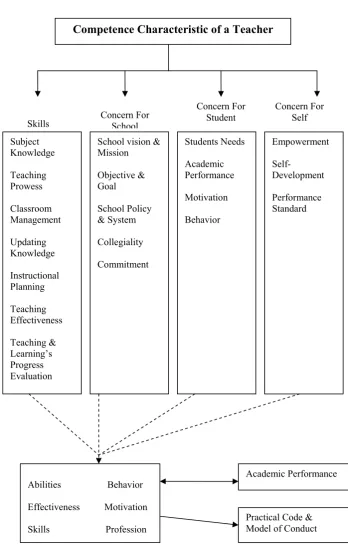
competence characteristics of a teacher are dividing into four scales. They are testing on skills, concern for school, concern for student and concern for self.
Skills scales have seven sub-scales which consist scales on subject knowledge, teaching prowess, classroom management, updating knowledge, instructional planning, teaching effectiveness and; teaching and learning’s progress evaluation.
Concern for school scales have five sub-scales which testing the concerns of teachers on school vision and mission, objectives and goals, school policy and system, collegiality; and commitment.
Concern for student scales have four sub-scales which testing the concerns of teacher on students’ need, academic performance, motivation and behavior.
Concern for self scales have three sub-scales which testing the concerns of teachers on his/her self development, self management and performance standard as teacher.
Figure 1.1: Conceptual Framework of the Study
Competence Characteristic of a Teacher
Skills Concern For School
Concern For Student Concern For Self Subject Knowledge Teaching Prowess Classroom Management Updating Knowledge Instructional Planning Teaching Effectiveness Teaching & Learning’s Progress Evaluation
School vision & Mission Objective & Goal School Policy & System Collegiality Commitment Students Needs Academic Performance Motivation Behavior Empowerment Self- Development Performance Standard
Abilities Behavior
Effectiveness Motivation
Skills Profession
1.8 Importance of the Study
According to Whitty and Willmott (1995), competence was perceived as task being clearly defined and the criteria of success being set out alongside this. It encompasses intellectual, cognitive and attitudinal dimensions as well as performance. Therefore, this study has important implications to most teachers as well as to the schools and educational institutions administrators.
As proposed by Page (1978), a competency test is designed to assess which particular skills have been learned. In educational context, a competency test means a test to develop for the purpose of assessing knowledge, skills, values and attitudes of the students and /or teachers. Teaching competency is a set of abilities, knowledge and belief which teacher possesses and also uses for an effective teaching and learning process. In other words, competency is the possession of sufficient skills and understanding to so certain kind of works satisfactorily. Understanding the terms and concepts of competence will help teachers to develop a controllable belief of own ability, value and profession in regulating teaching and learning strategies while handling students’ needs and academic task. Thus, this study can enlighten postgraduate students cum teachers to their teaching competence and skills thus enabling them to improve their weakness and foster quality competence characteristics.
Findings of this study will reveal practicing teachers who are postgraduate students. Such information can assist their schools’ administers to design the curriculum and/ or intervention programmes to enhance the level of competence as well as promoting optimal academics outcomes (e.g. The Model of Effective Teacher and Professional Characteristics of a Teacher)
refinement in this research area in getting more precise result to be generalized to different schools and higher education teaching context.
1.9 Scope and Limitations of Study
The study is focused on identified teachers’ competencies that been and constantly practiced. The participants are restricted to the postgraduate students in UTM, Skudai. Therefore, the finding may not appropriate to generalize to other schools and learning institutions.
The instrument used in the study is self-report questionnaire. In order to get the effective data, respondents must be both willing and able to answer the questions. Furthermore, these types of questions may not be very good at capturing the actual events or on-going dynamic process of self-regulated strategies.
1.10 Concept and Definition
1.10.1 Competency
According to Wojtczak (2002), competence defined in generic terms as a possession of a satisfactory level of relevant knowledge and acquisition of a range of relevant skills that include interpersonal and technical components at a certain point in the educational process. Such knowledge and skills are necessary to perform the tasks that reflect the scope of professional practices.
A review of the literature showed three main positions taken toward a definition of the term. Competencies were defined as either:
i. Observable performance (Boam and Sparrow, 1992; Bowden and Masters, 1993);
ii. The standard or quality of the outcome of the person's performance (Rutherford, 1995; Hager et al.,1994); or
iii. The underlying attributes of a person (Boyatzis,1982; Sternberg and Kolligian, 1990).
In this study, competency is means the individuals’ abilities such as skills and knowledge that will result in effective and excellent working performance.
1.10.2 Teaching Competency
Teaching competency refers to cognitive knowledge of the teachers, which entails effects on student learning. Page et al. (1979) use the term competency-based teaching which they describe as “the movement in teacher education which aims to train students in specific classroom skills. It includes the use of teaching methods such as interaction process analysis, microteaching simulation etc.”
In this study, teaching competency are referring to ability of teacher in presenting his/her knowledge, capturing effective and efficient skills, concerns for school, students and self which means his/ her has high ability to act as a competent teacher and also as a professional in education field.
1.10.3 Competency Test
In the educational context, a competency test means a test developed for the purpose of assessing knowledge, skills, values and attitudes of the students and/or teachers. According to Page et al. (1979), a competency test is designed to assess which particular skill has been learned.
In this study, competency test means a test that developed for the purpose of assessing the knowledge, skills, concerns, and attitude of teachers. Competency test in this study is testing from four main scales; there are skills scale, concern for school scale, concern for student scale and concern for self scale.
1.10.4 Effective Teaching
does the right thing consistently. To be and effective and efficient teacher, the teacher must have three very important characteristics for student success. Positive expectations, extremely good classroom management skills, and know how to design lessons for student mastery. Positive expectations are essential to student success. When the teacher has high expectations, not high standards, the students will perform to teachers’ expectations.
Effective teaching in this study is described in terms below: i. Has good education and is able to solve problem independently ii. Is a very experienced teacher
iii. Is able to understand and concern students
iv. Know the important of commitment and friendly relationship which will build and create a nice and energetic environment for school and student development.
v. Know how to take the responsibility for things happening in the school
vi. Provide a good example in his/her behaviors vii. Effective time and stress management
1.10.5 Profession
1.10.6 Subject knowledge
The educator’s expertise in respective discipline which is hard earned, thorough in content, extensive enough to assess and that is exhibited with confidence to supplement students in their core skills of the subjects.
1.10.7 Teaching Prowess
The ability of the educator to employ appropriate pedagogy, effective communication skills, and demonstrate classroom management skills competent enough to sustain his/her credibility.
1.10.8 Updating Knowledge
It describes his/her aspiration for updating his/her knowledge and improving the process of teaching through professional training, research and action research.
1.10.9 Collegiality
1.10.10 Commitment
The educator’s personal and professional investment of time and space with dedication to his profession that entails his/her work, institution, colleagues, students and the community.
1.10.11 Teacher student relationship
The educator enrich his/her bond with the students through his/her interpersonal skills and developing a sense of responsibility, confidence and self discipline that enables them to interact freely and effectively in groups and also feel a sense of fair treatment and being attended with care and respect.
1.10.12 Empowerment
The capacity of the educator to engross information and execute autonomy with discretion and control in decision making.
1.10.13 Self-development
1.10.14 Remuneration
The indisputable characteristic which rewards the complexity of the knowledge, skills and capabilities expressed by the educator that motivates and retains the talented individuals.
1.10.15 Ethical Code of Conduct
REFERENCES
Abd. Rahim Abd. Rashid. (2005). Profesionalisme Keguruan: Prospek Dan
Cabaran. (1st ed.) Kuala Lumpur: Dewan Bahasa dan Pustaka.
Albee, J.J. & Piveral, J. (2003). Management Process for Defining and Monitoring Dospositions. Journal of Educational Management, 17(7), 346-356.
Asher, J. William. (1976). Educational Research and Evaluation Methods. Canada: Little, Brown & Company.
Barth, M., Godemann, J., Rieckmann, M. & Stoltenberg. (2007). Developing Key
Competencies for Sustainable Development in Higher Education.8(4),
416-430.
Best, John W. & Kahn, James V. (1998). Research In Education. Needham Street: Allyn and Bacon.
Burden, P.R. & Byrd, D.M. (2003). Methods for Effective Teaching. Boston: Pearson Education Inc.
Chrusciel, D. (2004). Consultant as Teacher or Teacher as Consultant: What is the Relationship? Journal of Leadership & Organization Development, 25(8), 663-667.
Cohen, L., Manion L. and Morrison, K. (2001). Research Methods in Education. (1st ed.) New York: Routledge Falmer.
Connolly, P. (2007). Quantitative Data Analysis in Education: A Critical
Introduction Using SPSS. New York: Rutledge Taylor & Francis Group.
Conrad, Clifton F. & Serlin, Ronal C. (2006). The Sage Handbook for Research in
Education: Engaging Ideas and Enriching Inquriy. New Dehli: Sage
Publications, Inc.
Epstein, D. & Boden, R. (2005). Teaching and Supervision. London: Sage Publications Ltd.
Frankel, Jack R. & Wallen, Norman E. (2003). How To Design and Evaluate
Research in Education. (5th ed.) New York: McGraw-Hill Higher Education.
Gage, N.L. (Eds.). (1963). Handbook of Research on Teaching. Chicago: Rand Mcnally & Company.
Galfo, Armand J. (1983). Educational Research Design and Data Analysis.
England: University Press of America, Inc.
Gall, Meredith D., Gall, Joyce P. & Borg, Walter R. (2003). Educational Research:
An Introduction. (8th ed.) Bostan: Allyn and Balcon.
Gay, L.R. (1987). Educational Research: Competencies for Analysis and
Application. Ohio: Merrill Publishing Company.
Gelman, S. A. (2000). The role of essentialism in children's concepts. Advances in
Gelman, S. A. & Medin, D. L. (1993). What’s so essential about essentialism? A different perspective on the interaction of perception, language, and conceptual knowledge. Cognitive Development, 8,157-167.
Gratton, R. (2004). Teacher Appraisal: A Lesson on Confusion Over Purpose.
Journal of Educational Management. 18(5), 292-296.
Hackeet, S. (2001). Educating for Competency and Reflective Practice: Fostering a Conjoint Approach in Education and Training. Journal of Workplace
Learning, 13(3), 103-112.
Hargreaves, A. (Eds.).2005). Extending Educational Chance: International
Handbook of Educational Cahnge. The Netherlands: Springer .
Hoffmann, T. (1999). The Meanings of Competency. Journal of European
Industrial Training. 23(6), 275-285.
Khim, O.K., Ang, S.Y., Chong, W.L. & Hu, W. S. (2008). Teacher Appraisal and Its Outcomes in Singapore Primary Schools. Journal of Educational
Administration. 46(1), 39-53.
Hasley, A.H., Lauder, H., Brown, P. & Wells, A. S. (2003). Education: Culture,
Economy and Society. Great Clarendon Street: Oxford University Press.
Hodkinson, Phil & Issit, Mary. (1995). The Challenge of Competence. New York: Cassell Education.
Liam, F. (1999). Striving for Success: Assessing the Opportunities. The
International Journal of Educational Management. 13(3), 135-141.
Mohammad Saeed & Mohmood Khalld. (2002). Assessing Competency of
Pakistani Primary School Teachers in Mathematics, Science and Pedagogy.
Journal of Education Management. 16(4), 190-195.
Mohd. Najib Abdul Ghafar. (1999). Penyelidikan Pendidikan. (1st ed.) Skudai: Universiti Teknologi Malaysia.
Mohd. Najib Abdul Ghafar. (2003). Reka Bentuk Tinjauan Soal Selidik Pendidikan.
(1st ed.) Skudai: Universiti Teknologi Malaysia.
Muijs, D. & Reynolds, D. (2005). Effective Teaching: Evidence and Practice. (2nd ed.) London: Sage Publications.
Neuman, W. L. (2003). Social Research Methods: Qualitative and Quantitative
Approaches. (5th ed.) Boston: Education, Inc.
Omar Osman, Salfarina Abdul Gapar & Zainal Abidin Sanusi. 2006. Education for Sustainable Development: The Roles of Universities as Regional Centres of
Expertise. Pulau Pinang: Universiti Sains Malaysia.
Patton, Micheal Quinn. (1980). Qualitative Evaluation and Research Methods. (2nd ed.) California: Sage Publications, Inc.
Painter, S. (2002). Principals’ Efficacy Beliefs about Teacher Evaluation. Journal
Patton, Micheal Quinn. (1980). Qualitative Evaluation and Research Methods. (2nd ed.) California: Sage Publications, Inc.
Petty, G. (2002). Teaching Today: A Practical Guide. (2nd ed.) Cheltenham: Nelson Thornes Ltd.
Rabey, G.P. (2001). Motivation is Response. Journal of Industrial and Commercial
Training, 33(1), 26-28.
Rahimah Haji Ahmad. (1998). Educational Development and Reformation In Malaysia: Past, Present and Future. Journal of Educational Administration, 36(5), 462-475.
Reusser, J., Butler, L., Symonds, M., Vetter, R. & Wall, T. (2007). An Assessment System For Teacher Education Program Quality Improvement. Journal of
Education and Management, 21(2), 105-113.
Smith, R. & Bradley, G. (1994). The Influence of Thermal Concitions on Teachers’
Works and Student Performance.32(1), 34-42.
Sonia Blandford. (2004). Mengurus Pembangunan Professional Di Sekolah. (1st ed.) Selangor Darul Ehsan: Institut Terjemahan Negara Malaysia Berhad.
Stones, E. (1992). Quality of Teaching: A Sample of Cases. (1st ed.) New Fatter Lane: Routledge Famler.
Sufean Hussin. (2002). Dasar Pendidikan Progresif: Prespektif Makro dan Mikro.
(1st ed.) Kuala Lumpur: Utusan Publications & Distributors Sdn Bhd. Sufean Hussin. (2002). Revitalizing Education: Some prospective Policy
Innovations.(1st ed.) Kuala Lumpur: Utusan Publications & Distributors