OPEN ACCESS
EURASIA Journal of Mathematics Science and Technology Education ISSN 1305-8223 (online) 1305-8215 (print) 2017 13(1):3-17 DOI 10.12973/eurasia.2017.00601a© Authors. Terms and conditions of Creative Commons Attribution 4.0 International (CC BY 4.0) apply. Correspondence: Abdul Halim Abdullah, Faculty of Education, Universiti Teknologi Malaysia, 81310 UTM Johor Bahru, Johor, Malaysia,
Mathematics Teachers’ Level of Knowledge and
Practice on the Implementation of Higher-Order
Thinking Skills (HOTS)
Abdul Halim AbdullahFaculty of Education, Universiti Teknologi Malaysia, MALAYSIA Mahani Mokhtar
Faculty of Education, Universiti Teknologi Malaysia, MALAYSIA Noor Dayana Abd Halim
Faculty of Education, Universiti Teknologi Malaysia, MALAYSIA Dayana Farzeeha Ali
Faculty of Education, Universiti Teknologi Malaysia, MALAYSIA Lokman Mohd Tahir
Faculty of Education, Universiti Teknologi Malaysia, MALAYSIA Umar Haiyat Abdul Kohar
Faculty of Management, Universiti Teknologi Malaysia, MALAYSIA
Received 24 January 2016 ▪ Revised 17 July 2016 ▪ Accepted 10 October 2016
ABSTRACT
This study aims to identify the level of knowledge and practice on the implementation of higher-order thinking skills (HOTS) among mathematics teachers at a secondary school in the district of Terengganu. The study focused on the aspects of curriculum, pedagogy and assessment and compared them with demographic factors of the respondents. It used the quantitative approach and adopted descriptive survey method involving 196 respondents. Also, inferential analysis was conducted using Pearson correlation and Multivariate Analysis of Variance Test (MANOVA). The findings showed that the level of knowledge and practice of the assessment aspect was the weakest. Also, there was a relationship between the level of knowledge and practice of HOTS in each aspect. Significant differences exist in the level of knowledge and practice in the implementation of HOTS based on demographic factors such as gender, the location of school and exposure in the HOTS course.
Keywords: higher-order thinking skills (HOTS), curriculum, pedagogy, assessment
INTRODUCTION
M. Mokhtar et al.
Ministry of Education (MOE) (2013) stated that HOTS is the ability to apply knowledge or methods to solve problems creatively, innovatively and consequently able to create a new dimension based on the knowledge that has been learnt.
HOTS was widely introduced in 2013 by the MOE to pursue the continuation of critical and creative thinking skills (CCTS) (MOE, 2013). The three key components which lead to the implementation of HOTS are changes in curriculum, pedagogy and assessment (MOE, 2013). Meanwhile, the elements of co-curricular, community and private supports, capacity building, and the resources will also support the needs of the three most important components. HOTS are implemented explicitly in the aspect of the curriculum since the curriculum standard document emphasises the ability of students to apply, analyse, assess and create knowledge through the process of teaching and learning in schools (MOE, 2013). Therefore, suitable and effective pedagogy needs to be applied in classrooms for students to be trained as creative, innovative and critical thinkers. Teaching and learning styles in Standard Curriculum for Primary Schools (SCPS) and Standard Curriculum for Secondary School (SCSS) also emphasise the principles of HOTS. It is inclined to the theory of constructivism in which students construct their knowledge as well as associating the existing knowledge with the newly learnt knowledge (Nurazilawati et al., 2013). Furthermore, HOTS are implemented in the assessment framework so that students can assess their ability to solve higher-order questions.
Mathematics is an important subject in school, and it is also among complex subjects (Jamil et al., 2008). The implementation of HOTS in the teaching and learning of mathematics is essential to change the stigma of the society on the difficulty of mathematics. HOTS can also attract students to foster their interest in mathematics. Tengku Zawawi et al. (2009) said that mathematics will be appreciated as an easy and fun subject if students are given the opportunity to build their understanding, attitude, and creativity. HOTS are consistent with this notion because one of the indicators highlighted in HOTS is to create continuous learning and instil creativity among individuals.
LITERATURE REVIEW
EURASIA J Math Sci and Tech Ed
Level of Knowledge and Practice of Teachers in the Aspect of Curriculum
Curriculum specification standard covers aspects of objectives, content, methods and assessment in the curriculum (Abdul Rahim, 2007). After the curriculum is established, teachers should play their roles in ensuring the achievement of all the aspects stated in the curriculum. According to Atakpo et al. (2008), change in thinking and attitude of the teachers should also be created to ensure that teachers are open minded to accept knowledge and actual information about the curriculum as well as the policy that is introduced into the national education system. Therefore, knowledge and understanding on HOTS elements are essentially needed. This notion is supported by Salleh (2003); the main factor that determines the success of curriculum dissemination is the ideology or knowledge of those who do the dissemination. The knowledge of curriculum is also one of the fundamental knowledge which teachers need to acquire (Shulman, 1987; Tengku Zawawi, 2009).
The practice of teaching and learning are undertaken by teachers have a close relationship with the knowledge from the aspect of the curriculum. According to Wilkins (2008), there is a significant association between knowledge and proficiency of teachers in a syllabus (SP) and their classroom teaching He also argued that weak proficiency on educational content among teachers may cause absence of confidence in carrying out teaching activities for their students. Therefore, acceptance of the teachers on the introduction of HOTS in mathematics should be taken into consideration for determining the level of HOTS programme practices in the process of classroom teaching and learning. According to Amiza et al. (2012), implementing curriculum changes at a larger scale and is very difficult to implement if the existing curriculum has been adopted for so many years.
Level of Knowledge and Practice of the Teachers from the Aspect of Pedagogy
According to Sabri et al. (2006), most teachers are not proficient in understanding the problems of learning and do not know how to adapt to the appropriate techniques, methods as well as approaches to help students develop mathematics knowledge dynamically and progressively. Anthony and Walshaw (2009) stated that teachers who have deep knowledge of pedagogy can build better procedural skills to challenge and encourage the students’ ideas. As HOTS focus on holistic student participation in learning, the current pedagogy allows teachers to manage learning based on the desired strategy (Abu Bakar, 2013). According to Anthony and Walshaw (2009) and Bales and Saffold (2011), every teacher needs the knowledge of pedagogical content to help students develop and expand the level of understanding on the basic knowledge of mathematics.
M. Mokhtar et al.
objectives. One of the methods for teachers to enhance students’ thinking skills is to use appropriate questions and effective questioning techniques (Supramani, 2006). This notion is also recognised by Adams (2011), who stated that questioning the HOTS questions can improve the students’ understanding of mathematical concepts because they will know the strategy in solving problems and put efforts to prove that every solution has its justification.
Level of Knowledge and Practice of the Teachers from the Aspect of Assessment
In addition to the knowledge of curriculum and pedagogy, teachers also need to be proficient on the aspect of assessment for HOTS implementation in mathematics. Nenty et al. (2007) and Hwa and Lim (2008) highlighted that assessment plays a major role in mathematics education. One of the factors which influence the effectiveness of assessment is the understanding and knowledge of teachers on how assessment being carried out in the education system (Makeleni & Sethusha, 2014; Rasidayanty, 2014). Rasidayanty (2014); Makeleni and Sethusha (2014), argue that teachers need proper programme and training to enhance their knowledge on assessment to improve assessment in schools and classrooms. Every teacher needs in-depth knowledge and skills to assess students in accordance with the specific strategy that is only appropriate for assessing specific objective (Hammond, 2006).
One of the shifts in PPPM 2013-2025 is to upgrade the education quality to international standard by adopting HOTS practices, and this has led to the reshuffling of assessment and examination systems of the country (LPM, 2013). To achieve the objective, Ganapathy and Kaur (2014) argued that all teachers should ensure that classroom assessment and training focus on the elements of HOTS and not only the answer all the questions. Effective assessment is when teachers can recognise levels of students’ learning and also acknowledge the effectiveness of their teaching activities (Nenty et al., 2007; Rasidayanty, 2014). Thus, teachers also need to be proficient in every type of assessment to ensure that the assessment adopted in the classroom is in line with the students’ ability. According to Zhang and Judith (2003), every test or assessment undertaken by teachers needs to have the continuity with learning besides applying the elements of HOTS.
OBJECTIVES OF THE STUDY
The objectives of this study are to:1. To identify the level of knowledge and practice of the teachers from the aspect of the curriculum, pedagogy and assessment in the implementation of HOTS.
2. To study the relationship between the level of knowledge and practice of the teachers on the implementation of HOTS from the aspects of the curriculum, pedagogy, and assessment.
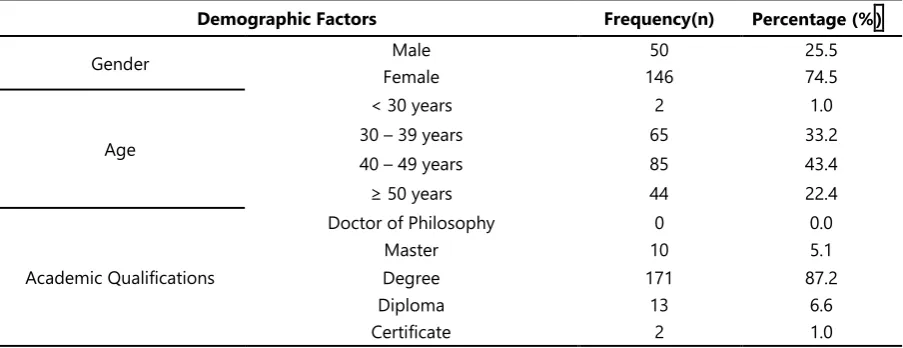
EURASIA J Math Sci and Tech Ed
METHODOLOGY
This study used the quantitative approach and focused on the descriptive survey method. It was conducted in 37 secondary schools in the district of Kuala Terengganu. The researchers chose simple random sampling method to determine the respondents of the study. Based on the table of Krejcie and Morgan (1970), this study involved 196 mathematics teachers as the respondents. The profile of respondents is shown in Table 1. The dependent variables of the study were the effects on the level of knowledge and practice of secondary school mathematics teachers in the implementation of HOTS from the aspects of the curriculum, pedagogy, and assessment. The demographic factors of gender, age, academic qualifications, grade, and years of experience in teaching mathematics, school locations and participation in HOTS courses were stated as independent variables. It was because the researchers wanted to examine whether the demographic statistics were related to the level of knowledge and practice in the implementation of HOTS from all the three aspects or not. The study of knowledge and practice of the secondary school mathematics teachers on the implementation of HOTS, the main statistics used was a set of questionnaire which was in the form of closed questions and applied the Likert scale. This study applied descriptive and inferential statistics by using Statistical Package for Social Science (SPSS) version 16.0 in performing data analysis. The level of knowledge and practice on the implementation of HOTS for each aspect was analysed by using descriptive statistics which analysed frequency, percentage, and mean values. The relationship between knowledge of the practice of all aspects of the implementation of HOTS was analysed through inferential statistics using Pearson correlation method as the dependent and independent variables, and they were represented by interval scale (Chua, 2013; Noraini, 2013). Multivariate Analysis of Variance Test (MANOVA) was applied by the researchers to know the difference of each demographic factor on the dependent variable.
Table 1: Profiles of respondents
Demographic Factors Frequency(n) Percentage (%)
Gender Male 50 25.5
Female 146 74.5
Age
< 30 years 2 1.0
30 – 39 years 65 33.2
40 – 49 years 85 43.4
≥ 50 years 44 22.4
Academic Qualifications
Doctor of Philosophy 0 0.0
Master 10 5.1
Degree 171 87.2
Diploma 13 6.6
M. Mokhtar et al.
FINDINGS OF THE STUDY
All items in section B of the questionnaire on the level of knowledge in the aspect of curriculum showed the relatively high overall mean of 3.91. The findings on the teaching and learning of HOTS from the aspect of curriculum showed an overall mean value of 3.73. Meanwhile, the results of correlation between the level of knowledge on the practice of HOTS from the aspect of the curriculum were found to have moderately strong positive correlation and significant (r=0.52, p<0.01). From the aspect of pedagogy also the findings of the analysis indicated that teachers have a high level of knowledge with an overall mean value of 3.71. The findings on the teaching and learning practice of HOTS from the aspect of pedagogy also showed a high score with an overall mean value of 3.81. The relationship between the level of knowledge on the practice of HOTS from the aspect of pedagogy was positive and moderately strong as well as significant (r=0.54, p<0.01). The findings on the knowledge of HOTS from the aspect of assessment showed an overall mean value relatively low compared to the knowledge of HOTS from the aspect of curriculum and pedagogy in which the value was 3.59. Furthermore, the overall mean for teaching and learning practice of HOTS from the aspect of assessment was also low with the value of 3.58. The relationship between the level of knowledge on the practice of HOTS from the aspect of assessment was positively weak and significant (r=0.46, p<0.01). The level of knowledge should be in line with the practice for the implementation of HOTS to be systematic and smooth. Based on the analysis of the findings, there was a strong positive correlation and significant (r=0.68, p<0.01) between the level of knowledge on the implementation of HOTS as a whole in the classroom (Iran, 2004; Chua, 2013; Noraini, 2013). The correlation between the level of knowledge and practice as a whole was positively strong.
EURASIA J Math Sci and Tech Ed
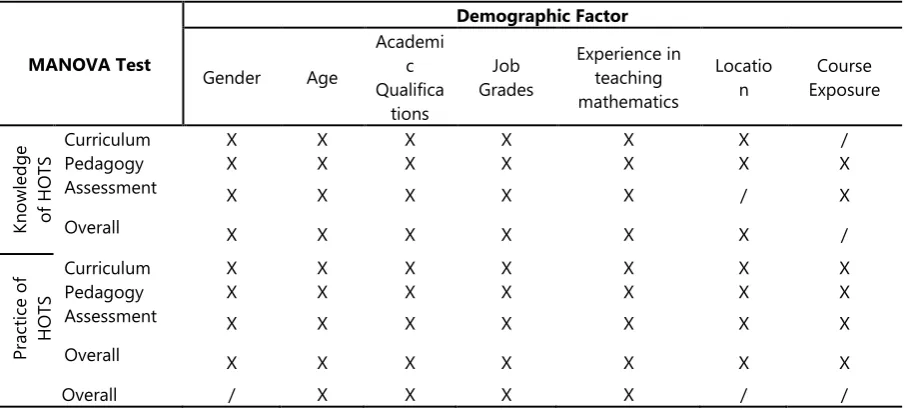
Table 2:Summary of analysis showing the differences among demographic factors on the level of knowledge and practice of HOTS
MANOVA Test
Demographic Factor
Gender Age
Academi c Qualifica tions Job Grades Experience in teaching mathematics Locatio n Course Exposure Kn owl edg e of H O TS
Curriculum Pedagogy X X X X X X X X X X X X X /
Assessment X X X X X / X
Overall X X X X X X /
Pra ct ice of H O TS
Curriculum X X X X X X X
Pedagogy X X X X X X X
Assessment X X X X X X X
Overall X X X X X X X
Overall / X X X X / /
Note: / = there is a difference, x = there is no difference
The results of the study found that there was a major effect of the demographic factor of gender which was significant (F (6,189) =2.29, p<0.05). Another analysis on the dependent variables found that the eight elements had no significant differences based on Bonferroni alpha level (0.05/8=0.00625). The MANOVA test results showed that there was no major effect of gender on all of the dependent variables in this study. Based on the Bonferroni alpha level, the results showed that significantly, the level of knowledge and practice of HOTS was not influenced by gender. The results of multivariate Pillai’s Trace also indicated that there was no effect of age, academic qualifications, grades for the teaching post and years of mathematics teaching experiences on the level of knowledge and practice of HOTS. The MANOVA test analyses were performed on all dependent variables separately, and they clearly showed that there were no significant differences between the four categories of age, five categories of academic qualifications and experiences in teaching mathematics as well as the eight categories of grades for the teaching post on the knowledge and practice of HOTS. These results indicated that age, academic qualifications, grades for the post of instruction and experiences in teaching mathematics among the samples of the study did not influence their level of knowledge and practice of HOTS.
M. Mokhtar et al.
assessment. The latest results of multivariate Pillai’s Trace showed that exposure to the HOTS courses affected the eight dependent variables since the results were significant (F(6,189)=2.29, p<0.05). The MANOVA test analyses performed on all dependent variables separately showed that there were significant differences between the two categories exposure to HOTS course on the level of knowledge of HOTS from the aspect of curriculum (F(1,194)=14.164, p<0.00625) and the overall level of knowledge of HOTS (F(1,194) = 11.526, p <0.00625). These results indicated that the exposure of HOTS course of the samples influenced the level of knowledge of HOTS from the aspect of the curriculum and their overall knowledge of HOTS.
DISCUSSIONS
The overall mean value of the item on knowledge of HOTS from the aspect of the curriculum was 3.91. Knowledge of thinking skills, which is stated as one of the aspirations in the Malaysian Education Development Plan (PPPM), is an item which was agreed by the majority of respondents in the study and received the highest mean value of eight other items. This result showed that the mathematics teachers were sensitive to their surroundings and aware of the current issues in the implementation of HOTS in PPPM. Ifwan (2013) and Rosyahaida (2014) also explained that HOTS were made as one of the key elements highlighted by PPPM and all teachers need to know and understand it. Meanwhile, the item of understanding and knowing to differentiate all the six cognitive levels, namely two cognitive levels in lower order thinking skills (LOTS) and four cognitive levels in HOTS had a mean value of 3.59 and were the two items that received the lowest mean value as compared to other items. Most teachers know the cognitive levels of Bloom’s taxonomy in principle, but they still do not understand the differences and functions of each level in LOTS and HOTS (Nenty, 2007).
EURASIA J Math Sci and Tech Ed
Based on the findings of the study, with the highest mean value of 3.84, it was found that the majority of the teachers learn how to encourage the students to cultivate thinking habits. The implementation of HOTS also able to instil the habits of developing a higher level of thinking skills among students rather than just memorising facts (Siti Marlina, 2013). Meanwhile, with a mean value of 3.51, the third item in section D ‘knowing what thoughtful questioning techniques’ was the lowest mean value. According to Noresah (2007), the thoughtful questioning can be defined as questions which require thinking to find the right answers.
A creative minded society is an important asset in creating human capital that possesses HOTS. The results of the analysis showed that teachers encouraged the students to give new ideas from creative thinking with the highest mean value of 4.03. However, Azhari and Zaleha (2013) and Norsita and Zainal (2014) showed different results when they stated that teachers know how to develop students’ creative thinking, but still they did not practice it in the classrooms. The findings also indicated that the item that was less practised by the respondents was ‘using eight different types of i-THINK mind map’ which the mean value was 3.27. Although the MOE is actively promoting the use of mind map as a form of teaching aid which is appropriate for HOTS (MOE, 2012), most teachers only adopt some parts of the mind map, and they are not proficient in all the eight types of mind mapping.
Assessment is an important aspect and should be the main concern in determining the direction of a programme or national education system. Thus, HOTS elements in the subject of mathematics assessment need to be emphasized since it can measure teachers understanding on the implementation of HOTS in mathematics classroom (Nenty et al., 2007; Serdyukova, 2015). Based on the findings, it was found that the highest value of mean was that the teachers knew the general characteristics of HOTS questions. Most of the respondents chose the scale of agree and strongly agree in this item because they knew the HOTS questions in general, but it did not mean they knew it in specific. This was clearly shown in the fifth item, which was the lowest mean value because most teachers were not sure if they knew the nine principles of assessment of HOTS item or not. The findings of this study showed that the mathematics teachers still did not have in-depth knowledge of HOTS from the aspect of assessment, and this could have an impact on the implementation process of HOTS in mathematics at schools.
M. Mokhtar et al.
Chew and Shashipriya (2014) also highlighted that some teachers believe that thinking can lead to the slow process of delivering education, and it burdens the teachers.
The findings showed a moderately strong and significant positive correlation existed (r=0.52, p<0.01) between the level of knowledge and practice of the mathematics teacher in the implementation of HOTS from the aspect of the curriculum. According to Mohsin et al. (2008) and Muzirah and Farhana (2013), the curriculum is regularly updated so that it can produce quality students and meet the requirements of the current market. However, society needs to know that most of the time what is being practised in schools differs from what is stated in the curriculum (Muzirah & Farhana, 2013). Various constraints on the implementation of the curriculum can be the cause of the discrepancy.
The findings of the analysis also showed a strong and significantly moderate positive correlation (r=0.54, p<0.01) between the level of knowledge on the practice of the teachers in the implementation of HOTS from the aspect of pedagogy. Anuar and Nelson (2015) said that a competent teacher should have a high level of pedagogical knowledge as it can help the teacher to select appropriate and effective teaching strategies. Sole dependence on textbooks does not help teachers in their teaching sessions whereas knowledge on diverse teaching techniques and methods as well as bright ideas can help students to optimize their thinking (Jonathan et al., 2013). This fact shows that the knowledge of pedagogy is closely related to the ability of the teachers to implement HOTS with the students effectively.
The assessment element was the last element considered by the researchers in this study, and it was found that it has a weak significant and positive correlation with the value (r=0:46, p<0.01). The knowledge of HOTS assessment is critical because it aims to help teachers to improve teaching methods and enhance students learning (Serdyukova, 2015). However, most teachers are still weak in the aspect of assessment because they are not exposed to the knowledge of assessment thoroughly and accurately. The knowledge of HOTS assessment is related to the practice of HOTS as Anthony and Walshaw (2009) stated that effective teachers can teach students on how to conduct assessment and evaluation on their work without fully expecting help from the teachers.
EURASIA J Math Sci and Tech Ed
Although demographic factors can have a certain impact on the success of educational policy, it cannot be used as obstacles to implementation of the policy. Based on the findings, the demographic factors of gender, location, and exposure to HOTS courses have certain influences on the implementation of HOTS. While demographic factors of age, academic qualifications, grades of teaching post and years of experience in teaching mathematics did not have any influence the level of knowledge and practice in the implementation of HOTS in mathematics.
According to Qistina and Fredelis (2010); Aminuddin (2014), currently the majority of educators in Malaysia are female and there is a shortage of male teachers. Based on the study, gender is clearly a factor to be taken into account in establishing the country educational system. Although the overall analysis demonstrated that gender had significant differences, the results of separate analyses showed no difference regarding gender and the level of knowledge and practice of HOTS. Nevertheless, the analyses showed that male teachers were more dominant and had higher mean values in most categories of the dependent variable than the female teachers.
Next, the location of schools also gave significant difference to the knowledge and practice on the overall level of implementation and knowledge of HOTS of the teachers in the aspect of assessment. Mathematics teachers who work in rural areas have high knowledge and diverse strategies in applying HOTS. According to Canadian Council on Learning (2008), most of the teachers in rural areas have the advantage of practising effective teaching and learning because the number of students is lesser than the schools in the urban areas. The atmosphere in rural schools is regarded to be more comfortable due to the smaller class size, and the students appreciate the lessons taught by the teachers (Canadian Council on Learning, 2008). Indirectly, this situation can strengthen the relationship between teachers and students as well as two-way learning can be implemented as planned.
Participation in HOTS courses is the last demographic factor that has significant differences on the level of knowledge and practice of HOTS among the mathematics teachers. Based on the findings, it was found that the degree of knowledge of HOTS among the mathematics teachers from the aspect of the curriculum and overall is different between the teachers who have and never participated in HOTS courses. It is because the course content provided by MOE focuses on the introduction of HOTS (MOE, 2012). Previously, teachers only knew Critical and Creative Thinking Skills (CCTS) but not in detail.
CONCLUSION
M. Mokhtar et al.
mathematics at schools. The perception that curriculum is the only concern of the MOE and should not be meddled by teachers need to be changed because only teachers know the path of the curriculum in schools and the level of achievement of a programme that should be implemented on students (Ornstein & Hunkins, 2004).
Next, competence on the aspect of teaching pedagogy is essential since a well-designed curriculum is futile if teachers or group of implementers have no knowledge on pedagogical practice (Mc Aleavy et al., 2013). The knowledge of pedagogy on the implementation of HOTS in the process of teaching and learning should be understood and practised by all teachers because they are the ones who need to use different teaching methods or strategies to produce proficient students in HOTS (Rosma et al., 2012; Caroline & Abdul Said, 2014). This study shows that the aspect of assessment was still at a non-satisfactory level as compared to the other two aspects. Consequently, many teachers are still unable to move away from the practice of exam-oriented education system and teacher centred (BPK, 2012; Caroline & Abdul Said, 2014). The results of this study highlighted how demographic factors influenced the level of knowledge and practice in the implementation of HOTS among the mathematics teachers. One of the results of this study also showed that the exposure of teachers in HOTS courses has given deep impact on the level of knowledge in the implementation of HOTS. Therefore, courses or training on the knowledge and implementation of should be continuously done for teachers to keep abreast of any change and improvement in implementing the knowledge and skills of HOTS in mathematics teaching and learning (Caroline & Abdul Said, 2014).
ACKNOWLEDGEMENTS
The authors would like to thank University Technology Malaysia and Ministry of Education for their financial support. This work was supported by the TIER 2 Encouragement Grant no. Q.J130000.2631.10J70.
REFERENCES
Abdul Rahim Hamdan (2007). Pengajian Kurikulum. Johor Bahru: Universiti Teknologi Malaysia Press. Abdul Razak Idris dan Nor Asmah Salleh (2010). Pendekatan Pengajaran Dalam Pengajaran Dan
Pembelajaran Matematik. Journal of Science and Mathematics Education. 4(1), 1-7. Abdul Said Ambotang, Mohd Yusof Abdullah, Baharom Mohamad dan Shukri Zain (2008),
Pengaruh Pengetahuan Pedagogi dan Kandungan Terhadap Efikasi Guru dalam Pengajaran Ekonomi. Jurnal Majlis Dekan Pendidikan Malaysia. 10 (1), 1-12.
Abu Bakar Nordin. (2013). Kurikulum Ke arah Penghasilan Kemahiran Berfikiran Kritis, Kreatif dan Inovatif. Jurnal Kurikulum & Pengajaran Asia Pasifik. 1(1), 10-18.
Adams, C. (2011). Teaching Problem Solving Skills in Math by Engaging Higher Order Thinking. Masters
Research Project, St. Mary’s College of Maryland.
Aminudin Mansor (2014, April 13). Seimbangkan guru lelaki dan wanita. Sinar Harian. Navigated on April 7, 2015, from http://www.sinarharian.com.my
EURASIA J Math Sci and Tech Ed
Based Education di Politeknik Port Dickson. Prosiding Seminar Pendidikan. Politeknik Port Dickson: Negeri Sembilan, 1-15.
An, Q. Xu, D. dan Brooks, G. P. (2013). Type I Error Rates and Power of Multiple Hypothesis Testing Procedures in Factorial ANOVA. Multiple Linear Regression Viewpoints. 39(2), 1-16.
Anuar Ahmad dan Nelson, J. (2015). Pengaruh Kompetensi Kemahiran Guru Dalam Pengajaran Terhadap Pencapaian Akademik Pelajar Dalam Mata Pelajaran Sejarah. Jurnal Kurikulum & Pengajaran Asia Pasifik. 3(2), 1-11.
Anthony, G. dan Walshaw, M. (2009). Effective Pedagogy In Mathematics. Switzerland: International Academy of Education.
Atakpo, T. E., Oghuvwu, E. P. dan Musa, R. J. (2008). Challenges in Implementing the Primary School Curriculum in Nigeria. Journal of the National Council on Educational Reconstruction. 1(1), 34-37. Azhari Mariani dan Zaleha Ismail. (2013). Pengaruh Kompetensi Guru Matematik Ke Atas
Amalan Pengajaran Kreatif. 2nd International Seminar on Quality and Affordable Education. Universiti teknologi Malaysia, Johor, 181-187.
Bahagian Pembangunan Kurikulum (2012). Membudayakan Kemahiran Berfikir. Kuala Lumpur: Ministry of Education of Malaysia.
Bales, B. L. dan Saffold, F. (2011). A New Era in the Preparation of Teachers for Urban Schools: Linking Multiculturalism, Disciplinary-Based Content, and Pedagogy. Urban Education. 46(5), 953–974.
Canadian Council on Learning. (2008). Rural-Urban Gap Education. Navigated on January 14, 2015, from http://www.ccol.com.my
Caroline L. D. dan Abdul Said Ambotang. (2014). Profesionalisme Guru Novis dalam Pengurusan Pengetahuan, Kesediaan Mengajar dan Kemahiran Berfikir Aras Tinggi (KBAT) Terhadap Pelaksanaan Pengajaran. Seminar Kebangsaan Integriti Keluarga 2014. 11 December, Universiti Malaysia Sabah.
Chew, F. P. Dan Shashipriya, N. (2014). Pelaksanaan Kemahiran Berfikir Kreatif Dan Kritis Dalam Pengajaran Dan Pembelajaran Komsas Di Sekolah Menengah. Jurnal Pendidikan Bahasa Melayu. 4(2), 10-24
Chua, Y. P. (2013). Asas Statistik Penyelidikan: Analisis Data Skala Likert. (2nd Edition). Selangor: McGraw Hill Education Sdn. Bhd.
Cope, L. (2014). Task Analysis and Implementation Activities as Vehicles for Middle School Math Teacher Growth. Delta Journal of Education. 4(2), 11-23.
Forster, M. (2004). Higher Order Thinking Skills. Research Developments. 11(1), 10-15.
Ganapathy, M. dan Kaur, S. (2014). ESL Students’ Perceptions of the use of Higher Order Thinking Skills in English Language Writing. Advances in Language and Literary Studies. 5(5), 80-87.
Grice, J. W. dan Iwasaki, M. (2007). A Truly Multivariate Approach to Manova. Applied Multivariate Research. 12(3), 199-226.
Hammond, L. D. (2006).Constructing 21st Century Teachers Education. Journal of Teacher Education. 57(1), 1-15.
Hwa, T. Y. dan Lim, C. S. (2008). Implementing School-Based Assessment: The Mathematical
M. Mokhtar et al.
Ifwan Tun Tuah (2013, Julai 31). Rangsang Kemahiran Berfikir Aras Tinggi. Berita Harian. Navigated on September 14, 2014, from http://www.bhonline.com.myIran Herman. (2004). Statistik dan analisis data sains sosial. Publisher of Ustara, Kedah
Jamil Ahmad, Norlia Goolamally & Norhashimah Saad (2008). Miskonsepsi Matematik-Satu Refleksi.
Seminar Kebangsaan Pendidikan Sains dan Matematik. 11 12 October. Johor, Malaysia: Universiti Teknologi Malaysia.
Jonathan, L. B., Thiede, K., Strother, S., Bunning, K. & Peck, D. (2013). Developing Mathematical
Thinking: Changing Teachers’ Knowledge and Instruction. Journal of Curriculum and Teaching.
2(2), 62-75.
Krejcie, R. V., & Morgan, D. W. (1970). Determining sample sizes for research activities. Educational and Psychological Measurement, 607-610
Ministry of Education, Malaysia (2012). Pelan Pembangunan Pendidian Malaysia 2013- 2025.
Ministry of Education, Malaysia (2013). Inisiatif Kemahiran Berfikir Aras Tinggi di Sekolah.
Makeleni, N. T. dan Sethusha, M. J. (2014). The Experiences of Foundation Phase Teachers in Implementing the Curriculum. Mediterranean Journal of Social Sciences. 5(2), 103-109.
Murray, E. C. (2011).Implementing Higher-Order Thinking In Middle School Mathematics Classrooms. Doctor of Philosophy, Athens, Georgia.
Muzirah Ab Mokhti dan Nurhana Mohamad Rafiuddin. Persepsi Guru Sains Yang Mengamalkan Lesson Study Sebagai Program Pembangunan Profesional Guru Terhadap Keberkesanan Pengajaran Dan Pembelajaran. Proceeding of the Global Summit on Education 2013. 11-12 March 2013. Kuala Lumpur, 516-534
Nelson, B. S. dan Sassi, A. (2000). Shifting Approaches to Supervision: The Case of Mathematics Supervision. Educational Administration Quarterly. 36(4), 553-584.
Nenty, H. J., Adedoyin, O. O., Odili, J. N. dan Major, T. E. (2007). Primary Teacher’s Perceptions of Classroom Assessment Practices as Means of Providing Quality Primary/basic Education by Botswana and Nigeria. Educational Research and Review. 2 (4), 74-81.
Nooraini Othman dan Khairul Azmi Mohamad (2014). Thinking Skill Education and Transformational Progress in Malaysia. International Education Studies. 7(4), 27-32.
Noraini Idris (2013). Penyelidikan dalam Pendidikan. (Edisi ke-2). Selanggor: McGraw Hill Education Sdn. Bhd.
Noresah Ahmad (2007). Kamus Dewan Edisi Keempat. Selangor: Dewan Bahasa dan Pustaka.
Nurazilawati Abdullah, Abdul Talib Hashim, Rosnidar Mansor, Noraini Mohamed Noh, Norul Haida Reduzan. (2013, Jun). Konstruktivisme: Dari Kaca Mata Guru Sains Dan Matematik.
International Conference On Social Science Research, ICSSR 2013. 4-5 June. Penang, Malaysia, 1231-1242.
Ornstein, A. C. dan Hunkins, F. P. (2004). Curriculum Foundation: Principles and Issues. (Edisi ke 4). Boston: Pearson Publication.
Qistina Binti Abdullah & Fredelis Bin Stephen.(2010). Kekurangan Pelajar Lelaki Menceburi Profesion Perguruan Sebagai Kerjaya: Satu Tinjauan. Unpublished thesis. Universiti Teknologi Malaysia. Rasidayanty Saion (2014). Persepsi Guru-Guru Kemahiran Hidup Bersepadu Terhadap Literasi Pentaksiran
Dalam Pelaksanaan Pentaksiran Berasaskan Sekolah. Master of Technical Education and Vocational, University Tun Hussein Onn Malaysia
EURASIA J Math Sci and Tech Ed
Salleh Abd. Rashid (2003). Pemikiran Profesional Keguruan Terhadap Kurikulum dan Pengajaran. School of Social Education and Development: Universiti Malaysia Sabah.
Serdyukova, N. (2015). What Does Indirect Assessment Tell Us?. Journal of Research in Innovative Teaching. 8(1), 161-172.
Shamsiah Sidek, Nurin Abdul Majid, Nelly Ezatul Fazlina Md Sah, Hamidah Mohamed dan Mohd Noor Hashim (2010). The role of TVET teachers in school based assessment of vocational electives subjects at Sekolah Menengah Kebangsaan Dato‟ Onn, Batu Pahat, Johor. World Congress on Teacher Education for TVET in conjunction with World Teachers Day Celebration. 5 - 6 October. Universiti Tun Hussein Onn Malaysia, 203-229.
Shulman, L. S. (1987). Knowledge and Teaching: Foundations of the New Program. Harvard Educational Review. 57(1), 1-21.
Siti Marlina Sabran (2013). Kemahiran Berfikir Aras Tinggi (KBAT) Pelajar Tingkatan 5 Dalam Penyelesaian Masalah Matematik. Masters. Universiti Teknologi Malaysia, Skudai.
Supramani, S. (2006). Penyoalan Guru: Pemangkin Pemikiran Aras Tinggi Murid. Jurnal Pendidikan. 225-246.
Tan, W.C., Baharuddin Aris dan Salleh Abu (2006). GLOTT Model: A pedagogically enriched design framework of learning environment to improve higher order thinking skills. Association for the Advancement of Computing in Education Journal, 14(2), 139-153.
Tengku Zawawi Tengku Zainal, Ramlee Mustapha dan Abdul Razak Habib (2009).
Pengetahuan Pedagogi Isi Kandungan Guru Matematik bagi Tajuk Pecahan: Kajian Kes di Sekolah Rendah. Pendidikan Malaysia, 34(1), 131-153.
Thompson, T. (2008). Mathematics Teachers’ Interpretation of Higher-Order Thinking In
Bloom’s Taxonomy. International Electronic Journal of Mathematics Education. 3(2), 96-109.
Wilkins, J. M. (2008). The Relationship Among Elementary Teachers’ Content Knowledge, Attitudes,
Beliefs And Practice. Journal of Mathematics Teacher. 11(2), 139-164.
Yeam, K. P. (2007).Tahap Pencapaian dan Pelaksanaan Kemahiran proses Sains dalam Kalangan Guru Pelatih. Masters, Universiti Sains Malaysia.
Zhang, Z. dan Judith, A. B. (2003). Classroom Assessment Practices and Teachers’ Self Perceived
Assessment Skills. Applied Measurement in Education. 16(4), 323–342