THE IMPACT OF MOBILE COMPUTER-BASED PHYSICS LABORATORY IN LEARNING FORCES AND MOTION
NUR HAZWANI BINTI ZAKARIA
THE IMPACT OF MOBILE COMPUTER-BASED PHYSICS LABORATORY IN LEARNING FORCES AND MOTION
NUR HAZWANI BINTI ZAKARIA
A thesis submitted in fulfilment of the requirements for the award of the degree of
Doctor of Philosophy (Physics Education)
Faculty of Education Universiti Teknologi Malaysia
iii
ACKNOWLEDGEMENT
Bismillahirahmanirrahim. Alhamdulilah. All praises be to Allah the Almighty, the Most Gracious and the Most Merciful, for granting me the assistance to complete this thesis.
I would like to express my gratitude to my supervisor, Assoc. Prof. Dr. Fatin Aliah Phang for her dedication, encouragement, critiques and continuous support. Only Allah can repay her kindness. She guided me through ups and downs throughout my PhD journey. Also, Assoc. Prof. Dr. Mohamad Bilal Ali, Dr. Norazrena Abu Samah and Dr. Abd Khamim Ismail. Only Allah can repay you, Insha’Allah.
Special thanks to all Sinergi friends, especially Najihah, Nurolbiah, Intan, Anis, Rohani and Suraiya. Your thoughts and motivation inspire me during my journey.
v
ABSTRACT
ABSTRAK
vii
TABLE OF CONTENTS
CHAPTER TITLE PAGE
DECLARATION ii
DEDICATION iii
ACKNOWLEDGEMENTS iv
ABSTRACT V
ABSTRAK vi
TABLE OF CONTENTS vii
LIST OF TABLES xiii
LIST OF FIGURES xv
LIST OF SYMBOLS xvii
LIST OF APPENDICES xviii
1 INTRODUCTION 1
1.1 Introduction 1
1.2 Background of the Problem 3
1.2.1 Students’ Interest towards Physics
through Computer-based Experiment 5
1.2.2 Forces and Motion 6
1.2.3 Conventional experiments and
Computer-based experiments 7 1.2.4 Microcomputer-based Laboratory (MBL) 9 1.2.5 Mobile Science Laboratory (MSL) 11 1.2.6 Teaching and Learning Module 14 1.2.7 Students in Rural Area, Experiential
1.2.8 Students’ Higher Order Thinking Skills
(HOTS) 17
1.3 Problem Statement 19
1.4 Research Objectives 20
1.5 Research Questions 21
1.6 Research Hypothesis 22
1.7 Significance 22
1.8 Theoretical Framework 24
1.9 Conceptual Framework 31
1.10 Operational Definitions of Terms 34
1.11 Conclusion 38
2 LITERATURE REVIEW 39
2.1 Introduction 39
2.2 Experiential Learning Theory 40
2.3 Self – determination Theory 45
2.3.1 Interest 46
2.3.2 Perception 51
2.4 Revised Bloom’s Taxonomy 54
2.5 Overview of Physics Experiments in
Secondary Schools 57
2.6 The Microcomputer-based Laboratory (MBL) 59 2.7 The Mobile Science Laboratory (MSL) 63 2.7.1 Development of MSL Vehicle 76
2.7.2 Funds 77
2.7.3 Learning Module in MSL 78 2.8 Forces and Motion and Achievement in
Physics 80
2.9 PASCO 82
2.10 Inquiry-discovery in Physics Teaching and
Learning Strategy 83
2.11 Teaching and Learning Method 88
ix
3 RESEARCH METHODOLOGY 91
3.1 Introduction 91
3.2 Research Design 91
3.3 Procedure 95
3.4 Research Method 98
3.5 Research Instrument 99
3.5.1 MCPL Teaching and Learning Module 100 3.5.2 Forces and Motion Conceptual
Evaluation (FMCE) 103 3.5.3 Intrinsic Motivation Inventory (IMI) 103 3.5.4 The Instrument to Measure Perception
towards MCPL (IMP-MCPL) 104
3.5.5 Interview Protocol 105
3.6 The Physics on the Go (PoTGo) 109
3.7 Population and Sample 110
3.8 Pilot study 111
3.8.1 Validity 111
3.8.2 Reliability 113
3.9 Data Analysis 115
3.9.1 Level of students’ interest in Physics 115 3.9.2 Students’ achievement in Forces and
Motion 116
3.9.3 Students’ achievement at HOTS in
Forces and Motion 118 3.9.4 Students’ perception toward the use of
MCPL 119
3.9.5 Qualitative data analysis 120
3.9.6 Trustworthiness 120
3.10 Conclusion 121
4 QUANTITATIVE DATA ANALYSIS 122
4.1 Introduction 122
4.3 Descriptive Analysis for Students’ Interest 123
4.3.1 Pre test 123
4.3.2 Post test 124
4.4 Level of students’ interest in Physics before
the use of MCPL 125
4.5 Level of students’ interest in Physics after the
use of MCPL 125
4.6 Difference in the Level of students’ interest in
Physics before and after the use of MCPL 126 4.7 Descriptive Analysis for Students’
Achievement 128
4.7.1 Pre test 129
4.7.2 Post test 131
4.8 The students’ achievement in Forces and
Motion before the use of MCPL 134 4.9 The students’ achievement in Forces and
Motion after the use of MCPL 134 4.10 Difference in the students’ achievement in the
topic of Forces and Motion questions before
and after the use of MCPL 135
4.11 Descriptive Analysis for Students’
Achievement at HOTS 136
4.11.1 Pre test 136
4.11.2 Post test 138
4.12 Students’ achievement in the topic of Forces
and Motion at HOTS before the use of MCPL 140 4.13 Students’ achievement in Forces and Motion
at HOTS after the use of MCPL 141 4.14 Difference in the students’ achievement in the
topic of Forces and Motion at HOTS before
and after the use of MCPL 141
xi
4.17 The Contents that are suitable for the MCPL teaching and learning module for the topic of
Forces and Motion 145
4.18 Conclusion 146
5 QUALITATIVE DATA ANALYSIS 148
5.1 Introduction 148
5.2 Overview of data analysis procedure 148
5.3 Coding 150
5.4 Sub-theme 170
5.5 Analysis of Sub-theme 177
5.6 MCPL impacts on Experiential Learning, Interest, Conceptual understanding and Perception by the students
and teachers 184
5.6.1 Experiential Learning helps in Learning
Forces and Motion 184 5.6.2 MCPL perception by the students 187 5.6.3 MCPL perception by the teachers 190 5.6.4 MCPL influences students’ interest 191 5.6.5 MCPL influences the students’
conceptual understanding in Forces and
Motion 194
5.6.6 The framework of MCPL for the teaching and learning Forces and Motion using Experiential Learning Theory in
Malaysian School 197
5.7 Conclusion 209
6 DISCUSSION, CONCLUSION AND
RECOMMENDATION FOR FUTURE WORKS
200
6.1 Introduction 200
6.3 Discussion on research findings 203 6.3.1 Students’ interest in Learning Forces and
Motion 203
6.3 2 Students’ achievement in Forces and
Motion 205
6.3.3 Experiential Learning influences
students’ learning 207 6.3.4 Perception by the students and teachers
on MCPL 209
6.4 Recommendations 215
6.5 Implication 219
6.6 Limitation 221
6.7 Recommendation for future research 222
6.8 Conclusion 223
REFERENCES 225
xiii
LIST OF TABLES
TABLE NO. TITLE PAGE
1.1 Some examples of MSLs in the world 13
2.1 The MSLs project, domain and webpage link 65
2.2 Type of inquiry-based learning (NRC, 2000) 85
3.1 Timeline for MCPL intervention 98
3.2 Development of MCPL Module 101
3.3 Items and constructs in analysing students’ interest 103
3.4 IMP-MCPL constructs and SPTDWB 106
3.5 Research objective, research question, instrument and
data analysis 110
3.6 Coefficient and relation between variables (Noraini, 2013)
111
3.7 Range of score and conclusion for level of interest 112 3.8 Range of score and conclusion for achievement 114 3.9 Range of score and conclusion for achievement at
HOTS 117
3.10 Range of score and conclusion for perception 125 3.11 Phases and process in thematic analysis (adapted Braun
and Clarke, 2006)
127
4.1 Level of interest before the use of MCPL 135
4.2 Level of interest after the use of MCPL 136
4.3 Wilcoxon Signed-Ranks Statistical Analysis for interest
before and after the use of MCPL 139
4.6 Descriptive analysis of post test for achievement 143 4.7 Respondents’ score with conclusion for post test 145 4.8 Wilcoxon Signed-Ranks Statistical Analysis for
achievement before and after the use of MCPL 146 4.9 Descriptive analysis of pre test for achievement at
HOTS 148
4.10 Respondents’ score at HOTS with conclusion before the
use of MCPL 149
4.11 Descriptive analysis of post test for achievement at
HOTS 150
4.12 Respondents’ score at HOTS with conclusion after the
use of MCPL 151
4.13 The paired sample statistics for differences between score for achievement at HOTS before and after the use
of MCPL 153
4.14 Students’ perception 156
4.15 Summary for quantitative analysis 157
5.1 Respondents’ details 160
5.2 Example of code and sub-theme 161
5.3 List of codes and sub-themes 180
5.4 Excerpt with Sub-theme to the code 189
6.1 Comparison between Experiential Learning Theory (Kolb, 1984) and Experiential Learning Theory used in
xv
LIST OF FIGURES
FIGURE NO. TITLE PAGE
1.1 Experiential learning theory (Kolb, 2009; Kolb, 1984) 27 1.2 The cognitive and knowledge dimensions of the
Revised Taxonomy (Krathwohl, 2002) 30
1.3 Theoretical framework 30
1.4 Conceptual framework 33
2.1 Kolb’s experiential learning theory (Healey and
Jenkins, 2000; Kolb and Kolb, 2005; Kolb, 1984). 43 2.2 Teaching strategies promoting higher order thinking
skills and their impact on students’ critical thinking
(Miri et. al., 2007) 56
2.3 The plan for MSL of MOBILIM (Erol et al., 2012) 77
2.4 Arrangement of apparatus in the experiment 83
3.1 The sequential explanatory design for the study
(adapted from Creswell, 2003; 2009) 93
3.2 Research design 93
3.3 The phases in MCPL intervention from ADDIE Model 95
3.4 Some activities during intervention 97
3.5 Features of MCPL Teaching Module 101
3.6 Features of MCPL Learning Module 102
3.7 DC-AC converter attached to PoTGo 110
4.1 Histogram for data distribution (pre test for
achievement) 130
4.3 Histogram for data distribution (post test for
achievement) 133
4.4 Q-Q plot for data distribution (post test for
achievement) 133
4.5 Histogram for data distribution (pre test for
achievement at HOTS) 137
4.6 Q-Q plot for data distribution (pre test for achievement
at HOTS) 137
4.7 Histogram for data distribution (post test for
achievement at HOTS) 139
4.8 Q-Q plot for data distribution (post test for achievement
at HOTS) 140
5.1 Experiential learning in learning Forces and Motion 186 5.2 Characteristics of MCPL perceived by the students 189 5.3 Characteristics of MCPL perceived by the teachers 191
5.4 MCPL affects students’ interest 194
5.5 MCPL affects students’ conceptual understanding 196 5.6 Framework of MCPL teaching and learning Forces and
xvii
LIST OF SYMBOLS
LIST OF APPENDICES
APPENDICES TITLE PAGE
A Approval Letter by Department of Boarding School
and Excellent School 238
B JPN Johor Approval Letter 239
C Approval Letter by EPRD 240
D Consent Letter 241
D1 The development of MCPL Module 242
E Force and Motion Conceptual Evaluation (FMCE) 244
F Intrinsic Motivation Inventory (IMI) 294
G Instrument to Measure Perception- Mobile
Computer-based Physics Laboratory (IMP-MCPL) 298
G1 Interview protocol for respondents (teachers) 302 G2 Interview protocol for respondents (students) 303
H Validity of FMCE 304
I Validity of IMI 306
J Validity of IMP-MCPL 308
K Validity of MCPL Teaching Module 309
L Validity of MCPL Learning Module 310
M Validity of Interview Protocol 314
N Frequency of score students’ interest before using
MCPL 316
O Analysis every item for students’ interest 317
P Frequency of score students’ interest after using MCPL 320 Q Frequency for before and after using MCPL for
xix
R Frequency for Achievement before using MCPL 322
S Frequency for Achievement after using MCPL 323
T Difference of gain before and after the use of MCPL
for achiement 324
U Frequency of score (pre test for achievement at HOTS) 325 V Frequency of score (post test for achievement at HOTS) 326 W Difference of gain before and after the use of MCPL for
students’ achievement at HOTS 327
X Analysisof Perception 328
Y Analysis by constructs 329
CHAPTER 1
INTRODUCTION
1.1 Introduction
2
In Malaysia, Science is a combination of the three core subjects which are Biology, Physics and Chemistry (MOE, 2013; Tan, 1991). Based on the Secondary School Integrated Curriculum, better known as Kurikulum Bersepadu Sekolah Menengah (KBSM), Form 1 to Form 3 students (aged 13 to 15) learn Science at the introductory level. Form 4 and 5 students (aged 16 to 17) then choose to enrol in either the Science stream or Art stream (MOE, 2013). In the Science stream, they can learn Physics, Chemistry and Biology more deeply as separate subjects (MOE,2013). In particular, Physics education has been emphasised recently due to the government's intention to have more experts and professionals in science by the year 2020, in conjunction with Vision 2020 (MOE, 2013). As one of the STEM subjects, Physics shows lower enrolment at university level compared to Chemistry and Biology (Ffiseg and Bghymru, 2010; Sawtelle, Brewe, and Kramer, 2012). There is a vital need to explore the Physics curriculum, teachers’ pedagogical approaches and students' thinking in order to produce students skilled for the 21st century.
Currently, ICT is being used widely in Malaysia in every aspect of life at work and at home. For teaching and learning, computer aided teaching has been practised by most teachers but is still not yet being used in the school laboratory. Computer-based experiments are an example of experiments that have used computers and probewares that minimize the time required for carrying out experiments and data collection. Such experiments have relevance to science teaching involving sophisticated apparatus (Dimian, Cojocariu, and Ursuleanu, 2012).
laboratories is a way to improve Physics education. Alongside, it is hoped that teachers and students can also benefit from this research.
There is a decline in the number of students in the science stream at secondary as well as tertiary level (Ffiseg and Bghymru, 2010; Sawtelle, Brewe, and Kramer, 2012; Carlone, 2003; Trumper, 2006; Kamisah, Zanatun and Lilia, 2007). Research has been carried out to identify factors underlying the decline in science enrolments, in order to promote student attachment to scientific and technological disciplines (Richardson, 2013), including Physics (Mujtaba and Reiss, 2012; Bøe and Henriksen, 2013). The Ministry of Education in Malaysia (MOE) has implemented a policy to increase the number of students in the science stream in upper secondary school. However, the 60:40 policy is yet not been achieved (Mohd Salleh et al., 2012). Therefore, appropriate actions should be taken to promote interest among students in science and technology, as we need more expert professionals such as engineers and scientists (MOE, 2013) who meet the qualities of human capital.
1.2 Background to the Problem
4
strategies. Students learn more in school in formal settings, and teaching and learning is the most suitable time allocated to teachers and students for use in a meaningful way. Generally, experiments constitute one strategy used in teaching and learning for secondary school. Students gain benefit while conducting experiments, such as by gaining a better understanding regarding a concept. The topic Forces and Motion involves the study of forces acting on objects, and is a classic study of mechanics. However, students claim that the topic is abstract, hard and rigorous (Carlone, 2003) which involves laws, theories and many mathematical formulas (Zurida, Mohd Ali and Ahmad Nurulazam, 2005). Some teachers do carry out fewer experiments due to the fact that some schools do not have enough apparatus (MOE, 2013), while some teachers tend to finish teaching all the syllabus topics on time, therefore, some students are unable to carry out experiments (Ojediran et al., 2014). Meanwhile, experiments carried out by the students are referred to as structured cookbook experiments (Bolte, Holbrook, and Rauch, 2012), referring to the reference books and text books provided in the Physics Curriculum Specification (Curriculum Development Centre, 2005). The students find that the use of experiments in developing Physics concept does not solve students’ learning problems in Physics, especially concerning basic concepts that can be demonstrated by carrying out experiments using conventional teaching methods (Ojediran et al., 2014). Conventional teaching methods in experimenting mainly tend to focus on low thinking skills among students such as remembering and understanding (Ojediran et al., 2014). In addition, most teachers teach science by delivering facts and principles, while a minority of teachers apply teaching along with study skills, thinking skills and problem solving (Salmiza and Afiq, 2012).
given by the Ministry of Education (MOE) are not enough to provide equally for all schools. Therefore, a mobile laboratory for science is a way to overcome the problem. This is called a Mobile Science Laboratory (MSL) at international level, and previous studies show that teachers and students both benefit from these laboratories (Franzblau et al., 2011; Long et at., 2012; Erol et al., 2012).
1.2.1 Students’ Interest in Physics
6
1.2.2 Forces and Motion
According to Kurikulum Bersepadu Sekolah Menengah (KBSM) for Form 4, Physics consists of five topics (Curriculum Development Centre, 2005; 2012). These are Introduction to Physics, Forces and Motion, Forces and Pressure, Heat and Light. An investigation on secondary school students’ use of the concept of force shows that it is ‘hard’ due to the way it is taught, and due to students’ cognitive representations (MOE, 2008). Reports of the overall performance of the candidates show that students’ understanding of facts and concepts in Physics was moderate in the topic of Forces and Motion (MOE, 2010; MOE, 2008) compared to other topics. Analysis from TIMSS in 2011 indicates that items related to Physics also showed Force and Motion was moderately understood among the Malysian students (MOE, 2013). The analysis referred to the Sijil Pelajaran Malaysia (SPM) Physics Paper 2 in the years 2008 and 2010. Furthermore, the topic covers twelve subtopics from Kinematics to Energy (Curriculum Development Centre, 2005) such that the syllabus takes time to complete.
A study by Turner (2005) states that kinematics becomes problematic for students because they have difficulties in connecting physical concepts to their corresponding representation, and in connecting the representations to the real world. Kinematics is usually represented by varied graphs of kinematics (position, velocity, or acceleration). Students have difficulties in interpreting how aspects of graphical representations (slope, intercept, or area under the graph) correspond to the physical concept (velocity, acceleration, or displacement). This is because students learn the concept in a discrete unit and not within their real life experience (Carlone, 2003), suggesting that concepts should be taught in a contextual way.
Ha, 1999). Besides, students’ experiences in real life situations can be useful for carrying out scientific teaching in the laboratory. This involves practical work such as experiments and hands-on activities for interesting science exploration. A study by Williams et al. (2003) shows that practical work is interesting for students to learn Physics and they perceive these as ‘relevant’, referring to the relevance of studying Physics in the context of everyday life.
1.2.3 Conventional experiments and computer-based experiments
The laboratory is necessary for learning science. Physics is the study of matter and natural events and most of them involve empirical observations and quantitative measurements (Ojediran et al., 2014). A lot of experiments and activities can be carried out to enhance understanding in learning and interacting with laboratory apparatus (Dziabenko, Ordufia and Garcia-zubia, 2013), investigate the condition of matter, verify theories, enhance experimenting skills (Ojediran et al., 2014; Sin, 2014), and make linkages between experimental observation and theoretical concepts, helping students to understand abstract concepts, and develop a cooperative and critical attitude towards Physics (Ojediran et al., 2014).
8
Conventional experiment instruction in the Physics laboratory is perceived as a difficult thing for students, as the Physicist already disseminates the content of knowledge, leading to misconceptions in introductory courses in Physics (Chambers, 2014). Computer-based experimentation is a strategy to connect real motion to its graphical representations using the microcomputer-based laboratory (MBL) (Turner, 2005). A study by Benson (2010) states that computers and Information and Communication Technology (ICT) play a potential role in transforming teaching and learning of science, and help students understand phenomena better by animations and visualizations of multiple representations. According to Trumper and Gelbman (2001) ICT becomes a laboratory data logger, and visualization and its ability to collect data in vast quantities, with high accuracy of measurements, eliminates the drudgery of the data and display, and provides students with easy access of different information. ICT lets students play an active role, reinforcing their conceptual learning of Physics concepts and developing their understanding of the science-technology relationship. ICT is attractive to a larger number of students and it attracts students’ interest in learning. Time for learning is also shortened using MBL experiments (Zacharia and Constantinou, 2008). A recent study by Chambers (2014) shows that real-time data using computer-based experiments has a positive impact on students’ conceptual understanding of motion.
1.2.4 Microcomputer-based Laboratory (MBL)
Technology affects every aspect of daily life and Malaysia’s education system has changed over the years, such that computers are used as an instructional tool in teaching and learning, integrating ICT by the end of 20th century (MOE, 2013). Numerous studies on the effects of technology in the classroom have been carried out since the 1980s, and high school classroom studies began in early 2000 (Venables, 2008). The integration of technology in education has been widely used since then (Chambers, 2014).
Computer applications have been used in teaching and learning in the classroom as a computer aid instruction. Currently, students are exposed to technology available at school and home, and the applications influence how knowledge and skills are applied in real-world tasks (Norlidah and Siraj, 2012). A study by Norlidah and Siraj (2012) shows how appropriate technology and learning styles increase achievement for active learners, reflective learners and visual learners.
10
Students use MBLs for experiments and data collection. They carry out data collection in a short time and display graphs. They can also compare results from various experiments, which takes less time than conventional measurement apparatus. There is also a spreadsheet where the data is arranged in a table and a sheet is provided to write notes or reports of experiments (PASCO, 2005). MBL is able to solve time constraints during learning in the laboratory, cultivate critical thinking and avoid misconceptions of Physics concepts (Tomshaw, 2006). Studies by Venables (2008) show that MBL has positive effects on students’ learning with slightly higher achievement compared to the traditional laboratory. The mean achievement score for students using MBL also increases with the duration of the teacher’s work experience. Hence, competent MBL teachers can increase students’ achievement in conducting experiments.
1.2.5 Mobile Science Laboratory (MSL)
A mobile science laboratory (MSL) is a solution to provide equal access to pedagogies and facilities that support meaningful laboratory learning experiences for all students (Franzblau et al., 2011). The MSL is a trailer or specialized bus replicated as a travelling laboratory (Long et al., 2012; Franzblau et al., 2011) and basically offers a service or off-the-shelf version (Erol et al., 2012). The MSL was established in the United States of America in 1998 and since then was widely implemented in outreach activities in the United Kingdom, certain European countries, India, South Africa and other developing countries (Erol et al., 2012).
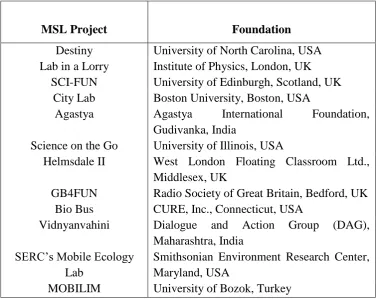
The MSL was developed by universties such as the University of North Carolina, which established its own Travelling Science Laboratory named Destiny; Lab in a Lorry was developed by the Institute of Physics, London (Erol et al., 2012). Other MSLs in the world are listed in Table 1.1. The MSL is equipped with advanced technology and techniques, instrumentation and teachers’ training for using equipment and supplies (Franzblau et al., 2011). It also provides a range of laboratory experiences that involve verifying established scientific knowledge and promoting thought-provoking inquiry for both teachers and students (Franzblau et al., 2011). Hence, it promotes students’ engagement, learning and high retention (Franzblau et al., 2011).
12
The time format for activities in the MSL is flexible for teachers, which they can supplement with the curriculum or regularly schedule as student investigation in field trip format (Franzblau et al., 2011; Erol et al., 2012). The activities involved are rich in pedagogical materials which creates meaningful science explorations for students, proven by the increased achievement in state-level tests (Franzblau et al., 2011). In addition, teachers’ perceptions towards MSL are positive, and their abilities in teaching science can be improved through MSL collaboration (Franzblau et al., 2011; Erol et al., 2012). MSL offers quality enrichment activities without the cost of taking students off-site and a large number of students can participate. Many students have been inspired to explore science as a career as a result of conducting experiments in the mobile laboratory (Franzblau et al., 2011). In order to achieve improvements in students’ engagement in Physics through using MSL, teachers are enriched with professional development workshops. These workshops provide an introduction to experiments and laboratory equipment and teachers’ training using the modules provided.
A study by Erol et al. (2012) shows that the module, Modular Mobile Education: Science Experiments (MOBILIM), when used in MSL activities for teachers, has raised their pedagogical skills and encouraged them to do more experiments in lessons by 96.7%. A study by Long et al. (2012) shows that the ChemKits programme has provided 23,450 experiments for 33 high schools from the year 2002 to 2005 and 17 high schools from 2004 to 2005. The teachers are trained on how to use MSL and the module which is developed from previous innovative projects such as the Bristol ChemLabs, by Mobile Teaching Unit in the UK and other relevant experiments or activities.
Physics education, less research has been carried out to enhance HOTS and conceptual understanding using MSL activities and experiments, teachers’ pedagogical skills using modules in the MSL and its effect on increasing achievement in Physics.
Table 1.1: Some examples of MSLs around the world
MSL Project Foundation
Destiny University of North Carolina, USA Lab in a Lorry Institute of Physics, London, UK
SCI-FUN University of Edinburgh, Scotland, UK City Lab Boston University, Boston, USA
Agastya Agastya International Foundation, Gudivanka, India
Science on the Go University of Illinois, USA
Helmsdale II West London Floating Classroom Ltd., Middlesex, UK
GB4FUN Radio Society of Great Britain, Bedford, UK Bio Bus CURE, Inc., Connecticut, USA
Vidnyanvahini Dialogue and Action Group (DAG), Maharashtra, India
SERC’s Mobile Ecology Lab
Smithsonian Environment Research Center, Maryland, USA
MOBILIM University of Bozok, Turkey
14
laboratory learning. In conclusion, Malaysia should study MSL as more developing countries are trying to cope with the problems of learning Physics.
For this research, the integration of MSL and MBL is seen to assist with Physics learning problems. MBL and MSL have proved to be effective in increasing students’ achievement, students’ interest through experiments and hands-on activities. Therefore, the intervention of the Mobile Computer-based Physics Laboratory (MCPL) is capable of meeting the needs of students with learning difficulties in Physics and enhances students’ high thinking skills.
1.2.6 Teaching and Learning Module
Teachers lack an effective module for teaching and learning (Nik Syaharudin et al., 2015; Norlidah and Siraj, 2012; Ojediran et al., 2014). They are only given curriculum specifications which have learning objectives, learning outcomes, suggestion activities and a glossary. Excellent teachers have their own module for teaching and learning but novice teachers must plan and work according to the needs of students regardless of the number of students in class and level of understanding of students. Therefore, an effective module of teaching and learning is required to produce effective teaching and learning, and improve perceptions towards the Physics teacher (Ojediran et al., 2014). For this research, a new module is developed in order to use computer-based experiments that guide the teachers and students to learn effectively.
examinations for low achievers, and score higher grades for high achievers. Teachers use lectures and rarely use other approaches during the teaching and learning process. Otherwise, there are a variety of teaching approaches as guidance for imparting knowledge. As Cottaar (2012) shows, variation in teaching has strong correlation with interest in regular Physics students.
Besides, learning strategies differ depending on teachers’ personal approaches, and situations in the classroom. A study by Trumper (2006) shows that teachers who are familiar with didactic modes of teaching can attract students to learn Physics. Student-centred learning is one way to involve students more in classroom activity compared to one-way instruction that is teacher-centred.
Meanwhile, for student-centred learning strategies, students learn by doing, and by trying to understand how things work. From a scientist’s point of view, students should investigate problems and draw a theory or solution (Sin, 2014) but for students, learning Physics is just about knowing the knowledge, and learning in structured and organized ways. Salmiza and Afiq's (2012) study suggests that 91.67% of student respondents use a formula method in solving a problem compared to 8.33% of respondents who use a formula method creatively. Therefore, teachers play an important role in arranging strategies of learning to utilise students’ learning.
1.2.7 Students in Rural Areas, Experiential Learning and the Boarding School
16
shows that teachers who lack training on particular subjects have low expectations of students, contributing to low achievement (Long et al., 2012).
In Malaysia, the Ministry of Education (MOE) has developed Science Boarding Schools such as Sekolah Tunku Abdul Rahman, Sekolah Dato Abdul Razak, Sekolah Sultan Abdul Hamid, Sekolah Seri Puteri and Sekolah Tun Fatimah to increase the number of science students from rural areas, as suggested in Laporan Razak 1956 (Alimuddin, 2012). Students in Secondary Religious Schools (Sekolah Menengah Kebangsaaan Agama, SMKA) and MARA Science Junior College (Maktab Rendah Sains MARA, MRSM) are also encouraged to enrol in the science stream (Mohd Saleh et al., 2012). The academic background for Boarding school students and regular National Secondary School (Sekolah Menengah Kebangsaan, SMK) differ since they are screened from Primary School Test results (Ujian Penilaian Sekolah Rendah, UPSR) and Lower Secondary School Test results (Penilaian Menengah Rendah, PMR). Excellent students in boarding schools are expected to fulfil the need for human capital in science, with an additional minority of science students in regular National Secondary School. As of April 2013, there are 68 boarding schools (MOE, 2014) and yet these schools have been unable to produce as many students in science as the ministry has intended (Alimuddin, 2012).
For both high and low achieving students, experiential learning resulted in better achievement at LOTS (low order thinking skills) and HOTS (higher order thinking skills) (Kiong et al., 2012). A study by Obenchain and Ives (2006) used experiential learning in the study for measuring achievement at HOTS and LOTS. The findings showed that the experimental group gained better achievement in HOTS compared to control groups. However, for LOTS achievement, students in the control group performed significantly higher compared to the experimental group. Hence, research on experiential learning among students at different levels of performance can help determine the solution for the decreasing number of students in science and engineering at the tertiary level.
1.2.8 Students’ Higher Order Thinking Skills (HOTS)
International assessments of the quality of education focus on many countries worldwide including Malaysia, with the main assessments including The Trends in International Mathematics and Science Study (TIMMS) and Programme for International Student Assessment (PISA) for 14 and 16 year old students accordingly. Malaysia was ranked below the international average in TIMMS in 2011, two fourfold up since 2009 due to low scores in TIMMS and PISA. It reflects the low achievement in higher order of thinking skills (HOTS) in Science and Mathematics. The same goes for the Malaysia Result of PISA in 2009 (MOE, 2013). Items in these assessments tested a variety of thinking skills, whereas assessments at national examination cover a limited mastery of scientific concepts (MOE, 2013).
18
being and achieved its validation (Sin, 2014). The students lack in the skills needed, especially the subject matter itself, because they pay too much attention to answering examination-based questions (Sadler and Tai, 2000). A study has shown that among 800,000 students who took Physics in high school, only half of them continue to college because they are unable to acquire science manipulative skills (Sadler and Tai, 2000).
Consequently, low thinking skills among secondary students produce low achievement in their tertiary learning. Thus, the call towards Physics should be viewed as the accumulation of coherent structures of concepts. Such perceptions can create students’ beliefs and develop problem-solving skills with critical thinking, in order to have a strong knowledge structure (Sin, 2014). A study by Kiong et al. (2012) showed that students’ thinking skills in Physics were poor. According to Krathwohl (2002), HOTS encompasses applying, analysing, evaluating and creating. Moreover, the Malaysia Curriculum Development Centre (2012) provides a conceptual framework which highlights critical and creative skills, and thinking strategies as a guidance for teachers. However, a study by Habibah et al. (2004) shows that creative thinking skills are moderately incorporated by teachers in their teaching in Malaysia. This may be because teachers are unfamiliar with the meaning of thinking skills and the convergent and divergent thinking required to develop HOTS in students (Habibah et al., 2004).
to get students’ feedback from the questions. Teachers were not taught on how to deliver HOTS during teaching and learning. The research only accumulates HOTS questions and measures students’ achievement at HOTS using questions only. Therefore, the use of computer-based experiment with integration of HOTS and experiential learning through the module can increase the students’ higher thinking skills as well as their achievement and interest.
1.3 Problem Statement
20
Therefore, the Mobile Computer-based Physics Laboratory (MCPL) is seen as a suggested solution to the above problems. This research investigates students’ level of interest in Physics and their achievement through a module developed using MBL and MSL for Forces and Motion. Students’ and teachers’ perceptions of the use of MCPL are investigated by exploring the effect of MCPL on students’ conceptual understanding related to experiential learning, the effects of MCPL on students’ interest and achievement, and achievement in HOTS due to the MCPL module.
1.4 Research Objectives
This study is carried out to
(i) develop a module for a MCPL teaching and learning experiment in the topic of Forces and Motion using Experiential Learning Theory
(ii) determine the level of students’ interest in Physics before and after the use of MCPL
(iii) determine students’ achievement levels in the topic of Forces and Motion before and after the use of MCPL
(iv) determine students’ achievement in the topic of Forces and Motion on HOTS questions before and after the use of MCPL
(v) identify students’ perceptions of MCPL
(vi) explore students’ conceptual understanding using MCPL with experiential learning theory
(vii) explore students’ perceptions of the MCPL learning module (viii) explore teachers’ perceptions of the MCPL teaching module
(ix) explore the impact of MCPL on students’ interest in Forces and Motion (x) explore the impact of MCPL on students’ conceptual understanding of Forces
and Motion
1.5 Research Questions
This study is carried out to investigate;
(i) What are the contents that are suitable for the teaching and learning module using MCPL for the topic of Forces and Motion using Experiential Learning Theory?
(ii) What is the level of students’ interest in Physics before the use of MCPL? (iii) What is the level of students’ interest in Physics after the use of MCPL? (iv) Is there a significant difference in the level of students’ interest in Physics
before and after the use of MCPL?
(v) What is the achievement of students in the topic of Forces and Motion before the use of MCPL?
(vi) What is the achievement of students in the topic of Forces and Motion after the use of MCPL?
(vii) Is there a significant difference in students’ achievement in the topic of Forces and Motion before and after the use of MCPL?
(viii) What is the achievement of students in the topic of Forces and Motion on HOTS questions before the use of MCPL?
(ix) What is the achievement of students in the topic of Forces and Motion on HOTS questions after the use of MCPL?
(x) Is there a significant difference in students’ achievement in the topic of Forces and Motion on HOTS questions before and after the use of MCPL?
(xi) What are students’ perceptions of the use of MCPL?
(xii) How does experiential learning help in the conceptual understanding of Physics using MCPL?
(xiii) How do students perceive the MCPL learning module? (xiv) How do teachers perceive the MCPL teaching module? (xv) How does MCPL influence students’ interest in Physics?
(xvi) How does MCPL influence students’ conceptual understanding of Forces and Motion?
22
1.6 Research Hypothesis
The hypotheses for the research questions are:
H0: There is no significant difference in the pre-test level of students’ interest and post-test level of students’ interest using MCPL.
H0: There is no significant difference in the pre- and post-test level of students’ achievement in the topic of Forces and Motion using MCPL.
H0: There is no significant difference in the pre- and post-test level of students’ achievement in the topic of Forces and Motion on HOTS questions using MCPL.
1.7 Significance of the Study
Malaysia’s education policy has been revised and published via the Malaysia National Blueprint Year 2013-2025. The MCPL approach can have an enormous impact on Physics teachers in their teaching pedagogies and students to narrow the infrastructure gap between the diverse backgrounds of students, reducing the achievement gap in HOTS among students with supportive experiments using advanced technology. Hence, our future generation of scientists and engineers can fulfil the nation’s vision successfully.
as other successful education systems in developed countries. This research is a call to ensure that students are instilled with motivation, strong academic achievement as well as HOTS. The MCPL intervention in Physics education is able to produce more competent teachers with the use of current technology in assisting pedagogical approaches in the laboratory and helping students to learn better. With guidance and proven competent skills, it is hoped that teachers will apply them without hesitation. The MCPL offers advanced technology instrumentation so that more experiments can be carried out compared to conventional experimental approaches. The use of probeware such as sensors helps students carry out experiments without excess workload in accumulating data, tabulating data and creating graphs. The use of computer-based experiments saves time and allows more investigation. Teaching and learning sessions can be more student-centred, and inquiry and discovery can be carried out by students where the teacher facilitates them. MCPL is rooted in inquiry-based learning, and engages students in experience-inquiry-based learning. When students conduct various experiments, they grasp the activities and relate them to their own experience. This can help them understand phenomena relevant to life and retain knowledge for longer periods.
24
MCPL is developed with a mobile laboratory named Physics on the Go (PoTGo) which functions as a transporter for laboratory apparatus and advanced tools from PASCO. It is able to supply electricity to run laptops and PASCO tools. It was funded and built for this research study and it has already been beneficial to students as it reaches schools for learning. For instance, experiments carried out in the laboratory create higher interest, positive perceptions toward the use of probes and students engage themselves in doing more investigation. The State Education Department can gain positive impact by ensuring that the quality of advanced apparatus in the MCPL relates to students’ conceptual understandings, inculcating interest in science from primary and lower secondary school students. There is no doubt that most teachers find that the use of computer-based experiments in teaching and learning can solve time constraints.
In addition, the application of this research involves the MCPL framework that can help teaching and learning by the teachers, and help students learn by using the MCPL modules. The students can gain achievement and interest and therefore, the learning can be meaningful. Teachers as facilitators ensure authentic learning for students and the students execute the experiment by themselves. Apart from this, HOTS questions were constructed in the module to ensure that they are exposed to higher level thinking using questions that they need to take into consideration based on the experiment. Their answer reflects the concept that they have when they carry out experiments, think about possible outcomes and make applications in different situations using the same concepts.
1.8 Theoretical Framework
apparatus and carrying out experiments by themselves provides a meaningful learning experience as well as improving memory retention and restructuring their conceptual understanding. The students can also examine their conceptual understanding and HOTS in the research. The students’ interest also was investigated in depth on how they perceived learning through the research. Theories related to experience were Constructivism (Piaget, 1976), Social Constructivism (Vygotsky, 1978), Experiential Learning (Kolb, 1984) and Situated Learning (Lave and Wenger, 1991). Constructivism Theory (Piaget, 1976) was a paradigm that posits that learning is an active process. People actively construct and create their knowledge which started with prior knowledge to subjective mental representations. Then, social constructivism by Vygotsky emerged to emphasize the collaborative nature of learning. Peer instruction was focussed during learning (Vygotsky, 1978). Meanwhile, the Situated Learning Theory emphasized that learning occurs when the learners are embedded with activity, context and encompassing culture discourses. Learning occurs when the learner is involved in an activity within a context and becomes a full participant in sociocultural practises. Therefore, the theory supported the students learning viewed by the researcher as a learner, individually was Experiential Learning Theory (Kolb, 1984). Based on the research problem, Experiential Learning Theory was chosen as a theoretical framework since the paradigm of the researcher that students should be seen as a whole.
26
individual to do work or task. As intrinsic motivation was explored further, the intention of the research was aligned to determine interest in learning by using advanced apparatus. Therefore, the theory chosen to determine students’ interest was Self-determination Theory (Ryan and Deci, 2000).
Therefore, theories underpinning the research are Experiential Learning Theory (Kolb, 1984), Self-determination Theory (Ryan and Deci, 2000) and Revised Bloom’s Taxonomy (Krathwohl, 2002). Experiential learning has its intellectual origins in the works of Dewey, Lewin and Piaget. It emphasizes the central role that experience plays in the learning process (Kolb, 1984). Based on the Lewinian Model of Action Research and Laboratory Training, the integration of action research and experience from laboratory methods produces a modification in learners’ behaviour and their choices from new experiences. According to Dewey’s Model of Learning, experience and education are two different things, because some experiences provide the wrong kind of education. Hence, reflective thought is needed to assist learners in determining the learning that can be drawn from educational experience (Kolb, 1984).
The model of learning stresses on transforming the impulses, feelings and desired concrete experience into a higher order purposeful action. According to Piaget’s model of learning, children reorganize perceptions through the process of assimilation and accommodation to make sense of their world (Kolb, 1984). Their learning moves from a concrete phenomenal view of the world to an abstract constructionist view, from an active egocentric view to a reflective internalized mode of knowing (Kolb, 1984).
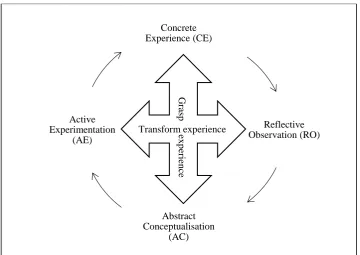
concrete experience (CE), reflective observation (RO), abstract conceptualization (AC) and active experimentation (AE) (Kolb, 1984).
Two aspects in truly experiential learning are (a) engagement of the learner and the phenomena related to the study and (b) reflection upon the experience, analysing it and learning from it (Hedin, 2010). Methods that suit experiential education are internships, apprenticeships, work or study programs, cooperative education, outdoor education, studio arts, laboratory studies and field projects (Hedin, 2010). According to Clark, Threeton, and Ewing (2010), Kolb’s learning styles in Experiential Learning Theory have been developed into the Learning Style Inventory (LSI) to analyse individuals’ understanding of the process of learning from experience and the uniqueness of the individual in learning. Figure 1.1 shows the experiential learning cycle (Kolb, 2009) that emphasizesgrasping experience which dialectically relates to Concrete Experience and Abstract Conceptualization, and the transformation that takes place dialectically relates to Reflective Observation and Active Experimentation.
Figure 1.1 Experiential Learning Theory (Kolb, 2009; Kolb, 1984) Concrete
Experience (CE)
Reflective Observation (RO)
Abstract Conceptualisation
(AC) Active
Experimentation (AE)
Gr
asp
ex
p
er
ien
ce
28
Previous studies on the use of experiential learning show significantly better achievement compared to lecture-based teaching for different levels of achievement (Hamer, 2014; Obenchain and Ives, 2006). Experiential learning has been used in science research (Perlman, 2013) but there is less research on Physics students who have different levels of achievement. Therefore, experiential learning is suitable as a learning environment whereby learning using the MCPL module was developed according to the Experiential Learning Cycle (Kolb, 1984) with a cognition process of experiencing, reflective observation, abstract conceptualization and active experimentation. Based on Hamer (2014), experiential learning has been used in the discipline of science and corroborated with real world experience. It has been proven able to increase instructor and students’ interest, students’ performance, enjoyment in enhancing learning and increased perceived value of the learning experience. For this research, experiential learning is suitable to provide enjoyment and students’ interest by coping with students’ learning difficulties. Students’ interest and their perception have been important in teaching and learning. Therefore, their motivation can be seen from their experience of the value given to learning.
According to Self-determination Theory (Ryan and Deci, 2000), motivation is varied for people with different levels of motivation and orientation. The orientation of motivation is the concern that moves a person to do work or an action. For a student, he or she does homework because of curiosity and interest. Curiosity and interest shows the willingness to learn a new set of skills which are also developed due to joy and interest (Ryan and Deci, 2000).
subjective criterion with specific meaning for intrinsic learning – motivation which is associated with self-intentionality for a person (Krapp, 1999).
In addition, students’ higher thinking skills were investigated under Revised Bloom’s Taxonomy (Krathwohl, 2002). Bloom’s taxonomy of learning was originally developed in the year 1956 by Benjamin S. Bloom, and comprises low thinking skills (knowledge, comprehension), medium thinking skills (application, analysis) and high thinking skills (synthesis and evaluation) (Krathwohl, 2002). The framework is cited and translated for almost 22 countries. The Revised Bloom’s Taxonomy was created by Krathwohl (2002) with two dimensions. The first is the knowledge dimension and the second is the cognitive process. Figure 1.2 shows the cognitive and knowledge dimensions of the Revised Taxonomy. In this research, students were analysed on their ability at Applying and Analyzing (under the knowledge dimension), which involves students carrying out experiments and distinguishing relevant from irrelevant parts (Anderson et al., 2001), while conceptual understanding was also analysed (under the cognitive dimension). Each dimension is elaborated from lower order thinking skills (LOTS) to higher order thinking skills (HOTS). HOTS students are expected to able to evaluate and creatively solve problems based on their awareness of their own reflective thinking and their extent of knowledge.
30
Higher order thinking skills (HOTS)
Cognitive Dimension
(verbs)
Knowledge Dimension
(definitions)
Creating (designing, generating, inventing)
Evaluating (accessing, checking,
critiquing)
Analysing (distinguishing, differentiating,
attributing)
Applying (executing, implementing)
Understanding (classifying, summarizing,
inferring, comparing, explaining)
Remembering (recognizing, recalling)
Metacognitive (awareness of own cognition; strategic or reflective knowledge of how to
solve problems; contextual knowledge; knowledge of self)
Procedural (Ability to do something specific; methods of inquiry; specific skills,
techniques, methodologies)
Conceptual (classifications, principles, theories, models, structures)
Factual (essential facts, terminology, elements)
Lower Order Thinking Skills (LOTS)
Figure 1.2 The Cognitive and Knowledge Dimensions of the Revised Taxonomy (Krathwohl, 2002)
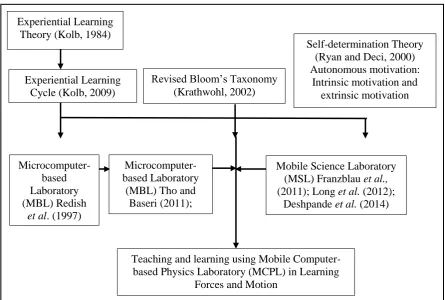
Figure 1.3 Theoretical framework
Experiential Learning Theory (Kolb, 1984)
Experiential Learning Cycle (Kolb, 2009)
Revised Bloom’s Taxonomy (Krathwohl, 2002)
Self-determination Theory (Ryan and Deci, 2000) Autonomous motivation:
Intrinsic motivation and extrinsic motivation
Mobile Science Laboratory (MSL) Franzblau et al.,
(2011); Long et al. (2012); Deshpande et al. (2014)
Microcomputer-based Laboratory (MBL) Redish
et al. (1997)
Microcomputer-based Laboratory
(MBL) Tho and Baseri (2011); Chen et al., (2014)
Teaching and learning using Mobile Computer-based Physics Laboratory (MCPL) in Learning
Figure 1.3 shows the theoretical framework used in the research, based on Experiential Learning Theory (Kolb, 1984). The framework is used to provide experience-based learning for students who can use computer-based experimentation to develop their understanding of the subject matter, and Revised Blooms’ Taxonomy is used to explore the relationship with different HOTS that can be developed and nurtured using experience-based learning in experimentation. Students’ interests are also investigated to measure the level of their interest towards MCPL.
Apart from this, students’ achievement and perceptions are measured as they are important variables in investigating the impact of the research. Therefore, MCPL can contribute to self-development for students in achievement, so that they can equip themselves for 21st century challenges, and so that teachers can use experiments for effective teaching and learning strategies (MOE, 2013; Preus, 2012).
1.9 Conceptual Framework
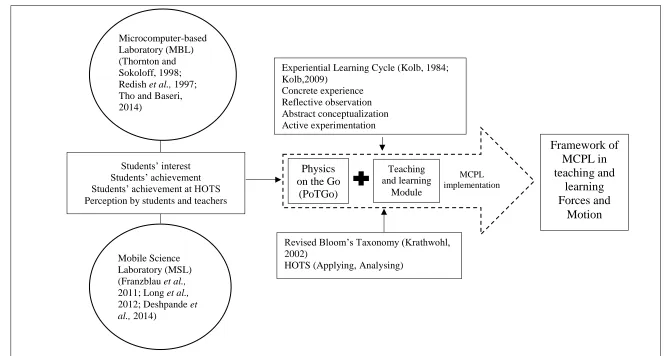
32
the students by assisting them in carrying out experiments while the teacher monitored the students and guide them along the intervention process.
Currently, the routine experiments carried out in schools with prepared procedures do not improve students’ understanding and achievement in Physics (Ojediran et al., 2014). Therefore, students need to explore experiments with guided instruction as well as by eliciting their higher order thinking skills (HOTS). Students need to learn with their own willingness, and such learning in active experimentation contributes to better conceptual understanding (Ryan and Deci, 2000). Therefore, students with little or zero background of the subject matter of science can have the interest to explore scientific learning (Ojediran et al., 2014; Chambers, 2014).
Figure 1.4 Conceptual framework MCPL implementation Experiential Learning Cycle (Kolb, 1984;
Kolb,2009) Concrete experience Reflective observation Abstract conceptualization Active experimentation Teaching and learning Module Physics
on the Go (PoTGo) Microcomputer-based
Laboratory (MBL) (Thornton and Sokoloff, 1998; Redish et al., 1997; Tho and Baseri, 2014)
Mobile Science Laboratory (MSL) (Franzblau et al.,
2011; Long et al.,
2012; Deshpande et al., 2014)
Students’ interest Students’ achievement Students’ achievement at HOTS Perception by students and teachers
Framework of MCPL in teaching and learning Forces and Motion Revised Bloom’s Taxonomy (Krathwohl,
2002)
HOTS (Applying, Analysing)
34
1.10 Operational Definitions
The following section contains terms used within the context of the study. These operational definitions are provided for the reader to fully understand the terminology utilized in this study.
1.10.1 Interest
Interest refers to the intrinsic learning-motivation which is associated with learning a task, and an individual’s object of interest contributes to their self-intentionality (Krapp, 1999). It is a motivation which is discussed under Self-determination theory by Ryan and Deci (2000). In this study, interest is measured as a dependent variable, emphasizing situational interest in learning outcomes due to the ‘interestingness’ of an object. Within this study, the first step is a stimulus, then interaction of the students with the object, and finally the rating of ‘interestingness’ and performance is determined (Krapp, 1999).
1.10.2 Achievement
1.10.3 Achievement of HOTS
Achievement in HOTS refers to the score obtained by students and for this study, questions in HOTS is verified as analysis level based on the Revised Blooms’ Taxonomy (Krathwohl, 2002) and the test used is adapted from the FMCE of Thornton and Sokoloff (1998).
1.10.4 Perception
Action involves reasoning and evaluating using subjective processes in the mind, relative to sensory perception such as observation, hearing, touch, experience, reading or prior experience (stimulation), registration (selected stimuli), organization (based on selected prior experience) or interpretation (analyze and understand based on prior experience). It affects behaviour, communication and the feelings of a person, and what the person interprets or perceives may be substantially different from reality (Pickens, 2005). In this research, perception is evaluated for internal attribution which reflects causality to factors within the person.
1.10.5 Teaching and Learning Module
36
1.10.6 Forces and Motion
The subject-matter consists of linear motion (in 1-dimension, 1D), motion graph, inertia, momentum, effect of forces, impulse, gravity, motion (in 2-dimension, 2D) forces in equilibrium, work, energy, and elasticity (MOE, 2005).
1.10.7 Microcomputer-Based Laboratory (MBL)
Experiments are carried out using computer technology for practical experience and learning theory content. It helps students to grasp the essence of the depth and nature of experience and knowledge of the subject matter, and it fulfils the training needs of modern engineering talent (Redish et al., 1997; Shiming and Bin, 2014). PASCO is a product that consists of probeware, data logging software called Data Studio which is a data collection and analysis software for advanced physics and engineering. The probeware included is Motion Sensor and Photogate which measures positions, velocity and acceleration of a target, and the interface used is The PASPORT Interface. The apparatus provided by PASCO products can analyse Mechanics from basic Kinematics work and energy concepts. Forces and Motion can be explored using the PASCO apparatus (PASCO Scientific, 1999).
1.10.8 Mobile Science Laboratory (MSL)
1.10.9 The Mobile Computer-Based Physics Laboratory (MCPL)
MCPL involves an integration of MSL and MBL. MSL is a trailer or specialized bus replicated as a travelling laboratory (Long et al., 2012; Franzblau et al., 2011) and it is offered as a service or off-the-shelf version (Erol et al., 2012). It is accomplished with a module on teaching Physics for teachers, and activities as well as experiments to enhance creative and critical thinking skills among students (Franzblau et al., 2011). The module is accomplished with PASCO products for data collection and interpreting data (PASCO Scientific, 1999).
1.10.10 Learning
Learning in the research refers to students learning by conducting experiments on the topic Force and Motion within an environment of experientce-based learning. The experiential learning theory by Kolb (1984) consists of four modes; concrete experience, reflective observation, abstract conceptualization and active experimentation. The process of learning involves the use of the MCPL Learning Module. The learning outcome is assessed from students’ interest, achievement, achievement at HOTS and perception towards MCPL.
1.10.11 Impact
38
intended with dimensions of the application. It encompasses projection (changes to subjects’ achievement, interest and perception), prospective (researcher controlled threats) and retrospective (evaluation designed and conducted at the end of the intervention).
1.11 Conclusion
Factors affecting Physics learning problems include low interest under conventional teaching and laboratory instruction, the lack of effective modules, and teaching strategies that are more teacher-centred, which leads to rote learning and poor understanding of concepts. Teachers find that time constraints in teaching Forces and Motion lead to less experiments being conducted among students in the laboratory. Meanwhile, the lack of apparatus and laboratory malfunction give students no opportunity to carry out experiments hands-on. By analysing these factors, this research develops a teaching and learning strategy outside the conventional laboratory and at the same time generates a variety of hands-on experiments to elicit among HOTS students.
REFERENCES
Abdulilah H. Al-Arfaj (2001). The Perception of College Students in Saudi Arabia Towards Distance Web-Based Instruction. Phd Thesis, University of Ohio, United State of America
Ahmad Tarmimi Ismail and Shahrul Kadri Ayob (2016). Tahap Kefahaman dan Salah Konsep Terhadap Konsep Daya Dan Gerakan Dalam Kalangan Pelajar Tingkatan Empat. Jurnal Fizik Malaysia. 1 (37), 1090-1101.
Agastya International Foundation (2014a). Mobile Labs. Retrieved from
http://www.agastya.org/how/how-we-do-it/mobile-labs on 20 December,
2014.
Agastya International Foundation (2014b). Quarterly Report - April-June 2014. Agastya Foundation. Retrieved from report-april-june-2014 on 20 December, 2014.
Ainsley, M. (2012). Students’ Interest and Engegement in Classroom Activities. Handbook of Research on Student Engagement. 283 - 302
Aksela, M. K. (2004). Engaging students for meaningful chemistry learning through microcomputer-based Laboratory (MBL) inquiry. Educació Química EduQ . Volume 9 (2011) p. 30-37
Alimuddin, M. D. (2012 , 19 April). Menarik minat pelajar ke aliran Sains. Utusan Malaysia, Retrieved on 20 April, 2014, from http://www.utusan.com.my Allen, W. C. (2006). Overview and Evolution of the ADDIE Training System.
Advances in Developing Human Resources, 8(4), 430–441.
Angell, C., Guttersrud, Øy., Henriksen, E. K., and Isnes, A. (2004). Physics: Frightful, but fun. Pupils’ and teachers’ views of physics and physics teaching. Science Education, 88(5), 683–706.
226
Bahbah, S., Golden, B. W., Roseler, K., Enderle, P., Saka, Y., and Southerland, S. a. (2012). The Influence of RET’s on Elementary and Secondary Grade Teachers’ Views of Scientific Inquiry. International Education Studies, 6(1), 117–132.
Beier, M. E., and Rittmayer, A. D. (2008). Literature Overview : Motivational factors in STEM : Interest and Self- Concept. SWE-AWE CASEE ARP Resources, 110. Retrieved on 28 April 2014, from http://www.aweonline.org
Benson Mun Hong Soong. (2010). Improving Secondary Students’ Revision of Physics Concepts through Computer-mediated Peer Discussion and Prescriptive Tutoring. PhD thesis, University of Cambridge, London
Bøe, M. V., and Henriksen, E. K. (2013). Love It or Leave It: Norwegian Students’ Motivations and Expectations for Postcompulsory Physics. Science Education, 97(4), 550–573.
Bolte, C., Holbrook, J., & Rauch, F. (2012). Inquiry-based Science Education in Europe : Reflections from the PROFILES Project. 1st International PROFILES Conference. 24-26 September , 2012.
Boston University. (2014). CityLab. Retrieved on 2 December 2014, from http://www.bumc.bu.edu/citylab/mobilelab/
Boswell, S. S. (2013). Undergraduates ’ Perceived Knowledge, Self-Efficacy, and Interest in Social Science Research. The Journal of Effective Teaching, 13(2), 48–57.
Braun, V., and Clarke, V. (2006). Using thematic analysis in psycology. Qualitative Research in Psycology, 3(2), 77–101.
Braun, V., 7 Clarke, V., (2013). Successful Qualitative Research: A Practical Guide for Beginners. Sage Publications : London
Carlone, H. B. (2003). Innovative Science Within and Against a Culture of “Achievement.” Science Education, 87, p.307–328.
Chambers, T. (2014). Three Pedagogical Approaches to Introductory Physics Labs and their Effect on Student. PhD thesis. University of Arizona: United State of Amerika