SHARIFAH AZNEE BT SAID ALI @ SYED ALI
A project report submitted in partial fulfilment of the requirements for the award of the degree of
Master of Engineering
(Mechanical - Advanced Manufacturing Technology)
Faculty of Mechanical Engineering University Technology Malaysia
ABSTRACT
ABSTRAK
TABLE OF CONTENTS
CHAPTER TOPIC PAGE
DECLARATION ii
DEDICATION iii
ACKNOWLEGEDMENT iv
ABSTRACT v
ABSTRAK vi
TABLE OF CONTENTS vii
LIST OF TABLES xi
LIST OF FIGURES xiii
LIST OF APPENDICES xvi
1 INTRODUCTION
1.1 Introduction 1
1.2 Problem Statement 3
1.3 Background to the problems 5
1.4 Terminologies of slips and falls 8
1.4.1 Slip 8
1.4.2 Fall 8
1.4.3 Trip 8
1.5 Objective of study 9
1.6 Scope of study 10
1.7 Organization of thesis 10
2 LITERATURE REVIEW
2.1 Introduction 11
2.2 Slips and Falls Theories 12
2.2.1 Slip and Fall Theory –
Extreme Order Statistics 12
2.2.2 Floor Reliability With Respect
To “Slip and Fall” 12
2.2.3 Stochastic Theory of Human Slipping 13 2.2.4 Slip and Fall Characterization of Floors 13
2.2.5 Extreme Value Formulation of Human Slip:
A Summary 14
2.3 Types of falls 15
2.3.1 Same level falls 16
2.3.2 Falls from heights 17
2.4 Slip and Fall Statistics 18
2.5 Workplace injuries 20
2.6 Slips and falls case study 26
2.6.1 Environmental issues 26
2.6.2 Housekeeping issues 27
2.6.3 Incident report Injury 29
2.7 Research from HSE/HSL 32
2.7.1 Pendulum 33
2.7.2 Surface micro roughness 34
2.8 Research for walkway surface 35
2.9 Conclusion 37
3 METHODOLOGY
3.1 Introduction 38
3.2 Strategy of Experiment 39
3.3 “Best-guess” experiments 39
3.3.1 Questionnaire Development 40
3.3.3 Surface roughness value 44 3.4 One-factor-at-a-time (OFAT) experiments 45
3.4.1 Experiments 46
3.4.2 Experimental set up 48
3.4.3 Experimental layout 48
3.4.4 Experimental apparatus and liquid 50
3.4.4.1 Tape measurement 50
3.4.4.2 Digital Camera 51
3.4.4.3 Footwear 51
3.4.4.4 Weight measurement 53
3.4.4.5 Viscosity apparatus 54
3.4.4.6 Liquid 56
3.4.5 The experimental procedure 57
3.5 Data Analysis 58
3.6 Conclusion 59
4 RESULTS AND ANALYSIS
4.1 Introduction 60
4.2 Questionnaire result 60
4.3 Experiments result 64
4.3.1 Water as liquid 65
4.3.2 Combination of Water and Detergent
as liquid 67
4.3.3 Sharlu oil as liquid 69
4.3.4 Castrol oil as liquid 73
4.4 Result of loses (A case study) 78
4.5 Result of guidelines 79
4.6 Conclusion 80
5 DISCUSSION
5.1 Introduction 81
5.3 Review on Experiment 83
5.4 Review on losses 85
5.5 Review on guideline 88
5.6 Conclusion 90
6 FUTURE WORK AND CONCLUSION
6.1 Introduction 91
6.2 Future Work 91
6.3 Conclusion 92
REFERENCES 94
LIST OF TABLES
TABLES NO. TITLE PAGE
1.1 Types of Accident from Year 2006 until June 2009 4 1.2 Types of body Injuries from Year 2006 until June 2009 6 1.3 Number of Permanent Disablements by Body Part Injured,
Year 2006 and 2007 7
2.1 Workplace Injuries by type of accident and degree of
disablement on Year 2007 21
2.2 Industrial Accident Reported to the Labour Department
and SOCSO by Industry1, 2004 – 2008 23
2.3 Number of Accidents by cause of accident – 2006 24 2.4 Slip potential classification, based on
Pendulum Test Value (PTV) 33
2.5 Slip potential classification, based on Ra micro
roughness values 34
2.6 Typical Ra surface micro roughness levels for a
low slip potential, as function of contaminant type 35 2.7 Example of Typical Roughness characteristics for Some
Common Floor surfaces 36
3.1 Point Likert Scale Indicator 42
3.2 Surface roughness for floor and footwear 45
3.3 Value of liquid 57
4.1 Water testing result 65
4.3 Sharlu oil testing result 69
4.4 Castrol oil testing result 74
4.5 Guidelines from selected organizations 79
5.1 Recommended Guidelines 88
LIST OF FIGURES
FIGURES NO. TITLE PAGE
2.1 Primary fall, faller and prevention categorizations 15 2.2 Number of major injuries to employees by most kind of
accident 1996/97 to 2007/08 20
2.3 Total of industrial Accidents and Fatal Accident
(2004-2008) 22
2.4 The unsuitable and suitable environment to avoid
Slips and Falls 27
2.5 Provide a clear workplace and systematic storage area 28 2.6 Poor housekeeping can easily cause a slip,
trip or fall hazard 28
2.7 Incident Report Injury (1-3) 29
2.8 Slip potential model 32
2.9 The pendulum CoF test 32
2.10 Surface micro roughness meters 33
3.1 Surtronic 3+ 43
3.2 Flooring Surface 46
3.3 Footwear Surface 47
3.4 Water 47
3.5 Oil 47
3.6 Floor surface at Fitting laboratory 48
3.7 Plan layout of experimental set up 49
3.9 Scale to measure slip distance 50
3.10 Tape measurement 50
3.11 Digital Camera 51
3.12 Type Shoe 1 52
3.13 Type Shoe 2 52
3.14 Weight measurement 53
3.15 Weight of three different person 54
3.16 Digital Viscometer model DV-II 55
3.17 Liquid to test in slip and fall experiment 56
4.1 Gender Respondent 61
4.2 Age Group Respondent 61
4.3 Respondent who have seen and know the Slip and Fall signs 62 4.4 Respondent have experience on slips and falls 63
4.5 Cause of Slip and Fall 64
4.6 Graph Water testing for subject no. 3 without footwear 66 4.7 Graph Water testing for subject no. 3 with old footwear 66 4.8 Graph Water + detergent testing for subject no. 3
without footwear 68
4.9 Graph Water + detergent testing for subject no. 3
with old footwear 68
4.10 Graph Sharlu oil testing for subject no. 1 without footwear 70 4.11 Graph Sharlu oil testing for subject no.2 without footwear 70 4.12 Graph Sharlu oil testing for subject no. 3 without footwear 71 4.13 Graph Sharlu oil testing for subject no. 2 with old footwear 71 4.14 Graph Sharlu oil testing for subject no.3 with old footwear 72 4.15 Graph Sharlu oil testing for subject no. 2 with new footwear 72 4.16 Graph Sharlu oil testing for subject no. 3 with new footwear 73 4.17 Graph Castrol oil testing for subject no. 1 without footwear 74 4.18 Graph Castrol oil testing for subject no.2 without footwear 75 4.19 Graph Castrol oil testing for subject no. 3 without footwear 75
LIST OF APPENDICES
APPENDIX TITLE PAGE
A The Company profile 97
B The three source that have potential to cause slips
and falls at SCA Hygiene company 100
C The place of incident related to slip and fall at
SCA Hygiene company 102
D The Questionnaire survey 103
E The Surface roughness at SCA Hygiene Company 107
F The Surface roughness for glasses 108
G The Surface roughness at Fitting Laboratory 109
H The Surface roughness for footwear 110
I The Quantity of liquid 111
J The graph distance of slip during experiment 115 K Guidelines on Occupational Safety and
Health in the office 124
L Guidelines for Protecting The Safety and Health 127 M Occupational Health, Safety and
INTRODUCTION
1.1 Introduction
Study about slips and falls are very interesting. The reason because slips and falls are an intriguing problem. These are common incidents and can cause everywhere either in an office setting, a school, a factory, a public building or a warehouse, inside and outside. Slips usually occur as a result of too little friction or traction between footwear and the walking surface, or tires and the road in the case of sliding accidents and the most important is afflicting to human life from childhood until old age. Slips and falls whether on or off the job are expensive, disruptive, painful, and may be tragic. Although, the number of cases in Malaysia is less but the impact will create lots of losses and become serious in the long term.
In this case, the workplace have high potential and risk to attend the hazard and cause the injuries to the employees. If the employees are not sensitive or avoid the safety rules or wear proper safety apparatus, they might be the victims of slips and fall accident.
Besides injuries, employer may face the loss of manpower. Their employees might not fit well to their jobs and get the medical certificate or leave the jobs. So by that time factory will face the less manpower especially if it involve skill workers. So these problems will affect the production department. On the other hand, if there are a lots of slips and falls problems, the company also could spent plenty of money for compensation claim from employees.
So, this study is carried out to identify the factors why slips and falls occur at work place. What are the main causes of slips and falls? Why these accident happen and how to reduce the number of cases? From the result of study, some rules can be produced useful to industries hence reduce their loss of human power at their work place or other work that can reduce their loss of employees.
This study is important because slips and falls not only happen among employees but it might happen to employers because those who work at the workplace could have potential to involve in such accident. As human, accident cannot be avoided but human can reduce it or take a first step to prevent it from occurring especially at workplace because workplace is an area that most people would spend their day time there.
1.2 Problems statement
Slip and fall are one of the frequent types of accident at workplace. Although such accident is not a major accident but slip and fall can contribute to serious impact when it occurs especially to people or employees.
Normally employees are trained when they enter a workplace. Employer will give them training about safety and supply them with proper clothes or safety clothes suitable to their tasks. Even though they are trained and wear proper clothes, accidents still occur at workplaces especially in manufacturing industries. Why do this accident still exist? Sometimes the number of such accident increase every year and it become more serious when there are fatalities.
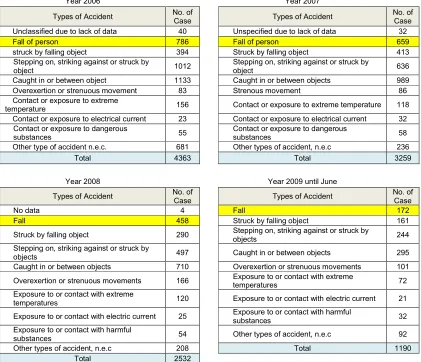
Table 1.1 : Types of Accident from Year 2006 until June 2009
(Source: Department of Occupational Safety and Health - DOSH)
Year 2006 Year 2007
Types of Accident No. of Case Types of Accident No. of Case Unclassified due to lack of data 40 Unspecified due to lack of data 32
Fall of person 786 Fall of person 659
struck by falling object 394 Struck by falling object 413 Stepping on, striking against or struck by
object 1012 Stepping on, striking against or struck by object 636 Caught in or between object 1133 Caught in or between objects 989 Overexertion or strenuous movement 83 Strenous movement 86 Contact or exposure to extreme
temperature 156 Contact or exposure to extreme temperature 118 Contact or exposure to electrical current 23 Contact or exposure to electrical current 32 Contact or exposure to dangerous
substances 55 Contact or exposure to dangerous substances 58 Other type of accident n.e.c. 681 Other types of accident, n.e.c 236
Total 4363 Total 3259
Year 2008 Year 2009 until June
Types of Accident No. of Case Types of Accident No. of Case
No data 4 Fall 172
Fall 458 Struck by falling object 161
Struck by falling object 290 Stepping on, striking against or struck by objects 244 Stepping on, striking against or struck by
objects 497 Caught in or between objects 295
Caught in or between objects 710 Overexertion or strenuous movements 101 Overexertion or strenuous movements 166 Exposure to or contact with extreme temperatures 72 Exposure to or contact with extreme
temperatures 120 Exposure to or contact with electric current 21 Exposure to or contact with electric current 25 Exposure to or contact with harmful substances 32 Exposure to or contact with harmful
substances 54 Other types of accident, n.e.c 92
Other types of accident, n.e.c 208 Total 1190
Total 2532
Are the increasing injuries shows that employers are not serious in safety and health for their employees or employees ignore safety rules? These two factors are difficult to establish. Sometimes action taken by employer is very good and employee also done their task very well. But accident still exist. Who want to take a responsibility to this problem either the employers or the employees.
slips and falls especially at workplace, how to reduce or prevent it from occurring, and at the end some rules can be listed for use as guidelines in industries to help them control and reduce the slips and falls accident at their workplace.
1.3 Background to the problems
From the problems statement mentioned in Section 1.2, there are a lots of accident occur in manufacturing field or more specific in factories. All these accident definitely cause the workplace injuries to employees.
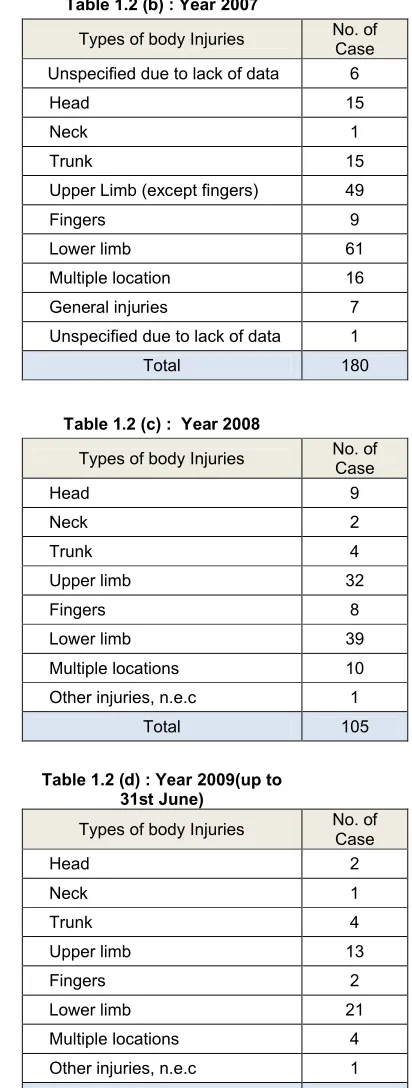
Table 1.2a to Table 1.2d shows the types of body injuries from 2006 until June 2009. These data from Department of Occupational Safety and Health (DOSH), Malaysia are for those accidents that occur in manufacturing industry. Although the total number of the cases are reduced every year, but injuries are accounted for. These body injuries data are referred to slips and falls problems.
Table 1.2 : Types of body Injuries from Year 2006 until June 2009 (Source: Department of Occupational Safety and Health - DOSH)
Table 1.2 (a) : Year 2006 Table 1.2 (b) : Year 2007
Types of body Injuries No. of Case Types of body Injuries No. of Case
Head 10 Unspecified due to lack of data 6
Face 10 Head 15
Neck 1 Neck 1
Trunk 3 Trunk 15
Back 16 Upper Limb (except fingers) 49
Chest 3 Fingers 9
abdomen 1 Lower limb 61
Upper limb 3 Multiple location 16
Shoulder 10 General injuries 7
Upper arm 3 Unspecified due to lack of data 1
Elbow 4 Total 180
Forearm 3
Wrist 5 Table 1.2 (c) : Year 2008
Hand 35 Types of body Injuries No. of Case
Finger 21 Head 9
Lower limb 12 Neck 2
Knee 23 Trunk 4
Leg 41 Upper limb 32
Foot, ankle or toe 48 Fingers 8
Multiple location 27 Lower limb 39
General injuries 1 Multiple locations 10
Other locations n.e.c. 2 Other injuries, n.e.c 1
Total 282 Total 105
Table 1.2 (d) : Year 2009(up to 31st June)
Types of body Injuries No. of Case
Head 2
Neck 1
Trunk 4
Upper limb 13
Fingers 2
Lower limb 21
Multiple locations 4
Other injuries, n.e.c 1
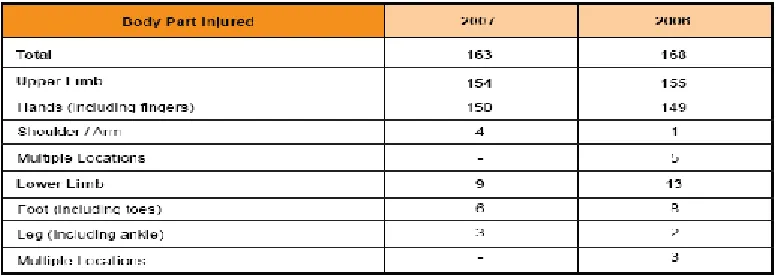
Table 1.3 shows that “Accident The Body Part Injured” for more than 9 in 10 permanent disablements (94%) reported in 2007 and this involved the upper limb, predominantly hands (including fingers). Around 5.5% of the victims sustained permanent injuries localized to the lower limb, down from 7.7% as compared to the previous year.
Table 1.3 : Number of Permanent Disablements by Body Part Injured, Year 2006 and 2007
(Source: Occupational Safety and Health Division, Singapore Ministry of Manpower- MOM)
Table 1.2 and Table 1.3 clearly defined that slips and falls problems are not suitable for occupational safety and health. The causes slips and falls to be known as risk factors. The greater the number of risk factors to which an individual is exposed, the greater the probability of a fall, and the more likely the results of the fall that will threaten the person's health and independence.
For example, when somebody slip and fall, the person will experience pain on particular parts of the body. This injury might not be on the outer portion of the body but may cause in deep or inside of the body such as problem in blood vessels. This illness has to be treated immediately and it may affect the brain if the blood vessels do not deliver adequate blood to the brain.
1.4 Terminologies of slips and falls
1.4.1 Slip
A sliding motion where the foot (shoe) losses traction with the floor surface resulting in a loss of balance.
1.4.2 Fall
A drop in height of the human body.
1.4.3 Trip
1.5 Objective of study
The main objectives of this project are:
a) To identify and determine the main causes of slips.
b) To analyze the relationship between the selected sources of slips. c) To compute the monetary losses by employees due to slips and falls
incidents (A case study).
d) To establish the guidelines for factories to reduce the slips and falls accident from occurring.
The main objective of this study is to identify and determine the main causes of slips. Through this objective, a survey will be done to identify and determine what is the main cause of slips to human when walk on that floor surface at the selected company.
The second objective is to analyze the relationship between the selected sources of slips. This objective will use the floor surface as a basic factor but will be added with other factor for example wet floor. What causes wet floor, with either water or oil. So through these added factors combined with floor factor will initiate experiments to study their relationship between those factors.
The third objective is to compute the losses of employees. This objective want to study about the effect and impact to the employees when slips and falls occur. If this problem occur, some losses will be faced. Employees should take a medical leave, the factory will loose their employees, and they have to pay a claim and insurance that will cover injuries. So this objective would highlight the causes after the slips and falls problem occur.
1.6 Scope of study
This project cover:
a) Slips and falls incidents occur on the same level only. b) Concentrate on adult male working population.
c) The study involve manufacturing industry (A case study).
1.7 Organization of Thesis
Chapter 1, explained the introduction and background of the slips and falls incidents especially at work place. Chapter 2, the literature review will discuss on slips and falls some information on its theories, types of fall and some case studies related to slips and falls. Chapter 3 consists of methodology about how to apply and carries out the analysis. This chapter provides the development of questionnaire to obtain results. Chapter 4 provides the results of experiment and analysis that have been used. Chapter 5 included discussion. Chapter 6 is about project conclusion recommendations for future work.
1.8 Conclusion
REFERENCES
Akta Kilang Dan Jentera Dan Peraturan – peraturan
(2005), MDC Publisher Sdn.
Bhd.
Anderson and Lagerlof (1983).
Occupational Slips and Falls: More Than A Trivial
Problem
. Ergonomics 487- 498.
Bailer, Stout, Reed & Gilbert (2001).
Falls in Older People: Risk Factors and
Strategies for Prevention.
Cambridge University Press.
Carpolio (1995).
Occupational Injuries and Illness: Counts, Rates, and
Characteristics,
US Department of Labor, Bureau of Labor Statistics.
Colin W.Fuller (1999).
Alignments to Workplaces Safety Principles: An Application
to Mining,
Journal of Safety Research, 173-185.
Dekker (2002).
Occupational Injury Prevention
. Journal of Safety Research.
Elderly (1987).
The Prevention of falls in later life.
Danish Medical Bulletin, 34,
215 – 219.
Guidelines On Occupational Safety And Health In The Office (1996). Department Of
Guidelines for the Interior Lighting and the Visual Environment, Department of
Occupational Safety and Health, Malaysia.
Guidelines for Protecting The Safety and Health of Health Care Workers (1988). U.S
Department of Health and Human Service, National Institute for Occupational Safety
and Health.
Heinrich, H.W, Peterson, D and Roos, N (1980).
Industrial Accident Prevention A
Safety Management Approach.
New York: McGraw-Hill.
J.E.Gordon (1978).
Structures or Why Things Don’t Fall Down.
Penguin Books
Canada.
Kines (1981).
Safety in construction: Human Factors/Ergonomics For Building and
Construction.
Wiley New York.
Matthew J. Burkart, Michael McCann and Daniel M. Paine (2004).
Elevated Work
Platforms and Scaffolding: Job Site Safety Manual.
The McGraw-Hill Companies.
Occupational Health, Safety and Welfare Regulation (1995). Government of South
Australia.
Occupational Safety and Health Act (1994). Government of Malaysia.
Porritt, the Right Honourable Lord (1985).
Slipping, tripping and falling: familiarity
breeds contempt.
Ergonomics, 28, 947-948.
Ralph L. Barnett (2002).
Triodyne Safety Brief
. Volume 21 No. 3.
Ralph L. Barnett, Suzanne A. Glowiak and Peter J. Poczynok (2003).
Triodyne
Safety Bulletin
. Volume 22 No. 4.
Ralph L. Barnett and Peter J. Poczynok (2004).
Triodyne Safety Brief
. Volume 26
No. 2.
Ralph L. Barnett and Suzanne A. Glowiak (2005).
Triodyne Safety Brief
. Volume 27
No. 4.
Roger Haslam and David Stubbs (2006).
Understanding and Preventing Falls
.
Taylor & Francis Group.
Thomas J Anton (1996).
Organizational Climate and Culture: The Physiological of
the Workplaces.
In Applying Psychology in Business: Lexington Books.