74:2 (2015) 117–121 | www.jurnalteknologi.utm.my | eISSN 2180–3722 |
The Role of Cost Breakdown Structure in Life Cycle Cost Model
Ooi Chu Huia*, Abdul Hakim Mohammedb
aFaculty Geoinformation and Real Estate, Universiti Teknologi Malaysia, 81310, UTM Johor Bahru, Johor, Malaysia bCenter of Real Estate, Universiti Teknologi Malaysia, 81310, UTM Johor Bahru, Johor, Malaysia
*Corresponding author: [email protected]
Article history
Received :1 November 2014 Received in revised form : 31 March 2015
Accepted :30 April 2015
Abstract
This paper highlights the basic process of developing a life cycle cost model and the role of cost breakdown structure for water distribution pipeline networks. A life cycle cost is the total cost of owning an asset during its predicted useful life, while a cost breakdown structure illustrates all the costs emerged in each single phase of the asset’s life cycle cost. Its purpose is to identify, define and organize all cost elements to be taken into account in a life cycle cost. Each cost element included in developing a cost breakdown structure will also be discussed in this paper.
Keywords: Life cycle cost; cost breakdown structure
Abstrak
Kertas kerja ini membincangkan proses pembangunan model kos kitaran hayat dan peranan struktur pecahan kos dalam membangunkan model tersebut. Kos kitaran hayat adalah jumlah kos untuk memiliki satu asset dalam satu tempoh masa yang dijangka berguna manakala struktur pecahan kos menggambarkan semua kos yang terlibat didalam setiap fasa kos kitaran hayat sesuatu aset. Tujuan struktur pecahan kos adalah untuk mengenalpasti, menentukan dan mengatur semua elemen kos yang perlu diambil kira dalam kos kitaran hayat. Setiap elemen kos termasuk dalam membangunkan struktur pecahan kos akan dibincangkan dalam kertas kerja ini.
Kata kunci: Kos kitaran hayat; struktur pecahan kos
© 2015 Penerbit UTM Press. All rights reserved.
1.0 INTRODUCTION
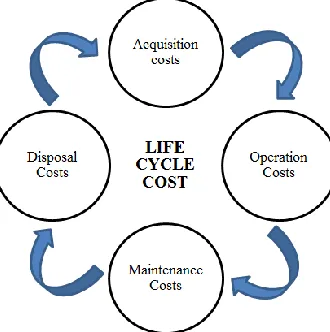
Life cycle cost is defined as the overall cost of ownership of machinery and equipment, including its cost of acquisition, operation, maintenance, and decommission (Rozis and Rahman, 2004). The word “life cycle” refers as the total time period between the time of acquisition of the asset and the time when the asset is dispose (Forte, 2012). Through literature, this term has been changed over the years from cost in use to life cycle costing (LCC) and further to whole life costing (WLC) and whole life appraisal (WLA). Thus, several different terms can be found in literature. It is an economic assessment to an item, system, assets or facility over its expected life and expressed it in the terms of equivalent cycle costing. In other words, life cycle cost is the overall cost of owning an asset over its
Figure 1 Typical diagram of water treatment and distribution systems. Source: Rozis and Rahman, 2004
Figure 2 Life cycle cost (acquisition phase)
Life cycle cost is a generic method that enables comparative cost assessments over a period of several years. It is also known as a methodology which can assist cost management efforts by calculating the total cost of an ownership over the life span of an asset (Brown et al., 1985). The total cost includes the cost of acquiring the asset, cost of maintenance, cost of rehabilitate and cost of replacement. In this decade, as society more frequently demands for greater accountability and cost effectiveness, noticeable return-on-investment and defendable justifications for asset acquisition, life cycle cost methodology become an increasingly popular method in cost management and financial planning (Hall and Dusenberry 2009). Apart from that, some literature defined life cycle cost as the tool used to assess the total cost of an asset over its useful time including the costs of acquisition, operation, maintenance and disposal. Emblemsvåg (2003) defined life cycle cost as a tool used to support decision where the decision requires the assessment of current and future costs. Ammar et al. (2012) also agreed that life cycle cost is a decision support tool which can effectively help engineers and practitioners in making decision such as comparing and selecting the most cost effective method. Primarily, life cycle cost is used in evaluating various alternatives by identifying and assessing the economic impacts over the life of each alternative to achieve the client’s need (Anurag Shankar Kshirsagar, 2010; Langdon, 2007).
Overall, the main objective of life cycle cost is to determine the total cost of ownership of an asset and the purpose of life cycle cost is to estimate the overall cost incurred in a whole life cycle and monitor the cost throughout the life cycle of an asset. Primarily, it focuses on cost after acquisition of an
asset. In addition, life cycle cost generally seeks to identify long term cost and therefore the aim of life cycle cost is to get a comprehensive estimation of the total cost of various alternatives in the long run. Besides, life cycle cost may usually affect the future expenses needed by planning the use and operation of an asset or by maintaining the asset. Via practicing life cycle cost, it is possible to identify the pattern of the cost in different phases of the life cycle and the trade-offs between cost elements to minimize the total costs. Life cycle cost is not only used to forecast future expenses but it also helps in monitoring the current expenses.
2.0 PROCESS TO DEVELOP LIFE CYCLE COST MODEL
Figure 3 Life cycle cost process
In the second stage of the process, a life cycle cost model selected or developed should satisfy the objectives of the analysis and thus the model should create or adopt a cost breakdown structure that identifies all relevant cost categories in all appropriate life cycle phases. From that, each cost categories should continue to breakdown until a cost can be readily estimated for each cost element. In other words, it means that to develop a life cycle cost model, there are also several stages such as identifying the cost elements, determining the cost cateogories and developing a cost breakdown structure that needed to be done so that all the cost required in a project could be determine. Firstly, the cost elements need to be identified and grouped according to relevant cost category. Once relevant cost categories have identified, a cost breakdown structure should be developed. Finally, based on the developed cost breakdown structure, a life cycle cost model could be developed.
Based on the reviewed of life cycle cost guideline (2004) and tutorial from different countries which have widely practiced life cycle cost, the most basic step to develop a life cycle cost model is to first develop a cost breakdown structure(Barringer and Weber, 1996; Mearig et al., 1999; Total Asset Management, 2004; Davis et al., 2005; Department of Sport and Recreation, 2005; Fuller, 2005; Langdon, 2007). El-Haram et al. (2002) strongly recommend to follow a LCC structure which may facilitate in the identification of LCC element. In practice, only the cost breakdown structure provides relevant LCC elements and thus cost breakdown structure is essential in order to formulate LCC (Langdon, 2010). Figure 4 below illustrate the process of developing a life cycle cost model.
Figure 4 Process of developing life cycle cost
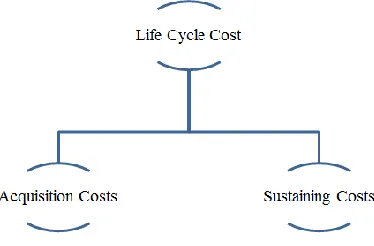
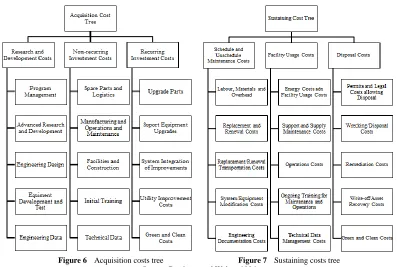
Based on Barringer and Weber (1996), life cycle cost can be broken down into a very simple structure which consists of acquisition costs and sustaining costs as shows in Figure 5. The acquisition costs and sustaining costs are formed by adding all
the cost elements which can be further broken down into details. In other words, the acquisition costs and sustaining costs can be broken down into several detail cost elements as show in Figure 6 and Figure 7.
Figure 5 Top down level of life cycle cost tree
Model
Results
Analysis
Life Cost
Analysis
Cost Elements
Cost Categories
Cost
Breakdown
Structure
Figure 6 Acquisition costs tree Figure 7 Sustaining costs tree Source: Barringer and Weber, 1996
3.0 COST BREAKDOWN STRUCTURE
In the analysis of life cycle cost, consideration must be given not only to the initial purchase cost, but also the other costs incurred during the whole life span. As defined in ISO 15686, Part 1, life cycle cost is a technique which enables comparative cost assessment to be made over a specific period of time, taking into account both in terms of initial capital investment and future operational costs (Ugarelli, 2010). As an example, in a water distribution pipeline networks, the life cycle costs not only involve the costs of acquisition which includes consultancy from the expert, design and construction costs and equipment, but also take into account the operational and maintenance costs over its whole useful life until its disposal. All the future activities costs must be taken into consideration as without the periodic maintenance and rehabilitation, the water distribution pipelines will not provide continuous service to the end-users. Based on literature, most of the life cycle cost models implemented are more or less the same basic equation regardless of which industry it is. The only thing, that differentiate them are the cost breakdown structure. All the costs incurred in life cycle cost can be broken down into several categories of cost. Fundamentally, it can be broken down into initial or acquisition costs, operating costs, maintenance costs and disposal costs. The costs can further break down into more specific cost such as labour cost, equipment cost, material cost, installation and commissioning cost, energy cost, logistic support cost and so on.
A cost breakdown structure illustrate all the costs emerged in each single phase of the asset’s life cycle cost and its purpose is to identify, define and organize all cost elements to be taken into account in a life cycle cost (Langdon, 2010). The cost breakdown structure helps in estimating the life cycle cost, as all the costs included will further breakdown until a cost can readily be estimated such as asset purchase price, labour cost, training fees and so on. The life cycle cost breakdown into four essential cost categories which are acquisition costs, operating
costs, maintenance costs and disposal costs. However, this may vary according to the industries where life cycle cost model is being applied because the cost elements in each cost breakdown structure vary in scope and details (Langdon, 2010; Barringer and Weber, 1996). For example, the life cycle cost in the Society of Automotive Engineers (SAE) has five breakdown categories which are acquisition cost, operating cost, schedule maintenance cost, unscheduled maintenance cost and conversion or decommission cost. As in Fabrycky and Blanchard (1991), the authors stated that life cycle cost has four breakdown categories which consist of research and development costs, production and construction costs, operation and maintenance costs and retirement and disposal costs. This is because the life cycle cost model applies in manufacturing industry involved research and development cost and the production costs. For construction industry, based on United Kingdom ISO 15686-5, the breakdown of the structure will consists of planning, design, construction, operation, maintenance and demolition. Whereas as stated by El-Haram et al. (2002), British Standard 5760-23 shows that a life cycle cost consists of five levels which are project level, phase level, category level and task level and each level has its own breakdown. As an example, project level could be broken down into several costs such as capital cost. From capital cost, it could further be broken down into more particular cost such as design cost.
3.1 Acquisition Cost
3.2 Operating Cost
Operating cost is the cost required to operate a system or an asset during its useful life. According to El-Haram and Horner (2003), operating cost is categorized under the facility management cost which is the same categories with maintenance cost. Operating cost is one of the cost categories which consume a large portion of the total cost. It might probable be two to three times higher than the acquisition cost. In life cycle cost analysis, operating cost is usually a future cost which is unknown, especially for newly developed assets, where assumption and forecast are needed in estimating the cost (Ellis, 2007). Therefore, the operating cost data are likely to be unavailable and practitioners or decision makers need to make assumption based on their experiences. Generally, operating cost can be broken down into direct labour cost, utilities cost, spare parts maintenance cost, custodial cost, insurance and rental.
3.3 Maintenance Cost
Maintenance cost is the cost required in maintaining a system or an asset when the system or asset breaks down during its useful life. Similar to operating cost, it is also an unknown cost data for newly developed asset as it is the future cost outlays and assumption is required (Ellis, 2007). For example, in the Society of Automotive Engineers (SAE) life cycle cost model, the maintenance cost is divided into two categories which are scheduled maintenance cost and unscheduled maintenance cost. Maintenance cost can further be broken down into preventive maintenance cost, reactive maintenance cost, custodial cost, material cost, labour cost and cost of repair.
3.4 Disposal Cost
Disposal cost or also known as residual value is also a future cost and it is often difficult to estimate. It is the cost used in disposing or getting rid of the asset after the end of its useful life. However, sometimes disposal cost also known as salvage value if the asset could be sold as a second hand product and gain some cost from it. Thus, disposal cost could be broken down into salvage value, removal cost, conversion cost, cleaning of site and waste disposal.
4.0 CONCLUSIONS
Life cycle cost model is a multi-stages development process and cost breakdown structure is said to be an essential basic process
and inaccurate. Hence, the process of identifying cost elements for each asset is very important.
References
[1] Ammar, M., Moselhi, O. and Zayed, T. 2012. Decision Support Model for Selection of Rehabilitation Methods of Water Mains. Structure and Infrastructure Engineering: Maintenance, Management, Life-Cycle
Design and Performance. 8(9): 847–855.
[2] Anurag Shankar Kshirsagar, Mohamed A. El-Gafy, Tariq Sami Abdelhamid. 2010 Suitability of Life Cycle Cost Analysis (LCCA) as Asset Management Tools for Institutional Buildings. Journal of Facilities Management. 8(3): 162–178.
[3] Barringer, H. P. and Weber, D. P. 1996. Life Cycle Cost Tutorial. 5th International Conference on Process Plant Reliability. 2–4 October. Houston, Texas.
[4] Brown, R. J. 1985. Introduction to Life Cycle Costing. Atlanta, Georgia: Fairmont Pr.
[5] Davis, M., Coony, R., Gould, S. and Daly, A. 2005. Guideline For Life Cycle Cost Analysis. Stanford University.
[6] Department of Sport and Recreation. 2005. Government of Western Australia: Department of Sport and Recreation.
[7] Ellis, B. A. 2007. Life Cycle Cost. In International Conference of Maintenance Societies.
[8] El-Haram, M. A., Marenjak, S. and Horner, M. W. 2002. Development of a Generic for Collecting Whole Life Cost Data for The Building Industry. Journal of Quality Maintenance Engineering. 8(2): 144–151. [9] Emblemsvåg, J. 2003. Life Cycle Costing–Using Activity-based
Costing and Monte-Carlo Methods to Manage Future Costs and Risks.
Hoboken, New Jersey: John Wiley & Sons.
[10] Fabrycky, W. J. and Blanchard, B. S. 1991. Life Cycle Cost and Economic Analysis. Prentice Hall, Englewood Cliffs, NJ.
[11] Forte. 2012. Life Cycle Costing-The Basics. European Copper Institute, Copper Alliance.
[12] Fuller, S. K. 2005. Guidance on Life Cycle Cost Analysis.
Gaithersburg: National Institute of Standards and Technology. [13] Hall, R. and Dusenberry, E. D. 2009. The Application of Cost
Management and Life-Cycle Cost Theory to Homeland Security National Priorities. Journal of the Naval Postgraduate School Center for Homeland Defense and Security. 5(2): 1–17.
[14] Langdon, D. 2007. Life Cycle Costing (LCC) as a Contribution To Sustainable Construction-Guidance on the Use of the LCC Methodology and its Application in Public Procurement.
[15] Langdon, D. 2010. Development of a Promotional Campaign for Life Cycle Costing in Construction.
[16] Mearig, T., Coffee, N. and Morgan, M. 1999. Life Cycle Cost Analysis
Handbook. Alaska Department of Education and Early Development.
[17] Rozis, N. and Rahman, A. 2004. A Simple Method for Life Cycle Cost Assessment of Water Sensitive Urban Design. American Society of Civil Engineers. 1–11.
[18] Total Asset Management. 2004. New South Wales: New South Wales Treasury.