MAULSTBY, JR., GREGORY ALLAN. Comparison of COBRA-EN and COBRA-CTF Simulation Predictions to Benchmark Data for Representative Boiling Water Reactor Conditions. (Under the direction of Dr. Joseph Michael Doster).
The purpose of this study is to compare predictions of two subchannel thermal-hydraulic codes,
COBRA-EN and COBRA-CTF, under representative boiling water reactor (BWR) operating
conditions with the steady-state, two-phase pressure drop benchmark data from the Nuclear
Power Engineering Corporation of Japan BWR Full-size Fine-mesh Bundle Test database.
Chapter two contains a brief description of the test facility used to conduct the experiments
along with the test assembly, grid spacers, and operating conditions and measured pressure
drop data for the test cases. Both COBRA-CTF and COBRA-EN sections include explanations
of input deck entries, methods to determine axial geometry, and unique differences and
challenges encountered. A mesh convergence study revealed that pressure predictions in both
thermal hydraulic codes were insensitive to the axial node length for a uniform node length of
0.1545m (0.50689ft) based on the given power profile. An additional study in COBRA-EN
determined two optimum combination of correlations based on pressure drop alone and another
that considers vapor fraction. The comparison of both codes to the benchmark data concluded
that COBRA-CTF requires further investigation of vapor fraction near the grid spacers, and
that both codes slightly under predict total pressure drop. In addition, COBRA-EN and
COBRA-CTF match the benchmark database well at most pressure drop identifiers but
measured vapor fraction is required to definitively claim which code predictions better
© Copyright 2018 by Gregory Allan Maultsby Jr.
for Representative Boiling Water Reactor Conditions
by
Gregory Allan Maultsby Jr.
A thesis submitted to the Graduate Faculty of North Carolina State University
in partial fulfillment of the requirements for the degree of
Master of Science
Nuclear Engineering
Raleigh, North Carolina
2018
APPROVED BY:
______________________________ _______________________________
Dr. Maria Nikolova Avramova Dr. Stephen D Terry
BIOGRAPHY
Gregory Allan Maultsby, Jr. was born in Raleigh, North Carolina. He graduated high school in
1993 and returned to further his education in 2009. Received an Associate in Pre-Engineering in
2012 from Wake Technical Community College. Upon completion of the associate’s degree, he
transferred to North Carolina State University’s Nuclear Engineering program in the fall of
2012. After obtaining a bachelor in Nuclear Engineering in 2015, he stayed to pursue a Master
ACKNOWLEDGMENTS
“It takes a village to raise a child.”
-Unknown
By no far measure did I accomplish this master’s thesis alone. I would like to acknowledge the
following people for their contributions throughout this journey. First, I would like to thank
my graduate school advisor Dr. J. Michael Doster, of the Nuclear Engineering Department at
North Carolina State University for offering the opportunity to continue my education after my
undergraduate studies. He has continued to provide mentorship through his persistent patience
and guidance during the learning process of this master’s thesis. I would also like to
acknowledge Dr. Maria Avramova and Dr. Stephen Terry, as committee members. Also, I
would like to acknowledge Dr. Bourham, for taking time out of his schedule to attend my
defense as a committee member substitute. I received invaluable assistance from Dr. Taylor
Blythe for COBRA-CTF technical support, Dr. Robert Salko for general COBRA-CTF
support, and Dr. Konor Frick for his guidance and intellectually spirited discussions. I would
like to extend my appreciation for the funding support from CASL. Lastly, I would like to
acknowledge those who have contributed in a non-academic capacity. Sherry Bailey was a
consistent source of moral support throughout my experience in graduate school. We should
never forget those that wait for us while we chase our dreams. Ingrid Medina was a constant
source of stability in my life who always stood beside me for the full duration of my
TABLE OF CONTENTS
LIST OF TABLES ... vii
LIST OF FIGURES ... x
CHAPTER 1: Introduction ... 1
CHAPTER 2: NUPEC BFBT Benchmark ... 3
2.1 NUPEC Rod Bundle Test Loop ... 4
2.2 NUPEC BFBT High Burn-Up Assembly ... 6
2.3 Bundle Pressure Drop Locations ... 8
2.4 NUPEC BFBT C2A Power Profiles ... 10
2.5 NUPEC BFBT Grid Spacer ... 11
2.6 Subchannel Grid Spacer Loss Coefficients... 13
2.7 Representative BWR Operating Conditions ... 16
2.8 NUPEC BFBT Test Cases ... 19
CHAPTER 3: COBRA-CTF ... 21
3.1 Generalized Conservation Equations ... 24
3.2 Normal Wall Flow Regime Map ... 25
3.3 Pressure Drop ... 27
3.3.1 Friction Loss model ... 27
3.3.2 Form (Local) Loss Model ... 28
3.4 Water Properties... 28
3.5 Global Boundary Conditions ... 29
3.4.1 Inlet and Outlet Boundary Conditions ... 30
3.5 Convergence Study for COBRA-CTF ... 31
3.5.1 Methods for Mesh refinement ... 32
3.5.2 Base Mesh Refinement Technique ... 33
3.5.3 Uniform/Variable Mesh Refinement Technique ... 34
3.5.4 Mesh Refinement Cases ... 36
3.5.5 Adjustment to 5X24 ... 37
3.5.6 Adjustment to 6X24 ... 39
3.5.7 Adjustment to 7X24 ... 40
3.5.8 Adjustment to 8X24 ... 46
3.6 Total Power Forcing Function ... 47
3.6.1 Axial Power Profile... 48
3.7.1 P60001, Mesh Convergence Study Pressure and Vapor Fraction Plots ... 50
3.7.2 P60007, Mesh Convergence Study Pressure and Vapor Fraction Plots ... 51
3.7.3 P60015, Mesh Convergence Study Pressure and Vapor Fraction Plots ... 52
3.8 Mesh Convergence Study Analysis ... 53
3.8.1 Absolute Relative Differences for the Mesh Refinement Convergence Study ... 55
3.8.2 P60001, Axial Position Influence on Absolute Relative Differences ... 56
3.8.3 P60007, Axial Position Influence on Absolute Relative Differences ... 60
3.8.4 P60015, Axial Position Influence on Absolute Relative Differences ... 64
3.9 Convergence Study Conclusion ... 68
3.10 Axial Peaking Factors ... 70
3.11 Evaluation of the 1X24 and ETD Mesh Refinement Cases ... 73
3.11.1 P60001, Pressure and Vapor Fraction Plots of 1X24 and ETD Cases ... 74
3.11.2 P60007, Pressure and Vapor Fraction Plots of 1X24 and ETD Cases ... 75
3.11.3 P60015, Pressure and Vapor Fraction Plots of 1X24 and ETD Cases ... 76
3.11.4 P60015, Example of Differences in Pressure for 1X24 and ETD Cases ... 77
3.12 COBRA-CTF Results ... 80
CHAPTER 4: COBRA-EN ... 81
4.1 Subchannel Conservation Equations... 83
4.2 Subcooled Boiling Models ... 86
4.3 Void Quality Relations ... 88
4.4 Two Phase Friction Model ... 91
4.5 Pressure Drop ... 92
4.6 Water Properties... 94
4.7 COBRA-EN Axial Nodes ... 95
4.7.1 Description of the Normal Axial Nodes in COBRA-EN ... 97
4.7.2 Illustration of the Introduced Axial Nodes in COBRA-EN ... 98
4.8 Power Profile ... 100
4.9 COBRA-EN Boundary Conditions ... 102
4.9.1 Inlet Boundary Conditions ... 102
4.9.2 Outlet Boundary Conditions ... 103
4.10 Case Studies for COBRA-EN ... 103
4.10.1 Combination of Correlations for COBRA-EN ... 104
4.10.2 P60001, Evaluation of Total Pressure Drop ... 105
4.10.4 P60007 and P60015, Total Pressure Drop ... 108
4.10.5 P60007 and P60015, Pressure Drop for the Pressure Drop Identifiers ... 109
4.10.6 Result of the Correlations Study for Pressure Drop... 111
4.10.7 Further Evaluation of the Correlations Study ... 112
4.10.8 P60001, Plots for the Extended Correlations Study ... 114
4.10.9 P60007, Plots for the Extended Correlations Study ... 116
4.10.10 P60015, Plots for the Extended Correlations Study... 118
4.10.11 Results of the Extended Correlations Study ... 120
4.10.12 Conclusion of the Extended Correlations Study ... 122
4.11 Convergence Study with COBRA-EN... 123
4.12 Results of Convergence Study with COBRA-EN ... 124
CHAPTER 5: Comparison of COBRA-EN and COBRA-CTF ... 125
5.1 Comparison for Test Case P60001 ... 126
5.2 Comparison for Test Case P60007 ... 129
5.3 Comparison for Test Case P60015 ... 132
Conclusion and Future Work ... 135
REFERENCES ... 138
APPENDICES ... 139
Appendix A ... 140
Appendix B ... 142
Appendix C ... 143
Appendix D ... 146
Appendix E ... 155
Appendix F... 161
Appendix G ... 162
Appendix H ... 166
LIST OF TABLES
Table 2.1: Maximum Operating Conditions ... 4
Table 2.2: High Burn-up 8x8 Assembly ... 6
Table 2.3: Pressure Tap Axial Positions ... 9
Table 2.4: Length Between Pressure Tap Positions... 9
Table 2.5: Spacer Grid Locations ... 11
Table 2.6: ABWR and ESBWR Operating Conditions ... 17
Table 2.7: ABWR Operating Conditions ... 17
Table 2.8: Typical 8X8 BWR Operating Conditions... 18
Table 2.9: Selected Test Case Operating Conditions and Pressure Drop Measurements ... 19
Table 2.10: Range of NUPEC BFBT Test Parameters ... 20
Table 3.1: Total Inlet Mass Flow Rate... 29
Table 3.2: Average Linear Heat Rate per Rod ... 29
Table 3.3: Initial Guess for Pressure, PREF ... 30
Table 3.4: Inlet Fluid Temperature, TIN ... 30
Table 3.5: Mesh Refinement Case Uniform Node Length ... 36
Table 3.6: Test Case Mesh Refinement Technique Legend ... 36
Table 3.7: 5X24 Adjustment, Evaluation of 0.1mm Node Before 5th Grid Spacer ... 37
Table 3.8: 5X24 Adjustment, Change in Node Before 5th Grid Spacer ... 38
Table 3.9: 6X24 Adjustment, Evaluation of 0.75mm Node After 7th Grid Spacer ... 39
Table 3.10: 6X24 Adjustment, Change in Node After 7th Grid Spacer ... 39
Table 3.11: 7X24 Adjustment, Evaluation of 0.214mm Node Before 3rd Grid Spacer ... 40
Table 3.12: 7X24 Adjustment, Change in Node Before 3rd Grid Spacer ... 40
Table 3.13: Further Adjustment to 7X24 Base Technique ... 41
Table 3.14: 7X24 Test 1, Evaluation of Node After 2nd Grid Spacer ... 42
Table 3.15: 7X24 Test 1, Change in Node After 2nd Grid Spacer ... 42
Table 3.16: 7X24 Test 1, Evaluation of Node After 7th Grid Spacer ... 43
Table 3.17: 7X24 Test 1, Change in Node After 7th Grid Spacer ... 43
Table 3.18: Uniform/Variable Technique, 7X24 Test 6 and Test 8 ... 44
Table 3.19: Uniform/Variable Grid Spacer Padding for 7X24 Test 8 ... 45
Table 3.20: 8X24 Test 1 and Test 2 ... 46
Table 3.21: Powers with 0.3125 Extrapolated Axial Peaking Factor ... 48
Table 3.22: P60001 Absolute Relative Difference for 1X24 to 3X24 ... 54
Table 3.24: COBRA-CTF, P60001 Convergence Study Error Results for Void Fraction ... 57
Table 3.25: COBRA-CTF, P60001 Convergence Study Error Results for Flow Quality ... 58
Table 3.26: COBRA-CTF, P60007 Convergence Study Error Results for Pressure ... 60
Table 3.27: COBRA-CTF, P60007 Convergence Study Error Results for Vapor Fraction ... 61
Table 3.28: COBRA-CTF, P60007 Convergence Study Error Results for Flow Quality ... 62
Table 3.29: COBRA-CTF, P60015 Convergence Study Error Results for Pressure ... 64
Table 3.30: COBRA-CTF, P60015 Convergence Study Error Results for Vapor Fraction ... 65
Table 3.31: COBRA-CTF, P60015 Convergence Study Error Results for Flow Quality ... 66
Table 3.32: COBRA-CTF Center Points with Associated Axial Peaking Factors ... 71
Table 3.33: Measured Total Pressure Drop (psi) ... 73
Table 3.34: P60015, Smaller Node Size Between 5.577ft and 5.597ft in ETD Case ... 78
Table 3.35: P60015, Smaller Node Size Between 10.6463ft and 10.636ft in ETD Case ... 79
Table 3.36: COBRA-CTF Results for Pressure Drop ... 80
Table 4.1: COBRA-EN Node Edges ... 99
Table 4.2: COBRA-EN Thermal Output (MW) ... 100
Table 4.3: COBRA-EN Center Points ... 101
Table 4.4: Inlet Fluid Temperature, HIN ... 102
Table 4.5: Total Inlet Mass Flux Rate, GIN ... 102
Table 4.6: Exit Pressure, PEXIT ... 103
Table 4.7: Legend for Combinations of Correlations Used in COBRA-EN ... 104
Table 4.8: P60001 Evaluation for Total Pressure Drop of Measured Value 3.974 psi ... 105
Table 4.9: P60001 Absolute Relative Difference for Pressure Drop at Pressure Drop Identifiers ... 107
Table 4.10: P60007 Evaluation for Total Pressure Drop of Measured Value 8.396 psi ... 108
Table 4.11: P60015 Evaluation for Total Pressure Drop of Measured Value 16.530 psi ... 109
Table 4.12: P60007, Absolute Relative Difference for Pressure Drop at Pressure Drop Identifiers ... 110
Table 4.13: P60015, Absolute Relative Difference for Pressure Drop at Pressure Drop Identifiers ... 110
Table 4.14: COBRA-EN Results for Suite of Correlations, Set 8 ... 111
Table 4.15: P60001, Extended Combinations of Correlations Study ... 115
Table 4.16: P60007, Extended Combinations of Correlations Study ... 117
Table 4.17: P60015, Extended Combinations of Correlations Study ... 119
Table 4.18: P60001, COBRA-EN Extended Correlation Study Sets ... 120
Table 4.20: P60015, COBRA-EN Extended Correlation Study Sets ... 121
Table 4.21: COBRA-EN Results for Extended Set of Correlations, Set 1 ... 122
Table 4.22: COBRA-EN Convergence Study Uniform Node Lengths ... 123
Table 4.23: Results of COBRA-EN Convergence Study for Pressure (psi) ... 124
Table 5.1: P60001 COBRA-EN and COBRA-CTF Pressure Drop Comparison ... 126
Table 5.2: P60007 COBRA-EN and COBRA-CTF Pressure Drop Comparison ... 129
LIST OF FIGURES
Figure 2.1: System diagram of test facility for NUPEC rod bundle test series ... 5
Figure 2.2: Top-down view of the 8X8 high burn-up test bundle ... 7
Figure 2.3: Top left corner of 8X8 high burn-up test bundle... 7
Figure 2.4: Locations for pressure tap positions and pressure drop identifiers ... 8
Figure 2.5: Axial peaking factors in NUPAC BFBT C2A thermal profile ... 10
Figure 2.6: Radial peaking factors in NUPAC BFBT C2A thermal profile ... 10
Figure 2.7: Dimensions of ferrule type grid spacer (mm) ... 12
Figure 2.8: Legend of subchannel grid spacer loss coefficients ... 13
Figure 2.9: Typical diagram of a two-dimensional fuel channel ... 14
Figure 2.10: Grid spacer loss coefficients for top left corner ... 14
Figure 2.11: Grid spacer loss coefficients surrounding the central water channel ... 15
Figure 2.12: Average power/flow per bundle map for the ESBWR and BWR ... 16
Figure 3.1: COBRA-CTF normal wall flow regime map ... 26
Figure 3.2: Diagram of the Base mesh refinement technique ... 33
Figure 3.3: Diagram of the Uniform/Variable mesh refinement technique ... 35
Figure 3.4: Diagram of the padding in proximity of a grid spacer ... 35
Figure 3.5: Plot of failed solution convergence for P60001 5X24 with the 0.1mm node .... 37
Figure 3.6: Plot of solution convergence for P60001 5X24 without the 0.1mm node ... 38
Figure 3.7: Heat input over one fluid node ... 47
Figure 3.8: P60001, Pressure at axial positions for the convergence study mesh refinement cases ... 50
Figure 3.9: P60001, Vapor fraction at axial positions for the convergence study mesh refinement cases ... 50
Figure 3.10: P60007, Pressure at axial positions for the convergence study mesh refinement cases ... 51
Figure 3.11: P60007, Vapor fraction at axial positions for the convergence study mesh refinement cases ... 51
Figure 3.13: P60015, Vapor fraction at axial positions for the convergence study mesh refinement cases ... 52
Figure 3.12: P60015, Pressure at axial positions for the convergence study mesh refinement cases ... 52
Figure 3.14: P60001 Vapor fractions at shared axial position for all mesh refinement cases ... 59
Figure 3.15: P60007 Vapor fractions at shared axial position for all mesh refinement cases ... 63
Figure 3.17: Axial peaking factors for COBRA-CTF 1X24 and ETD compared to the
given values ... 72 Figure 3.18: P60001, Pressures of the COBRA-CTF 1X24 and ETD mesh
refinement cases ... 74 Figure 3.19: P60001, Vapor Fractions of the COBRA-CTF 1X24 and ETD mesh
refinement cases ... 74 Figure 3.20: P60007, Pressures of the COBRA-CTF 1X24 and ETD mesh
refinement cases ... 75 Figure 3.21: P60007, Vapor Fractions of the COBRA-CTF 1X24 and ETD mesh
refinement cases ... 75 Figure 3.22: P60015, Pressures of the COBRA-CTF 1X24 and ETD mesh
refinement cases ... 76 Figure 3.23: P60015, Vapor Fractions of the COBRA-CTF 1X24 and ETD mesh
refinement cases ... 76 Figure 3.24: Shift in pressure predictions observed in lower assembly positions for
1X24 and ETD cases ... 77 Figure 3.25: Shift in pressure predictions observed at 5.587ft and 7.27ft for 1X24 and
ETD cases ... 78 Figure 3.26: Shift in pressure predictions observed at 9.124ft, 10.646ft, and 11.57ft for
1X24 and ETD cases ... 79 Figure 4.1: Diagram of the lateral momentum control volume ... 85 Figure 4.2: Diagram to illustrate the construction of a normal COBRA-EN axial node ... 97 Figure 4.3: Diagram to illustrate the construction of an introduced COBRA-EN
axial node. ... 98 Figure 4.4: P60001, COBRA-EN EPRI suite’s vapor fraction predictions compared to
COBRA-CTF ... 114 Figure 4.5: P60001, Matched COBRA-EN sets compared to COBRA-CTF exit vapor
fraction predictions ... 114 Figure 4.6: P60001, Selected COBRA-EN sets compared to COBRA-CTF vapor
fraction trends ... 115 Figure 4.7: P60007, COBRA-EN EPRI suite’s vapor fraction predictions compared to
COBRA-CTF ... 116 Figure 4.8: P60007, Matched COBRA-EN sets compared to COBRA-CTF exit vapor
fraction predictions ... 116 Figure 4.9: P60007, Selected COBRA-EN sets compared to COBRA-CTF vapor
fraction trends ... 117 Figure 4.10: P60015, COBRA-EN EPRI suite’s vapor fraction predictions compared to
COBRA-CTF ... 118 Figure 4.11: P60015, Matched COBRA-EN sets compared to COBRA-CTF exit vapor
fraction predictions ... 118 Figure 4.12: P60015, Selected COBRA-EN sets compared to COBRA-CTF vapor
Figure 5.1: P60001, Pressure drop values at pressure tap identifiers ... 127
Figure 5.2: P60001, Percent difference in predicted to measured pressure drop ... 127
Figure 5.3: P60001, Pressure predictions of COBRA-CTF compared to COBRA-EN ... 128
Figure 5.4: P60001, Vapor fraction predictions of COBRA-CTF compared to COBRA-EN ... 128
Figure 5.5: P60007, Pressure drop values at pressure drop identifiers ... 130
Figure 5.6: P60007, Percent difference in predicted to measured pressure drop ... 130
Figure 5.7: P60007, Pressure predictions of COBRA-CTF compared to COBRA-EN ... 131
Figure 5.8: P60007, Vapor fraction predictions of COBRA-CTF compared to COBRA-EN ... 131
Figure 5.9: P60015, Pressure drop values at pressure drop identifiers ... 133
Figure 5.10: P60015, Percent difference in predicted to measured pressure drop ... 133
Figure 5.11: P60015, Pressure predictions of COBRA-CTF compared to COBRA-EN ... 134
CHAPTER 1: Introduction
The purpose of this study is to compare predictions of two subchannel thermal-hydraulic codes,
COBRA-EN and COBRA-CTF, under representative boiling water reactor (BWR) operating
conditions with benchmark data from the Nuclear Power Engineering Corporation (NUPEC)
of Japan BWR Full-size Fine-mesh Bundle Test (BFBT) database. This study is a continuation
of the ongoing validation and verification (V&V) process pertaining to the stand -alone
component, COBRA-CTF, in the code package VERA-CS sponsored by the Consortium for
Advanced Simulation of Lightwater Reactors (CASL). The primary validation metric for this
study is the steady-state, two-phase pressure drop benchmark from the NUPEC BFBT
database. Three of twenty-two test cases were selected to explore a variety of given parameters
such as thermal output, exit quality, total pressure drop, and mass flow.
First, it is important to understand the methods involved in collecting the measured benchmark
data in the NUPEC BFBT database. An electrically heated test loop was designed to simulate
a range of BWR operating conditions. Pressure drop measurements were taken at selected axial
positions along the heated bundle illustrated in figure 2.4 under operating conditions listed in
table 2.9. The BWR bundle design, axial and radial peaking factors, and grid spacer positions
are provided in the NUPEC BWR Full-size Fine-mesh Bundle Test (BFBT) Benchmark,
Volume I: Specifications [7]. The grid spacer local loss coefficients used in this study are
the same as used in previous CASL studies as represented in the, “CTF Validation and
For evaluation purposes, COBRA-EN and COBRA-CTF, are considered in separate sections.
These sections briefly describe the methods and models utilized in each code. In addition, there
are explanations of input deck entries, methods to determine axial geometry, and unique
differences and challenges encountered in each code. Furthermore, a mesh refinement study
was performed to determine the appropriate axial node length suitable for typical BWR
simulations. This supplementary study determines whether decreasing the axial mesh length
contributes to significant changes in code generated values at shared axial positions. The
default mesh length is based on the NUPEC BFBT database provided axial power peaking
factors illustrated in figure 2.5. These values are given for twenty-four uniform nodes of
lengths 154.5mm (0.50689ft) that sum to a total heated length of 3708mm (12.1654ft).
COBRA-CTF offers limited user options for choosing empirical closure relations as compared
to COBRA-EN. An additional study explores various combinations of two-phase correlations
and models in COBRA-EN to determine a best choice suite for comparison to the NUPEC
BFBT benchmark data. The “best choice suite” of correlations and models serves as the basis
CHAPTER 2: NUPEC BFBT Benchmark
The experimental data utilized for this study originates from the BFBT benchmark developed
by the NUPEC of Japan as a result of the fourth OECD/NRC BWR TT Benchmark Workshop
held on the sixth of October 2002 in Seoul, Korea [7].The NUPEC BFBT database addresses
concerns for nuclear applications to refine models for best estimate calculations based on good
quality experimental data [7]. Refer to NUPEC BWR Full-size Fine-mesh Bundle Test (BFBT)
Benchmark, Volume I: Specifications for the complete collection of the benchmark details and
exercises conducted. The primary focus for this study is the two-phase pressure drop, P6 series,
experiments located in the Phase II, “Critical Power Benchmark”, Exercise 0, “Steady State
Pressure Drop Benchmark. These experiments were conducted at the NUPEC BFBT facility
that can operate at the high pressure, and high fluid temperature conditions for typical reactor
2.1 NUPEC Rod Bundle Test Loop
Figure 2.1 illustrates the test loop used to conduct the NUPEC BFBT experiments. The structural
components are made of stainless steel (SUS304), and the cooling fluid is demineralized
water [7]. Electrically heated rod bundles are used to simulate a full scale BWR fuel
assembly [7]. The cladding, insulator, and heater were made of Inconel, boron nitride and
nichrome, respectively [7]. Mechanical properties listed in the appendix A are based on the
MATPRO model used in the TRAC code [7]. An adiabatic condition is suggested for the
benchmark considering no information on heat loss is available in the NUPEC BFBT
database [7]. The test loop can simulate a large range of steady-state BWR operating conditions.
Table 2.1 contains the maximum operating conditions for the BFBT test facility [7].
Table 2.1: Maximum Operating Conditions
Pressure Temperature Power Flow Rate
Metric
10.3 MPa 315 °C 12 MW 75 t/h
Standard
8.97 × 10¹³ 𝑙𝑏𝑚
𝑓𝑡 ℎ𝑟2 599 °F 4.09 × 10⁷
𝐵𝑇𝑈
ℎ𝑟 1.653 × 10
5 𝑙𝑏𝑚
A system diagram for the NUPEC rod bundle test series is illustrated in figure 2.1. A circulation
pump moves the coolant through three parallel control valves of different sizes to match the
desired flow rate for each case [7]. The fluid temperature entering the test section is controlled
by a direct-heating tubular pre-heater [7]. Sub-cooled coolant flows upward into the test section
where it is heated by the electrically heated rods to simulate the BWR operating conditions [7].
The coolant exiting the bundle is a mixture of steam and water that enters a separator where
the steam is separated and condensed using a sub-cooled water spray from two air-cooled heat
exchangers [7]. The condensed water is return to the circulation pump to complete the loop [7].
2.2 NUPEC BFBT High Burn-Up Assembly
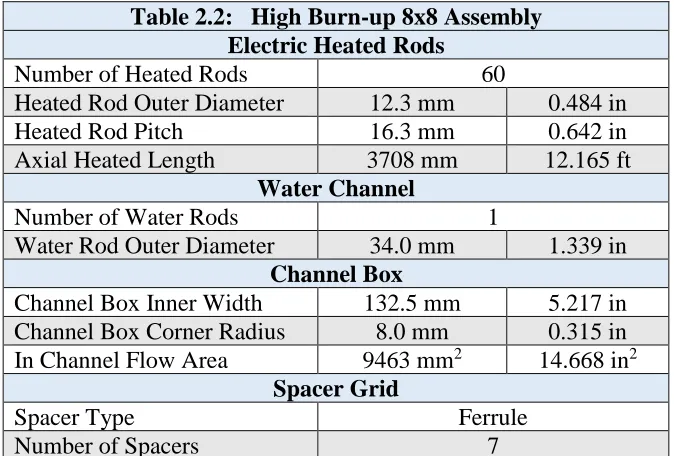
The 8X8 High Burn-Up assembly is the chosen full-scale test bundle for this study. In addition,
the high burn-up assembly, classified as C2A, simulates beginning of operation radial peaking
conditions illustrated in figure 2.6 [7]. Table 2.2 list the number and dimensions of the heated
rods and water channels, the number of grid spacers, and the dimensions of the BWR
channel box [7].
Table 2.2: High Burn-up 8x8 Assembly Electric Heated Rods
Number of Heated Rods 60
Heated Rod Outer Diameter 12.3 mm 0.484 in
Heated Rod Pitch 16.3 mm 0.642 in
Axial Heated Length 3708 mm 12.165 ft
Water Channel
Number of Water Rods 1
Water Rod Outer Diameter 34.0 mm 1.339 in
Channel Box
Channel Box Inner Width 132.5 mm 5.217 in
Channel Box Corner Radius 8.0 mm 0.315 in
In Channel Flow Area 9463 mm2 14.668 in2
Spacer Grid
Spacer Type Ferrule
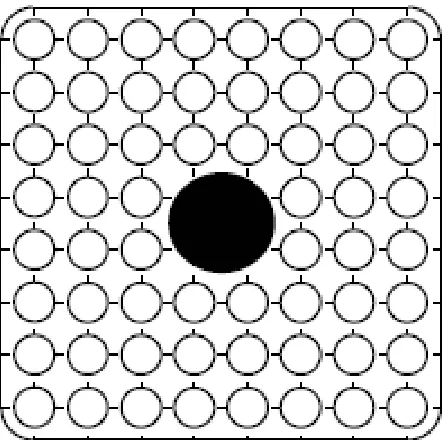
Figure 2.3 is a diagram of the top left corner with dimensions given in table 2.2.
0.642 in
0.484 in 0.315 in
Figure 2.2: Top-down view of the 8X8 high burn-up test bundle
2.3 Bundle Pressure Drop Locations
The bundle pressure drop was monitored at the locations indicated in Figure 2.4 [7].
Table 2.3 list seven pressure tap locations along the axial length of the test bundle where pressure
measurements were recorded. Both codes predict pressure at these positions that will be used to
determine the pressure drop at the nine pressure drop identifiers shown in figure 2.4.
Table 2.3: Pressure Tap Axial Positions Pressure Tap
Position Identifier
Axial Position (ft)
Axial Position (mm)
pt1 2.2375 682
pt2 5.5971 1706
pt3 7.2769 2218
pt4 8.9567 2730
pt5 9.7966 2986
pt6 10.6365 3242
pt7 11.4764 3498
Table 2.4 contains the nine pressure drop identifiers along with their associated lower and
upper axial positions, and spacing.
Table 2.4: Length Between Pressure Tap Positions Pressure Drop
Identifier
Lower Axial Position (ft)
Upper Axial
Position (ft) ΔZ (ft) ΔZ (mm)
dpt9 0.0 12.1654 12.1654 3708
dpt8 0.0 2.2375 2.2375 682
dpt7 2.2375 7.2769 5.0394 1536
dpt6 5.5971 7.2769 1.6798 512
dpt5 7.2769 8.9567 1.6798 512
dpt4 8.9567 10.6365 1.6798 512
dpt3 10.6365 12.1654 1.5289 466
dpt2 9.7966 10.6365 0.8399 256
2.4 NUPEC BFBT C2A Power Profiles
The axial power peaking factors are a cosine shape as shown in figure 2.5 [7].
The radial power profile for the beginning of operation (C2A) is illustrated in figure 2.6 [7].
1.15 1.30 1.15 1.30 1.30 1.15 1.30 1.15 1.30 0.45 0.89 0.89 0.89 0.45 1.15 1.30 1.15 0.89 0.89 0.89 0.89 0.89 0.45 1.15
1.30 0.89 0.89 0.89 0.89 1.15
1.30 0.89 0.89 0.89 0.89 1.15
1.15 0.45 0.89 0.89 0.89 0.89 0.45 1.15 1.30 1.15 0.45 0.89 0.89 0.45 1.15 1.30 1.15 1.30 1.30 1.15 1.15 1.15 1.30 1.15
Figure 2.5: Axial peaking factors in NUPAC BFBT C2A thermal profile
2.5 NUPEC BFBT Grid Spacer
Spacer grids provide structural support to the rod bundle during normal operation. Grid spacers
act as a local flow obstruction by means of decreasing the cross-sectional flow area resulting
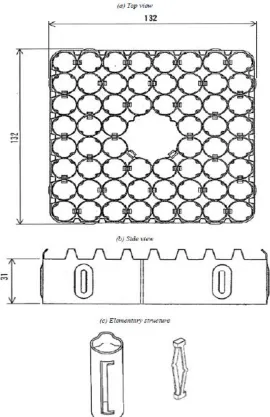
in a local pressure drop. A ferrule type spacer is used in the NUPEC BFBT High Burn-Up
8X8 assembly experiments. These ferrule-type spacers contain circular tubes to guide each
heated rod as well as the central water rod [7]. Table 2.5 list the grid spacer positions along the
axial length of the heated rods [7].
Table 2.5: Spacer Grid Locations
(mm) (ft)
455 1.493
967 3.173
1479 4.852
1991 6.532
2503 8.212
3015 9.892
Figure 2.7 is an illustration of the ferrule-type grid spacer used during the NUPEC BFBT High
Burn-Up 8X8 assembly C2A experiments [7].
2.6 Subchannel Grid Spacer Loss Coefficients
For both COBRA-EN and COBRA-CTF, a local loss coefficient is supplied at user specified
axial position for each subchannel to model the impact of local flow obstructions due to grid
spacers. The approach in this study is to use the same loss coefficients as in CASL’s prior
evaluation of the NUPEC BFBT experiments illustrated in figure 2.8 [2]. These loss
coefficients were determined by B.S. Shiralkar and D.W. Radcliffe and reported in, “An
experimental and analytical study of the synthesis of grid spacer loss coefficients. Tech. rep.
NEDE-13181. General Electric, 1971” [2]. The loss coefficients identified in figure 2.8 have
not been independently verified in this study.
1.348 1.278 1.606 1.222 1.304 1.222 1.606 1.278 1.348
1.606 0.748 0.748 0.748 0.748 0.748 0.748 0.748 1.606
1.278 0.748 0.748 0.748 0.748 0.748 0.748 0.748 1.278
1.304 0.748 0.748 1.475 0.926 1.475 0.748 0.748 1.304
1.222 0.748 0.748 0.856 0.856 0.748 0.748 1.222
1.304 0.748 0.748 0.778 0.926 0.778 0.748 0.748 1.304
1.278 0.748 0.748 0.748 0.748 0.748 0.748 0.748 1.278
1.606 0.748 0.748 0.748 0.748 0.748 0.748 0.748 1.606
1.348 1.278 1.606 1.222 1.304 1.222 1.606 1.278 1.348
Figure 2.10 and figure 2.11 illustrate how the local loss coefficients for subchannels at the grid
spacer locations are defined as inputs to the codes. Figure 2.10 is the top left corner of the
bundle and represents a quarter of a fuel channel with a loss coefficient of 1.348, while along
the wall sides the sub-channels are half a fuel channel with respective loss coefficients of 1.278
and 1.606. The subchannel with the loss coefficient of 0.748 is a typical subchannel.
0.748 1.278
1.606 1.348
Figure 2.9: Typical diagram of a two-dimensional fuel channel
The large water channel in the center of the fuel assembly is treated as stagnant and not
associated with the mass flow of the bundle. The subchannel geometry and loss coefficients
surrounding the water channel are shown in figure 2.11.
1.475
0.856 0.856
1.475 0.926
0.926
0.778 0.778
2.7 Representative BWR Operating Conditions
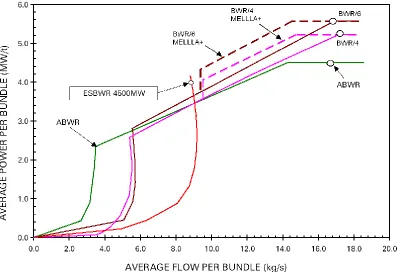
Figure 2.12 is an operaing power/flow map comparing the natural circulation ESBWR with
typical pump-driven BWRs currently in operation [9]. Figure 2.12 indicates that the typical
operating flow rate per bundle for currently operating BWRs is approximately 17kg/s while
the ESBWR is projected to operate near 9.0kg/s. In addition, the nominal average power per
bundle is approximately in a range between 3.8 to 5.8MWth for typical operating BWRs.
According to the IAEA website, https://aris.iaea.org/sites/core.html, table 2.6 is an additional
collection of typical operating conditions for the currently operating ABWR and the licensed
ESBWR [6].
Table 2.6: ABWR and ESBWR Operating Conditions Reactor
Type
Thermal Output
(MW)
Coolant Flow Rate
(kg/s)
Operating Pressure
(MPa)
Coolant inlet Temperature
(°C)
Number of Assemblies
ABWR 3926 14502 7.07 278 872
ESBWR 4500 9570 7.17 276.2 1132
Furthermore, the ABWR general design by General Electric reinforces the typical operating
conditions seen in table 2.7 [11].
Table 2.7: ABWR Operating Conditions Reactor
Type
Thermal Output
(MW)
Coolant Flow Rate
(Mkg/hr)
Operating Pressure
(MPa)
Exit Quality %
Number of Assemblies
Number of Rods per Assembly
ABWR 3926 52.2 7.17 14.5 872 92
The average bundle power and mass flow have been generalized in the following calculations
for comparison purposes to the test conditions in the NUPEC BFBT experiments.
ABWR average bundle power:
𝐴𝑣𝑒𝑟𝑎𝑔𝑒 𝐵𝑢𝑛𝑑𝑙𝑒 𝑃𝑜𝑤𝑒𝑟 = 3926𝑀𝑊
872 𝐵𝑢𝑛𝑑𝑙𝑒 = 4.502𝑀𝑊 𝑝𝑒𝑟 𝐵𝑢𝑛𝑑𝑙𝑒
ABWR average bundle mass flow:
𝐴𝑣𝑒𝑟𝑎𝑔𝑒 𝐵𝑢𝑛𝑑𝑙𝑒 𝑀𝑎𝑠𝑠 𝐹𝑙𝑜𝑤 = 14502
𝑘𝑔 𝑠
872 𝐵𝑢𝑛𝑑𝑙𝑒 = 16.63 𝑘𝑔
ESBWR average bundle power:
𝐴𝑣𝑒𝑟𝑎𝑔𝑒 𝐵𝑢𝑛𝑑𝑙𝑒 𝑃𝑜𝑤𝑒𝑟 = 4500𝑀𝑊
1132 𝐵𝑢𝑛𝑑𝑙𝑒 = 3.98𝑀𝑊 𝑝𝑒𝑟 𝐵𝑢𝑛𝑑𝑙𝑒
ESBWR average bundle mass flow:
𝐴𝑣𝑒𝑟𝑎𝑔𝑒 𝐵𝑢𝑛𝑑𝑙𝑒 𝑀𝑎𝑠𝑠 𝐹𝑙𝑜𝑤 = 9572
𝑘𝑔 𝑠
1132 𝐵𝑢𝑛𝑑𝑙𝑒 = 8.45 𝑘𝑔
𝑠 𝑝𝑒𝑟 𝐵𝑢𝑛𝑑𝑙𝑒
These approximate values for the ABWR and ESBWR average bundle mass flow rates and
powers are based on 10X10 assemblies and are similar to values seen in figure 2.12. From “The Guide Book to Nuclear Reactors,” typical operating conditions for a pre-ABWR 8X8 are
seen given in table 2.8 [10].
Table 2.8: Typical 8X8 BWR Operating Conditions Thermal
Output (MW)
Coolant Flow Rate
(Mg/s)
Operating Pressure
(MPa)
Exit Quality %
Number of Assemblies
Number of Rods per Assembly
3579 13 7.0 14.7 748 62
BWR average bundle power:
𝐴𝑣𝑒𝑟𝑎𝑔𝑒 𝐵𝑢𝑛𝑑𝑙𝑒 𝑃𝑜𝑤𝑒𝑟 = 3579𝑀𝑊
748 𝐵𝑢𝑛𝑑𝑙𝑒 = 4.785𝑀𝑊 𝑝𝑒𝑟 𝐵𝑢𝑛𝑑𝑙𝑒
BWR average bundle mass flow:
𝐴𝑣𝑒𝑟𝑎𝑔𝑒 𝐵𝑢𝑛𝑑𝑙𝑒 𝑀𝑎𝑠𝑠 𝐹𝑙𝑜𝑤 = 13
𝑀𝑔 𝑠
748 𝐵𝑢𝑛𝑑𝑙𝑒 = 17.38 𝑘𝑔
2.8 NUPEC BFBT Test Cases
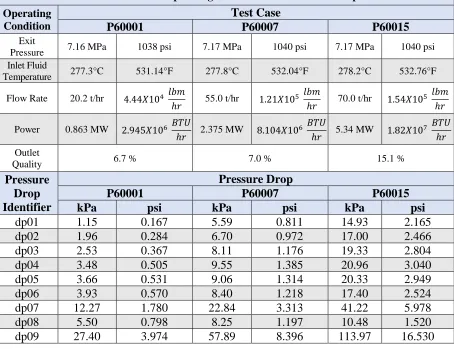
The test cases P60001, P60007, and P60015 were selected to span a range of thermal
outputs, mass flows, and exit qualities. All three test cases exhibit the typical BWR exit
pressure of approximately 7.17MPa (1040psi). Test case P60015 approximates nominal
BWR operating conditions.
Table 2.9: Selected Test Case Operating Conditions and Pressure Drop Measurements Operating
Condition
Test Case
P60001 P60007 P60015
Exit
Pressure 7.16 MPa 1038 psi 7.17 MPa 1040 psi 7.17 MPa 1040 psi Inlet Fluid
Temperature 277.3°C 531.14°F 277.8°C 532.04°F 278.2°C 532.76°F Flow Rate 20.2 t/hr 4.44𝑋104 𝑙𝑏𝑚
ℎ𝑟 55.0 t/hr 1.21𝑋10 5 𝑙𝑏𝑚
ℎ𝑟 70.0 t/hr 1.54𝑋10 5 𝑙𝑏𝑚
ℎ𝑟
Power 0.863 MW 2.945𝑋106 𝐵𝑇𝑈
ℎ𝑟 2.375 MW 8.104𝑋10 6 𝐵𝑇𝑈
ℎ𝑟 5.34 MW 1.82𝑋10 7 𝐵𝑇𝑈
ℎ𝑟
Outlet
Quality 6.7 % 7.0 % 15.1 %
Pressure Drop Identifier
Pressure Drop
P60001 P60007 P60015
kPa psi kPa psi kPa psi
dp01 1.15 0.167 5.59 0.811 14.93 2.165
dp02 1.96 0.284 6.70 0.972 17.00 2.466
dp03 2.53 0.367 8.11 1.176 19.33 2.804
dp04 3.48 0.505 9.55 1.385 20.96 3.040
dp05 3.66 0.531 9.06 1.314 20.33 2.949
dp06 3.93 0.570 8.40 1.218 17.40 2.524
dp07 12.27 1.780 22.84 3.313 41.22 5.978
dp08 5.50 0.798 8.25 1.197 10.48 1.520
The full list of test case operating conditions and pressure drop measurements for the
P6 series experiments in the “Steady State Pressure Drop Benchmark” with the 8X8 High
Burn-Up test bundle, C2A, is in appendix B [7]. The range of given test parameters listed for
the NUPEC BFBT pressure drop experiment are given in table 2.10.
Table 2.10: Range of NUPEC BFBT Test Parameters
Flow Rate (t/h) Power (MW) Outlet Quality (%) Total Pressure Drop (kPa)
CHAPTER 3: COBRA-CTF
COBRA-TF was originally developed in 1980 by Pacific Northwest Laboratory under
sponsorship of the Nuclear Regulatory Commission (NRC) as a thermal hydraulic rod-bundle
analysis code [1]. COBRA-TF contributed toward goals set by revisions to NRC safety
analysis requirements (10 CFR.50.46) in 1988 to improve plant economy and safety with the
use of computational best-estimate models in plant design and operation [1]. COBRA-TF was
primarily designed to perform LWR rod-bundle transient analysis and simulate pressurized
water reactor (PWR) whole-vessel loss-of coolant accidents (LOCA) [1]. COBRA-CTF is an
improved version of COBRA-TF developed and maintained by the Reactor Dynamics and
Fuel Management Group (RDFMG) at the Pennsylvania State University (PSU) [1]. RDFMG
PSU improvements include [1]:
• Transition to FORTRAN 90 source code
• Enhanced user-friendliness with improved error checking and free-form input
• Quality assurance utilizing an extensive validation & verification (V&V) matrix
• Turbulent mixing, void drift and direct heating model improvements
• Enhanced computational efficiency by implementation of new numerical solution schemes
• Better code physical model and user modeling documentation.
As of August 2015, the RDFMG has been rebranded the Reactor Dynamics and Fuel Modeling
COBRA-CTF uses a two-fluid modeling approach involving three separate independent flow
fields which consist of a liquid film, liquid droplets, and vapor [1]. Each of the three fields
is modeled with its own set of conservation equations [1]. However, the liquid and droplet
flow fields are assumed to be in thermal equilibrium and share an energy equation [1]. The
user may choose how the sets of conservation equations are formulated either using a
Cartesian coordinate system or a subchannel approach [1]. A flow regime map based on a nodes’ current time step vapor fraction determines flow topology [1]. This allows for
determination of the interphase contact area, interphase heat transfer and drag, and the correct
selection of closure models [1].
The sub-channel approach is used for this study where only axial and lateral flows are
considered [1]. The lateral flow has no direction once it leaves a gap and applies to any
orthogonal direction to the vertical axis [1]. The COBRA-CTF Theory Manual states, “This is
a suitable assumption for the axially-dominated flow of a reactor fuel bundle because the
relatively minuscule lateral flows transfer little momentum across sub-channel mesh cell
elements [1].” The reason for choosing the simplified subchannel approach is that it utilizes
one less momentum equation for each of the three flow fields and is consistent with the
The equations are solved simultaneously using the Semi-Implicit Method for Pressure-Linked
Equations (SIMPLE) described in S.V. Patankar’s book, “Numerical Heat Transfer and
Fluid Flow [1].”
The steps of the SIMPLE algorithm are [1]:
1. Guess the pressure field, 𝑝∗.
2. Solve the momentum equations to obtain fluid velocities, 𝑢∗, 𝑣∗, and 𝑤∗.
3. Use the continuity equation to solve for the pressure field correction, 𝑝′.
4. Calculate the corrected pressure field, p, by adding 𝑝′ to 𝑝∗.
5. Calculate the corrected velocity field, u, v, and w, using the corrected pressure field.
6. Solve remaining discretized equations that influence the flow field.
7. Treat the corrected pressure, p, as the new guessed pressure, 𝑝∗ and repeat steps 1-6
until convergence is reached.
The SIMPLE method is explained in further detail in the COBRA-CTF theory manual. It is
important to take notice of the first step that mentions, “…the user must provide a reference
pressure... [1].” This guess for initial pressure is one of the inputs seen in Card 1, PREF, in
3.1 Generalized Conservation Equations
COBRA-CTF models each phase with its own set of mass, momentum, and energy equations [1].
The conservation equations for each flow field are linked by interaction terms that account for
mass, energy, and momentum transfer between phases [1]. The conservation equations are
discretized in space and time, and along with the appropriated closure relations, solved
numerically to provide estimates of the solution variables at fixed time intervals over mesh
cells representing the spatial domain [1]. There is a list of the parameters for the generalized
conservation equations in appendix C.
Generalized Phasic Mass Conservation Equation [1]: 𝜕
𝜕𝑡(𝛼𝑘𝜌𝑘) + ∇ ∙ (𝛼𝑘𝜌𝑘𝑉⃗ 𝑘) = 𝐿𝑘𝑀𝑒
𝑇 (1)
Generalized Phasic Momentum Conservation Equation [1]: 𝜕
𝜕𝑡(𝛼𝑘𝜌𝑘𝑉⃗ 𝑘) + 𝜕
𝜕𝑥(𝛼𝑘𝜌𝑘𝑢𝑘𝑉⃗ 𝑘) + 𝜕
𝜕𝑦(𝛼𝑘𝜌𝑘𝑣𝑘𝑉⃗ 𝑘) + 𝜕
𝜕𝑧(𝛼𝑘𝜌𝑘𝑤𝑘𝑉⃗ 𝑘) =
𝛼𝑘𝜌𝑘𝑔 − 𝛼𝑘∇𝑃 + ∇ ∙ [𝛼𝑘(𝜏𝑘𝑖𝑗 + 𝑇𝑘𝑖𝑗) + 𝑀⃗⃗ 𝑘𝐿+ 𝑀⃗⃗ 𝑘𝑑 + 𝑀⃗⃗ 𝑘𝑇]
(2)
Generalized Phasic Energy Conservation Equation [1]: 𝜕
𝜕𝑡(𝛼𝑘𝜌𝑘ℎ𝑘) + ∇ ∙ (𝛼𝑘𝜌𝑘ℎ𝑘𝑉⃗ 𝑘) = −∇ ∙ [𝛼𝑘(𝑄⃗ 𝑘+ 𝑞 𝑘
𝑇)] + Γ
𝑘ℎ𝑘𝑖 + 𝑞𝑤𝑘′′′ + 𝛼𝑘
𝜕𝑃 𝜕𝑡 (3)
The subscript k denotes the phase:
𝑘 = {
3.2 Normal Wall Flow Regime Map
Flow regime maps are used to characterize the flow topology in each mesh cell [1]. This allows
for determination of the interphase contact area necessary for determination of interphase heat
transfer and drag, as well as the correct selection of flow regime dependent closure models [1].
The normal wall flow regime map is used when the maximum wall surface temperature in the
mesh cell described in equation 4 is below the critical heat flux temperature:
𝑇𝑊= 𝑚𝑖𝑛(705.3℉, 𝑇𝐶𝐻𝐹) (4)
where the upper limit of 705.3 °F corresponds to the critical temperature of water, and the
critical heat flux temperature is approximated by [1]:
𝑇𝐶𝐻𝐹 = (𝑇𝑆𝑎𝑡+ 75)℉ (5)
The hot wall flow regime map is used if the maximum wall temperature exceeds the value given
An initial void fraction check is made first to ensure that the mesh cell flow regime is consistent
with adjacent axial mesh cells. COBRA-CTF then selects the flow regime once the appropriate
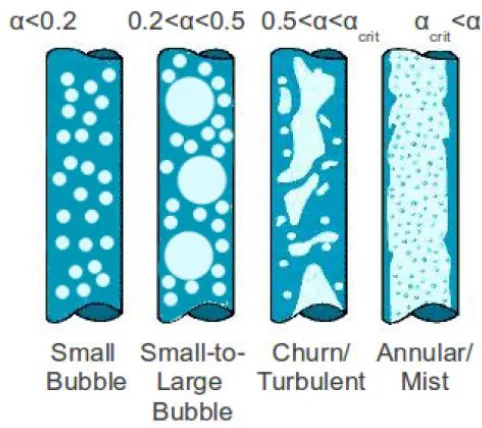
void fraction is determined. Figure 3.1 illustrates the normal wall flow regimes with associated
vapor fraction ranges [1].
3.3 Pressure Drop
For more details on how pressure drop is managed in COBRA-CTF, refer to the Macro-Mesh
Cell Closure Models chapter in the COBRA-CTF theory manual [1].
3.3.1 Friction Loss model
COBRA-CTF uses a two-phase pressure drop model based on the work of Wallis [1]:
𝑑𝑃 𝑑𝑋)𝑓𝑟𝑖𝑐,𝑘
= 𝑓𝑤𝑘𝐺𝑘
2
2𝐷ℎ𝜌𝑘
Φ2 (6)
The frictional pressure drop term is calculated for both the vapor and liquid phase fields where
the mass flux of the field of interest is, 𝐺𝑘, and Φ2, is defined as [1]:
Φ2 = {1 𝛼1⁄ 𝑙 𝑓𝑜𝑟 𝑛𝑜𝑟𝑚𝑎𝑙 𝑤𝑎𝑙𝑙 𝑐𝑜𝑛𝑑𝑖𝑡𝑖𝑜𝑛𝑠 𝛼𝑣
⁄ 𝑓𝑜𝑟 ℎ𝑜𝑡 𝑤𝑎𝑙𝑙 𝑐𝑜𝑛𝑑𝑖𝑡𝑖𝑜𝑛𝑠 (7)
The phasic friction factor, 𝑓𝑤𝑘, is defined using the phase Reynold’s number [1]. The
single-phase friction factor, 𝑓𝑤𝑘, selected in the frictional pressure drop term has been used with prior
CASL evaluations of NUPEC BFBT two-phase pressure drop, P6 series, experiments for the Phase II, “Critical Power Benchmark”, Exercise 0, “Steady State Pressure Drop Benchmark.
𝑓𝑤𝑘 = max {64 𝑅𝑒⁄ 𝑘 𝑙𝑎𝑚𝑖𝑛𝑎𝑟
0.204Re𝑘−0.2 𝑡𝑢𝑟𝑏𝑢𝑙𝑒𝑛𝑡 (8)
Phase Reynolds number is based on phasic properties [1]:
𝑅𝑒𝑘 =𝐷ℎ|𝐺𝑘|
3.3.2 Form (Local) Loss Model
The local pressure drop is defined as [1]: 𝑑𝑃
𝑑𝑋)𝑓𝑜𝑟𝑚,𝑘
= 𝛼𝑘
𝐾𝑥
2Δ𝑋𝜌𝑘|𝑈𝑘|𝑈𝑘 (10)
The phase field, k, can be either liquid, vapor, or entrained droplets, and 𝑈𝑘 is the field velocity
[1]. The form loss coefficient, 𝐾𝑥, may be user supplied, or code-calculated [1]. The grid spacer
loss coefficients labeled in figure 2.8 are the user supplied form loss coefficient, 𝐾𝑥. COBRA-CTF
provides three methods to introduce local losses which include:
1. User specified loss coefficient provided at an axial location for a specified subchannel.
2. Calculate a flow blockage coefficient with a user specified pressure loss coefficient
multiplier and a user defined ratio of blocked area to flow area.
3. Grid spacer models explained in the COBRA-CTF theory manual.
This study only explored the first option as this is consistent with the method used by COBRA-EN
to manage local losses due to obstructions. This approach does not explicitly consider obstruction
type, geometry, or any other parameter other than its location and associated loss coefficient.
3.4 Water Properties
COBRA-CTF can calculate water properties such as thermal conductivity, specific heat,
viscosity, surface tension, and enthalpy for subcooled liquid, superheated vapor, and saturated
properties of both phases [1]. The International Association for the Properties of Water and
Steam (IAPWS) correlations to calculate the properties of water and steam have been
3.5 Global Boundary Conditions
The operating conditions are entered in Card 1.2, Global Boundary Conditions, for COBRA-CTF.
The total inlet mass flow rate is used to calculate subchannel mass flow rates for the user
specified subchannels flow areas [3].
Table 3.1: Total Inlet Mass Flow Rate
P60001 P60007 P60015
kg/s
5.611 15.278 19.444
lbm/s
12.370 33.682 42.868
t/hr
20.2 55.0 70.0
The average linear heat rate per rod is total bundle power divided by the total rod length
multiplied by the total number of rods [3]. This entry is used later to build power profiles.
Table 3.2 consist of the test cases’ value for with associated given thermal output.
𝑞̅ =′ 𝑄
𝑁𝐻𝑓𝑢𝑒𝑙 (11) where:
𝑁 = Number of electrically heated rods (60)
𝐻𝑓𝑢𝑒𝑙= Axial length of the electrically heated rod (3708mm or 12.165ft)
𝑄 = Total bundle thermal output
Table 3.2: Average Linear Heat Rate per Rod Test Case
P60001 P60007 P60015
Given Thermal Output (MW)
0.863 2.375 5.340
Average Linear Heat Rate per Rod (kW/m)
The initial guess for pressure in the fluid domain, PREF, for each test cases is listed in table 3.3.
Table 3.3: Initial Guess for Pressure, PREF
P60001 P60007 P60015
bar
71.6 71.7 71.7
MPa
7.16 7.17 7.17
psi
1038.4702 1039.9206 1039.9206
The user can either specify initial inlet enthalpy, HIN, or temperature, TIN, for the fluid
domain [3].
Table 3.4: Inlet Fluid Temperature, TIN
P60001 P60007 P60015
°C
277.3 277.8 278.2
°F
531.14 532.04 532.76
3.4.1 Inlet and Outlet Boundary Conditions
The inlet boundary conditions are total inlet mass flow rate used to calculate subchannel mass
flow rates for the user specified subchannels flow areas, and inlet fluid temperature, TIN. The
outlet boundary conditions are inlet fluid temperature, TIN, and exit pressure, PREF. The
COBRA-CTF user manual does provide the following disclaimer:
Note: The enthalpy specified at the exit is not used by COBRA-TF if flow is in the positive
direction (i.e. out of the model). In the case of positive flow, the user may enter any number
3.5 Convergence Study for COBRA-CTF
A mesh refinement (convergence) study was conducted to determine the sensitivity of
simulation results to axial node length. This was accomplished by establishing a uniform
mesh length based on the original data provided in figure 2.5. It is difficult to maintain a
true uniform axial mesh with COBRA-CTF as the local losses due to grid spacers require
their own identifying axial positions that interrupt this uniformity. This is not the situation
for COBRA-EN.
The specified uniform mesh length is propagated along the heated bundle until encountering
the non-uniform nodes before and after the grid spacer positions. Adjustments are made to
accommodate these varying size nodes in proximity of the grid spacer. Then, the uniform node
length would continue until it encountered the next grid spacer. This “Base” technique is a
viable option for a majority of the mesh refinement cases for the three test cases evaluated.
Modifications were required to ensure that some test cases would converge on a solution
with extra attention placed on nodes in proximity of the grid spacers. This modified technique labeled “Uniform/Variable” was required for the 7X24 and 8X24 mesh refinement cases with
the P60007 and P60015 test cases. In addition, the 5X24 mesh refinement case required a node
size of 0.1 mm to be absorbed into a previous node to achieve a converged solution. Lastly,
there was an exploration of relative size nodes in proximity of each other conducted in the
3.5.1 Methods for Mesh refinement
The methods chosen to conduct the mesh refinement convergence study for the three test cases
follow these constraints:
• Most importantly, achieve a converged solution with COBRA-CTF.
• Maintain the maximum number of uniform nodes possible while still providing grid
spacer identifiers.
• Attempt to maintain some uniformity between COBRA-EN and COBRA-CTF for
positions along the heated bundle to acquire data at the same locations.
• Maximize the number of axial positions shared between all the mesh refinement cases
to reduce the need to interpolate to determine a quantity of interest at a specific position.
This last criterion ensures that the values generated by COBRA-CTF are being evaluated at
common positions instead of introducing interpolation error. The primary quantities of interest
are pressure drops, considering that is the parameter being compared to in the NUPEC BFBT
benchmark database. There is also an evaluation of the vapor fraction, and flow quality. These
3.5.2 Base Mesh Refinement Technique
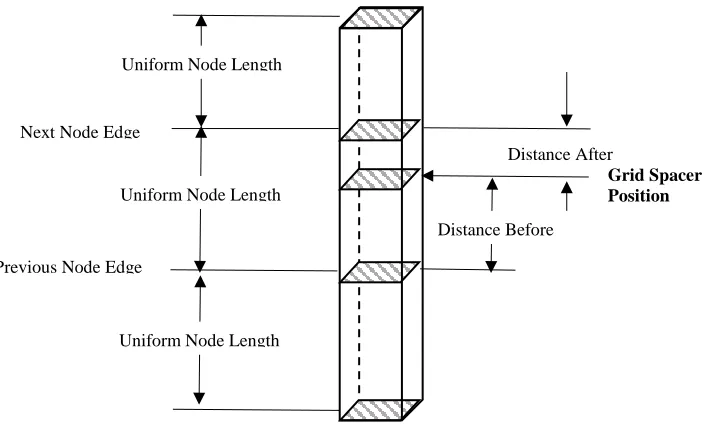
The distance before the grid spacer is determined by subtracting the upper edge of the previous
uniform node from the grid spacer position. The distance after the grid spacer is determined by
subtracting the grid spacer position from the lower edge of next uniform node. Figure 3.2
illustrates the Base technique applied near the grid spacer positions. It was observed that the
size of the nodes before and after the grid spacers pose issues with run time or inhibit a
converged solution. Furthermore, the run would converge faster and appear to be more stable
between each step if all node sizes are close to the same size as the surrounding nodes.
Grid Spacer Position
Next Node Edge
Previous Node Edge
Uniform Node Length
Uniform Node Length Uniform Node Length
Distance After
Distance Before
3.5.3 Uniform/Variable Mesh Refinement Technique
The Uniform/Variable (U/V) technique is a modified version of the Base technique built on
observations that nodes of the same size in proximity to each other affect the speed and stability
of reaching a converged solution. The variability introduced is due to the approximate uniform
mesh lengths specified for a mesh refinement case within the distances before and after the
grid spacers.
An arbitrary distance is determined by adding the previously calculated distance before the
grid spacer to a collection of uniform nodes. Then, this arbitrary distance is divided to provide
a node size that is approximately the same as the specified uniform node size. The same process
is repeated after the grid spacer. The specified uniform mesh size is reintroduced at the end of
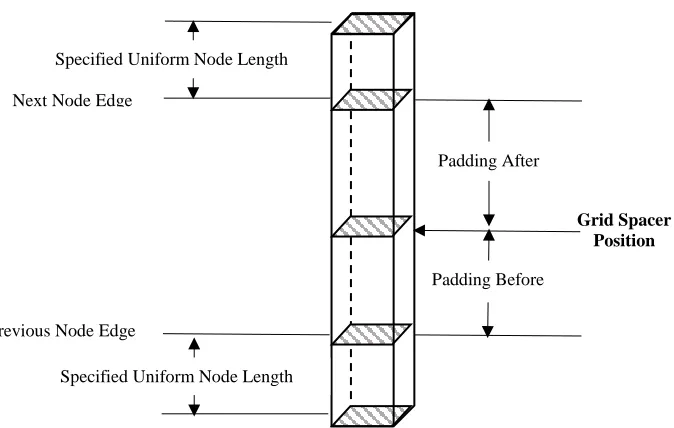
the arbitrary distance after the grid spacer. Figure 3.3 illustrates the U/V technique at one grid
spacer. This process repeats for every grid spacer. This arbitrary distance before and after the grid spacer will be referred to as “padding.” Figure 3.4 illustrates this padding that contains a
collection of equal sized nodes that are approximately of the specified uniform node length.
The padding reduces the quantity of specified uniform node sizes and results in a reduction in
shared axial positions for the mesh refinement cases. Furthermore, this padding will introduce
Grid Spacer Position
Next Node Edge
Previous Node Edge
Specified Uniform Node Length
Padding After
Padding Before
Specified Uniform Node Length
Figure 3.4: Diagram of the padding in proximity of a grid spacer Figure 3.3: Diagram of the Uniform/Variable mesh refinement technique
Node Length of Approximate Uniform Node Length Size
“Padding” Stack of Nodes with Lengths
of Approximate Size of the Specified Uniform Node
3.5.4 Mesh Refinement Cases
The mesh refinement cases are categorized by the number of times the original node size seen
in figure 2.5 is sub-divided.
𝑈𝑛𝑖𝑓𝑜𝑟𝑚 𝑁𝑜𝑑𝑒 𝐿𝑒𝑛𝑔𝑡ℎ = 𝐻𝑓𝑢𝑒𝑙
𝐷𝑁 (12)
𝐻𝑓𝑢𝑒𝑙= Axial length of the electrically heated rod
𝐷 = Number divisions per node
𝑁 = Number original nodes
Table 3.5: Mesh Refinement Case Uniform Node Length Mesh Refinement Case
1X24 3X24 4X24 5X24 6X24 7X24 8X24
Uniform Node Length Metric (m)
0.1545 0.0515 0.038625 0.0309 0.02575 0.02207 0.0193125
Standard (in)
6.08268 2.02756 1.52067 1.21654 1.01378 0.86895 0.76033
* Bold indicates approximates values
Table 3.6 reflects the mesh refinement technique used to produce the results for each test case
for each mesh refinement case.
Table 3.6: Test Case Mesh Refinement Technique Legend
Test Case Mesh Refinement Case
1X24 3X24 4X24 5X24 6X24 7X24 8X24
P60001 Base Base Base *Base *Base *Base Base
P60007 Base Base Base *Base *Base *Base U/V
P60015 Base Base Base *Base *Base U/V U/V
3.5.5 Adjustment to 5X24
Applying the Base technique results in the spaces before and after the fifth grid spacer seen in
table 3.7. The axial positions are defined by the node edges. Axial position 2.503m, is the fifth
grid spacer position while 2.472m and 2.5338m are axial positions shared by all the mesh
refinement cases.
Table 3.7: 5X24 Adjustment, Evaluation of 0.1mm Node Before 5th Grid Spacer Node Length (m)
Uniform Node
Previous Uniform Node
Before Grid Spacer
After Grid Spacer
Next Uniform Node
Uniform Node
0.0309 0.0309 0.0001 0.0308 0.0309 0.0309
Axial Position (m)
2.472 2.5029 2.503 2.5338 2.5647
Figures 3.5 and 3.6 are plots of the time steps versus percent total energy storage for both
techniques for mesh refinement case 5X24. Figure 3.5 illustrates that after 40,000 steps the
solution does not appear to be reaching convergence after a force quit was applied. This may
reach a converged solution, but it would have taken excessive run times.
0 100 200 300 400 500 600 700 800 900 1000
0 5000 10000 15000 20000 25000 30000 35000 40000
%
T
o
ta
l En
er
g
y
Sto
ra
g
e
Time Steps
A solution was obtained once the 0.1mm before the grid spacer is adjusted. Table 3.8 reflects
that the 0.1mm space was absorbed in the next uniform space after the 2.472m position.
This preserves the positions of interest, 2.472m, 2.503m, and 2.5338m. in addition, all the
nodes in this area are approximately the same size. This correction allows for the run to
converge on a solution.
2.472𝑚 + 0.031𝑚 = 2.503𝑚
Table 3.8: 5X24 Adjustment, Change in Node Before 5th Grid Spacer Node Length (m)
Uniform Node
Previous Uniform Node
Before Grid Spacer
After Grid Spacer
Next Uniform Node
Uniform Node
0.0309 0.0309 0.031 0.0309 0.0309 0.0309
Axial Position (m)
2.4411 2.472 2.503 2.5338 2.5647
Figure 3.6 illustrates that the solution is achieved at 4610 steps.
0 100 200 300 400 500 600 700 800 900 1000
0 1000 2000 3000 4000 5000
%
T
o
ta
l En
er
g
y
Sto
ra
g
e
Time Steps
3.5.6 Adjustment to 6X24
Applying the Base technique results in the space before and after the seventh grid spacer seen
in table 3.9. Axial position, 3.527m, is the seventh grid spacer position while 3.5535m is an
axial position shared by all the mesh refinement cases.
Table 3.9: 6X24 Adjustment, Evaluation of 0.75mm Node After 7th Grid Spacer Node Length (m)
Uniform Node
Previous Uniform Node
Before Grid Spacer
After Grid Spacer
Next Uniform Node
Uniform Node
0.02575 0.02575 0.025 0.00075 0.02575 0.02575
Axial Position (m)
2.47625 3.502 3.527 3.52775 3.5535
Table 3.10 shows that the 0.75mm space is absorbed with the following uniform distance
starting at 3.52775m. This preserves the positions of interest 3.527m, and 3.5535m. in addition,
all the nodes in this area are approximately the same size. All three test cases can use both
methods to converge on a solution.
Table 3.10: 6X24 Adjustment, Change in Node After 7th Grid Spacer Node Length (m)
Uniform Node
Previous Uniform Node
Before Grid Spacer
After Grid Spacer
Next Uniform Node
Uniform Node
0.02575 0.02575 0.025 0.0265 0.02575 0.02575
Axial Position (m)
3.47625 3.502 3.527 3.5535 3.57925
Including the 0.75mm after the grid spacer, the run for P60001 takes 24,810 steps to reach a
converged solution. When the distance of 0.75mm is absorbed, the solution converges after
3.5.7 Adjustment to 7X24
Applying the Base technique to P60001 test case results in the space before and after the third
grid spacer seen in table 3.11. Axial position, 1.479m, is the third grid spacer position. The
uniform mesh size of approximately 0.022071m, allows for four nodes before and one node
after the two spaces surrounding the grid spacer which results in the two axial positions shared
by all the mesh refinement cases, 1.3905m and 1.545m respectively.
Table 3.11: 7X24 Adjustment, Evaluation of 0.214mm Node Before 3rd Grid Spacer Node Length (m)
Uniform Node
Previous Uniform Node
Before Grid Spacer
After Grid Spacer
Next Uniform Node
Uniform Node
0.022071 0.022071 0.000214 0.021857 0.022071 0.022071
Axial Position (m)
1.4567 1.4788 1.479 1.50086 1.5229
Table 3.12 shows that the 0.214mm space is absorbed with the previous uniform distance
starting at 1.4567m. This preserves the grid spacer position 1.479m. In addition, all the nodes
in this area are approximately the same size.
Table 3.12: 7X24 Adjustment, Change in Node Before 3rd Grid Spacer Node Length (m)
Uniform Node
Previous Uniform Node
Before Grid Spacer
After Grid Spacer
Next Uniform Node
Uniform Node
0.022071 0.022071 0.022286 0.021857 0.022071 0.022071
Axial Position (m)
1.4346 1.4567 1.479 1.50086 1.5229
The same acceleration is observed as the mesh refinement case 6X24. Including the 0.214mm
after the grid spacer, the run for P60001 takes 56,632 steps to reach a converged solution. The
The Base technique used in the P60001 test case did not converge on a solution and exhibited an
oscillatory behavior for P60007 until a user force quit applied at 80,000 steps. This lead to more
adjustments to the Base technique labeled “Test 1” where further attempts to ensure node lengths
are more similar in size to nodes in proximity. Table 3.13 reflects the location of further
adjustments made compared to the Base technique for the 7X24 mesh refinement case labeled “With 0.241mm.” The locations marked in bold red indicate quantity of nodes, JLEV, with node
lengths, VARDX, prior to adjustments while the bold black text marks the adjustments. Further adjustments to the 7x24 mesh refinement case labeled “Test 1” include modifications to node
lengths near the second and seventh grid spacer.
Table 3.13: Further Adjustment to 7X24 Base Technique
With 0.214mm Without 0.214mm 7X24 Test 1
JLEV VARDX JLEV VARDX JLEV VARDX
No Change
46 0.017928571429 46 0.017928571429 46 0.017928571429
47 0.004142857143 47 0.004142857143 47 0.026214285714
70 0.022071428571 69 0.022071428571 68 0.022071428571
71 0.000214285714 70 0.022285714286 69 0.022285714286
72 0.021857142857 71 0.021857142857 70 0.021857142857
No Change
167 0.017642857143 166 0.017642857143 165 0.017642857143
168 0.004428571429 167 0.004428571429 166 0.026500000000
176 0.022071428571 175 0.022071428571 174 0.022071428571
*JLEV is a numbering system used by COBRA-CTF to determine a quantity of nodes of the
same size, VARDX. The actual value for JLEV is determined by subtracting the previous value
from the next in sequence. Example: