HYBRIDIZATION OF BACKPROPAGATION NEURAL NETWORK AND GENETIC ALGORITHM
SITI HAJAR BINTI ARBAIN
A thesis submitted in fulfillment of the requirement for the award of the degree of Master of Science (Computer Science)
Faculty of Computing Universiti Teknologi Malaysia
NON-LINEAR WATER LEVEL FORECASTING OF DUNGUN RIVER USING HYBRIDIZATION OF BACKPROPAGATION NEURAL NETWORK AND
GENETIC ALGORITHM
SITI HAJAR BINTI ARBAIN
A thesis submitted in fulfillment of the requirement for the award of the degree of Master of Science (Computer Science)
Faculty of Computing Universiti Teknologi Malaysia
ACKNOWLEDGEMENT
In preparing this thesis, I was in contact with many people, researchers, and lecturers. It is my greatest pleasure to take this opportunity to express my gratitude and thank you to all the people involve whether direct or indirect in my effort to successfully finish this project.
First of all, I would like to express my heartfelt thanks and deep sense of gratitude to my supervisor, Dr Antoni Wibowo for his guidance, patient, and encouragement as well as suggestions throughout the research. This project could never be successfully completed without his assistance and support. I am also very thankful to my co-supervisor, Prof. Madya Dr. Mohd Salihin Bin Ngadiman for his guidance and supportive in this research analysis. Without their continued support, this thesis would not be successfully finished.
ABSTRACT
ABSTRAK
TABLE OF CONTENTS
CHAPTER TITLES PAGE
SUPERVISOR’S DECLARATION i
STUDENT’S DECLARATION iv
DEDICATION v
ACKNOWLEDGEMENTS vi
ABSTRACT vii
ABSTRAK viii
TABLE OF CONTENTS x
LIST OF TABLES xiv
LIST OF FIGURES xvi
LIST OF APPENDICES xix
1 INTRODUCTION 1
1.1 Background of Research 1
1.2 Statement of Problem 7
1.3 Problem Questions 9
1.4 Objective of Research 10
1.5 Scope of Research 10
1.6 Significance of Study 11
2 LITERATURE REVIEW 12
2.1 Introduction 12
2.2 Treatment of Missing Data 13
2.3 Autoregressive Integrated Moving 15
Average (ARIMA)
2.4 Artificial Neural Network (ANN) 16
2.5 Hybridization of BPNN-GA 20
2.6 Summary 22
3 METHODOLOGY 23
3.1 Introduction 23
3.2 Research Operational Framework 24
3.3 Phase 1 : Problems Identification 26
and Pre-processing Data Analysis
3.3.1 Ordinary Linear Regression (OLR) 27
3.3.2 Mean Substitutions 28
3.3.3 Normalized Data 28
3.4 Model Development
3.4.1 Phase 2: ARIMA 30
3.4.2 Phase 2: SARIMA 35
3.4.3 Phase 2: ANN 35
3.4.4 Phase 3: Hybrid BPNN-GA 38
3.5 Phase 4: Comparative Output Analysis 39
3.6 Summary 40
4 PROPOSED METHODS 41
4.2 BackPropagation Neural Network (BPNN) 42
4.3 Genetic Algorithm (GA) 45
4.4 Hybrid BPNN-GA 46
4.4.1 Fundamental Process of Hybrid 47
S- BPNN-GA
4.4.2 Fundamental Process of Hybrid 48
M-BPNN-GA
4.5 Summary 50
5 RESULTS AND DISCUSSION 51
5.1 Introduction 51
5.2 Case study 51
5.3 Original data 52
5.3.1 Treatment of Missing Data 52
5.3.1.1 Using OLR Approach
5.3.1.2 Using Mean Approach
5.3.2 Normalized data 55
5.4 Model Development 57
5.4.1 ARIMA 57
5.4.2 BPNN 68
5.4.3 ARIMA Model versus BPNN Model 71
of Dungun River
5.4.4 NARX 74
5.4.5 BPNN Model versus NARX Model 79
of Dungun River
5.5 Hybrid BPNN-GA 81
6 CONCLUSION AND FUTURE WORKS 86
6.1 Conclusion 86
6.2 Future works 88
REFERENCES 89
LIST OF TABLES
TABLE NO. TITLES PAGE
2.1 Hidden Nodes Formula 17
5.1 The Original Missing Data 55
5.2 The Substitution Missing Values 57
Using OLR Approach
5.3 The Substitution Missing Values 58
Using Mean Approach
5.4 The Normalized Treatment Data 59
5.5 The performance using ARIMA 69
5.6 The Variables Selection using BPNN 72
5.7 The Combination Variables using BPNN 73
5.8 The Performance of Combination variable 74
using BPNN
5.9 Comparison Result of Linear and Nonlinear 75
Model for Water Level in Dungun River
5.10 Comparison Result of Performance 76
Model for Water Level in Dungun River
5.11 The Variables Selection using NARX 78
5.12 The Combination variables using NARX 79
using NARX
5.14 The Performance of Optimization 80
NARX 4-6-1 and NARX 3-10-1
using Several Delay Lines (d)
5.15 The Performance of BPNN and NARX for 82
Mean and OLR Treatment Data Process
5.16 The performance of ARIMA/SARIMA, BPNN 87
and NARX, BPNN-GA and M-BPNN-GA for
LIST OF FIGURES
FIGURES NO. TITLES PAGE
1.0 Location of the Dungun District 2
1.1 Image Radar of R1 and R2 on 20-23 Mac, 3
the Widespread of Rainfall
1.2 Image Radar of R3 and R4 on 25-29 Mac, 4
the Widespread of Rainfall
3.1 Researches Operational Framework 26
3.2 ACF and PACF Plots of Stationary Data 33
3.3 BPNN Structure 37
3.4 The Snapshot of NARX Network 38
4.1 Connection Networks 44
4.2 Hybrid Single BPNN-GA 51
4.3 Hybrid Multi BPNN-GA 52
5.1 Time Series plot of Rainfall Data 61
5.2 Time Series plot After Differencing Data 61
5.3 ACF and PACF plots of Stationary Data 62
5.4 Output Final Estimation of 62
5.5 Output final estimation of model 63 ARIMA (0, 2,1)
5.6 ACF residual of model ARIMA (0, 2, 1) 64
5.7 Output final estimation Ljung-Box 64
Statistics of model ARIMA (0,2,1)
5.8 Time Series Plot of water level data 65
5.9 ACF and PACF plots of stationary data 66
5.10 Output Final estimation 66
5.11 Output Final estimation 67
5.12 Output Final estimation 68
5.13 Output Final Estimation 68
5.14 The Time Series plot between 77
Actual and the Predicted Monthly Water Level for Dungun River with Testing data in 2011 and 2012
5.15 The Time Series plot between 81
Actual and the Predicted Monthly Water Level for Dungun River with Testing data in 2011 and 2012
5.16 The Time Series plot between 83
Actual and the Predicted Monthly Water Level for Dungun River with Testing data in 2011 and 2012
5.17 The Time Series plot between 87
LIST OF APPENDICES
APPENDIX TITLES PAGE
CHAPTER 1
INTRODUCTION
1.1 Background of Research
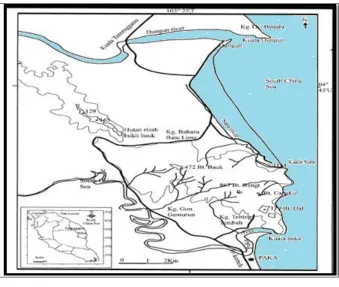
Figure 1.0 Location of the Dungun District
Figure 1.0 shows the location of the Dungun District between two main rivers which are the Dungun River and Sura River. In reports of flooding in Dungun District, Department of Irrigation and Drainage (DID) stated that there are two types of flooding which are flash floods and river flood. Flash flood usually occurs in urban areas where it is usually caused by short, intense localized thunderstorm rains, where it is usually experienced during the evening (DID, 2009). Besides flash flood, there is also river flood usually happens when the flow in a river exceeds its conveyance capacity, the water in the river rises above its bank level and overspills into adjacent low-lying areas, causing river floods.
heavy rain, resulting in massive flooding in the southern state of the peninsular (DID, 2002). It was known to cause major destruction to the residents of that particular area. According to the flood report by DID, there is a series of floods occurred in Dungun district-Terengganu from the year 2000 till 2004. Dungun was hit by a larger flood in the third week of November 2000. From March 2011 till April 2011, Terengganu was affected by a heavy rainfall which exceeded 200mm per day and resulted in a massive flood.
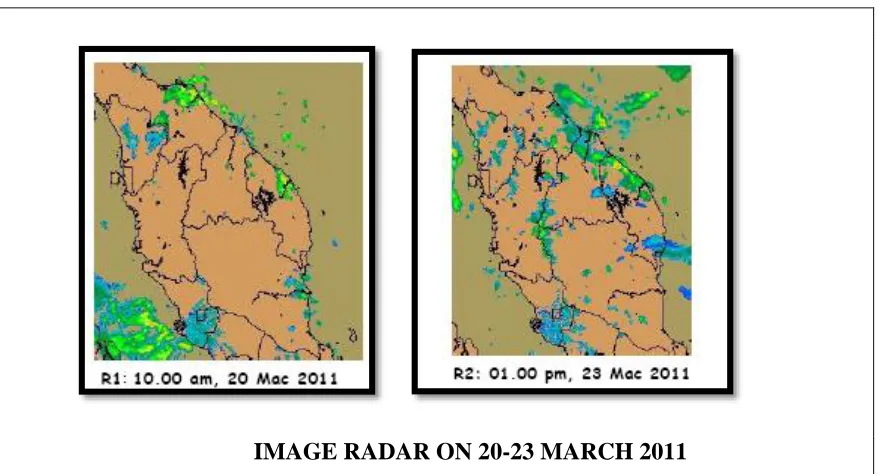
IMAGE RADAR ON 20-23 MARCH 2011
Figure 1.1 Image Radar of R1 and R2 on 20-23 Mac, the Widespread of Rainfall
Sources: Report on Heavy Rainfall That Cause Flash Flood in Terengganu
During The Period Prepared by MMD
coastal areas of southern Thailand, Kelantan, Terengganu and Pahang, morning of 20th March 2011.
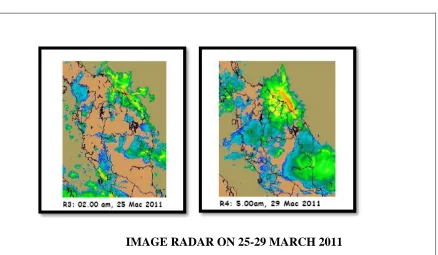
However, there is slightly different on image R4 in Figure 1.2 where the widespread of torrential rain can be clearly observed over Kelantan and north of Terengganu. Whereas, the widespread rain (green colour) still continues since 23rd March over other part of Terengganu and Pahang.
IMAGE RADAR ON 25-29 MARCH 2011
Figure 1.2 Image Radar of R3 and R4 on 25-29 Mac, the Widespread of Rainfall
Sources: Report on Heavy Rainfall That Causes Flash Flood in Terengganu
During The Period Prepared by MMD
and duration. In terms of water level, DID have introduced three categories of critical level stages namely normal, alert and danger levels (Gasim et al. 2007). One of the rivers spotted by DID that had reached the danger level was Sungai Dungun located at Dungun district.
There is a case study which identified the factors that are related to the occurrence of flood phenomenon in Dungun, Terengganu. The occurrence of flood in Dungun district was due to a combination of physical factors such as elevation, its close proximity to the sea as well as the heavy rainfall experienced during the monsoon period (Gasim et al., 2007).
The stages of water level are designed to make the local authority aware of the level of danger posed by the rising water level so that a necessary emergency arrangement could be initiated for the welfare of the local community affected by the river. As water level forecasting could reduce damage from impact of flooding in agriculture, public uses, avoid life losing and economic loses, it is therefore important to predict its appearance.
Prediction the pattern of water level is one of the benchmark points in flood forecasting analysis. It has been one of the most important issues in hydrological research. Water level is an essential component in the process of forecasting flood resources evaluation and is considered as a central problem in hydrology (Ekhwah et al., 2009). Flood forecasting relies on real time rainfall and water level data obtained from DID’s network of telemetric stations.
rainfall data (DID, 2009). In Terengganu, there are 94 and 28 stations set up for rainfall and water level inventory stations, respectively, prepared by DID so that the data can be collected in real-time. For flood forecasting to be effective and sufficient, the lead time must be available. Lead time is the time between the detection or the forecasting of flood and the time of actual occurrence of the event.
Water level forecasting is one of the forecasting problems that have attracted the interest of scientists (Amir et al., 1999). Estimating the water level can have significant impact, as this can help in agricultural water management and in protection from water shortages and possible flood damages. In statistics analysis, there are a lot of ways in doing the predicting. Time series forecasting is highly used in predicting economic and business trends.
Recently there are many researchers who have been successfully make prediction in hydrology like rainfall forecasting, flooding, water quality, water level, water consumption and etc (Faruk, 2010). In this study, the methods of Autoregressive Integrated Moving Average (ARIMA) or seasonal ARIMA (SARIMA), Backpropagation Neural Network (BPNN), Nonlinear Autoregressive Models with exogenous inputs (NARX), have been applied as a model of water level prediction allocation at the selected water level, rainfall, evaporation, temperature and relative humidity at monitoring stations prepared by DID and MMD in the Dungun River-Terengganu.
be compared to the traditional methods such as ARIMA, BPNN and NARX standalone methods to evaluate the predictive performance between those methods. Since the weights in BPNN model are hard to estimate due to the large number of possible solutions, therefore GA is implemented to improve the performance of artificial neural networks. GA is adopted in searching optimal design based on the weight and biased in BPNN which proposed hybrid sense.
In this research, we used monthly rainfall, rate of evaporation, rate of temperature, relative humidity and water level which are collected from Department of Irrigation (DID) and Drainage and Meteorological Department (MMD) for Dungun district-Terengganu, comprises a total of 75 data observations covered from year 2006 until 2012.
1.2 Statement of Problem
After the flood in 2000 and 2001, the Dungun River might be over saturated hence, the rise in the water level. When the water level starts to rise above the river banks or dams, the water starts overflowing which often causes flood. The phenomenon of the flood could result in a lot of destructions to the livelihood and the local populations.
where it will handle the imperfect characteristics of the data such as missing and inconsistent value of data.
Due to the fact that water level forecasting involves a complex nonlinear data pattern; there are a lot of forecasting methods to improve the forecasting accuracy. It was reported that DID used general regression and linear transfer function model for their hydrological modelling (DID, 2012). It means that DID perform linear models for forecasting hydrological modelling. Commonly, the linear models when applying to complex real-world problem are not always satisfactory. To deal with the issues of linearity of model, hybrid nonlinear model will be proposed.
There are a number of alternative ways to deal with missing data. In some cases, deletion or elimination of the missing variable is the default method for most procedures (Howell, 2007). However in time series regression, this approach does not seem to be a favour. Treatment of missing data is very important in time series data because it is not only about the issues of ‘missingness” but the value of observation is the most important one. In this research, we used two types of treatments in dealing with missing data which are using Ordinary Linear Regression (OLR) and Mean substitution. Therefore, we need to identify how good these two types of methods can handle the missing data, in order to get better prediction model.
mechanism is nonlinear. However, we need to conduct variables selection to find the dominant variables which influence the water level predicition. The reducing of the number of variables can decrease the learning process time in water level prediction.
In addition, BPNN and NARX may be difficult to determine the optimal network of architecture and weights design since the optimal weights are different in each learning process, implying that, it is difficult to get the best model in prediction. Therefore, we considered hybrid BPNN and another metaheuristic method to improve the quality of water leter prediction.
1.3 Problem Questions
Based on statement of problem above, we summarized the problem questions as follows:
i) What is the suitable method for pre-processing treatment of missing data? ii) What are the dominant variables in water level prediction of Dungun River? iii) How to improve the performance of Neural Network in water level
prediction?
1.4 Objective of Research
Based on the problems in this research, the objectives of the research are:
i) To treat missing data using OLR and mean substitution in order to achieve complete time series data.
ii) To find best variables using the common time series methods such as ARIMA/ SARIMA, BPNN and NARX.
iii) To hybrid single and multi-classifiers BPPN with GAs for water level prediction in Dungun District.
iv) To compare the performance of two types of hybrid BPNN-GA methods with the common time series methods which is standalone BPNN, NARX and ARIMA in prediction of water level.
1.5 Scope of Research
Based on the objective, the scope f the research are:
i) For data analysis, data months, monthly rainfall, rate of evaporation, rate of temperature, relative humidity and water level were used, which were collected from DID and MMD for Dungun district-Terengganu. The total number of observation is 75 which covered from January year 2006 until March 2012.
ii) Only two methods are considered for treatment missing data which is OLR and Mean Substitution.
iii) Hybridization process included Single BPNN-GA and Multi BPNN-GA. iv) A comparative study is carried out between ARIMA/ SARIMA, BPNN,
1.6 Significance of Research
The domain of this research is forecasting of water level prediction in Dungun River, Terengganu. In this research, we used time series regression method which included linear and nonlinear methods. Both methods have good forecasting model but there are some limitation problems that need to be considered. Therefore, hybrid nonlinear method is proposed to overcome the limitation of traditional methods. It is hoped that this research will be one of the beneficial findings that will be used by the government as one of the solutions to predict water level for further investigation. Although this is caused by the natural phenomenon, but hopefully this research will be one of the efforts to analyze the pattern of water level, rainfall, rate of evaporation, temperature and relative humidity to provide a better flood warning service and flood forecasting service in DID and MMD.
1.7 Thesis Organization
REFERENCES
Amir, F. A., Suzan, M.E., Samir, I.S., and Mohamed, S.E., (1999). A Comparison Between Neural Network Forecasting techniques- Case Study: River Flow Forecasting. IEEE Transactions on Neural Networks, Vol. 10, No. 2.
Areekul, P., Senjyu, T., Toyama H., and Yona, A., (2010). A Hybrid ARIMA and Neural Network Model for Short-Term Price Forecasting in Deregulated Market. Japan : Department of Electric. & Electron, Engineer University of the Ryukyus, Nishihara.
Aryal, D.R. and Wang, Y.W., (2003). Neural Network Forecasting of the Production level of Chinese Construction Industry. Journal of Comparative International Management, Vol. 6, No. 2, 45-64.
Barrett, C.B., and others, (1985). Hydrology Subcommittee of the interagency Advisor Committee on Water Data, Guidelines on Community Local Flood Warning and Response System. Springfield.
Billa, L. , Mansor, S.B. and Mahamod, A.R., (2000). Quantitative Precipitation Forecasting using Cloud-Based Technique on AVHRR data. Journal of Disaster Research, 11(1): 1-2.
Bowerman, B.L. and Connell, R.T., (1987). Time Series Forecasting, 2nd Ed, USA: Duxbury Press.
Box, G.E.P. and Jenkins, G.M., (1976). Time Series analysis: Forecasting and control, Holden-Day, San Francisco.
Box, G.E.P. and Jenkins, G.M., (1994). Time Series Analysis, Forecasting and Control, Prentice Hall, Englewood Cliffs.
Burn, D.H. and McBean, E.A., (1985). River Flow Forecasting Model For Sturgeon River. Journal of Hydraulic Engineering, Vol 111(2), 316-333.
Chen, T.L., (2011). Forecasting the Taiwan Stock Market with a Novel Momentum-based Fuzzy Time Series. Academic Research Centre of Canada, Review Economics &Finance, 1923-8401.
Cohen, J. and Cohen, P.(1983). Missing data. Applied Multiple Regression: Correlation Analysis for the Behavioral Ssciences ,pp. 275-300.
Connor, J., and Atlas, L., (1993).Recurrent Neural Networks and Time Series Prediction. Proceedings of the International Joint Conference on Neural Networks 1:301-306.
Dorigo, M. and Caro, G.D., (1999). Ant Algorithm for Discrete Optimization, Artificial Life, Vol(5), pp. 137-172.
Ekhwah, M.T., Juahir, H., Mokhtar, M., Gazim, M.B., Abdullah, S.M.S. and Jaafar, O., (2009). Predicting for Discharge characteristics in Langat River, Malaysia using Network Network Application Model. Research journal of Earth Sciences, 191:15-21.
El-Fandy, M.G., Ashour, Z.H., Taiel, S.M.M., (1994). Time Series Models Adopted for Forecasting Nile Floods and Ethiopian Rainfalls, Bulletin of the American Meteorological Society, 75(1):83-94.
Eugen, (2008). The use of NARX Neural Networks to Predict Chaotic Time Series. WSEAS Transactions of Computer Research. Issue 3, Volume 3.
Faruk, D. O., (2010). A Hybrid Neural Network and ARIMA Model for Water Quality Time Series Prediction. Journal of Engineering Applications of Artificial Intelligence 23, 586-594.
Ganji, H. and Wang, L., (2011). Hybrid Neural Network Models for Hydrologic Time Series Forecasting Based on Genetic Algorithm. Fourth International joint Conference on Computational Sciences and Optimization.
Hagan, M.T., H.B. Demuth and M.H. Beale, 1996. Neural Network Design. 1st Edition, PWS Publishing Company, Boston, ISBN-10: 0534943322, pp: 736.
Hanke, J.E. and Wichern, D., (2009). Business Forecasting, Pearson International Edition.
Holger, K. and Thomas, S., (2004). Non Linear Time Series Analysis, Cambridge Second Edition.
Holland, J. H. (1975/1992). Adaptation In Natural And Arti¯Cial Systems. Cambridge,MA: MIT Press. Second Edition (1992). (First Edition, University Of Michigan Press, 1975).
Horne, B.G. and Giles, C.L., (1995). An Experimental Comparison of Recurrent Neural Network, in Advances in Neural Information Processing Systems 7, MA:MIT press, pp. 697-704.
Howell, D.C., (2007). The Analysis of Missing Data. In Outhwaite, W. & Turner, S. Handbook of Social Science Methodology, London.
Huang, G. and Wang, L., (2011). Hybrid Neural Network Models for Hydrologic Time Series Forecasting Based on Genetic Algorithm. Fourth International Joint Conference on Computational Sciences and Optimization.
Jan, S., and Katarina, H., (2010). The Implementation of Hybrid ARIMA-Neural network Prediction Model for Aggregate Water Consumption Prediction. Journal of Applied Mathematics, Vol (3),No. 3.
Jonathan, P.R, and Montas, H.J., (2006). A Comparison of Artificial Neural Networks and Statistical Regression with Biological Resources Applications. Thesis Master of Science, 2006.
Kaiser, J.(1990). The robustness of regression and Substitution by Mean Methods in Handling Missing Values. Paper Presented at the second Islamic Countries Conference on Statistical Science, Malaysia.
Kirkpatrik, S., Gelatt, C.D. and Vecchi, M.P., (1983). Optimization by Simulated Annealing, Sciences 220, pp. 671-680.
Kuan, C. M. and White, H. (1994) Artificial Neural Networks: An Econometric Perspective. Econometric Reviews, 13, 1-91.
Kumar, G., (2005). Artificial Neural Network and Its Applications, New Delhi.
Liang, Y.H., (2009). Combining seasonal time series ARIMA method and neural networks
with genetic algorithms for predicting the production value of the mechanical
industry in Taiwan. Neural Computing & Applications, Vol. 18 Issue 7, p833.
Lisboa, P.J.G., Edisbury, B.and Vellido, A., (2000). Business Applications of Neural Networks, the State of the Art of Real World Application, Springer Publications. Little, R.J.A. and Rubin, D. B. (1987). Statistical Analysis with Missing Data. John
Wiley & Sons.
Maasoumi E., Khotanzad,, A., and Abaye, A., (1996). Artificial neural networks for some macroeconomic series: a first report. Econometric Reviews, 13 (1), 105-122.
Nair, B.B., Sai, S.G., Naveen, A.N., Lakshmi, A., Venkatesh, G.S., and Mohandas, V.P., (2011). A GA-Artificial Neural Network Hybrid System for Financial Time Series Forecasting. Springer-Verlag Berlin Heidelberg, pp. 499-506. Pham, D.T. and Liu, X., (1995). Neural Network for Identification, Prediction and
Control, Springer Publications.
Rajasekaran, S. and Vijayalakshmi, G.A., (2007). Neural Networks, Fuzzy Logic, and Genetic Algorithms: Synthesis and Applications. Prentice Hall of India Private Limited, New Delhi.
Roth, P. (1994). Missing data: A conceptual review for applied psychologists. Personnel Psychology, 47, 537-560.
Schafer, J. L., and Graham, J.W., (2002). Missing Data : Our View of the State of The Art. American Psychological Association. Inc, Vol. 7, No. 2, 147-177.
Sharda, R. and Patil, K., (1994). Neural Networks for the MS/OR Analysis. International Journal of Economics, 24: 116-130.
Simon H., (1999). Neural Networks, Second Edition, Pearson Education.
Tsay, R., (2010). Estimation of Univariate ARIMA Models. Lecture 8 Time Series Analysis.
Tseng, F.M., Yu, H.C., Tzeng, G.H., (2002). Combining Neural Network Model with Seasonal Time Series ARIMA model. Journal of Technological Forecasting and Social Change, 69 : 71-87.
Vaziri, M., (1997). Predicting Caspian Sea Surface Water Level by ANN and ARIMA models. Journal of Waterway, Port, Coastal, and Ocean Engineering, Vol (123) No. 4.
Walczak, S. (2001). An Empirical Analysis of Data Requirements for Financial Forecasting with Neural Networks. Journal of Management Information Systems, Spring, 17, (4), 203-22.
Wang L., Tang F., and Wu H., (2005). Hybrid genetic algorithm based on quantum computing for numerical optimization and parameter estimation. Applied Mathematics and Computation, 171(2): 1141-1156.
Wang, D., Lum, K.Y., Yang, G., (2002). Parameter Estimation of ARX/NARX Model: A Neural Network Based Method. Proceedings of the 9th International Conference on Neural Information Processing, Vol. 3.
Weigend, A., Mangeas, M. and Srivastava, A., (1995). Nonlinear gated experts for time series: Discovering regimes and avoiding overfitting. Int. J. Neural Syst., vol. 6, pp. 373–399.
Westin, L.K., (2002). Missing Data and The Preprocessing Perceptron. Department of Computing Sciences.
White, H (1988). Economic Prediction using Neural Networks: The Case of IBM Daily Stock Returns. Proceeding of the IEEE International Conference on Neural Networks II, 451-58.
Wolfram, S., (1994). Cellular Automata and Complexity. First edition, Addison-Wesley.
Zhang, G., Patuwo, E.B. and Hu, M.Y., (1998). Forecasting with artificial neural networks: the state of the art. International .Journal of Forecasting, 14, 35-62. Zhang, G.P., (2002). Time Series Forecasting Using Hybrid ARIMA and ANN Model.
World Applied Sciences Journal, 50:159-175.
Zhang, G.P., M.Qi, (2005). Neural Network Forecasting for Seasonal and Trend Time Series. European Journal of Operational Research, 160: 501-514.
—, ( 2010). World Meteorological Organizational (WMO). Guide to Agriculture Meteorological Practices, Edition 2010, No. 124.
__, (2001). Department of Irrigation and Drainage (DID). Laporan Banjir 2000/2001. Unit Hidrologi Jabatan Pengairan dan Saliran Negeri Terengganu.
__, (2002). Department of Irrigation and Drainage (DID). Laporan Banjir 2001/2002. Unit Hidrologi Jabatan Pengairan dan Saliran Negeri Terengganu.