AN ALTERNATIVE ROUTE OPTIMIZATION HANDOFF SCHEME
FOR MOBILE IPV6
HISHAM MOSTAFA ATTIR
A project report submitted in partial fulfillment of the
requirements for the award of the degree of
Master of Science (Computer Science)
Faculty of Computer Science and Information Systems
Universiti Teknologi Malaysia
v
ABSTRACT
Mobile nodes using MIPv6 suffer long handoff delays due to the Route
Optimization registration process. Route Optimization eliminates the triangular
routing effect faced in MIPv4. The long handoff latencies may cause severe
performance degradation of transmission protocols such as TCP and UDP. Such
negative effect can be reduced by some enhancements to the handoff procedure.
FastRA, RA Caching, Advanced DAD, Optimistic DAD and Optimistic Node are
some of the handoff schemes proposed to reduce the handoff latencies. The aim of
this project is to propose an alternative approach to reduce the handoff latencies in
MIPv6. Early Handoff (EH) is a handoff scheme that takes advantage of the
coverage overlapping areas to perform earlier and smoother handoffs. Simulations
using NS-2 and Mobiwan had been carried out to evaluate the performances of EH,
FastRA and Optimistic Node. The simulations were conducted within addressing and
security issues free environments using 1, 10, 20 and 30 Mobile Nodes settings. The
results show that EH has achieved good results in terms of low handoff latency, low
packets loss rate, low signaling load and good bandwidth per station when
implemented in environments with little number of nodes. On the other hand,
FastRA outperformed Optimistic Nodes and EH respectively when the number of
vi
ABSTRAK
Nod bergerak yang menggunakan MIPv6 mempunyai kelemahan iaitu masa
menunggu yang panjang ketika sambungan disebabkan oleh proses pendaftaran
laluan optimum (Route Optimization). Route Optimization dapat mengatasi masalah
laluan segitiga yang dihadapi dalam MIPv4. Masalah sambungan yang panjang boleh
menyebabkan penurunan prestasi yang besar terhadap protokol transmisi seperti TCP
dan UDP. Masalah ini boleh dikurangkan dengan melakukan beberapa
pengubahsuaian pada prosidur sambungan. FastRA, RA Caching, Advanced DAD,
Optimistic DAD dan Optimistic Node adalah antara beberapa skema sambungan yang
telah dicadangkan untuk mengurangkan masalah yang dinyatakan di atas. Matlamat
projek ini adalah untuk mencadangkan satu pendekatan alternatif untuk
mengurangkan masalah tersembunyi sambungan MIPv6. Sambungan terawal (EH)
ialah satu skema sambungan yang mengambil kelebihan daripada penguasaan
kawasan-kawasan yang bertindih untuk melaksanakan sambungan dengan lebih awal
dan lancar. Simulasi-simulasi menggunakan NS-2 dan Mobiwan telah dijalankan
untuk menilai perestasi EH, FastRA dan Optimistic Node. Simulasi-simulasi tersebut
telah dikendalikan dalam isu-isu keselamatan persekitaran bebas menggunakan 1, 10,
20 dan 30 set nod bergerak. Hasil dari simulasi menunjukkan bahawa EH telah
mencapai hasil yang baik dalam terma masalah tersembunyi sambungan yang
rendah, kadar kehilangan paket yang rendah, beban isyarat yang rendah dan jalur
lebar yang baik bagi setiap perhentian apabila dilaksanakan di dalam persekitaran
dengan jumlah nod yang sedikit. Di dalam situasi yang lain, FastRA menunjukkan
prestasi yang lebih baik berbanding Optimistic Nodes dan EH apabila jumlah nod
vii
TABLE OF CONTENTS
CHAPTER TITLE PAGE
PROJECT TITLE i
DECLARATION ii
DEDICATION iii
ACKNOWLEDGMENT iv
ABSTRACT v
ABSTRAK vi
TABLE OF CONTENTS vii
LIST OF TABLES xi
LIST OF FIGURES xii
LIST OF ABBREVIATIONS xiv
LIST OF APPENDICES xvi
1 INTRODUCTION 1
1.1 Introduction 1
1.2 Networking Technologies 2
1.2.1 IPv4 2
1.2.2 IPv6 3
1.2.3 Wireless Technology 3
1.3 Problem Background 4
viii
1.5 Project Objective 7
1.6 Project Scope 7
1.7 Importance of Study 8
1.8 Organization of the Report 8
1.9 Summary 10
2 LITERATURE REVIEW 11
2.1 Introduction 11
2.2 The TCP/IP Protocol Suite 12
2.2.1 The TCP Protocol Concept 14
2.2.2 The UDP Protocol Concept 16
2.3 Mobile IPv6 18
2.3.1 Route Optimization 20
2.4 Handoff Procedure in MIPv6 21
2.4.1 Router Discovery 22
2.4.1.1 FastRA 24
2.4.1.2 RA Caching 25
2.4.2 Movement Detection 26
2.4.3 Address Configuration 27
2.4.3.1 Duplicate Address Detection 28
2.4.3.2 Alternative Address
Configuration Methods 29
A) Advance Duplicate Address
Detection 29
B) MLD-DAD 30
C) Optimistic DAD 30
2.4.4 Home Agent and Corresponding Node
Registration 32
2.4.4.1 Mobile IPv6 Optimization 33
2.5 Comparison between Existing Handoff Schemes 36
2.5.1 Fast RA 36
ix
2.5.3 Advanced DAD 37
2.5.4 Optimistic DAD 37
2.5.5 Optimistic Mobile Node 37
2.6 Simulation Tools 39
2.6.1 Network Simulator 2 39
2.6.2 MobiWan: ns-2 Extension to Support
mobility in IPv6 Networks 40
2.7 Summary 40
3 METHODLOGY AND FRAMEWORK 42
3.1 Introduction 42
3.2 Operational Framework 43
3.2.1 Phase One 43
3.2.2 Phase Two 44
3.2.3 Phase Three 44
3.2.4 Phase Four 45
3.2.5 Phase Five 45
3.2.6 Phase Six 46
3.3 The Network Model 47
3.4 The Simulation Model 48
3.5 The Simulation Setup 49
3.5.1 Simulation Metrics 52
3.6 Simulation Test-Bed 53
3.7 Summary 53
4 EARLY HANDOFF (EH) 55
4.1 Introduction 55
4.2 Early Handoff 56
4.3 EH Implementation 59
4.3.1 Router Advisements Beacon 59
x
4.4 Summary 62
5 SIMULATION RESULTS 64
5.1 Introduction 64
5.2 Simulation Results 65
5.2.1 Handoff Latency 65
5.2.2 Packet Loss 70
5.2.3 Signaling Load 72
5.2.4 Bandwidth per Station 73
5.3 Discussion 75
5.4 Summary 77
6 ACHIEVEMENTS, LINITATIONS AND FUTURE
RECOMMENDATIONS 78
6.1 Introduction 78
6.2 Achievements of the Study 79
6.3 Limitations 82
6.4 Recommendations for Future Work 82
REFERENCES 84
CHAPTER 1
INTRODUCTION
1.1 Introduction
Computer networks have become a very important aspect in today’s human
world. Networking and Internetworking are now very well known terminologies
among specialists in every field of knowledge. For instance, banks use computer
networks to link their branches as well as to assist in doing businesses. In another
scenario, libraries use networks to link and share their digital resources with the
world. Nowadays Internet has become known to the entire world. The Internet is now
been used to link countries, corporations, companies, banks, hospitals, customers and
so on. The technologies used in the Internet are merely computer networking
technologies. Since its first launch, the Internet is facing a rapid growth in user
numbers as well as more sophisticated technologies are being implemented. Such
advancements make the costs for users to connect to the Internet get lower each day.
Services such as sending voice signals over Internet technology, which is known as
Voice over Internet Protocol (VoIP) (Davidson et al., 2006), are cheaper compared to
2
also cheaper and more convenient for meetings and conferences compared to the
traditional methods where one should travel for such meetings.
The Internet uses TCP/IP protocol suite for communication. Current Internet
uses version 4 of the TCP/IP protocol suite which is also known as IPv4. The rapid
growth of users and higher sophisticated services are forcing the Internet community
to migrate to a more convenient TCP/IP protocol suite (IPv6) (Forouzan, 2006).
1.2 Networking Technologies
1.2.1 IPv4
IPv4 (Postel, 1981a) has been the most dominant protocol to be used and
support connectivity for the Internet. Throughout the years IPv4 has seen many
updates and changes to support the growth of the Internet. Technologies like
Network Address Translation (NAT) (Egevang, 1994) have been introduced to
support the reuse of IP addresses within private networks and corporations, which
connect to the Internet through an Internet Server. Mobile IP has been introduced in
order to support mobility and connectivity while roaming through different wireless
3
1.2.2 IPv6
IPv6 was first introduced to solve the problem of depleting IPv4 addresses,
where IPv6 uses an astonishing 128-bits addressing space compared to just 32-bits
used in IPv4. However, technologies like NAT have slowed down the real migration
to IPv6. IPv6 also addresses some other problems currently faced in IPv4, For
example, it provides a better support for multimedia sharing and better mobility
support (Deering and Hinden, 1998; Johnson, Perkins and Arkko, 2004).
1.2.3 Wireless Technology
Wireless networking uses the technologies that help sending signals over
transmission mediums without the needs of physical infrastructure. These
technologies allows for a fair data rate to be sent and received through the wireless
link. Wireless networking can be a better solution in situations where cabling is an
option. Wireless LANs offer a combination of data connectivity with freedom of
mobility (Wheat et al., 2001).
Wireless networks offer flexibility and reduce the cost and time needed to
build up and break down a temporary network or groups of networks. This can be a
big advantage for companies which hold up meetings and conferences frequently,
where visitors can connect to the network using their own laptops.
Wireless networks also can be proven to be very convenient for old buildings
where the costs of installing a WLAN can be very low compared to the costs of
4
1.3 Problem Background
Since its first launch, the Internet faces an increasing number of challenges
every day. Because of the rapid growth in the numbers of Internet users, the use of
higher bandwidth and the introduction of more sophisticated technologies the cost to
use the Internet these days is getting lower and lower. Handheld devices have
become very small and capable of connecting to the Internet. Mobile IP (Postel,
1981a) was introduced to serve the demand of going mobile while being connected at
the same time. It allows a moving node to stay connected while roaming across
different sub-networks. The wireless network access offers some interesting
advantages such as; it allows movements during communication and at a fair transfer
rate (Montavont and Noël, 2002).
IPv6 (Deering and Hinden, 1998) was proposed to solve the problems
currently faced in IPv4. One of the problems is the incapability of the IPv4 to support
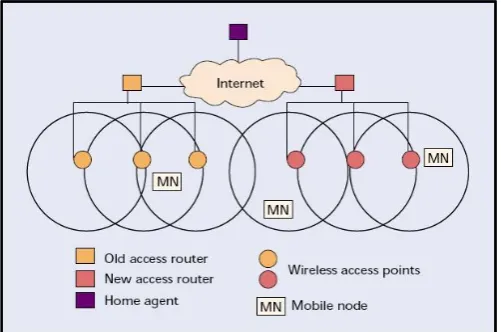
communications for huge numbers of mobile nodes. Figure 1.1, illustrates the
wireless architecture in IPv6 (Montavont and Noël, 2002).
5
Mobile IPv6 (Johnson, Perkins and Arkko, 2004) was designed to manage
mobile nodes movements across wireless IPv6 networks. However, during the
movements, the active communication will be interrupted due to the changes of the
network prefix of the new network. During this interruption, the mobile node cannot
receive any IP packets on its new point of attachment until the handoff procedure
ends. This interruption can take up to two seconds during a standard handoff
procedure in MIPv6 (Vogt, 2006). This delay includes the time needed for new
router discovery, movement detection, a new care-of-address establishment, and
notifying the original router (Home Agent) and corresponding node of the new
network attachment. Figure 1.2, shows the steps involve in the handoff procedure
(Vogt, 2006).
6
Route Optimization (Johnson, Perkins and Arkko, 2004; Vogt and Doll,
2006) was introduced in Mobile IPv6 (Johnson, Perkins and Arkko, 2004) to solve
the problem of triangular routing (Forouzan, 2006) as faced in MIPv4, by creating a
direct path between the two communicating nodes. It allows an end-to-end way of
communication between peers. Such situation is illustrated in Figure 1.2.
1.4 Problem Statement
In this project, several existing Route Optimization handoff techniques will
be analyzed and simulated to study the efficiency of each technique. The standard
Route Optimization approach in Mobile IPv6 shows a delay of up to 2 seconds
before resume communication between two peers (Vogt, 2006). The performance of
the Real-time applications streaming will be the focus of the study. In Real-time
streaming (e.g. VoIP or video conferencing), the delay during the handoff can
become a huge setback in implementing MIPv6 (Johnson, Perkins and Arkko, 2004).
A new approach will be proposed to reduce the time gap between link-layer
handoff and resuming routability. A simulation then will be carried out to examine
7
1.5 Project Objectives
With reference to the problem stated above, this study is attempting to
achieve the following objectives:
1. To study the existing handoff schemes of Route Optimization in Mobile IPv6.
2. To propose an alternative approach to reduce the latencies and packets loss
for real-time communication streaming caused by the current Route
Optimization techniques.
3. To analyze the performance of the proposed technique.
1.6 Project Scope
1. The study of the existing handoff schemes of Route Optimization in MIPv6
will focus upon five of the most popular techniques.
2. The performance analysis of the proposed technique will be carried out by
using ns-2 simulation tools.
3. TCP and UDP Packets of real-time streaming communication will be used as
comparison metrics in the performance analysis between the proposed
technique and the existing ones.
4. Security issues during handoff will not be addressed. This study will consider
that there are neither security issues nor any kind of authentication or network
keys for the Access Routers during the handoffs.
5. The simulation topology and model described in chapter 3 will not be
8
1.7 Importance of Study
This study gives an insight on the issues of handoff latencies in MIPv6. By
studying and comparing several existing techniques proposed to solve the handoff
latencies and optimize Route Optimization in MIPv6, this projects aims to propose a
new approach to solve the issues regarding real-time multimedia streaming in order
to improve the performance of the Transmission Control Protocol (TCP) and User
Datagram Protocol (UDP) during the handoffs.
1.8 Organization of the Report
The report is organized as follows:
Chapter (1) introduces the general idea of wireless network and the protocols
that help achieve node mobility. This chapter also briefly discussed the Route
Optimization handoff procedure and its issues faced in mobile IPv6. The project
objectives and scope are mentioned in this chapter.
Chapter (2) discusses the literature reviews, where the background details and
concepts of Transport Control Protocol (TCP), User Datagram Protocol (UDP) and
Mobile IP were explained. The chapter also explains the Mobile IPv6 handoff
procedure. The chapter also discusses some existing related works that concern with
improving the performance of handoff and Mobile IPv6. The end of chapter two
discusses some of the handoff schemes which will be simulated. A brief comparison
9
Chapter (3) discusses the methodology used in this study. In this chapter the
operational framework is presented to show the steps that are needed to be followed
to achieve the objectives of this project. The Network Model will also be described
in this chapter. The Network Model is designed as simple as possible to avoid
unnecessary drawbacks, whether they are caused by the complexity of the design or
the infrastructure of the network model. The Simulation Model that shows the
parameters and metrics of the simulation is also described in this chapter.
Chapter (4) discusses the proposed scheme along with the algorithm and
coding of the scheme. The simulation coding will be illustrated here as well.
Chapter (5) discusses the simulation model and the simulation metrics that
are going to be studied for each chosen scheme. These metrics represents the times
needed to be reduced in order for the scheme to perform better. The chapter also
illustrates the results of the conducted simulations. Different existing MIPv6 handoff
schemes along with the proposed alternative are simulated using the same network
model. A comparison is carried out to compare the performance of each scheme.
Chapter (6) discusses the findings of the simulations and the study. The
achievements of the study are discussed in this chapter as well. Some future works is
proposed that can tune the proposed scheme and help implementing it in real MIPv6
10
1.9 Summary
The ease of use, low cost and the vast variety of information made the
Internet a necessity in the modern world. Users want to access information, their
emails or even make businesses while they drive their cars or commute to work.
Mobile IP was introduced to solve the problem of changing network attachments
while keep communication available. The issues of handoff procedures (the process
of changing network prefixes) delay the full implementation of Mobile IP over
mobile networks. This report discusses some of these issues and proposes an
REFERENCES
Altman, E., and Jimenez, T. (2003), “NS Simulator for Beginners”, University De
Los Andes, France, Lecture Notes (2003/2004).
Aura, T. (2005), “Cryptographically Generated Addresses (CGA)”, RFC 3972, http://www.ietf.org/rfc/rfc3972.txt.
Choi, J., and Shin, D. (2002), “Fast Router Discovery with AP Notification”,
http://www.ietf.org/internet-drafts/draft-jinchoi-l2trigger-fastrd-01.txt.
(Work in Progress).
Clark, D. (1982), “Window and Acknowledgement Strategy in TCP”, RFC 813, http:// www.ietf.org/rfc/rfc813.txt.
Daley, G., and Nelson, R. (2003), “Duplicate Address Detection Optimization using IPv6 Multicast Listener Discovery”, http://tools.ietf.org/html/draft-daley-ipv6-mcast-dad-02. (Work in Progress).
Daley, G., Pentland, B., and Nelson, R. (2003), “Movement detection optimizations in mobile IPv6”. The 11th IEEE International Conference on Networks. 28 SEP. – 1 OCT. 2003. 687-692.
Daley, G., Pentland, B., and Nelson, R. (2006), “Effects of Fast Router
Advertisement on Mobile IPv6 Handovers”. Proceedings of the Eighth IEEE
International Symposium on Computers and Communication ISCC’03.
30 June – 3 July. Kemer - Antalya, Turkey. 1, 557-562.
Davidson, J., Peters, J., Bhatia, M., Kalidindi, S., and Mukherjee, S. (2006). Voice
over IP Fundamentals (2nd ed.): CiscoPress.
85
Droms, R., Bound, J., Volz, B., Lemon, T., Perkins, C., and Carney, M. (2002), “Dynamic Host Configuration Protocol for IPv6 (DHCPv6)”,
http://www.tools.ietf.org/html/draft-ietf-dhc-dhcpv6-28.
Egevang, K. (1994) “The IP Network Address Translator (NAT)”, RFC 1631, http://www.ietf.org/rfc/rfc1631.txt.
Ernest, T. (2001), “MobiWan A NS-2.1b6 Simulation Platform for Mobile IPv6 in Wide Area Networks”, MobiWan Official Manual.
Ernest, T. (2002), “MobiWan: ns2 extensions to study mobility in Wide-Area IPv6 Networks”. http://www.inrialpes.fr/planete/mobiwan.
Fall, K., and Varadhan, K. (Eds.) (2008), “The ns Manual”.
Fikouras, A., El Malki, K., Cvetkovic, S., and Smythe, C. (1999), “Performance of
TCP and UDP during Mobile IP Handoffs in Single-Agent Subnetworks”.
Wireless Communications and Networking Conference, WCNC 1999.
21-24 September. New Orleans: IEEE, 3, 1258-1262.
Forouzan, B. (2006), TCP/IP Protocol Suite, (3rd ed.): McGraw-Hill.
Han, Y., Choi, J., Jang, H., and Park, P. (2003), “Advance Duplicate Address Detection”, https://datatracker.ietf.org/drafts/draft-jinchoi-l2trigger-fastrd. (Work in Progress).
Heidemann, J., and Huang, P. (2002), “IPAM Tutorial: Network Modeling and
Traffic Analysis with ns-2”
Johnson, D., Perkins, C., and Arkko, J. (2004), “Mobility Support in IPv6”,
RFC 3775, http://www.ietf.org/rfc/rfc3775.txt
Jung, J., Montgomery, D., Cheon, J., and Kahng, H. (2003), “Mobility Agent with SIP Registrar for VoIP Services”, International Conference on
Human.Society@Internet No2, 18-20 June 2003, Seoul, South Korea. 2713,
454-464
Kempf, J., Khalil, M., and Pentland, B. (2005), “IPv6 Fast Router Advertisement”,
http://tools.ietf.org/html/draft-mkhalil-ipv6-fastra-05. (Work in Progress).
Liu Y., Ye, M., and Zhang, H. (2003), “The Handoff Schemes in Mobile IP”.
Vehicular Technology Conference, VTC 2003. 4-9 October. Orlando, Florida:
The 57th IEEE Semiannual, 1, 485-489.
86
Montavont, N., and Noël, T. (2002), “Handover Management for Mobile Nodes in IPv6 Networks”, Communications Magazine, IEEE, 40(8), 38-43.
Moore, N. (2006), “Optimistic Duplicate Address Detection (DAD) for IPv6”, RFC 4429, http://www.ietf.org/rfc/rfc4429.txt.
Narten, T., and Draves, R. (2001), “Privacy Extensions for Stateless Address Autoconfiguration in IPv6”, RFC 3041, http://www.ietf.org/rfc/rfc3041.txt. Narten, T., Nordmark, E., and Simpson, W. (1998), “Neighbor Discovery for IPv6”,
RFC 2461, http://www.ietf.org/rfc/rfc2461.txt.
Naugle, M. (1998), Illustrated TCP/IP, (1st ed): Wiley Computer Publishing, John
Wiley & Sons, Inc.
P´erez-Costa, X., Torrent-Moreno, M., and Hartenstein, H. (2003a), “A Performance
Comparison of Mobile IPv6, Hierarchical Mobile IPv6, Fast Handovers for
Mobile IPv6 and Their Combination”. Mobile Computingand Communications
Review, 7(3), 5-19.
P´erez-Costa, X., Torrent-Moreno, M., and Hartenstein, H. (2003b), "A Simulation
Study on the Performance of Hierarchical Mobile IPv6". ACM SIGMOBILE
Mobile Computing and Communications Review, 7(4), 5-19. Perkins, C. (2002), “IP Mobility Support for IPv4”, RFC 3344,
http://www.ietf.org/rfc/rfc3344.txt.
Postel, J. (1980), “User Datagram Protocol”, RFC 768, http://www.ietf.org/rfc/rfc768.txt.
Postel, J. (1981a), “Internet Protocol”, RFC 791, http://www.ietf.org/rfc/rfc791.txt. Postel, J. (1981b), “Transmission Control Protocol”, RFC 793,
http://www.ietf.org/rfc/rfc793.txt.
Stevens, W. (1997), “TCP Slow Start, Congestion Avoidance, Fast Retransmit, and Fast Recovery Algorithms”, RFC 2001, http://www.ietf.org/rfc/rfc2001.txt. Thomson, S. and Narten, T. (1998), “IPv6 Stateless Address Autoconfiguration”,
RFC 2462, http://www.ietf.org/rfc/rfc2462.txt.
Vogt, C. (2006), “A comprehensive and efficient handoff procedure for IPv6 mobility support”. Proceedings of the 2006 International Symposium on a World of Wireless, Mobile and Multimedia Networks WoWMoM'06.
87
Vogt, C., and Doll, M. (2006), “Efficient End-to-End Mobility Support in IPv6”.
Wireless Communications and Networking Conference, WCNC 2006. 3-6 April.
Las Vegas, NV: IEEE, 1, 575-580.
Wheat, J., Hiser, R., Tucker, J., Neely, A., and Mcculloug, A. (2001), Designing a
Wireless Network: Understand How Wireless Communication Works, (1st ed.):
Syngress Publishing, Inc.
Willig, A., Kubisch, M., and Wolisz, A. (2001), “Measurements and Stochastic
Modeling of Wireless Link in an Industrial Environment”, Technical University
Berlin, Telecommunication Networks Group, TKN Technical Report
TKN-01-001.