STUDENTS’ SELF-REGULATION AND CRITICAL THINKING IN LEARNING E-COMMERCE THROUGH SOCIAL NETW ORKING SITE
JACQUELIN S. LINGGU
A thesis submitted in fulfilment o f the requirements for the award o f the degree of Doctor o f Philosophy (Educational Technology)
Faculty o f Education Universiti Teknologi Malaysia
iv
ACKNOW LEDGEMENT
All praises to God the Almighty, the M ost Gracious and the M ost Merciful, for granting me the strength to complete this thesis. W ithout Him none o f this would have been possible.
I wish to express my deepest appreciation to my supervisor, Prof. Dr. Zaidatun Tasir for her support, guidance and motivation throughout my PhD journey. May God Bless her kindness for believing in me, spending time, and patience. I am very grateful for her.
My warmest thanks to my dear friends especially Lulu Vasan to proof read the thesis, Fannie Ferdinand and Suhaila Gayoh for their thoughtful suggestions and perceptive feedbacks. My sincere thanks also goes to Nurul Farhana who provided wonderful support to me during the analysis o f quantitative and qualitative data and for helpful guidance. They are my strength and motivator. My thanks also goes to my dearest student participated in this study. W ithout their cooperation, this study would not have been possible.
VI
ABSTRAK
CHAPTER TITLE PAGE
DECLARATION ii
DEDICATION iii
ACKNOW LEDGEMENT iv
ABSTRACT v
ABSTRAK vi
TABLE OF CONTENTS vii
LIST OF TABLES xiii
LIST OF FIGURES xvii
LIST OF ABBREVIATIONS xviii
LIST OF APPENDICES xix
1 INTRODUCTION 1
1.1 Introduction 1
1.2 Background o f Problem 5
1.3 Statement o f Problem 13
1.4 Research Objectives 16
1.5 Research Questions 16
1.6 Hypotheses 17
1.7 Theoretical Framework 17
1.7.1 Self-Regulation Level 20
1.7.2 Critical Thinking Skill 22
1.7.3 Social Learning Environment 23
1.8 Research Framework 25
1.9 Rationales of Study 27
Vl l l
1.10.1 Students 29
1.10.2 Educators 29
1.10.3 Higher Education Institution-University 30
1.10.4 Ministry o f Education (MOE) 30
1.10.5 Societies 31
1.11 Scope o f the Research 31
1.12 Operational Definitions 31
1.12.1 Social Networking Tools 32
1.12.2 College Students 32
1.12.3 Self-Regulated Learning 32
1.12.4 Critical Thinking 34
1.12.5 Social Learning Environment 34
1.12.6 Performance 34
1.13 Summary 35
2 LITERATURE REVIEW 35
2.1 Introduction 35
2.2 Self-Regulated Learning 34
2.2.1 Self-Regulation Model by Zimmerman 36 2.2.2 Self-Regulation Model by Pintrich 39 2.2.3 Self-Regulation Model by Barnard, Lan and Paton 40
2.3 Measuring Self Regulated Learning 42
2.3.1 Learning and Studies Strategies Inventory (LASSI) 43 2.3.2 Motivated Strategies for Learning
Questionnaire (MSLQ) 44
2.3.3 Metacognitive Awareness Inventory (MAI) 46 2.3.4 Self - regulated Learning Interview Schedule
Strategies (SRLIS) 48
2.3.5 Academic Self-regulated Learning Scale (A-SRL-S) 49 2.3.6 Online Self-Regulated Learning Questionnaire
(OLSQ) 50
2.3.6.1 Element in Online Self-Regulated
Learning Questionnaire 54
2.4.1 Critical Thinking Model by Watson Glaser 58 2.4.2 Critical Thinking Model by Paul Elder 59 2.4.3 Critical Thinking Model by Peter A. Facione61
2.5 Measuring Critical Thinking 63
2.5.1 California Critical Thinking Disposition Inventory
(CCTDI) 64
2.5.2 Health Science Reasoning Test(HSRT) 66 2.5.3 Professional Judgment Rating Form(PJRF) 67 2.5.4 Teaching for Thinking Student Course Evaluation
Form 67
2.5.5 Hoslistic Critical Thinking Scoring Rubric 68 2.5.6 Peer Evaluation o f Group Presentation Form 70 2.5.7 Cornell Critical Thinking Test 70 2.5.8 Ennis-W eir Critical Thinking Essay Test 71 2.5.9 James Madison Test o f Critical Thinking 72 2.5.10 W atson-Glaser Critical Thinking Appraisal 73 2.5.11 California Critical Thinking Skills Test 74 2.6 Social Networking Tool in Teaching and Learning 82
2.6.1 Ning 83
2.6.2 Elgg 83
2.6.3 Facebook 84
2.7 Social Learning Environment 87
2.7.1 Model by Bandura 88
2.7.1.1 Motivating Student 89
2.7.1.2 Encourage Social Interaction 90
2.7.1.3 Self-Efficacy 90
2.7.1.4 Observational Learning 91
2.7.1.5 Active Learning 91
2.8 Self-Regulated Learning, Critical Thinking, and
Performance 92
2.9 Research on Self-Regulated Learning and
Critical Thinking 92
3 RESEARCH METHODOLOGY 97
3.1 Introduction 97
3.2 Research Design 97
3.3 Research Procedure 101
3.3.1 First Phase : Preparing the Research Instrument and
Conducting the Pilot study 103
3.3.2 Second Phase : Identifying the Self-Regulated Learning
and Critical Thinking Level 104
3.3.3 Phase 3 : Conducting the Pre-experimental
Research 104
3.4 Samples and Population 105
3.5 Instrumentation 106
3.5.1 Online Self-regulation Learning
Questionnaire (OLSQ) 107
3.5.2 Critical Thinking Test 109
3.5.3 Performance Test 119
3.5.4 Interview 124
3.5.4.1 Observation through Facebook Discussion 125
3.5.5 Facebook Learning Activities 130
3.6 Pilot Study 136
3.6.1 Online Self Regulated Learning Questionnaire
(OLSQ) 136
3.6.2 Critical Thinking Test (CTT) 137
3.6.3 Performance Test 137
3.7 Data Analysis 138
3.7.1 Analysis o f Self-Regulated Level among
Undergraduate Students 138
3.7.2 Analysis o f Critical Thinking Level among
Undergraduate Students analysis 139
3.7.3 The Effect o f SNS based on Social Learning Environment towards students Performance, Self regulation and Critical Thinking in Learning E-
Commerce analysis 140
3.7.4 The Relationship o f Students’ Self-Regulation and Critical Thinking Skills and Performance when using
SNS Analysis 141
3.7.5 How Student Cultivate Self-regulation and
Critical Thinking in Learning when using SNS 143
3.8 Summary 145
4 RESULTS AND FINDINGS 147
4.1 Introduction 147
4.2 Background o f Respondents 147
4.3 Students’ Level o f Self-Regulated learning 149 4.4 Students’ Level o f Critical Thinking 155 4.5 The Effect o f SNS based on SLE towards students’
performance, self-regulation, and critical thinking in learning
E-Commerce. 156
4.5.1 Students’ Academic Performance 156
4.5.2 Students’ Self-Regulated Learning 168
4.5.3 Students’ Critical Thinking 174
4.5.4 Students’ Self-Regulation and Critical Thinking
Level 181
4.6 The relationship o f SNS based on SLE towards students’ Self regulation, Critical thinking and performance in learning E-
Commerce 183
4..7 The analysis on how student cultivate self-regulation and
critical thinking in learning when using SNS 199 4.7.1 Analysis o f Self-Regulated Learning using
Facebook 202
4.7.2 Analysis o f Critical Thinking using Facebook 206
4.8 Summary 210
5 DISCUSSION, SUGGESTION AND CONCLUSION 211
5.1 Introduction 212
5.2 Research Summary 212
5.3 5.4
5.5 5.6 5.7 REFERENCE
Appendices A - 1
5.2.2 Critical thinking skill o f students 218 5.2.3 The effect o f Social learning environment through
SNS towards students’ performance in learning E-Commerce, self-regulated learning and critical
Thinking 221
5.2.4 Relationship between students’ Self-regulated learning, Critical thinking skills and Academic performance
when using SNS 227
5.2.5 How student cultivate self-regulated and critical
thinking in learning when using SNS 231
Conclusion 233
Implication and Contribution 235
5.4.1 Implications on SNS Approach Learning System 236 Limitations o f the Research
Suggestion for Further Research Summary
239 239 241 242
TABLE NO. TITLE PAGE
2.1 Learning and Study Strategies Inventory (LASSI) Scales 43 2.2 Motivation Components and Learning Strategies (MSLQ) 45
2.3 Metacognitive Awareness Inventory (MAI) Scales 46
2.4 Self-regulated Learning Interview Schedule Strategies
(SRLIS) Item 48
2.5 Factors in Academic Self-regulated Learning Scale (A-SRL-S) 50 2.6 Factors in Online Self-Regulated Learning Questionnaire (OLSQ) 51 2.7 Summary Findings for Types o f Self-regulated learning
Measurement 51
2.8 Internal consistency for each subscale on three studies using
Online Self-Regulated Learning Questionnaire (OLSQ) 54 2.9 The scales for the California Critical Thinking
Disposition Inventory. 65
2.10 The scales for the Health Science Reasoning Test 66 2.11 The Four Levels o f the Holistic Critical Thinking Scoring Rubric 68
2.12 Components o f Cornell Critical Thinking Test 71
2.13 Subscales on W atson-Glaser Critical Thinking Appraisal 73 2.14 Test Manual for the California Critical Thinking Skills Test 74
2.15 Critical thinking skills definitions 75
2.16 Summary Findings for Types o f Critical Thinking Test
Instrument 78
2.17 Summary Findings for Social Networking Tools for Teaching and
Instrument Learning 86
3.1 Total Item and Subscale o f Questionnaire 108
3.2 Detail Item on the Questionnaire 108
3.4 Detail item on the Questionnaire 111 3.5 Phases in Bloom ’s Taxonomy relevant to Critical Thinking 119
3.6 Total Item and Type o f Questions 120
3.7a Type o f Questions and Taxonomy Level (Objective Questions) 120 3.7b Type o f Questions and Taxonomy Level (Subjective Questions) 121 3.7c Type o f Questions and Taxonomy Level (Essay Questions) 122 3.8 Items o f question for each level for Taxonomy Bloom 122
3.9 Students’ Grading System 124
3.10 Performance Test Grading Scheme 122
3.11 Type o f Questions, topics and total Item 125
3.12 List o f Questions ask during Interview 125
3.13 SRL elements, descriptions and example o f statements 127 3.14 CT elements, desriptions and example o f statements 128
3.15 Interpretati on o f Kapp a value s 130
3.16 Facebook Learning Activities 132
3.17 Scheme o f W ork 134
3.18 OLSQ Alpha Cronbach value 137
3.19 Critical Thinking Test Alpha Cronbach value 135
3.20 Data analysis Based on Research question 138
3.21 SRL Level 139
3.22 CT Level 140
3.23 Interpretation o f effect size (Leech, Barrett and Morgan, 2011) 141 3.24 Interpretation o f correlation coefficient (Dancey and Reidy, 2004) 140 3.25 The topic, theme, description, percentage and example of
statements 143
3.26 Example o f reported findings on students SRL in using Facebook 145 3.27 Example o f frequency on students CT in using Facebook 146
4.1 Frequencies and Percent Respondent Information 148
4.2 Students’ Age 149
4.3 Mean and Standard Deviation for Goal Setting 149
4.4 Mean and Standard Deviation for Environment Structuring 150
4.5 Mean and Standard Deviation for Task Strategies 151
4.6 Mean and Standard Deviation for Time M anagement 152
4.7 Mean and Standard Deviation for Help Seeking 152
4.8 Mean and Standard Deviation for Self-evaluation 153
4.9 Students Self-Regulated Learning 154
4.10 Students’ level o f Self-Regulation 154
4.11 Students’ Critical Thinking Score 155
4.12 Student’s level o f Critical Thinking 155
4.13 Students’ Pretest and Posttest Marks 156
4.14 Students’ Pretest and Postest Marks for Each Bloom Item 158
4.15 Students’ Grade for Pretest and Posttest 161
4.16 Students’ Pretest, Posttest scores and score’s differences in
learning performances 162
4.17 The students’ Pretest and Posttest descriptive analysis o f means,
standard deviation and maximum and minimum scores, means 163
4.18 Normality Test o f Pretest and Posttest data 164
4.19 Normality Test on Differences Pretest and Posttest Data 166 4.20 Pretest and Posttest data paired sample t-test 166 4.21 Post hoc power analysis academic performance and effect size
value 167
4.22 Normality Test Pre and Post-Test Marks for SRL 168
4.23 Students’ Pre and Post-Test Marks for SRL 169
4.24 Mean and Standard Deviation o f students’ Self-regulated Learning 171 4.25 Self-regulated Learning Pretest and Posttest for Paired Sample
t-Test 172
4.26 Effect size value and post hoc power analysis SRL 174
4.27 Students’ Pre and Post-Test Marks for CT 175
4.28 Normality Test on Pre and Post Marks for CT 179
4.29 Mean and standard deviation for Students’ Critical Thinking 180 4.30 Paired Sample t-Test Pre and Post-Test for Critical Thinking 180
4.31 Effect size value and post hoc analysis CT 181
4.32 Level o f Self-regulation before and after Using Facebook 182 4.33 Level o f Critical Thinking before and after Using Facebook 182 4.34 Pearson correlation matrix among students’ SRL, CT and their
Academic Performance 183
4.35 Crosstabulation for CT Level and SRL Level 184
xvi
Level 182
4.37 Cross tabulation for Academic Performance and CT Level 185
4.38 Frequency on each item for SR 186
4.39 Frequency on each item CT 190
4.40 Prediction on Student Grade based on sequence and types o f posts 193
4.41 Theme Identification 199
4.42 Students’ Feedback from Interview 200
4.43 Answers from student in Facebook with SRL elements and
Frequency 202
FIGURE NO. TITLE PAGE
1.1 Theoretical Framework 18
1.2 Research Framework 26
2.1 A cyclic model o f self-regulatory learning
(Zimmerman et a l, 1996) 37
2.2 A cyclical model o f self-regulated learning
(Zimmerman, 2008) 38
2.3 Paul-Elder Critical thinking Model (1997) 60
2.4. Social Learning Theory Diagram 88
3.1 One-group Pre-experimental Design 98
3.2 Research Procedure 102
3.3 Page Feature in Facebook 130
4.1 Student Grade Performance in Pretest and Posttest 161 4.2 Comparison o f students’ Pretest and Posttest scores on
academic performance 165
4.3 Frequency o f each SRL element posting used over the Semester 188 4.4 Frequency o f Each CTelement Used Over The Semester 191
4.5 Decision Tree Analysis Model 197
4.6 Total Frequency o f All elements in SRL Used Over The Semester 204 4.7 Total Frequency o f All elements in CT Used Over The Semester 209
LIST OF ABBREVIATION
SNS - Social Networking Site
SPSS - Statistical Package fo r Social Sciences SLE - Social Learning Environment
PBL - Problem Based Learning
CT Critical Thinking
CTT Critical Thinking Test
SRL Self-regulated Learning
SR Self-regulation
LIST OF APPENDICES
APPENDIX TITLE PAGE
A Self Regulation and Critical Thinking Questionnaire 268
B Performance Test Questions 280
C Students’ Critical Thinking Score 286
D Decision Tree Analysis Model 298
E Validation E-Commerce Performance Test 299
F Validation Self-Regulated Learning Questionnaire
Translation 302
G Validation Critical Thinking Test Questionnaires 304
H Validation Facebook Learning Activities 305
CHAPTER 1
INTRODUCTION
1.1 Introduction
The emergence o f the 21s1 century technology has impacted a lot in our lives. These technologies bring us to the world o f high technology and virtual lives whereby we could never imagine this happening in this era. Youngsters nowadays are exposed to gadgets and use them in their daily lives. Mobile handphones, iPod, iPad, notebooks, instant messaging, skype, tango are used to connect with friends, families, colleagues, employers and others in their community and around the globe. These generations are well versed with the gadgets whereby educators must know how to tap into this technology and use it for the benefit o f teaching and learning. The urge to connect with other people is a natural process that brings excitement to youngsters. The cost o f getting these technology gadgets is affordable and enables youngsters to purchase with their own pocket money and monthly allowance from the parents. Children as young as seven years old have been exposed to this wireless technology that it is hard to block this technology advancement. Advertisements are everywhere promoting the public about the latest technology available. Even retail shops are selling this product at a very competitive and affordable price.
location, sexual preference, occupation) and interests (hobbies, favourite books, movies, television programs, music and so on)(Golder et al., 2007). One o f the well known social network website is Facebook. Mark Zuckerberg created Facebook at Harvard University in February 2004 (Bosch 2009). Initially, Mark Zuckerberg created Facebook for Harvard students only together with Dustin Muskovitz and Chris Hughes. Eventually, it extended towards college students, high school network, work network, business network and all Internet users in general. Facebook is one of the many Web 2.0 tools, which are wikis, Del.icio.us, YouTube, podcasts-listed as having potential application for teaching and learning. M oreover it has been argued that the current generation o f youth, often described as Net Geners or Digital Natives, may be resistant to traditional methods o f teaching and learning (Bosch 2009). Since young people will likely continue to be at the forefront o f technological change, Net Geners will continue to have a lot to teach educators about evolving technology. Yet educators must not abdicate their role as authorities directing the learning experience o f their students. Today’s digital and computer technologies allow us to remedy this by giving us the tools to teach Net Geners not just what to learn but how to learn (Barnes et al., 2007).
Business operation and function on daily basis had change since the emergence o f technology. There is a constant need from executives as well as college professors to have updated technology in their working environments in order to effectively educate their peers or associates on new concepts and ideas in a particular subject. The wave o f computers, as well as the Internet has enhanced the way a person obtains education from a college or university. To be successful, people need to take time to learn these technologies or they will miss the opportunities (Shilesky and Casey, 2004).
3
Facebook. Reynard (2009) states that much has been written recently about the impact o f social networking tools in teaching and learning and how educators can build on the skills o f their students in using these tools.
A quite number o f studies have shown that social networking sites are a useful tool for promoting effective academic practice. Gunawardena and Richmond (2009) defines social networking technology as tools that facilitate collective intelligence through social negotiation when participants are engaged in shared practice. Similar findings were reported by Veletsianos and Navarette (2012), where learners supported one another in their learning and noted that they perceived their learning experience using Elgg online social network was enhanced by their interactions. Research conducted by (Brady et al., 2010) surveyed the students using Ning shows that there are potential benefits in using social networking tools to improve learning experiences. Kayri and Cakir (2010) study shows that students actively participated in virtual environment using Facebook and might be suggested as an effective learning environment. Students in this study who spent much time on Facebook perceived Facebook as an educational tool. Using Facebook as teaching and learning in Bosch (2009) research appeared to be beneficial to the students in terms o f helping them to identify and find learning material on the Internet, answer question about logistics and also used during university vacations to connect with others about holiday projects, and to share lecture and study notes. Similar findings were found in Tian et al. (2011) study where Facebook usages were found to be social and educational in nature. It was reported that Facebook allowed them to connect with the faculty and other students in term o f friendship, provide comments to share knowledge, share feelings with peers, join groups established for subjects, collaboration: notification, discussion, course schedule, project management calendar and to use educational applications for organizing learning activities.
that shows students generally learn as much online as they do in traditional classroom environment (Swan, 2003).
Students who self-regulate their learning appeared to be more successful in academic than those who do not self-regulate (Montalvo and Torres, 2004; Schloemer and Brenan, 2006). Student who self-regulate proactively use strategies to accomplish their goals because they believe change and success are possible. Students who portray self-regulated learning behaviour exhibit the following qualities(Montalvo and Torres, 2004; Schloemer andBrenan, 2006):
i. They consciously use cognitive strategies to succeed.
ii. They do planning, controlling, and directing their mental efforts.
iii. They use motivational beliefs and emotions to promote their own achievement. iv. They manage their time and effort.
v. They choose favourable work environments.
vi. They show initiative to participate in academic tasks and planning.
Although the concept o f self-regulated learning has been around for many years, the application to online learning environment has not been widely researched. The online environment requires more o f learners’ mind than the passive absorption o f knowledge from the instructor’s brain. Learners must monitor the learning process as they attend to information delivered over the Internet (Anderton, 2006).
Another factor that would contribute to the success o f a student is critical thinking ability. Critical thinking has been widely discussed in the education field for the past decades. Researchers such as Sonn (2000) and Olafson (2003) indicated that educators spend too much time devoted to instruction but less focus placed on the construction o f knowledge, thinking skills and how to evaluate them. Students who have high critical thinking ability proved to be more successful in academic and higher metacognitive abilities (Downing, 2009).
5
performance, it is necessary now to access the relevance o f self-regulation and critical thinking skills toward learning through social learning environment.
1.2 Background of Problem
Self-regulated learning approach is widely used due to the learning system that inculcates a person to regulate his or her own learning. Learning through online need a person to be self-regulated due to the nature on the learning environment. Research conducted by Chang (2005) discovered that students in online environment trained with SRL ability were more responsible with their learning and oriented intrinsically. However, there has been relatively little empirical research on the usage o f SRL through social learning environment through social networking site.
Studies have shown that critical thinking is lacking in student nowadays due to the way the student have been brought up and educational system whereby the skill o f critical thinking have not been established. Studies by Lorenzo and Dziuban (2006) indicated that graduates with high level ability using the technology at their workplace still lacking critical thinking skills. This shows that they still lack of critical thinking skill. Thus, learning design which is up to date with the technology is needed for student to be able portray their ability when using it.
There have been study in E-commerce subject to seek the effective learning system by using simulation game providing group based student-centered learning environment for students to learn online auction (Lok and Ngai, 2005). Even though online learning environment was used in learning E-commerce but it is not similar to online learning through social networking site.
a single course which they wrote more than 20 pages over the course o f the semester. This finding indicated that students have not been self-regulating their studies and learning at all.
Zimmerman and Schunk (2001) points out that there have been exciting discoveries regarding the nature, origins, and development o f how students regulate their own learning processes. Self-regulation is important because a major function o f education is the development o f lifelong learning skills whereby one o f it is critical thinking. Critical thinking is an important and vital topic in modem education and mostly educators are interested in teaching critical thinking to their students (Schafersman, 1991).
There have been decades o f numerous studies on self-regulated learning and critical thinking skill. Social networking sites especially Facebook have been one of the favorite topics for researchers for the past few years since Marc Zuckerberg started it. However, there have been lacks o f studies that demonstrate the use o f self regulation learning and critical thinking skill using Facebook to improve the performance o f undergraduate students in E-Commerce. This lack o f research may be due to the lack o f agreement whether students should be taught to self-regulate their learning and critical thinking without being taught in the course or taught as a part o f an integral component o f the subject. Studies conducted on social networking sites-Facebook are mostly researched on the social part without taken into consideration about the usefulness o f integrating teaching and learning as part of learning when socialising. Research also suggests that using social networking site- Facebook can be use as a tool for teaching and learning, but this may not guarantee success unless students’ self-regulated learning and ability o f critical thinking skill level is high. Self-regulated learning and critical thinking are essential skills to predict the performance achievement for student. There has been lack o f information on these skills on research looking at this element. Therefore, there is a need to conduct the research to seek the relationship.
7
they are expected to manage their own learning (Rakes and Dunn, 2010). Research by (Styles and Zariski, 2000) also indicated that learning in online environment need students to be highly self-regulated and responsible for organising and reflecting on their learning.
The lack o f Self-regulated and critical thinking skill through online learning environment need to be develop in order for them to perform n their studies. Study conducted by (Orange, 1999) indicated that student lack o f self-regulatory skills especially in an online environment where student is expected to manage their learning. Critical thinking relates closely with self-regulated learning whereby when student manage to regulate their studies, critical thinking comes to place. Lack of critical thinking discovered in McLoughlin and Luca (2000) research shows that students in a project management course in a forum do not possess this higher order skills or critical thinking skills.
Self-regulation is not a mental ability or an academic performance skill; rather it is the self-directive process by which learners transform their mental abilities into academic skills (Zimmerman, 2002). Wolters (2010) has indicated that student characterized as self-regulated learners are seen as more effective, efficient and productive students when compared to their peers who fail to self- regulate.
environment. The Online Self-Regulated Learning Questionnaire (OLSQ) designed by Barnard et al. (2009) are suitable to measure for students in online environments that consists o f six subscales constructs, including environment structuring, goal setting, time management, help seeking, task strategies, and self-evaluation.
Another factor that students lack nowadays are critical thinking skills (AcademyHealth Report, 2006; Telg and Irani, 2005, Arum and Roksa, 2011). According to Brooks and Brooks (2001), student often complete assignments, do well on tests and get good grades but do not learn to think critically. The mere acquisition o f knowledge through memory is often not sufficient for effective learning. Learners need to make sense o f what they have learned and know when, where and how to use knowledge. To acquire the understanding o f knowledge, effective learning is fundamental and the mental process in understanding is thinking (Mohd Nazir, 2010).
(Facione, 1990) defined critical thinking as purposeful, self-regulatory judgm ent which results in interpretation, analysis, evaluation and inference, as well as explanation o f the evidential, conceptual, methodological, criteriological, or conceptual considerations upon which that judgm ent is based. Studies have shown that student ability for critical thinking is significantly correlated towards the improvement in academic performance (Collins and Onwuegbuzie, 2000; Fahim et al., 2010)
9
Bloom and his associates have included the category o f critical thinking in the field o f education whereby they come up with a taxonomy to differentiate the level o f competency. Bloom ’s taxonomy is categorized, with “comprehension” at the bottom and “evaluation” at the top. The three highest levels which are analysis, synthesis and evaluation represent critical thinking (Kennedy et al., 1991). Facione (2000) and Paul (1992) discuss that educators should model critical thinking in their own instruction by “thinking aloud” method so that reasoning is visible to students and they can observe the teacher using evidence and logic to support arguments and assertions.
Critical thinking skills are important because they allow students to deal efficiently with social, scientific and practical problems (Shakirova, 2007). Beside critical thinking skills, self-regulated learning will enable student to adjust their time in learning E-Commerce subject. These two skills are important for learning. There have been numerous research conducted on using self-regulated learning and critical thinking skill for learning but lack o f study for E-Commerce subject. By implementing social networking as a tool to improve student’s performance, it will boost up their critical thinking skills and self-regulation adding ways to seek knowledge. Bower and Callaghan (2012) studies discovered that students were able to deliver all the tasks instructed when learning through social networking sites without any teacher intervention which shows that social networking sites does enable self-regulated learning.
With the fast emergence o f Internet communication tools such as Social Networking Tools, there is a potential where critical thinking and self-regulated skills can be enhanced through those communication tools. Ryberg and Christiansen (2008) research conducted through social networking site shows that learning and development facilitated by various modes o f belonging, afforded when the site- structure and design allows self-regulation and collective, social regulation around problem solving.
Previous study conducted by Cheng (2011) enhanced student their self regulated skill by optimising their learning strategies through continuous self assessment o f their learning efficacy. The finding also shows that it is the interests of teachers to develop students’ self-regulation ability if they really want to enhance students’ learning. Previous studies enhance critical thinking skills and self regulated skill but not many studies considering social learning environment through online learning to enhance critical thinking skills and self-regulated skills.
11
Self-regulated learning using social networking tool will enable student to learn without being forced. Self-regulated learning within the social networking environment can be more self-organised, customised and occurs in collaborative learning environment whereby social networking tools provide a way of communication to both students and educators to support and enriching the educational experience. By using the skill o f critical thinking student can use social networking tools as a way o f learning and decide the worthiness o f information receive through socializing with one another. The popularity o f social networking applications could make a powerful cognitive tool if adapted for academic pursuits and career goals. Colleges and universities could take advantage o f the new approach in order for student to interact with one another (Pempek et al., 2009).
The development o f Web 2.0 tools has been significant for general social purposes unfortunately not to the same extent in an educational context. This lag o f use o f technologies for learning and teaching purposes, verses its use generally mirrors a similar lag in pre-Web 2.0 tools. Therefore, in contrast to the lack o f uptake o f technologies in education, the impact o f technology in general day-to-day practice has been more pervasive. The usage o f computers, mobile devices and the Internet are now standard aspects o f daily practices, organisations are technologically enabled, and there is a core set o f technologies for finding and using information and for communication. Using email for working contexts is now the main communicative channel. Google is the first port o f call for finding information, Word and PowerPoint are standard tools for production o f content (Conole et al., 2010).
There are various materials which relate to online learning using E- Commerce. For example, HKCyberU has successfully launched a Web-based post graduate courses online which is using E-Commerce subjects and the student feedbacks for the course are positive. Web based teaching is considered a new trend in education (Cheung, 2001). North Carolina State University, R appa’s course Managing The Digital Enterprise have moved completely to online delivery in E- Commerce course for distance mode (Rappa, 2002). Open Polytechnic o f New Zealand design a degree level E-Commerce subject and web-based learning environment to integrate different modes into teaching. Leong and Petkova (2003) states that in active learning classroom students generally must adopt higher order thinking, critical thinking, analysis and evaluation. However, the material is limited because o f the lack o f research relating to self-regulated learning and critical thinking through social networking site using E-Commerce.
Research must be conducted to gain more information on how these technologies can be implemented in the teaching and learning process to see the potential in using social networking sites as a tool. This is to identify what kind of patterns o f this technologies or Web 2.0 user behavior are emerging in order to understand and design the learning activities that can be integrated into the teaching and learning system or syllabus. This is to enable better finding, sharing, discussing o f learning and teaching ideas and design (Conole et al., 2010).The students may improve their critical thinking skills and learning performance if they are using social networking throughout their learning activities. The integration o f self-regulated learning process through social networking tool to enhance critical thinking skills should be explored more systematically through proper research. This finding from the research will be used as a guidance for educators in the future that would like to use social networking sites as a tool in their teaching and learning activities.
13
from listening to the lecture, requires a lot o f initiative and imaginative (Leong and Petkova, 2003). Sims, Dobbs and Hand (2001) studies also indicated that interactivity and clear instructional design remain essential in the process o f learning online. Students tend to communicate and interact more continuously through online by using social networks for the past few years since social networking site has been introduced.
Kovacic (2002) research on E-Commerce subject and web based learning environment shows that well-defined structure between E-Commerce topics and activities on one sideband collaborative area with discussion forum on the other side integrates various parts o f the learning environment into effective learning place. In E-Commerce subjects, active learning improves retention o f material and stimulates an interest in learning, this is due to the involvement o f the students in discussions, project presentations, and debates to name a few. Furthermore, teacher-student interaction is greatly enhanced through active-review session, analysis and evaluation o f class project (Leong and Petkova, 2003). Dhamija, Heller and Hoffman (1999) have used unique teaching arrangements and styles for example, bringing together students with different backgrounds at different levels to engage in real- world E-Commerce projects. Shilesky and Casey (2004) demonstrate that the use of web-based teaching and learning in E-Commerce is effective technology in today’s education and therefore, the potential o f using social networking tool in learning E- Commerce topic should be explored more where social learning is the core learning environment that requires proper learning structure such as self-regulated learning process.
1.3 Statement of Problems
Tappan and Blount (2011) state that undergraduate students lack the analytical and communication skills to benefit from the approach o f having to read and write about the subject and also lack a quantitative basis for making, evaluating and justifying their decision. In E-Commerce subject the skill o f self-regulated learning and critical thinking are required.
When focusing on learning, these both skills o f self-regulated learning and critical thinking are important in order for the student to be able to explore independently, analyse the resources and apply the information accordingly. However, students were found not being taught to think or learn independently and apply these skills (Landsman and Gorski, 2007).
In order to understand how educators can teach students to self-regulate and think critically about E-Commerce, more studies in self-regulation and critical thinking are needed.History o f E-Commerce dates back to the invention o f the very old notion o f selling and buying, electricity, cables, computers, modems, and the Internet. E-Commerce became possible in 1991 when the Internet was opened to commercial use (Laudon and Traverm, 2008). Computer scientist working under contract for CERN “Tim Bem ers-Lee” made a huge advancement by communicating via the Internet. This achievement has expanded towards common application that are related to electronic commerce for example, email and messaging, documents, spreadsheets, database, accounting and finance systems, orders and shipment information, enterprise and client information reporting.
15
because these courses have gained stature and popularity among many students (Lee, 2003).
A few methods o f teaching E-Commerce had been studied by researchers to improve the students performance. These methods include socializing with one another to gain information. Teaching methodologies have evolved over time. Implementing a suitable teaching methodology depends greatly on the nature o f the course and the content coverage.
College or undergraduate level E-Commerce courses provide rich and frequent opportunities to develop analytical and critical thinking skills yet the recent study by Leong and Petkova (2003), may face problem and reluctance in trying out new pedagogies. Ray (2001) states that E-Commerce is a subject difficult to teach due to the depth and breadth o f this subject rival that o f any other course in any other discipline and its content changes constantly.
Another new method o f improving student performance through socialising using social networking sites on E-Commerce, is encouraging student to participate in the discussion. This method will involve student self-regulation and critical thinking ability to maximize their potential in academic performance. Although technology is not necessary to achieve these outcomes but it can help a great deal to facilitate the process in achieving the potential from the student. New technology is about connecting, networking, collaborating and mobility. These technologies merely enrich the learning potential rather that diminish it for students. Ideas can be articulated and shared not only within a class, but networks can be created that will connect students with a wider community o f learner that enlightens and challenges their own thinking (Reynard, 2010). Educators are now turning to Web 2.0 tools, to support in creating, collaborating and sharing content (Towner and Munoz, 2009).
information and activate emotional reactions through modelling, instruction and social persuasion (Bandura, 1989). Varieties o f models are influenced by learning or cognition. Learning will continually occur through social interactions and influences from the community, media and the Internet. Bandura’s (1986) social cognitive theory incorporates the factors o f person, behaviour and environment and their interactions which will provide the theoretical basis for this study. Based on the models that were developed from the literature reviewed, five general principles appear to be critical for quality social learning environment, which are motivating student, encourage social interaction, self-efficacy, observational learning, and active learning.
17
1.4 Research Objectives
The objectives o f this research are as follows:
i. To identify self-regulation level among undergraduate students. ii. To identify critical thinking level among undergraduate students.
iii. To study the effect o f Social learning environment through SNS towards students’ performance, self-regulation and critical thinking in learning E- Commerce.
iv. To investigate the relationship nature o f students’ self-regulation and critical thinking skills and performance when using SNS.
v. To examine how does learning through SNS improves students’ self regulation and critical thinking.
1.5 Research Questions
Several research questions that will be answered in this research including: i. W hat is self-regulation level among undergraduate students? ii. W hat is critical thinking level among undergraduate students?
iii. W hat is the effect o f social learning environment through SNS towards students’ performance, self-regulation and critical thinking in learning E- Commerce?
iv. W hat is the relationship o f students’ self-regulation and critical thinking skills and performance when using SNS?
v. How do students cultivate self-regulation and critical thinking in learning when using SNS?
1.6 Hypotheses
i) Null Hypothesis, H0 :This hypothesis predicts that the instructor guidance from giving treatment (Facebook learning activity) to the students’ learning performance do not have significant effect.
Alternative Hypothesis, H i : This hypothesis predicts that the instructor guidance from giving treatment (Facebook learning activity) to the students’ learning performance do have significant effect
ii) Null Hypothesis, Ho :This hypothesis predicts that the instructor guidance from giving treatment (Facebook learning activity) to the students’ Self Regulation do not have significant effect.
Alternative Hypothesis, H i : This hypothesis predicts that the instructor guidance from giving treatment (Facebook learning activity) to the students’ Self-Regulation do have significant effect
iii) Null Hypothesis, Ho :This hypothesis predicts that the instructor guidance from giving treatment (Facebook learning activity) to the students’ Critical Thinking do not have significant effect.
Alternative Hypothesis, H i : This hypothesis predicts that the instructor guidance from giving treatment (Facebook learning activity) to the students’ Critical Thinking do have significant effect
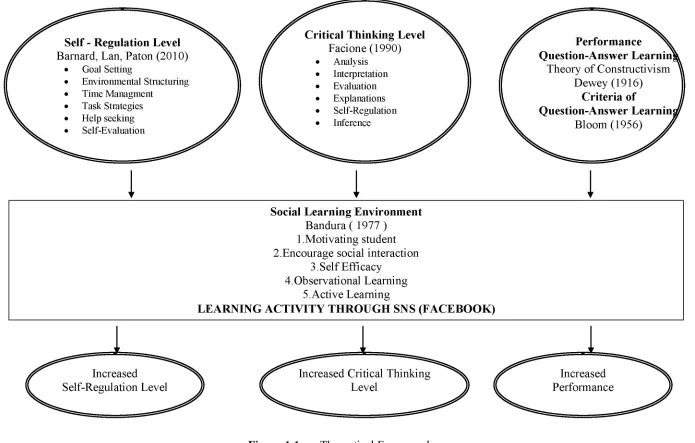
1.7 Theoretical Framework
Self - Regulation Level Barnard, Lan, Paton (2010)
Goal Setting
Environmental Structuring Time Managment
Task Strategies Help seeking Self-Evaluation
Critical Thinking Level Facione (1990)
Analysis Interpretation Evaluation Explanations Self-Regulation Inference
Performance Question-Answer Learning
Theory o f Constructivism Dewey (1916)
Criteria of
Question-Answer Learnin§ Bloom (1956)
I
I
I
Social Learning Environment Bandura ( 1977 )
1 .Motivating student 2.Encourage social interaction
3. Self Efficacy 4.Observational Learning
5.Active Learning
LEARNING ACTIVITY THROUGH SNS (FACEBOOK)
1
Increased Self-Regulation Level
1.7.1 Self-Regulation Level
Self-regulation level is a theoretical measurement. It can be measured through the learners’ characteristics that can be addressed both by observing the behaviors and analysis outcomes o f these actions. These behaviors include but not limited to environment structuring, goal setting, time management, help seeking, task strategies and self-evaluation. The emphasis on the ability to self-regulate as the ability to exercise control over one’s behaviour suggest evidence toward the role of an individual’s cognition in their observed behaviours (Bandura, 1977). Skills and strategies play an important role for student to perform in their learning. Student success in this self-regulated activity dependent on the level o f their achievement. The development o f self-regulatory skills would appear from the online learning factors, where learners would receive feedback from their behaviours in these online environments (Barnard et al., 2008). These online environments would include lack o f checking online for missed assignment deadlines, quizzes and other activities related to the course taken. Barnard, Lan and Paton (2008) points that there is a positive relationship between student perceptions o f online course communication and collaboration and academic achievement through online self-regulatory learning behavior.
In environment structuring level students can select or arrange their physical setting according to their own time and convenience. This will isolate or eliminate distractions that can occur when studying through online. Distractions will enable student to spend good quality learning and will not achieve the result expected. Studying can be break up into certain time allocated which provides the most convenient time for efficient learning. In addition, a good location and comfortable place also play a big role in determining how to spend time studying.
21
Study conducted by (Morisano et al., 2010) found that goal setting was able to successfully improved academic achievement among undergraduate students.
Time management is another aspect o f students to identify the self-regulation level that involves their time. Management o f time involves planning, scheduling and identifying when is the appropriate time to study. Studies found that managing time wisely helped students self- regulate their use o f studying effectively and improved their academic results.
Help seeking level is the process o f finding and receiving support from others. This level is important whereby students will experience tough times and cannot solve the problem themselves. Research identified that seeking assistance from others does really help in self-regulating learners and aid them in improving academic performance.
In task strategies level is important for students to improve their planning, organizational and metacognitive abilities. Strategies must be planned in order to achieve the desired result such as spend time to go thoroughly on the notes and reading aloud instructional material in order to fight against distractions. Other strategies include preparing questions before joining chat room, discussion and do extra tutorials, problem other than the one assigned on the subject.
1.7.2 Critical Thinking Skills
Developing critical thinking skills is important to measure the academic performance. It indicates that the researcher tested the model develop by Facione for infusing critical thinking into various domains by using it through social learning environment by implementing social networking sites on E-Commerce subject. The researcher will construct questionnaire based on Facione’s model (Facione, 1990), which is based on six activities that include analysis, inference, explanations, interpretation, self-regulation and evaluation. These six activities will focus on evaluating core critical thinking skills o f analysis-interpretations, inference-deductive reasoning and inductive reasoning, and evaluation-explanation. Five research questions were stated, indicating intentions to test the effectiveness o f the model empirically using the instrument constructed to assess students’ response.
Analysis is to identify the intended and actual inferential relationships among statements, questions, concepts, descriptions, or other forms o f representation intended to express belief, judgment, experiences, reasons, informations or opinions. (Facione, 2010). This includes examining ideas, detecting arguments, and analysing arguments as sub-skills o f analysis.
The CCTST uses inference to identify and secure elements needed to draw reasonable conclusions, form conjectures and hypotheses, consider relevant information and to deduce the consequences flowing from data, statements, principles, evidence, judgments, beliefs, opinions, concepts, descriptions, questions, or other forms o f representation (Facione, 2010). This also includes querying evidence, conjecturing alternatives, and drawing conclusions. Deductive reasoning skill is a basic form o f valid reasoning. It begins with a general hypothesis or known fact and creates a specific conclusion from that generalization. Inductive reasoning skills involves creating broad generalizations from specific observations.
23
situation judgment, belief, or opinion, and to assess the logical strength o f the actual or intended inferential relationships among statements, descriptions, questions or other forms o f representation (Facione, 1990). This also includes determining the credibility o f a source o f information, judging statements and evidence to support conclusion being drawn.
1.7.3 Social Learning Environment
It has been known that one o f the foundations o f constructivism is Vygotsky’s theory. Vygotsky’s theory promotes learning where students play an active role in learning. This theory is related to Bandura’s theory whereby behavior o f a person is learned from the environment through the process o f observational learning (Bandura, 1977). Bandura’s theory is based on Vygotsky, where Bandura focuses more on social learning environment. In online environment context, self- regulatory behavior is important in the learning perspective. In this research focus will be towards using social networking site-Facebook as a tool to see the improvement in academic performance using E-Commerce subject.
On the social learning environment, motivating student play a big role in enhancing academic achievement. Through reinforcement it acts as a motivational device and the intervening o f influences o f goal setting and self-evaluative reactions (Bandura, 1977). Bandura defines motivation as an inner stimulus that leads to mimic the learned behavior. M otivating student can be divided into intrinsic and extrinsic motivation. Students who do not yet have powerful intrinsic motivation to learn can be helped by extrinsic motivators in the shape o f rewards.
the process o f receiving this input new behaviors continue to be learned, accepted, or rejected and then modeled and adopted. Sharing information, engaging in conversation, creating bonds, establishing rules, becoming part o f a social system and a group allows for this method o f communication to set the conditions for learning (Bandura, 1997).
Self-efficacy is concerned with judgments o f personal capability in a particular situation. According to Bandura (1977), there are four major sources of self-efficacy: mastery experiences, social modeling, social persuasion and psychological responses. Through these major sources, those who have a sense of efficacy tend to learn better in formal school environments as well as in informal environments outside the school. Studies have shown that self-efficacy have significant impact on student performance whereby when confidence levels high, the performance level also high (Detrue, 2004).
In observational learning refers to learning that occurs from the observation o f others. Bandura claimed that learning is heavily reliant on observation. This learning is also known as social learning theory whereby it occurs when an observer’s behavior changes after viewing the behavior o f a model. An observer’s behavior can be affected by the positive changes or negative consequences (Bandura,
1977).
25
As an educator we need to seek ways to do online activities instruction to take advantage o f increasing the knowledge o f students. We need to guide the students in ways they can take control o f getting knowledge using all sorts o f technological means. In constructivism theory it emphasizes on learning is an active social process in which individuals make meanings through interactions with each other and with the environment they live in. Knowledge is thus a product o f humans and is socially and culturally constructed. Constructivist learning environments are intended to provide multiple paths for students to learn meaningfully with teachers performing the role o f guides, mentors or facilitators (Keengwe et al., 2009)
With these elements taken into consideration, we can evaluate whether students’ learning has improved in their performance. Social networking sites playing an increasingly important role in today's society, educators are exploring how they can be used as a teaching and learning tool. Online social networking has deeply penetrated university campuses, influencing multiple aspects o f student life. Stimulating students to engage in learning is the nature and structure o f constructivist learning. In order for the learners to construct their understandings on a topic, using authentic tasks in real-life situations increases the possibility they will invest the effort and time (Vrasidas, 2000).
It is critical how we perceive the world, reacting to events, challenges, problems, questions and even life itself. To ensure the success o f our students, as educators we need to develop the thinking o f our students within the various subject areas or professional skills that we teach. Their thought patterns will influence students in how they respond to challenges, create new ideas, new knowledge and that, in turn, will be helpful to them as ongoing students and as long term employees (Reynard, 2010). Student performance will be improved when students have self regulation and critical thinking skill. Thus, self-regulated learning and critical thinking skill strategies will allow student to succeed in this social learning environment.
embedded in the social networking sites to seek the improvement in the students performance when interaction or learning occur. Social learning environment and social networking sites is interrelated due to the surrounding environment that deals with interaction with one and another.
1.8 Research Framework
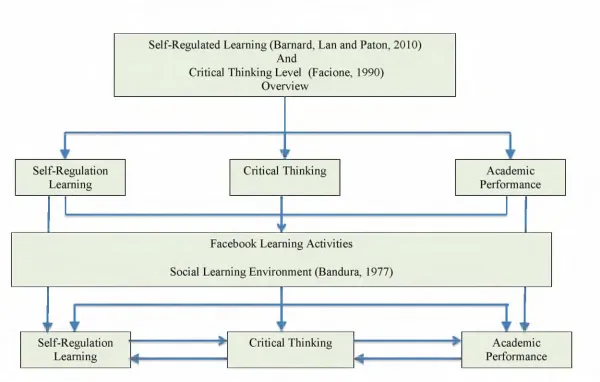
A research framework (Figure 1.2) illustrates how the researcher conducted this study in order to produce a framework o f learning activities through SNS. Prior to identifying the students’ self-regulated learning, critical thinking level and academic performance. The researcher distributed Self-regulated Learning Questionnaire as the one developed by Barnard, Lan and Paton (2010). The self regulated learning question comprises questions that aim to identify the level o f self regulation in six elements : environment structuring, goal setting, time management, help seeking, task strategies and self-evaluation.
Next, the critical thinking skill questionnaire adapted from Facione (1990) was distributed to identify the level o f critical thinking which comprised o f six elements: analysis, inference, explanation, interpretation, self-regulation and evaluation.
Finally, the academic performance test to identify the improvement in the E- Commerce subject after going through the learning activities through SNS. This academic performance test use Taxonomy Bloom level which consists o f 6 levels : knowledge, understanding, application, analysis, synthesis and evaluation.
1.9 Rationales of the Study
The usage o f social networking sites as a mode o f communicating virtually is very popular in this 21st century. Much has been written recently about the impact of social networking tools in teaching and learning and how educators can build on the skills o f their students in using these tools. Wang et al. (2011) study in English vocabulary indicated that students tended to provide and share more ideas on social networking sites compared to traditional taught classroom. Research conducted by (Melor and Hadi, 2012) found that using Facebook group does help them in their writing, learning new vocabulary from reading the comments o f others in the group, spell check feature helps reduce spelling error and ideas or opinions by peers help them in getting better idea for writing and easier to complete their essay when participating in the Facebook group discussion. Other subjects using Facebook also have similar findings whereby the researcher focus study on computer programming discovered to be useful in delivering content, assisting learners with learning difficulties after normal learning time and results proved to be positive (Dzvapatsva et a/.,2011). Studies conducted by (Junco, 2011) shows that from the finding o f the research conducted using Facebook have engagement and academic benefits and could be developed for further educational practices. This engagement can be helpful for obtaining academic outcomes to seek improvement in learning.
29
technological advancement, students are likely to learn as much from social networking sites as they are from their assigned tasks and textbooks in the class.
Recent studies by Diaz (2009) discovered that traditional educational practices no longer provide a successful integration o f ICT into the classroom. This requires encouraging cooperative interaction, and collaborative learning where new teacher roles and professional development based on social learning environment. California Test o f Critical Thinking Skills (CCTST) was considered to be used since it involves quantitative measure using objective test. However, the questionnaire is not suitable for E-Commerce subject due to the content o f the test not relevant. Adaptation o f the California Test o f Critical Thinking Skills (CCTST) will be used to make it suitable according to the subject.
This study can help to support social networking sites as a tool that can enhance student self-regulation and critical thinking when learning the E-Commerce subject. In addition, the study can help to support the relationship among students’ self-regulation, critical thinking skills and performance when using social networking sites.
1.10 Importance of the Study
1.10.1 Students
Students nowadays are exposed to many different types o f tools for getting information, communication and sharing information in their learning process. Creative and innovative thinking outcome had been included in their subject syllabus. In such a way students are encouraged to do predictions and have skills in getting information and using technology so that they can use the data from accessing Internet to help them get ideas and gain new knowledge. The use o f social networking sites would help these students to improve their performance in the study process and enable them to communicate with the academicians without barrier. This research conducted would help in getting information with the other user and the sharing and interactivity would gain them good knowledge beyond the boundaries o f knowledge only inside the classroom setting. This research is important also to teach and encourage students to cultivate self-regulated and be more independent in acquiring new knowledge or information. Whereby the importance o f critical thinking would also assist the students in making decision and improve their own futures for their benefit individually and society as a whole. Students are our future leaders if we want our nation to be highly developed and progressed at par with other countries we must develop the learning o f self-regulation and critical thinking from young.
1.10.2 Educators
31
their teaching so that at par with the latest trend in current technology. We have move to the 21st century whereby the use o f technologies has transformed the approach of learning. The way the educators have open mind and always encourage student to explain ideas and think critically and appreciate the students’ views on a particular aspect. This research is important in finding new ways and many approaches in ensuring teaching and learning is implemented efficiently. Now that information is ubiquitous, educators need to facilitate learning that can improve the performance o f students by the skills o f self-regulation and critical thinking.
1.10.3 Higher Education Institution - University
Higher Education Institution is a place whereby education takes place. It plays a big role in moulding and bringing up a person to be knowledgeable. M anagement in higher education institution plays a big role in ensuring students and educators are well exposed to the current trend in technology and the changes surrounding them. The content o f instruction must be parallel with the information obtained and implement it in the teaching and learning approach. This research would help the public or private higher education institution in providing changes towards teaching and learning approach to cope with the changes in education now. Innovation and creativity in education is needed to face the world without borders. The findings will provide important information to the IPTAs whereby self-regulated learning and critical thinking are important and social networking sites can be used in E- Commerce learning.
1.10.4 Ministry of Education (MOE)
networking sites as a tool in teaching and learning would give a big impact in the way how they exchange information and ideas with other users and at the same time improve the standard level o f education in our country in terms o f self-regulation learning and critical thinking skill.
1.10.5 Societies
This research is important to the society whereby it gives exposure towards the usage o f using social networking tools that has been widely used in our society in our country. This social networking tool will encourage society to exchange views and share information with their friends not only for socializing but also for educational purposes.
1.11 Scope of the Research
This research conducted involves students in local Higher Institute o f Studies in Kota-Kinabalu, Sabah. This research will see the changes in the improvement of performance o f students in their studies by looking into student’s self-regulation and critical thinking in learning E-Commerce through social networking site. This research will only see the self-regulation and critical thinking factors to identify whether there is improvement in their performance if conducted through social networking sites. The limitations of the study are that this research will not consider gender, age, personal preferences and abilities.
1.12 Operational Definitions
33
1.12.1 Social Networking Site (Facebook)
Social networking site has been widely used by societies nowadays to communicate and do work online. There are many types o f social networking sites that are getting popular in our society. The social networking site that is going to be used in this research is Facebook. Selwyn (2007) study shows that Facebook has quickly become the social network site o f choice by college students and an integral part o f the college experience for interaction online.
1.12.2 College Students
College students include students that are studying in local private higher institution. In this research, it refers to students with the range age o f 18 to 25 and have started studying at least one semester. These students are “ Sijil Pelajaran Malaysia (SPM)” school leavers and taking Diploma level course in management field.
1.12.3 Self-Regulated Learning