DEVELOPMENT OF MATTER CONCEPT ON
SUBMICROSCOPIC LEVEL ACROSS AGES
Nurdiana Abdullah, Johari Surif and Syuhaida Ismail
ABSTRACT
This study is conducted to understand the development of the matter concept on the submicroscopic level among students of various age groups (16-17 and 24-25 years). A qualitative study with descriptive design was implemented across the ages. A total of ten open-ended questions from Ujian Kefahaman Konsep Jirim Pada Aras Submikroskopik (SUKKJPAS) were used to collect the data. 604 secondary students and training institute teachers were chosen using random sampling for this study. The data then were analysed using descriptive study and content analysis. The finding shows that the development of the matter concept on the submicroscopic level among the students is moderate from the scientific explanation aspect and poor from the scientific drawing aspect. Majority of the students has a basic knowledge about scientific explanation and scientific drawing, in fact, the matter concept also has becomes better across the ages from scientific explanation. Hence, this study recommends the teachers to emphasize on generating a drawing during in giving explanation about chemical phenomenon or situation so that the students will have a better understanding and at the same time familiarize the students with the scientific drawing. Students on the other hands should be encouraged to adapt this concept in giving explanation about chemical phenomenon or situation.
INTRODUCTION
Matter is included in the secondary science curriculum in most countries (Martin, Mullis, Gonzales and Chrostowski, 2004) and is identified as one of the fundamental concepts that should be understood by students (Singer and Wu, 2003). However, empirical studies in science education indicate poor understanding of the concept among secondary students (Johnson and Papageorgiou, 2010) and tertiary students (Case and Fraser, 1999). The difficulties of the students in understanding this concept is related to the student’s capability in mastering the submicroscopic level. Submicroscopic level means the phenomenon or situation that understood in the form of particles matter namely atoms, molecules and ions (Williamson and Abraham, 1995). For example, at the submicroscopic level, a corroding nail becomes a chemical process in which the iron atoms of the nail react with the oxygen molecules in the air and produced the iron oxide eventually. Even though the submicroscopic level is very important in mastering the matter concept, the previous studies indicates that most of the students fail to master this level properly (Ben-Zvi, Eylon and Silberstein, 1986; Griffiths and Preston, 1992; Snir, Raz and Smith, 2003).
AIM
This study must be undertaken due to the most of the previous studies regarding the development of matter concept are only focusing on the particular age of students, for instance, secondary students (Johnson and Papageorgiou, 2010). Besides that, research related to this concept which also focuses on student drawing on the submicroscopic level is very limited in Malaysia. Hence, the researcher is using the different approach by executing a research on the students with a various groups of ages which is 16-17 to 24-25 years. This study is carried out to understand the development of the matter concept on the submicroscopic level among the students with a various groups of ages from the explanation and drawing aspects.
METHODOLOGY
reading, rereading and coding in order to identify the participants’ categories of conceptual understandings of the matter as well as the quantitative analysis such as numeric values for frequency and percentage.
RESULTS AND DISCUSSION The findings of the study are presented as below.
What is the level of understanding on the development of the matter concept on the submicroscopic level among the students of various groups of ages?
The development of the matter concept on the submicroscopic level is moderate from the explanation aspect
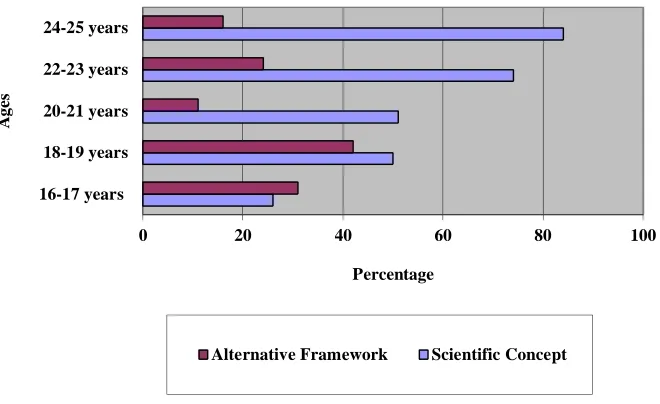
The finding shows that the explanation given by the students in illustrating the concept of matter can be categorized into two – scientific explanation and explanation with alternative framework (Figure 1). Most of the students’ performance for the scientific explanation is moderate with the percentage is more than fifty percent.
The following is an example of the scientific explanation given by the students for the gas condensation phenomenon:
Lack of heat means lack of energy. Hence, the particles do not move as much as in the gaseous state, so their arrangement close to one another
(20-21 years student)
The following is an example of the explanation with alternative framework given by the students for the gas condensation phenomenon:
The gas particles will be reduced and combined when the cooling gas turns to a liquid
Figure 1 The percentage of scientific concept and alternative framework of various ages of students in the matter conception from the explanation aspect
According to Figure 1, most of the students’ performance (18-19 to 24-25 years) is moderate for the scientific explanation with the percentage more than fifty percent. The 16-17 years students mostly give the explanation with the alternative framework (74 percent). That percentage actually is still far behind compared to the older students. This is due to the 16-17 years students represent the secondary school that still have a poor understanding in the submicroscopic level compared to the higher education level students (18-19 to 24-25 years). This weakness is not surprising as being claimed by Chang (1999) and Gopal, Kleinsmidt and Case (2004) who reveals that the tertiary students also have a superficial understanding regarding this concept.
The development of the matter concept on the submicroscopic level is poor from the drawing aspect
The development of the matter concept by students on the submicroscopic level also demonstrated that the students’ drawing consists the scientific drawing and drawing with alternative framework (Figure 4).
0 20 40 60 80 100 16-17 years
18-19 years 20-21 years 22-23 years 24-25 years
Percentage
A
ges
Figure 2 Scientific drawing by students for the gas condensation phenomenon
Example of the drawing with the alternative framework is as follows:
Figure 3 Drawing with the alternative framework by students for the gas condensation phenomenon
Figure 4 The percentage of scientific concept and alternative framework of various ages of students in the matter conception from the drawing aspect
0 20 40 60 80 100 120
16-17 years 18-19 years 20-21 years 22-23 years 24-25 years
Percentage
A
g
es
Figure 4 indicates that students with various groups of ages have a poor performance for the scientific drawing with the percentage less than ten percent. The finding shows that the students failed to generate a scientific drawing on the submicroscopic level. Although the percentage of the scientific explanation is high, it does not guarantee the capability to produce the scientific drawing on the submicroscopic level. The fact is, the students are capable to explain the condensation phenomenon properly but failed to generate the scientific drawing for the phenomenon. This situation is in line with the findings of the study conducted by Calik and Ayas (2005) who claims that the chemistry between the teacher and the student is also a part of the alternative drawing concept on the submicroscopic level. This is because the students are less encouragement and exposure in generating the scientific drawing during the explanation of the chemical phenomenon to help them in having a better understanding. It can’t be argued that the textual explanation that comes with the drawings and figures do help the student to understand thus explaining the chemical phenomenon better (Nyachwaya and Wood, 2014). Other than that, the drawing generated by the students in the tests plays a big role in particularizing the students thought (Mulford and Robinson, 2002; Nyachwaya et al., 2011; Onwu and Randal, 2006).
The student’s scientific matter conception on the submicroscopic level develop consistently with the age
The finding also indicates that the percentage of the scientific explanation is enhancing in line with the increasing of the student’s age which is 50 to 84 percent for the 18-19 to 24-25 years except the 16-18 years which only recorded 26 percent. Thus, most of the students with the age from 18-19 to 24-25 years managed to solve the matter phenomenon problems scientifically which exceeds to fifty percent while the 16-17 years students are less than thirty percent. This finding proves that the younger students are underprivileged to solve the problems compared to the older students. The massive difference shows that the age and maturity level plays a significant role in the chemical learning process. Nevertheless, from the drawing aspect, the finding shows that the increasing age does not influencing the student’s capability to generate the scientific drawing. More than seventy percent of the students (majority) are only able to sketch a drawing with alternative framework. It shows that there is no certain pattern in constructing the student’s concept on the submicroscopic level from the drawing aspect as they grow older. This is in line with Treagust et al. (2011) which includes the secondary, undergraduate and postgraduate students.
CONCLUSION
shows that the age and maturity level do influence the chemical learning process. From the drawing aspect, most of the students are only able to generate the drawing with the alternative framework. This difference occurs due to less exposure about this aspect during the explanation. Besides, chemical text book also seems to have less drawing on the submicroscopic level as being claimed by Nyachwaya and Wood (2014) that only fifteen percent of the drawing in the chemical text book is on the submicroscopic level. On the contrary, 85 percent from the drawings are the symbol level. As a result, the students failed to generate the scientific drawing on the submicroscopic level even the drawing could reflect their thoughts, feelings and minds (Thomas and Silk, 1990). Their weakness in mastering the scientific drawing implies that the teachers should emphasize on producing a drawing during the chemical explanation so that it can be easily understood by the students and at the same time could adapt the technique. Some changes by the teacher and students are crucial in order to capture the issues and challenges in mastering the matter concept on the submicroscopic level particularly and the other science concepts generally thus enhance the educational sustainability.
REFERENCES
Ben-Zvi, R., Eylon, B. and Silberstein, J. 1986. Is An Atom of Copper Malleable?. Journal of Chemical Education, 63: 64-66.
Boz, Y. 2006. Turkish Pupils’ Conceptions of the Particulate Nature of Matter. Journal of Science Education and Technology, 15: 203-213.
Calik, M. and Ayas, A. 2005. A Comparison of Level of Understanding of Eighth-Grade Students and Science Student Teachers Related to Selected Chemistry Concepts.
Journal of Research in Science Teaching, 42(6): 638-667.
Case, J. M. and Fraser, D. M. 1999. An Investigation into Chemical Engineering Students’ Understanding of the Mole and the Use of Concrete Activities to Promote Conceptual Change. International Journal of Science Education, 21(12): 1237-1249.
Chang, J. 1990. Teacher College Students’ Conceptions about Evaporation, Condensation and Boiling. Science Education, 83(5): 511-526.
Gopal, H., Kleinsmidt, J. and Case, J. 2004. An Investigation of Tertiary Students’ Understanding of Evaporation, Condensation and Vapor Pressure. International Journal of Science Education, 26(13): 1597-1620.
Johnson, P. and Papageorgiou, G. 2010. Rethinking the Introduction of Particle Theory: A Substance-Based Framework. Journal of Research in Science Teaching, 47(2): 130-150.
Martin, O., Mullis, I., Gonzales, E., and Chrostowski, S. 2004. Timss 2003 International Science Report. International Association for the Evaluation of Educational Achievement (IEA). Boston College, MA: TIMSS and PIRLS International Study Centre.
Mulford, D. R. and Robinson, W. R. 2002. An Inventory for Alternate Conceptions among First-Semester general Chemistry Students. Journal of Chemical Education, 79(6): 739.
Nyachwaya, J. M., Abdi-Rizak Mohamed, A.-R., Roehrig, G. H., Wood, N. B., Kern, A. L. and Schneider, J. L. 2011. The Development of An Open-Ended Drawing Tool: An Alternative Diagnostic Tool for Assessing Students' Understanding of the Particulate Nature of Matter. Chemistry Education Research and Practice, 12: 121-132.
Nyachwaya, J. M. and Wood, N. B. 2014. Evaluation of Chemical Representations in Physical Chemistry Textbooks. Chemistry Education Research and Practice., 4(15): 720-728.
Onwu, G and Randall, E. 2006. Some Aspects of Students’ Understanding of A Representational Model of the Particulate Nature of Chemistry in Three different Countries. Chemistry Education: Research and Practice, 7(4): 226-239.
Singer, J. E and Wu, H. K. 2003. Students’ Understanding of the Particulate Nature of Matter. School Science and Mathematics, 103(1): 28-41.
Snir, J., Raz, G. and Smith, C. L. 2003. Linking Phenomena with Competing Underlying Models: A Software Tool for Introducing Students to the Particulate Model of Matter. Science Education, 87: 794-830.
Thomas, G. V. and Silk, A. M. J. 1990. An Introduction to the Psychology of Children’s Drawings. Hemel Hempstead: Harvester Wheat Sheaf.
Treagust, D. F., Chandrasegaran, A. L., Ahmad, N. M. Z., Eng, T. H., Karpudewan, M. and Lilia, H. 2011. Evaluation of An Intervention Instructional Program to Facilitate Understanding of Basic Particle Concepts among Students Enrolled in Several Levels of Study. Chemistry Education Research and Practice, 12: 251-261.