77:9 (2015) 47–60 | www.jurnalteknologi.utm.my | eISSN 2180–3722 |
Jurnal
Teknologi
Full Paper
T
OWARDS
E
FFECTIVENESS OF
I
NTEGRATION AND
I
NTEROPERABILITY OF
O
NE
-
STOP
E-
GOVERNMENT
P
ORTAL
Khairul Anwar Sedek
a,b, Mohd Adib Omar
b, Shahida
Sulaiman
ca
Faculty of Computer and Mathematical Sciences,
Universiti Teknologi MARA, 02600 Arau, Perlis, Malaysia
b
School of Computer Sciences, Universiti Sains Malaysia,
11800 USM Pulau Pinang, Malaysia
c
Faculty of Computing, Universiti Teknologi Malaysia, 81310
UTM Johor Bahru, Johor, Malaysia
Article history Received 2 February 2015 Received in revised form 8 October 2015
Accepted 12 October 2015
*Corresponding author
[email protected]
Graphical abstract
Abstract
An effective one-stop e-government portal requires a system with good integration and interoperability. However, most e-government portals lack in integration and interoperability. This work aims to find an effective approach for e-government integration and interoperability for onstop government portal. This paper presents a hybrid e-government architecture based on architectural principles, enterprise operational interoperability architecture and service component architecture (SCA). The experiment shows the proposed architecture is able to satisfy interoperation in terms of potentiality, compatibility, and performance tests for integration and interoperability e-government applications and services. The architecture is suitable for the development of onstop e-government portal.
Keywords: Software architecture, one-stop e-government portal, integration, interoperability, service component architecture (SCA)
Abstrak
Satu portal e-kerajaan sehenti yang berkesan memerlukan satu sistem dengan integrasi dan saling boleh kendali yang berkesan. Walau bagaimanapun, kebanyakan portal e-kerajaan kekurangan dalam integrasi dan saling boleh kendali. Kerja ini bertujuan untuk memperolehi seni bina integrasi dan saling boleh kendali e-kerajaan yang berkesan untuk portal kerajaan sehenti. Kertas ini membentangkan senibina hibrid e-kerajaan berdasarkan kepada prinsip-prinsip seni bina dari seni bina antara operasi perusahaan dan kerangka komponen perkhidmatan (SCA). Eksperimen dalam kajian menunjukkan seni bina yang dicadangkan dapat memenuhi potensi saling kerja dalam aspek, kebolehan, keserasian, dan ujian prestasi. Seni bina ini sesuai untuk pembangunan portal e-kerajaan sehenti.
Kata kunci: Senibina perisian, portal e-kerajaan sehenti, integrasi, kebolehan saling-kendali, senibina komponen perkhidmatan (SCA)
1.0 INTRODUCTION
One-stop e-government concept refers to
accessibility of public services in a single platform [1]. An e-government should be capable in providing a one-stop point-of-service as an access channel that conveys a simple and effective image of the concerned government. Users need an effective one-stop e-government portal which provides central access to all government services in a single window [2].
In order to provide a one-stop e-government, some challenges and issues need special attention due to increasing of service complexity. The issues and challenges of a one-stop e-government include:
1. Addressing integration and interoperability issues
[3]–[5].
2. Reducing redundancy of services [6].
3. Building trust among departments and agencies
as service providers [7].
4. Choosing enterprise architecture that can be
adopted by e-government projects [8]
Indeed integration and interoperability are the main obstacles to provide an effective onstop e-government portal. Two challenges in integration and interoperability are implementation to connect heterogeneous government systems and large number of complex systems, which are developed
from proprietary development platform,
unavailability of standards, and heterogeneous hardware and software [9].
This work proposes enterprise architecture (EA) for
integration and interoperability among
e-government system components, applications, and services. According to Bellman and Rausch [10], “Enterprise architectures are ‘blueprints’ for systematically defining an organization’s current (baseline) and/or desired (target) environment.” EA provides guidelines in integrating the strategic and business process with information, technology, and data system at all levels in an enterprise [11]. Its primary strength can define concepts and instruments to predict and control complex technical systems. Furthermore, due to the nature of e-government where technical and organizational processes involve different organization at different interdependent level and different function, EA program is important for e-government integration and interoperability.
E-government integration defines how
e-government involves in interaction with other government agencies, businesses, and citizens. Four e-government formations are government to citizen
(G2C), government to government (G2G),
government to business (G2B), and government to employee (G2E) [12].
Vernadat [13] defines enterprise interoperability as “the ability of an enterprise to use information or services provided by one or more other enterprises.” Specifically, e-government interoperability involves technical capability of a heterogeneous government system to smoothly and effectively work together in a
predefined and agreed-upon fashion [14]. Therefore, integration and interoperability approach should support collaboration of different e-government systems for an effective public service provision.
This paper proposes an enterprise architectural approach for integration and interoperability of e-government applications and services using a hybrid and distributed e-government. The aim is to design
an effective one-stop e-government portal. The
architecture is designed based on architectural principles from enterprise operational interoperability architecture and service component architecture (SCA).
The research starts with problem identification using systematic literature review [15]. This phase examines current and related work in e-government
architecture, architectural principles and
e-government requirements. The second phase defines research design and hypothesis. The third phase develops proposed solution based upon the result in the previous phases. This phase defines enterprise architectural for e-government. The fourth phase conducts research validation using prototype development as a case study. The proposed architecture is evaluated in prototype development of e-government consists of one-stop e-government
portal, e-government applications, and
e-government services. This work assesses the prototype using integration and interoperability assessment [16]. The final phase is analysing and discussing the research result.
The experiment shows that the proposed architecture satisfies integration and interoperability test on interoperation in terms of potentiality,
compatibility, and performance tests. The
architecture is suitable for the development of one-stop e-government portal. The aim of this paper is to present a hybrid and distributed architecture for government that consists of a onstop e-government portal, e-e-government application providers, and e-government service providers.
The remainder of this paper is organized as follows. Section 2.0 reports the related work. Section 3.0 describes the proposed methodology. Section 4.0 presents the prototype implementation and the prototype evaluation. Section 5.0 presents the discussion of the results derived from the evaluation. Finally, Section 6.0 presents the conclusion.
2.0 RELATED WORK
portal [18]. Assessment of e-government service interoperability consists of interoperability potentiality, compatibility, and performance [19].
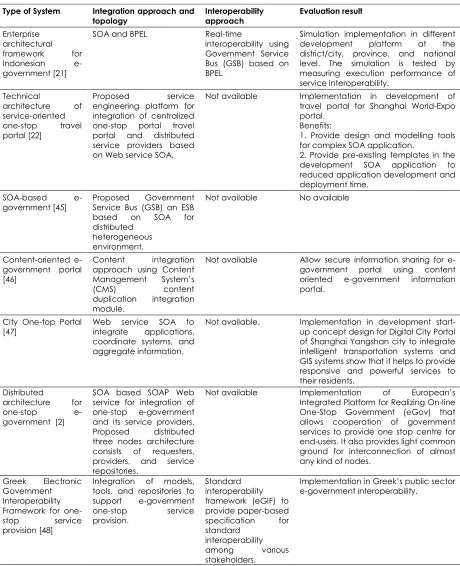
There are many approaches to improve e-government integration and interoperability. The integration and interoperability approach can be classified into architectural standards, styles, topologies, and infrastructures. Table 1 in Appendix A summarizes some related works.
The majority of current e-government integration
and interoperability use Service Oriented
Architecture (SOA) based on Web service technology such as [20]–[22]. SOA is an architectural style for building distributed service-oriented application system that is interoperable across any system platforms [23]. SCA is development and deployment model for SOA [24]. It provides a complete model for the construction, assembly and deployment of composite service application.
Basically, integration approach involves a method for connecting systems in a distributed environment to allow data information to be exchanged with each other. Some examples of integration technologies are Simple Object Access Protocol (SOAP), Java Remote Method Invocation (Java RMI), Common Object Request Broker Architecture (CORBA), and Representational State Transfer (REST). Currently, the most common integration technologies are web service based on SOAP and REST. REST implementation is better than SOAP in terms of performance and simplicity. Besides that, SOAP Web service is better in terms of standardization and support from software providers [25].
Interoperability approach ensures services from different providers can work together to perform a certain business process. Interoperability model defines three interoperability levels: technical, semantic, and organizational interoperability [26]. Criteria and approach for each level of interoperability are different. Table 2 presents the interoperability criteria and approach.
E-government needs both approaches (integration and interoperability) because they serve different purposes. Integration focuses on effective data
exchange but interoperability focusses on
interoperation of services to create a value-added service. Successful integration does not guarantee interoperability, but interoperability requires correct integration approach [27]. However, very few researchers give attention on both integration and interoperability. Limited works have considered interoperability in their architecture. Research in e-government needs to cope with integration and interoperability obstacles by focusing on at least the following three general directions [14]:
1. Foci and purposes of integration and
interoperability.
2. Specific limitations and constraints on
e-government nature, characteristics, and
interaction methods.
3. Processes and outcomes that make
e-government integration and interoperability operations successful or unsuccessful.
Table 2 Criteria and approach of interoperability [26]
Interoperability
level Criteria Approach
Technical Systems get physically
connected to allow data and messages can be exchange reliably and securely.
Process coordination using BPMN, and BPEL
Semantic The ability to achieve meaningful exchange and sharing of information
Metadata registries and Ontology
Organizational The ability of organizations to provide services to each other.
Define coordination and
collaboration mechanism for
inter-organizational processes.
E-government architectures are classified into
centralized, decentralized (distributed), full
decentralized, and hybrid [28]. In centralized approach all e-government application is hosts in a single node. This approach is easy to maintain and have no integration issue with other system. However, due to collaboration needs among government agencies this approach will increase burden of centralized e-government to host all e-government application and services. In distributed architecture, system resources are distributed amongst the participating nodes, and no centralized unit is mandatory [2]. This approach has no control by a centralized body to encourage collaboration. All government agencies has burden to develop their own e-government application which need very high development effort, expertise and cost. Therefore, a hybrid approach which combines both centralized and distributed approach is needed. In hybrid approach, components in e-government integration and interoperability can be in centralized or
distributed. This approach can segregate
development effort, expertise and cost accordingly based on the structure, role and size of organization.
based on national administration structure that consists of national, province, and district/city administration level whereas other works propose e-government portal integration with e-e-government service providers using SOA, Web service, or ESB. Each service provider can directly become service provider to the e-government portal. The initial Indonesian e-government infrastructure is based on complex full distributed grid service topology [30] and government service bus (GSB) [21]. As comparison, this proposed architecture is not fully distributed. It has centralized one-stop portal and centralized e-government application at ministry level. E-government services are totally distributed to all e-government service providers at government department level.
3.0 INTEGRATION AND INTEROPERABILITY
ARCHITECTURE FOR E-GOVERNMENT
This research is based on software engineering science research method [31]. It has seven phases:
1. Problem identification: define problem based on
Malaysia e-government and provide the value of integration and interoperability for one-stop e-government portal.
2. Hypothesis creation: provide description of new
architectural approach for e-government portal by formulation of one-stop e-government portal requirements and architectural principals.
3. Working method definition: identify research
paradigm and method.
4. Solution formulation: design and develop
integration and interoperability architecture for one-stop e-government portal.
5. Validation and verification of solution:
demonstrate the implementation of architecture in a prototype of Malaysia e-government system which consists of one-stop e-government portal, government application providers and e-government service providers. It becomes
proof-of-concept prototype to validate the
application in design and development of one-stop e-government portal.
6. Result of analysis and conclusion: the prototype
is evaluated using integration and
interoperability assessment.
7. Report writing: write documentation of research
result and discussion.
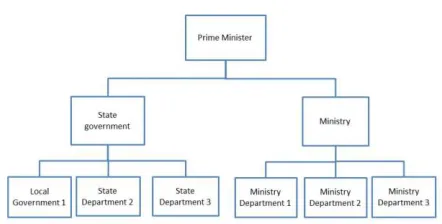
Malaysian public administration has a federal government, three federal territories (Kuala Lumpur, Labuan, and Putrajaya) and 13 state governments. Figure 1 depicts the organizational chart of Malaysia’s public administration. Based on 2013 cabinet line-up, the federal government have 24 ministries. The Public Service Department (PSD) is responsible for human-resource management policy. The Malaysia Administrative Modernisation and Management Planning Unit (MAMPU) is a federal agency under Prime Minister Office Department that is responsible to develop Malaysia E-government
system. The Malaysian e-government site is www.malaysia.gov.my. It is a central portal of Malaysian E-government, which provides links to other e-government services.
Figure 1 Malaysia administration organizational chart
According to MyGov Statistic for May 2013, as at April 2013 there are 49 online services [32]. The number of external online services is 1,264 and downloadable form is 913. From April 2012 to April 2013, the total number of Malaysian e-government portal is stated as 6,584,966 visits, 191,299 hits to internal online service, and 210,545 hits to the external online services. Four e-government user categories are citizen, permanent resident, non-citizen, and business. Most e-government users are citizen and business users. Malaysia also has a private
owned e-government portal called MyEG
(www.myeg.com.my). The portal provides online services for nine public agencies that are Road Transport Department, Royal Police of Malaysia, Tenaga Nasional Berhad, Telekom Malaysia Berhad, Jabatan Insolvensi Malaysia, National Registration Department, Malaysia Immigration Department, and Pusat Pungutan Zakat. Based on the number of hits, it show that the demands for e-government is quite high. However, Malaysian e-governments still have limited number of online services. Most of the services faces integration problem [33].
This paper proposes an architectural solution for a one-stop e-government. The main strategy in the methodology is to improve the integration and interoperability of an government portal with e-government service providers. The fundamentals or elements of system architecture as defined in ISO/IEC 42010 (IEEE Standard 1471-2000) [34] consist of the following items:
1. System elements that constituents make up the
system.
2. The relationships of both internal and external to
the system.
3. The principles of system design and evolution.
The architecture for one-stop e-government is
designed based on the requirement and
3.1 Architectural Principles
Architectural principles are one of the important elements of system architecture. It describes the elements of the system and their function relationship for the integration and interoperability between system elements. The design principles can be derived from practice or reviewing literature [20]. The literature review adopts the systematic literature review (SLR) based on Kitchenham [35]. The architectural principles in this paper are derived from earlier study [36] and architectural requirements.
The architectural requirement is as the following:
1. Effective integration and interoperability of
government service network.
2. Integration of both traditional and online delivery
channel.
3. Support process interoperability in e-government
application and service.
4. Loosely-coupled integration of onstop
e-government portal, e-e-government application providers, e-government services providers and other shared e-government services.
5. Interoperability of e-government applications
and e-government services.
Architectural principle is adapted from
architectural principles by Gong and Janssen [20]. Based on the architectural requirement above, this work proposes architectural principles as the following:
1. Develop an organization of e-government
applications and services according to
government administration structure.
2. Create an e-government application from the
components of e-government services (EGS).
3. Separate government rules (GR) derived from a
policy from operational concerns.
3.2 Architecture Component and Relationship
The e-government architecture is aimed to improve
integration and interoperability among
e-government systems and services using hybrid and distributed architecture. Users access e-government services through a centralized onstop e-government portal. The distributed e-e-government applications and services provide a single access point of e-government applications. It supports interoperability among e-government services to allow effective service sharing and reuse.
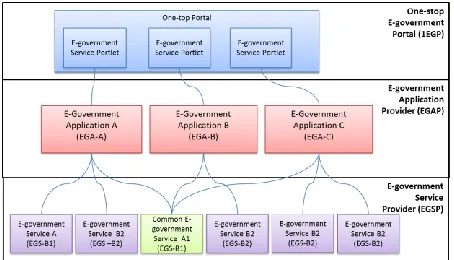
The components relationship of an e-government is described in organizational structure. Figure 2 depicts the conceptual architecture of three main components of e-government architecture in organizational structure.
The structure is organized in accordance to national administration structure, which consists of ministries, states and government agencies under ministries and state governments. The main components are one-stop e-government portal (1EGP), e-government application providers (EGAP),
and e-government service providers (EGSP). The portlet in 1EGP linked (shows as free line between portlet and EGA) to EGA in EGAP. EGA is linked (shows as free line between EGA and EGS) to EGS in EGSP.
This structure provides clear roles and
responsibilities of each e-government component. This approach should reduce service redundancy and improve service reuse and sharing.
Figure 2 Three-layer e-government conceptual architecture
This work derives distributed e-government architecture based on the conceptual architecture as defined above. Figure 3 depicts the overall hybrid e-government architecture using SCA Assembly Model. SCA Assembly Model is specification to describe SCA application design as example in Figure 4 [37]. IEGP is centralized portal which hosts all e-government application (EGA) to be accessed by e-government users. EGAP provides EGA to 1EGP. EGA is distributed application provided across EGAP. A ministry centralized all EGA under its responsibility. For example all education application such as school
application, examination result, and school
information is hosts in Education Ministry. EGAP also
responsible to coordinates integration and
interoperability of EGSP. EGSP is distributed e-government services.
Figure 4 Example of Web shopping application using SCA Assembly Model [37]
EGAP provides EGA to be published in 1EGP. End-users can subscribe EGA according to their need. EGA consists of a portlet as the view layer of EGA and composite application as the application implementation layer. The composite application is responsible to interoperate with e-government service (EGS). EGS is e-government service, which provides supporting service for EGA such as MyIdentity service, examination result service, and student profile service.
3.3 One-stop E-government Portal
1EGP provides a centralized access point for all e-government applications to end-users. The portal is responsible to manage user security and registration, application subscription, and application hosting. The portal needs to integrate with EGAP because EGAP develops and provides the application to be accessed from 1EGP. From the end-user’s view, the application is provided from a single system. The application is a result from the integration and interoperability of 1EGP, EGAP, EGSP in many remote systems. Government employees do not have to maintain many front-end systems because 1EGP provides the end-users interface. Government employees of EGAP can use and maintain the existing system.
3.4 E-government Application Provider
The e-government application layer describes the functionality of EGAP. Figure 5 depicts the EGAP architecture. It shows how EGAP integrates with 1EGP and EGSP. EGAP is responsible to develop and provide e-government application (EGA) for 1EGP. It provides distributed application to 1EGP and also centralized all application under it responsibility under a ministry. For example, Education ministry level provides education EGA. EGA is complete portlet application. It is ready to be plugged-in into the 1EGP. EGAP can have multiple EGA as many as needed. The maximum number of EGA in an EGAP is depending on the capacity of the EGAP server.
The main roles of EGAP are:
1. Develop, maintain, and publish complete
e-government applications for 1EGP.
2. Develop e-government applications from
composition of services.
3. Ensure integration and interoperability between
1EGP and EGSP.
4. Secure the privacy and integrity of applications
and information.
The application implementation has five
implementation phases: submission and registration, information gathering, filtering, decision making, and notification and issuing phase. The phases ensure
effective technical, semantic and process
interoperability in application implementation. It is based on enterprise operational interoperability architecture [20].
Figure 5 E-government application provider architecture for application and service interoperability
The submission and registration phase saves information from end-user input to the application database. Then, the information-gathering phase obtains the required information from EGSP. For example, this phase retrieves citizen profile detail using supplied user id from the end-users as the process input. The information is provided from different parties from different system. The data format might be different and will caused incompatibility of data. This issue can be handled using automatic data transformation. Tuscany SCA databinding framework can be used to automate data transformation from different format [37].
maker). End-users do not have to provide all documentation requirements to submit any service request. The decision maker can make correct decision because the required information for
decision making is accurate and trusted.
Furthermore, many steps in the application processing have been automated and the information accuracy is achieved through easy, fast, and accurate decision-making.
3.5 E-government Service Provider
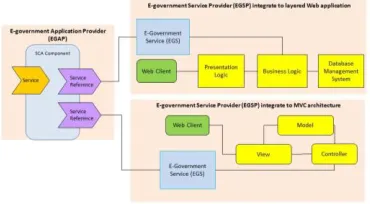
EGSP is responsible to implement and manage e-government services (EGS). EGSP provides EGS for EGAP. EGS is full distributed Web service that integrates with the existing the legacy system in the EGSP.
Figure 6 depicts EGS integration with legacy system. It shows two example scenarios. In the first scenario, EGS provides service from existing business logic of legacy Web application in layered architecture. In the second scenario, EGS provides service from controller component of legacy application in MVC architecture. Government agencies at the departmental level are responsible to manage and develop EGA. One EGSP can have many EGS.
Service component granularity can be designed to fine-grained to course-grained component. Fine-grained component has less number of messages than coarse-grained component. Thus, fine-grained component ensure maximum service reuse [38]. Therefore, EGS is fine-grained service to ease EGAP to create coarse-grained component. This reduces the burden of EGSP in development and maintenance of EGS. Furthermore, this approach is more suitable because normally, the departmental level has less development and maintenance resources than those at the ministerial level. Therefore, the burden of development and maintenance is segregated fairly between EGAP and EGSP.
Figure 6 EGSP integration with legacy system
4.0
EXPERIMENTAL
PROTOTYPE
AND
ASSESSMENT
The main goal of prototyping is to test the
architecture in terms of integration and
interoperability level through the implementation of the architecture in development of the e-government system.
This work follows the following steps:
1. Design the e-government application.
2. Design and develop e-government services.
3. Develop e-government application.
4. Publish e-government application as portlet.
5. Integrate the portlet with 1EGP using remote
portlet.
6. Test the e-government application and services.
4.1 Case Study Prototype
The prototype simulates the implementation of
Malaysian One-stop E-government Portal
(MyOneEG). MyOneEG is the one-stop e-government portal that provides e-government services from various agencies in a single access point. The users should be able to access any e-government service without the need to access another portal or e-government system. Figure 7 depicts the end-to-end government architecture implementation of the e-government school application. It shows the flow of the service requests from user through the application portlet in the portal. The portal sends the request to EGA. Then the EGA processes the request, which goes through five phases of service implementation in the composite application as described in the Section 3.4. The composite application is responsible to process the request, including interoperability with external EGS to obtain external service.
The MyOneEG is implemented using Liferay, an open source portal, web publishing, content, social and collaboration enterprise solutions [39]. The Liferay portal is a portal server and portlet container. The portal provides content as portlets application. The portlet is a complete Java application based on JSR 168 [40] and JSR 286 [41] standards. In this architecture, the portlet can be internal portlet and remote portlet. Internal portlet is portlet hosted in the portal server. Remote portlet is portlet provided by portlet provider and hosted in another portal server. This paper proposes this concept to integrate 1EGP and EGAP. The integration uses Web Service for Remote Portlet (WSRP) standard produces by OASIS. The current Liferay version supports both WSRP 1.0 and WSRP 2.0 specification.
4.2 Integration and Interoperability Assessment
The proposed work uses interoperability assessment based on the earlier work by Elmir and Bounabat [16]. Three characteristics of the assessment are
interoperation potentiality, interoperation
compatibility, and interoperation performance. The
evaluation processes include the following
assessment steps:
1. Delineating the scope of the study.
2. Quantifying the interoperation potentiality.
3. Calculating the compatibility degree.
4. Evaluating the operating performance.
5. Aggregating the degree of interoperability.
4.3 Interoperability Potentiality
Interoperability potentiality measures interoperability
maturity model level (IMML) within the kth department
<<IPk>>. E-government IMML evaluation is based on
the existing works [42] [26]. Table 3 defines the e-government IMML and the characteristics of each level. The IMML is the combination of enterprise interoperability and e-government interoperability.
The enterprise interoperability focuses on
interoperability among department or business unit
within a business company. E-government
interoperability is based on the scope of government. Interoperability at the national e-government level involves interoperability among
department agencies across the national
administration level, including ministerial,
departmental and state level.
This work evaluates the interoperation potentiality (IP) on e-government applications and services. Table 4 lists EGA and EGS involved in interoperability potentiality test.
Table 3Quantification of the interoperability maturity
E-government IMML
Potential Quantification (0.25 * IMML)
Technical 1 0.25
Semantic 2 0.5
Process 3 0.8
Organizational 4 1
Table 4List ofEGA and EGS
EGA EGS
School application (EGA1)
Student Service (EGS11)
School Service (EGS12)
Examination application (EGA2)
Examination service (EGS21)
MyIdentity application (EGA3)
MyIdentity Service (EGS31)
Each application has interoperability with EGA and EGS. For example, IP1 has interoperability with School application (EGA1), Student Profile Service (EGS11), Examination Result Service (EGS12), and MyIdentity Service (EGS21). The IP value of IP1 is 0.8. The min of IP of all three EGA is 0.8.
IP = min (IP1, IP2, IP3) (Eq. 1)
IP1 = School Application
=(EGA1, EGS11, EGS12, EGS21 )
= 0.8
IP2 = MyIdentity Application = (EGA3, EGS31 )
= 0.8
IP3 = MyExamination = (EGA2, EGS21, EGS31 )
= 0.8
IP = min (IP1, IP2, IP3)
= min(0.8, 0.8, 0.8) IP = 0.8
The test result shows that the e-government system has achieved process interoperability potentiality level.
4.4 Interoperability Compatibility Degree
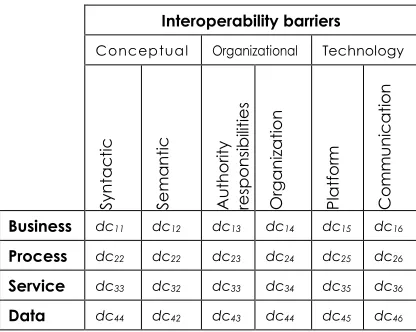
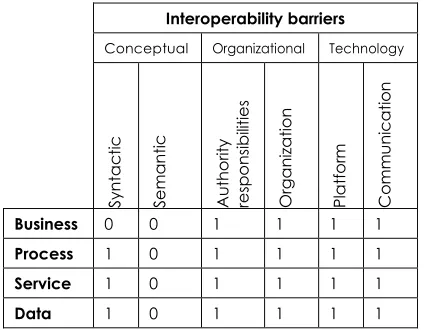
Interoperability compatibility measures the existence interoperability barriers between collaborated parties [43]. It defines four interoperability concerns and three interoperability barriers. Four interoperability concerns are businesses, processes, services, and data. Three interoperability barriers are conceptual, organizational, and technology. Table 5 shows the elementary degree of interoperation compatibility <<dcij>>. The evaluation is assigned value 1 to dcij if
interoperability is satisfied and value 0 to dcij if it is not
fully satisfied. For example, there is no satisfied interoperability for business interoperability in syntactic interoperability barrier. However, the process interoperability in syntactic barriers is satisfied. Table 6 shows the result of interoperability compatibility evaluation.
Table 5 Interoperability compatibility matrix
Interoperability barriers Conceptual Organizational Technology
Syn
ta
c
tic
Se
ma
nt
ic
A
ut
ho
rit
y
re
sp
on
sib
ilit
ie
s
O
rg
a
ni
za
tion
Pl
a
tfor
m
C
o
mm
u
ni
c
a
tio
n
Business dc11 dc12 dc13 dc14 dc15 dc16
Process dc22 dc22 dc23 dc24 dc25 dc26
Service dc33 dc32 dc33 dc34 dc35 dc36
Table 6 Interoperability compatibility barrier evaluation result
Interoperability barriers Conceptual Organizational Technology
Syn ta c tic Se ma nt ic A ut ho rit y re sp on sib ilit ie s O rg a ni za tion Pl a tfor m C o mm u ni c a tio n
Business 0 0 1 1 1 1
Process 1 0 1 1 1 1
Service 1 0 1 1 1 1
Data 1 0 1 1 1 1
The degree of compatibility <<DC>> is given as follows:
𝐷𝐶 = ∑ 𝑑𝑐𝑖𝑗/24 (Eq. 2)
𝐷𝐶 =19
24= 0.79
The test result shows that the e-government system has satisfied in the interoperability compatibility test.
4.5 Availability Performance Test
This work uses Apache JMeter to measure availability rate of onstop government portal to provide e-government application to end-users. Apache JMeter is a performance testing tool for Web application [44]. It simulates a heavy concurrent load on Web-based application. Table 7 presents the result of the one-stop e-government performance test.
Table 7 Availability performance test
Parameters Results
# of th read s Ramp -up Loo p co un t Th roug hp ut requ es ts / min A ver a g e M edia n ( ms ) Er ror ( % )
5 10 50 5.8 1943 2443 0 50 10 50 5.6 2237 2513 0 100 10 50 9.4 3738 4636 0
The test simulates the submission of school application in three different numbers of concurrent users: 5, 50, and 100 users. The results show that when the numbers of concurrent users increase, system throughput becomes faster and still maintains 0% error rate. This shows that the availability performance (PO) is 1.
The test result shows that the integration and interoperability of e-government applications and services has good availability performance and have no error.
4.6 Aggregating the degree of interoperability
The degree of interoperability is measured by aggregating the three interoperability indicators as the following calculation:
𝑅𝑎𝑡𝑙𝑜𝑝 = 𝑓(𝑃𝐼, 𝐷𝐶, 𝑃𝑂) (Eq. 3)
The degree of interoperability value is equal to 1 if it is fully satisfied and 0 if it is fully unsatisfied.
𝑅𝑎𝑡𝑙𝑜𝑝 = (𝑃𝐼, 𝐷𝐶, 𝑃𝑂)/3
𝑅𝑎𝑡𝑙𝑜𝑝 = (0.8 + 0.79 + 1)/3 (Eq.4)
𝑅𝑎𝑡𝑙𝑜𝑝 = 0.86
The degree of interoperability is equal to 0.86 which is very to near to 1. This result shows that the degree of interoperability is satisfied.
5.0 DISCUSSION
This work presents hybrid architecture for e-government integration and interoperability. As a result, the architecture helps to improve onstop e-government portal effectiveness. The proposed hybrid architecture comprises a centralized one-stop
e-government portal (1EGP), distributed
e-government application provider (EGAP), and distributed e-government service providers (EGSP). 1EGP centralizes all e-government applications in a single place so that portal users can access all online services in the portal. The EGAP is responsible to provide e-government application (EGA) to be hosted in 1EGP. EGA is distributed application provided at the level of a ministry. Therefore, there are 24 EGAPs if all 24 ministries in Malaysia participate as EGAP. Furthermore, EGA is a centralization of EGS in a ministry that is provided by respective departments under the ministry. For example, Education Ministry EGAP centralizes all education-related applications under it hosting server. EGA is built from composition of distributed e-government services (EGS) while EGSP is responsible to provide EGS for EGAP.
architecture is implemented in the business rules implementation of SCA application of EGA.
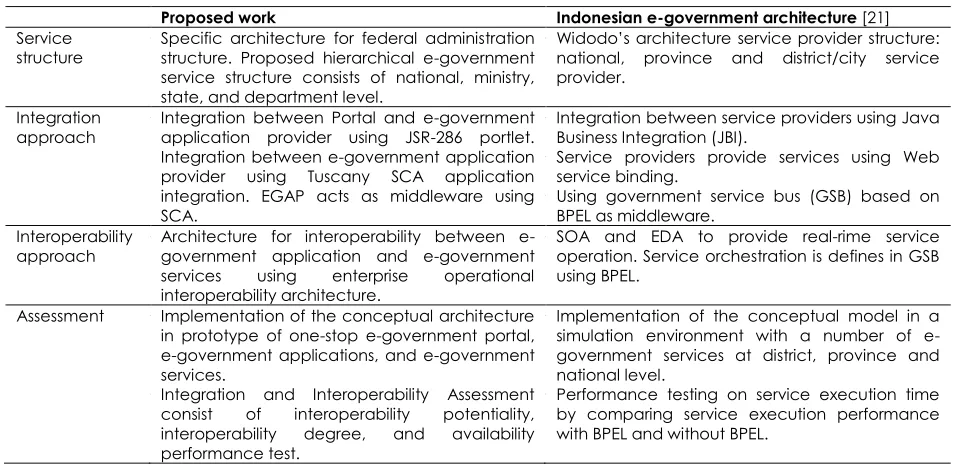
Table 6 in Appendix B shows the comparison evaluation between Indonesian proposed
e-government architecture [21] and the proposed
architecture in this paper. The Indonesian architecture is the nearest approach with this work as it has organizational structure of e-government service but in different political structure. Malaysia is federal constitutional monarchy consists of thirteen states and three federal territories. In contrast, Indonesia is a republic country with presidential. There is political structure may affect the control of e-government services. This work proposed a hierarchical e-government service structure to ease coordination of integration and interoperability of EGAP and EGSP provided by ministry, department, state, and local government. This work uses common implementation integration between 1EGP, EGAP, and EGSP. EGAP provides EGAP using JSR-286 portlet application as it is a simple and effective method to integrate application and portal. Interoperability in this architecture involves e-government application and e-government services using Tuscany SCA application. Its advantage includes EGA that can be implemented in Java or BPEL unlike Widodo’s
architecture [21] that can be implemented in BPEL
only. It is easier to develop business logic in BPEL; however Java platform provides more flexibility due to its nature of a multi-purpose programming language.
The interoperability potentiality test shows that the architecture achieves process interoperability as presented in Section 4.3 that is anticipated to be sufficient for e-government interoperability in a developing country like Malaysia and Indonesia.
Interoperability compatibility barrier evaluation result achieved satisfied result, 0.79 satisfaction level as shown in Section 4.4. It means that the architecture can overcome interoperability barriers and interoperability concerns effectively.
Based on the availability performance test result as in the Section 4.5, it shows that the prototype has achieved throughputs 9.4 requests per minute and 0% error. Interoperability compatibility barrier evaluation result achieved satisfied result that is 0.79 satisfaction level. It means that the architecture can
overcome interoperability barriers and
interoperability concerns effectively. The overall result shows 0.86 degree of interoperability that the architecture achieved satisfied integration and interoperability test. However, this work needs further evaluation in a real-world scenario and includes more variety of e-government applications and services.
6.0 CONCLUSION
This work finds effective integration and
interoperability for one-stop e-government portal
using hybrid e-government architecture. The hybrid architecture integrates one-stop e-government portal, government application providers and e-government service providers based on architectural principles, enterprise operational interoperability architecture and SCA. The architectural principles provide guideline for e-government integration and
interoperability architecture. The enterprise
operational interoperability provides approach for e-government applications and e-e-government services interoperability. SCA is used mainly for integration among government application providers and e-government service providers.
This paper evaluates the architecture based on a prototype called MyOneEG that simulates an e-government. The integration and interoperability of the prototype is evaluated based upon the
interoperability potentiality, interoperability
compatibility degree, and availability performance test. Based on the result and discussion of this paper, the proposed architecture promotes the following benefits:
1. Development of effective one-stop
e-government portal is supported by effective integration and interoperability of EGAP and EGSP.
2. Simple and effective integration and
interoperability hybrid e-government
architecture.
3. 1EGP, EGAP, and EGSP have their own function
and roles as the entities in the e-government system.
4. The whole of the e-government system (1EGP,
EGAP, and EGSP) are more structured and manageable.
The implementation provides an insight on the advantages and disadvantages of the proposed concepts and the chosen design alternatives. It can
help future e-government research and
development, especially in federal administration structure like Malaysia.
Acknowledgement
The main author is grateful for partial funding from the UiTM’s PhD scholarship. In addition, the authors acknowledge the Ministry of Education (MoE) of Malaysia under the Fundamental Research Grant Scheme (FRGS), cost center 4F263 of Universiti Teknologi Malaysia for the partial support in this research
References
[1] Verma N. and Mishra A. 2010. India’s Approach in
Constructing One-Stop Solution Towards E-Government.
[2] Dias, G. P. and Rafael, J. A. 2007. A Simple Model and a Distributed Architecture for Realizing One-stop
E-Government. Electronic Commerce Research and
Applications. 6(1): 81-90. Spring.
[3] Wimmer, M. A. 2002. Integrated Service Modelling for
Online One-Stop Government. Electronic Markets. 12(3):
149-156.
[4] Goldkuhl, G. 2008. The Challenges of Interoperability in
E-Government: Towards A Conceptual Refinement. In
Proceedings pre-ICIS 2008 SIG eGovernment Workshop.
[5] Markande, K. 2011. One-stop Services: A Conceptual
Approach Using EA Reference Framework. SETLabs
Briefings. 9(2): 23.
[6] Tambouris, E. 2001. An Integrated Platform for Realising
Online One-Stop Government: The Egov Project. In Database and Expert Systems Applications, International Workshop on, Los Alamitos, CA, USA. 0: 0359.
[7] United Nations. 2012. United Nations e-government Survey
2012: E-Government for the People-United Nations Department of Economic and Social Affairs. Department of Economic and Social Affairs, United Nations, 2012.
[8] Ahuja, A. and Ahuja, N. 2008. Why Enterprise Architecture
is Must for One-Stop E-Government? In Emerging
Technologies in E-Government. New Delhi: GIFT Publishing.
[9] Al-Khanjari, Z., Al-Hosni, N., and Kraiem, N. 2014.
Developing A Service Oriented E-Government
Architecture Towards Achieving E-Government
Interoperability.
[10] Bellman, B. and Rausch F. 2004. Enterprise Architecture for e-Government. In Electronic Government, vol. 3183, R. Traunmüller, Ed. Berlin, Heidelberg: Springer Berlin Heidelberg. 48-56.
[11] Hjort-Madsen, K. 2006. 2005. Enterprise Architecture Implementation and Management: A Case Study on Interoperability.
[12] Siau, K. and Long, Y. Synthesizing e-government Stage Models–A Meta-Synthesis Based on Meta-Ethnography Approach. Industrial Management & Data Systems. 105(4): 443-458.
[13] Vernadat, F. B. 2009. Enterprise Integration and Interoperability. Springer Handbook of Automation. 1529-1538.
[14] Scholl, H. J. and Klischewski R. 2007. E-government Integration and Interoperability: Framing the Research
Agenda. International Journal of Public Administration.
30(8): 889-920.
[15] Kitchenham, B., Pearl Brereton, O., Budgen, D., Turner, D., Bailey, J., and Linkman, S. 2009. Systematic Literature Reviews in Software Engineering-A Systematic Literature
Review. Information and Software Technology. 51(1): 7-15.
[16] Elmir, B. and Bounabat, B. 2012. Integrated Public
E-Services Interoperability Assessment. International Journal
of Information Science and Management (IJISM). 1-12.
[17] Maheshwari, B., Kumar, V., Kumar, U., and Sharan, V. 2007.
E-government Portal Effectiveness: Managerial
Considerations for Design and Development. Presented at
the 5th International Congress of e-Governance (ICEG
2007), Hyderabad, India. 12.
[18] Masrek bin M. N. 2007. Measuring Campus Portal
Effectiveness and the Contributing Factors. Campus-Wide
Information Systems. 24(5): 342-354.
[19] Elmir, B. and Bounabat, B. 2010. E-Service Interoperability Measurement within Business Collaboration Networks. Proceedings of MICS.
[20] Gong, Y. and Janssen, M. 2013. An Interoperable Architecture and Principles for Implementing Strategy and
Policy in Operational Processes. Computers in Industry.
[21] Widodo, A. P., Istiyanto, J. E., Wardoyo, R., and Santoso, P. 2013. Framework Based on a Real Time Architecture Time
Architecture. IJCSI International Journal of Computer
Science Issues. 10(1).
[22] Li, Y., Chen, H., Zheng, X., Tsai, C.-F., Chen, J.-H., and Shah N. 2011. A Service-oriented Travel Portal and Engineering
Platform. Expert Systems with Applications. 38(2):
1213-1222.
[23] Xu, D. J., Liao, S. S., and Li, Q. 2008. Combining Empirical Experimentation and Modeling Techniques: A Design Research Approach for Personalized Mobile Advertising
Applications. Decision Support Systems. 44(3): 710-724.
[24] Edward, M. 2007. Service Component Architecture (SCA) Specification. OASIS - Open CSA, 2007. [Online]. Available: http://www.oasis-opencsa.org/sca.
[25] Mulligan, G. and Gracanin, D. 2009. A Comparison of SOAP and REST Implementations of a Service Based Interaction Independence Middleware Framework. In Simulation Conference (WSC), Proceedings of the 2009
Winter. 1423-1432.
[26] Novakouski, M. and Lewis, G. A. 2012. Interoperability in
the E-Government Context. SEI, Carnegie Mellon
University.
[27] Panetto, H. and Molina, A. 2008. Enterprise Integration and Interoperability in Manufacturing Systems: Trends and
Issues. Computers in Industry. 59(7): 641-646.
[28] De Angelis, F. 2009. Interoperability in e-Government Services. School of Advanced Studies-Doctorate Course in “Information Science and Complex Systems”(XXI cycle). [29] Verginadis, G., Gouvas, P., and Mentzas, G. 2005. An
Hybrid Intermediation Architectural Approach for Integrating Cross-Organizational Services. In On the Move to Meaningful Internet Systems OTM 2005 Workshops. Meersman R., Tari Z., and Herrero P., Eds. Springer Berlin Heidelberg. 452-460.
[30] Rachmawati, U. A., Sensuse, D. I., and Suhartanto, H. 2012. Initial Model of Indonesian E-Government Grid Services
Topology. International Journal of Computer Theory and
Engineering. 656-661.
[31] Marcos, E. 2005. Software Engineering Research Versus
Software Development. ACM SIGSOFT Software
Engineering Notes. 30(4): 1-7.
[32] MAMPU. 2013. Operations Suppport Assistance
Management Report - Mygov Statistic. Unit Pemodenan Tadbiran Dan Perancangan Pengurusan Malaysia. [33] Ramli, R. M. 2012. Hybrid Approach of E-Government on
Malaysian E-Government Experience. International
Journal of Social Science and Humanity. 2(5).
[34] ISO/IEC, ISO/IEC 42010:2007. 2007. Standard for Systems and Software Engineering-Recommended Practice for Architectural Description of Software-Intensive Systems. New York: ISO/IEC, 2007.
[35] Kitchenham, B. A. 2007. Guidelines for Performing Systematic Literature Reviews in Software Engineering Version 2.3. Keele University and National ICT Australia Ltd., Joint Technical Report.
[36] Sedek, K. A., Sulaiman, S., and Omar, M. A. 2011. A Systematic Literature Review of Interoperable Architecture
for E-Government Portals. In Software Engineering
(MySEC), 2011 5th Malaysian Conference in. 82-87.
[37] Laws, S., Combellack, M., Feng, R., Mahbod, H., and Nash, S. 2011. Tuscany SCA in Action. Stanford, CT: Manning. [38] Erradi, A., Anand, S., and Kulkarni, N. 2006. SOAF: An
Architectural Framework for Service Definition and
Realization. In IEEE International Conference on Services
Computing, 2006. SCC ’06. 151-158.
[39] Yuan, J. X. 2012. Liferay Portal Systems Development.
Birmingham: Packt Publishing,
[40] Abdelnur, A. and Hepper, S. 2003. JSR 168: Portlet specification. Sun Microsystems and IBM.
[41] Nicklous, M. and Hepper, S. 2008. JSR 286: Portlet Specification 2.0. Standard Available (retrieved 2011-06-25) at http://www. jcp. org/en/jsr/detail.
[42] Chen, D., Doumeingts, G., and Vernadat, F. 2008.
Architectures for Enterprise Integration and
Interoperability: Past, Present and Future. Computers in
Industry. 59(7): 647-659.
[43] Chen, D., Vallespir, B., and Daclin, N. 2008. An Approach
for Enterprise Interoperability Measurement. Proceedings
[44] Wu, Q. and Wang, Y. 2010. Performance testing and
optimization of J2EE-based web applications. In 2010
Second International Workshop on Education Technology
and Computer Science (ETCS). 2: 681-683.
[45] Yan, P. and Guo, J. 2010. Researching and Designing the
Architecture of E-Government Based on SOA. In 2010
International Conference on Business and
E-Government (ICEE). 512-515.
[46] Qing, Chen. 2010. Content-oriented E-Government
Information Portal Architecture and Strategies. In 2010
International Conference on Business and
E-Government (ICEE). 468-471.
[47] Zhu D., Li Y., Shi J., Xu Y., and Shen W., “A service-oriented city portal framework and collaborative development platform,” Information Sciences, vol. 179, no. 15, pp. 2606– 2617, Jul. 2009.
[48] Charalabidis, Y., Lampathaki, F., Sarantis, D., Sourouni, A. M., Mouzakitis, S., Gionis, G., Koussouris, S., Ntanos, C., Tsiakaliaris, C., Tountopoulos, V., and others. 2008. The Greek Electronic Government Interoperability Framework: Standards and Infrastructures for One-Stop Service
Appendix A
Table 1 Related work in e-government architecture
Type of System Integration approach and
topology Interoperability approach Evaluation result
Enterprise architectural framework for Indonesian e-government [21]
SOA and BPEL Real-time
interoperability using Government Service Bus (GSB) based on BPEL
Simulation implementation in different development platform at the district/city, province, and national level. The simulation is tested by measuring execution performance of service interoperability.
Technical
architecture of service-oriented one-stop travel portal [22]
Proposed service engineering platform for integration of centralized one-stop portal travel portal and distributed service providers based on Web service SOA.
Not available Implementation in development of travel portal for Shanghai World-Expo portal.
Benefits:
1. Provide design and modelling tools for complex SOA application.
2. Provide pre-existing templates in the development SOA application to reduced application development and deployment time.
SOA-based
e-government [45] Proposed Service Bus (GSB) an ESB Government based on SOA for distributed
heterogeneous environment.
Not available No available
Content-oriented e-government portal [46]
Content integration approach using Content Management System’s (CMS) content duplication integration module.
Not available Allow secure information sharing for e-government portal using content oriented e-government information portal.
City One-top Portal
[47] Web service SOA to integrate applications, coordinate systems, and aggregate information.
Not available. Implementation in development start-up concept design for Digital City Portal of Shanghai Yangshan city to integrate intelligent transportation systems and GIS systems show that it helps to provide responsive and powerful services to their residents.
Distributed
architecture for one-stop e-government [2]
SOA based SOAP Web service for integration of one-stop e-government and its service providers. Proposed distributed three nodes architecture consists of requesters, providers, and service repositories.
Not available Implementation of European’s Integrated Platform for Realizing On-line One-Stop Government (eGov) that allows cooperation of government services to provide one stop centre for end-users. It also provides light common ground for interconnection of almost any kind of nodes.
Greek Electronic Government Interoperability Framework for one-stop service provision [48]
Integration of models, tools, and repositories to support e-government one-stop service provision.
Standard interoperability framework (eGIF) to provide paper-based specification for standard
interoperability among various stakeholders.
Appendix B
Table 8 Comparison between Indonesian E-government Architecture and the proposed architecture
Proposed work Indonesian e-government architecture [21] Service
structure
- Specific architecture for federal administration structure. Proposed hierarchical e-government service structure consists of national, ministry, state, and department level.
- Widodo’s architecture service provider structure: national, province and district/city service provider.
Integration approach
- Integration between Portal and e-government application provider using JSR-286 portlet. Integration between e-government application provider using Tuscany SCA application integration. EGAP acts as middleware using SCA.
- Integration between service providers using Java Business Integration (JBI).
- Service providers provide services using Web service binding.
- Using government service bus (GSB) based on BPEL as middleware.
Interoperability approach
- Architecture for interoperability between e-government application and e-e-government services using enterprise operational interoperability architecture.
- SOA and EDA to provide real-rime service operation. Service orchestration is defines in GSB using BPEL.
Assessment - Implementation of the conceptual architecture in prototype of one-stop e-government portal, e-government applications, and e-government services.
- Integration and Interoperability Assessment consist of interoperability potentiality, interoperability degree, and availability performance test.
- Implementation of the conceptual model in a simulation environment with a number of e-government services at district, province and national level.
![Table 2 Criteria and approach of interoperability [26]](https://thumb-us.123doks.com/thumbv2/123dok_us/1297791.1162370/3.612.321.558.118.341/table-criteria-approach-interoperability.webp)
![Figure 4 Example of Web shopping application using SCA Assembly Model [37]](https://thumb-us.123doks.com/thumbv2/123dok_us/1297791.1162370/6.612.333.542.221.349/figure-example-web-shopping-application-using-assembly-model.webp)