78: 8-2 (2016) 95-105 | www.jurnalteknologi.utm.my | eISSN 2180–3722 |
Jurnal
Teknologi
Full Paper
ONTOLOGY
REASONING
USING
SPARQL
QUERY:
A
CASE
STUDY
OF
E-LEARNING
USAGE
Dewi Octaviani
b*, Mohd Shahizan Othman
aa
Faculty of Computing, Universiti Teknologi Malaysia, 81310 UTM
Johor Bahru, Johor, Malaysia
b
Department of Information Technology, HELP University, Kuala
Lumpur, Malaysia
Article history
Received 30 November 2015 Received in revised form
4 April 2016 Accepted 17 March 2016
*Corresponding author
[email protected]
Graphical abstract
Abstract
The involvement of learning pedagogy towards implementation of e-learning contribute to the additional values, and it is assign as a benchmark when the investigation and evaluation will carry out. The results obtained later believed would be fit to the domain problem.The results might provide instructional theories including recommendation after reasoning that can be used to improve the quality of teaching and learning in the virtual classroom. Ontology as formal conceptualization has been chosen as research methodology. Ontology conceptualization helps to illustrate the e-learning usage including activities and actions, likewise learning pedagogy in the form of concepts, class, relationships and instances. The ontology constructed in this paper is used in conjunction with the SPARQL rules, which are designed to test the reasoning ability of ontology. Reasoning results should be able to describe the knowledge contained in ontology, as well the facts on it. The SPARQL rules contains triplets to verify if the students are actively engaged in a meaningful way towards e-learning usage. The backward engine is optimized to store the facts obtained from queries. Development of ontology knowledge based and reasoning rules with SPARQL queries allow to contribute a sustainable competitive advantages regarding the e-learning utilization. Eventually, this research produced a learning ontology with reasoning capability to get meaningful information.
Keywords: ontology, SPARQL query, ontology reasoning, knowledge representation, e-learning activities and actions.
Abstrak
Katakunci: ontologi, SPARQL query, penalaranontologi, representasi pengetahuan, aktiviti dan aksi e-pembelajaran.
© 2016 Penerbit UTM Press. All rights reserved
1.0 INTRODUCTION
E-learning is trusted to replace classroom learning [1]. It brings a huge recognition for higher institution and become vital to provide e-learning as a tool to deliver learning materials or to support synchronous and asynchronous communication between lecturer and students or among students. Recent tool known as Learning Management System (LMS) have been presenting to handling the large number of educational data, and this is running the important role in e-learning environments [2]. It provides convenience for lecturer to organize learning materials and provide easiness for students to access. In spite of advantages of e-learning systems and LMSs, it brings unsolved issue. Lecturer cannot guarantee the students’ performance in their virtual learning. The different circumstances shown when they are in the classroom, lecturer is able to openly observe the students’ performance and behavior.
For the negative case, lecturer might encourage students to be more active and engage students’ participation in the class discussion or group works. Lecturer also might create paper based report for students’ activity grades. But, what will happens in the virtual learning? Lecturer composed the activities in the online course such that resource, forum, assignment, quiz, wiki, blog, chat, or survey. By this availability, students are able to interact with lecturer and among students. They are also able to access learning material uploaded by lecturer. When they log in and performed activities in the e-learning they are creating educational data. The educational data is in terms of their activities and actions history. For example, one student log in into e-learning and access to the resource page, he is later downloading certain lecture material. By this time, he is generating his online activity history called as a ‘resource download’, resource is for activity information and download is for action information. Lecturer is able to see the history of activities and actions have been done by students. This history stored in a file called as a log file and this file contains huge data about the virtual learning usage. However, the log file is merely created for human consumption, because this is human-readable file. This educational data can be used for analysis to investigate students’ behavior during their virtual learning. Along with the growth of e-learning existence, it is necessary to conduct this analysis to define the facts about student’s capability such that the knowledge gained [3]. Recent scholars had been done the analysis on e-learning domain for different purposes using diverse methodologies. Yet,
the majority was observed the student learning data, the result obtained such that the availability tools to search learning materials based on students need. Nevertheless, the need of tools to analyze students’ behavior is become viral. It allow lecturer to define learning pattern and interactions among students, as early warning for the case of ‘risk’ students [4], and to provide dynamically changing for lecturer in term of teaching strategy [2]. The semantic ontology approach has been presenting to overcome these needs, it define the e-learning log file in the form of class, instance, relationship, data object, and data type. It allow log file transform into machine-readable file, for instances it brings convenience way to develop automatic tool to analyze learning pattern and interactions of e-learners.
2.0 RELATED WORKS
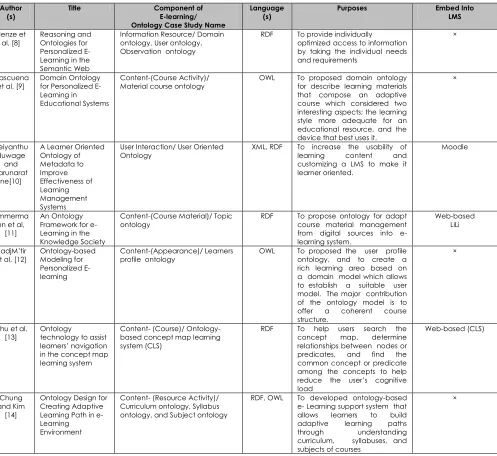
Knowledge representation (KR) ontology engage several things on ontology conceptualization to formalize knowledge [5]. Some of the benefits by applying ontologies is able to represent knowledge which is usable in computer applications; permit sharing knowledge among several computers; assist humans to enhance the understanding and associating of knowledge area [6]. The use of ontology in e-learning system can have a role: to explain semantic level of e-learning system and define the context of e-learning usage based on knowledge representation.
Table 1 Studies using Ontology on E-learning Framework
3.0 METHODOLOGY
The continues issues on the web based application has been investigated by Rokou et al, includes the web character of the program, the pedagogical background, and the personalized management of the learning material [15]. The web character implies the information system itself includes the data communication through network and protocol such that HTTP server, the pedagogical background implies the association of learning concepts in order to achieve the learning goals, the personalized management implies the availability to provide user’s needs based on certain characteristics. To address these problems, an ontology approach is introduced
in this paper. Ontology describes the
conceptualization of learning management systems
along with the association of learning pedagogy in the form of class, instances, relationship, and attributes. Moreover, the ontology language such that XML, OWL and RDF are able to support web-based applications, it provides feasibility to mining the educational data.
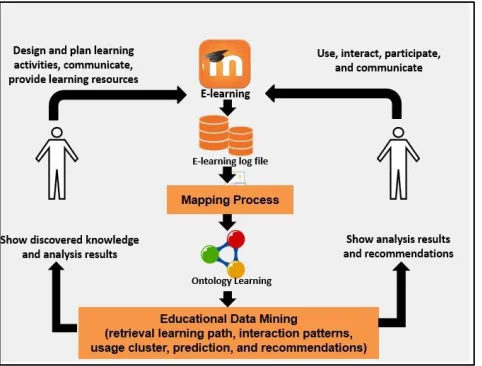
In our approach as shown in Figure 1, we gained the log file data from e-learning system. This file contains usage data from instructors and students, thereafter the mapping process carried out to map the data from log file to ontology learning. This process to gain the knowledge discovery from log file, because the ontology constructed based on conceptualization of e-learning and meaningful learning pedagogy. The next phase is to mining the Author
(s) Title Component of E-learning/ Ontology Case Study Name
Language
(s) Purposes Embed Into LMS
Henze et
al, [8] Reasoning and Ontologies for Personalized E-Learning in the Semantic Web
Information Resource/ Domain ontology, User ontology, Observation ontology
RDF To provide individually optimized access to information by taking the individual needs and requirements
×
Gascuena
et al, [9] Domain Ontology for Personalized E-Learning in Educational Systems
Content-(Course Activity)/
Material course ontology OWL To proposed domain ontology for describe learning materials that compose an adaptive course which considered two interesting aspects; the learning style more adequate for an educational resource, and the device that best uses it.
× Heiyanthu duwage and Karunarat ne[10]
A Learner Oriented Ontology of Metadata to Improve Effectiveness of Learning Management Systems
User Interaction/ User Oriented
Ontology XML, RDF To increase the usability of learning content and customizing a LMS to make it learner oriented.
Moodle
Zimmerma nn et al,
[11]
An Ontology Framework for e-Learning in the Knowledge Society
Content-(Course Material)/ Topic
ontology RDF To propose ontology for adapt course material management from digital sources into e-learning system.
Web-based LiLi
HadjM’tir
et al, [12] Ontology-based Modeling for Personalized E-learning
Content-(Appearance)/ Learners
profile ontology OWL To proposed the user profile ontology, and to create a rich learning area based on a domain model which allows to establish a suitable user model. The major contribution of the ontology model is to offer a coherent course structure.
×
Chu et al,
[13] Ontology technology to assist learners’ navigation in the concept map learning system
Content- (Course)/ Ontology-based concept map learning system (CLS)
RDF To help users search the
concept map, determine
relationships between nodes or predicates, and find the common concept or predicate among the concepts to help reduce the user’s cognitive load
Web-based (CLS)
Chung and Kim
[14]
Ontology Design for Creating Adaptive Learning Path in e-Learning Environment
Content- (Resource Activity)/ Curriculum ontology, Syllabus ontology, and Subject ontology
RDF, OWL To developed ontology-based e- Learning support system that allows learners to build
adaptive learning paths
through understanding
curriculum, syllabuses, and subjects of courses
log file such that to generate the learning and interactions pattern, cluster the usage based on meaningful learning characteristics, and define the recommendations based on the analysis results.
The aim of this paper is to highlight the construction of ontology knowledge based for e-learning usage and to validate the reasoning functionality of the ontology using SPARQL queries.
Figure 1 Research Procedures
3.1 Ontology Construction
An ontology is an explicit specification of a
conceptualization[16]. The structural parts of
ontology are as follows: (1) Concepts (class, categories, and types), describes the important idea of main domain, for example in the domain e-learning, the important idea about learning activity e.g., user, type of activity, type of actions, curriculum level, etc. Those main ideas will be stated as concepts; (2) Property (attribute, slot, and role) describes the possibly intercourse between concepts. On the classical taxonomy property is-a
and consists-of merely used to represent the member
of sub-class. Ontology also capable to set binary property, one example of this case for restriction domain-range; (3) Instances (individuals, member) describes as a member of each concept. The simple way to add instances is direct put onto ontology; however ontology is capable to import instances from database. On this case, we have to strictly consider about design of field on database, data type, size and others data constraints; (4) Formal axioms, set of formal axioms merely use as a domain knowledge. The formal expressions have respect to the further process such as: computation or search engine. Formal axioms derived from informal questions or statement, for example someone cannot be a student and lecturer in the same time moreover it will follow by rules constructions.
Methontology is one of methodology to construct ontology conceptualization. It is ideal for knowledge based system [5] as the aims of this paper. There are eleven phases involved in the methontology[17], however the process is not sequential as in waterfall model.
1. Build glossary of terms 2. Build concept taxonomies
3. Build ad hoc binary relation diagrams 4. Build concept dictionary
5. Describe ad hoc binary relations 6. Describe instance attributes 7. Describe class attributes 8. Describe constants 9. Describe formal axioms 10. Describe rules
11. Describe instances
3.2 SPARQL Query
Based on the definition, Semantic Web has the same goal as a Web content, however the semantic web cannot be simply expressed in natural language that is understood by only humans, but also in a form that can be understood, interpreted and used by software/machine (software agents). Semantic Web allow a variety of software to find, share and integrate information in an easily way. SPAQRQL query is a bridge for human/machine to retrieve information from data in the database.
SPARQL is a query for RDF/OWL, used to retrieve the data that is written using RDF/OWL or XML. This query uses an URI to retrieve the structure or information of RDF/OWL. SPARQL query language is nearly the same as regular SQL query, however the queries structure have more complexity. If the RDF/OWL changes the structure of the language, the SPARQL will however changes. To be able to retrieve information from database, SPARQL need the wrapper whichis common development using Java language. The full tutorial of SPARQL query commands have been described in Prud and Seaborne [18].
In this paper, we were using SPARQL query to test reasoning capability of our ontology model.
4.0 RESULTS AND DISCUSSION
The findings describe in the sub sections below are following the phases in methontology.
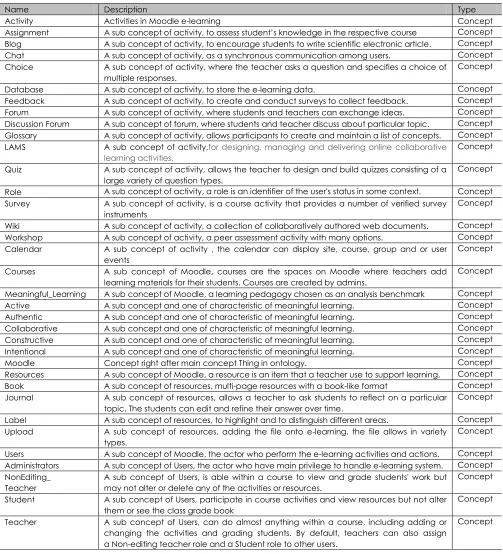
4.1 Glossary of Terms
The glossary of terms shows in Table 2 defined to tackle all the relevant terms of main domain. The main domain of this paper is Moodle e-learning particularly in usage of activities and actions and
Table 2 Glossary of Terms
Name Description Type
Activity Activities in Moodle e-learning Concept
Assignment A sub concept of activity, to assess student’s knowledge in the respective course Concept Blog A sub concept of activity, to encourage students to write scientific electronic article. Concept Chat A sub concept of activity, as a synchronous communication among users. Concept Choice A sub concept of activity, where the teacher asks a question and specifies a choice of
multiple responses.
Concept
Database A sub concept of activity, to store the e-learning data. Concept
Feedback A sub concept of activity, to create and conduct surveys to collect feedback. Concept Forum A sub concept of activity, where students and teachers can exchange ideas. Concept Discussion Forum A sub concept of forum, where students and teacher discuss about particular topic. Concept Glossary A sub concept of activity, allows participants to create and maintain a list of concepts. Concept LAMS A sub concept of activity,for designing, managing and delivering online collaborative
learning activities.
Concept
Quiz A sub concept of activity, allows the teacher to design and build quizzes consisting of a large variety of question types.
Concept
Role A sub concept of activity, a role is an identifier of the user's status in some context. Concept Survey A sub concept of activity, is a course activity that provides a number of verified survey
instruments
Concept
Wiki A sub concept of activity, a collection of collaboratively authored web documents. Concept Workshop A sub concept of activity, a peer assessment activity with many options. Concept Calendar A sub concept of activity , the calendar can display site, course, group and or user
events
Concept
Courses A sub concept of Moodle, courses are the spaces on Moodle where teachers add learning materials for their students. Courses are created by admins.
Concept
Meaningful_Learning A sub concept of Moodle, a learning pedagogy chosen as an analysis benchmark Concept Active A sub concept and one of characteristic of meaningful learning. Concept Authentic A sub concept and one of characteristic of meaningful learning. Concept Collaborative A sub concept and one of characteristic of meaningful learning. Concept Constructive A sub concept and one of characteristic of meaningful learning. Concept Intentional A sub concept and one of characteristic of meaningful learning. Concept
Moodle Concept right after main concept Thing in ontology. Concept
Resources A sub concept of Moodle, a resource is an item that a teacher use to support learning. Concept Book A sub concept of resources, multi-page resources with a book-like format Concept Journal A sub concept of resources, allows a teacher to ask students to reflect on a particular
topic. The students can edit and refine their answer over time.
Concept
Label A sub concept of resources, to highlight and to distinguish different areas. Concept Upload A sub concept of resources, adding the file onto e-learning, the file allows in variety
types.
Concept
Users A sub concept of Moodle, the actor who perform the e-learning activities and actions. Concept Administrators A sub concept of Users, the actor who have main privilege to handle e-learning system. Concept NonEditing_
Teacher
A sub concept of Users, is able within a course to view and grade students' work but may not alter or delete any of the activities or resources.
Concept
Student A sub concept of Users, participate in course activities and view resources but not alter them or see the class grade book
Concept
Teacher A sub concept of Users, can do almost anything within a course, including adding or changing the activities and grading students. By default, teachers can also assign a Non-editing teacher role and a Student role to other users.
Concept
4.2 Taxonomy
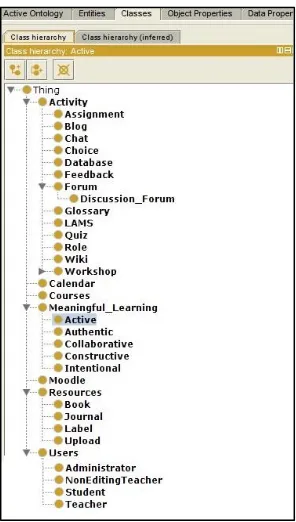
Concept taxonomy defined the hierarchy of terms defined in the glossary of terms. Figure 2 shows part of hierarchy in our ontology model. Where courses, users, and discussion are subclass of Moodle concept. Teacher and student are subclass of users
Figure 2 Part of Taxonomy
4.3 Relation Diagrams
Once the taxonomy has been constructed, the relation diagram obtained to define the characteristics of relations. The characteristics of relations are useful for machine when doing the reasoning process. For instance, based on the previous taxonomy that Teacher concept can teaches Course concept, we set Teaches relation inverse with Teach By relation as shows in Figure 3. In addition, Figure 4 shows when student enroll in a course, and course teach by one teacher, we can find the respective teacher, therefore we set enroll as transitive relation with teach by.
Figure 3 Inverse Relation
Figure 4 Transitive Relation
4.4 Dictionary
Concept dictionary consists of concept name with their class attributes, instances attributes, and their relations as show in Table 3.
4.5 Relations in Detail
For each relation, the ontology must specify the source, target, mathematical properties and inverse relation (if any) as show in Table 4.
Table 3 Part of Dictionary
Concept _Name Class_ Attributes Instances_ Attributes Relations
Teacher - Has_Name
Has_IdNumber
Teaches Has_Student Action_To
Student - Has_Name
Has_IdNumber
Enroll Has_Teacher Action_To
Courses - Has_Shortname
Has_Fullname Has_IdMember
Teach_By
Activity Has_Active_ Weight Has_Collaborativ e_Weight Has_Constructive _Weight Has_Authentic_ Weight Has_Intentional_ Weight - -
Table 4 Part of Detail Relations
Relation_ Name
Source Target Mathematic
al_Properties
Inverse_ Relation
Teaches Teacher Courses Symmetric
Transitive
Teach_By
Teach_By Course Teacher Symmetric
Transitive Teaches
Has_Teacher Student Teacher Teach_By
Has_Student Teacher Student Symmetric
Transitive Has_Teacher Has_Active_
Weight
Activity Meaningful
_Learning - -
4.6 Instances and Attributes in Detail
Each row of instance attributes contains a description show in Table 5, instance attributes might be different with concept attributes.
4.7 Constants in Detail
This phase describe in detail of the contacts in glossary of terms. For example, if we want to execute the reasoning to find teacher who teach a particular student, what we will get is the teacher name which has string as a datatype, and it gather from the property Has_Name from Users concept, as show in Table 6.
Teach_By Teaches
o
Add_Post_To
Teacher Course
s Teaches Add_Post_To Moodl e Discussion Forum Instance-of Subclass-of Teacher_ 1 _1 Courses_1 Student_1 _1 Courses_1
Subclass-of Subclass-of
Subclass-of Instance-of User s Subclass-of Courses_ 1 Instance-of Course s Teach
er Topic_1
_1
Courses_1
Studen t
Teaches Add_Post_T
o Instance-of Has_Teacher o Add_Post_To Enroll o Add_Post_To Teach By o Add_Post_To
Table 5 Part of Detail Instances and Attributes
Instance_Attribute_ Name
Concept_ Name
Value_ Type
Measurement_ Unit
Has_Name Users String Data
Has_IdNumber Users String Data Has_Shortname Courses String Data Has_Fullname Courses String Data Has_IdMember Courses String Data Has_ActiveWeight Activity Float Quantity
Table 6 Part of Detail Constants
Name Value_
Type
Value Measurement_
Unit Teacher that
teach student
String Has_Name Users
4.8 Formal Axioms
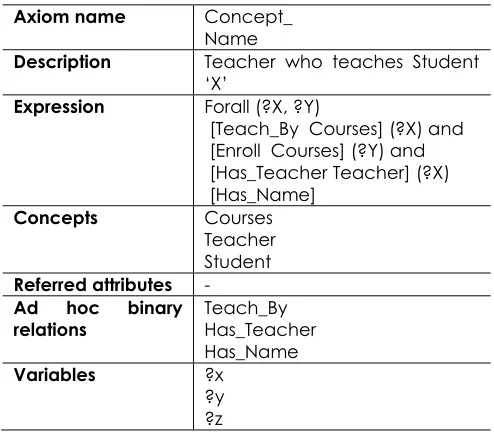
Using the sample in Table 6, we defined the formal axiom that shows in Table 7. There are two variables defined namely X and Z, where X is teacher variable, Y is course variable. The concepts involved in the axiom are courses, teacher, and student, while the relations involved are Teach_By, Has_Teacher, and Has_Name. The axiom will reveal the value of Has_Name which gather from Teacher.
Table 7 Example of Formal Axiom.
Axiom name Concept_ Name
Description Teacher who teaches Student ‘X’
Expression Forall (?X, ?Y)
[Teach_By Courses] (?X) and [Enroll Courses] (?Y) and [Has_Teacher Teacher] (?X) [Has_Name]
Concepts Courses Teacher Student
Referred attributes -
Ad hoc binary
relations Teach_By Has_Teacher Has_Name
Variables ?x ?y ?z
4.9 Reasoning Rules using SPARQL Queries
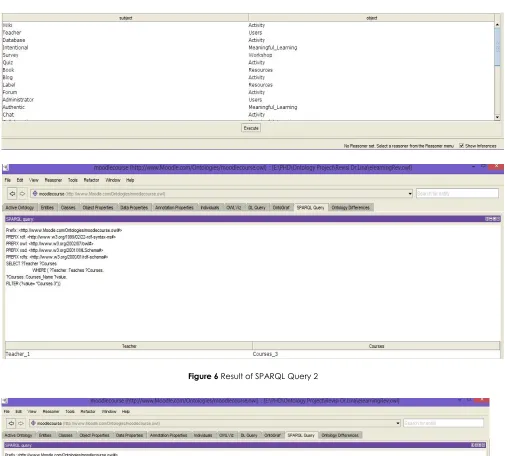
SPARQL queries have been constructed to test the reasoning capability of ontology model, the first query to gather all the concepts in ontology model.
The second query to gather the instance who teach particular course. While query three to gather the property of instance who teach particular course. The result of SPARQL queries show in Figure 5-7.
Query 1
PREFIX rdf: <http://www.w3.org/1999/02/22-rdf-syntax-ns#>
PREFIX owl: <http://www.w3.org/2002/07/owl#> PREFIX xsd: <http://www.w3.org/2001/XMLSchema#> PREFIX rdfs: <http://www.w3.org/2000/01/rdf-schema#> SELECT ?subject ?object
WHERE { ?subject rdfs:subClassOf ?object },
Query 1 is intended to obtain information on the parent class from a class. Child class is declared as a
subject and parent class declared as an object.
Meanwhile, to get the relationship parent-child relationship by declaring the relation RDFS: sub Class Of.
Query 2
Prefix
:<http://www.Moodle.com/Ontologies/moodlecourse.owl#> PREFIX rdf: <http://www.w3.org/1999/02/22-rdf-syntax-ns#>
PREFIX owl: <http://www.w3.org/2002/07/owl#> PREFIX xsd: <http://www.w3.org/2001/XMLSchema#> PREFIX rdfs: <http://www.w3.org/2000/01/rdf-schema#> SELECT ?Teacher ?Courses
WHERE { ?Teacher :Teaches ?Courses. ?Courses :Courses_Name ?value.
FILTER (?value= "Courses 3")}
Query 2 is intended to obtain information about the teacher who taught in a course. Teacher declared as a Teacher variable and course declared as a
Courses variable. To get the relationship of a teacher
teaching on a course, then the relationship Teaches has been declared. In this query, the results to be revealed is a teacher code and course name, with an additional filter only for teachers who taught the course named Courses 3.
Query 3
Prefix
:<http://www.Moodle.com/Ontologies/moodlecourse.owl#> PREFIX rdf: <http://www.w3.org/1999/02/22-rdf-syntax-ns#>
PREFIX owl: <http://www.w3.org/2002/07/owl#> PREFIX xsd: <http://www.w3.org/2001/XMLSchema#> PREFIX rdfs: <http://www.w3.org/2000/01/rdf-schema#> SELECT ?Teacher ?Courses
WHERE { ?Teacher :Teaches ?Courses. ?Teacher :Has_Name ?value.
FILTER (?value= "DewiOctaviani")}
Course variable has been declared beside the relationship Teaches. Information of teachers reveals based on the teacher's name, for it the relation
Has_Name was declared. Additional filters can be
used to focus on finding one of teacher.
Figure 6 Result of SPARQL Query 2
Figure 7 Result of SPARQL Query 3
4.11 Ontology Model Visualization
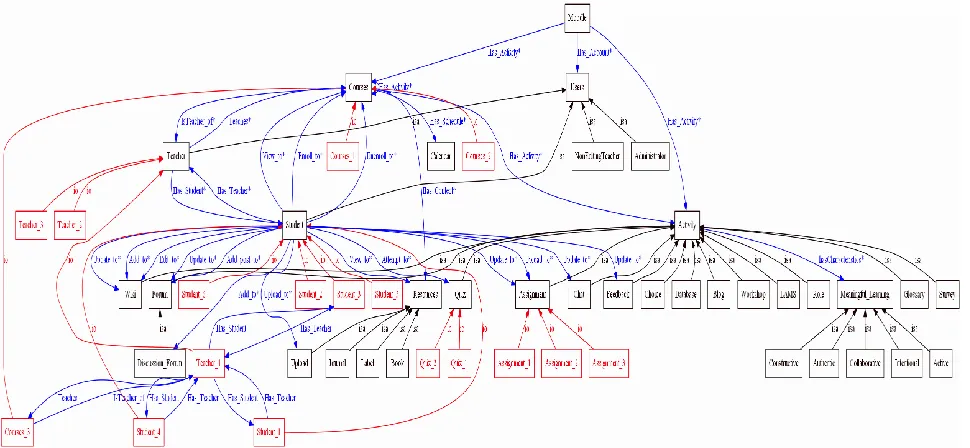
The ontology visualization show the actual ontology model has been constructed. Figure 8 shows the
order to do reasoning process, and Figure 11 shows the full of ontology visualization.
Figure 8 Concepts in Ontology Model
Figure 9 Properties in Ontology Model
Figure 10 Instances in Ontology Model
4.12 DISCUSSION
Figure 11 Ontology Visualization
Figure 11 shows the overall concept of the learning ontology. Moodle is described as the first concept which is located under the main concept which is Thing. As instances, part of concept descriptions exist in learning ontology described as follows. When someone makes a Moodle account, then he generates Has_Account relation which as Users. Users that have various sub-classes namely Teacher,
Student, Administrator and NonEditingTeacher, these
sub-classes has a relationship is-a with the Users class. Moreover, Moodle class consists of many other a sub-classes, one of them is a Courses class.
A Courses class might have variety of relationships
with other classes, such as Has_Schedule with
Calendar class, Has_Teacherwith Teacher class,
Has_Studentwith Student class or a Student conduct
relations Enroll_toagainst Courses class, and
Has_Activityin Activity class. There are many
relationships that may occur as an Activity class has diversity of sub-classes. As instance, Assignment class is part of the Activity class represented by the relationship is-a. Relationships that may occur with the attachment relationship show in Figure 12 and 13 as examples.
Figure 12 shows a Student 1 which is part of Users class, obtained Enroll_tocourse number B100 and performed Upload_Toonto Assignment class. Based on ontology reasoning ability and because Course class Has_Activity Assignment class, it can be conclude that Student 1 upload for assignment on B100 Course.
User s
Enroll_To
Upload_To
Student
Student 1
Course s
Course B100
Assignment
io
Assignment 1
Has_Activity
io io
is a
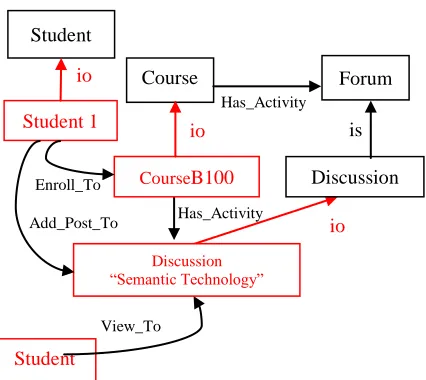
Another illustration shows in Figure 13, Student 1 add a post called "Semantic Technology" topic that has a relation io (instances of) in the Discussion class that is also part of the Forum Activity on Course B100. When Student 2 do View_to on the "Semantic Technology topic can be deduced that he saw the topic made by Student 1.
5.0 CONCLUSION
The objective of this paper to construct the ontology knowledge based for e-learning activities and actions and to test the reasoning capability. The set of knowledge representation which linked to meaningful learning pedagogy. Processes included: build glossary of terms, build concept taxonomies, build ad hoc binary relation diagrams, build concept dictionary, describe ad hoc binary relations, describe instance attributes, describe class attributes, describe constants, describe formal axioms, describe rules, and describe instances. The knowledge expected inferring user requirements to interpreted meaningful activities usage using SPARQL queries. Future works, we will accomplish to complete ontology structural and knowledge construction for overall activities and actions, set the rules, and establish the glossary of knowledge representation. In addition, e-learning experts and lecturers has a main role in order to gathering proper informal competency questions as of to achieve the competence expectation.
Reference
[1] Zhang, D., Zhao, J. L., Zhou, L., and Nunamaker Jr, J. F.
2004. Can E-Learning Replace Classroom Learning?
Communications of the ACM. 47(5): 75-79.
[2] Ranbaduge, T. 2014. Use of Data Mining Methodologies in
Evaluating Educational Data. International Journal of
Scientific and Research Publications. 25.
[3] Romero, C., Ventura, S., Espejo, P.G., and Hervás, C. 2008.
Data Mining Algorithms to Classify Students. EDM. 8-17.
[4] Cash, T., Dawicki, C., and Sevick, B. 2011. Springfield Public
Schools Dropout Prevention Program Assessment & Review (PAR).
[5] Gómez-Pérez, A., Juristo, N., Montes, C., and Pazos, J.
1997. Ingeniería del Conocimiento: Diseño y Construcción
de Sistemas Expertos. Ceuta, Madrid, Spain.
[6] Gruber, T. R. 1995. Toward Principles For The Design Of
Ontologies Used For Knowledge Sharing. International
Journal Of Human Computer Studies. 43(5): 907-928.
[7] Baader, F. 2003. The Description Logic Handbook: Theory,
Implementation, And Applications. Cambridge University
Press.
[8] Henze, N., Dolog, P., and Nejdl, W. 2004. Reasoning And
Ontologies For Personalized E-Learning In The Semantic
Web.Educational Technology & Society. 7(4): 82-97.
[9] Gascuena, J. M., Fernandez-Caballero, A., and Gonzalez,
P. 2006. Domain Ontology For Personalized E-Learning In
Educational Systems. Advanced Learning Technologies,
2006. Sixth International Conference on. IEEE. 456-458.
[10] Heiyanthuduwage, S. and Karunaratne, D. 2006. A Learner
Oriented Ontology Of Metadata To Improve Effectiveness
Of Learning Management Systems. International Journal
Of The Computer, The Internet And Management. 14.
[11] Zimmermann, K., Mimkes, J., and Kamke, H.U. 2006. An
Ontology Framework for e-Learning in the Knowledge Society. Knowledge organization for a global learning
society. Proceedings Of The Ninth International ISKO
Conference, 4-7 July 2006, Vienna Austria. Ergon Verlag.
85.
[12] Hadj M'tir, R., Jeribi, L., and Rumpler, B. 2007.
Ontology-based Modeling for Personalized E-learning. World
Conference on E-Learning in Corporate, Government,
Healthcare, and Higher Education. 2601-2609.
[13] Chu, K. K., Lee, C. I., and Tsai, R. S. 2011. Ontology
Technology To Assist Learners’ Navigation In The Concept
Map Learning System. Expert Systems with Applications.
38(9): 11293-11299.
[14] Chung, H. S. and Kim, J. M. 2012. Ontology Design for
Creating Adaptive Learning Path in e-Learning
Environment. Proceedings of the International Multi
Conference of Engineers and Computer Scientists.
[15] Rokou, F. P., Rokou, E., and Rokos, Y. 2004. Modeling
Web-based Educational Systems: Process Design Teaching
Model. Educational Technology & Society. 7(1): 42-50.
[16] Gruber, T. R. 1993. A Translation Approach To Portable
Ontology Specifications.Knowledge acquisition. 5(2):
199-220.
[17] Gómez-Pérez, A., Fernández-López, M., and Corcho, O.
2006. Ontological Engineering: with examples from the areas of Knowledge Management, e-Commerce and the
Semantic Web. Springer Science & Business Media.
[18] Prud’Hommeaux, E. and Seaborne, A. 2008. SPARQL
Query Language For RDF. W3C recommendation. 15
Figure 13 Student-Course-Forum Discussion Relationship
io
Has_Activity Has_Activity
Course s
Forum
Discussion
CourseB100
is a
io
Discussion “Semantic Technology”
Student 1
View_To Add_Post_To
Student 1
Enroll_To
io