ABSTRACT
BUSCHE, BRADLEY JAMES. Compatibilization of Polystyrene/Poly(dimethylsiloxane) using Star Polymers Containing a γ-Cyclodextrin Core and Polystyrene Arms. (Under the direction of C. Maurice Balik and Alan E. Tonelli.)
Star polymers containing a γ-cyclodextrin (CD) core and polystyrene (PS) arms (CD-star)
were successfully synthesized by atom transfer radical polymerization. These stars are the first of their kind containing a γ-CD core. CD-stars made with twelve PS arms proved to be
soluble in typical PS solvents. Control over CD-star arm length was achieved, as shown by nuclear magnetic resonance (NMR) and gel permeation chromatography (GPC) analysis.
Rapidly stirred blends of polydimethylsiloxane (PDMS) and PS prepared in chloroform with and without CD-star formed an emulsion. Adding CD-star to these turbid solutions resulted in clearing, whereas control solutions without CD-star remained turbid. Post-stirring, these clear solutions demonstrated excellent temporal stability illustrating their successful compatibilization. Characterization of these clear solutions by 2D-NMR revealed that CD-stars were threaded onto PDMS. This complexation formed a hybrid slip-ring copolymer
with PDMS as the backbone and CD-star PS arms effectively acting as the grafts. Solution characterization via capillary viscometery, dynamic light scattering, and GPC showed traits similar to traditional graft copolymers.
© Copyright 2009 by Bradley James Busche
Compatibilization of Polystyrene/Poly(dimethylsiloxane) Blends Using Star Polymers Containing a γ-Cyclodextrin Core and Polystyrene Arms
by
Bradley James Busche
A dissertation submitted to the Graduate Faculty of North Carolina State University
in partial fulfillment of the requirements for the Degree of
Doctor of Philosophy
Materials Science and Engineering
Raleigh, North Carolina
2009
APPROVED BY:
________________________ ________________________ Keith Dawes Richard J. Spontak
DEDICATION
BIOGRAPHY
Brad was born and raised in Olympia, Washington. He attended the University of Washington in Seattle earning a Bachelor of Science in Ceramic Engineering. During his undergraduate career he was exposed to the “Nylon rope-trick” which presented a world of polymer curiosities, which consequently, influenced his future studies in polymers. As an undergraduate student, he was awarded summer research Fellowships at Pacific Northwest National Laboratories (PNNL) in Richland, Washington. His knowledge in organic synthesis and interfacial interactions was seeded under the mentorship of Dr. Glen E. Fryxell at PNNL. Brad’s involvement in interfacial and materials chemistry during his time at PNNL fueled his yearning to further understand material properties.
ACKNOWEDGMENTS
I sincerely thank Professors C. Maurice Balik and Alan E. Tonelli for their excellent mentorship and guidance during my time in graduate school. It was due to their curiosity and passion for polymers that resulted in me fully enjoying my time under their direction. I truly appreciate all they have done for me. I would also like to thank Dr. Keith Dawes for his organic synthesis/polymerization mentorship and for his willingness to be on my committee. I also thank Dr. Richard Spontak for his instruction in polymer blends and for agreeing to be on my committee.
Furthermore I would like to thank my past group members Dr. Marcus Hunt, Dr. Tamer Uyar, Drs. Cristian and Mariana Rusa, Dr. Jennifer Ayres, John Osborne, and Jacob Majikes for their help and insightful conversations, not to mention laughs. Also I wish to thank my current group members Jaewook Seok, Brandon Williamson, Anushree Mohan, Gerry Antony, and Marc Moore for their help and valuable conversations. I extend my appreciation to Andy Newell for his help in SEM imaging, and Ka “Wingo” Wong for his help in conducting EDX. I thank Evren Ozcam for his time in conducting nanoindentation. I especially thank Dr. Hanna Gracz for her invaluable help in performing ROESY NMR. Finally I would like to thank Ms. Birgit Andersen for her characterization help spanning my time at NCSU as well as Dr. Keith Beck for his help in performing GPC measurements.
TABLE OF CONTENTS
LIST OF TABLES... viii
LIST OF FIGURES ...x
1. INTRODUCTION ...1
1.1. Properties of Cyclodextrins... 1
1.2. Cyclodextrin Inclusion Complexes... 3
1.2.1. Small Molecule/Cyclodextrin Inclusion Complexes ... 3
1.2.2. Polymer/Cyclodextrin Inclusion Complexes ... 5
1.3. Factors Affecting Formation of Cyclodextrin Inclusion Complexes... 8
1.3.1. Solvent Effects ... 9
1.3.2. Guest Molecule Size Effects... 10
1.3.3. Temperature Effects... 10
1.4. Polymers Chemically Modified with Cyclodextrin ... 10
1.4.1. Linear Cyclodextrin Polymers ... 11
1.4.2. Grafted Cyclodextrin Polymers ... 12
1.4.3. Networked Cyclodextrin Polymers... 12
1.4.4. Cyclodextrin Star Polymers ... 13
1.5. Compatibilization of Blended Homopolymers ... 14
1.5.1. Compatibilization by Reactive Blending... 14
1.5.2. Compatibilization by Addition of a Compatibilizer ... 15
1.5.3. Compatibilization with Unmodified Cyclodextrins... 16
1.5.4. Compatibilization using Cyclodextrin-Stars... 18
1.6. Motivation and Organization ... 19
1.7. References... 21
2. EXPERIMENTAL...28
2.1. Materials ... 28
2.2. Physical and Chemical Structure Analysis ... 28
2.2.1. X-Ray Diffraction ... 28
2.2.2. Fourier Transform Infrared Spectroscopy ... 28
2.2.3. Nuclear Magnetic Resonance Spectroscopy... 29
2.3. Solution Property Analysis ... 29
2.3.1. Capillary Viscometry ... 29
2.3.2. Dynamic Light Scattering ... 29
2.3.3. Gel Permeation Chomatography... 30
2.4. Solid State Property Analysis ... 30
2.4.1. Thermal Property Analysis ... 30
2.4.1.1. Thermal Gravimetric Analysis... 30
2.4.1.2. Differential Scanning Calorimetry... 30
2.4.2. Mechanical Property Analysis ... 31
2.4.3. Surface Property Analysis... 31
2.4.3.1. Water Contact Angle... 31
2.4.4. Microstructural Analysis... 32
2.4.4.1. Optical Microscopy... 32
2.4.4.2. Scanning Electron Microscopy ... 32
2.4.4.3. Atomic Force Microscopy ... 32
3. SYNTHESES OF STAR POLYMERS CONTAINING γ-CYCLODEXTRIN CORES AND POLYSTYRENE ARMS ...33
3.1. Background... 33
3.2. Synthesis of α-bromo Cyclodextrin ATRP Initiator ... 36
3.3. Synthesis of PS Stars with a γ-Cyclodextrin Core... 37
3.3.1. Kinetic Analysis of ATRP Polymerization... 39
3.4. Molecular Structure Analysis ... 40
3.4.1. X-Ray Diffraction ... 40
3.4.2. Determination of Star-arm Number and DP via 1H-NMR... 40
3.4.3. Chemical Structure Analysis Using FTIR and 13C-NMR... 44
3.4.4. Polydispersity Analysis of Stars ... 48
3.5. Solution Property Analyses... 50
3.5.1. Radius of Gyration Studies of Stars... 50
3.5.2. Dilute Solution Viscosity Studies of Stars... 55
3.6. Thermal Analysis of Stars... 59
3.6.1. Glass Transition Temperature of Stars ... 59
3.6.2. Thermal Stability ... 63
3.7. Conclusions... 65
3.8. References... 66
4. SOLUTION COMPATIBILIZATION EFFECTS BETWEEN INCOMPATIBLE POLYMERS PS/PDMS AND PS ARMED γ-CYCLODEXTRIN STARS...70
4.1. Background... 70
4.2. Preparation of Solutions... 74
4.2.1. Room Temperature Processing... 74
4.2.2. Heat Processing... 74
4.3. Effect of CD-Stars on Compatibilization of PDMS and PS ... 75
4.3.1. Confirmation of PDMS Threading in Compatibilized Solutions ... 80
4.3.2. Effect of Star Components on Compatibilization... 86
4.3.3. Solvent Effects on Compatibilization ... 87
4.3.4 Effect of Star Arm Length on Compatibilization ... 89
4.4 Evidence of Micelle Formation ... 96
4.4.1. Intrinsic Viscosity Measurments of Compatibilized Solutions ... 96
4.4.2. Dynamic Light Scattering of Compatibilized Solutions... 100
4.4.3. GPC of Compatibilized Solutions... 103
5. SOLID-STATE MORPHOLOGIES OF POLYMER BLENDS COMPATIBILIZED
BY γ-CYCLODEXTRIN STARS ...113
5.1. Background... 113
5.2. Microstructure of Spun cast films... 115
5.2.1 Spin Casting of Solutions... 115
5.2.2 Morphologies of Spun Cast Films ... 116
5.2.3 Water Contact Angle Analysis of Spun cast films... 126
5.2.4 Aging and stability of spun cast films... 128
5.3. Microstructure of Solution Cast Films... 131
5.3.1. Solvent Casting of Solutions... 131
5.3.2. Compression Molding of Films ... 132
5.3.3. Determination of PDMS Remaining in Films after Processing... 133
5.3.4. Compression Molded Film Morphology ... 137
5.4. Conclusions... 141
5.5. References... 142
6. THERMAL AND MECHANICAL PROPERTIES OF BLENDED FILMS CONTAINING γ-CYCLODEXTRIN STARS...144
6.1. Background... 144
6.2. Thermal Properties of Blended Films ... 146
6.2.1 Differential Scanning Calorimetry... 146
6.2.2 Thermal Gravimetric Analysis... 154
6.3. Dynamic Mechanical Analysis ... 156
6.3.1. Evaluation of E’, E’’, and Tan δ for Blended Films ... 158
6.4. Conclusions... 165
6.5 References... 166
7. CONCLUSIONS AND FUTURE WORK ...168
7.1. Conclusions... 168
7.2. Future Work... 170
7.2.1 Gamma-Irradiation of Blends Before Solution Casting... 170
7.2.2 PDMS End-Capping After Threading of CD-star ... 173
7.2.3 Continued Polymerization of PS Arms on Threaded Complexes... 174
LIST OF TABLES
TABLE 1.1. Properties of cyclodextrins. ...2
TABLE 1.2. Polymers that have been found to form CD-ICs...6
TABLE 1.3. Abbreviations and definitions of select polymers...7
TABLE 1.4. Summary of CD-stars found in literature...13
TABLE 3.1. Molecular weights of the CD-stars found by 1H-NMR. ...44
TABLE 3.2. Comparison of GPC and 1H-NMR molecular weights for CD-stars. ...50
TABLE 3.3. Dynamic light scattering (DLS) data for CD-stars and the corresponding calculated g ratios. ...52
TABLE 3.4. GPC data for CD-stars and the corresponding radius of gyration ratio (g) calculations comparing star and linear polymers...53
TABLE 3.5. Zimm-Stockmayer radius of gyration ratios, g, for stars...54
TABLE 3.6. Summary of CD-star intrinsic viscosities measured in THF at 25° C and some related values...57
TABLE 3.7. Linear-fitting values found from Figure 3.13 for equation 3.8...62
TABLE 4.1. Mass compositions for sample blends containing 1 wt% CD-core with varying PDMS content...75
TABLE 4.2. Relative molar ratios of CD-stars to PDMS. ...80
TABLE 4.3. Compositions of solutions prepared in CDCl3 for 1H-NMR analysis...81
TABLE 4.4. Variables used to calculate χ between homopolymers and solvents...88
TABLE 4.6. Summary of functional groups and their corresponding molar attraction constants for a twelve armed γ-CD-star...92 TABLE 4.7. Calculated solubility parameters for the CD-stars. ...93
TABLE 4.8. Calculated polymer overlap concentration (c*) for the blended polymers. ...96
TABLE 5.1. Components making up the blends and the calculated molar ratios of PDMS/star...123
LIST OF FIGURES
FIGURE 1.1. Dimensions and physical properties of cyclodextrins. After reference [2]...1
FIGURE 1.2. Common crystal structures of cyclodextrins. After reference [9]...3
FIGURE 1.3. Host-guest complexation of cyclodextrin and toluene in an aqueous environment. After reference [10]. ...3
FIGURE 1.4. Procedure for making CD-ICs and the resultant extended polymer structure after coalescence. After reference [37]. ...5
FIGURE 1.5. Possible structures obtained by attaching CD to polymer by (A) grafting, (B) networking, (C) linearly polymerizing, and (D) star formation. Images A-C from reference [79]...11
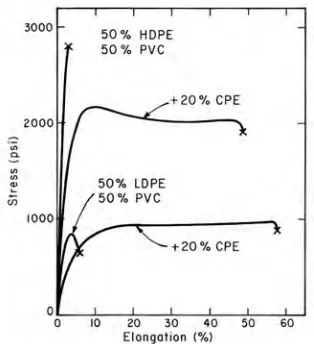
FIGURE 1.6. Stress-Strain curves for blends of low-density or high-density polyethylene (LDPE or HDPE) and poly(vinyl chloride) (PVC) using a compatibilizer of chlorinated polyethylene (CPE). From reference [110]. ...15
FIGURE 1.7. Intimate blending of two immiscible polymers (Poly-A and Poly-B) and their processing to achieve intimate blends using CDs. ...16
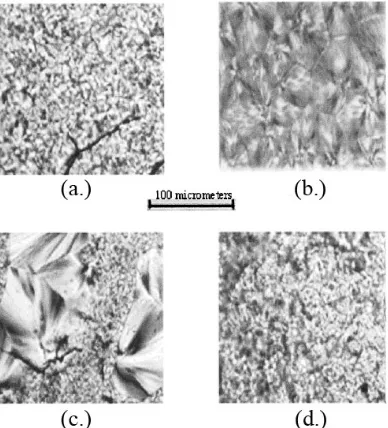
FIGURE 1.8. Polarized optical micrographs of (a.) PLLA, (b.) PCL, (c.) solution cast, and (d.) coalesced PLLA/PCL blends. After reference [111]...17
FIGURE 1.9. An illustration of how compatibilization might work with CD-stars. ...18
FIGURE 3.1. Illustration of PS chains with different tacticities and their cross-sectional dimensions compared with the γ-CD core diameter...36 FIGURE 3.2. General synthesis route of CD-stars where (i.) is the Br-γ-CD ATRP
initiator route, and (ii.) is the ATRP route for the PS-γ-CD stars. For ATRP, Kdeact > Kact...37
FIGURE 3.5. 1H-NMR of PS5-γ-CD star showing the peaks ratioed to determine arm
length...43
FIGURE 3.6. FTIR of a.) γ-CD, b.) PS, c.) Br-γ-CD initiator, and d.) PS5-γ-CD star...45
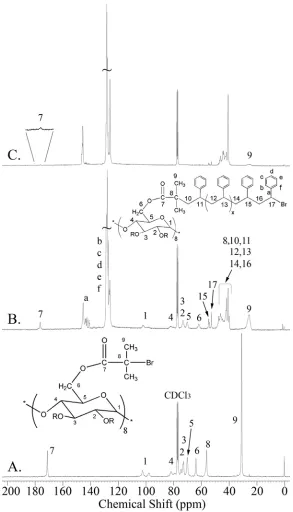
FIGURE 3.7. 13C-NMR of (A.) Br-γ-CD, (B.) PS5-γ-CD star, and (C.) PS29-γ-CD...47
FIGURE 3.8. GPC elution time traces and polydispersity indexes (PDI) of stars...49
FIGURE 3.9. Plot comparing (g) for equal Mn of star and linear polymers using DLS data, GPC data, and calculated by ZS (equation 3.1). ...55
FIGURE 3.10. Representative viscosity measurement showing CD-star DP = 51. Data set (- • ―) is fitted to equation 3.3, and (- × -) is fitted to equation 3.4 to find the intrinsic viscosity...56
FIGURE 3.11. Universal calibration plot comparing PS-γ-CD stars with linear PS polymer standards. ...59
FIGURE 3.12. (A.) DSC traces showing Tg dependance with respect to CD-star arm length, and (B.) comparison of Tg data with linear PS standards, where the Mn of the star is found various ways (see text for details)...60
FIGURE 3.13. Plot of (1/Mn) vs. Tg for various sample sets. The various sample sets (1) to (4) are described in the legend, where each set shows the fitted linear equation...62
FIGURE 3.14. Comparative TGA derivative plots for various arm lengths of CD-stars where (A.) presents all of the data collected, (B.) shows an expanded low temperature regime focused on the CD-core fraction of the stars, and (C.) gives an expanded high temperature regime around the PS-arm/PS decomposion temperature. ...64
FIGURE 4.1. Structure of polystyrene (PS), polydimethylsiloxane (PDMS), and star polymer with a γ-cyclodextrin core and PS arms (CD-star). ...71
FIGURE 4.3. Blended solutions of PS and PDMS in chloroform containing no star and with CD-star before and after heating to 60° C. The white Teflon coated magnetic stir bar on the bottom of the vials can be used to gauge solution clarity. ...77
FIGURE 4.4. All solutions above were stirred at room temperature and contained a constant CD-star amount (1wt% CD-core) with varying amounts of PDMS (308 kg/mol). The white Teflon coated magnetic stirbar on the bottom of the vials can be used to gauge solution clarity...78
FIGURE 4.5. The images above probe whether a 2-component blend (CD-star and PDMS only) will clear in solution. It is observed that no clearing of solutions is accomplished for a 2-component blend. If PS is added to the 2-component mixture, and again heated, clearing of the solution results. All solutions above maintain a concentration of 10g/dl in chloroform. The white Teflon coated magnetic stir bar on the bottom of the vials can be used to gauge solution clarity...79
FIGURE 4.6. 1H-NMR spectra for PS and PDMS blends containing 1wt% PDMS-308 with (1) 0.2wt% CD-core, (2) 0.6wt% CD-core, and (3) 1wt% CD-core. ....82
FIGURE 4.7. (A.) Typical 1H-NMR spectra of compatibilized CD-star blends. For (B.-D.) these spectra show an expanded CD-core region for samples containing 0.2wt%, 0.6wt%, and 1wt% CD-core, respectively. Vertical lines were drawn to emphasize peak shift occurance. ...83
FIGURE 4.8. (A.) 1H-NMR of the compatibilized CD-star solution whereas (1) and (2) show a partial correlated 2D-ROESY from this solution...85
FIGURE 4.9. Control solutions comparing various additives testing compatibilization. All solutions were prepared in chloroform with 5wt% PDMS (308 kg/mol) and, where applicable, contained 1 wt% γ-CD core. The white Teflon stirbar on the bottom of vials can be used to gauge solution clarity. ...87
FIGURE 4.11. Heat processed solutions of PS/PDMS blends containing varying arm length DPs for CD-stars and the observed effects on solution clarity. All solutions above contain 10wt% PDMS-308 with concentrations of 10g/dl. The white Teflon stirbar on the bottom of vials can be used to gauge solution clarity...91
FIGURE 4.12. (A) Interaction parameters between CD-stars and other blended components with respect to star arm length and (B) an interpretive illustration based on the relative Δδ2 values for each CD-star arm DP at the PDMS interface...94
FIGURE 4.13. (A) Intrinsic viscosities of the blended solutions containing constant amounts of PDMS while the amount of CD-star (or CD-core) is varied. (B) mass compositions of the sample solutions in which data set (1) has no-PDMS, (2) has 5wt% PDMS, and (3) has 10wt% PDMS. Within (B) the black bar represents the PDMS, the gray bar is the PS, and the red bar is the CD-star mass component. ...98
FIGURE 4.14. (A) Intrinsic viscosities of cleared solutions containing a constant amount of CD-star (1wt% CD-core) with various amounts of PDMS. Compatibilized solutions with PDMS-62(-○-) and PDMS-308(-●-) room temperature processed, and with PDMS-308(-▲-) heat processed. (B) Mass compositions of the sample solutions. Data set (1) has no CD-star, (2) has CD-star. The composition represented by black bar is the PDMS, the gray bar is the PS, and the red bar is the CD-star mass component...99
FIGURE 4.15. DLS of cleared solutions with CD-star where A.) shows deff after 2
hours in 1g/dl solution, and B.) shows deff after 2 days in 1g/dl solution....102
FIGURE 4.17. (A) Comparison plot of the GPC trace area ratios for PS/CD-star from Figure 4.13(B), and molar ratios of PS/CD-star from the compatibilized solutions. (B) shows the mass compositions for the compatibilized sample solutions examined, which CD-star is shown in red, and PDMS in black...107
FIGURE 5.1. Monte Carlo simulations showing the effectiveness of A-g-B copolymers to compatibilize homopolymers A and B. Image (a) does not contain graft copolymer, whereas images (b-e) have graft copolymer. The volume fractions assigned for homopolymer A (○ and -), homopolymer B (● and open white area), and copolymer, are 0.243, 0.568, and 0.189, respectively. After reference [8]. ...114
FIGURE 5.2. Comparison of spun cast films without star and with 1wt% CD-core with varying PDMS-62 content. ...117
FIGURE 5.3. Comparison of spun cast films without star and with 1wt% CD-core with varying PDMS-308 content. ...117
FIGURE 5.4. Atomic force microscope images of select spun cast films containing PDMS-308, where all samples incorporated 1wt% CD-core. The area scanned is 1μm x 1μm in all cases where the height and corresponding phase images and scales are shown. ...119
FIGURE 5.5. Scanning electron microscope images of spun coated films without (A) CD-star and with (B) CD-star. Both samples have 10wt% PDMS-308 incorporation. The CD-star sample (B) contains 1 wt% CD-core. ...120
FIGURE 5.6. Optical microscope images of spun cast films containing 5wt% PDMS with varying amounts of CD-star...121
FIGURE 5.7. Optical microscope images of spun cast films containing a constant 10wt% PDMS with varying amounts of CD-core. ...122
FIGURE 5.8. Illustration of a water contact angle measurement and the relation of surface tensions to Young's equation...126
FIGURE 5.10. Water contact angle for samples with A.) 5 wt% PDMS, and B.) 10 wt % PDMS. The maximum standard deviation for each data set is shown. ...128
FIGURE 5.11. Spun cast films containing PDMS-62 aged at 125° C for 3 days...130
FIGURE 5.12. Spun cast films containing PDMS-308 aged at 125 °C for 3 days...130
FIGURE 5.13. Shown are cast films of PDMS and PS blends without star. These films are also representative for the cast films containing CD-star. ...132
FIGURE 5.14. PDMS residue remaining on mold-release film after compression molding the 20 wt% PDMS-308 cast film (without CD-star). ...133
FIGURE 5.15. Representative 1H-NMR spectrum showing integrated areas used to determine PDMS retained from the dissolved PS/PDMS/CD-star film with 5 wt% PDMS-308. Set of peaks in area (1) are due to PS phenyl groups, set (2) peaks are due to PS backbone groups and the CD-core, and (3) peak is due to PDMS. ...135
FIGURE 5.16. Initial PDMS wt% vs actual retained PDMS wt% obtained by 1H-NMR. The CD-core content in data set (1) is constant at 1 wt%...136
FIGURE 5.17. Amount of PDMS remaining in compression molded films initially...137
FIGURE 5.18. Transmission optical micrographs for films with PDMS-62. Sample films containing star all have 1 wt% CD-core. Presented above these images are the compression molded films illustrating film opacity, as judged by the ability to read the “NC-State” text. ...138
FIGURE 5.19. Transmission optical micrographs for films with PDMS-308. Sample films containing star all have 1 wt% CD-core. Presented above these images are the compression molded films illustrating film opacity, as judged by the ability to read the “NC-State” text. ...138
FIGURE 5.21. Transmission micrographs for films with constant 10wt% PDMS and varying amounts of CD-core. Presented above these images are the compression molded films illustrating film opacity, as judged by the ability to read the “NC-State” text...140
FIGURE 6.1. DSC thermograms of (A) individual components making up the blends, and (B) blends of PS and CD-star with varying amounts of CD-star. Traces have been shifted vertically for clarity...147
FIGURE 6.2. DSC thermograms for films with initially 5wt% PDMS (A and B), and 10 wt% PDMS (C and D) with varying amounts of CD-core. Retained values of PDMS wt% are shown in parentheses as found by 1H-NMR after film processing. Traces have been shifted vertically for clarity...148
FIGURE 6.3. Plot showing Tg trends of the blended films. Sample assignments (A-D)
should be referenced as the thermogram sets from Figure 6.2. The sample set with “no PDMS” can be referenced in Figure 6.1(B). The Fox equation line is described in the text...150
FIGURE 6.4. DSC thermograms for films with constant CD-star (1wt% CD-core) and varying amounts of PDMS-308. Retained values of PDMS wt% values are shown in parentheses as found by 1H-NMR after film processing. Traces have been shifted vertically for clarity...151
FIGURE 6.5. Plot showing trends of Tg for blended films. Sample assignments (A-D)
should be referenced as the thermogram sets from Figure 6.4. The Fox equation data set is described in the text...153
FIGURE 6.6. Comparitive TGA derivative plots of films containing PS and PDMS blends with 1 wt% CD-core (-▲-), 0.6 wt% CD-core (-○-), 0.2 wt% CD-core (-□-), along with the individual components of PDMS-308 (- - -), PS (— —), and CD-star (——). Insets show (A.) expansion of lower temperature region, and (B.) expansion of higher temperature region. ...155
FIGURE 6.7. Sinusoidal oscillation and response of a linear viscoelastic material. From reference [14]. ...158
FIGURE 6.10. Tan delta (δ) for samples with varying PDMS and constant 1wt% CD-core...164
FIGURE 7.1. Comparision of spun cast films with and without CD-star. Solutions with CD-star were irradiated before spin casting...172
COMPATIBILIZATION OF
POLYSTYRENE/POLY(DIMETHYLSILOXANE) BLENDS
USING STAR POLYMERS CONTAINING A
γ
-CYCLODEXTRIN CORE AND POLYSTYRENE ARMS
1.
INTRODUCTION
1.1.
Properties of Cyclodextrins
Cyclodextrins are natural cyclic oligosaccharides first discovered and purified in 1891.1 Three types of cyclodextrins (CDs) exist in nature and only differ by the number of glucopyranose units found within the cyclodextrin ring. These three are referred to as α -cyclodextrin, β-cyclodextrin, and γ-cyclodextrin, which have 6, 7, and 8 glucopyranose units in their ring, respectively. The physical structure of cyclodextrin is a torus shaped molecule that has a hydrophilic exterior with a relative hydrophobic core as illustrated in Figure 1.1. It is the cyclodextrin core that gives these molecules their interesting properties.
FIGURE 1.1. Dimensions and physical properties of cyclodextrins. After reference [2].
structure of water and α-CD or γ-CD is found and of which both have been shown to contain even-symmetry. However, since β-CD has odd-symmetry, then no such favorable overlap with the structure of water exists resulting in a lower solubility in water.3
TABLE 1.1. Properties of cyclodextrins.
Property α-CD β-CD γ-CD
glucopyranose units† 6 7 8
molecular weight (g/mol)† 972 1135 1297
solubility in water (g/L)‡ 145 20 220
outer diameter (Å)§ 13.7 15.3 16.9
inner diameter (Å)§ 5.7 7.8 9.5
height of torus (Å)§ 7.8 7.8 7.8
† After reference [5]. ‡ After reference [3]. § After reference [2].
FIGURE 1.2. Common crystal structures of cyclodextrins. After reference [9].
1.2. Cyclodextrin Inclusion Complexes
1.2.1. Small Molecule/Cyclodextrin Inclusion Complexes
The hydrophobic cavity of CDs enables these molecules to play host to various molecular guests. This interaction can result in increased aqueous solubility for guest molecules that commonly only experience low solubility. This apparent increase in solubility for the guest is a consequence of the CD hydroxyl groups, which promote excellent solubilization in aqueous environments. For example, this interaction can be seen in Figure 1.3 between CD and toluene in water. This figure illustrates how the toluene guest resides in the CD host. Establishment of an equilibrium that favors inclusion of a guest is created if a lower energy state is experienced by toluene within the CD cavity, rather than in the aqueous environment.
Many guest molecules have been discovered to include into CD, leading to many applications being proposed to take advantage of this interaction.11 It is well documented that CDs have very low toxicity and are thus well-suited as food flavor stabilizers or delivery vehicles.12 One anticipated application is within the area of pharmaceuticals.1, 13-15 Since the human body is an aqueous-based environment, beneficial drugs that have low solubility in water can be administered at higher doses due to the increased solubility via the CD cavity. However, it should be noted that drug guests need to be of a size and shape complementary to the CD cavity for full or partial inclusion to occur.16
Besides pharmaceuticals, textile applications are seen as a promising application for CDs and are predicted to be involved in a lucrative revolution for this industry.1 For instance, when CDs were used in textiles for dyeing, Savarino and coworkers saw a four to ten fold improvement in the color uniformity for Nylon 66 and Nylon 6 when CD was used as the dye delivery vehicle.17-19 Commonly, inclusion of dyes into CD results in increased stability and fluorescence of the dyes.20, 21 After laundering in the presence of CDs, the surfactant remaining on the fiber is largely reduced, which can benefit the final dyeing and finishing processes in the textile industry.22 Furthermore, CDs can act as scent delivery vehicles to either introduce and retain perfumes in garments, or as time-release agents.23 On the other hand, instead of perfumes, if small molecules designed for insect repellants, antistatic, antistain, antibiotics,24, 25 or flame retardents26 were used, then the functionality of the garment is increased further.23
ability to trap apolar guests. These applications are just a few of the practical ideas for which CDs can be successfully used.
1.2.2. Polymer/Cyclodextrin Inclusion Complexes
Cyclodextrins not only form inclusion complexes with small molecules but also complex with macomolecules as well. Polymer/cyclodextrin inclusion-compounds (CD-ICs) are very interesting due to the induced confinement of the polymer chain while threaded into the CD-core. A typical procedure for making CD-ICs is shown in Figure 1.4. This illustration displays the characteristic channel structure that CD-ICs adopt. Confinement of the polymer chains in the CD channel serves to order them in the direction of the tube axis. This threaded complex is generally referred to as a polyrotaxane and has been found to occur with several polymers.34, 35 After CD-ICs are formed, CD can be washed away or enzymatically degraded to yield a coalesced polymer structure that possesses a higher degree of ordering than initially seen for the homopolymer itself.36
FIGURE 1.4. Procedure for making CD-ICs and the resultant extended polymer structure after coalescence. After reference [37].
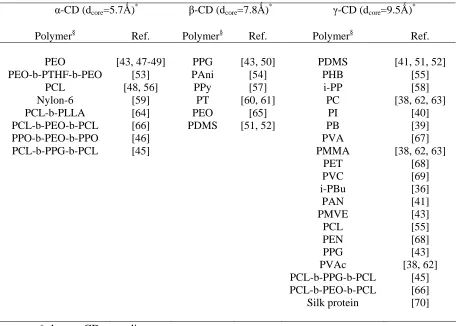
seen, many polymers have been found to thread into γ-CD, while α-CD and β-CD show fewer polymer species threaded. Characterization of the CD-ICs typically involves x-ray diffraction, which identifies the transformation of the CD crystal from the cage to columnar structure.38-41 Other characterization techniques such as NMR,42-44 FTIR,38, 45 DSC,38, 46 and TGA38, 45 have all been employed to confirm successful CD-IC complexation. Commonly, if a semicrystalline polymer is used to form a CD-ICs (or coalesced from CD-ICs), the precipitated product can exhibit higher degradation temperatures, increased levels of crystallinity, unusual polymorphs, and higher melting.37 For amorphous polymers, an increase in the glass transition temperature is characteristically observed.37
TABLE 1.2. Polymers that have been found to form CD-ICs.
α-CD (dcore=5.7Ǻ)* β-CD (dcore=7.8Ǻ)* γ-CD (dcore=9.5Ǻ)*
Polymer§ Ref. Polymer§ Ref. Polymer§ Ref.
PEO [43, 47-49] PPG [43, 50] PDMS [41, 51, 52]
PEO-b-PTHF-b-PEO [53] PAni [54] PHB [55]
PCL [48, 56] PPy [57] i-PP [58]
Nylon-6 [59] PT [60, 61] PC [38, 62, 63]
PCL-b-PLLA [64] PEO [65] PI [40]
PCL-b-PEO-b-PCL PPO-b-PEO-b-PPO
[66] [46]
PDMS [51, 52] PB
PVA
[39] [67]
PCL-b-PPG-b-PCL [45] PMMA [38, 62, 63]
PET PVC i-PBu PAN PMVE [68] [69] [36] [41] [43] PCL PEN PPG [55] [68] [43] PVAc PCL-b-PPG-b-PCL PCL-b-PEO-b-PCL Silk protein [38, 62] [45] [66] [70]
* dcore = CD-core diameter
TABLE 1.3. Abbreviations and definitions of select polymers.
i-PBu poly-1-butene PLLA poly(L-lactide)
PAN polyacrylonitrile PLU pluronic 105
PAni polyaniline PMeDMA poly(2-(dimethylamino)
PB polybutadiene ethyl methacrylate
PBH poly(R,S-3-hydroxybutyrate) PMMA poly(methyl methacrylate) PBS poly(butylene succinate) PMVE poly(methyl vinyl ether) PC polycarbonate PPG/PPO poly(propylene glycol) PCL poly(ε-caprolactone) PPy polypyrrole
PDMS poly(dimethylsiloxane) PS polystyrene
PEG/PEO poly(ethylene glycol) PT polythiophene PEI polyethylenimine PtBA poly(t-butyl acrylate) PEN poly(ethylene 2,6-naphthalate) PTHF poly(tetrahydrofuran) PET poly(ethylene terephthalate) PVAc poly(vinyl acetate)
PI polyisoprene PVC poly(vinyl chloride)
PLA polylactide
In addition, polymerizing monomers with CDs in an aqueous environment has been shown to be a viable and environmentally friendly method for making polymers.10, 60, 61, 72, 73 This is made possible by the monomer being included in the cavity, thereby solublizing it in water. Nanowires have also been shown to be made when a monomer is used in polymerizing a conductive polymer to form the CD-IC, in which the CD acts as an insulator.54, 60 Therefore if an organic solvent is used for a given common polymerization, this technique may reduce the environmental impact by replacing the solvent with water in making the polymer.
Possibly the most promising application is the use of CD-ICs as nucleation agents in bulk polymers. Since the formed CD-IC aligns the polymer chains, then the aligned chains protruding from the CD complex can aid in nucleation of bulk polymer chains. Dong et al. found that by adding 2 wt% CD-IC made with semicrystalline polymers (PCL, PEG, or PBS), of nucleation is enhanced in the crystalline regions of the respective bulk polymers.74, 75 It was shown by Zhang et al. that the storage modulus of PEG films nucleated with PEG-CD-IC increased with increased amounts of CD coverage.76 In addition they illustrated that films nucleated with PEG-CD-IC could be used as shape memory materials, using the CD-IC as a fixing phase, and achieving a recovery ratio of 97%. Furthermore, Vogel and coworkers successfully demonstrated that PHB melt-spun fibers nucleated by PHB-CD-ICs possessed a higher tensile strength than fibers without PHB-CD-IC.77 These examples illustrate the effectiveness of using CD-IC to enhance nucleation in bulk polymers.
guest in the CD cavity, therefore making this action unfavorable for complex formation.43 However, when a guest is included into the CD cavity, the overall ΔS value is slightly positive which stems from the release of a large number of solvent molecules from the CD core.47 With that said, the dominating interaction is enthalpic for nearly all CD/guest systems polymeric or otherwise.11, 53, 78 It has also been noted that if the guest is capable of hydrogen bonding, then interactions between the guest and CD hydroxyls may aid to further stabilize it.11, 79 In general, Lo Nostro and coworkers conclude that the driving force for guest/host complexation lies within the hydrophilic solvent pushing the hydrophobic polymer chain into the hydrophobic CD-core, thereby resulting in stabilization of the entire system.50
S T H G =Δ − Δ
Δ --- (1.1)
1.3.1. Solvent
Effects
The inclusion environment that a guest senses greatly depends on the comparative hydrophobicity of the CD-core to the solvent. Okumura et al. report that, in a set of polymers varying from hydrophilic to hydrophobic, CD-IC formation increases with increasing guest hydrophobicity.43, 52 Solvents that ranged in hydrogen bonding strength were studied by Ceccato et al., who found that the amount of time to thread (tth) PEG slightly
increased with decreasing hydrogen bonding strength (D2O > H2O > urea).47 This conclusion
was confirmed using the identical solvents with PPG and PLU.80
Lo Nostro and coworkers also studied the formation of amine-terminated PPG CD-IC with various salts.50 They found that anions affect the kinetics of CD-IC formation more than cations, giving larger fluctuations in threading times. The threading times for these environments decreased in the order of F- > OH- > Cl- > Br- > I- for anions, whereas for cations K+ > NH4+ > Na+ > Ca2+ > Li+. They conclude that hydrophobic forces in the
1.3.2. Guest Molecule Size Effects
There are two chain dimensions that have been found to affect the threading of the guest in the CD host: (1) the cross sectional dimension of the chain, and (2) the length (or molecular weight) of the chain. This second type was discussed previously in section 1.2.2, establishing that an increase in chain length promoted improved stability of the CD-IC. With regard to the first dimension, cross-sectional size exclusions can be manipulated by either using a polymer with bulky pendant groups, or in some cases, by changing the polymer tacticity. As stated earlier, molecular modeling has shown that isotactic PS can thread into γ -CD, however syndiotactic PS is found to be too large and is excluded.71 If a triblock
copolymer, such as for α-CD and PCL-b-PPG-b-PCL, is used for CD-IC formation the end blocks of PCL are favored for IC formation, while the midblock of PPG is not, in which case CD-ICs will preferentially form on the end blocks.45 Likewise if the midblock of a triblock copolymer is preferred to form CD-ICs, such as for α-CD and PPO-b-PEO-b-PPO, then CDs will develop primarily on the PEO.46 Therefore placement of the CDs can be controlled by the manipulation of the polymer chemical structure. Many researchers have shown that if a polymer which typically forms CD-ICs (eg. PEO) is capped with large bulky groups on the chain end, these endgroups can either prevent CDs from including or trap CDs on the chain.43
1.3.3. Temperature
Effects
In all solvent cases (D2O, H2O, urea), Lo Nostro et al. found that both ΔH and ΔS of the
complex decrease with increasing temperature.80 However they note that the enthalpic and enthropic contributions balance resulting in little change in ΔG with temperature.80 Ikeda and coworkers essentially observed this as well, and found that ΔG decreased slightly with increasing temperature after forming a rotaxane with PEO-b-PTHF-b-PEO.53
1.4. Polymers
Chemically
Modified with Cyclodextrin
the CD within polymer backbones and to polymers have been derived.81 Possible structures that can be obtained from CD attachment are shown in Figure 1.5, and will be individually discussed in the following sections. If the CD is not chemically bonded to the polymer, then leaching of the CD could be a concern when in an aqueous environment.12
FIGURE 1.5. Possible structures obtained by attaching CD to polymer by (A) grafting, (B) networking, (C) linearly polymerizing, and (D) star formation. Images A-C from reference [79].
1.4.1. Linear
Cyclodextrin
Polymers
Linear polymers with CD within the backbone chain have been prepared.79 However these
1.4.2. Grafted Cyclodextrin Polymers
Grafting CDs onto polymers presents similar challenges in that there are many reactive hydroxyl groups, thus making crosslinking highly probable. However there are typically two methods which are used: (1) to chemically attach the CD directly onto the surface of a preformed substrate, or (2) to chemically attach CD as a pendant group onto the polymer chain. Lee et al. employed method (1) to graft β-CD onto cotton fibers after which it was complexed with an antibacterial guest and observed to give a drastic increase in the antibacterial properties of the material even after ten laundering cycles.84 Others have done
the same with Nylon-6, and again with cotton.85, 86 In order to accomplish method (2), one
pathway to attach CD grafts is to prepare an alternating or random copolymer which contains one monomer that can react with CD while the other will not. This method was used by Renard et al. to successfully graft CDs on the copolymer backbone of poly(methyl vinyl ether)-alt-(maleic anhydride) by an esterification reaction.87 The product was found to be water soluble, which suggests no networking. As for linear CD polymers, grafted CD polymers are possible. However, due to the many hydroxyls on the CD this method becomes challenging to perform.
1.4.3. Networked Cyclodextrin Polymers
thereby forming an inorganic/organic composite.94 Insoluble networked CD-polymer particulates could be blended with homopolymer to form films or fibers, but uniform distribution of CDs cannot be accomplished to any great degree.
1.4.4. Cyclodextrin Star Polymers
Since this dissertation is primarily concerned with CD-star polymers, an exhaustive literature search reveals that only stars containing cores of α-CD and β-CD were found and have been thus far investigated. Table 1.4 shows the results of this search.
TABLE 1.4. Summary of CD-stars found in literature.
CD core polymer§ arm species # of arms polymerization
method Mn,star‡ PDI‡ Ref.
α-CD PtBA 18 ATRP not given not given [95]
PEI 6 Step-growth 1,490 (NMR) not given [96]
PEI 5 Step-growth 4,200 (NMR) not given [96]
β-CD PLA 14 ring-opening 12,500 (NMR) 1.7 (DLS) [97]
PMeDMA 21 ATRP 669,000 1.49 [98]
PMeDMA 21 ATRP 26,400 1.15 [98]
PMMA 21 ATRP 61,200 1.89 [99]
PMMA 21 ATRP 33,000 1.06 [100]
PMMA 21 ATRP 162,000 1.13 [100]
PS 21 ATRP 11,500 1.5 [99]
PS 7 TEMPO 45,200 1.05 [101]
PS 21 ATRP 14,200 1.12 [100]
PS 21 ATRP 53,700 1.41 [100]
PS 1 NMP 10,860 1.17 [102]
PS 7 RAFT 21,000 1.75 [103]
PS 7 RAFT 56,000 1.65 [103]
PtBA 21 ATRP 18,000 1.1 [95]
PtBA 21 ATRP 80,000 1.05 [95]
PtBA 21 ATRP 98,000 1.13 [104]
PtBA 21 ATRP 147,000 1.12 [104]
§ See Table 1.3 for polymer abbreviation definitions.
‡ Number average molecular weight (Mn) and polydispersity index (PDI) found by
The synthesis methods used for making the CD-stars involved mostly living polymerizations. In this table, the polymerization routes used to make CD-stars included reverse addition-fragmentation chain transfer (RAFT) polymerization, 2,2,6,6-tetramethylpiperidine-1-oxyl (TEMPO) initiation, nitroxide mediated polymerization (NMP), and atom transfer radical polymerization (ATRP). Use of living polymerization is beneficial due to the fact that termination by coupling is virtually nonexistent, thereby preventing a networked structure from forming. Essentially these CD-stars are observed to be monodisperse having polydispersity indices between 1 and 2, while the number of arms varied from 1 to 21. The advantage of CD-star polymers is in the control of the number and length of star-arms, which results in well-defined structures.
1.5. Compatibilization of Blended Homopolymers
Compatibilization lowers the interfacial energies between blend phases and stabilizes the dispersed phase. This often results in a reduction of the blend domain size in a solid-state film. More often than not, benefits of compatibilization are often seen as an improvment in the resultant mechanical properties of a film. Essentially there are two types of compatibilization: (1) reactive compatibilization and (2) compatibilization by addition of a third component that promotes blending.105 These two methods will be discussed further in the following sections.
1.5.1. Compatibilization
by Reactive Blending
(HIPS) is a classic example of type (2) reactive blending. The rubber phase in HIPS material is blended, while free radial polymerization of styrene monomer occurs resulting in graft-coupling of PS to the rubber phase.109 Both methods typically give an increase in impact toughness as a consequence of improved interfacial bridging.
1.5.2. Compatibilization by Addition of a Compatibilizer
Addition of a third component that serves to bridge the interface and lower interfacial energies is referred to as a compatibilizer. For this type of compatibilizer to be successful the added component needs to be capable of migrating to the interface while being processed. Two types of compatibilizer additives are found: (1) copolymer that contains both blended polymer species, or (2) as a multi-purpose compatibilizer (co-solvent). The quantity of compatibilizer typically added to a blend is between 0.5 - 4 wt% for a copolymer, while 15 - 35 wt% is added for a multi-purpose compatibilizer.107 The addition of a tailored compatibilizer generally results in an increase in stress transfer and toughness. Figure 1.6 shows the mechanical affects of adding a compatibilizer, in this case CPE, to blends of HDPE/PVC and LDPE/PVC. Clearly when CPE is present in the blends, a drastic increase in toughness occurs.
1.5.3. Compatibilization with Unmodified Cyclodextrins
Compatibilization is also possible by processing with pure CDs. If two immiscible polymers are mixed simultaneously to form a common CD-IC, then an intimate blend between these homopolymers can be obtained. An illustration of this concept can be seen in Figure 1.7. Since the formed ICs are fully covered in a jacket of CD, then the polymer pairs are shielded from each other. This results in the polymer chains having the ability to be intimately blended without being in intimate contact with one another and experiencing repulsive interactions that may increase their phase segregation. When coalescence of the CD-IC blend is performed by washing with warm water, the material produced from the blended polymer pair remains intimately blended.
FIGURE 1.7. Intimate blending of two immiscible polymers (Poly-A and Poly-B) and their processing to achieve intimate blends using CDs.
This compatibilization technique was first discovered by Rusa and Tonelli.111 They found if PCL and PLLA were processed together to form a common CD-IC, and were subsequently coalesced, characteristics identifiable with an intimate blend became evident.111 The intimate CD-IC mixture that was collected had weight fractions of 55/45 w/w for PCL/PLLA. Glass transition temperatures (Tg) for both homopolymers, as well as the melting temperature of
PCL (Tm), were unobservable. The only thermal event observed for this blend was the
of 56.6% for the pure homopolymer to 5.5% for the coalesced blend. However a physical blend of PCL/PMMA (50/50, w/w) showed all thermal events for both polymers in addition to the PLLA retaining a crystallinity of 41%. Visual evidence of blending can be seen within the micrographs in Figure 1.8, where all films used in this study were examined after annealing for 3 minutes at 200 °C.
FIGURE 1.8. Polarized optical micrographs of (a.) PLLA, (b.) PCL, (c.) solution cast, and (d.) coalesced PLLA/PCL blends. After reference [111].
Intimate blending via CD-ICs of several other polymer pairs have since been found. Similar observations were made with blends of PC/PMMA,63 PHB/PCL,55 PET/PEN,68 PC/PVAc,62, 112 and PMMA/PVAc.62 For many of these materials, the final stoichiomentry of the CD-IC
1.5.4. Compatibilization using Cyclodextrin-Stars
Achieving compatibilization of immiscible polymers with CD-stars was conceived as an extension of the research done by Rusa and Tonelli where they use as-received CDs for intimately blending polymers, as described in the previous section. Rather than using excess CD with respect to included polymer (typically CD ~90 wt% of the CD-IC), as performed in that work, our current work uses CD as a minor component (CD-core ~1wt%) in which the majority of mixed material is the blended homopolymers. Therefore an idea was envisioned that uses CDs as a compatibilizer to physically handcuff an incompatible polymer into a polymer matrix. Figure 1.9 illustrates this concept.
To accomplish compatibilization with CD-stars, the star polymer arms (poly-A) that are attached to the CD-core need to be of the same species as the matrix polymer (poly-A). This results in being able to homogeneously blend the CD-star into the polymer matrix via the compatibilizing star arms. This is in contrast to blending unmodified CD which forms aggregates in the polymer. Therefore, by adding CD-stars to a blend of poly-A and poly-B, and subsequent threading of poly-B into the CD-stars, poly-B will be anchored and physically blended into the matrix of poly-A.
Compatibilizers of this type have not been realized before. CD-star molecules have the ability to thread and compatibilize many different polymers (refer to Table 1.2) into a given polymer matrix. The primary advantage in using the CD-star compatibilizers, verses block or graft copolymers, is the versatility and ease of blending many polymers without the need to synthesize a new copolymer compatibilizer for each polymer blend. Interestingly, the final CD-star complex is analogous to a graft copolymer in structure and properties. This structure is a result of the threaded polymer (poly-B) creating the “backbone” of the polymer whereas the CD-star core with arms of poly-A making up the hybrid “slip-ring grafts” from poly-B. Therefore it is reasonable to imagine that the resultant properties of the CD-star system will be similar to traditional graft copolymers.
In fact it has been found, and will be discussed in this dissertation, that there are many similarities between the CD-stars and graft copolymers with respect to compatibilization. A brief summary of these findings are 1.) clearing of turbid solutions which possibly indicate unimolecular-micelle formation, 2.) a drastic decrease in blended polymer domain size for spun-cast films, 3.) stabilization of the phase morphology to annealing, 4.) increased retention of blended polymer due to physical constraint incurred by the CD-star slip-ring grafts, and 5.) thermal and mechanical property measurements that suggest compatibilization. These and other results will be discussed in the following chapters.
1.6. Motivation and Organization
The motivation for this work is to develop a general compatibilizer that can be used with various polymer blends so as to tailor the desired properties found in the homopolymers to the application of interest. As discussed earlier, cyclodextrins have been shown to thread onto many polymers offering a variety of possible blending options. The flexibility of having one compatibilizer additive that can be potentially used for blending several polymers within a given polymer matrix might be more cost effective. If blending occurs with CD-stars, syntheses of special blend-specific compatibilizers are not necessary. This leads to a compatibilizer system that is more advantageous from a cost and convenience standpoint.
Initially one immiscible system will be studied (in this case PS and PDMS), and the processing variables and resultant properties will be explored to determine the principles that are important for accomplishing compatibilization using CD-star molecules. In theory, the principles found for this blend can then be applied to other polymer blends for accomplishing compatibility. Therefore this dissertation will cover the following topics which involve CD-stars for blend compatibilization.
• CD-star synthesis and chemical characterization.
• Solution blending and processing.
• Resultant film morphology found by solution and spin casting.
• Thermal and mechanical properties of blended films.
1.7. References
1. Szejtli, J. Pure Appl. Chem. 2004, 76, (10), 1825-1845.
2. Larsen, K. L. Journal of Inclusion Phenomena and Macrocyclic Chemistry 2002, 43, 1-13.
3. Tchoreloff, P.; Baszkin, A.; Boisonnade, M.-M.; Zhang, P.; Coleman, A. W. Supermolecular Chemistry 1995, 4, 169-171.
4. Coleman, A. W.; Nicolis, I.; Keller, N.; Dalbiez, J. P. Journal of Inclusion Phenomena and Molecular Recognition in Chemistry 1992, 13, 139-143.
5. Martin Del Valle, E. M. Process Biochemistry 2004, 39, (9), 1033-1046.
6. Harata, K. Chemical Reviews 1998, 98, (5), 1803-1828.
7. Hunt, M. A.; Rusa, C. C.; Tonelli, A. E.; Balik, C. M. Carbohydrate Research 2004, 339, (17), 2805-2810.
8. Hunt, M. A.; Rusa, C. C.; Tonelli, A. E.; Balik, C. M. Carbohydrate Research 2005, 340, (9), 1631-1637.
9. Uyar, T. Nanostructuring Polymers with Cyclodextrins. Dissertation, North Carolina State University, Raleigh, NC, 2005.
10. Ritter, H.; Tabatabai, M. Progress in Polymer Science 2002, 27, 1713-1720.
11. Rekharsky, M. V.; Inoue, Y. Chemical Reviews 1998, 98, 1875-1917.
12. Hedges, A. R. Chemical Reviews 1998, 98, 2035-2044.
13. Uekama, K. Chem. Pharm. Bull. 2004, 52, (8), 900-915.
14. Singh, M.; Sharma, R.; Banerjee, U. C. Biotechnology Advances 2002, 20, (5-6), 341-359.
15. Bibby, D. C.; Davies, N. M.; Tucker, I. G. International Journal of Pharmaceutics 2000, 197, 1-11.
16. Chen, W.; Chang, C.-E.; Gilson, M. K. Biophys. J. 2004, 87, (5), 3035-3049.
18. Savarino, P.; Parlati, S.; Buscaino, R.; Piccinini, P.; Barolo, C.; Montoneri, E. Dyes and Pigments 2006, 69, 7-12.
19. Savarino, P.; Parlati, S.; Buscaino, R.; Piccinini, P.; Degani, I.; Barni, E. Dyes and Pigments 2004, 60, 223-232.
20. Park, J. S.; Wilson, J. N.; Hardcastle, K. I.; Bunz, U. H. F.; Srinivasarao, M. Journal of the American Chemical Society 2006, 128, 7714-7715.
21. Liu, Y.; Han, B.-H.; Chen, Y.-T. Journal of Organic Chemistry 2000, 65, 6227-6230.
22. Buschmann, H. J.; Denter, U.; Knittel, D.; Schollmeyer, E. Journal of the Textile Institute 1998, 89, (3), 554-561.
23. Szejtli, J. Starch-Starke 2003, 55, (5), 191-196.
24. Huang, L.; Taylor, H.; Gerber, M.; Orndorff, P. E.; Horton, J. R.; Tonelli, A. Journal of Applied Polymer Science 1999, 74, (4), 937-947.
25. Lu, J.; Hill, M. A.; Hood, M.; Greeson, D. F.; Horton, J. R.; Orndorff, P. E.; Herndon, A. S.; Tonelli, A. E. Journal of Applied Polymer Science 2001, 82, (2), 300-309.
26. Huang, L.; Gerber, M.; Lu, J.; Tonelli, A. E. Polymer Degradation and Stability 2001, 71, (2), 279-284.
27. Leslie, T.; Xiao, H.; Dong, M. Journal of Petroleum Science and Engineering 2005, 46, 225-232.
28. Wang, X.; Brusseau, M. L. Environ. Sci. Technol. 1995, 29, 2632-2635.
29. Hardt, I. H.; Wolf, C.; Gehrcke, B.; Hochmuth, D. H.; Pfaffenberger, B.; Huhnerfuss, H. Journal of High Resolution Chromatography 1994, 17, 859-864.
30. Wang, X.; Brusseau, M. L. Environ. Sci. Technol. 1993, 27, 2821-2825.
31. Sawunyama, P.; Bailey, G. W. Journal of Molecular Structure (Theochem) 2001, 541, (1-3), 119-129.
32. Kamiya, M.; Kameyama, K.; Ishiwata, S. Chemosphere 2001, 42, (3), 251-255.
33. Zeng, Q.; Liao, B.; Luo, Y.; Liu, C.; Tang, H. Bull. Environ. Contam. Toxicol. 2003, 71, 668-674.
35. Nepogodiev, S. A.; Stoddart, J. F. Chemical Reviews 1998, 98, 1959-1976.
36. Rusa, C.; Wei, M.; Bullions, T. A.; Rusa, M.; Gomez, M. A.; Porbeni, F. E.; Wang, X.; Shin, I. D.; Balik, C. M.; White, J. L.; Tonelli, A. E. Crystal Growth & Design 2004, 4, (6), 1431-1441.
37. Tonelli, A. E. Polymer 2008, 49, (7), 1725-1736.
38. Uyar, T.; Rusa, C. C.; Hunt, M. A.; Aslan, E.; Hacaloglu, J.; Tonelli, A. E. Polymer 2005, 46, (13), 4762-4775.
39. Michishita, T.; Okada, M.; Harada, A. Macromol. Rapid Commun. 2001, 22, 763-767.
40. Michishita, T.; Takashima, Y.; Harada, A. Macromol. Rapid Commun. 2004, 25, 1159-1162.
41. Porbeni, F. E.; Edeki, E. M.; Shin, I. D.; Tonelli, A. E. Polymer 2001, 42, (16), 6907-6912.
42. Paik, Y.; Poliks, B.; Rusa, C. C.; Tonelli, A. E.; Schaefer, J. Journal of Polymer Science Part B-Polymer Physics 2007, 45, (11), 1271-1282.
43. Harada, A. Coordination Chemistry Reviews 1996, 148, 115-133.
44. Martinez, G.; Gomez, M. A.; Villar-Rodil, S.; Garrido, L.; Tonelli, A. E.; Balik, C. M. Journal of Polymer Science Part a-Polymer Chemistry 2007, 45, (12), 2503-2513.
45. Shuai, X. T.; Porbeni, F. E.; Wei, M.; Bullions, T.; Tonelli, A. E. Macromolecules 2002, 35, (6), 2401-2405.
46. Li, J.; Ni, X.; Zhou, Z.; Leong, K. W. Journal of the American Chemical Society 2003, 125, 1788-1795.
47. Ceccato, M.; Lo-Nostro, P.; Baglioni, P. Langmuir 1997, 13, 2436-2439.
48. Huang, L.; Allen, E.; Tonelli, A. E. Polymer 1998, 39, (20), 4857-4865.
49. Rusa, C. C.; Tonelli, A. E. Macromolecules 2000, 33, (5), 1813-1818.
50. Lo-Nostro, P.; Lopes, J. R.; Ninham, B. W.; Baglioni, P. Journal of Physical Chemistry B 2002, 106, 2166-2174.
52. Okumura, H.; Kawaguchi, Y.; Harada, A. Macromolecules 2001, 34, 6338-6343.
53. Ikeda, T.; Lee, W. K.; Ooya, T.; Yui, N. J. Phys. Chem. B 2003, 107, 14-19.
54. Yoshida, K.-i.; Shimomura, T.; Ito, K.; Hayakawa, R. Langmuir 1999, 15, 910-913.
55. Shuai, X. T.; Porbeni, F. E.; Wei, M.; Bullions, T.; Tonelli, A. E. Macromolecules 2002, 35, (8), 3126-3132.
56. Rusa, C. C.; Luca, C.; Tonelli, A. E. Macromolecules 2001, 34, (5), 1318-1322.
57. Chen, W.; Wan, X.; Xu, N.; Xue, G. Macromolecules 2003, 36, 276-278.
58. Rusa, C. C.; Wei, M.; Bullions, T. A.; Rusa, M.; Gomez, M. A.; Porbeni, F. E.; Wang, X. G.; Shin, I. D.; Balik, C. M.; White, J. L.; Tonelli, A. E. Crystal Growth & Design 2004, 4, (6), 1431-1441.
59. Wei, M.; Davis, W.; Urban, B.; Song, Y. Q.; Porbeni, F. E.; Wang, X. W.; White, J. L.; Balik, C. M.; Rusa, C. C.; Fox, J.; Tonelli, A. E. Macromolecules 2002, 35, (21), 8039-8044.
60. Lagrost, C.; Lacroix, J.-C.; Chane-Ching, K. I.; Jouini, M.; Aeiyach, S.; Lacaze, P.-C. Adv. Mater. 1999, 11, (8), 664-667.
61. Takashima, Y.; Oizumi, Y.; Sakamoto, K.; Miyauchi, M.; Kamitori, S.; Harada, A. Macromolecules 2004, 37, 3962-3964.
62. Uyar, T.; Rusa, C. C.; Wang, X. W.; Rusa, M.; Hacaloglu, J.; Tonelli, A. E. Journal of Polymer Science Part B-Polymer Physics 2005, 43, (18), 2578-2593.
63. Wei, M.; Tonelli, A. E. Macromolecules 2001, 34, (12), 4061-4065.
64. Porbeni, F. E.; Shin, I. D.; Shuai, X. T.; Wang, X. W.; White, J. L.; Jia, X.; Tonelli, A. E. Journal of Polymer Science Part B-Polymer Physics 2005, 43, (15), 2086-2096.
65. Udachin, K. A.; Wilson, L. D.; Ripmeester, J. A. Journal of the American Chemical Society 2000, 122, 12375-12376.
66. Lu, J.; Shin, I. D.; Nojima, S.; Tonelli, A. E. Polymer 2000, 41, (15), 5871-5883.
68. Bullions, T. A.; Edeki, E. M.; Porbeni, F. E.; Wei, M.; Shuai, X.; Rusa, C. C.; Tonelli, A. E. Journal of Polymer Science Part B-Polymer Physics 2003, 41, (2), 139-148.
69. Gerardo Martínez, M. A. G., Silvia Villar-Rodil, Leoncio Garrido, Alan E. Tonelli, C. Maurice Balik,. Journal of Polymer Science Part A: Polymer Chemistry 2007, 45, (12), 2503-2513.
70. Rusa, C. C.; Bridges, C.; Ha, S.-W.; Tonelli, A. E. Macromolecules 2005, 38, (13), 5640-5646.
71. Hunt, M. A.; Jung, D. W.; Shamsheer, M.; Uyar, T.; Tonelli, A. E. Polymer 2004, 45, (4), 1345-1347.
72. Uyar, T.; Gracz, H. S.; Rusa, M.; Shin, I. D.; El-Shafei, A.; Tonelli, A. E. Polymer 2006, 47, (20), 6948-6955.
73. Hu, J.; Huang, R.; Cao, S.; Hua, Y. e-Polymers 2008, 171, 1-15.
74. Dong, T.; He, Y.; Zhu, B.; Shin, K.-M.; Inoue, Y. Macromolecules 2005, 38, (18), 7736-7744.
75. Dong, T.; Shin, K.-m.; Zhu, B.; Inoue, Y. Macromolecules 2006, 39, (6), 2427-2428.
76. Zhang, S.; Yu, Z.; Govender, T.; Luo, H.; Li, B. Polymer 2008, 49, (15), 3205-3210.
77. Vogel, R.; Tändler, B.; Häussler, L.; Jehnichen, D.; Harald Brünig. Macromolecular Bioscience 2006, 6, (9), 730-736.
78. Tellini, V. H. S.; Jover, A.; Garcia, J. C.; Galantini, L.; Meijide, F.; Tato, J. V. Journal of the American Chemical Society 2006, 128, (17), 5728-5734.
79. Crini, G.; Morcellet, M. Journal of Separation Science 2002, 25, 789-813.
80. Lo Nostro, P.; Lopes, J. R.; Cardelli, C. Langmuir 2001, 17, (15), 4610-4615.
81. Khan, A. R.; Forgo, P.; Stine, K. J.; D'Souza, V. T. Chemical Reviews 1998, 98, 1977-1996.
82. Tian, W.; Fan, X.; Kong, J.; Liu, T.; Liu, Y.; Huang, Y.; Wang, S.; Zhang, G. Macromolecules 2009, 42, (3), 640-651.
84. Lee, M. H.; Yoon, K. J.; Ko, S.-W. Journal of Applied Polymer Science 2000, 78, 1986-1991.
85. Gawish, S. M.; Ramadan, A. M.; Mosleh, S.; Morcellet, M.; Martel, B. Journal of Applied Polymer Science 2006, 99, 2586-2593.
86. Lee, M. H.; Yoon, K. J.; Ko, S.-W. Journal of Applied Polymer Science 2001, 80, 438-446.
87. Renard, E.; Volet, G.; Amiel, C. Polymer International 2005, 54, 594-599.
88. Manakker, F. v. d.; Vermonden, T.; Morabit, N. e.; Hennink, C. F. v. N. W. E. Langmuir 2008, 24, 12559-12567.
89. Ooya, T.; Akutsu, M.; Kumashiro, Y.; Yui, N. Science and Technology of Advanced Materials 2005, 6, 447-451.
90. Gao, Z.; Zhao, X. Polymer 2003, 44, 4519-4526.
91. Crini, G. Bioresource Technology 2003, 90, 193-198.
92. Yu, J. C.; Jiang, Z.-T.; Liu, H.-Y.; Yu, J.; Zhang, L. Analytica Chimica Acta 2003, 477, 93-101.
93. Busche, B. J.; Balik, C. M. Abstracts of Papers of the American Chemical Society 2006, 231: 155-PMSE Mar 26.
94. Ogoshi, T.; Chujo, Y. Macromolecules 2003, 36, 654-660.
95. Karaky, K.; Reynaud, S.; Billon, L.; François, J.; Chreim, Y. Journal of Polymer Science Part A: Polymer Chemistry 2005, 43, (21), 5186-5194.
96. Yang, C.; Li, H.; Goh, S. H.; Li, J. Biomaterials 2007, 28, (21), 3245-3254.
97. Adeli, M.; Zarnegar, Z.; Kabiri, R. European Polymer Journal 2008, 44, (7), 1921-1930.
98. Li, J. S.; Xiao, H. N.; Kim, Y. S.; Lowe, T. L. Journal of Polymer Science Part a-Polymer Chemistry 2005, 43, (24), 6345-6354.
100. Ohno, K.; Wong, B.; Haddleton, D. M. Journal of Polymer Science Part a-Polymer Chemistry 2001, 39, (13), 2206-2214.
101. Kakuchi, T.; Narumi, A.; Matsuda, T.; Miura, Y.; Sugimoto, N.; Satoh, T.; Kaga, H. Macromolecules 2003, 36, (11), 3914-3920.
102. Miura, Y.; Narumi, A.; Matsuya, S.; Satoh, T.; Duan, Q.; Kaga, H.; Kakuchi, T. Journal of Polymer Science Part a-Polymer Chemistry 2005, 43, (18), 4271-4279.
103. Stenzel, M. H.; Davis, T. P.; Fane, A. G. Journal of Materials Chemistry 2003, 13, (9), 2090-2097.
104. Plamper, F. A.; Becker, H.; Lanzendorfer, M.; Patel, M.; Wittemann, A.; Ballauf, M.; Muller, A. H. E. Macromolecular Chemistry and Physics 2005, 206, (18), 1813-1825.
105. Utracki, L. A. Canadian Journal of Chemical Engineering 2002, 80, (6), 1008-1016.
106. Brown, S. B., Reactive compatibilization of polymer blends. In Polymer Blends Handbook, Utracki, L. A., Ed. Kluwer Academic Publishers: Dordrecht, The Netherlands, 2003; Vol. 1, pp 339-415.
107. Utracki, L. A., Role of polymers blends' technology in polymer recycling. In Polymer Blends Handbook, Utracki, L. A., Ed. Kluwer Academic Publishers: Dordrecht, The Netherlands, 2003; Vol. 2, pp 1117-1165.
108. Sperling, L. H.; Hu, R., Interpenetrating polymer networks. In Polymer Blends Handbook, Utracki, L. A., Ed. Kluwer Academic Publishers: Dordrecht, The Netherlands, 2003; Vol. 1, pp 417-447.
109. Akkapeddi, M. K., Commercial Polymer Blends. In Polymer Blends Handbook, Utracki, L. A., Ed. Kluwer Academic Publishers: Netherlands, 2003; Vol. 2, pp 1023-1115.
110. Paul, D. R., Interfacial Agents ("Compatibilizers") for Polymer Blends. In Polymer Blends, Paul, D. R.; Newman, S., Eds. Acadenic Press: New York, 1978; Vol. 2, pp 35-62.
111. Rusa, C. C.; Tonelli, A. E. Macromolecules 2000, 33, (15), 5321-5324.
2.
EXPERIMENTAL
2.1.
Materials
ACS grade solvents and basic-alumina were purchased from Fisher Scientific or Sigma Aldrich Chemical Co. and used without further purification, unless otherwise noted. Reagents used in syntheses were purchased from Sigma Aldrich Chemical Co. and used without further purification, with the exception of the styrene monomer, which had the inhibitor removed by filtration through a basic-alumina column just before use. γ -Cyclodextrin was purchased from Cerestar, and randomly methylated γ-cyclodextrin (50% methylated) was purchased from Cyclodextrin Technologies Development Inc. of High Springs, Florida.
Low molecular weight PS standards used in glass transition temperature analysis in Chapter 3 were purchased from Pressure Chemical Company. PS was purchased from the Aldrich Chemical Company, and PDMS purchased from Gelest Incorporated. All polymers were used as received.
2.2.
Physical and Chemical Structure Analysis
2.2.1.
X-Ray Diffraction
Wide angle x-ray diffraction (WAXD) measurements were performed on a Siemens type-F x-ray diffractometer with a Ni-filtered Cu Kα radiation source (λ = 1.54 Å). The voltage and current were 30kV and 20mA, respectively. X-ray intensities were measured every 0.1° from 2θ = 5 to 30° at a scanning rate of (2θ = 3°) per minute.
2.2.2.
Fourier Transform Infrared Spectroscopy
dry air to eliminate water vapor. The spectra were collected over a range of 4000 to 400 cm-1, with a resolution of 2 cm-1 obtained after 64 scans.
2.2.3.
Nuclear Magnetic Resonance Spectroscopy
1H-NMR and 13C-NMR were collected on a Varian Gemini 300 MHz Spectrometer equipped
with a narrow bore magnet and 5 mm 4N (1H, 13C, 19F, and 31P) probe at room temperature. All samples examined by 1H-NMR had 32 sampling repetitions whereas 13C-NMR samples had 20,000 sampling repetitions. 1H-NMR solutions were prepared at a concentration of 50mg/ml, whereas 13C-NMR samples were prepared at 200mg/ml.
2.3.
Solution Property Analysis
2.3.1.
Capillary Viscometry
Capillary viscometery was conducted with a #25 Cannon Ubbelohde semi-micro dilution type viscometer. Viscosity measurements were conducted in a 25 gallon water bath which was equilibrated overnight at 25°C. The viscometer was allowed to equilibrate in the water bath before introducing the solution to be measured. All solutions were prepared just before introduction into the viscometer, and were filtered through a 1μm polytetrafluoroethylene (PTFE) syringe filter to remove any particulates. The amount of time for the meniscus to move between the two timing marks was recorded manually using a stop-watch that read to 0.01 seconds.
2.3.2.
Dynamic Light Scattering
Solvents used were tetrahydrofuran (THF) with a viscosity of 0.480cP and a refractive index of 1.407, and chloroform (CHCl3) with a viscosity of 0.542cP and a refractive index of 1.446.
2.3.3.
Gel Permeation Chomatography
Gel permeation chromatography (GPC) was implemented to determine molecular weight distributions, Mw/Mn, of the star-molecule samples. These measurements were conducted
using a Waters Breeze High Performance Liquid Chromatograph with wavelength absorbance and refractive index detectors. The GPC instrument was calibrated for quantitative measurement using linear polystyrene standards. The UV absorbance detector was calibrated for a wavelength of 254nm. The elutant used in all cases was tetrahydrofuran (HPLC grade). The solution concentration was 1mg/ml. All samples were examined at 25°C. All solutions were filtered through a 0.2μm PTFE syringe filter to remove any particulates before introduction into the sample cuvette.
2.4.
Solid State Property Analysis
2.4.1.
Thermal Property Analysis
2.4.1.1.
Thermal Gravimetric Analysis
Sample degradation temperatures and thermal stability were examined with a TA Instruments Q5000 thermal gravimetric analyzer. The examined temperature range was from 25 °C to 600 °C at a ramp rate of 5 °C/min. Samples were heated under an atmosphere of nitrogen with sample masses of approximately 10mg. A platinum pan and hang-down wire were used when heating the samples.
2.4.1.2.
Differential Scanning Calorimetry
156.61 °C. The temperature accuracy after calibration is stated to be 0.1 °C per the manufacturer. Calibrations were done using standard aluminum sample pans with a heating rate of 10 °C/min under helium gas. Data was analyzed using the TA Universal Analysis software.
Thermal examination of the samples was performed while under a helium purge of 25ml/min. All heating and cooling rates were conducted at 10°C/min. The DSC traces reported within this dissertation are the second heating cycle. Sample masses for testing were on the order of 10mg and sealed in a standard aluminum sample pan.
2.4.2.
Mechanical Property Analysis
2.4.2.1.
Dynamic Mechanical Analysis
Dynamic mechanical analysis was conducted on a TA Instruments DMA-600 in tension using a frequency of 1Hz and a strain amplitude of 0.1%. Cryogenic temperatures and control was accomplished with a liquid nitrogen cooling system. The samples were tested in the temperature range of -130 °C to 130 °C with a ramp rate of 2 °C/min. Each sample was allowed to equilibrate at -130 °C before heating.