Noise Reduction in Subtle Video Motion
Magnification Using Combined Wavelet
Domain Spatio-Temporal Video De-Noising
By Block Based Motion Detection Method
Kranti S. Kamble
1, R A Patil
2PG Scholar [EXTC], Dept. of Electrical Engg, VJTI, Mumbai, Maharashtra, India1
Associate Professor, Dept. of Electrical Engg, VJTI, Mumbai, Maharashtra, India2
ABSTRACT: We introduced the noise reduction technique in Eulerian video motion magnification based on wavelet domain filters.The goal of this paper is to reduce noise in subtle video motion Magnification and amplify temporal variations to reveal imperceptible changes which are difficult to see with naked eye. The input to this method is a standard video sequence, then spatial decomposition is applied followed by temporal filtering to the frames which is called “Eulerian Video Magnification”. The obtained signal is magnified to disclose hidden information. In the proposed method the amplified temporal variations are de-noised with combined spatial filter in wavelet domain and temporal filter to give noise free results in videos. We exhibit the advantages of this approach on natural and synthetic video sequences, and explore applications in visualization, video enhancement and scientific analysis.
KEYWORDS:Spatio-temporal analysis, Eulerian motion, wavelet domain spatial filter,temporal filter .
I.INTRODUCTION
The human visual system has limited spatio-temporal sensitivity. Very small signals below this sensitivity are difficult to see with naked eye but it can be informative. These motions can disclose some mechanical behaviour or potential information about the world. The motion magnification technique acts like microscope for visual motion [1]. It can amplify subtle video motions which are invisible to human visual system. Recently proposed Eulerian based video magnification (EVM) eliminates the need for costly flow computation and process the video separately in time and space [2]. The limitation of EVM is that it i) supports small amplification factors at high spatial frequencies ,ii) Noise can
be
magnified linearly with amplification factor. To overcome these issues Wadhwa et al. proposed the Eulerian based phase based video processing approach using complex steerable pyramids[3].Unfortunately, for sequences with noisy phase signal, the part of image in magnified video may appear to move incoherently.Main contribution of this paper is to reduce the noise in Eulerian video motion magnification to achieve the high quality de-noised video. The noise reduction technique used here is combined spatial filter in wavelet domain and temporal filter. . In spatial filtering, we propose a new wavelet shrinkage method, which estimates how probable it is that a wavelet coefficient represents a “signal of interest” given its value, given the locally averaged coefficient magnitude and given the global sub band statistics. The temporal filter combines a motion detector and recursive time-averaging. The results show that this combination outperforms single resolution spatio-temporal filters in terms of quantitative performance measures as well as in terms of visual quality.
II.BACKGROUND OF EULERIAN VIDEO MOTION MAGNIFICATION (EVM)
the input is standard video sequence. Next the video sequence is decomposed into spatial frequency bands followed by temporal filters. The obtain frames are amplified to reveal the hidden information.
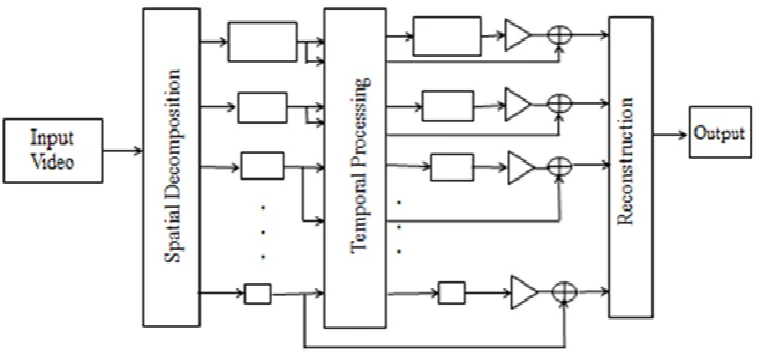
The EVM process is shown in fig 1.where combination of spatial and temporal processing is used to emphasize the subtle variations of video.
Fig. 1 EVM framework
The video sequences are first decomposed into different spatial frequency bands by using Laplacian pyramids. These bands are then applied to band-pass filters to extract the frequency bands of interest. Now these filtered signals are amplified differently with amplification factor (α) according to signal to noise ratio and spatial frequencies. This process can amplify the small motions without costly flow computation or tracking motion as in Lagrangian method [1].
The drawback of EVM is that it support only small amplification factor and significantly amplify the noise with amplification factor.
In section III we will show how to extract and amplify video
III.MOTION MAGNIFICATION
In this section, the pixel level motion is analysed by spatio-temporal processing only. Here, for explaining the relation between temporal processing and motion magnification, we consider the simple case of 1D signal undergoing translation motion just like in Wu.et al [2]. This analysis generalises directly to 2D locally- translation motion. This section shows how motion magnification is obtain by temporal processing using an analysis that relies on the Taylor series first-order expansions common in optical flow analyses [4-5].
Let I (x, t) denote the image intensity at position x and time t. In EVM, the intensities are observed with respect to a displacement function δ(t), Since the image undergoes translational motion, such that I (x, t) = f (x + δ(t)) and I (x, 0) = f (x). The synthesized pixel value in motion magnification is obtained as,
Î (x, t) = f (x + (1 + α) δ(t)) (1)
For fixed amplification factor (α).
Assuming the image f (x + δ(t)) at time t can be approximated by using first order Taylor series expansion about x as,
𝐼 𝑥, 𝑡 ≈ 𝑓 𝑥 + 𝛿 𝑡 𝜕𝑓 (𝑥)
Let the result of applying broadband temporal bandpass filter to image I (x, t) at every position x be B(x, t). Assuming the motion signal δ(t), is within passband of temporal bandpass filter. Then we have,
𝐵 𝑥, 𝑡 = 𝛿 𝑡 𝜕𝑓 (𝑥)
𝜕𝑥 . (3)
Now we amplify the bandpass signal with some amplification factor α and add it back to original signal I (x, t) to obtain the processed signal as,
ĩ(x, t) = I (x, t) + αB(x, t). (4)
Combining Eqs. 2, 3, and 4, we have
ĩ 𝑥, 𝑡 ≈ 𝑓 𝑥 + (1 + α) 𝛿 𝑡 𝜕𝑓 (𝑥)
𝜕𝑥 . (5)
Assuming the first-order Taylor expansion holds for the amplified larger perturbation, (1 +α)δ(t), we can relate the amplification of the temporally bandpassed signal to motion magnification. The processed output is simply
ĩ (x, t) ≈ f (x + (1 + α)δ(t)). (6)
Above equation shows that temporal processing magnifies motion-the spatial displacement 𝛿 𝑡 of local image f(x) at time t is amplified with magnitude of (1+ α).
IV.PROPOSED METHOD
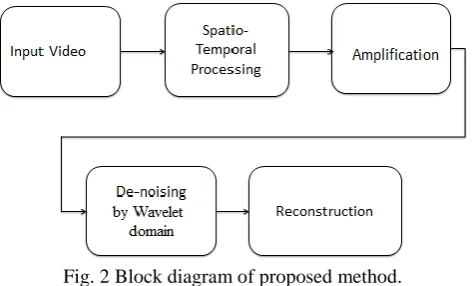
In this section the proposed method for noise reduction in EVM using combined wavelet domain spatio-temporal processing is discussed. The block diagram for proposed method is shown in fig.2.
Fig. 2 Block diagram of proposed method.
The process up to amplification is same as EVM and based on Eulerian based linear approximation method [2]. Here noise gets amplify linearly with amplification factor. Therefore to overcome this drawback of EVM, we used the proposed method called combined wavelet domain spatial filtering and temporal processing video de-noising method. Next, the output is reconstructed by adding the de-noised amplified motion to original and disintegrating the spatial pyramid.
In proposed algorithm the amplified temporal variations are de-noised with combined spatial filter in wavelet domain and temporal filter to give noise free results.
show that this combinationoutperforms single resolution spatio-temporal filters in terms of quantitative performance measures as well as in terms of visual quality.
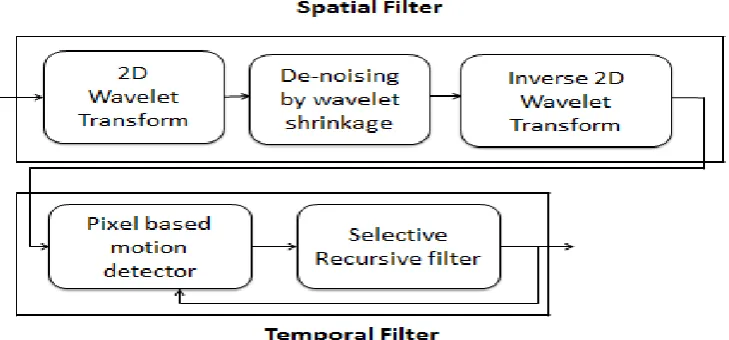
Video de-noising algorithm is performed in two steps; 1. Spatial filtering of individual frames in wavelet domain, 2.Temporal filtering of spatially filtered frames using block based motion detection and recursive time averaging of the spatially filtered frames. The block diagram of proposed video de-noising method is shown in fig.3.
Fig. 3 Block diagram of video de-noising by wavelet domain spatial filter and temporal processing.
A. Spatial filtering
First, the amplified video frames say g of size m × n are converted to image of size 512 × 512. The 2D redundant wavelet transform is applied to each frame. The frames are decomposed up to 4 levels. The Symmlet wavelet transform with 4 vanishing moments are used here [6-7]. The obtained wavelet coefficients at each level of decomposition are shrinked by adaptive bayesian wavelet shrinkage method [8,9].
The noise reduction is generally done by wavelet shrinkage: the magnitude of each coefficient is decreased by a given amount depending on the noise level and depending on how likely it is that a given coefficient represents an actual discontinuity. Each wavelet coefficient is shrinked according to probability that it represents a “signal of interest”. The imperative coefficient whose magnitude is above a certain threshold is defined as the signal of interest. Thresholding is common shrinkage approach, which puts the wavelet coefficients with “small” magnitudes to zero while keeping the remaining ones unchanged (“hard- thresholding ”) or shrinking in magnitude the remaining ones (“soft thresholding”).
Taking inverse wavelet transform the modified coefficients are reconstructed. The reconstructed images are converted back to frames of original sizes.
B. Temporal Filtering
In video de-noising, it is well known that spatial de-noising produces disturbing artifacts and unpleasant visual quality [10]. This is due to the fact that residual noise and annoying artifacts differ from frame to frame causing unpleasant “flickering” effect. In the algorithm, a temporal filter suppresses the residual noise and artifacts produced by the 2-D wavelet domain filter. Temporal filtering is based on a simple block based motion detection and recursive time averaging of spatially filtered frames. We use a pixel-based motion detector and we switch off the recursive filtering at those positions (in space and time) where motion is detected.
recursive filter accumulates and averages the pixel intensities at a given position from all the previous frames if the motion was not present at that position. The detection of a motion resets the filter.
V. RESULT AND DISCUSSION
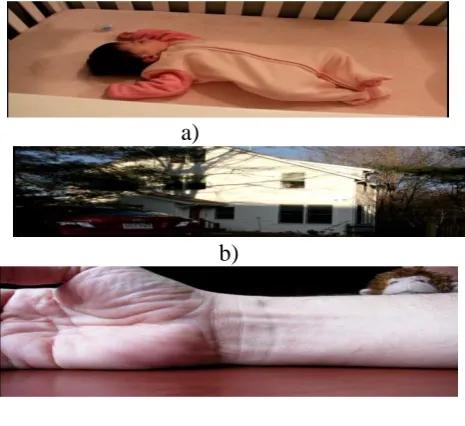
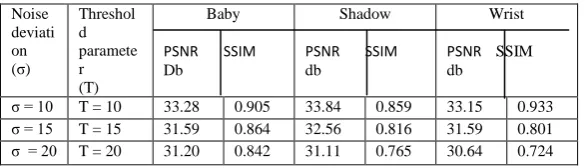
The performance of the de-noising algorithm is tested on four different videos: “Baby,” “shadow,” and “wrist,” These test videos have been corrupted with Gaussian noise of the following standard deviation values: σ = 10, 15 and 20. The spatial filtering part is implemented with a non-decimated wavelet transform with 4 decomposition levels. The wavelet used is sym4 for decomposition [8]. The optimal value of threshold is selected as T= σ. The peak signal to noise ratio (PSNR) and structural similarity index (SSIM) [12] are the two criteria to calculate the de-noised results.
PSNR is defined as,
PSNR= 20 log10 (𝟐𝟓𝟓
𝑹𝑴𝑺𝑬)
Where, RMSE is root mean squared error between noise free frame and de-noised frame . SSIM is defined as,
SSIM (x,y) = (𝟐𝝁𝒙𝝁𝒚+𝒄𝟏)(𝟐𝝈𝒙𝒚+𝒄𝟐)
(𝝁𝒙𝟐+𝝁𝒚𝟐+𝒄𝟏)(𝝈𝒙𝟐+𝝈𝒚𝟐+𝒄𝟐)
Where,𝜎𝑥2, 𝜇𝑥 and 𝜎𝑥𝑦 are the variance, mean and cross correlation computed within local window respectively. Fig 4.shows the test frame images and fig.5.Shows the comparative result between different methods and proposed method for de-noised baby sequence.Fig.6. shows the comparision between linear EVM method and proposed method in handling noise for some amplification factor (α= 3,6,10)
.
Table 1 shows the experimental results of test videos in terms of PSNR and SSIM. Table 2 shows the comparison results between linear approximations EVM, phase based EVM, E2VM and proposed method in terms of PSNR and SSIM. The proposed method improves the visual quality of all test sequences.a)
b)
c)
a)
b)
c)
d)
e)
fig.5. Results for the 50th frame of the denoised “Baby” sequence. (a) Noisy image frame with σ = 15; (b) Linear approximation EVM, PSNR=16.15 (c) Phase based video processing, PSNR=27.21dB; (d) E2VM, PSNR=26.01dB; (e)
Proposed method (combined wavelet domain with temporal filtering), PSNR=31.59 dB.
(d)
Fig 6: Comparison between linear Eulerian motion magnification and proposed method in handling noise. (a) A frame in a sequence of IID noise. In both (b) and (c), the motion is amplified by a factor of 50, where (b) uses the linear technique and (c) uses the Proposed video denoising approach. (d) shows a plot of the error as
function of noise for each method, using several magnification factors(α= 3,6,10).
Table 1: NUMERICAL RESULTS ON TEST VIDEO FRAME AVARAGED ON 50TH FRAME
Table 2:.COMAPARISM RESULTS ON THE TEST VIDEOS FRAMES AVERAGED ON 50TH FRAMES BETWEEN LINEAR APPROXIMATION [2], PHASE BASED VIDEO PROCESSING [3], E2VM METHOD [11]
AND PROPOSED METHOD.
Noise deviati on (σ) Threshol d paramete r (T) Baby
PSNR SSIM Db
Shadow
PSNR SSIM db
Wrist
PSNR SSIM db
σ = 10 T = 10 33.28 0.905 33.84 0.859 33.15 0.933 σ = 15 T = 15 31.59 0.864 32.56 0.816 31.59 0.801 σ = 20 T = 20 31.20 0.842 31.11 0.765 30.64 0.724
Video sequence
Noise
deviation(σ)
Baby
10 15 20
Shadow
10 15 20
Wrist
10 15 20
PSNR(db)
Linear
method
EVM
17.5 17.44 16.22
18.23 18.15 17.55
22.88 22.72 22.71
Phase
based
EVM
29.42 28.21 27.87
29.55 27.64 28.59
30.74 29.24 27.45
E2VM
27.78 26.0125.98
29.27 29.44 28.69
30.5 30.04 29.81
Proposed
method
VI.CONCLUSION
The developed sequential spatio-temporal scheme for video de-noising, where 2-D wavelet de-noising is followed by selective recursive temporal filtering. To achieve a high-quality video de-noising, we used a non-decimated wavelet transform and a spatially adaptive wavelet shrinkage method. Here the performance of proposed methods gives noise free results compare to previous Eulerian based method.
To improve the result of the 2D wavelet filtering, we combined it with a temporal filter, which combines a pixel based motion detector and a recursive time-averaging. The results show that this combination of the 2D wavelet domain and temporal filtering for video de-nosing outperforms in terms of quantitative performance measures and in terms of visual quality.
REFERENCES
[1] Liu C, Torralba A, Freeman W T, et al. Motion Magnification. ACM Transactions on Graphics. 2005, 24(Jul): 519-526.
[2] Wu H, Rubinstein M, Shih E, et al. Eulerian Video Magnification for Revealing Subtle Changes in the World. ACM Transactions on Graphics. 2012, 31(4): 65.
[3] Wadhwa N, Rubinstein M, Durand F, et al. Phase-Based Video Motion Processing. ACM Transactions on Graphics. 2013, 32(4).
[4] LUCAS, B. D., AND KANADE, T. 1981. An iterative image registration technique with an application to stereo vision. In Proceedings of IJCAI, 674–679.
[5] HORN, B., AND SCHUNCK, B. 1981. Determining optical flow Artificial intelligence 17, 1-3, 185–203. [6] I. Daubechies, Ten Lectures on Wavelets, Philadelphia:SIAM, 1992.
[7] S. Mallat, A wavelet tour of signal processing,Academic Press, London, 1998.
[8] A. Pizurica, V. Zlokolica, and W. Philips, “Combined wavelet domain and temporal video denoising,” in Proc. IEEE Conf. Adv. Video Signal- BasedSurveillance, Miami, Fla, USA vol. 1, pp. 334–341, Jul.2003.
[9] Seema Mishra and P. Swami.”Spatio-Temporal Video Denoising by Block-Based Motion detection”,International Journal of Engineering Trends and Technology (IJETT) - Volume4 Issue8- August 2013.
[10] J. C. Brailean, R. P. Kleihorst, S. Efstratidis, K. A Katsaggeleos, and R. L. Lagendijk, “Noise reduction filters for dynamic image sequences: A review,” IEEETrans. on Image Process., vol. 83, no. 9, pp. 1272– 1292, Sep. 1995.
[11] . Le Liu , Lu L, Jingjing Luo ,Jun Zhang, Xiuhong Chen.: „Enhanced Eulerian video magnification.‟ 7th International Congress on Image and Signal Processing (CISP), oct.2014.