ISSN (Print) : 2320 – 3765 ISSN (Online): 2278 – 8875
I
nternational
J
ournal of
A
dvanced
R
esearch in
E
lectrical,
E
lectronics and
I
nstrumentation
E
ngineering
(An ISO 3297: 2007 Certified Organization)
Vol. 3, Issue 11, November 2014
10.15662/ijareeie.2014.0311100
FPGA Based 64-Bit Low Power RISC
Processor Using Verilog HDL
V.Prasanth, K.V.Rajeshkumar
M.Tech (Ph.D) Head of the Department, Department of ECE, Pragati Engineering College, Surampalem, AP, India
P.G.Student, Pragati Engineering College, Surampalem (Ap) India)
ABSTRACT:RISC is a design philosophy to reduce the complexity of instruction set that in turn reduces the amount of power consumption, space, cycle time, cost and other parameters taken into account during the implementation of the design. The advent of FPGA has enabled the complex logical systems to be implemented on FPGA. The intent of this paper is to design and implement 64 bit RISC processor using FPGA Spartan 3E tool. This processor design depends upon design specification, analysis and simulation. It takes into consideration very simple instruction set. The momentous components include Control unit, ALU, shift registers and accumulator register. Power consumption reduced by designing clocking techniques.
KEYWORDS: RISC, control unit, processor
I. INTRODUCTION
Now days, Computers are mainstream in quotidian activities. RISC Processor is a CPU design strategy that uses simplified instructions for higher performance with faster execution of instruction. It also reduces the delay in execution. It uses general instructions rather than specialized instructions. They are less costly to design, test and manufacture. This has helped in implementation of RISC in technological field. Its range of application includes signal processing, convolution application, supercomputers such as K computers and wider base for smart phones.
In this work, a 64 bit RISC processor is presented with higher performance and efficiency being the main aim. This processor comprises of Control unit, general purpose registers, Arithmetic and logical unit, shift registers. Control unit follows instruction cycle of 3 stages fetch, decode and execute cycle. According to the instruction to the fetch stage, control unit generate signal to decode the instruction. The architecture supports 16 instructions for arithmetic, logical, shifting and rotational operations.
The whole paper is divided into the following sections. Section I describes the architecture of the processor. Section II explains the various modules of the processor. Result has been presented in the section III
II. ARCHITECTURE
ISSN (Print) : 2320 – 3765 ISSN (Online): 2278 – 8875
I
nternational
J
ournal of
A
dvanced
R
esearch in
E
lectrical,
E
lectronics and
I
nstrumentation
E
ngineering
(An ISO 3297: 2007 Certified Organization)
Vol. 3, Issue 11, November 2014
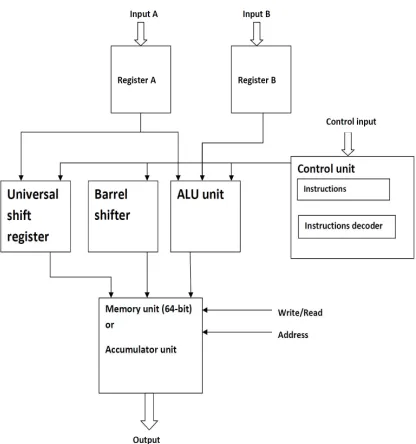
Figure 1.Architecture of 64 bit RISC processor
The control unit accepts the opcode and generate the signal that triggers the components and data path to work accordingly and perform the desired function. The control unit has two instruction decoders. These two decoders decode the instruction bits and direct the signal to either into ALU, universal shift register or barrel shift rotator. The operands are received from register A or register B. Upon receiving the operands from registers and the decoded instruction bits arithmetic and logical unit perform arithmetic and logical functions. Universal shift register and barrel shift rotator receives the input from register A and depending upon the decoded information perform the desired operation of either shifting or rotation and the result is stored in the accumulator register.
Figure 2.State diagram
III. MODULES IN THE DESIGN OF 8 BIT RISC PROCESSOR
ISSN (Print) : 2320 – 3765 ISSN (Online): 2278 – 8875
I
nternational
J
ournal of
A
dvanced
R
esearch in
E
lectrical,
E
lectronics and
I
nstrumentation
E
ngineering
(An ISO 3297: 2007 Certified Organization)
Vol. 3, Issue 11, November 2014
10.15662/ijareeie.2014.0311100
1. Control Unit:
The control unit is based on state diagram as depicted in the figure 2. The state machine performs the functions of arithmetic, logical, shifting and rotating functions. If bit instruction is 0100 then OR operation is performed as soon as next instruction is received then appropriate operation is performed. The control unit consists of two decoders. The first decoder performs arithmetic and logical function and the second decoder performs shifting and rotating operations. The top block of control unit is shown in the figure 3.
Figure 3: RTL diagram of RISC processor
2. ALU
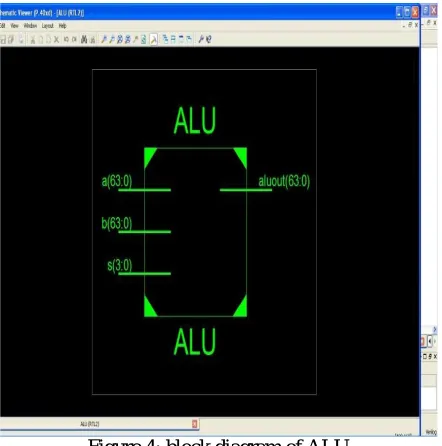
Arithmetic and logical unit is a digital circuit that performs arithmetic and logical operations. The proposed design performs seven logical functions and two arithmetic functions. The logical operations to be executed are AND, NAND, OR, NOR, XOR, XNOR and NOT while two logical operations are performed Addition and Subtraction. ALU will receive instruction bits from control unit and will execute the desired operation. For example, if input to control unit is 0000, the decoded bits will be 64-bit data and after receiving the instruction bits from the decoder AND operation is performed by ALU according to the operands from register A and register B. The top block is shown in the figure 4.
ISSN (Print) : 2320 – 3765 ISSN (Online): 2278 – 8875
I
nternational
J
ournal of
A
dvanced
R
esearch in
E
lectrical,
E
lectronics and
I
nstrumentation
E
ngineering
(An ISO 3297: 2007 Certified Organization)
Vol. 3, Issue 11, November 2014
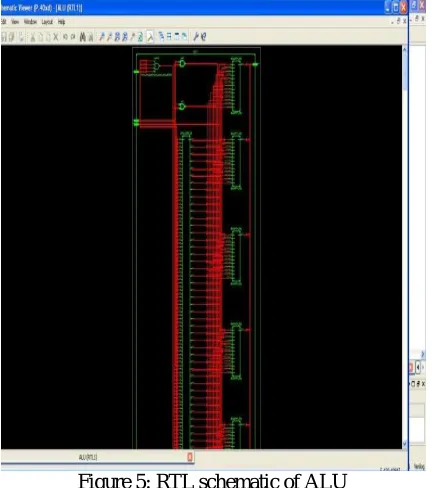
Figure 5: RTL schematic of ALU
Selection line decode output function
0000 output = A and B AND Operation
0001 output = A nand B NAND Operation
0010 output = A or B OR Operation
0011 output = A nor B NOR Operation
0100 output = A xor B XOR Operation
0101 output = A xnor B XNOR Operation
0110 output = not A NOT Operation
0111 output = A + B ADDITION Operation
1000 output = A – B SUBTRACT Operation
ISSN (Print) : 2320 – 3765 ISSN (Online): 2278 – 8875
I
nternational
J
ournal of
A
dvanced
R
esearch in
E
lectrical,
E
lectronics and
I
nstrumentation
E
ngineering
(An ISO 3297: 2007 Certified Organization)
Vol. 3, Issue 11, November 2014
10.15662/ijareeie.2014.0311100
3. Barrel Shifter:
Barrel shifter is shown in the figure 6. It is a digital circuit that shifts the number of bits by specified times. It will receive the decoded instruction bits from the second instruction decoder inside the control unit and performs the desired operation depending upon operand from register A and select lines.
Figure 6: block diagram of barrel shifter.
ISSN (Print) : 2320 – 3765 ISSN (Online): 2278 – 8875
I
nternational
J
ournal of
A
dvanced
R
esearch in
E
lectrical,
E
lectronics and
I
nstrumentation
E
ngineering
(An ISO 3297: 2007 Certified Organization)
Vol. 3, Issue 11, November 2014
Selection line decode output function
1001 output = A62…A0,A63 one bit left Rotate
1010 output = one bit left A61…A0,A63,A62 rotate
1011 output = one bit left A2…A0,A63….A3 rotate
1100 output = one bit left A59…A0,A63..A60 rotate
Table 2: operation of Barrel shifter
Figure 8: Barrel shifter simulation result
4. Universal Shift Register
The architecture is shown in the figure 9. This architecture performs four main functions as follows loading the value, left shift and right shift and no change. If s4 and s5 both are low while z is equal to 01000000 the value is loaded. If s4 is low and s5 is high with decoded output z as z63….z0 left shift operation is performed.
ISSN (Print) : 2320 – 3765 ISSN (Online): 2278 – 8875
I
nternational
J
ournal of
A
dvanced
R
esearch in
E
lectrical,
E
lectronics and
I
nstrumentation
E
ngineering
(An ISO 3297: 2007 Certified Organization)
Vol. 3, Issue 11, November 2014
10.15662/ijareeie.2014.0311100
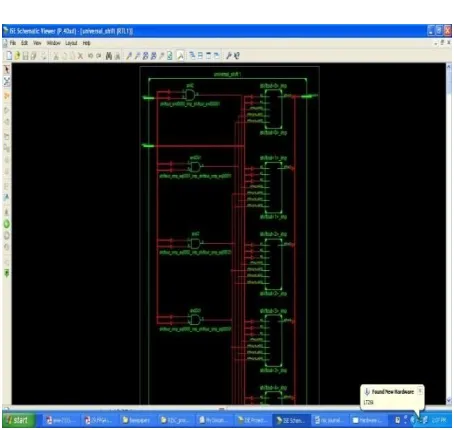
Figure 10: RTL diagram of universal shift.
Selection line decode output function
1101 output = A62…A0,0 one bit left Rotate
1110 output = one bit left 0,A63….A1 rotate
1111 output = one bit left A63….A0 rotate
Table 3: Operation of Universal shift register
5. General Purpose Register
General purpose register stores the 8 bit data. There are total 8 D flip flops. Two general purpose registers are A and B. If reset is high then register is clear, on the other hand if reset is low, rd is taken to be high and clock is high data is stored in the register. It is shown in the figure 11.
Input Output
Clock reset wr/rd input
1 1 X XXXX 0000 1 0 1 1010 0000 1 0 0 1010 1010
Table 4: Operation of general purpose register
6. Accumulator Register:
ISSN (Print) : 2320 – 3765 ISSN (Online): 2278 – 8875
I
nternational
J
ournal of
A
dvanced
R
esearch in
E
lectrical,
E
lectronics and
I
nstrumentation
E
ngineering
(An ISO 3297: 2007 Certified Organization)
Vol. 3, Issue 11, November 2014
Figure 11: block diagram of accumulator
IV. RESULT
Figure 12: Simulation results
Figure 13: Design summary
ISSN (Print) : 2320 – 3765 ISSN (Online): 2278 – 8875
I
nternational
J
ournal of
A
dvanced
R
esearch in
E
lectrical,
E
lectronics and
I
nstrumentation
E
ngineering
(An ISO 3297: 2007 Certified Organization)
Vol. 3, Issue 11, November 2014
10.15662/ijareeie.2014.0311100
the figure. The data is received from two 8 bit registers A and B. Signal READ (rd) is a memory interface signal. This signal adumbrates the memory location to be read and data to be put into the data bus. The synchronization is done utilizing clk signal. Design of processor has been accomplished using two control signals namely rd and reset. If reset is high, processor will not perform any operation and continue to remain in idle state. If reset is low and rd is high data is loaded into register. Depending upon the opcode from control unit the processor performs the operation. This 64 bit RISC processor works on one clock cycle. clk is the external clock signal and triggers the input and result in the output. rd triggers the state of registers A and B. s0 to s3 specifies the opcode to enable the operation. If opcode is 0100 then OR operation is performed
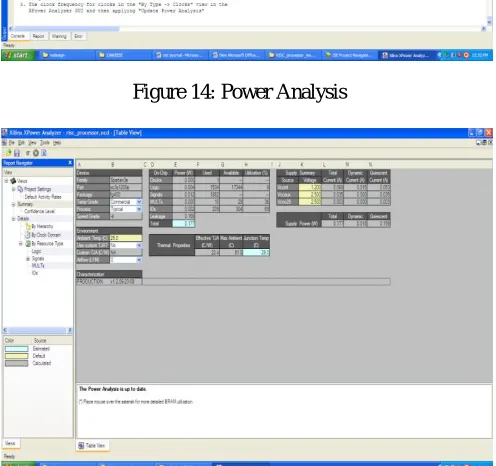
V. POWER ANALYSIS
Whereas power consumption point of view this RISC processor consumes 0.177mW within the frequency range of 1000 MHz.
Figure 14: Power Analysis
ISSN (Print) : 2320 – 3765 ISSN (Online): 2278 – 8875
I
nternational
J
ournal of
A
dvanced
R
esearch in
E
lectrical,
E
lectronics and
I
nstrumentation
E
ngineering
(An ISO 3297: 2007 Certified Organization)
Vol. 3, Issue 11, November 2014
VI. CONCLUSION
A 64 bit RISC processor with 16 instruction set has been designed. Every instruction has been executed in one clock cycle with 3 stage pipelining. Verification has been endeavored by exhaustive simulation. Power consumption also reduced by using clocking techniques, the processor can be used for mathematical computation in portable calculators as well as in gaming tool kit, signal processors, vending machines, etc...
REFERENCES
[1] B. Rajesh Kumar, Ravisaketh and Santha Kumar, 2014, “Implementation of A 16-bit RISC Processor for Convolution Application”, Research India publications, pp 441-446.
[2] Aneesh, R.; Jiju, K. "Design of FPGA based 8-bit RISC controller IP core using VHDL", India Conference (INDICON), 2012 Annual IEEE, On page(s): 427 - 432
[3] Ferdous, T. "Design and FPGA-based implementation of a high performance 32-bit DSP processor", Computer and Information Technology
(ICCIT), 2012 15th International Conference, on page(s): 484 – 489
[4] R Uma, Design and performance analysis of 8 bit RISC processor using Xilinx tools, March-April 2012, ”, International Journal of Engineering
Research and Applications (IJERA), pp 053-058.
[5] MD.Shabeena Begum, M.Kishore Kumar, “FPGA based implementation of 32 bit risc processor”, International Journal of Engineering Research
and Applications (IJERA), pp 1148-1151
[6] Mr. Sagar P. Ritpurkar, Prof. Mangesh N. Thakare, Prof. Girish D. Korde ,” Review on 32-bit MIPS RISC Processor using VHDL”, IOSR
Journal of Electrical and Electronics Engineering (IOSR-JEEE), PP 46-50
[7] Anjana R & Krunal Gandhi, “VHDL Implementation of a MIPS RISC Processor”, August 2012, International Journal of Advanced Research in