Zigbee Assisted Power Saving Management for
Mobile Devices
Danson Sahu
1; Ankit Prasad
2& G.Tamizharasi
31, 2 UG Student, Dept.Of Electronics and Telecommunication Engineering, Bharath University, India
[email protected]; [email protected]
3
Asst. professor, Dept. Of Electronics and Telecommunication Engineering, Bharath University, IndiaAbstract
WiFi transmission can consume much energy on energy-constrained mobile devices. Over the years WiFi has gained immense popularity in networking devices to transfer data over short distances. WiFi communication can consume a lot of energy on battery powered devices like mobile phones.To improve energy efficiency, the Power Saving Management (PSM) has been standardized and applied. The standard PSM, however, may not deliver satisfactory energy efficiency in many cases as the wakeup strategy adopted by it cannot adapt dynamically to traffic pattern changes. Motivated by the fact that it has been more and more popular for a mobile device to have both WiFi and other low-power wireless interfaces such as Bluetooth and ZigBee, we propose a ZigBee-assisted Power Saving Management (ZPSM) scheme, leveraging the ZigBee interface to wake up WiFi interface on demand to improve energy efficiency without violating delay requirements. The simulation results have shown that ZPSM can save energy significantly without violating delay requirements in various scenarios.
Keywords:
Zigbee; power saving management; energy efficiency; delay bound1.
Introduction
Mobile devices nowadays are extremely powerful devices used by people to stay in touch with others and manage everyday tasks. Mobile devices like smartphones are battery driven and hence they are energy constrained. And so their operational time is limited. It often happens that users forget to recharge their phones for days and a power source is not always available when the battery dies. Hence, it is important to address the energy consumption problem. A longer operational time is a desirable feature for users as well as the mobile manufacturers who are interested in offering longer operational times to their customers. Smart phones dominate the mobile devices market and they are equipped with multiple network interfaces like Wi-Fi and Bluetooth along with the cellular interface. WiFi technology is specified in the IEEE 802.11 standard [IEEE (1999)]. The presence of WiFi on mobile devices enables users to connect to networks without use of cables to the Internet which makes wireless networks very popular. Most of the web applications demand high bandwidth and low
latency and high throughput. Wi-Fi supports very good data rates, high latency and throughput. Also, the range of WiFi spans several meters. Hence it makes WiFi a very reliable and indispensible technology in present day mobile devices. Unfortunately, WiFi consumes a lot of power when it is turned on always. This is undesirable as this would drain the battery of the mobile device very quickly and the user would have to keep recharging through an external power source. Users can conserve power by turning of the WiFi when they do not use it, but this can burden the user. Improving energy efficiency of Wi-Fi networks is a long standing problem in wireless networks.
2.
Literature Review
minimized without affecting the Round Trip Time (RTT). They have achieved considerable improvement in energy consumption against the Constant Awake (CAM) mode. A Smart PSM scheme has been proposed in [Qiao and Shin (2005)]. In this the desired user delay is translated into a penalty function which is thereby translated into an optimal WiFi radio sleep/wakeup sequence. Hence the energy consumed is minimized under the user delay constraints. In [Agrawal et al. (2010)], the authors propose an algorithm called opportunistic PSM (OPSM) which is takes advantage of the activity over the WiFi radio which means that the radio needn't wakeup as frequently as in the case of static PSM (SPSM). So based on the traffic pattern the wakeup sequence changes which saves power. WLAN radiostypically conserve energy by staying in sleep mode. With real-time applica tions like Voice Over Internet Protocol (VoIP), the continuous nature of traffic makes it difficult for the radio to stay in the lower power sleep mode enough to reduce energy consumption significantly [Jin et al. (2011)] proposes the
WiZiCloud in which both mobile phones and access points have dual WiFi-ZigBee radio. This scheme saves energy by using ZigBee to maintain connec- tivity. Since WiFi radio isn't used for this purpose it saves energy. [Qin et al. (2011)] presents a system
for ZigBee-assisted WiFi transmission in which mobile devices form clusters. The devices in the cluster save power by taking turns to transmit packets. This reduces the contention and collision as well as energy consumption.
Area Network (PAN) and
WLAN
.
[Ananthanarayanan and Stoica (2009)]presents a simple scheme called Blue-Fi in which energy is conserved by using WiFi only when WiFi connectivity is available. This reduces idle power consumed when trying to discover connectivity and thus saves power. The WiFi connectivity is predicted using bluetooth contact patterns and cell tower information.
3.
Existing System
WiFi devices usually support two power modes: the power saving mode (PSM) in which the radio periodically wakes up to receive data packets so as to reduce the duration for idle listening and thereby energy consumption, and the constantly awake mode
(CAM) in which data packets can be received promptly at the cost of high power consumption. In the PSM, the AP broadcasts beacon frames every beacon interval (BI); each client wakes up every certain number of BIs, called listening interval (LI), to check whether it has data packets buffered at the AP. The AP indicates the presence of buffered packets by setting the Traffic Indication Map (TIM) fields in the beacon frame. If a client finds the corresponding TIM field is set, it sends a Power Save Polling (PS-POLL) frame to retrieve buffered packets from the AP. Besides, the AP uses MORE bit in the data packet to indicate if more packets are buffered, helping the client to decide when to go to sleep. Parameter LI is configurable, and its setting directly influences the performance.
4.
Proposed System
To utilize the co-existence of WiFi and ZigBee interfaces, a realistic concern is how severely they can interfere with each other, as both ZigBee and WiFi interfaces may work on the same frequency band (e.g., 2.4 GHz). Experiments have shown that WiFi communication can interfere with Zig- Bee communication severely if their working channels overlap. However, if their channels do not overlap, the interference becomes insignificant. To verify the validity of the above observation when WiFi and ZigBee interfaces are co-located in the same mobile station, we further conducted experiments. The experimental results indicate that, concurrent transmissions launched by co-located WiFi and ZigBee interfaces only result in small packet loss ratio (< 5%) on the ZigBee communication if the channels
used by them do not overlap.
percentage of packets received with a delay lower than the desired delay bound di among all incoming packets should be at least _i (called delay-meet ratio), where 0 < _i < 1. This is called delay requirements. Here, the delay is defined as the time elapsed from the arrival of a packet at the AP to the receipt of the packet at the destination client. For compatibility with SPSM, ZPSM clients are only allowed to retrieve packets after receiving a beacon frame as specified in the SPSM. Hence, in the worst case, a packet may have a delay up to two BIs (i.e., one BI delay for the AP to wait for client to wake up and one BI delay for the client to be served by the AP). Thus, for each ZPSM client, the delay bound should be at least two BIs; otherwise, it defaults to SPSM. As with the SPSM, we assume all clients are synchronized with the AP. In addition, due to the unreliable link quality of ZigBee channel, ZigBee transmission may fail; as the ZigBee interface at a client may be used for other purposes, packets transmitted by the ZigBee interface at the AP may fail to reach the client occasionally. We use the link quality pi to represent the probability that a packet sent by the AP through its ZigBee interface arrives at client i successfully. Note that the value of pi may vary over time. The AP is static while the clients can be mobile. We assume that the mobility of clients is relatively low. For example, the mobile WiFi devices may be carried by people who stay in conference rooms, libraries, cafe shops, stadiums, etc., where it is typical that a client is static, or moves for a while and then pauses for a while and so on and so forth, following the well-known random waypoint model.
In our proposed system wifi is nothing but acts like the load in any kind of system. Our project deals with only the power saving management technique. The further communication through the WiFi is not coming under consideration of the main idea of the project therefore in our prototype kit we are replacing the Wifi module with the relay switch and one electric servo motor.
5.
Wakeup Strategies
1.Regular wakeup: The client’s WiFi interface wakes up once every one LI to retrieve buffered data packets from the AP. This active wakeup strategy is also supported by the SPSM.
2.On-demand wakeup: The client’s WiFi interface is
woken up on demand by the AP through the ZigBee communication. This is a passive wakeup strategy proposed in this paper. With this strategy, time is divided into slots (called wakeup slots) of equal length denoted by W. The ZigBee interface of the AP is always awake and broadcasts a wakeup frame through its ZigBee interface once every certain number of wakeup slots called wakeup interval (WI). A wakeup frame contains bits indicating at which BI each client should wake up to receive beacons through the WiFi interface and retrieve data packets following the SPSM. In this paper, W is set to 40 ms which is the typical time to exchange one message between the AP and a client via their ZigBee interfaces. Apparently, using on-demand wakeup only can maximize energy efficiency as clients wake up their WiFi interfaces only when necessary. However, due to the unreliable link quality of ZigBee channel and occasional unavailability of ZigBee interface at a client, the delay requirements may not be satisfied. On the other hand, the regular wakeup strategy can guarantee delay requirements by setting appropriate LI(Listening Interval), but this strategy may spend much energy on unnecessary wakeups. Hence, our proposed design aims to employ these two approaches in a combined manner to strike a balance between energy consumption and delay.
6.
DESIGN
The Overview or we can say the schematic block diagram of our proposed system is given above.
6.1Zigbee
ZigBee is an IEEE 802.15.4-based specification for a suite of high-level communication protocols used to create personal area networks with small, low-power digital radios. The technology defined by the ZigBee specification is intended to be simpler and less expensive than other wireless personal area networks (WPANs), such as Bluetooth or Wi-Fi. Applications include wireless light switches, electrical meters with in-home-displays, traffic management systems, and other consumer and industrial equipment that requires shortrange low-rate wireless data transfer. Its low power consumption limits transmission distances to 10–100 meters line-of-sight, depending on power output and environmental characteristics. ZigBee devices can transmit data over long distances by passing data through a mesh network of intermediate devices to reach more distant ones. ZigBee is typically used in low data rate applications that require long battery life and secure networking (ZigBee networks are secured by 128 bit symmetric encryption keys.) ZigBee has a defined rate of 250 kbit/s, best suited for intermittent data transmissions from a sensor or input device.ZigBee was conceived in 1998, standardized in 2003, and revised in 2006. The name refers to the
waggle dance of honey bees after their return to the beehive. ZigBee is a low-cost, low-power, wireless mesh network standard targeted at the wide development of long battery life devices in wireless control and monitoring applications. Zigbee devices have low latency, which further reduces average current. ZigBee chips are typically integrated with radios and with microcontrollers that have between 60-256 KB flashes memory. ZigBee operates in the industrial, scientific and medical (ISM) radio bands: 2.4 GHz in most jurisdictions worldwide; 784 MHz in China, 868 MHz in Europe and 915 MHz in the USA and Australia. Data rates vary from 20 kbit/s (868 MHz band) to 250 kbit/s (2.4 GHz band). The ZigBee network layer natively supports both star and tree networks, and generic mesh networking. Every network must have one coordinator device, tasked with its creation, the control of its parameters and basic maintenance. Within star networks, the coordinator must be the central node. Both trees and
Figure 1 Block diagram for the Node 1
Figure 2 Block Diagram for the Node 2
meshes allow the use of ZigBee routers to extend communication at the network level. ZigBee builds on the physical layer and media access control defined in IEEE standard 802.15.4 for low-rate WPANs. The specification includes four additional key components: network layer, application layer, ZigBee device objects
(ZDOs) and manufacturer-defined application objects which allow for customization and favor total integration. ZDOs are responsible for some tasks, including keeping track of device roles, managing requests to join a network, as well as device discovery and security. ZigBee is one of the global standards of communication protocol formulated by the significant task force under the IEEE 802.15 working
group.
The fourth in the series, WPAN Low Rate/ZigBee is the newest and provides specifications for devices that have low data rates, consume very low power and are thus characterized by long battery life. Other standards like Bluetooth and IrDA address high data rate applications such as voice, video and LAN communications.
6.2 Arduino Uno
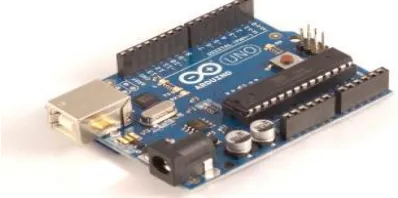
The Arduino Uno is a microcontroller board based on the ATmega328 (datasheet). It has 14 digital input/output pins (of which 6 can be used as PWM outputs), 6 analog inputs, a 16 MHz crystal oscillator, a USB connection, a power jack, an ICSP header, and a reset button. It contains everything needed tosupport the microcontroller; simply connect it to a computer with a USB cable or power it with a AC-to-DCadapter or battery to get started. The Uno differs from all preceding boards in that it does not use the FTDI USB-to-serial driver chip.
Instead, it features the Atmega8U2 programmed as a USB-to-serial converter."Uno" means one in Italian and is named to mark the upcoming release of Arduino 1.0. The Uno and version1.0 will be the reference versions of Ardiuno, moving forward. The Uno is the latest in a series of USB Arduino boards, and the reference model for the Arduino platform; for a comparison with previous versions.
7.
Software tools
In our Project we used two software tools one for the simulation and the another one for the programming of the above mentioned Arduino Uno Microcontroller.
Simulation Tool (Proteus ISIS)
Here we used Proteus ISIS(Intelligent Schematic Input System) as simulation tool. Proteus ISIS is the best simulation software in the world for various designs with electronics & microcontroller. It is mainly popular because of availability of almost all microcontrollers in it. So it is a handy tool to test programs and embedded designs for electronics hobbyist & expert. You can simulate your programming of microcontroller in Proteus 8 Simulation Software. After simulating your circuit using Proteus Software you can directly make PCB design with it so it could be an all in one package for students and hobbyists. So I think now you have a little bit idea about what is proteus software,
Programming Tool (Arduino IDE 1.6.8)
The open- source Arduino Software (IDE integrated development environment) makes it easy to write code and upload it to the board. It runs on Windows, Mac OS X , and Linux. The environment is written in Java and based on Processing and other open – source software. This Software can be used with any Arduino Board.
8.
Conclusion
In this project report, we proposed and prototyped a ZigBee assisted PSM system to improve energy efficiency in WiFi communication. Results of prototype-based experiment have shown significant improvement on energy the energy saving of ZPSM
over SPSM is still as high as 60% on average consumption compared to the standard PSM system.
9.
Reference
[1] R. Krashinsky and H. Balakrishnan, “Minimizing Energy for Wireless Web Access with Bounded Slowdown,” MobiCom 2002.
[2] G. Ananthanarayanan and I. Stoica, “Blue-Fi: Enhancing Wi-Fi Performance using Bluetooth Signals,” MobiSys 2009.
[3] TazTag TPHONE, www.nfc-phones.org/taztag-tph-one/.
[4] J. Yoo and et al., “A Cooperative Clustering Protocol for Energy Saving of Mobile Devices with WLAN and Bluetooth Interfaces,”
TMC 2011.
[5] Wikipedia, “ZigBee,” www.wikipedia.org/wiki/Zigbee.
[6] S. Kim, J. Chong, and et al., “Experiments on Interference and Coexistence between Zigbee and WLAN Devices Operating in the 2.4GHz ISM band,”
NGPC 2005.
Author’s Detail
DANSON SAHU
Pursuing bachelor of technology in Electronics & Telecommunication engineering from Bharath University, Chennai, India
Email: [email protected]
ANKIT PRASAD
Pursuing bachelor of technology in electronics & Telecommunication engineering from Bharath University, Chennai, India