Advanced Insulin Bolus Calculator Using Run
To Run Control and Case Based Reasoning
Algorithm
M. Vijay Shree1, D. Saravanan2,
M.E. (Embedded System Technologies), Department of ECE,Mahath Amma Institute of Engineering and Technology,
Pudukkottai, Tamil Nadu, India.
Assistant Professor, Department of ECE, Mahath Amma Institute of Engineering and Technology, Pudukkottai, Tamil
Nadu, India.
ABSTRACT: This paper exhibits a propelled insulin bolus consultant for individuals with diabetes on various day by day infusions or insulin pump treatment. The proposed framework, which keeps running on a cell phone, keeps the straightforwardness of a standard bolus adding machine while upgrading its execution by giving more versatility and adaptability. This is accomplished by method for applying a review enhancement of the insulin bolus treatment utilizing a novel blend of rushed to-run (R2R) that utilizations discontinuous ceaseless glucose observing information, and case-based thinking (CBR). The legitimacy of the proposed approach has been demonstrated by in-silico considers utilizing the FDA-acknowledged UVa-Padova sort 1 diabetes test system. Tests under more reasonable in-silico situations are accomplished by redesigning the test system to copy intrasubject insulin affectability varieties and instability in the capillarity estimations and sugar admission. The CBR(R2R) calculation performed well in reproductions by essentially diminishing the mean blood glucose, expanding the time in euglycemia and totally taking out hypoglycaemia. At last, contrasted with a R2R remain solitary form of the calculation, the CBR(R2R) calculation performed better in both grown-ups and pre-adult populaces, demonstrating the advantage of the use of CBR. Specifically, the mean blood glucose enhanced from 166 ± 39 to 150 ± 16 in the grown-up populaces (p = 0.03) andfrom167 ± 25 to 162 ± 23 in the juvenile populace (p = 0.06). Furthermore, CBR(R2R) could totally wipe out hypoglycaemia, while the R2R alone was not ready to do it in the immature populace.
KEYWORDS: Artificial intelligence, decision support systems, diabetes, iterative learning control, knowledge-based systems, runto-run control.
I.INTRODUCTION
Sort 1 diabetes mellitus is a ceaseless metabolic infection portrayed by an immune system pulverization of the insulin-emitting β-cells of the endocrine pancreas. The subsequent outright insulin inadequacy results in hyperglycemia [i.e., high blood glucose (BG)]. At present, the greater part of individuals with T1DM control their BG levels through different day by day infusions (before suppers and basally) so as to copy the normal insulin discharge of the pancreatic β-cells and by drawing blood from the fingertips and testing the glucose level with an electronic glucose meter (self-observing of BG). An option treatment to various day by day infusions is given by constant subcutaneous insulin implantation (insulin pump treatment), which permits variable basal rates of insulin and stays away from numerous uncomfortable infusions.
as it may, with special case of insulin bolus number crunchers fused in a large portion of the financially accessible insulin pumps and in some glucose meters, none of these calculations have been received economically.
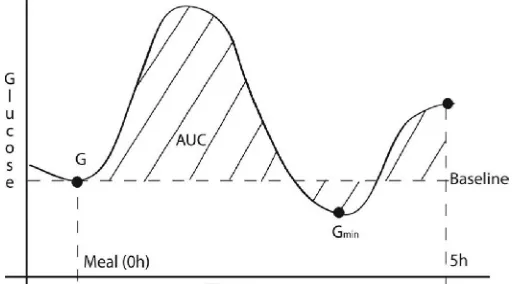
Fig. 1. Graphical representation of the postprandial glucose area under the curve (AUC) (i.e., striped area). Horizontal dashed line represents the baseline to calculate the AUC. Vertical dashed line represents the meal
ingestion time (0 h) and the 5 h postprandial period. G is the BG value at the time of meal ingestion (0 h) andGmin is theminimum glucose values during the postprandial excursion (5 h).
This absence of commercialization is mostly down to monetary danger, security issues, and inactivity to change, however the principle explanation behind the absence of accessible frameworks is the generally little remedial advantage accomplished by these frameworks contrasted and the huge weight required by the clients. Therefore, extra exertion toward more shrewd self-governing frameworks is required. The clinical advantage of hurried to-run (R2R) control for naturally conforming the insulin-to-sugar proportion (ICR) parameter of a bolus mini-computer has been considered with some underlying promising results. In any case, its appropriateness is restricted by the supposition of strict dreariness in the every day routine of individuals with T1DM. This paper displays an inventive choice bolster calculation for supper insulin dosing that gives improved versatility and adaptability to current bolus number crunchers by utilizing R2R control and case-based thinking (CBR). It is imperative to note that, dissimilar to existing shut circle control calculations for glucose control, which convey an insulin measurements each 5 min in view of a constant enhancement, our proposed calculation is a choice emotionally supportive network giving bolus insulin dosage suggestions taking into account review advancement, which requires endorsement by the client.
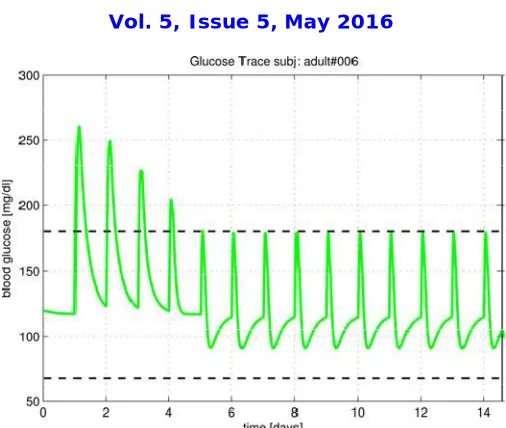
Fig. 2. Glucose concentration resulting from applying the proposed R2R algorithm over 14 days (single meal) on subject adult 6 of the T1DM simulator with an initial nonoptimal ICR. Upper and lower dashed lines indicate
hyper- /hypoglycemia limits (i.e., target zone).
A. Insulin Bolus Calculators
Insulin bolus calculators are simple decision support systems incorporated in most of the commercially available insulin pumps and more recently available within capillary BG monitors. These calculators consist of a relatively simple formula that uses subject-specific metabolic parameters to calculate an insulin dose. The standard bolus calculator is described as
B = CHO ICR + G − GTISF − IOB (1)
Fig. 3. CBR cycle proposed by Aamodt and Plaza
B. R2R Control
R2R is a control method designed to exploit repetitiveness in the process that is being controlled. Its purpose is to enhance performance, using a mechanism of trial and error. Owens et al. used this idea to exploit the repetitive nature of the insulin therapy regimen of the diabetic patient. This algorithm uses an update law that corrects the ICR of (1) for the next day based on a performance metric used to evaluate the postprandial glucose excursion. A pilot clinical study showed the efficacy of the R2R algorithm in T1DM subjects. However, the R2R algorithm presents some limitations that may restrict its scope of applicability. First of all, the algorithm requires two capillarity BG samples to evaluate the postprandial excursion.
On top of the burden that this represents to the subject, the postprandial excursion of a mixed meal depends on the composition, and these two measurement points may not be valid to evaluate certain meals. Then, R2R assumes that the insulin therapy regimen of the person with T1DM is repetitive, which is somewhat unrealistic in many cases. It is important to note that the original R2R algorithm only distinguishes between three situations (breakfast, lunch, and dinner). Therefore, the utilization of the R2R algorithm may be limited to subjects willing to carry out at least nine capillarity measurements per day and with a very repetitive daily routine.
II. TUNING AND INITIALIZATION
III. SAFETY AND EFFICACY MEASURES
The following safety and efficacy measures [36] (presented as Mean ± Standard Deviation) were used: The primary outcome was mean BG (mg/dL); secondary outcomes were percentage of time and incidence below range (any BG < 70 mg/dL), percentage of time within the 70–180 mg/dL target range, percentage of time above range in hyperglycemia (BG > 180 mg/dL), and BG risk index and risk zones of the control variability grid analysis (CVGA). CVGA is a method for visualization of the extreme glucose excursions caused by a control algorithm in a group of subjects, with each subject presented by one data point for any given observation period. CVGA is divided into nine zones (A, B, lower-B, upper-B, lower-C, upper-C, lower-D, upper-D, E), being zones A+B (including lower and upper) considered as optimal control and zones D+E considered as suboptimal control.
IV.RESULTS
In their work, Owen et al. proposed a convergence analysis for their R2R algorithm. However, the same analysis cannot be directly applied to the presented CBR(R2R) algorithm due to the different nature of the algorithms, i.e., addition of a CBR algorithm. Nevertheless, it is important to note that CBR(R2R) is equivalent to multiple incidences of an R2R algorithm. Therefore, by assuming that the information provided to the CBR(R2R) algorithm is within realistic limits of uncertainty, which allow to correctly retrieve the correct case from the case base, the convergence analysis of CBR(R2R) is reduced to the analysis of a single incidence of R2R. Therefore, if the proposed R2R algorithm is proven to converge, the CBR(R2R) algorithm is, by extension, also convergent. To carry out a convergence analysis of the R2R algorithm, a scenario containing one meal with carbohydrate load variability of [40, 60] gram (uniform distribution) was employed. The initial BG was randomly selected within the range [70,140] mg/dl (uniform distribution). The analysis was performed by isolating the parameters CHO, capillary BG and CGM measurements while adding different levels of uncertainty to these parameters. Unlike the convergence analysis proposed, we considered uncertainties within their realistic bounds and the combination of such uncertainties.
The initial ICR0 for the R2R algorithm was randomly selected within a range of [0.25 · ICR, 4 · ICR] (uniform distribution), where ICR is the optimal ICR provided by the T1DM simulator. The past analysis shows the performance of the R2R algorithm for each case study after 20 iterations together with the results for a bolus calculator without adaptation. For this purpose, the ten adult subjects of the T1DM simulator were employed. It can be seen that the algorithm is capable to converge to the target range, i.e., [70, 180] mg/dl, even when significant levels of uncertainty are added. Finally, no significant variability was observed on the number of iterations needed to converge to the glucose target range for the selected levels of uncertainty. The CBR(R2R) algorithmwas evaluated using the one-month scenario presented and four simulation runs. First of all, an initial simulation run (Run 1) was carried out using the bolus calculator formula (1) with nonoptimal parameters (ICR and ISF) and without any adaptation. Run 2 consisted of applying the CBR(R2R) algorithm with a case base containing a unique case with the same solution as the bolus calculator.
Runs 3 and 4 were like Run 2, but starting from the case base generated in the corresponding previous runs. In order to evaluate the benefit of enhancing the R2R algorithm with CBR, the R2R algorithm in a stand-alone mode was executed in the same scenario. For this purpose, the R2R algorithm in a stand-alone mode was configured with three instances of the algorithm corresponding to breakfast, lunch, and dinner show the simulation results corresponding to four runs of the R2R algorithm in a stand-alone mode and the CBR(R2R) algorithm, respectively. Results are presented as mean ± 1 standard deviation.
primary outcome improved from 166 ± 39 to 150 ± 16 in the adult populations and from 167 ± 25 to 162 ± 23 in the adolescent population. In addition, CBR(R2R) was able to completely eliminate hypoglycaemia, while the R2R alone was not able to do it in the adolescent population. Fig. 4 shows an example for subject adult#010 comparing the R2R and the CBR(R2R) algorithm during Run 4 of the simulation.
V. CONCLUSION
We presented a novel decision support algorithm for insulin dosing that enhances current standard bolus calculators through the utilization of an R2R, CBR, and intermittent usage of CGM data. Good in-silico results using an FDA-accepted type 1 diabetes simulator were obtained with the presented CBR(R2R) algorithm. First of all, a convergence analysis for the novel R2R algorithm was successfully carried out. To evaluate the incremental benefit of using R2R and CBR, the full version of the algorithm [i.e., CBR(R2R)] was compared against the R2R control algorithm in a stand-alone mode.
This comparison demonstrated a clear benefit of using CBR in combination with R2R with respect to using R2R alone. The R2R stand-alone version not only underperformed the CBR(R2R) version, but in some cases (i.e., adult population) performed worse than the standard bolus calculator. The reason for the poor performance of the R2R stand-alone version can be explained by its inability to cope with the significant insulin variability introduced in the simulations. It is important to note that R2R is based on the assumption of daily repetitiveness in the process, which is not the case for the employed scenario. The obtained results demonstrate that the propose CBR(R2R) algorithm is able to tackle with intrasubject variability and external perturbations, and robustness in front of uncertain inputs, i.e., carbohydrate intake and noisy CGM measurements.
It is important to remark that, although very useful for designing and testing purposes, simulators have their limitations. In general, simulation environments tend to overestimate the benefits of an intervention, since they do not incorporate all of the uncertainty and perturbations that occur in the real world. For this reason, clinical studies are required in order to fully validate the proposed algorithm. Therefore, modifications in the current version algorithm may be required when tested in a real scenario. Although the proposed algorithm showed robustness against sensor noise in simulation, CGM technology still presents some problems of accuracy and reliability that may affect the performance of the proposed algorithm in a real-life setting. One way to reduce this problem would be the utilization of two sensors.
However, this solution may be too cumbersome for the subject. Another way to improve sensor accuracy would be to ask for a postprandial recalibration (e.g., 2 h), which seems a reasonable measure since it is the recommendation given for the standard therapy. Finally, in order to deal with sensor failures (e.g., sensor drifts and communication problems), a fault detection algorithm could be incorporated to the system. It is important to note that the utilization of a CGM device does not need to be continuous, since the decision support system can still provide advice during the days when no CGM data are available by using the available cases in the case base, even if they are not optimal. Obviously, the R2R control update law can only be executed when these data are available. Therefore, using the CGM sensor periodically, although it may take longer to converge an optimal solution, may be beneficial in some cases because of usability issues.
REFERENCES
[1] A. Schiffrin and M. Belmonte, “Multiple daily self-glucose monitoring: Its essential role in long-term glucose control in insulin-dependent diabetic patients treated with pump and multiple subcutaneous injections,” Diabetes Care, vol. 5, no. 5, pp. 479–484, 1982.
[2] A. Flyvbjerg, G. Holt, C. Cockram, and B. J. Goldstein, Textbook of Diabetes: A Clinical Approach, 4th ed.NewYork,NY, USAWiley-Blackwell, 2010.
[3] Diabetes Control and Complications Trials Research Group, “The effect of intensive treatment of diabetes on the development and progression of long-term complications in insulin-dependent diabetes mellitus,” N. Engl. J. Med., vol. 329, pp. 977–986, 1993.
[4] L. H. Chanoch, L. Jovanovic, and Ch. M. Peterson, “The evaluation of a pocket computer as an aid to insulin dose determination by patients,” Diabetes Care, vol. 8, no. 2, pp. 172–176, 1985.
[5] A. Schiffrin, M. Mihic, B. S. Leibel, and A. M. Albisser, “Computerassisted insulin dosage adjustment,” Diabetes Care, vol. 8, no. 6, pp. 545– 552, 1985.
[7] A. M. Albisser, “Analysis: Toward algorithms in diabetes selfmanagement,” Diabetes Technol. Ther., vol. 5, no. 3, pp. 371–373, 2003. [8] C. L. Owens, H. Zisser, L. Jovanovic, B. Srinivasan, D. Bonvin, and F. J. Doyle III, “Run-to-run control of blood glucose concentrations for people with type 1 diabetes mellitus,” IEEE Trans. Biomed. Eng., vol. 53, no. 6, pp. 996–1005, Jun. 2006.
[9] H. Zisser, L. Robinson, W. Bevier, E. Dassau, C. Ellingsen, F. J. Doyle, and L. Jovanovic, “Bolus calculator: A review of four “smart” insulin pumps,” Diabetes Technol. Ther., vol. 10, no. 6, pp. 441–444, 2008.
[10] B. Bellazzi, “Telemedicine and diabetes management: Current challenges and future research directions,” J. Diabetes Sci. Technol., vol. 2, no. 1, pp. 98–104, 2008.
[11] C. C. Palerm, H. Zisser, W. C. Bevier, L. Jovanoviˇc, and F. J. Doyle III, “Prandial insulin dosing using run-to-run control: application of
clinical data and medical expertise to define a suitable performance metric,” Diabetes Care, vol. 30, no. 5, pp. 1131–1136, 2007.
[12] F. Gao, Y. Wang, and F. J. Doyle, “Survey on iterative learning control, repetitive control, and run-to-run control,” J. Process Control, vol. 19, no. 10, pp. 1589–1600, 2009.
[13] A. Aamodt and E. Plaza, “Case-based reasoning: Foundational issues, methodological variations, and system approaches,” AI Commun., vol. 7, no. 1, pp. 39–59, 1994.
[14] R. Hovorka, “Closed-loop insulin delivery: From bench to clinical practice,” Nat. Rev. Endocrinol., vol. 7, no. 7, pp. 385–395, 2011. [15] P. Herrero, P. Georgiou, N. Oliver, D. G. Johnston, and C. Toumazou, “A bio-inspired glucose controller based on pancreatic beta-cell physiology,” J. Diabetes Sci. Technol., vol. 6, no. 3, pp. 606–616, 2012.
[16] F. H. El-Khatib, S. J. Russell, D. M. Nathan, R. G. Sutherlin, and E. R. Damiano, “A bihormonal closed-loop artificial pancreas for type 1 diabetes,” Sci. Transl. Med., vol. 2, no. 27, p. 27ra27, 2010.
[17] B. P. Kovatchev, M. Breton, C. Dalla-Man, and C. Cobelli, “In silico preclinical trials: A proof of concept in closed-loop control of type 1 diabetes,” J. Diabetes Sci. Technol., vol. 3, no. 1, pp. 44–55, 2009.
[18] S. K. Garg, T. R. Bookout, K. K. McFann, W. C. Kelly, C. Beatson, S. L. Ellis, R. S. Gutin, and P. A. Gottlieb, “Improved glycemic control in intensively treated adult subjects with type 1 diabetes using insulinguidance software,” Diabetes Technol. Ther., vol. 10, no. 5, pp. 369–375, 2008.
[19] T. M. Gross, D. Kayne,A.King, C. Rother, and S. Juth, “Abolus calculator is an effective means of controlling postprandial glycemia in patients on insulin pump therapy,” Diabetes Technol. Ther., vol. 5, no. 3, pp. 365–369, 2003.
[20] B. Shashaj, E. Busetto, and N. Sulli, “Benefits of a bolus calculator in pre- and postprandial glycaemic control and meal flexibility of paediatric patients using continuous subcutaneous insulin infusion (CSII),” Diabet Med., vol. 25, no. 9, pp. 1036–1042, 2008.
[21] D. J. Keenan, J. J. Mastrototaro, H. Zisser, K. A. Cooper, G. Raghavendhar, S. W. Lee, J. Yusi, T. S. Bailey, R. L. Brazg, and R. V. Shah, “Accuracy of the enlite 6-day glucose sensor with guardian and Veo calibration algorithms,” Diabetes Technol. Ther., vol. 14, no. 3, pp. 225–231, 2012.
[22] K. J. Marran, B. Davey, and D. G. Segal, “Exponential increase in postprandial blood-glucose exposure with increasing carbohydrate loads using a linear carbohydrate-to-insulin ratio,” South African Med. J., vol. 103, no. 7, pp. 461–463, 2013.
[23] J. L. Kolodner, Case-based Reasoning. San Mateo, CA, USA: Morgan Kaufmann, 1993.
[24] R. Schmidt, A. Holt, I. Bichindaritz, and P. Perner, “Medical applications in case-based reasoning,” Knowl. Eng. Rev., vol. 20, no. 3, pp. 289– 292, 2006.
[25] E. Armengol, A. . Palaud`aries, and E. Plaza, “Individual prognosis of diabetes long-term risks: A CBR approach,” Methods Inf. Med., vol. 40, no. 1, pp. 46–51, 2001.
[26] R. Bellazzit et al., “A telemedicine support for diabetes management: The T-IDDM project,” Comput. Methods Programs Biomed., vol. 69, no. 2, pp. 147–161, 2002.
[27] F. L. Schwartz, S. J. Vernier, J. H. Shubrook, and C. R. Marling, “Evaluating the automated blood glucose pattern detection and case-retrieval modules of the 4 diabetes support system,” J. Diabetes Sci. Technol., vol. 4, no. 6, pp. 1563–1569, 2010.
[28] P. Cunningham, “A taxonomy of similarity mechanisms for case-based reasoning,” IEEE Trans. Knowl. Data Eng., vol. 21, no. 11, pp. 1532– 1543, Nov. 2009.
[29] A. B. King and D. U. Armstrong, “A prospective evaluation of insulin dosing recommendations in patients with type 1 diabetes at near normal glucose control: Bolus dosing,” J. Diabetes Sci. Technol., vol. 1, no. 1, pp. 42–46, 2007.
[30] P. Soru, G. De Nicolaoa, C. Toffanin, C. D.Man, C. Cobelli, and L. Magni, “MPC based Artificial Pancreas: Strategies for individualization and meal compensation,” Annu. Rev. Control, vol. 36, no. 1, pp. 118–128, 2012.
[31] P. Herrero, R. Calm, J. Vehi, J. Armengol, P. Gerogiou, N. Oliver, and C. Toumazou, “Robust fault detection system for insulin pump therapy using continuous glucose monitoring,” J. Diabetes Sci. Technol., vol. 6, no. 5, pp. 1131–1141, 2012.
[32] S. S. Kanderian, S. Weinzimer, G. Voskanyan, and G. M. Steil, “Identification of intraday metabolic profiles during closed-loop glucose control in individuals with type 1 diabetes,” J. Diabetes Sci. Technol., vol. 3, no. 5, pp. 1047–1057, 2009.
[33] C. C. Palerm, H. Zisser, L. Jovanoviˇc, and F. J. Doyle III, “A run-to-run control strategy to adjust basal insulin infusion rates in type 1
diabetes,” J. Process Control, vol. 18, no. 3–4, pp. 258–265, 2008.
[34] M. Cohen, E. Boyle, C. Delaney, and J. Shaw, “A comparison of blood glucose meters in Australia,” J. Diabetes Res. Clin. Pract., vol. 71, no. 2, pp. 113–118, 2006.