Effects of Dams on Environment: A Study in Global Perspective
Deepak Singh
Student of P.G. Diploma in Town Planning IGNOU, Delhi (India)
E-mail: [email protected]
Abstract:
Dams have been important to human civilisation since ancient times. Damconstruction dates back to as ancient as the Mesopotamia civilisation. Earlier in the agrarian
society dams were important as they supplied with water to fields. According to an estimate
there are around 45000 dams which divert water from almost all the flowing rivers in the
world. America has the most number of dams in the world followed by China. India ranks third
in the number of dams. Till the year 2000 around 19 percent of the world electricity was
generated from dams. Dams also play a crucial role in supplying water to the fields for
irrigation. However, dams have their own cons too. According to a study, around 40 million
people have been displaced due to construction of dams on their land. Also, dams are a threat
to the marine life of reservoir upon which they are built .Thus, further we will look at the pros
and cons of dam construction and their effects on the environment.
Keywords:
Dams, Narmada Bachao Andolan, Hydro Power, Agrarian Society, SustainableDevelopment.
Introduction:
Dams have been central tothe progress of a nation. From 1930 to 1970
dams became an important symbol for the
development and progress of a nation. It
not only gave humans technical
advancement but made us believe that we
can control the natural resources. This
ideology led to a sharp rise in the
construction of dams around the 1970s. It is
noteworthy here that there was once a
time when foundation of 2-3 new dams was
established everyday around the world.
Dams were believed to be very crucial to
economy as they supplied water to the
fields, generated electricity, provided new
jobs etc. In 1977 the World Bank published
it first report regarding investments of
Dam Commission (WDC) was established.
This commission after gave a report after 2
years which discussed in detail all the
merits and de-merits of dams construction.
However, because of the large no of dams
more and more people were being
displaced and this led to many protest and
movements against dams in India and
around the world. Famous movements like
the ‘Narmada Bachao Andolan’ were being
started in India to protect the rights of
those displaced due to dams construction.
Research Methodology:
The presentresearch paper is based on the secondary
sources of data collection. Most of the
research material has been taken from the
various journals and reference books
including some official websites related to
the research problem. However, the
research is exploratory in nature,
nevertheless, to pace the study; the
researcher has also used some
observational facts.
Research Objectives:
This researchpaper aims at the following research
objectives:
To point out the historical
background of dam construction.
To list the de-merits of constructing
dams.
To identify the human efforts
against dams.
The Race for Building Dams: According
to the definition given by International
Commission, the dams with 15 meter height
from base or 5-15 meter tall dams with a
capacity to hold 3 million cubic meter of
water fall into the category of large dams.
Some scholars argue that these large dams
are beneficial to the society as they on the
technical side have more merits than small
dams. Though, it is noteworthy here that
large no of people are displaced in
construction of both kind of dams. To
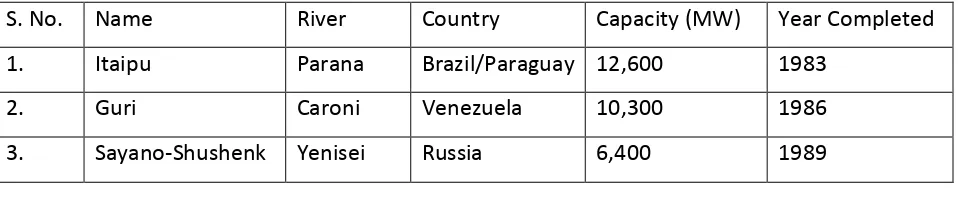
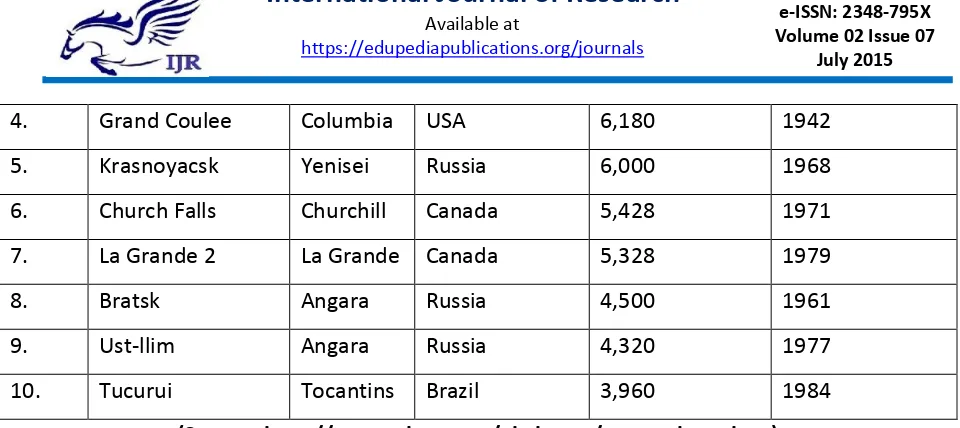
further explain this, given below is a table.
Table 1: World’s Largest Hydropower Projects
S. No. Name River Country Capacity (MW) Year Completed
1. Itaipu Parana Brazil/Paraguay 12,600 1983
2. Guri Caroni Venezuela 10,300 1986
4. Grand Coulee Columbia USA 6,180 1942
5. Krasnoyacsk Yenisei Russia 6,000 1968
6. Church Falls Churchill Canada 5,428 1971
7. La Grande 2 La Grande Canada 5,328 1979
8. Bratsk Angara Russia 4,500 1961
9. Ust-llim Angara Russia 4,320 1977
10. Tucurui Tocantins Brazil 3,960 1984
(Source:http://www.ehso.com/ehshome/energydams.htm)
From the following table we can see that
the most number of largest hydro power
projects were built from 1970 to 1990s.
Also, Russia has the most number of largest
dams. That was the time when dams were
considered precious to the economy and so
there was a race to build more and more
dams on every possible river after the
1970s which is clear from the table given
above. Moreover, we can see from the
table that these dams provide a large
amount of electricity which is often used as
a plus point by those debating in favour of
dams. It has however been argued that
earlier it was necessary to build dams for
survival but now it is mere exploitation of
resources.
Effects on Environment and Humans:
Often, very little attention is paid on what
effects the dams may have on the
environment. Everyone is busy searching
for monetary benefits out of these types of
projects. The main contributor that is the
people whose land is acquired are often
deprived of the benefits of the dams and all
the money earned from it goes to the
already rich people. It also affects the
environment in a very serious way. A few of
them are:
Ecology of the River: A dam terribly
affects the ecology of the river
which it is built upon. Due to
collection of water in reservoir and
its sudden release, most of the
marine animals get trapped in
rotating turbines and get killed. Also,
the standing water stagnates and
leads to high death rate of fishes
and other marine animals. This was
northern Thailand saw a sudden
sharp decrease in the fish catching.
This was because China increased
the height of its dams. Thus
although there was an increase in
electricity production of china but
the fisheries sector of Thailand was
affected. This could have also lead
to international conflicts. Often
some nations use dams as weapons
to create pressure on other
countries. Due to excessive
construction of dams in the Tigris
Euphrates basin of Turkey, Syria and
Iraq, the ecology of the region is
deeply disturbed. It is noteworthy
here that in order to keep the
ecology stable at maximum of 15
million water per cubic meter should
flow through the dams. Seeing these
ill effects, certain attempts have
been made to remove already
constructed dams. For instance in
case of America, there are around
75000 dams out of which less than
500 have been removed which are
10 meter or less in height. Even
though, if the dams are removed,
they would have terribly upset the
flow and ecology of the river
permanently until then. Moreover,
removal of dams can lead to floods
in the plain areas as due to removal
of dams, sludge flows down to the
plains. Moreover, these dams are
corroded because of the mud
flowing down into the dams from
the hilly areas. This has reduced the
life of Bhakra Dam in India from 88
years to 47 years whereas that of
Hirakund from 110 years to 35
years.Dams can also increase or
decrease the temperature of the
rivers thus killing the marine life in
the rivers and around it. Some
canals and other water bodies
emerge from dams. The soil in these
canals is degraded due to dams. As a
result of which fluoride, calcium and
other minerals get imbalanced in the
soil. Which, through crops lead to
gastrointestinal diseases, goitre etc
in humans.
Bursting of Dams: Due to the large
amount of water stored, it has a
huge potential therefore, the
structure holding it needs to be very
expensive. To cut on these costs,
often some engineers try cost
cutting methods which makes the
structure weak. This makes the
dams faulty and it might burst
leading to a catastrophe. One such
incident occurred at the St Francis
Dam, United States where the
reservoir busted on March 12, 1928.
About 47 million kilometres of water
swept away around 500 people.
Another such incident happed in
1963; a dam in Vaiont Valley in Italy
killed about 2,600 people. The dam
was just 3 years old and the water
rose over 60 meters high. However,
not all dams burst due to faulty
construction, some burst because of
the natural calamities. Two large
dams, the Banqiao and the
Shimantan, and about sixty other
small dams burst during typhoon
Nina washing away tens of
thousands of people in China in
1975. Some scientists have also
stated that the sheer volume of
water the dams hold can cause
earthquakes. Thus the dams which
power houses can become weapons
of mass destruction. India is also
currently under such risk, the
construction of Tihri Dam in India
was sanctioned despite the area
being prone to high risk of
earthquakes. Diseases like malaria
also increase in the areas adjacent
to dams because of the large volume
of standing water.
Movements
Against
Dam
Construction:
Due to increase innumber of dams its ill effects were soon
visible. This gave rise to many movements
in many places of the world to stop
construction of dams. Although there is a
large number of such movements but in this
paper we shall cover only some of them. In
the decade of 1960s a protest was started
in the Grand Canyon of America. A proposal
was passed in the 1950 to build dams in the
Colorado plateau. However, a series of
protest was started by the Sierra Club.
David Brouver and other environmentalists
later agreed to build dam on the Grand
Canyon on one condition that there would
be no construction in the Erko Park.
However, later they agreed that after this
project. In 1963 two more projects were
proposed but the protests became
stronger. Soon after this the front page of
New York Times and Washington Post were
published with advertisement explaining
that construction on Grand Canyon would
destroy its natural resources. As a result,
many people flooded the authorities with
letter in support of the environmentalists.
They were able to gather a massive support
and because of harsh criticism this project
was cancelled in 1967. It was a perfect
example of very first success of the
environmentalist in protecting the natural
resources against the ill effects of dams.
Taking a look at the scenario in
India, Hirakund dam was constructed in
India post independence. Because of this
many people were forced to migrate and
were displaced. This led to protests but this
yielded no results. The dam was finally
built. Similarly the famous ‘Narmada
Bachao Andolan’ was started to stop the
construction of a large number of dams on
the river Narmada. The displaced farmers
were soon joined by many
environmentalists; social workers etc and a
massive series of protests were started.
Lead by Medha Patkar this movement saw a
massive wave of protests to stop the
project which was funded by the World
Bank. Finally the court ruled the decision in
favour of the protestant and order to stop
the construction of these projects on the
river. Similarly in case of the construction of
Tihri Dam no movement helped. Sunder Lal
Bahugana Fought for nearly 20 years but
nothing worked. In India, these movements
didn’t work out very well but in the world
many successful movements have set an
example. Like the Grand Canyon movement
and the famous Franklin river dispute.
Conclusion:
To conclude, it can be saidthat often projects on the name of progress
damages our heritage and natural
resources. However, sustainable
development is the only way out. Dams
lead to a massive list of problems. Hence, a
nation must pay attention to construction
and development of dams and other
projects in areas with rich biodiversity.
Moreover, other alternatives can be looked
upon the meet the energy demands of a
nation which were to be fulfilled by the
dams. Support of people for sustainable
development is very necessary. Mass
awareness can prevent the harm to our
our coming generations. Also, the
government needs to build small barrages
where necessary to stop the harm cause by
large dams.
References:
S. K. Singh, “Evaluating Large Dams in India”, Economic and PoliticalWeekly, Vol. 25 (11), 17-23 March
1990.
A. Soffer, Rivers of Fire: The Conflict Over Water in The Middle East,Rowman & Littlefield, Oxford, 1999.
S. Parasuraman & S. Sengupta, “World Commission on Dams:Democratic Means for Sustainable
Ends”, Economic and Political
Weekly, Vol. 36 (21), 26 May- 1 June
2001.
J. Bandyopadhyay & Others, “Dams and Development”, Economic andPolitical Weekly, Vol. 37 (40), 5-11
October 2002.
M. P. Lawrence, “Damming Rivers, Damming Cultures”, AmericanIndian Law Review, Vol. 30 (1),
2006.
E. Duflo & R. Pandey, “Dams”, The Quarterly Journal of Economics,Vol. 122 (2), May 2007.
D. Fullbrook, “Dams it is”, The World Today, Vol. 64 (6), June 2008. https://en.wikipedia.org/wiki/Narm
ada_Bachao_Andolan.
http://www.academia.edu/3793851
/Big_dams_and_Protests_in_India_S
tudy_of_Hirakud_Dam.
http://nvdatabase.swarthmore.edu/
content/indian-villagers-protest-tehri-dam-construction-2001-2002.
http://www.thehindu.com/todays-
paper/tp-features/tp-
sundaymagazine/The-worldrsquos-
first-anti-dam-movement/article15401803.ece.
http://www.ehso.com/ehshome/en