Volume 2010, Article ID 927920,11pages doi:10.1155/2010/927920
Research Article
Parallelism Efficiency in Convolutional Turbo Decoding
Olivier Muller,
1Amer Baghdadi,
2and Michel J´ez´equel
21TIMA Laboratory, INP Grenoble, 46 avenue F´elix Viallet, 38031 Grenoble, France
2Institut Telecom, Telecom Bretagne, Universit´e Europ´eenne de Bretagne, UMR CNRS 3192 Lab-STICC, Technopˆole Brest Iroise, CS 83818, 29238 Brest, France
Correspondence should be addressed to Amer Baghdadi,[email protected]
Received 25 May 2010; Revised 20 October 2010; Accepted 21 November 2010
Academic Editor: Norbert Goertz
Copyright © 2010 Olivier Muller et al. This is an open access article distributed under the Creative Commons Attribution License, which permits unrestricted use, distribution, and reproduction in any medium, provided the original work is properly cited.
Parallel turbo decoding is becoming mandatory in order to achieve high throughput and to reduce latency, both crucial in emerging digital communication applications. This paper explores and analyzes parallelism techniques in convolutional turbo decoding with the BCJR algorithm. A three-level structured classification of parallelism techniques is proposed and discussed:BCJR metric level parallelism,BCJR-SISO decoder level parallelism, andTurbo-decoder level parallelism. The second level of this classification is thoroughly analyzed on the basis of parallelism efficiency criteria, since it offers the best tradeoffbetween achievable parallelism degree and area overhead. At this level, and for subblock parallelism, we illustrate how subblock initializations are more efficient with the message passing technique than with the acquisition approach. Besides, subblock parallelism becomes quite inefficient for high subblock parallelism degree. Conversely, component-decoder parallelism efficiency increases with subblock parallelism degree. This efficiency, moreover, depends on BCJR computation schemes and on propagation time. We show that component-decoder parallelism using shuffled decoding enables to maximize architecture efficiency and, hence, is well suited for hardware implementation of high throughput turbo decoder.
1. Introduction
Turbo decoding [1] is increasingly proposed in emerging and future digital communication systems, for example, fiber-optic communication, wireless communication, and storage applications. Practical turbo decoder designs, as the one used for IEEE 802.16e, Long-term Evolution (LTE) or IEEE 802.11 standards, require high data throughput (several hundred of Mbps) and low latency (ten ms or so). To cope with these requirements, turbo decoder implementations have to be massively parallel. Therefore, the parallelism involved in implementations of this iterative process has to be carefully analyzed through real industrial constraints such as area and throughput.
In iterative decoding algorithms, the underlying turbo principle relies on extrinsic information exchanges and iter-ative processing between different Soft-Input Soft-Output
(SISO) modules. Using input information and a priori
extrinsic information, each SISO module computesa pos-teriori extrinsic information. This constitutes the a priori information for the other modules and is exchanged via interleaving and deinterleaving processes. For convolutional
turbo codes, the SISO modules process the BCJR or forward-backward algorithm [2] which is the optimal algorithm for the maximum a posteriori (MAP) decoding of convolutional codes. So, a BCJR SISO firstly computes branch metrics (or γ metrics), which represent the probability of a tran-sition occurring between two trellis states. Then a BCJR SISO computes forward and backward recursions. Forward recursion (or α recursion) computes a trellis section (i.e., the probability of all states of the trellis) using the previous trellis section and branch metrics between these two sections, while backward recursion (orβrecursion) computes a trellis section using the future trellis section and branch metrics between these two sections. Finally, extrinsic information is computed from the forward recursion, the backward recur-sion and the extrinsic part of the branch metrics. Therefore, turbo decoders, because of iterative decoding process and BCJR complexity (bidirectional recursive computing), imply optimal parallelism exploitation in order to achieve high-data rates required in present and future applications.
the BCJR algorithm on elementary computations [3, 4]. At a coarse grain level, explored parallelism techniques are based on frame decoding schemes. State-of-the-art research is mainly focused on parallel processing of frame subblocks and on the parallel processing issues, such as computation complexity [3, 5], memory saving [3, 5, 6], initializations [5, 7], or on-chip communication requirements [8, 9]. Recently, a new parallelism technique named shuffled decod-ing was introduced to process in parallel the component decoders [10, 11]. However, interactions between these diverse parallelism techniques and different granularity levels are rarely discussed. Thus, predicting the combination of these parallelism techniques, in order to reach optimal parallelism for given performance requirements, becomes a complex task of hardware implementation.
In this paper, we propose a three-level classification of existing parallelism techniques in convolutional turbo decoding with the BCJR algorithm and analyze more thor-oughly the second level which includes subblock parallelism and component-decoder parallelism. Performance analyses of these techniques are conducted separately on the basis of parallelism efficiency criteria. Then, efficiency of combined parallelism techniques is improved collectively by taking into account interactions between these parallelism techniques.
The rest of the paper is organized as follows. The next section presents definitions of parallelism metrics that will be used in the paper.Section 3analyzes all parallel processing techniques of turbo decoding and proposes a three-level classification of these techniques. In Sections 4 and 5, subblock parallelism and component-decoder parallelism (shuffled decoding) are, respectively, analyzed on the basis of parallelism efficiency criteria. Finally,Section 6summarizes the obtained results and concludes the paper.
2. Definitions of Parallelism Metrics
Parallelism corresponds to the simultaneous execution of several independent processes in order to reduce processing time. Thus, due to dependencies in a real system, parallelism exploitation is naturally limited. In practice, algorithms always contain a sequential and incompressible part (e.g., processing synchronization) and a parallelizable part. The speedupS(d) of an algorithm is defined by
S(d)= t(1)
t(d)= 1
rs+rp/d, (1)
where t(1) is the execution time of the algorithm without parallelism and t(d) its execution time using a parallelism degree d. The speedup generally follows the well-known Amdahl’s law [12], wherersis the sequential part ratio and rpthe parallelizable part ratio (such asrs+rp=1)
For on-chip implementation purpose, parallelism has to be evaluated according to other criterion than speedup (e.g., accuracy, flexibility, latency, consumption, and chip area). In current implementations, the most important criterions are throughput and chip area. Therefore, in this paper, the efficiency of convolutional turbo decoder architectures,
denotedMe, is evaluated through execution timetand chip areaCfor equivalent results in terms of error-rates
Me= 1
tC. (2)
LetE(d) be the efficiency of a parallelism defined as
E(d)=Me(d)
Me(1) =
t(1)C(1) t(d)C(d)=
S(d)
O(d), (3)
whereMe(d) is the efficiency of a system using a parallelism degreedfor the studied parallelism andMe(1) its efficiency without this parallelism. This metric can also be seen as the ratio between decoding speedup of a parallelism and its area overheadO(d)=C(d)/C(1), whereC(d) (resp.C(1)) is the chip area of the system using a parallelism degreed (resp. without parallelism).
Since parallelism implies the duplication of only one part of the architecture (the ratio of the duplicated part in a nonparallelized chip area is denotedrdup), area overhead can be rewritten
O(d)=1 +rdup(d−1). (4)
3. Parallel Processing Levels
In turbo decoding with the BCJR algorithm, parallelism techniques can be classified at three levels:BCJR metric level parallelism, BCJR SISO decoder level parallelism,and Turbo-decoder level parallelism. The first (lowest) parallelism level concerns symbol elementary computations inside an SISO decoder processing the BCJR algorithm. Parallelism between these SISO decoders, inside one turbo decoder, belongs to the second parallelism level. The third (highest) parallelism level duplicates the turbo decoder itself.
3.1. BCJR Metric Level Parallelism. The BCJR metric level parallelism concerns the processing of all metrics involved in the decoding of each received symbol inside a BCJR SISO decoder. It exploits the inherent parallelism of the trellis structure [3, 4], and also the parallelism of BCJR computations [3–5].
3.1.1. Parallelism of Trellis Transitions. Trellis-transition par-allelism can easily be extracted from trellis structure as the same operations are repeated for all transition pairs. In log-domain [13], these operations are either ACS operations (Add-Compare-Select) for the max-log-MAP algorithm or ACSO operations (ACS with a correction offset [13]) for the log-MAP algorithm.
Each BCJR computation requires a number of ACS-like operations equal to half the number of transitions per trellis section. Thus, this number, which depends on the structure of the convolutional code, constitutes the upper bound of the trellis-transition parallelism degree.
Fr
am
e
N
0
α
β
Extrinsic Time
t/3 (c)
Fr
am
e
N
0
α
β
Extrinsic Time
t/3 (d)
Fr
am
e
N
0
α
β
Extrinsic
Time
t/3 (e)
Forward recursion Backward recursion
Forward recursion + extrinsic information Backward recursion + extrinsic information State metric memories
Fr
am
e
N
0
α
β, ext rinsic
Time
t
(a)
Fr
am
e
N
0
α
β
, ext rinsic
Time 2t/3 (b)
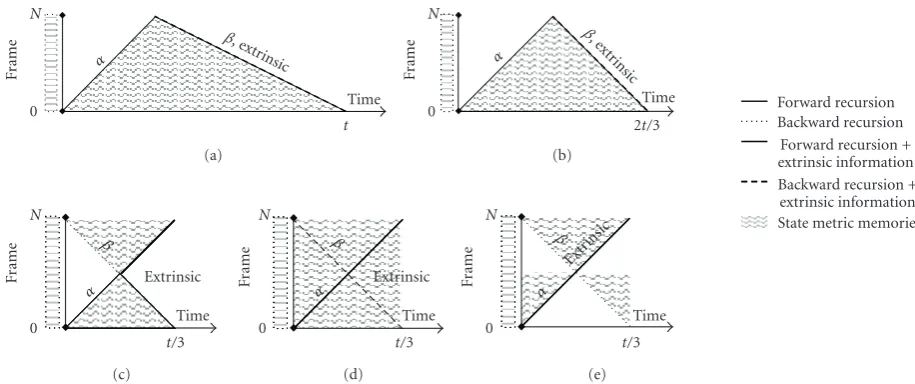
Figure1: BCJR computation schemes: (a) forward-backward without parallelism, (b) original forward-backward, (c) butterfly, (d) replica butterfly, (e) forward butterfly.
3.1.2. Parallelism of BCJR Computations. A second metric parallelism can be orthogonally extracted from the BCJR algorithm through a parallel execution of the three BCJR computations (forward recursion, backward recursion, and extrinsic information) [3, 5]. To preserve data dependen-cies in the BCJR algorithm, computations are scheduled following particular schemes as depicted in Figure 1. On the depicted schemes, use of state metric memories is represented by the gray regions. Size of this memory is equal to maximum height of gray region during the decoding. State memory requirement can be reduced using sliding window method [6,14].
Parallel computation of backward recursion and extrin-sic information was proposed with the original forward-backward scheme [2], depicted inFigure 1(b) In this scheme, we can notice that BCJR computation parallelism degree is equal to one in the forward part and two in the backward part. Thus, it enables a speedup of 1.5 in comparison with the sequential BCJR algorithm (BCJR computation parallelism degree is always one as depicted inFigure 1(a)) and its state metric memory depth is equal to frame length. To increase this parallelism degree, several schemes were proposed [5]. The most common is the butterfly scheme (Figure 1(c)) which doubles the parallelism degree of the original scheme through the parallelism between the forward and backward recursion computations (degree 2 in the first half of the butterfly and degree 4 in the second half) in order to perform a speedup of 3. Various schemes have been derived from this butterfly scheme. For example, the replica butterfly scheme (Figure 1(d)) extends the extrinsic information computations to the first half of the butterfly. This scheme was proposed in [15] to improve the shuffled decoding convergence, but it requires four BCJR computation units (full-time usage for a speedup of 3) and state metric storage between two consecutive iterations (since the extrinsic information computations in the first half of the butterfly require one recursion computation (forward or backward)
and take the other one (backward or forward) from the state metric storage). Globally, memory size is the same with this scheme as with the butterfly scheme or forward-backward one. A further example is the forward butterfly scheme (Figure 1(e)) that performs extrinsic information computation only in forward direction. Consequently, its BCJR computation parallelism degree is three on both half of the butterfly. Furthermore, the state metric memory is twice less deeper in this case. The resulting BCJR-SISO decoder requires smaller area (typically 30% less in comparison with others butterfly schemes), but the iterative process has a slower convergence (seeSection 4). We can note that, with all these schemes, BCJR computation parallelism is performed without any memory increase and only BCJR computation resources have to be duplicated.
As a conclusion, BCJR metric level parallelism (trellis-transition parallelism and BCJR computation parallelism) induces a minimal area overhead as it does not affect memory size, which occupies most of the area in a turbo decoder circuit. Nevertheless the parallelism degree is limited by the code structure and the decoding algorithm. Thus, achieving higher parallelism degree implies exploring higher processing levels.
3.2. BCJR-SISO Decoder Level Parallelism. The second level of parallelism concerns the SISO decoder level. It consists in using multiple SISO decoders, each executing the BCJR algorithm and processing a subblock of the same frame in one of the two component decoders. At this level, parallelism can be applied either on subblocks and/or on component decoders.
methods, namely acquisition and message passing (also know as next-iteration initialization) exist and are analyzed inSection 4.
Besides duplication of BCJR-SISO decoders, this paral-lelism leads to an on-chip communication issue related to the interleaver. Indeed, interleaving has to be parallelized in order to extend proportionally the communication band-width. In consequence, the complexity of communication structure (and also communication time) increases with parallelism degree and access conflicts may occur (even if latest standards use conflict-free interleavers). The latter problem can be resolved using an interleaving mapping to avoid conflicts [8] or using a communication structure to manage conflicts on the fly [9].
3.2.2. Component-Decoder Parallelism. The component-decoder parallelism is a new kind of parallelism that has become operational with the introduction of the shuffled decoding technique [10]. The basic idea of the shuffled decoding technique is to execute all component decoders in parallel and to exchange extrinsic information as soon as created. Using this method, the iteration period is halved in comparison with originally proposed serial turbo decod-ing [10]. Nevertheless, component-decoder parallelism may require additional iterations as explained inSection 5.
This level of parallelism can reach a reasonable paral-lelism degree and preserve memory area. Due to its great potential for scalability and mastered area overhead, new explorations are focused on this second level of parallelism.
3.2.3. Turbo-Decoder Level Parallelism. The highest level of parallelism duplicates the whole turbo decoder to process frames in parallel. Iteration parallelism occurs in a pipelined fashion (each parallel instance works on different frames and transmits their results to the instance in charge of the next iteration) with a maximum pipeline depth equal to twice the iteration number, whereas frame parallelism (each parallel instance decodes completely its frames) presents no limitation in parallelism degree. Nevertheless, turbo-decoder level parallelism is too area-expensive (all memories and computation resources are duplicated) and presents no gain in decoding latency and thus it is not considered in this work.
4. Initialization in Subblock Parallelism
As described inSection 3, subblock parallelism takes place at frame level and requires initializations. Proper initialization is mandatory to achieve correct decoding since information on recursion metrics is available at frame ending points, but not at subblock ending points. Estimation of undetermined information can be obtained either by acquisition or by message passing between neighboring subblocks.
4.1. Initialization by Acquisition. This widely used initial-ization method consists in estimating recursion metrics by means of an overlapping region called acquisition window or prolog. Starting from a trellis section, where all the states are initialized to a uniform constant, the acquisition window will
be processed on its length, denoted AL, to provide reliable recursion metrics at subblock ending points. This acquisition length is determined at design time in order to achieve negligible error-rate degradation. It is fixed according to the number of redundancy bits in the prolog (typically 6 bits). Another empirical rule recommends from 3 to 5 times the constraint length of the code for this acquisition length [17]. To evaluate this initialization method, we assume that the butterfly scheme is used in each subblock and that information is available concerning the beginning and ending states of the frame (circular trellis or tail-biting). So, the decoding computation time of an architecture withdSB subblocks (i.e., the parallelism degree isdSB) initialized with acquisition method is:
tSB(dSB)=dec·it
N dSB
+AL
tsym+tp(dSB)
fordSB>1,
tSB(1)=dec·it
Ntsym+tp(1)
,
(5)
where dec represents the number of component decoders (typically 2), it the number of iterations (note that it is independent of dSB), N the frame length in symbols, tsym the time required to process one symbol and tp(dSB) the propagation time spent by extrinsic information in commu-nication resources between component decoders (note that tpis usually negligible). The corresponding speedup is:
SSB(dSB)= tSB (1) tSB(dSB)=
Ntsym+tp(1) (N/dSB+ AL)tsym+tp(dSB)
= 1 +tp(1)/Ntsym
1/dSB+ AL/N+tp(dSB)/Ntsym.
(6)
This speedup follows an Amdahl’s law where the sequential and incompressible part is mainly related to computations of acquisition windows, which are mandatory to reliable initializations. Thus subblock parallelism with initialization by acquisition encounters a throughput ceiling value and the maximum speedup (obtained whendSBequals
N) is roughly equal toN/(AL +1) (by neglectingtp).
4.2. Initialization by Message Passing. The second method initializes dynamically a subblock with recursion metrics computed during the last iteration in the neighboring subblocks [16]. So this technique does not require addi-tional memory except for on-chip communication resources between BCJR SISO units. It was shown in [7] that the asymptotic error-rate, that is, the error-rate achieved with an infinite number of iterations, is not affected by the message passing approach whatever the parallelism degree. Conse-quently, it ensures that initialization by message passing can be used without error-correction performance degradation at the expense of additional iterations.
Table1: Message passing parameter for different code rates for double binary codes (DVB-RCS).
Code rate 6/7 3/4 1/2 1/3
f 21.5 13.5 8 6.5
decoding is stopped immediately after an iteration returning the right codeword and is not started for undecodable frame. Through large number of simulations, we observe that it(dSB) increases linearly with the parallelism degree and its slope varies with the inverse of the block size. Thus, we can express empirically it as:
it(dSB)=it(1)
1 + f
N(dSB−1)
, (7)
wheref is a constant value, that depends of the code rate and components codes.
For example, Table 1 gives the constant value f for different code rates of double binary codes. Note that f increases with the code rate since a lower code rate makes it possible to provide reliable metrics (recursion and extrinsic information) on shorter subblock size and, consequently, are less affected by parallelism effects.
Thus, the decoding time with this initialization technique can be refined in
tSB(dSB)=dec·it(dSB)
N dSBtsym
+tp(dSB)
=dec·it(1)
1 + f
N(dSB−1)
N dSBtsym
+tp(dSB)
,
(8)
and its speedup is
SSB(dSB)= tSB (1) tSB(dSB)
= it(1)
N tsym+tp(1)
it(1)1+f /N (dSB−1) (N/dSB)tsym+tp(dSB)
= 1+tp(1)/Ntsym
1−f /N /dSB+f /N 1+dSBtp(dSB)/Ntsym .
(9)
Like subblock parallelism with initialization by acqui-sition, an Amdahl’s law can be recognized in this speedup equation iftpterms are neglected. Thus, the sequential part of the subblock parallelism with message passing initial-ization is around f /N (compared to AL/N for acquisition initialization). Similarly, we can show (by neglectingtpterms and by remarking that f is much smaller thanN) that the maximum speedup (obtained whendSBequalsN) is roughly equal toN/(f + 1).
4.3. Subblock Parallelism Efficiency and Performance Com-parison. To evaluate the efficiency of initialization methods, a comparison of their subblock parallelism speedups is
0 5 10 15 20 25 30
Su
b
b
loc
k
par
allelism
speed
up
20 40 60 80 100
Parallelism degree Initialization methods:
Acquisition (AL=32) Acquisition (AL=24)
Message passing with prolog (AL=24) Message passing
Figure2: Simulated normalized speedup for several initialization methods, DVB-RCS,R = 6/7, 188 bytes frame,Eb/N0 = 4.2 dB,
5 bit quantization, Max-Log-MAP algorithm.
accurate enough since the ratios (rdup) between the BCJR-SISO decoder area and the overall architecture area are very close for both methods (the initialization methods only require memorization overheads, that are negligible with respect to the BCJR-SISO decoder area).
Each subblock parallelism speedup takes into account acquisition overhead and additional iterations. Note that using additional iterations with the acquisition method has quite no effect on error-correction performance.
For example, Figure 2 compares subblock parallelism normalized speedups obtained by simulations of a double binary turbo code at rate 6/7 for several initialization methods: message passing, acquisition with 24 and 32 symbols and message passing with a 24-symbol prolog (i.e., an acquisition is just perform for the first iteration). The figure shows clearly that the message passing technique outperforms the acquisition one whatever the acquisition length. The difference becomes sharper at high subblock parallelism degree. These results were also validated by simulations under various conditions (code rate, block size). Concerning the initialization of the first iteration, a prolog provides more reliable initialization than a uniform initialization. This enables to reduce the iteration number. But this reduction only improves the speedup if the gain is larger than the prolog overhead. In fact, improvements with prolog are only obtained for high code rate and at low parallelism degrees.
10−5
10−4
10−3
10−2
10−1
100
FER
3.6 3.8 4 4.2 4.4 4.6 4.8
Eb/N0 Initialization methods: Message passing Acquisition (AL=24)
Message passing with prolog (AL=24) Acquisition (AL=32)
Ref. without subblock parallelism
Figure 3: FER and initialization methods for high parallelism degree (47), DVB-RCS,R=6/7, 188 bytes frame, 5 bit quantization, Max-log-MAP algorithm.
Frame Error Rate (FER) performance for the same initial-ization methods and conditions as Figure 2 considering a DVB-RCS code [18] with a 47 subblock parallelism degree. In this case, the initialization with 32-symbol acquisition length implies a 0.15 dB degradation in comparison with the message passing initialization or the reference curve without parallelism.
Comparison between both techniques tends clearly in favor of the message passing technique, which enables better error-rate performance and better subblock parallelism efficiency. However, whatever the initialization method, the subblock parallelism speedup reaches a ceiling at high par-allelism degrees. Therefore, in order to find the parpar-allelism degree maximizing the architecture efficiency, we have to consider the subblock parallelism efficiency. For the message passing method, the subblock parallelism efficiency is:
ESB(dSB)= SSB (dSB)
O(dSB)
= 1 +ε
1 +rdup(dSB−1)
1−f /N /dSB+ f /N ,
(10)
where 1 +ε=(1 +tp(1)/Ntsym)/(1 +dSBtp(dSB)/Ntsym). The first derivative of the efficiency (once neglecting the tpterms) equals zero when its numerator does
1−rdup
1−f /N d2
SB
−rdup
f
N =0. (11)
Thus, the subblock parallelism efficiency has an
extremum when the parallelism degree is equal to
(1/rdup−1)(N/ f −1). Indeed, this extremum is a maximum as the first derivative is positive below this value (the denominator is always positive) and negative above. The maximum efficiency depends on rdup, on the block size, code rate and component decoders. Above this value, the architecture efficiency is degraded and other parallelisms have to be considered such as component-decoder parallelism.
5. Component-Decoder Parallelism Analysis
As described in Section 3.2.2, component-decoder paral-lelism takes advantage of the shuffled decoding technique that executes all component decoders in parallel and exchanges extrinsic information as soon as created. However, the relevance of this technique depends greatly on other parallelism choices and on interleaving rules.
5.1. Shuffled Decoding Speedup. By definition, the shuffled decoding process starts a new iteration without waiting the propagation of extrinsic information through the communi-cation resources. In other words, decoding and information exchange are performed concurrently in shuffled decoding. Thus, the shuffled decoding time only depends on the time needed to process a subblock and can simply be expressed as:
tshuffled(dshuffled,dSB)=itshuffled(dshuffled,dSB)N
dSBtsym
, (12)
wheredshuffledis the component-decoder parallelism degree (equals to dec for shuffled decoding), dSB the subblock parallelism degree used in each component decoder, and itshuffled the number of iterations required by the shuffled decoding process.
Then, by dividing the decoding time of the serial process with a subblock parallelism degree ofdSB—see (8)—by the shuffled decoding time, we get the shuffled decoding speedup
Sshuffled(dshuffled,dSB)
= tserial(dSB)
tshuffled(dshuffled,dSB)
=dec·itserial(dSB)
(N/dSB)tsym+tp(dSB)
itshuffled(dshuffled,dSB)(N/dSB)tsym
=dshuffled
itserial(dSB) itshuffled(dshuffled,dSB)
1 +dSBtp(dSB) Ntsym
. (13)
The impact of the propagation time will be dis-cussed in Section 5.3. In Section 5.2, a zero propagation time will be considered and the convergence speed of the shuffled decoding process, defined as CSshuffled = itserial(dSB)/itshuffled(dshuffled,dSB), is analysed.
0.6 0.65 0.7 0.75 0.8 0.85 0.9 0.95 1
C
o
n
ve
rge
nc
e
speed
o
f
sh
u
ffl
ed
dec
o
ding
20 40 60 80 100
dSB Butterfly schem
Replica butterfly schem Forward butterfly schem
Figure4: Evolution of convergence speed of shuffled decoding with subblock parallelism degree, message passing initialization, random interleaver,R=6/7, 188 byte frame.
5.2. Combining Shuffled Decoding with Other Parallelism Techniques. Considering to BCJR computation parallelism and subblock parallelism, the convergence speed of shuffled decoding is very disparate.
In [15], the influence of BCJR computation scheme was pointed out with the replica scheme proposal. The replica principle consists in generating two extrinsic information per symbol per iteration (one in the forward and one in the backward), instead of one extrinsic information in other schemes. Thus, decoders have more up-to-date extrinsic information and converge faster. Using the schemes pre-sented inFigure 1, our simulations also reveal that shuffled decoding convergence speed is always the greatest with the replica butterfly scheme (convergence speed observed around 0.8) and the lowest with the forward butterfly scheme (convergence speed observed around 0.6). However, in these conditions, shuffled decoding is not valuable for implementation, since its resulting speedup is less than the one obtained using subblock parallelism (same number of BCJR-SISO decoders) instead of component decoder parallelism.
Therefore, we proposed in [7] to combine component-decoder parallelism and subblock parallelism in order to improve the convergence speed of shuffled decoding. By definition, this latter is the iteration number required by a sequential execution of component decoders (using dSB BCJR-SISO decoders) over the iteration number required with shuffled decoding (i.e.,dshuffleddSBBCJR-SISO decoders working in parallel).Figure 4illustrates the behavior of shuf-fled decoding convergence speed with respect to subblock parallelism degree. Whatever the BCJR computation scheme, we can observe that convergence speed increases with the subblock parallelism degree. Additionally, the convergence speed with butterfly and forward butterfly schemes tends,
at high subblock parallelism, towards the convergence speed with replica scheme. Note that this latter for high subblock parallelism degree is close to the perfect convergence speed (equal to 1). In these conditions, component-decoder paral-lelism has to be used rather than subblock paralparal-lelism, which suffers from Amdahl’s law.
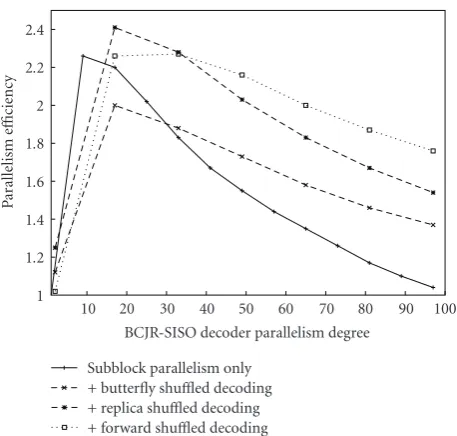
To help the selection of parallelism techniques and schemes for hardware implementation, the parallelism effi -ciency of BCJR-SISO decoder level parallelism (i.e., including subblock and component-decoder parallelisms) has to be considered
E(dshuffled,dSB)=tserial
(1)/tshuffled(dshuffled,dSB)
O(dshuffleddSB)
=SSB(dSB)Sshuffled(dshuffled,dSB) 1 +rdup(dSBdshuffled−1)
,
(14)
whereSSB(resp.Sshuffled) is the subblock parallelism speedup (resp. the shuffled decoding speedup). Note that the area overhead is considered to be similar for both parallelisms. Consequently, the global overhead depends on the product of the parallelism degrees.
Using the subblock parallelism speedup obtained with the message passing technique (9), the parallelism efficiency can be refined in
E(dshuffled,dSB)
= dSBdshuffledCSshuffled
1 +tp(1)/Ntsym
1−f /N+f /N dSB 1 +rdup(dSBdshuffled−1) .
(15)
1 1.2 1.4 1.6 1.8 2 2.2 2.4
Pa
ra
ll
el
is
m
e
ffi
ciency
10 20 30 40 50 60 70 80 90 100 BCJR-SISO decoder parallelism degree
Subblock parallelism only + butterfly shuffled decoding + replica shuffled decoding + forward shuffled decoding
Figure5: Parallelism efficiency with respect to BCJR-SISO decoder parallelism degree, message passing initializations, random inter-leaver,R = 6/7, 188 byte frame,tp = 0,rdup = 25% (butterfly,
replica) or=18% (forward).
5.3. Shuffled Decoding Implementation Issues
5.3.1. Propagation Time Effect on Shuffled Decoding. In real implementations of a parallel turbo decoder, exchanged extrinsic information is not immediately updated in the targeted SISO. We define the propagation time as the time required to update the extrinsic information value of a symbol. It includes the computation time of the extrinsic information value and the communication time. As com-plex communication structures (comcom-plexity increasing with subblock parallelism) are needed to perform interleaving without conflicts, communication time is particularly not negligible. However, for most of hardware implementations, propagation time is less than 3tsym.
Because of this propagation time, consistency conflicts (i.e., a component decoder performs a read access before the write access of the other component decoder is completed.) may occur in extrinsic information memory. Hence, the symbols suffering from consistency conflict must have one memory bank per decoder and their extrinsic information values are exchanged in the time interval of two iterations instead of one for other symbols. Consequently, the conver-gence of the shuffled decoding process is slowed down.
With simulations using random interleavers, we observe the mean degradation on the convergence speed implied
by the propagation time for replica shuffled decoding
(Figure 6) and for butterfly shuffled decoding (Figure 7). Time unit is the time required to process one symbol (tsym). In both figures, the convergence speed slows down when propagation time increases, but replica scheme is more robust. In addition, we can observe that degradations become significant when processing time of a subblock becomes comparable with propagation time. In this case, the
0.75 0.8 0.85 0.9 0.95
C
o
n
vergenc
e
speed
of
re
plica
sh
u
ffl
ed
dec
o
ding
20 40 60 80 100
Subblock parallelism degree Propagation time=0
Propagation time=1 Propagation time=3
Propagation time=6 Propagation time=10 754 84 44 30 23 18 15 13 12 10 9 8 8 7
Subblock size (in symbols)
Figure 6: Convergence speed of replica shuffled decoding and propagation time, random interleaver,R=6/7, 188 byte frame.
0.6 0.65 0.7 0.75 0.8 0.85 0.9 0.95
C
o
n
vergenc
e
speed
of
re
plica
sh
u
ffl
ed
dec
o
ding
20 40 60 80 100
Sub-block parallelism degree Propagation time=0
Propagation time=1 Propagation time=3
Propagation time=6 Propagation time=10 754 84 44 30 23 18 15 13 12 10 9 8 8 7
Sub-block size (in symbols)
Figure 7: Convergence speed of butterfly shuffled decoding and propagation time, random interleaver,R=6/7, 188 byte frame.
N
1
In
te
rl
ea
ve
d
o
rd
er
1 N
Natural order
←− t0(n)
− →t
0(n)
tp
− → t1(n)
←− t1(n)
(a)
N
1
In
te
rl
ea
ve
d
o
rd
er
1 N
Natural order
←t− 0(n)
− → t0(n)
tp
− → t1(n)
←− t1(n)
(b)
Figure8: Interleaver masks for: (a) butterfly scheme and (b) replica butterfly scheme.
Thus, preserving a good convergence speed of the shuffled process requires the preservation of a reasonable percentage of exchanging symbol reliabilities in the process. To better understand the influence of propagation time and interleaving rules on this percentage, we propose a geometrical explanation.
5.3.2. Geometrical Explanation of Propagation Time Effect. LetSkj be the SISO decoder that processes thekth subblock of the frame on thejth component decoder (e.g., j=0, 1 for a concatenation of two convolutional codes). Lettp denote the propagation time. According to the considered scheme of BCJR computations (Section 3.1.2), at theith iteration,Skj can deliver extrinsic information for the estimated symbolun in the forward recursion or/and in the backward recursion. Extrinsic information transmission time will be denoted
tj(n) for transmission in forward direction andtj← (n) for transmission in backward direction.
To avoid propagation time effect for a symbol, updating extrinsic information has to happen before processing for each SISO decoder. As forward and backward transmissions can be combined in both component decoders, each symbol has four possibilities to be updated during one iteration and one is sufficient for a good convergence. Thus, considering the interleaverΠ, the previous condition is expressed by:
t0(n)−t1(Π(n))> tp or
t0(n)−
← t1(Π(n))
> tp or
t←0(n)−t1(Π(n)) > tp or
t←0(n)−
← t1(Π(n))
> tp.
(16)
To describe the interleaving design rule, the two-dimensional representation of an interleaver introduced in [19] is well suited. In this representation, the natural order (resp. interleaved) is depicted on the horizontal-axis (resp. vertical-axis) and the symbol with indexnin natural order is represented with the point (n,Π(n)). On this representation, (16) is translated into banned regions constituting themask of the interleaver [20]. So, symbols have a slower convergence inside the interleaver mask than outside.
Depending on BCJR computation schemes, (16) can
define various interleaver masks. For example, Figure 8 represents interleaver masks of butterfly and replica butterfly schemes. The first example (a), the butterfly scheme is used by both component decoders. For this scheme, tj and tj← are defined only on the second half of processing time and have exclusive existence for each symbol. Consequently, each symbol is only concerned by one inequality and the four inequalities define four half-diagonal banned regions. Combining these banned regions constitutes the interleaver mask associated to butterfly scheme. Note that the mask covers the entire space as soon as the propagation time is equal to half the frame length. In these conditions, extrinsic information exchanges need exactly the time of two iterations. This means that the convergence speed of shuffled decoding in this case is one half. This result exactly match with the simulation results previously observed inFigure 7.
enables a better convergence of the iterative process. Like for butterfly mask, the replica mask covers the entire space whentp is equal toN/2. However, convergence speed is not slowed down to 0.5 (seeFigure 7) since, with replica scheme, additional extrinsic information exchanges exist in the time interval of one iteration. Indeed, one information update is used at two different instants (forward and backward), but (16) only consider the closest instant. Additional exchanges are the secondary reason of the robustness of replica shuffled decoding to long propagation time.
5.3.3. Concluding Remark on Real Shuffled Decoding. Finally, in a real implementation context (propagation time less than 3tsym), the propagation time effect on the convergence speed (and efficiency) of the shuffled decoding process introduces loss always less than 10% for replica shuffled decoding and less than 12% for butterfly shuffled decoding. Therefore, with the efficiency gap observed in Figure 5 between implementations using only subblock parallelism and implementations using ideal shuffled decoding, we can conclude that real shuffled decoding implementations based on replica and butterfly schemes are more efficient for high parallelism degree.
6. Conclusion
This paper thoroughly examines parallel convolutional turbo decoding. We have analyzed and classified the various paral-lelism techniques that could be used in convolutional turbo decoding with the BCJR algorithm. The three-level clas-sification proposed includes: BCJR metric level parallelism, BCJR SISO decoder level parallelism, and Turbo-decoder level parallelism.Considering its achievable high parallelism degrees and mastered area overhead, our analyses focus on the BCJR SISO decoder level, which includes subblock parallelism and component-decoder parallelism. On the one hand, we demonstrate that subblock initialization is more efficient with the message passing technique than with the acquisition technique and also that subblock parallelism becomes inefficient for high subblock parallelism degrees. On the other hand, we show that component-decoder paral-lelism efficiency depends on the BCJR computation scheme, on subblock parallelism degree, and on propagation time. Furthermore, results point out that the shuffled decoding, until now never considered in hardware implementation, improves the efficiency of very high-throughput low-latency implementations.
Acknowledgment
This work was supported in part by the UDEC project of the French Research Agency (ANR).
References
[1] C. Berrou, A. Glavieux, and P. Thitimajshima, “Near SHAN-NON limit error-correcting coding and encoding: turbo-codes,” inProceedings of the IEEE International Conference on
Communications (ICC ’93), pp. 1064–1070, Geneva, Switzer-land, May 1993.
[2] L. R. Bahl, J. Cocke, F. Jelinek, and J. Raviv, “Optimal decoding of linear codes for minimizing symbol error rate,” IEEE Transactions on Information Theory, vol. 20, no. 2, pp. 284– 287, 1974.
[3] E. Boutillon, W. J. Gross, and P. G. Gulak, “VLSI architectures for the MAP algorithm,”IEEE Transactions on Communica-tions, vol. 51, no. 2, pp. 175–185, 2003.
[4] G. Masera, G. Piccinini, M. R. Roch, and M. Zamboni, “VLSI architectures for turbo codes,”IEEE Transactions on Very Large Scale Integration (VLSI) Systems, vol. 7, no. 3, pp. 369–379, 1999.
[5] M. M. Mansour and N. R. Shanbhag, “VLSI architectures for SISO-APP decoders,”IEEE Transactions on Very Large Scale Integration (VLSI) Systems, vol. 11, no. 4, pp. 627–650, 2003. [6] C. Schurgers, F. Catthoor, and M. Engels, “Memory
optimiza-tion of MAP turbo decoder algorithms,”IEEE Transactions on Very Large Scale Integration (VLSI) Systems, vol. 9, no. 2, pp. 305–312, 2001.
[7] O. Muller, A. Baghdadi, and M. Jezequel, “Exploring par-allel processing levels for convolutional turbo decoding,” inProceedings of International Conference on Information & Communication Technologies: From Theory to Applications (ICTTA ’06), April 2006.
[8] A. Tarable, S. Benedetto, and G. Montorsi, “Mapping inter-leaving laws to parallel turbo and LDPC decoder architec-tures,”IEEE Transactions on Information Theory, vol. 50, no. 9, pp. 2002–2009, 2004.
[9] M. J. Thul, F. Gilbert, T. Vogt, G. Kreiselmaier, and N. Wehn, “A scalable system architecture for high-throughput turbo-decoders,”Journal of VLSI Signal Processing Systems for Signal, Image, and Video Technology, vol. 39, no. 1-2, pp. 63–77, 2005. [10] J. Zhang and M. P. C. Fossorier, “Shuffled iterative decoding,”
IEEE Transactions on Communications, vol. 53, no. 2, pp. 209– 213, 2005.
[11] O. Muller, A. Baghdadi, and M. J´ez´equel, “On the par-allelism of convolutional turbo decoding and interleaving interference,” inProceedings of the Global Telecommunications Conference (GLOBECOM ’06), December 2006.
[12] G. M. Amdahl, “Validity of the single processor approach to achieving large scale computing capabilities,” inAFIPS Spring Joint Computing Conference, pp. 483–485, April 1967. [13] P. Robertson, P. Hoeher, and E. Villebrun, “Optimal and
sub-optimal maximum a posteriori algorithms suitable for turbo decoding,”European Transactions on Telecommunications, vol. 8, no. 2, pp. 119–125, 1997.
[14] S. Benedetto, D. Divsalar, G. Montorsi, and F. Pollara, “Soft-input soft-output maximum a posteriori (MAP) module to decode parallel and serial concatenated codes,” TDA Progress Report, 1996.
[15] J. Zhang, Y. Wang, M. Fossorier, and J. S. Yedidia, “Replica shuffled iterative decoding,” inProceedings of the IEEE Interna-tional Symposium on Information Theory, Adelaide, Australia, September 2005.
[16] S. Yoon and Y. Bar-Ness, “A parallel MAP algorithm for low latency turbo decoding,”IEEE Communications Letters, vol. 6, no. 7, pp. 288–290, 2002.
[17] T. Wolf, “Initialization of sliding windows in turbo decoders,” inProceedings of the 3rd International Symposium on Turbo Codes and Related Topics, pp. 219–222, Brest, France, Septem-ber 2003.
Proceedings of the 2nd International Symposium on Turbo Codes & Related Topics, pp. 535–538, Brest, France, 2000.
[19] C. Heegard and S. B. Wicker,Turbo Coding, Kluwer Academic Publishers, Dodrecht, The Netherlands, 1999.