R E S E A R C H
Open Access
Molecular evolution of
rbcL
in three gymnosperm
families: identifying adaptive and coevolutionary
patterns
Lin Sen
1,2, Mario A Fares
3,4, Bo Liang
5,6, Lei Gao
1, Bo Wang
1,2, Ting Wang
1*and Ying-Juan Su
7*Abstract
Background:The chloroplast-localized ribulose-1, 5-biphosphate carboxylase/oxygenase (Rubisco), the primary
enzyme responsible for autotrophy, is instrumental in the continual adaptation of plants to variations in the concentrations of CO2. The large subunit (LSU) of Rubisco is encoded by the chloroplastrbcLgene. Although adaptive processes have been previously identified at this gene, characterizing the relationships between the mutational dynamics at the protein level may yield clues on the biological meaning of such adaptive processes. The role of such coevolutionary dynamics in the continual fine-tuning of RbcL remains obscure.
Results:We used the timescale and phylogenetic analyses to investigate and search for processes of adaptive
evolution inrbcLgene in three gymnosperm families, namely Podocarpaceae, Taxaceae and Cephalotaxaceae. To understand the relationships between regions identified as having evolved under adaptive evolution, we performed coevolutionary analyses using the software CAPS. Importantly, adaptive processes were identified at amino acid sites located on the contact regions among the Rubisco subunits and on the interface between Rubisco and its activase. Adaptive amino acid replacements at these regions may have optimized the holoenzyme activity. This hypothesis was pinpointed by evidence originated from our analysis of coevolution that supported the correlated evolution between Rubisco and its activase. Interestingly, the correlated adaptive processes between both these proteins have paralleled the geological variation history of the concentration of atmospheric CO2.
Conclusions:The generbcLhas experienced bursts of adaptations in response to the changing concentration of
CO2in the atmosphere. These adaptations have emerged as a result of a continuous dynamic of mutations, many of which may have involved innovation of functional Rubisco features. Analysis of the protein structure and the functional implications of such mutations put forward the conclusion that this evolutionary scenario has been possible through a complex interplay between adaptive mutations, often structurally destabilizing, and
compensatory mutations. Our results unearth patterns of evolution that have likely optimized the Rubisco activity and uncover mutational dynamics useful in the molecular engineering of enzymatic activities.
Reviewers:This article was reviewed by Prof. Christian Blouin (nominated by Dr W Ford Doolittle), Dr Endre Barta
(nominated by Dr Sandor Pongor), and Dr Nicolas Galtier.
* Correspondence: [email protected]; [email protected] 1CAS Key Laboratory of Plant Germplasm Enhancement and Specialty Agriculture, Wuhan Botanical Garden, Chinese Academy of Sciences, Wuhan, China
7
State Key Laboratory of Biocontrol, School of Life Sciences, Sun Yat-Sen University, Guangzhou, China
Full list of author information is available at the end of the article
Background
In spite of its slow non-specific catalysis the chloroplast-localized ribulose-1,5-biphosphate carboxylase/oxygenase (Rubisco, EC 4.1.1.39), the most abundant protein in nature, is the primary enzyme responsible for autotro-phy [1]. Rubisco is a bi-functional enzyme catalyzing both the carboxylation of D-ribulose-1,5-bisphosphate (RuBP) that initiates photosynthetic CO2 fixation and
the oxygenation of RuBP that starts the nonessential photo-respiratory pathway [2]. Its holoenzyme in green algae and higher plants consists of eight large subunits (LSUs) encoded by the chloroplast (cp) generbcL and eight small subunits (SSUs) encoded by the nuclear gene rbcS. Active sites are formed at the intra-dimer interfaces among the C-terminal, a/bbarrel domain of one large subunit and the N-terminal domain of another [3]. CO2 and O2 mutually compete as substrates for the
active sites, and the ratio of carboxylation to oxygena-tion ultimately affects the efficiency of net carbon assim-ilation [4]. Understanding of the molecular evolution of rbcLgenes may shed light on the functional/structural features governing Rubisco activity. The knowledge is also paramount from the biotechnological point of view since photosynthesis is tightly linked to the delicate bal-ance between carboxylation and oxygenation. Subtle alteration of this balance can have a significant impact upon photosynthetic productivity [5].
Most of the evolutionary changes optimizing Rubis-co’s function have been likely subjected to selection forces owing to the direct relationship between this function and the biological fitness of the plant. Most molecular changes favouring the enzyme function would be fixed by adaptive evolution, while the changes compromising its activity would be removed by purify-ing selection. Followpurify-ing the inverse rational, investiga-tion of adaptive evoluinvestiga-tion processes in Rubisco can aid in identifying key changes in its function. Adaptive evolution has seldom been observed in cp genes [6], mainly due to: i) Low rates of evolution of protein-cod-ing cp genes [7], which challenges the sensitivity of the methods to identify selection due to the lack of statisti-cal power [8]; ii) With the exception of few cases [6], cp genes present a low propensity to undergo duplica-tion [9], a fundamental mechanism in generating the source of novel functions [10]; and iii) The lack of models that realistically parameterize the evolution of cp genes, known to present codon usage bias and hence to yield misleading selection results when inap-propriate models are applied [11,12]. Nonetheless, the use of more realistic models may prove successful in identifying true adaptive molecular changes in cp genes, many of which would be linked to plant adaptive radiations [13].
Rubisco enzymatic efficiency has been shown to be fine-tuned in diverse autotrophy species [14]. Significant positive selection events have been also identified in the RbcL subunit of most land plant lineages by using simu-lation approaches [15]. In particular, the adaptive evolu-tion ofrbcLgenes has been found in the aquatic plant Potamogeton[16] and the F-type lineage of Conocepha-lum[17]. These findings make it plausible to hypothe-size that RbcL subunit may have undergone“continual fine-tuning”in green plants to adapt to CO2
concentra-tion changes across geological epochs [18]. How are these adaptive process reflected at the molecular level? To understand and answer these questions, adaptive evolution analysis must be complemented with the iden-tification of coevolutionary dynamics that can highlight the intricate co-adaptive relationships between residues in the protein under an estimated timescale [14,19]. In this respect, current molecular evolutionary methods such as the identification of coevolutionary sites [20] and relaxed molecular clock inference models [21,22] offer a unique opportunity to dissect the rbcL gene fine-tuning.
Podocarpaceae comprises members that extend both southern and northern hemispheres, accounting for nearly 14% of the gymnosperm diversity. The family is predominantly occupying mesic temperate and sunny tro-pical mountain habitats [23]. Taxaceae (also known as taxads or the yew family), including 25 species, is a wide-spread albeit locally endangered gymnosperm family [24]. The genus Cephalotaxus was previously listed in the Taxaceae [25]. However, recent molecular evidences con-firmed that it should be treated as a family (Cephalotaxa-ceae) [26]. Since these three families possess different contemporary net diversification, characterizations of the evolutionary processes in key genes may help to unearth the dynamics of their species diversification. In the pre-sent study we conduct an exhaustive analysis of such evo-lutionary dynamics and address the following questions: i) Whether and to what extent have adaptive evolution played a role in the evolutionary innovation of the rbcL gene; ii) How important have this evolutionary force been in the ecological diversification of the three gymnosperm families (Taxaceae, Cephalotaxaceae and Podocarpaceae); and iii) What is the coevolutionary pattern within the RbcL subunit of these families?
Results
Alignments and sequence characteristics
was determined by Modeltest 3.7 [27] and Datamonkey 2010 website (http://www.datamonkey.org) [28].
Dating the phylogenetic divergence events
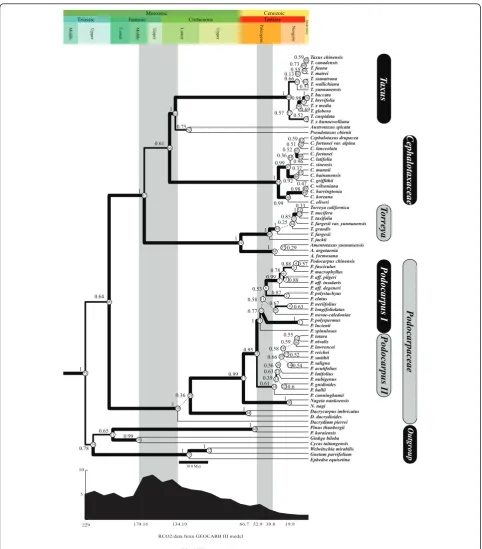
Two monophyletic clades of Taxaceae-Cephalotaxaceae and Podocarpaceae were identified by the Bayesian ana-lysis, both supported with high posterior probabilities (Figure 1). Within Podocarpaceae, besides Podocarpus three well-supported genera were obtained: Nageia, Dacrycarpus and Dacrydium. Dacrydium was basal to the remain Podocarpaceae species. The genus Podocar-pusdiverged into two groups, PodocarpusI and Podo-carpus II. In the Taxaceae-Cephalotaxaceae clade, four major lineages were resolved. Among them the Torreya-Amentotaxuslineage was sister to the remainder; the family Cephalotaxaceae was sister to the three remaining genera of the family Taxaceae; and the genusTaxuswas the sister to the Pseudotaxus-Austrotaxuslineage. These results indicated that the divergence between Taxaceae-Cephalotaxaceae and Podocarpaceae represented the first major split during the evolution of the three families and that Cephalotaxaceae is nested in Taxaceae. The absolute divergence time and evolutionary rates of all nodes in the tree were estimated under the uncor-related lognormal model (UCLD), and the global atmo-spheric CO2concentrations were also mapped according
to the estimated timescale (Figure 1, Table 1). This ana-lysis provided a time estimate of 204 Mya to the most recent common ancestor (MRCA) for the extant Podo-carpaceae (Figure 1). The results demonstrated that the splitting between the genera Nageia and Podocarpus occurred during early Paleocene following the Cretac-eous-Tertiary (K/T) extinction event, after which the genusPodocarpussegregated into two groups ( Podocar-pusI and II). The lineageTorreya-Amentotaxusdiverged from the remainder of the other members in Taxaceae-Cephalotaxaceae during the Jurassic; Taxaceae-Cephalotaxaceae departed with the rest three genera in Taxaceae during the Cretaceous; andTaxus split with Pseudotaxus-Aus-trotaxusduring the Tertiary.
Consistent adaptive evolution in the phylogeny ofrbcL
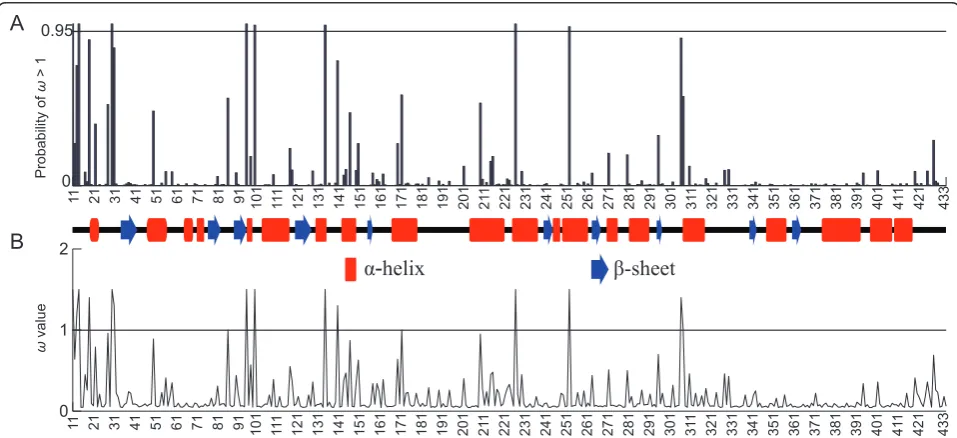
The primary proportion of the sites (p0> 89%,ω0< 0.1) in
the three families were under purifying selection (Figure 2, Table 2). A small proportion of sites (p2= 2%,ω2= 2.92)
were under positive selection (Table 2). Seven sites (A11V, Q14K, K30Q, S95N, V99A, I133L, and L225I) were signifi-cantly identified as positively selected sites under both PAML and Selecton programs via random-site models, and three more (G86D, S143A, and T262V) were found to have evolved under adaptive evolution using the branch-site models. One branch-site (K30Q) was also recognized as posi-tively selected via conservative nested models (M1a/M2a). The significant level of nested models was assessed by the
likelihood ratio test (Table 2). Thec2test indicated that all the alternative hypotheses (M2a, M3, and M8) in the random-site models significantly outperformed their com-parable null test (M1a, M0, and M7/M8a). Moreover, the branch-site model A (ω2 estimated) fit five branches
(Podocarpaceae, Podocarpus I and II, Taxaceae, and Taxus) significantly better than its null model (ω2 = 1
fixed) (Table 2 and 3). Podocarpaceae andPodocarpusI and II were also identified to be under positive selection, even after correcting for multiple tests by the Bonferroni correction [29] (Table 3). By contrast, whenTorreyaand Cephalotaxaceae were specified as the foreground branches, both the test and null models had similar log-likelihood values, indicating that there was not enough evi-dence to support adaptive diversifying scenarios.
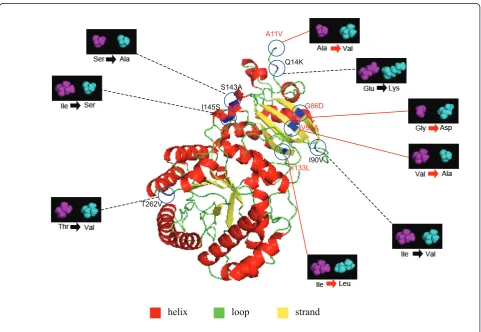
Four sites (A11V, G86D, V99A, and I133L) were detected under adaptive evolution along the ancestral branch of Podocarpaceae (Figure 3). The ancestor of PodocarpusI presented two positively selected candidate sites (A11V and Q14K); however, neither of them was significantly supported by the posterior probabilities. As for PodocarpusII, two sites (S143A and T262V) were identified under selection with strong statistical sup-ports. In addition, three sites (A11V, V99A, and I133L) were found to be positively selected on the branch lead-ing to the ancestor of Taxaceae, whereas only one (K30Q) was identified in the ancestor ofTaxus.
Inter-dependent evolution of amino acid sites in the RbcL subunit
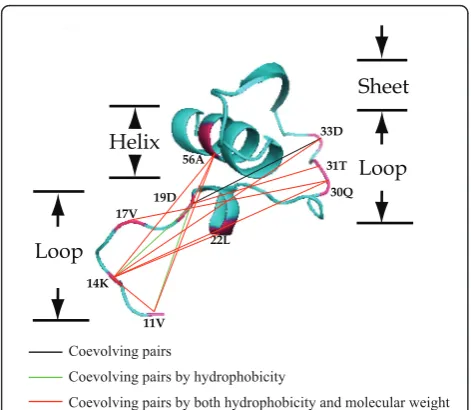
Analysis of coevolution in RbcL using CAPS identified 21 co-evolution groups (Figure 4). A coevolution group was defined to include all those sites that presented coe-volution signal with all the other sites within the same group: if site A was coevolving with B, B with C and A with C, then all three sites were included within one coevolution group. The largest group (Figure 5) included four sites (11V, 14K, 19D, and 56A), while the smallest contained only two. The residues belonging to most of the co-evolving pairs presented significant correlations with their physicochemical properties, including hydro-phobicity, molecular weight, or both of them. For exam-ple, four of the co-evolution pairs (11V/19D, 14K/19D, 11V/86D, and 50P/219V) detected among the 21 co-evolution groups exhibited correlated hydrophobicity; meanwhile, the other four pairs (14L/258R, 14K/142P, 95N/145S, and 255V/251M) correlated in their molecu-lar weight variance.
Discussion
Adaptive evolution of therbcLgene in the three
gymnosperm families
Podocarpaceae Podocarpus I Podocarpus II Cephalotaxaceae To rr ey a Taxus Outgroup 19.9 39.8 66.7 134.19 174.16 229 52.9 5 10
(Mya:Million years ago) RCO2:data from GEOCARB III model
Taxus chinensis T. canadensis T. fuana T. mairei T. sumatrana T. wallichiana T. yunnanensis T. baccata T. brevifolia T. x media T. globosa T. cuspidata T. x hunnewelliana Austrotaxus spicata Pseudotaxus chienii Cephalotaxus drupacea C. fortunei var. alpina C. lanceolata C. fortunei C. latifolia C. sinensis C. mannii C. hainanensis C. griffithii C. wilsoniana C. harringtonia C. koreana C. oliveri Torreya californica T. nucifera T. taxifolia
T. fargesii var. yunnanensis T. grandis T. fargesii T. jackii Amentotaxus yunnanensis A. argotaenia A. formosana Podocarpus chinensis P. fasciculus P. macrophyllus P. aff. pilgeri P. aff. insularis P. aff. degeneri P. polystachyus P. elatus P. neriifolius P. longifoliolatus P. novae-caledoniae P. polyspermus P. lucienii P. spinulosus P. totara P. nivalis P. lawrencei P. reichei P. smithii P. saligna P. acutifolius P. latifolius P. nubigenus P. gnidioides P. hallii P. cunninghamii Nageia nankoensis N. nagi Dacrycarpus imbricatus D. dacrydioides Dacrydium pierrei Pinus thunbergii P. koraiensis Ginkgo biloba Cycas taitungensis Welwitschia mirabilis Gnetum parvifolium Ephedra equisetina 60 58 59 62 63 61 54 55 64 56 57 53 41 42 43 44 40 47 45 46 48 49 50 31 32 33 34 35 36 37 38 4 5 6 3 7 8 2 11 9 10 12
13 1
25 15 16 18 17 19 20 14 21 23 22 24 26 51 39 27 28 69 72 73 29 30 65 52 66 70 71 74 75 68 67 0.78 0.65 0.99 1 1 1 1 0.36 0.99 0.95 1 0.77 0.58 0.67 0.53 1 0.99 1 1
0.610.39 0.6
0.63 0.56 0.54 0.52 0.66 0.58 0.59 0.55 0.63 0.87 0.88 0.78 0.88 0.57 0.59 0.73 0.130.55 0.51 0.66 1 0.75
0.57 0.520.69
0.981 0.360.52 0.510.59 0.96 0.99 0.92 0.37 0.47 0.98 0.99 1 1 0.61 1 0.64 1 0.33 1 0.85 0.25 1 1 0.29 1 1 30.0 Mya Quaternary Cretaceous Jurassic Triassic Cenozoic Mesozoic Tertiary Upper Middle Lower Upper
[image:4.595.57.540.86.636.2]Middle Lower Upper Paleogene Neogene
Figure 1The phylogenetic tree inferred fromrbcLsequences under the UCLD model. Geologic timescale is tagged above the
0 0.95
Probability of
ω
> 1
433
351 361 371 381 391 401 411 421 291 301 311 321 331 341
231 241 251 261 271 281 171 181 191 201 211 221
111 121 131 141 151 161 51 61 71 81 91 101
11 21 31 41
433
351 361 371 381 391 401 411 421 291 301 311 321 331 341
231 241 251 261 271 281 171 181 191 201 211 221
111 121 131 141 151 161 51 61 71 81 91 101
11 21 31 41
ω
value
0 1 2
α-
helix
β
-sheet
A
[image:5.595.56.534.100.413.2]B
Figure 2Estimated parameters under the M8 model using Selecton web-server. Approximate posterior means ofωare weighted by the
[image:5.595.58.537.458.677.2]posterior probabilities. Sites are numbered according to the reference sequence fromTaxus mairei(GenBank accession number: AY450856).
Table 1 Parameters estimated under the UCLD model
Node No. Posterior probability
Estimated divergence time (Mya)
Estimated rates (10-10nt/year)
Geologic period
1 100 8.62 1.52 Neogene
7 99.97 29.61 2.85 Paleogene/Neogene
13 100 49.65 2.69 Paleogene
25 95.51 52.95 1.69 Paleogene
26 100 19.98 2.06 Neogene
27 99.99 66.75 2.46 Paleogene
28 99.99 61.78 1.99 Paleogene
30 100 134.19 4.66 Lower Cretaceous
32 100 9.13 2.41 Paleogene
35 99.67 31.9 1.96 Paleogene
36 100 39.88 2.94 Paleogene
38 100 34.74 1.28 Paleogene
39 99.99 69.45 1.65 Cretaceous/Paleogene
40 96.18 8.18 1.59 Neogene
47 99.29 21.02 1.56 Neogene
49 98.09 4.12 1.48 Neogene/Quaternary
50 98.77 21.05 1.52 Neogene
51 100 30.85 2.53 Paleogene/Neogene
54 98.18 1.47 2.01 Neogene/Quaternary
55 100 9.98 2.47 Neogene/Quaternary
64 100 20.17 2.57 Neogene
65 99.76 136.64 1.58 Lower Cretaceous
67 100 168.52 2.89 Middle Jurassic
70 99.97 174.16 1.97 Middle Jurassic
gymnosperm families Podocarpaceae, Taxaceae and Cephalotaxaceae. Our results showed that most sites are under purifying selection, while a small part is under neutral evolution.
Recent improvements in the statistical models made it feasible to infer ancestral adaptive evolution events
[image:6.595.59.541.102.641.2][31,32]. Using these models we found that the amino acid sites in the RbcL subunit of both the ancestor of Podocarpaceae and that of Taxaceae-Cephalotaxaceae had undergone adaptive evolution. By contrast, no adap-tive evolution was detected in the ancestor of Cephalo-taxaceae. Moreover, within Podocarpaceae, no positively
Table 2 Parameter estimates from tests for selection
Model np ℓ Parameters Positively selected sites
M0: One ratio 137 -5654.77 ω= 0.173 None
M1a: Nearly neutral 138 -5539.34 p0= 0.885,ω0= 0.062;p1= 0.114,ω1= 1 Not allowed
M2a: Positive selection 140 -5529.73 p0= 0.892,ω0= 0.07;p0= 0.085,ω1= 1;p2=
0.023,ω2= 2.92
K30Q
M3: Discrete 139 -5536.84 p0= 0.92,ω0= 0.08;p1= 0.079,ω1= 1.46 A11V, Q14K, E28Q, K30Q, G86D, S95N, V99A, I133L,
L225I, I251M, K305R
M7:b 138 -5547.37 p= 0.015,q= 0.074 Not allowed
M8:b&ω 140 -5527.82 p0= 0.96;p= 0.09,q= 0.38;p1= 0.039,ω= 2.20 A11V, Q14K, K30Q, S95N, V99A, I133L, L225I
Branch-site models Taxaceae-Cephalotaxaceae
Model A:ω2= 1, fixed 139 -5533.19 p0=0.857,ω0=0.053;p1=0.061,ω1=1;p2a+p2b=
0.082,ω2= 1
Not allowed
Model A:ω2
estimated
140 -5530.95 p0=0.891,ω0=0.06;p1=0.078,ω1=1;p2a+p2b= 0.03,
ω2= 2.55
A11V, V99A, I133L
Taxus
Model A:ω2= 1, fixed 139 -5535.98 p0=0.852,ω0=0.057;p1=0.106,ω1=1;p2a+p2b=
0.042,ω2= 1
Not allowed
Model A:ω2
estimated
140 -5533.12 p0=0.86,ω0=0.06;p1=0.103,ω1=1;p2a+p2b= 0.027,
ω2= 5.9
K30Q
Torreya
Model A:ω2= 1, fixed 139 -5538.23 p0=0.82,ω0=0.059;p1=0.106,ω1=1;p2a+p2b= 0.073,
ω2= 1
Not allowed
Model A:ω2
estimated
140 -5538.33 p0=0.82,ω0=0.059;p1=0.106,ω1=1;p2a+p2b= 0.071,ω2= 1.02
None
Podocarpaceae
Model A:ω2= 1, fixed 139 -5527.9 p0=0.84,ω0=0.049;p1=0.057,ω1=1;p2a+p2b= 0.099,
ω2= 1
Not allowed
Model A:ω2
estimated
140 -5523.16 p0=0.89,ω0=0.065;p1=0.063,ω1=1;p2a+p2b= 0.047,
ω2= 2.41
A11V, G86D, V99A, I133L
PodocarpusI
Model A:ω2= 1, fixed 139 -5537.56 p0=0.786,ω0=0.05;p1=0.084,ω1=1;p2a+p2b= 0.129,
ω2= 1
Not allowed
Model A:ω2
estimated
140 -5533.91 p0=0.727,ω0=0.058;p1=0.091,ω1=1;p2a+p2b= 0.181,ω2= 1.12
None
PodocarpusII
Model A:ω2= 1, fixed 139 -5530.31 p0=0.81,ω0=0.054;p1=0.093,ω1=1;p2a+p2b= 0.097,
ω2= 1
Not allowed
Model A:ω2
estimated
140 -5526.95 p0=0.85,ω0=0.056;p1=0.096,ω1=1;p2a+p2b= 0.056,
ω2= 3.31
S143A, T262V
Model np ℓ Parameters Positively selected sites Cephalotaxaceae
Model A:ω2= 1, fixed 139 -5537.3 p0=0.82,ω0=0.058;p1=0.102,ω1=1;p2a+p2b= 0.077,
ω2= 1
Not allowed
Model A:ω2
estimated
140 -5536.84 p0=0.862,ω0=0.059;p1=0.105,ω1=1;p2a+p2b=
0.032,ω2= 2.68
None
Table 3 Tests for selection with Bonferroni correction
Model 2Δℓ d.f. p Sig.a= 0.05 Bonferroni correction Sig.a= 0.05
M0-M3 235.86 2 0 ● No need
M1a-M2a 19.22 2 0.0001 ● No need
M7-M8 39.1 2 0 ● No need
M8a-M8 4.86 1 0.0275 ● No need
A-A1 test
Taxaceae-Cephalotaxaceae 4.48 1 0.0343 ● 0.0686 ○
Taxus 5.72 1 0.0168 ● 0.084 ○
Torreya 0.2 1 0.6547 ○ 3.2735 ○
Cephalotaxaceae 0.92 1 0.3375 ○ 1.6875 ○
Podocarpaceae 9.48 1 0.0021 ● 0.0105 ●
PodocarpusI 7.3 1 0.0069 ● 0.0345 ●
PodocarpusII 6.72 1 0.0095 ● 0.0475 ●
In the branch-site model, the relevant hypotheses are verified under the Bonferroni correction to avoid false positive conclusion. The sign●denotes the results that pass the statistical significance tests, while○stands for the opposite.
A11V
Q14K
G86D
I90V V99A
I133L S143A
I145S
T262V
helix loop strand
Figure 3Positively selected sites in the RbcL subunit of the Podocarpaceae ancestor. Four positive selected sites of the Podocarpaceae
[image:7.595.57.539.309.641.2]11 V
14 K
17 V
19 D
22 L
30 Q
31 T
33 D
50 P
56 A
86 D
95 N
139R
142P
143A
145S
161K
219V
226N
251M
255V
258R
Coevolving pairs by both hydrophobicity and molecular weight Coevolving pairs by hydrophobicity
Coevolving pairs by molecular weight
Coevolving pairs Residues in loop
Residues in helix
Residues in sheet
[image:8.595.56.541.86.639.2]Residues connecting two structures
Figure 4Coevolutionary networks in the RbcL subunit of the three gymnosperm families. Residues in the networks are sorted clockwise
selected site was found in the ancestral branch of Podo-carpus I; however, two were detected in the branch leading to PodocarpusII (Figure 1). In Taxaceae, for the ancestor of Taxus, site 30 was identified as positively selected; but no such a site was found in the ancestor of Torreya. Totally, ten positively selected sites (A11V, Q14K, K30Q, G86D, S95N, V99A, I133L, S143A, L225I, and T262V) were identified in all the tests.
To fully understand the mechanism of the molecular adaptation of rbcL gene, both the structural and the
functional significance of those ten positively selected sites need to be elucidated (Table 4). Seven (A11V, Q14K, K30Q, I133L, S143A, L225I, and T262V) of the positively selected sites are located at the interface of Rubisco subunits, whereas the other three (G86D, S95N, and V99A) are at the interface between Rubisco and its activase (Table 2 and 4).
Most of the amino acid sites detected to be under adaptive evolution have been previously identified to have important functional roles. Of these adaptively selected sites, site 11 shows an adaptive substitution from Alanine to Valine. Valine has an additional methy-lene group (-CH2-) in comparison with Alanine, allows
a stronger van de Waal binding with the other residues at the LSU2 C-terminus [33], tightening therefore the
combination of LSU2 dimer [34]. In addition, lysine and
glutamine present side-chains that are positively and negatively charged, respectively [35]. Therefore the replacement of Q by K at site 14, identified to have evolved under positive selection, may create extra ionic bonds with its proximal amino acid sites [36]. Impor-tantly, site 30 is very close to site 28 [3], both possessing hydrophilic side-chains (Table 2). Kapralov and Filatov (2007) noted that site 28 is highly prone to fix amino acid replacements by positive selection in green plants [15]. Future examinations on sites 28 and 30 by using site-directed mutagenesis may unveil whether their hydrophilic side-chain substitutions have brought advan-tageous effects. The replacements at sites 133 and 143 may improve the stability of LSU2 dimer by modifying
side-chain physicochemical characters [37,38]. More-over, the nonsynonymous substitutions on sites 225 and 262 could contribute to the linkage of LSU and SSU
11V 14K
17V 19D
22L
30Q 31T 33D 56A
Coevolving pairs by both hydrophobicity and molecular weight Coevolving pairs by hydrophobicity
Coevolving pairs
Sheet
Loop Helix
[image:9.595.56.292.87.292.2]Loop
Figure 5Coevolving sites within the N-terminal structure of
the RbcL subunit. Amino acid residues involving in the coevolutionary network are highlighted red in the 3D structural diagram. And the residues are connected differently according to the nature and characteristics of their coevolution.
Table 4 Functional roles of the amino acid sites under adaptive evolution
Location
Site Domain Interface Functional roles References
A11V loop 1 To contribute to the holoenzyme thermal stability, catalytic efficiency, and CO2/O2specificity
Kellogg and Juliano (1997) [3]
Q14K Ottet al.(2000) [106]
K30Q loop 2 LSU dimers Du and Spreitzer (2000)
[107]
I133L bE Spreitzer and Salvucci
(2002) [36]
S143A aD Spreitzeret al.(2005) [64]
L225I a2 LSUs and SSUs Makowskiet al.(2008) [33]
T262V b4
G86D bC Rubisco and its activase
To affect the contacts between the Rubisco and its activase Duet al.(2003) [108]
S95N bD Portis (2003) [40]
V99A Portiset al.(2008) [42]
[image:9.595.56.543.516.714.2]subunits (Table 4). Recent genetic analyses of a hybrid Rubisco pointed to that the combination of LSU and SSU have effects on the holoenzyme expression [39].
Rubisco activase is involved in the opening of the closed state of the Rubisco form to release RuBP, produ-cing the active enzyme form [40]. The physical contact between the Rubisco site 89 and the activase site 314 has been reported by Liet al(2005) [41]. Moreover, the negatively charged Rubisco site 93 is potentially complementary to the positively charged activase site 312 [42]. Hence, changes of the three neighbouring sites (G86D, S95N, and V99A) around sites 89 and 93 may affect the contacts between the Rubisco and its activase. In summary, positively selected sites identified in the rbcLgene of the three gymnosperm families are located either on the contact surface between Rubisco subunits or between the Rubisco and its activase. Nonsynon-ymous substitutions among them have great potentials to optimize the enzyme characteristics.
RbcLgene is located in the large single copy region of chloroplast genome [43,44]. It has been regarded as a region with no evidence for adaptive evolution [45], but recent research has brought this into question [15]. Cur-rently, Ohno’s model is frequently used to describe pro-tein evolution and adaptation [46], which emphasizes the role that gene duplication plays in the adjustment of protein functions [47,48]. The “gene sharing” model stresses that it is at the single copy gene stage, namely before the occurrence of gene duplication, that func-tional genes have already adapted [49]. For instance, stu-dies on the eye lens crystallins showed that the gene duplication indeed occurred after the protein had diverged from its ancestral function [50,51]. This study on the rbcLgene further unveils adaptive evolutionary processes in the single copy chloroplast gene. It has been known that for rbcL, only a few nonsynonymous substitutions, especially those at catalytic active sites on the LSU and SSU interface or between the Rubisco and its activase interface, can significantly change the Rubisco features (e.g. thermal stability, catalytic efficiency, and CO2/O2 specificity) [52]. Indeed, the
positively selected sites we identified in the three gym-nosperm families are all located at these positions. Adaptive substitutions at the sites, possibly generated during chloroplast DNA replication or repair [53], may impose great potential for optimizing the Rubisco func-tional/structural characteristics. As shown in Table 2, our results suggest that: i) mutations at most sites in rbcL(p0 = 89.2%,ω0 = 0.07) may be deleterious; ii) 5.8%
of the substitutions probably have no significant effect on fitness; and iii) 2.3% of the replacements are likely to improve the Rubisco performance. It is therefore reason-able to postulate that the three gymnosperm families may have adaptively responded to habitat pressures by
adjusting the Rubisco function/structure during their evolution.
Historic adaptation of therbcLgene under continual
changing of CO2concentration
The historic accumulation of nucleotide substitutions in the rbcLgene has supplied the Podocarpaceae species with differentiated Rubisco catalytic efficiency, which could contribute to their adaptive radiation into diverse ecological niches [54]. By contrast, the absence ofrbcL adaptation inCephalotaxus andTorreyamay explain why their members tend to be locally distributed (Table 2).
Two positively selected sites were identified at the ancestral branch of Podocarpaceae and each was at the interface between the Rubisco and its activase (Table 2). The global CO2 concentration has been acutely
chan-ging since 170 Mya to 65 Mya [55]. Our results showed that the ancestor of Podocarpaceae diverged from Taxa-ceae-Cephalotaxaceae around 204 Mya; and its descen-dants started to diverge about 134 Mya [56]. From 170 Mya to 134 Mya, the rbcL variants in the ancestor of Podocarpaceae that could better adapt to the global reduction of CO2 concentration became consequently
fixed (Figure 1, Table 2). Sage and Coleman (2001) has noted that increasing the expression level of the Rubisco and its activase is an effective solution for plants to respond to the reduction of CO2 concentration [57].
Here we further demonstrated that the simultaneous and inter-dependent adjustment of the two enzymes provides an alternative adaptive mode.
Many transgenic manipulations have been attempted to improve Rubisco’s catalytic performance, since its property largely determines the maximum efficiency of photosynthesis in the use of light, water, and fertilizer N resources [58]. The function of Rubisco in terrestrial plants is identical. Evolutionary pressures seem to have driven it towards more efficient utilization of CO2, and
recent analyses have indicated that the optimal perfor-mance of Rubisco is basically determined by CO2
con-centration [59,60]. In this study, adaptive evolution of therbcLgene has been detected in Podocarpaceae and Podocarpus I and II (Table 3), which implies that the Podocarpaceae species have undergone continual modi-fication in their RbcL subunit for better fitness along with the changing atmosphere CO2concentration. The
positively selected sites identified (Table 3) may also benefit future studies for improving the Rubisco effi-ciency and for elucidating the interactions between the enzyme and its activase [61].
Site-specific coevolution in RbcL subunit
evolution is only expected to occur on functionally and structurally meaningful amino acid sites where nonsy-nonymous substitutions are most likely to destabilise and hence to compromise organism’s fitness [62,63]. Consequently, evolution of biological innovation is dependent upon the fixation of mutations close in the structure that can compensate the destabilising effects of innovative mutations. This may well explain the pat-tern we observe in the Rubisco, with many of the muta-tions that are under adaptive evolution and that co-evolve occurring at the interface of the protein dimer where stability is essential for the preservation of enzyme function and integrity. In support of the co-evo-lutionary hypothesis as a mean to fix innovative muta-tions in the RbcL subunit, previous research has shown that when multiple amino acid replacements are intro-duced, significant changes can occur in both enzyme catalytic efficiency and specificity [64]. In our co-evolu-tionary analyses, 21 co-evolution groups were identified within the RbcL subunit. In particular, evolutionary dependencies were recognized among sites belonging to different domains (Figure 5). Some correlated pairs (e.g. 251M and 255 V) were linearly proximal, whereas the others (e.g. 19D and 56A) were linearly distant but structurally proximal. Among the co-evolving sites, we also identified structurally and linearly distant sites (e.g. 14 K and 86D) (Figure 4 and 5). Although certain stu-dies have attributed a biological meaning for the linearly proximal sites [65], many other reports elucidated that physical connections can be established between distant functional sites in the quaternary protein structures [66-69].
Conclusions
This research presents substantial evidence that point to a complex adaptive process associated with the func-tional innovation of the Rubisco protein. This process involves a continuous checking of the structural and functional consequences of the fixation of novel muta-tions as well as the amelioration of the effects by such mutations through compensatory replacement events. Several other conditions related to the population genet-ics of the individuals have to be met in order for a com-pensatory mutation to be fixed before the individuals carrying the destabilising mutations are purged by selec-tion. Among the possible hypothetical scenarios is the relaxation of the action of selection or the action of other buffering mechanisms. Species from both Taxa-ceae and CephalotaxaTaxa-ceae are characterized by their small population sizes and clonality, which makes it feasible for genetic drift to act and facilitate the fixation of the mutations regardless of their immediate fitness consequences. Although this seems to be a possible sce-nario, several points remain to be investigated in future
studies such as to assess the real inter-dependence among mutations through directed mutagenesis or to examine the strength of genetic drift at the population levels. Our research however opens exciting new ave-nues that may lead to a more complete understanding of the functional novelties in the Rubisco among gymnosperms.
Methods
Plant Sampling
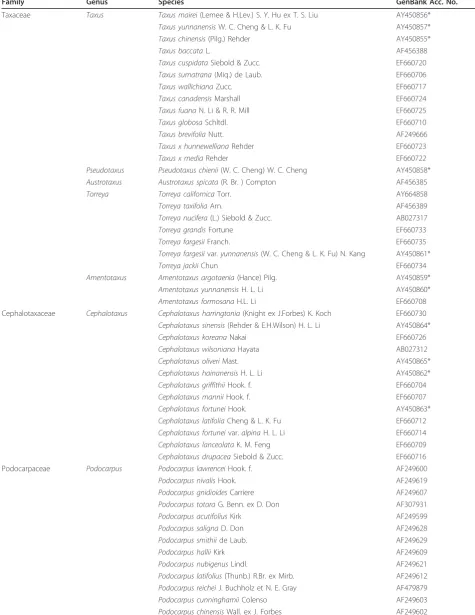
Plant materials sampled for this investigation (Table 5), includingCephalotaxus sinensis(Rehder & E. H. Wilson) H. L. Li, C. hainanensis H. L. Li, C. fortunei Hook., C. oliveriMast.,Taxus chinensis(Pilg.) Rehder,T. yunna-nensis W. C. Cheng & L. K. Fu, T. mairei(Lemee & H. Lev.) S. Y. Hu ex T. S. Liu,Amentotaxus yunnanensis H. L. Li,A. argotaenia(Hance) Pilg.,Torreya fargesiivar. yunnanensis(W. C. Cheng & L. K. Fu) N. Kang, Pseudo-taxus chienii(W. C. Cheng) W. C. Cheng,Podocarpus macrophyllus(Thunb.) Sweet,P. neriifoliusD. Don, Dacry-carpus imbricatus(Blume) de Laub., andDacrydium pier-reide Laub., were collected from South China Botanical Garden, Chinese Academy of Sciences, Guangzhou, China. In addition,Nageia nagi(Thunb.) Kuntze was collected from the campus of Sun Yat-sen University, Guangzhou, China.
Total genomic DNA extraction
Genomic DNA was extracted from leaves of individual trees by a modified cetyltrimethyl ammonium bromide (CTAB) method. 0.2 g fresh leaf tissue was ground to fine powder with a mortar and pestle in liquid nitrogen. The leaf powder was allotted equally into two Eppendorf tubes. One mL -20°C propanone was added to each tube. The tube was rocked gently for l min, centrifuged at 5,000 rpm for 10 min, and the supernatant was discarded; the proce-dure was repeated once. Each tube was added with 1 mL 60°C CTAB extraction buffer, mixed well, and incubated at 80°C for 4 hours. After incubation, 500μl chloroform: isoamyl alcohol (24: 1) was added, mixed and then centri-fuged at 13,000 rpm for 10 min. The top aqueous phase was removed to a new tube, added with 2/3 volume cold isopropanol, and mixed gently to precipitate DNA. DNA was dissolved in 70 μl TE buffer, and the quality was determined by 1% agarose gel electrophoresis.
PCR amplification and DNA sequencing
PCR amplification of rbcLsequences was carried out in 100μl volumes containing 50 mM KCl, 10 mM Tris-HCl (pH 8.0), 0.1% Triton X-100, 1.5 mM MgCl2, 0.2 mM
Table 5 Species and GenBank accession numbers for therbcLgene sequences analysed in this study
Family Genus Species GenBank Acc. No.
Taxaceae Taxus Taxus mairei(Lemee & H.Lev.) S. Y. Hu ex T. S. Liu AY450856*
Taxus yunnanensisW. C. Cheng & L. K. Fu AY450857*
Taxus chinensis(Pilg.) Rehder AY450855*
Taxus baccataL. AF456388
Taxus cuspidataSiebold & Zucc. EF660720
Taxus sumatrana(Miq.) de Laub. EF660706
Taxus wallichianaZucc. EF660717
Taxus canadensisMarshall EF660724
Taxus fuanaN. Li & R. R. Mill EF660725
Taxus globosaSchltdl. EF660710
Taxus brevifoliaNutt. AF249666
Taxus x hunnewellianaRehder EF660723
Taxus x mediaRehder EF660722
Pseudotaxus Pseudotaxus chienii(W. C. Cheng) W. C. Cheng AY450858*
Austrotaxus Austrotaxus spicata(R. Br. ) Compton AF456385
Torreya Torreya californicaTorr. AY664858
Torreya taxifoliaArn. AF456389
Torreya nucifera(L.) Siebold & Zucc. AB027317
Torreya grandisFortune EF660733
Torreya fargesiiFranch. EF660735
Torreya fargesiivar.yunnanensis(W. C. Cheng & L. K. Fu) N. Kang AY450861*
Torreya jackiiChun EF660734
Amentotaxus Amentotaxus argotaenia(Hance) Pilg. AY450859*
Amentotaxus yunnanensisH. L. Li AY450860*
Amentotaxus formosanaH.L. Li EF660708
Cephalotaxaceae Cephalotaxus Cephalotaxus harringtonia(Knight ex J.Forbes) K. Koch EF660730
Cephalotaxus sinensis(Rehder & E.H.Wilson) H. L. Li AY450864*
Cephalotaxus koreanaNakai EF660726
Cephalotaxus wilsonianaHayata AB027312
Cephalotaxus oliveriMast. AY450865*
Cephalotaxus hainanensisH. L. Li AY450862*
Cephalotaxus griffithiiHook. f. EF660704
Cephalotaxus manniiHook. f. EF660707
Cephalotaxus fortuneiHook. AY450863*
Cephalotaxus latifoliaCheng & L. K. Fu EF660712
Cephalotaxus fortuneivar.alpinaH. L. Li EF660714
Cephalotaxus lanceolataK. M. Feng EF660709
Cephalotaxus drupaceaSiebold & Zucc. EF660716
Podocarpaceae Podocarpus Podocarpus lawrenceiHook. f. AF249600
Podocarpus nivalisHook. AF249619
Podocarpus gnidioidesCarriere AF249607
Podocarpus totaraG. Benn. ex D. Don AF307931
Podocarpus acutifoliusKirk AF249599
Podocarpus salignaD. Don AF249628
Podocarpus smithiide Laub. AF249629
Podocarpus halliiKirk AF249609
Podocarpus nubigenusLindl. AF249621
Podocarpus latifolius(Thunb.) R.Br. ex Mirb. AF249612
Podocarpus reicheiJ. Buchholz et N. E. Gray AF479879
Podocarpus cunninghamiiColenso AF249603
min at 72°C, and 10 min at 72 °C. Negative controls where all reagents but DNA were added to the reaction mix were included in order to verify the absence of con-tamination. The forward and reverse primers were
5’-ATGTCACCACAAACAGAGACT-3’and 5’-CCTTCA
TTACGAGCTTGCACAC-3’, respectively. PCR products and sizes were verified in agarose gels. The purified PCR products were sequenced directly in both forward and reverse directions. Three repeats of each fragment were determined to control forTaqpolymerase errors.
Phylogeny with timescale
DNA sequences of the coding regions obtained experi-mentally plus those retrieved from the public databases (Table 5) were multiple aligned using the MUSCLE soft-ware [70]. To improve the accuracy of phylogenetic inference, we excluded: i) multiple data from identical species, ii) sequences containing frame-shift mutations, and iii) ambiguously aligned regions. The appropriate DNA substitution model was identified by Modeltest v.3.7 package [27] via comparing 56 available models using the Akaike Information Criterion (AIC). The data set was also uploaded to the Datamonkey 2010 website for the estimation of the best fit model [28]. The tree
topology inferred using the appropriate model forrbcL sequences was utilized as pre-defined tree in the adaptive and non-independent evolution analysis.
The following nodes within the phylogeny were cho-sen to constrain for a rate consistent with the known relationships: i) based on the Cratonia cotyledonfossils [71], the split of Gnetum and Welwitschia was con-strained to 110 Mya (Node 72); ii) the good estimation of the split of Taxus and Cephalotaxaceae was con-strained to 169 Mya (Node 66) [56]; iii) Node 75 was constrained to 225 Mya based on the earliest Pinaceae-type seed [72]; iv) Node 73 was constrained to 125 Mya based on the earliest Ephedra-type seed [73]. Following the suggestion of the authors of BEAST, we ran the empty alignment before the real data to avoid misspeci-fication of dating and taxon sampling.
[image:13.595.60.538.102.403.2]We applied BEAST to infer topology, branch lengths, and dates for therbcLgene. As the relationships of Tax-aceae and CephalotaxTax-aceae families have been histori-cally under debates, the prior information on these two families was not given before the estimation. A normal distribution was applied over the estimating of the abso-lute ages via the MCMC process. BEAST runs of 4 × 10⁷ generations, saving data every 1,000 generations,
Table 5 Species and GenBank accession numbers for therbcLgene sequences analysed in this study(Continued)
Podocarpus fasciculusde Laub. AF249622
Podocarpus aff. pilgeriMH6655 AF249624
Podocarpus aff. insularisMH6612 AF249611
Podocarpus macrophyllus(Thunb.) D. Don AY450866*
Podocarpus aff. degeneriMtLoftyBG AF249627
Podocarpus elatusR. Br. ex Endl. AF249606
Podocarpus polystachyusR. Br. ex Endl. AF249626
Podocarpus lucieniide Laub. AF249615
Podocarpus polyspermusde Laub. AF249625
Podocarpus neriifoliusD. Don AY450867*
Podocarpus longifoliolatusPilger AF249614
Podocarpus novae-caledoniaeViell. AF249620
Podocarpus spinulosus(Sm.) R.Br. ex Mirb. AF249630
Nageia Nageia nagi(Thunb.) Kuntze AY450868*
Nageia nankoensis(Hayata) R.R. Mill AF249649
Dacrycarpus Dacrycarpus imbricatus(Thunb.) de Laub. AY450869*
Dacrycarpus dacrydioides(Rich.) de Laub. AF249597
Dacrydium Dacrydium pierreide Laub. AY450870*
Outgroup Pinus koraiensisSiebold & Zucc. NC_004677
Pinus thunbergiiParl. NC_001631
Welwitschia mirabilisHook. NC_010654
Gnetum parvifolium(Warb.) W. C. Cheng NC_011942
Cycas taitungensisC. F. Shenet al. NC_009618
Ephedra equisetinaBunge NC_011954
Ginkgo bilobaL. DQ069500
produced 40,000 estimates of dates under a Yule specia-tion prior and an uncorrelated relaxed clock [74] for the rbcLgene dataset. Convergence statistics was analyzed in Tracer, resulting in 36,000 post-burn-in trees. We used TreeAnnotator v. 1.5.3 [74] to produce maximum clade credibility trees from the post-burn-in trees and to determine the 95% probability density of ages for all nodes in the tree.
To illustrate the relationship between the ancestral adaptation and the concentration of CO2 in the
atmo-sphere, the RCO2 value along with the time scale was
mapped under the phylogeny (Figure 1) [55].
Detection of positive and negative selection sites
Identification of adaptive evolution (positive selection) is fundamental to our understanding of the process of adaptation and diversifying selection. The general con-sensus is that nonsynonymous nucleotide substitutions (dN), whose alternatives leading to a change in the
codon and its corresponding amino acid, can be scaled by the number of synonymous replacements (dS), which
are nucleotide changes that only change the codon but not the amino acid and are consequently neutrally fixed and proportional to the divergence time between the sequences. Because the dN changed the amino acid
sequence and protein function depending on its struc-ture, this parameter is often under the filter of Natural selection. It follows consequently that the nonsynon-ymous-to-synonymous rates ratio (ω =dN/dS) can be
considered as a stringent measure of selection [75,76]. Positive adaptive evolution occurs episodically during the evolution of proteins and this selection signal is generally swamped in a background signal of negative selection, which makes it difficult to robustly identify adaptive evolution. In order to identify signs of adaptive evolution we used two maximum-likelihood based mod-els implemented in the CODEML program from PAML package version 4.1 [32], the random-site model and the modified branch-site model, for detecting the positive and negative selection sites within rbcL sequences among lineages. The random-site model allows theωto vary among amino acid sites within the multiple sequence alignment and this parameter is estimated by maximum-likelihood following Goldman and Yang (1994) [77]. Conversely, the branch-site model (BSM) accounts for the variation in selective constraints among sites and lineages in the phylogeny synchronously. Within the BSM, we applied the modified model A test to reduce the false positive results as advised in the manual file of PAML version 4.1 [78]. In addition to the previous models, we also compared codon-based models that estimate one or several ωvalues for the different categories of codons. We conducted the likelihood ratio
test (LRT) [79] to compare the different nested models (M0 vs. M3, M1a vs. M2a, M7 vs. M8, M8a vs. M8, and alternative test (ω2 estimated) vs. null test (ω2 = 1,
fixed)) [80]. In the branch-site models, the branches were selected to testify whether the species have a big-ger opportunity to undergo an episodic adaptive evolu-tion along with the acutely changing atmospheric CO2
concentration (Figure 1, grey regions). The following seven lineages were selected: (i) Taxaceae-Cephalotaxa-ceae, (ii) Taxus; (iii) Torreya; (iv) Podocarpaceae; (v) Podocarpus I; (vi)Podocarpus II; and (vii) Cephalotaxa-ceae. To address the problem of multiple comparisons, the Bonferroni correction was employed during the con-tinuous checking with the A-A1 models [29].
The multiple sequence alignment (MSA) was also sub-mitted to the Selecton website [81] for the comparison between empirical models and mechanistic empirical combination (MEC) models. Moreover, the ancestral states of therbcL sequences were reconstructed via the DAMBE package [82] and the ASR module on the Data-monkey website [28,83]. The offspring sequences were compared with the ancestral sequences on each node. And the sequence was submitted to European Bioinfor-matics Institute (http://www.isb-sib.ch/ Swiss-model) for predicting the three-dimensional structure of the RbcL subunit.
Identification of intra-protein coevolutionary pattern
To understand the broad implications of the amino acid replacements in the RbcL subunit we conducted an analy-sis of the evolutionary dependencies among sites to iden-tify functional/structural dependencies among residues. If two amino acid sites were under adaptive evolution and these sites were co-evolving, this may indicate their func-tional/structural dependency. Intra-protein co-evolution in rbcLwas tested via the program CAPS [20]. This algo-rithm implemented in this program takes the phylogenetic dependencies into account and correct them [84] and has been reported to outperform other approaches [85].
Reviewers’comments
Reviewer’s report 1
Prof. Christian Blouin (nominated by W Ford Doolittle), Dalhousie University Halifax, Nova Scotia, Canada
This reviewer provided no comments for publication.
Reviewer’s report 2
Dr Endre Barta (nominated by Sandor Pongor), Interna-tional Centre for Genetic Engineering and Biotechnology, Trieste, Italy
Gymnosperm plants played an important role in Earth’s flora, especially in the prehistoric ages. In this manuscript, the authors use elegant molecular evolutionary analyses to answer some open questions about the evolutionary pro-cesses tailoring the chloroplast-codedrbcLgene during the adaptation to the changing CO2concentration in the
atmosphere. The authors userbcLcoding sequences from three gymnosperm families. TherbcLis a very specific and very constrained protein, coded in the chloroplast genome and also being in complex with therbcS, which is coded in the nucleus. The three gymnosperm families are good sub-jects for this analysis because i) they represent almost 14% of the gymnosperm diversity and can be found globally on the Earth, ii) we have fossil records allowing to constrain the phylogenetic tree timescale.
The authors present a robust evolutionary analysis
based on the multiple alignment of rbcL coding
sequences from different gymnosperm species. They found that a complex adaptation process occurred during the evolution of these taxa. They also discussed the struc-tural and functional consequences of these processes and concluded that certain compensatory replacement muta-tions could play important role in the fixation of the functionally novel mutations. The analysis is very sound and in most cases based on different methods and mod-els. The basic idea and the results can be interesting for the broader community.
I have only some theoretical questions and three minor technical comments.
Questions:
Are there any known examples for the same compen-satory mutation pairs from other plant species (i.e. evi-dence for convergent evolution)?
Authors’ response: Recent report of the modification on both large and small subunits of Rubisco enzyme in Flaveria (Asteraceae) might be an example for the simi-lar patterns [88]. The two subunits are under selection during the evolution from C3 to C4 photosynthesis. This
pattern may be an evidence for convergent evolution under ecological pressures. However, the compensatory mutation pair is not coincided in the study.
How could the geographical isolation of different populations influence the results of this study? Are
there any samples (rbcLsequences) from geographically well separated plants from the same species? Do you expect any polymorphisms at any replacement site in the small populations of these gymnosperm species?
Authors’ response: If we take the geographical CO2
variation into account, the geographical isolation of dif-ferent populations will significantly influence the results of the present study. As has been reported previously, the rbcLgene has undergone adaptive evolution during the radiation in the Hawaiian endemic genus Schiedea, which demonstrates thatrbcLgene evolved under strong positive selection impacted by the geographical isolation [13]. Nonetheless, the present research is mainly focused on the relations above species level, so the samples (rbcL sequences) from the same species are excluded in the analyses. The polymorphisms at those replacement sites probably exist in the small populations of these gymnos-perm species.
The inferred tree topology and the taxonomic classifi-cation of the genera in Taxaceae seem to be different. How can you explain this?
Authors’ response: Since its lower evolutionary rate, therbcLgene has certain limitations on the deeper phy-logenetic levels (e.g. at the genus level)[89]. On the other respect, the molecular adaptation inrbcL gene per se also has impact on the inferring of the phylogenetic trees [17]. The above two factors may be the explanation for the disagreement between the inferred tree topology and the taxonomic classification.
Is it possible to deduce from this analysis the ancestral sequence of therbcLgene characteristic for the different nodes?
Authors’ response: Positive answer. However, more experimental data is required for the inference of the rbcL gene characteristic even though the inferring of the ancestral sequence from the current ones is of statistical efficiency[90,91].We believe that much more work have been left for the further research after our computational estimation.
Comments:
Reading the abstract at a first glance, it is not clear what is the relation between Rubisco and rbcL. Clarify-ing this would help the readers who are not familiar in plant biology.
Authors’ response: We agree with this remark and changed the sentence accordingly. One sentence has been added into the abstract especially for the introduction of the relation between Rubisco andrbcLgene.
It is very difficult to review the tables in general, and especially the Table 3. Using grids, or re-structuring them would help a lot.
Referencing Figure 4 is before the first reference to Figure 3, and no reference for Table 1 in the text.
Authors’ response: We appreciate the constructive comment. The order of referencing figures has been re-checked. Since Table1shows the original plant materials of this research, which cannot be omitted, we changed its appearance from the first table (former Table1)into the last one (new Table5).
Reviewer’s report 3
Dr Nicolas Galtier, CNRS-Université Montpellier II Laboratoire“Genome, Populations, Interactions, Adapta-tion”, Montpellier, France
This manuscript analyses the molecular evolution of the essential rbcLgene in three gymnosperm families. The functional relevance of amino-acid sites detected as positively selected or co-evolving is discussed. Here are my major comments:
The text is quite affirmative regarding divergence dates, and their relationship with atmospheric CO2
abundance. I am not sure that molecular dating is that trustable, even with the use of clock-relaxed models, as illustrated by many controversies in the recent literature (e.g. Graur & Martin 2004 Trends Genet, Douzeryet al. 2004 PNAS, Peterson et al. 2004 PNAS, Roger & Hug 2006 Philos Trans, Emerson 2007 Syst Biol), owing to paleontological uncertainty and tricky rate/time decou-pling [92-96]. Some prudence would appear required here, and the uncertainty of date estimates could be dis-cussed. This is especially true knowing that the uncorre-lated model in BEAST was used here, an approach which was criticized in the recent past (Lepage et al. 2007 Mol Biol Evol) [97].
Authors’response:Due to the paleontological uncer-tainty and trick rate/time decoupling, it is still an unre-solved scientific theme whether the modern molecular clock has the ability to reconcile the fossil evidence and the time estimation[98]. However, as indicated in many other literature (e.g. Welch & Bromham 2005 Trends Ecol Evol, Ho 2007 J Avian Biol, Ho 2009 Biol Lett), lots of recent methodological advances have been carried out focusing on the topic[99-101]. Specifically, although cor-related model (also known as corcor-related-rates model, or CR model) outperforms the uncorrelated model (also known as independent-rates model, or IR model) in the instance provided by Lepage et al (2007) [97], several authors have noticed that the uncorrelated model is bet-ter than the correlated model during estimating the dynamics of evolutionary rates in other instances [22,102-104]. Moreover, Zhong et al. (2009) argued quite recently that the uncorrelated model is superior to the correlated model in guesstimating the episodic rate accel-eration in ancestral plant lineages[105]. Collectively, all
the above conclusions indicate that the modern molecu-lar clock relied on uncorrelated model is applicable for our present study on the gymnosperm plants.
The reason for species sampling in this study is not obvious. Just three families were (thoroughly enough) sampled, when the focus of the study is onrbcL adapta-tion during the > 200 Mya of gymnosperm evoluadapta-tion. A more balanced sampling across gymnosperm families might help corroborate some of the results reported here.
Authors’ response:The three families (Podocarpaceae, Taxaceae and Cephalotaxaceae) represent over 14% of the gymnosperm diversity and can be found globally on the Earth[23,24]. Moreover, reliable fossil records can be obtained to calibrate molecular clock for dating the time of the phylogenetic trees [56]. So the thoroughly enough sampled species in the three families could partially represent adaptive and coevolutionary patterns ofrbcL gene in the related gymnosperms under geological time-line. And we also believe that further research including other families will shed new lights on the big thesis.
Along the same lines, it would be good to know whether the sites identified as positively selected or coe-volving in gymnosperms behave similarly in angios-perms (and perhaps other groups of plants), for which a huge database ofrbcLsequences is available.
Authors’ response:As far as we can see, the atmo-spheric CO2 concentration is one important factor (also
known as ecological pressure) related to the adaptation of Rubisco enzyme [14,60]. Nevertheless, other factors also have impact on the evolution of this enzyme. For instance, the C3/C4 photosynthesis in angiosperms have
effects on the modification ofrbcLgene [5]andrbcS gene [88]. The comparison analyses merely along the identical timeline, ignoring other ecological pressures, may mislead the conclusions. Since the above reasons, we only focus our sampling on the present families.
The discussion emphasizes potential adaptive pro-cesses, in possible connection to CO2 availability across
time. I note that ifrbcL evolution was related to atmo-spheric CO2 variations, we would expect adaptive
evolu-tion to occur simultaneously in contemporary branches of the tree, in line with sudden RCO2 changes. Such a
pattern is not clearly detected, so I wonder what in the data makes the author link rbcL evolution to atmo-spheric CO2 concentration, especially knowing that the
adaptative signal is not prominent.
with the rising of angiosperms, members from the con-temporary branches of gymnosperm plants are character-ized by their small population sizes, which make them feasible for genetic drift. The current analysis results and the biological background drew us a big imagination of the ancestralrbcL gene adaptation associating with the variations of the atmospheric CO2 concentration.
List of abbreviations used
Rubisco: ribulose-1, 5-biphosphate carboxylase/oxygenase; RuBP: D-ribulose-1, 5-bisphosphate; cp: chloroplast; RbcL: large subunit of Rubisco enzyme; RbcS: small subunit of Rubisco enzyme; LSU: large subunit; SSU: small subunit; MSA: multiple sequence alignment; Mya: million years ago; MRCA: the most recent common ancestor; K/T extinction: Cretaceous-Tertiary extinction; UCLD: uncorrelated lognormal model.
Acknowledgements
We appreciate the helpful assistance from Zhiwei Wang and Yuan Zhou at the Wuhan Botanical Garden, Chinese Academy of Sciences, China. This work was supported by grants from National Natural Science Foundation of China (30771763, 30970290, and 31070594); the“100 Talent Project”of the Chinese Academy of Sciences (0729281F02); and the Open Project of the State Key Laboratory of Biocontrol (2007-01), China. Mario A Fares was supported by a grant from the Spanish Ministerio de Ciencia e Innovación (BFU2009-12022) and a Research Frontiers Program (10/RFP/ GEN2685) grant from Science Foundation Ireland.
According to the authors’consensus, we decide to proceed to publication directly.
Author details
1CAS Key Laboratory of Plant Germplasm Enhancement and Specialty Agriculture, Wuhan Botanical Garden, Chinese Academy of Sciences, Wuhan, China.2Graduate University of Chinese Academy of Sciences, Beijing, China. 3Evolutionary Genetics and Bioinformatics Laboratory, Department of Genetics, Smurfit Institute of Genetics, University of Dublin, Trinity College Dublin, Dublin 2, Ireland.4Integrative and Systems Biology Group, Department of Abiotic Stress, Instituto de Biologia Molecular y Celular de Plantas (CSIC-Universidad Politecnica de Valencia), Valencia, Spain. 5
Department of Biochemistry, University of Missouri, Columbia, USA. 6Genetics Area Program, University of Missouri, Columbia, USA.7State Key Laboratory of Biocontrol, School of Life Sciences, Sun Yat-Sen University, Guangzhou, China.
Authors’contributions
LS carried out the molecular evolution analysis, participated in the sequence alignment and drafted the manuscript. MAF contributed to the analysis tools and drafted the manuscript. BL participated in the design of the study and helped to draft the manuscript. LG helped to draft the manuscript. BW performed the statistical analysis. TW and YJS conceived of the study, and participated in its design and coordination and helped to draft the manuscript. All authors read and approved the final manuscript.
Competing interests
The authors declare that they have no competing interests.
Received: 13 January 2011 Accepted: 3 June 2011 Published: 3 June 2011
References
1. Ellis R:The most abundant protein in the world.Trends Biochem Sci1979, 4:241-244.
2. Nishimura K, Ogawa T, Ashida H, Yokota A:Molecular mechanisms of RuBisCO biosynthesis in higher plants.Plant Biotech2008,25:285-290. 3. Kellogg EA, Juliano ND:The structure and function of Rubisco and their
implications for systematic studies.Am J Bot1997,84:413-428. 4. Lorimer GH, Andrews TJ:Plant photorespiration-inevitable consequence
of existence of atmospheric oxygen.Nature1973,243:359-360.
5. Christin PA, Salamin N, Muasya AM, Roalson EH, Russier F, Besnard G: Evolutionary switch and genetic convergence onrbcLfollowing the evolution of C4 photosynthesis.Mol Biol Evol2008,25:2361-2368. 6. Erixon P, Oxelman B:Whole-gene positive selection, elevated
synonymous substitution rates, duplication, and indel evolution of the chloroplastclpP1gene.PLoS ONE2008,3:e1386.
7. Muse SV, Gaut BS:A likelihood approach for comparing synonymous and nonsynonymous nucleotide substitution rates, with applications to the chloroplast genome.Mol Biol Evol1994,11:715-725.
8. Nozawa M, Suzuki Y, Nei M:Reliabilities of identifying positive selection by the branch-site and the site-prediction methods.Proc Natl Acad Sci USA2009,106:6700-6705.
9. Xiong AS, Peng RH, Zhuang J, Gao F, Zhu B, Fu XY, Xue Y, Jin XF, Tian YS, Zhao W, Yao QH:Gene duplication, transfer, and evolution in the chloroplast genome.Biotechnol Adv2009,27:340-347.
10. Lynch M, Conery JS:The evolutionary fate and consequences of duplicate genes.Science2000,290:1151-1155.
11. Adachi J, Waddell PJ, Martin W, Hasegawa M:Plastid genome phylogeny and a model of amino acid substitution for proteins encoded by chloroplast DNA.J Mol Evol2000,50:348-358.
12. Delport W, Scheffler K, Seoighe C:Models of coding sequence evolution.
Brief Bioinform2009,10:97-109.
13. Kapralov MV, Filatov DA:Molecular adaptation during adaptive radiation in the Hawaiian endemic genusSchiedea.PLoS ONE2006,1:e8. 14. Tcherkez GGB, Farquhar GD, Andrews TJ:Despite slow catalysis and
confused substrate specificity, all ribulose bisphosphate carboxylases may be nearly perfectly optimized.Proc Natl Acad Sci USA2006, 103:7246-7251.
15. Kapralov MV, Filatov DA:Widespread positive selection in the photosynthetic Rubisco enzyme.BMC Evol Biol2007,7:73-82.
16. Iida S, Miyagi A, Aoki S, Ito M, Kadono Y, Kosuge K:Molecular adaptation ofrbcLin the heterophyllous aquatic plantPotamogeton.PLoS ONE2009, 4:e4633.
17. Miwa H, Odrzykoski IJ, Matsui A, Hasegawa M, Akiyama H, Jia Y, Sabirov R, Takahashi H, Boufford DE, Murakami N:Adaptive evolution ofrbcLin Conocephalum(Hepaticae, bryophytes).Gene2009,441:169-175. 18. Igamberdiev AU, Lea PJ:Land plants equilibrate O2and CO2
concentrations in the atmosphere.Photosynth Res2006,87:177-194. 19. Fares MA:Computational and statistical methods to explore the various
dimensions of protein evolution.Curr Bioinform2006,1:207-217. 20. Fares MA, McNally D:CAPS: coevolution analysis using protein
sequences.Bioinformatics2006,22:2821-2822.
21. Kishino H, Thorne JL, Bruno WJ:Performance of a divergence time estimation method under a probabilistic model of rate evolution.Mol
Biol Evol2001,18:352-361.
22. Drummond AJ, Ho SY, Phillips MJ, Rambaut A:Relaxed phylogenetics and dating with confidence.PLoS Biol2006,4:e88.
23. Conran JG, Wood GM, Martin PG, Dowd JM, Quinn CJ, Gadek PA, Price RA: Generic relationships within and between the gymnosperm families Podocarpaceae and Phyllocladaceae based on an analysis of the chloroplast generbcL.Aust J Bot2000,48:715-724.
24. Quinn CJ, Price RA, Gadek PA:Familial concepts and relationships in the conifers based onrbcLandmatKsequence comparisons.Kew Bulletin
2002,57:513-531.
25. Van Tieghem MP:Structure et affinities desCephalotaxus.Bull Soc Bot Fr
1891,38:184-190.
26. Cheng YC, Nicolson RG, Tripp K, Chaw SM:Phylogeny of Taxaceae and Cephalotaxaceae genera inferred from chloroplastmatKgene and nuclear rDNA ITS region.Mol Phylogenet Evol2000,14:353-365.
27. Posada D, Crandall KA:Modeltest: testing the model of DNA substitution.
Bioinformatics1998,14:817-818.
28. Delport W, Poon AFY, Frost SD, Kosakovsky Pond SL:Datamonkey 2010: a suite of phylogenetic analysis tools for evolutionary biology.
Bioinformatics2010,26:2455-2457.
29. Anisimova M, Yang Z:Multiple hypothesis testing to detect lineages under positive selection that affects only a few sites.Mol Biol Evol2007, 24:1219-1228.