PROPAGATION OF LEAKING MODES IN A PLANE SEISMIC WAVEGUI DE
Thesis by
Robert Alden Phinney
Submitted in partial fu lfillment of the requ irements for the degree of Doctor of Philosophy
Division of Geolog ical Sciences California Institute of Technology
Abstract
The work of Rosenbaum describing propagation of imperfect ly trapped (leaking) modes in an acoust ic wa ve-guide is extended to two problems of geophysical import -ance . The problem of a li quid layer coupled to an elastic halfspace is considered first, in a paper ent itled:
Propagation of Leaking Modes in the Crustal Waveguide: The Oceanic PL wave. Theoret ical results obta ined in th is f irst paper may be app 1 i ed, after s 1 i ght genera 1 i zat ion, to the most general type of plane se ismic wavegu ide. In a second paper, entitled: Propagation of Leaking Interface Waves, we discuss these general izat ions and apply them to
the fundamental problem of pulse propagat ion along a plane interface. The most important result of both papers is the descript ion of the earli est-arri ving signal travel ing
in the wavegu ide as a result of a transient point exc itat ion. Numerical results for both ·problems were obtained
Table of Contents
Leaking Modes in the Crustal Wavegu ide: The Oceanic PL Wave.
Abstract
Introduct ion
3
The Formal Solution: A summary 12 Numerical Solution of the prob lem 17 Discussion of Numer ical Results 19 Pressure ahd Velocity Distribution 26 Late-arr iving Waves 28
Conclusions 31
Append ix:
Def init ions and Formulae 34 The Formal Solution: a detai led
development 36
Bibl iography 60
Illustrat ions and Captions 61
II Propagati on of Leaking Interface Waves.
Abstract
Table of Symbols 3
Introduct ion 6
General izations of the theory:
a summary 8 The genera 1 interface wave prob 1 em 12 Typical pulse shapes predicted by
The Lamb Problem 32 The Liquid/Sol id Interface Problem 38 The Solid/So l id Interface Problem 41 Appendix 1. Generalization to mu lti
-layered waveguides 42
General ization to two
halfspaces
(3
or 4 branch points) 44 Append ix 2. A Brief Look at theCagniard method 49
Bibliography 54
Ill ustrat ions and Captions 56
I I I Numer ical Solut ion of Complex Mode Problems : , I I 1':'1 Signal Flow Graphs as a Cod ing Aid:
CALIFORNIA
INSTITUTE
OF TECHNO
LO
GY
SEISMO
L
OGICAL
LABORATORY
LEAKING
MODES
IN TH
E CRUS
TAL
WAVEGUIDE
PA
RT
I:
THE
OCEAN
iC PL
WAVE
By
Robert
A. Phinney
LEAKING gODES IN THE CRUSTAL 1,:AVEGUIDE PAHT I : THS OCEANIC PL l;;AVEI
Robert A. Phinney Seismological Laboratory
California Institute of Technology Pasade~a, California
**********
Abstract
The problem of the seismic signal associated '.'lith the earliest P-wave is treated from the modal point of view, where the signal is regarded as a quasi-surface wave, coupled both to the motion of the earth' s layered surface and to body waves propagating in t he underlying media. Predictions made for the particular model assumed are relevant to explosion and earthquake sources. The osci l-lations following the initial P motion are explained.
The transient solution obtained by Rosenbaum for leak -ing mode propagation in an acoustic waveguide has been
generalized to describe propagation in an elastic halfspace overlain by a liquid layer. The early-arriving PL modes kno\\rrl from earthquake studies have been computed for
several theoretical models to test the effect of the elastic
- 2
-constants on their dispersion and attenu2.tion. Physic2.1 reasoning based on harmonic plane 'dave models, appears in -sufficient to predict r:lany features of the exact disper sion and attenuation. The analogy between PL waves and normal modes in the case treated by Pekeris is exploited and i t is also believed tllat PL ':Taves are related to an attenuated pseudo-surface ,.lave of a free solid hal fspace. Late
· J
In~roduc tion
Ti1e nature of the ground response to a transient seismic source, SUCi1 as an explo sion or an earthqua£e, has been ap -proached from tIm complementary pOints of viele? ':,hich are mathematically tractable. Geometric ray theory pred::'cts the ampli tudes and travel times of enersy travelling as compressional and shear waves in the earth. It has been especially valuable in interpreting the early part of a seismic signal containing the body waves P and S, as \-Iell as mixed phases such as PP, PS, PSP, etc., k:1Ol-m from earthquake studies. i'laveg<;.ide theory has heretofore COI1 -cerned itself ';,ith the later portion of a seismogran con -si st1ng largely of oscillations perfectly coupled to the earth's layered surface, such as Rayleigh waves and Love waves. This theory has not accounted, however, for the principal energy in the early-arriving body waves, namely
the oscillatory "tail" often associated vlith the P \'lave or the refraction arrival. Furthermore, early-arriving oscil -lations are often observed, whi ch have no apparent relation to either knolm body I'laves or theoretically predicted sur -face waves. It is to such problems that this paper is addressed. The waveguide theory is generalized to a
_ 1.:. _
from transient sources wnich ~1ave been largely ignored up to nOl"!. Although a liquid surface layer i s treated here t;1e method can be extended to a solid surface layer . The results for the latter case will appear in a forthcoming paper.
In the past decade much has been learned about the properties of surface waves on a layered elastic halfspace. One is able to deduce the dispersion and particle motion for ordinary Love or RayleiGh waves by finding the zeroes, in the real domain, of a secular determinant, as a function of the frequency parameter W. The definitive form of this
theory is due to Pekeris
[1
948
J,
who applied his results to a liquid layer lying over a liquid hal fspace . Since then various authors have obtained the dispersive properties of surface (-laves in a sufficient variety of cases to learn a great deal about the properties of the earth' s crust and upper mantle.vie\'lpoint, utilizing the nutual ~onstruc~ive interferen~e of plane ' .. raves totally reflectec. in t:'1e v/avegui de, arrives at the same result.
The plane I'lave interference id.ea strongly suggests t;1a~ one may observe other types of surface \'laVeS, in which the total reflection cri terion is Clot entirely satisfied. Hodes of motion exist in "Ihich energy is systematically leaked into the halfspace. TI1e constructive interference criterion I'Ji l l still select certain frequencies at vlhicl1 the leakage loss is small conpared with that at neighboring frequencies; these frequencies will propagate as quasi-surface wave s, damped exponentially in time and space, due to conti nual loss of energy from the waveguide.
Oliver and I'lajor [1960] recently discussed a class of leaking waves known in earthquake seismology as PL I'laves. They are observed as early-arr iving dispersed Signal s, coupled to the P I·lave velocity in the basement, and are
dual to Rayleigh .. laves in the sense that the surface orbital motion is generally prograde elliptical. The PL wave is the oscillatory portion of the familiar refraction arrival and corresponds to the normal modes obtained by Pekeris for the liquid botton problem.
r - 0
-corresponding roughly to an oceanic and a continental crust . ':'he Pekeris solution, however, is not sufficiently refined to yield damped modal solutions, so that the Oliver and
Najor curves, while intuitively reasonable, have no _ rigorous role in the Pekeris theory. Also, the steady-state theory does not predict the attenuatio'1 suffered by the various frequencie s.
Electromagnetic theory provides a familiar example of damped modes, -.,here the loss mechanism, conductivity, is intrinsi c to the propagation in the small. 'ile are not concerned with microscopic losses, which induce only slight additional dispersion, but will investigate leakage losses due to coupling of the waveguide to the halfspace. There is no analog in electromagnetic wave~uide theory to certain elastic phenomena which are due to the existence of both longi tudinal and transverse wave propagation. ':Ie do know, however , that the usual definitions of phase and group
velocity lose their precise meaning when attenuation occurs. It has long been felt that leaking modes could be in -cluded in the modal transient solution by taking account of the complex roots of the period equation lying on "
-
7
-point method in the complex k-plane. The final expressio:-ls for the modal solution, save for the introduction of an attenuation factor, are simple ~eneralizations of those ob
-tained in the Pekeris theory. The location of the saddle point 1'lhich defi nes the frequency and wave number of the
dispersed waves is now in general complex. Group velocity is obtained by an operational definition at the complex saddle point, while phase velocity appears as an auxiliary result. The Rosenbaum solution is distinguished by the following properties:
1. The solution is obtained as the first term of an asymptotic expansion in inverse powers of the
time, in contrast to the Pekeris solution in inverse powers of the horizontal distance r . This generaliza
-tion makes it possible to consider the form of the response at short distances and large times (singing modes).
2. Considered as an equivalent large-r represen -tation for waveguide propagation, the Rosenbaum
solu-tion contains as a special case, without da1')]ping, the
conventional normal mode surface waves.
3. Group velocity, phase velocity, frequency,
and vlave number, obtain preci se operatio:l.al meaning
only by virtue of the form of the solution obtained
- 8
-il Intuitive predictions, based on experience Ni th normal mode theory, are not entirely accurate. One is accustomed to speak of waves propagating at a gi ven phase velocity, and would li ke to kn01-1 hOVI
they are attenuated. The correct representation of
transient leaking modes shows that they are to be regarded as a superposition of transient damped os -cillations having a characteristic signal, or group, velocity; it is not correct to view ther:1 as a super -position of damped harmonic plane waves having a characteristic phase velocity. Here this done, the damping factor would arise from ei the:':' 1m
(tV
)
or 1m (k) alone, instead 0 f the correc t combination 0 f both. It is valuable, however, to use intui tiveplane ,'lave ideas as a check against the final results; there ~Iill always be a discrepancy, tut it cannot be too great or singular in nature.
Rosenbaum took as an example of his method the leaki ng modes in a Pekeris liquid waveguide. ;';e found ':Iaves wit" a small group velocity and large phase veloci ty whi ch are to be observed at times later than the Ai ry phase. These mode s may be cO:lsidered as due to constr'",cti ve i nterference between plane '.~aves i nCident in the surface layer on the
- J
-plate bounded by a free surface and an acoustically hard surface. In the limit as the lovler halfspace attains infinite acoustic impedance, the Rosenbaum modes become
identical \'li th the normal modes for an acoustic plate coc;plecl to a rigid halfspace. Likewi se, in the saMe limi t, the
Rosenbaum modes become entirely undamped, and the ground VIave branch of the dispersion disappears.
~urpose of the Present Paper
vIe shall nov: consider leaking modes in the case of a liquid waveguide coupled to an elastic ',alfspace. This differs fro::! the Rosenbaum problem in that certain leal(inG modes propagate at signal velocities greater than those of the norr.1al modes. The problem is relevant in both earth
-quake seismology and explosion seismology and concerns the oscillatory portion of the gui ded P-vlave propagating \':ith the velocity c
2 of P-waves i n the halfspace.
It vTill be necessary to generalize the contour trans -formations used by Rosenbau~n; the passage from a liquid to
- 10
-1-11:i ch depend strongly on the shear "IC',ve velocity structul'e, and propagate no faster than the stear ve10::ity in the ha1f -space. T'1e waves ,,:hich make up the Pekeris modes are no longer totally reflected at the li():..lid-solid interface,
and lose energy into the ha1fspace by virtue of a transmitted shear '!/Bve, even though the compressional wave is totally re f1ected _ Such '-laves, propagating Vii t'1 a higher signal velocity than the normal modes, but attenuated, due to leakage of energy into tJ:.e ha1fspace, are called PL Vlaves or P-modes. The 101-lest mode may be observed on long period earthquake seismographs as a 10\'1 amplitude signal preceding the shear wave for epicentral distances of 200 - 2000 kn. Hi gher modes may have some relevance in the propagation of
*
certain cyustal earthquake phases such as Pn and P. In seismic exploration applications these leaking modes form the oscillatory portion of the refraction arrival . P waves from nuclear explosions ''lOu1d sho\', oscillatory motion be -cause of near surface layering.
\'Ie now consider this in a little more detail by going to the impreci se, but helpful, notion of harmoni c plane waves bouncing in a layer at different angles of incidence
- 11
-ReferrinG to Fig. 2b -' "le see that it i s uni t;l for p~lase velocities less than ~2,giving rise to undalTlped shear modes
at all angles of inci dence between grazi ng (900 ) and t:-,e
criti cal angle for P--;. S transmission. Also, \'/hen c is
near c
2, the reflection coeffici ent approaches 1, suggest -ing that P-modes may propagate most efficiently for that
value of pnase velocity. This explains quali tatively, at
least, why the oceanic PL wave is propagated over unexpectedly
Great distances [Oliver and Na.1or 1960
J.
To esti mate the dispersion from this simple nodel,
l','e note that, whe:1 c = c
2' the phase change on reflection is zero; hence the dispersion should be identical with that i n a Pekeris liquid I'laveguide near cutoff (Fig. 1) . Oliver and Major used essentially this method to compute the dis -persion. In later sections I'le vli l l see that this picture
is indeed accurate in its gross aspect; i n detail i t is
incorrect. This discrepancy is due to the fundamental i n -ability of harmonic plane VlBves to describe atte!1uated transient modes. Physically ti1e discrepancies arise from
- 12
-The Formal Solut'on: A Summary
\1e consider a liquid layer I'li th free upper surface,
coupled to a solid halfspace, labeling the former 1 and
the latter 2 (Fig. 2a). The layer thickness is H; source
and receiver deptl1s are d and z, respectively; densities
are gi ven by p., compressional velocities by c., and shear
l l
velocities by ~i' The source is considered to be
a
transientpulse 1"Iith exponential decay S(t)
=
Ae-t/ 8. The appendixcontains a complete list of definitions. For the sake of
readability, we also relegate to the appendix all details
of the contour transformations vlhich yield the attenuated
modal solutions. The following points, however, deserve
mention here.
I
The three expressions denoted aI' a2, and a2 , contain
square root signs, which generate branch lines in the
complex plane. Jardetzky [1953] has sholom that a l does
not generate a relevant branch cut, due to the symmetry of
the integrands with respect to this branch point. The
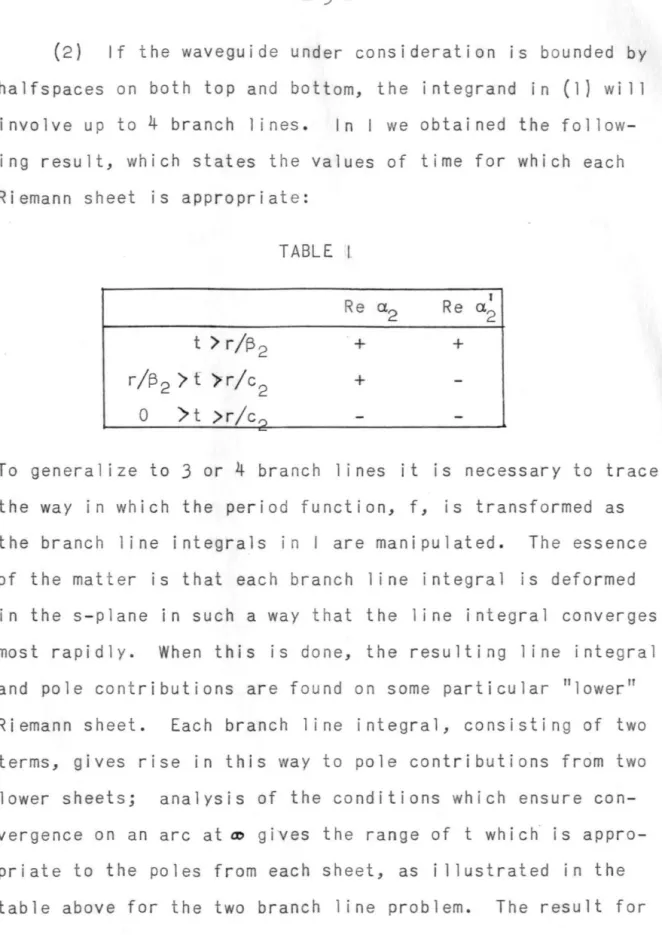
integrand then lies upon four Riemann surfaces in the
complex k or s plane, which we classify by the following
table:
Riemann surface: I II III IV
Table 1
+
+
+
- 13
-It is also inportant to note that all variables are normal ized:
f
l' C l' and H, are considered eq'..lal to one. The uni t of ti'le is, then, the vertical travel time of P ~Iaves in the layer, and so forth. s = i W will be used as t'1e frequency variable for purposes of trans~orming and evaluating the contourin tegral, whi Ie we speak in ter:ns 0 f tV in di SC-cl s sing the results.
The pressure response of the Vlave6Uide to a transient source i s Given by the double integral:
AfL'ao
/00
J
(1)
Plrz
tl=AJ
estds
J
(krJkg(lU,k;z;
elk
('I ) /
Jri
,5+8-
1 0 /{lev
kl
l-
L 00 0 (' ) JThis expression may be obtained in the usual manner by satisfy-ing the boundary conditions [EwinG, Jardetzky and Press 1957
J.
f is the period function and S is the response function.
f = -os 4 c .... 4 u . h a ' " ' [ (21 2, '" 2 2) 2 " k 2 -I
1
2 Sln_ 1 . ul cosnul ( T co S - '-T u2u2Transformation and evaluation of the formal integral solu -tion at residues lying in the second quadrant of the s-plane yields the following integral expressions in terms of forvlard propagating modes. He have neglected all non-oscillatory transient response terms.
P
=
pI + p"pI = +4ARe
E
(H(2)(kr)kl1=OL
0- 14
-r / t k
when <.... , ! pi = 0 other\·,!ise. The integration is over that portion of the real k axis, k> O, whose image s (k) lies
n
in the second quadrant of the s-plane, on the I Riemann sheet . This term is the normal mode contribution plus the late
-arri ving dar:-,ped mode s of the Ro senbaum type. s denotes a n
root of the period equation f
=
0.(4) p"
when r < t ' i p" = 0 otherwise. The integration is over
that portion of the real pOeitive k axis, I,ho se image s (k)
n lies in the second quadrant of the s-plane, on the III
Riemann sheet. These roots of the period equation Clre all
complex, and will generate the early-arriving damped oscil
-lations.
Approximate evaluation of integrals of the type (3)
and
(4)
has been thoroughly discussed by Rosenbaum. Themethod consists of replacing the Hankel function by its
asymptotic representation in terms of a I'lave
the positive direction, obtaining the factor
progressing
ei(CUnt-kr) in
in
the integrand. The k-contour is then considered to be de
-formed so that i t passes through saddle pOints defined by
dw
the condition: ~ = dkn The saddle point approximation
yields asymptotic solutions in t-l Complete evaluation also
yields contributions from the end points of the contour and
special expressions for the solution at an Airy phase, ;,hen
W " = 0 . The saddle point representation is then:
P(r,t) = !J .r. '
n=O
1
-- ...
--~
\'Inere L = I (CU c) - r
t I (k c)
n m n m n
The procedure for obtaining the dispersion and attenuation
curves for damped :nodes is as follows: solve the period equa
-tion f = 0 in tree complex plane in the neighborhood of the
contour 31 or SIll (eqs . 3 and 4 ). Evaluate the complex deri va
-d W
tive ____ n , and iterate this process until one obtains a point
dk
which is both a solution of the period equation and satisfies
dW
n
the condition r = ---- ~ U = real. The quantities appearing
t dk
in the asymptotic representation (5) are then obtained by
evaluation at the saddle point indicated by the superscript
In general there \'Iill exist a family of loci i n the complex
plane which describe the progress of the saddle poi nt as a
function of U, the group velocity.
In point of fact, cer tain diffi culties exist in applying
this recipe for obtaining the dispersion curves. One ~ust
be able to continuously deform the contour into such a posi
-tion that i t passes over each saddle point along a path of
steepest descent. The exi stence of branch points near the
- 16
-oescent conto~r. Rosenbaum recognized the complexity of t~e
problem, and ,'las able, in hi s case, to delimi':; the behavior
of t!1e roots of tile period equation wi t:1 enough preci sion to specify the steepest descent contour with confidence. In the liquid over solid problem, general statements about the
analytic properties of the roots s (k) are difficult to
n
make, due to the complexity of the period lunction. One is
forced, instead, to generalize from numerical results ob
-tained fro:n a fel' arbi trary mode Is.
It therefore is advisable to r egard any theoretical
results as tentative unless corroborative evidence is avail
-able. The dispersion curves must r esemble those predicted in an examination of the physi cs of the problem, as vie have
done in the introduction. Li kewise, the compu':;ed attenuation
coefficient Ln must not deviate too stro:1gly from the behavior predicted on physical grounds . It is helpful to disregard
saddle pOints whose attenuation i s so great as to forbid the possibility of observation. In practice O:1e i s interested in the least damped wave appropriate to any parti cular signal
veloci ty U. For the elastic Ivaveguide sunder di scussion, the
least damped I'lave i s the normal mode Gontribution, wr.en
UA L U ~ f32' \'Ther e U
A is the Airy phase velocity. Thus it
is l egiti:nate to ask after the properties of damped waves
-
17
-;1umerical Solution of the Problem
The period equation f
=
0 (2) was solved on an ele;;ti'oniccomputer, and the derivative dw n dk
evaluated by appropriate
forr.mlae in the neighborhood of the III sheet roots l<2
n (ld :
k real; k 7 0. In thi s I'lay the behavior of the aforementioned
roots (that i s, the initial contour 5111) was clearly estab
-lished, as well as the location of br anch points in the
neighborhood of 5111' Determination of the saddle point loci
dw
fo 110l1S by i tera tion to the condi tion ----1! real. On the
dk
Burroughs
220
Data Processor one pass at the period function ftakes 1 second, one root, ~ , and derivative are obtained in n
about 9 seconds. Solution of the same problem vlhen the super
-ficial layer is solid will be about 4 times slovler.
Dispersion and attenuation curves were computed for the
following assumed models:
Table 2
c
2
132
f
2
1
5
.1
96
3
·
000
3
·
000
2
3
·
000
1.
55
2
.
5
~
1.667
.
909
2
.
0
4
.
0
2
.3
09
2
.
5
5
3.
0
2
.
000
2
.
5
6
3.0
1.
732
2
.
5
7
5
.
1
96
2
.
8
74
3
·
0
-
IS
-Case 1 ~s c~osen to represent a sinplified model of t~e
oceanic waveGuide, '·Ti th the lo'·fer ned urn a Poisson solid.
Cases 4 and 6 represent Poisson solids also, \:i th a reduced
propagation velocity in the halfspace. Case
7
is Case1
wi tha smaller bottom i mpedance, accor:1plished by reducing the
shear velocity in the solid slightly. This ,·las chosen to
correspond to toe reduction in shear veloci ty be lie·ved to
occur in the upper mantle. Cases 2 and
5
show the effectof a decrease and an increase, respectively, in the shear
velocity of Case 6. The numerical results sholm in Figs. 3
through 12 are derived as follm·ls. U is t:'le value of t~e dC<)
derivative ____ n at a saddle point, and is plotted as a func
-dl{
tion of frequency, namely the value of Re W n at the saddle
pOint. TIle phase velocity is plotted to compare 1~i th toe
usual phase velocity plot in normal mode studies; from t~e
Recu
form of t~e solution (Eq. 12) c
=
----
,
at the saddle point.Re k
j·:e plot the attenuation constant Ln as a function of the
group velocity, 1·rhich is equivalent to plotting it on a scale
-1
- 19
-Disc"...lssion of lJ~::lel'i cal Results
T~e results ~or the firs~ three modes of Case 1 are plotted in Figures 3 and 4. The associated normal modes and several late -arri vine; leaky node s are shOlm for com
-parison. The pOints P represent the cutoff of the physically
similar Pekeris normal modes. Particularly notel·Torthy are
the follo~Ting points:
1. At cutoff the group velocity is equal to c2.
This cutof::' is imposed by the form of the intec;ral
solution (3) . The phase velocity at cutoff is slightly greater than c
2. The operational definitions implied by the form of the asymptotic solution
(5)
do not necessarily require that U follOl~s fron c by differen-tiation, a condition '-Ihich occurs only when CUC and kC
n n
ar e real. Electromagnetic theory contains exa:nples \"There a r.1icroscopic loss mechanism brings about a similar situation: the group velocity cannot exceed a maximum value, but the phase velocity may suffer possibly extreme increase or decrease determined by
the nature of the probler.J.
2. The frequency of the PL mode near cutoff is somel-That less than that of the analoGous acoustic mode (represented by the point p). l-lathema tically thi s discrepancy \'Ii t;1 the prediction of a harmonic plane .,ave model is due to the essential vagueness of the
- 20
-i t appears that ;;here -is sl-ight coupl-ing to an attenuated
long period surface vlave ,·:hich propagates in the solid
halfspace. This matter will oe discussed in detail in a
future paper.
3
.
The hi~her modes of Case 1 behave essentiallylil[e the first mode. The mode indices n = 1, 2, ....
are not arbitrary, but describe the number of nodal
surfaces of the 1-lave potential Hi th depth. He may thus
think of these as compressional modes, dual to the
shear modes. It will turn out that I'lhen ~2 is unusually
101'1, the first mode behaves more like a zero mode Ray
-" leigh "ave, but the notation selected here is the more
natural.
The behavior of the exponential decay constant has strong
bearing on the possibility of observinG a given dalnped mode.
Ln is plotted as a functi on of U (Figure
4)
.
The abscissamay also be considered as a non-linear time scale runninG
from right to left. For U
<
3.0 the curves are dashed, sincethe shear ,,,ave and Rayleigh Have dominate the signal in this
range. In the range 3.0
<:
U<
5.196, the maximum value ofthe attenuation incr eases '"Ii th increasing mode number, in
a ratio roughly 1:3:5 for the three modes computed. The
distances to I'Thich the modes 'viII propagate can be seen by
considering the oblique grid superimposed on Fig.
4
,
rep-resenting the distance at which a '"/ave is attenuated by the
-1
- 22
-is related to Ln by the formula:
u
=:
--y-nro is plotted in multiplies of the layer thickness, H. Thus the first mode is seen to propagate without appreciable loss
as far as 250 H. At a very great distance, \~e should see
just a small wave packet traveling at a group velocity of 3.9. At a range of 200, the second and third modes 1'lOuld appear at
best as a small damped oscillation following the first ar
-rival. For these modes the cusp at which L goes to zero n
occurs later than the shear 11ave, and is of no practical
importance . In order to see the entire second mode, one
.. lOuld have to be at a range of less than 100. Other rela
-tions of the same type may be extracted from Fig. ~.
It is important to inquire how readily earthquake data
may be inverted to compare with theoretical curves. The
first damped mode has a dimensionless mean angular frequency
of about 1.4, \'lhich implies a dimensionless mean period of
roughly 4.5. At a range of 100 H, for example, the time elapsed between the first arrival and the shear wave is
just
l3
.
3
~
c;
we should be able to see only 3 cycles of the lPL '"lave, albeit Virtually undamped. Such a signal could not
be read to give very accurate or even moderately dense esti
-mates of the dispersion, nor could the fine structure of
- 22
-fact that the v:ave decays at the desirable long ranges. In point of fact, signals of 6 - 10 cycles duration have been observed for oceanic paths. There is no reason ,,,hy data
from many earthquakes cannot be combined to yield sufficiently
detailed information. But as regards dispersion, there is some question whether the PL wave will ever be able to more than corroborate Rayleigh wave studies. The decay constant L , however, turns out to be quite sensi ti ve to the physical
n
properties of the solid halfspace. Discussion of this matter will follo'" in a later paragraph.
Fir st mode results for Cases 1, 4, and 6, are plotted in Figs. 5 and
6
.
These models demonstrate the effect of varying the P-wave velocity in the solid, while keepingPoisson's constant the same. Phase velocity, group velocity, and decay constant show almost identical behavior, save for
the scaling of the velocity variable. In particular, the "hump" in the decay factor near cutoff has nearly the same value for all three cases. There is a slight reduction in the value of the cutoff frequency as the cutoff velocity is decreased.
In Figures 7 and 8, Case 6 (the Poisson solid) is compared with Cases 2 and
5
,
in which the shear velocity of the solid is respectively decreased and increased. Case5,
representinG a high bottom impedance, involves less-
23
-cut off nearly at the Pekeris cutof~, and the damping ap
-proaches zero as U and c approach c 2. Ti1e opposite extreme,
Case 2, entails highly anomalous behavior. There the damp
-ing near cutoff is appreciably increased, and the dispersion
curves are severely distorted in the direction of lONer
frequency.
In vieN of the strong dependence of Ln on the ratio of compressional to shear velocity on the solid, we should look for possible applications to structure determinations in the
earth. Hith this in mind, we have computed Case
7,
to sim-ulate, by 'contrast with Case 1, the decrease in shear velocity \'ihich is believed to take place in a zone of the upper mantle.
There is no presupposition that the results of this paper
have direct numerical correspondence to the nature of actual
seismograms due to the simplified models necessarily employed.
One would like to know, however, what order of effect this simulated decrease might have on U, c, and Ln, to determine whether calculations for the multilayered model known from Rayleigh wave observations would be appropri ate. Figs.
9
and 10 show, as suspected, that Ln su~fers a pronounced in
-crease near cutoff, l'lhile U(w) and c(cu ) are affected only
slightly.
The computed group velocity for Cases 1 and
7
has also been plotted in Fi g.13
for the specific oceanic modelssho~m, and compared with data by Oliver and Hajor for three
• - 24
-better with the data than did the approximate curve" computed by Oliver and Major. Better fit could be achieved in two ways : (1) by varying the layer thickness of the model, we coul d make the vertical portion of the group velocity curve fit any of the sets of data shown; (2) by introducing an additional crustal (basaltic) layer in our model, it appears that we could "pull" the high velocity end of the theoretical curves down, into better agreement wi th the data. Thi sis not planned at present for practical reasons . Although the theoretical curve for Case 7 agrees best with the data, the very crudeness of the model forb ids us to say anything con -clusive. We defer instead to the refined researches now being carri ed out by means of mantle Rayleigh waves. It is conceivable, however, that the dependence of the attenuati on on the Poisson constant in the sol id may be uti 1 ized to
supplement information obtained with Love and Rayleigh waves. It wi 1 1 be necessary first to compute Ln for models in which the solid is generalized to several layers.
-
25
-large earthquakes by instruments in Pasadena. This P mode
nay involve motion as deep as the penetration depth of the P ray and \'lOuld require theoretical models with several layers. Preliminary examination of records suggests that this wave is the same for oceanic and continental paths.
Another point must be borne in mind regarding the effect of damping. Pronounced variations in layer properties or thicknesses Vlill have a very deleterious effect on the leak -ing ,'laves, as compared with their effect on Rayleigh \'laves. The latter propagate undamped, in a relatively wide fre-quency band \'T~ich is selected by the dispersion curve. Uhen
a change of thickness occurs, such as at a continental mar
-gin, each component frequency incident on the boundary merely "feeds" the nevI propagation modes at the same fre
-quency, but at a nel'/ group veloci ty determined by the local dispersion curves. Thus nearly all of the long-period enerGY in a Rayleigh l'laVe train is transmitted without loss across
structural boundaries, propae;ating locally as dictated by
the local dispersion curves. By contrast, leaking modes traverse appreciable paths only in restricted frequency bands (see Figs. 3 and 13) l'lhere the damping is small.
- 26
-charac ter of t,1e P-arri val.
For the sake of completeness, a model hes been con
-sidered, in \'r~icj1 the shear veloci ':;y of tr.e solid is less
than the compressional velocity in the liquid layer. In
such an instance, no shear modes can exist in the vlavec;uide
and the predominant observed guided wave will be the damped
P-oscillation. In Case 3, i l lustrated in Figures ·11 and 12,
''Ie have chosen
f
2
= 2, ~2 = .91, and c2 = 1.67, parameters
\'ihich might describe e semiconsolidated r ock basement such
as is found in shalloVi water exploration. The dO\ffiwerd
frequency shift noted in earlier figures in connection wit:'l
low shear velocity is the most striking feature of the dis
-persion.
Pressure and Velocity Distribution
'ere shall consider further the physical basis for the
behavior of the group velocity curves just cited, after
examining the distribution of the wave field in the liquid
layer. The z-dependence of the pressure, for the trapped
portion of the field, is given very nearly by !sinh Ct
l
zj,
provided the remaining factors in the excitation function
(eq.
5)
do not vary strongly in the ranze of U that is ofinterest. This has been evaluated for representative values
of U, for Cases 1, 2,
3,
5
,
and 7, and plotted in Figs. 14through 18. The reference curve labeled "Pekeris" is the
sinusoid \1hich represents tr.e pressure distribution at cut
- 27
-The vertical velocity distribution, u z' given by the z -derivative of the pressure, has been sinilarly plotted on the same figures. It will be apparent that the vertical
velocity shoHs most clearly the departure from the reference
shape.
1.'fe see that leakage into the bottom, which depressed the cutoff frequency, tends to modify the shape of the trapped wave, decreasing the phase di fference betl-Ieen the surface and bottom motion. As long as the leakage is relatively small (Cases 1,
5,
7),
\'Ie may consider the wave as a perturbation from the reference shape. This is not unexpected, since physical grounds have led us to classifythe PL modes \',i th the modes of the liquid/liquid case. The situation becomes more complicated \'/hen the damp -ing increases. Cases 2 and 3 show that leakage depresses so much of the waveform into the halfspace that the surface and bottom of the layer are nearly in phase. This, ho\vever, is the situation \'Then a long-wavelength Rayleigh wave, for example, i s propagated on a solid overlain by a thin liquid; the liquid merely moves in phase with the surface of the solid. vIe would want to classify these highly damped modes
-
2
8
-Late-arriving Haves
As mentioned previously, the present problem involves
late-arriving leak<J modes of the type found by Rosenbaum
for the liq~id/liquid problem. The group velocity curves
for these modes have the folloVling tl'/O properties: (1)
every Airy phase, 't!hether of a normal mode or a leaky mode
of the early-arriving type, is associated "~lith a late
-arriving brancr, ,·rr.ich "connects" the stationary value of U
\'lith U = O. (2) In the vicinity of U = 0, that is, for
arbitrarily large time, the frequencies of the late-arrivin
modes degenerate to the set of frequencies w = (n -~) 'i/.
Tr.is behavior is i llustrated in Fig.
3
,
l'Ihere three suchbranches have been computed, I'Ihich all degenerate near U =
°
to the value CU =
~
'iI. These results have relevance in theanalysis of the late-arriving signal from an earthqual{e,
transmitted along an oceanic path. It is a matter of ob
-servation that observed oceanic Rayleigh ';Iaves do not
terminate sharply in a strong Airy phase, but gradually
decay, "lith oscill ations near the expected Airy phase
fre-quency observed at very long times a:'ter the event. As is
seen in Fig.
3
,
the three different late-arriving modescomputed \,lill not differ signi::'icantly in frequency for
large times. In Fig. 19 ":e have computed the damping
coefficients :"or these three I-raves; the least damped for
any value of U being represented by the heavy line, whi ch
_ 0(,,: _
-
-Give~1 time. He ':lisn T:1erely to point out tllis explanation
for the 0"0 served late -arri ving \'!aves; a oefini ti ve conpari ::;or:.
of d2.ta Nith the theory is not attempted here.
Physically, the late -arri vins ' .. ,ave s correspond to plane
1'!aves nultiply reflected in the layer at nearly vertical
incidence. In contrast, the early-arriving 'Ilaves (?L or
shear) correspon::l to an ang:e of incidence nearly equal to
an appropriate critical angle for refraction into the half
-space. The hig!l-frequency branch of a normal mode is the
result of Naves travelin:>; at nearly grazing incidence in the layer.
Rayleigh wave observations for various paths reflect
these di fferences. It is indeed seldom that the high fre -quency branch is observed, for ei ther continental or oceanic paths. Instead, the Airy phase of the ear ly-arrivi ng (long
I"ave) branch is occasionally followed in time by a I-leak train of waves at the Airy phase frequency . In vie\'l of
the physical basis for these waves, i t is not surprisins
that the branch d'..le to grazing I'laves is destroyed by inhomo -geneities or variations in crustal thickness, a mechanism
~rhich Ivould not degr2.de the vertically bouncing \'laves as severe ly . A m2.jor s true tural bound2.ry \'IOU Id al so tend to
destroy t~e hi;;h freque?1C~l branch and favor by comparison
tile Ia te-arri vinE; Vlave.
Other phenomena rel2.ted to oceanic seismic Have propag2.
1. Sir.~e 2. 182.kin8 mode i s cO'-lpled to a bodj' ',:ave,
a siT:".ple application of reciproci ty sho\l]s that earti1
-qual{e boci.y ':laves may excite 2. le2.\:y $).rfE.ce 1'tave train. O::ive1' :1as applied tr.is to the compu':;ation 0:;" the long
-period \·:aveform 2.ssociated ':lit!: tl:e body S phase, "Thic:'1
exci tes a lealq PL mode of phase velocl ty equal to the
local trace velocity of the body \'lave.
2 . ~i!e rna:,' be concerned 1/li th the IIcomplementl! of a lea10J mode. A lea1-:;,,' mode repre sen t s narrovT-b2.ncl
ep..ergy te:.1porarily stored by ti1e surfa.ce portion of
tne 1:'72vegui::ie. Its cOIilplemen~ is merely the signal
released from tr.e surface and pernitted tc travel
into the bottom as 2. body ','lave. The osc::'llatory por
-tion of the P wave observed at ranGes of
25
togo
degrees (con~only a period of 13 to
28
seconds) isthe complenent of the late-arrivinG (vertically in
-cident) mode excited by an earthqua1<e at the base of
the crust, propagated 2.n the mantle along tile same
"ray" as the i,ni tial P-motion. Observed P osci11a
-tions of around 60 2nd 150 seconds are of the same
type, but, since their wavelength is of the same order
as the penetration depth of the P ray, the foregoinG
remarks become rather imprecise, anti i t vlill be
neces-sary to construct a conplete Have t:1eory for these
-
3
1
-3
.
I t is suggested that the late-arriving quasi -standinG mode may playa role in the propagation of seismic noise in oceanic regions. Widespread surface pressure variations, whether baronetri c or due tostanding water waves, will exci te this mode at least as efficiently as theyexci te undamped Rayleigh waves. The noise may then leave the source reg=-on ei ther by horizontal propagation in the layer or by means of
the P waves leaking i nto the bottom. The former must be regarded as a short range mechanism, while the
latter would carry the energy to appreciable distances as body waves. He merely mention these hypotheses, since further consideration will require appropriate experiments.
Conclusions
In the steady state, undamped normal modes are suf
- 32
-problem. The PL ;';ave dispersion differs, however, from
t:-:at of the Pekeris :1ormal modes in tha~ the existence of
leakage into the solid apparently caLlses the f:::>equency of
the I'raves to be decreased somel'lha t . ':':le attenuation fac tor
for PL I'raves is qt;.ite sensitive to t:1e Poisson constant of
the underlying solid. Du.e to the li:nited ranges of propaga
-tion, the extraction of dispersion and attentuation from
earthquake records presents considerable difficulty. Ehen
models with a high Poisson constant are considered, certain
complications arise . It appears that the resulting highly
damped wave may be thought of as a long period pseudo
-surface Have, an interface wave intrinsic to the solid
halfspace, which is in a sense the prograde elliptical
dual of the far:iliar Rayleigh I-lave . The late-arriving leabJ modes appear to be involved in several types of
seismic signals, such as P-type body >Iaves, late-arriving
surface waves, and microseisms.
The importance of P-modes in shaping t"e first
arrivals from large blasts cannot be too heavily emph sized.
In tile nuclear detection problem surface layering is respon
-sible for tile distortion of the P wave into an oscillatory
signal. For P vraves from blasts or near earthquakes tile
frequencies cOTIL'l1only observed may involve higher '.10des.
Pertinent to this, computations are no '.'1 in progress fo:::>
:-:1odels having 2. solid surface layer.
- 33
-involves a simple generalization to complex variables of
the technique employed in norma:!. mode problems. One comp,-; tes
complex so lu tions, C<J n' of the period equation for complex l:
by iteration and looks for the complex loci of this solution
d 4J
n
along which is also real and positive. Roughly
5
to dk.
' .. ~ppenQlX
Defini tions a;1d formulae :
A = so·",.rce ampli tude
b =
c = phase velocity
cl = compressional velocity in liquid layer
c2 = compressional velocity in soli d hal~space
D = source deptr. i'1 layer
f = period function defined by eQ. (2)
g = response function defined by eQ. (2)
Ii = layer thickness
k = complex wave number
Ln = exponential t~me decay factor for t~e nth mode
n = mode index
r
=
horizontal coordinater =
0 "decay range" for dar:1ped modes = U/L n
s = Laplace transform variable = i 4J
t = time
U
=
group velocity = dt.{) /dk \'~hen this quan ity is pure real nu =
z vertical veloci ty
z = depth coordinate, increasing dOlmward
The subscript n denotes evaluation at a root (nth mode) of ti1e equati on f( tV
n, k) = O. "'he superscript c in addition denotes eval;.Jation at a saddle point, ':ll1ere dw /dk = r/t.
'1
a
l
a 2
,
a 2
!3
2r
c
e
f
i
a )
=
=
=
=
=
=
=
=
=
- 35
-Appendix (continued)
1
(k2 +JS2)2
1
(k2 +"IS2)2
snear l-laVe velocity in halfspace
decay time of source pulse density of ith layer
- 36
-The formal Eolution in dimensionless variables is a
consequence of applying the appropriate boundary conditions
,:md specifyine; that the source be a point pressu",e pulse,
exponentially damped in time .
(1) P(r,z,t)
.
~
t
+i
~
1/i/I
-i oodl,
where f is the so-called period function and r; t'1e response
function.
:e shall deform the ini tial contour of intesration
(Fig. 20) in the s-plane, ca~sing it to lie partly on the
II and III Riemann surfaces of the integrand (see table 1).
For convenience, auxiliary functions are defined, in order
to remove part of the confusion of ,'Iorking ':Ii th several
Riemann sheets. If ,'Ie VIi sh to take the value of f on the
second sheet, ,'Ie \vri te r)II ' f* is defined to be the
function ,-Thich is defined on the first sheet to be identical
there to f)II ' Thus
\'!hile
f* =
=
In like fashion, VTe define f**)I =
- 37
-Figure 20 shoh's the oriGinal 3romwich contour for evalua -tion of (1) in the s-plane. Branch pOints due to u
2 = 0 and
u;
=
0 are located at s=
+
~
and s=
+~.
Toe familiar roots of the period equation produce poles of the integrand lying on the imaginar:l' s axis between s = ik and s = ik/c(that would be the real tv axis) . The branch cuts are
1
chosen by requiring that Re u2 = 0 and Re u2 = 0 along the
two cuts. This conventional choice, while not necessary to
thi s problem, I"ill be followed. The "top" or first Riemann sheet will then be identical !'lith that encountered in the recent literature. We may then make use of theorems that
have been proven regarding the disposition of the roots of
the period equation.
Si nce all quanti ties under the integr al sign are real
I~hen s is real, then they are complex conjugate at complex conjugate values of s. The positive and negative imaginary
halves of the contour in fig. 20 are combined, and we let
A
- ? 0, except for indentations at the singularities onthe i maginary axi s. Then:
P
= ;;I
{i~
o(A
-
l)
e st -1s+8
00
ds
j
Jo(kr)k+
dko
The contour may now be deformed as sholVTI in figure 21 . The
solution naturally decomposes into the four contributions
from the various si ngularities in the second quadrant. P = P
the source pole at s = _9-1.
~
he
contribution from the in-finite arc vanis~es 2S R -=;,..(}o The norJr.al ".lode po Ie s
yield residue con~ributions i'lhic'1 'de denote by PH' P
3P an::l
P~S are the t\·,o br2nch line i ntegrals. !:l
Evaluation of PI
(A-2) 2A
'iT
-1L ds
f
-1
Except at the indentation at s = -8 , the integrand is
purely real, giving no contribution. The semicircu12r
in-dent2tion is evaluated by residues :
(A-3) l~ (~) -1
- s=-8
dk
This expression, like all others encountered, can be shown
to vanish prior to an appropriate 2rrival time. \~2t is
important is that it is a forced non-oscillatory response,
and of no interest in the study of modal oscillatory solu
-tions. There is often some 2mbiguity in taking the
contribu-tion from a semicircular arc a~ a pole: in this case, how
-ever, the expression 2dopted is the only possible correct one . This result \'IOuld have been obtained if the infinite
contour of fig. 20 ,<,ere deformed i nto the left half-plane before reducing it to a semi-infinite contour. In that
event the pole 'o'iould contribute by vi rtue of the residue :'ormula, 1'lithout a":\biguity. ':!i~h this, 1;le shall drop CO:1
Evaluation of P R
P
R is the SUl"1 of residue contribu'cions due to roots
of f ~ 0 lyin;:; on the I sheet imaginary axis bet"leen s ~ ik
and s
~
~
It has been sho'!m that :10 other roots lie0:'1 the top sheet (tr1is is, of course, for k real a:1d
>
0) .For each mode there exists one root s ",hich appears on the n
:r: sheet if k
n ;::: knO' the cutoff value. For tl:e 101'iest
(Rayleigh) mode, kOO ~ O. For all others (the shear modes)
the cutoff is given by:
(A-4 ) k =
nO
1
(n - 2)11
~;,.
V
I
-(,>-Proceeding, "Ie perform the residue evaluation:
(A-5) PR~2'1)- i
Z
Res(Sn)= nI'lr.ere: (A-6 )
Branch Line Integrals:
00
> 4A Re
J
J(kr)~c
'--' 0
n 0
s t
e n , ( v.
'
r
11-=---_"lFl s "') _ .. {
sn+8 n
It will be necessary to rel'r.ri te the branch line integrals
in ter~s of contours along just one si de of the respective
For the first term in brackets, 1m CL
2
>
0; for the second,
ter:7l, 1m CL"
<
c
.
'-Combi !1ing, 't'le get
(p. -8 ) -
2
P
' 1mfW
J (kr)kTr 0
o
f
i OO
d k
ik/
c
ds
11here the contour runs along the righ t side of the cut, and:
(A-g) F2(s,k) =
2 4 4 2 ' ( I.
8 hk s
c
CL2 CL2 sinh eLlD
)
sin.'1leL l z) f . f*remembering, that using the f* notation implies Re CLi> O.
In like manner, the other branch line integral beco~es:
(A
-
I
O
)
1
00
p 2A , ~ 1
"BP
= -
-
Im J (kr)K Q K'fT
0o
F,,(s,k) ds J
y
\~here :
U -ll)
Evaluation of PBS
In the following l1e shall transform the contour integra2.
A-3 in the cOMplex plane, and will have occasion to break i t
up into several constituent parts. For clarity, a subscript
notation is adopted which, i t is hoped, viill make i t easier
to follow the mathemati cs and suggest the origin of any
given term. For eXaQple, PES is decomposed into the sum of
tl'IO terms; the se are de no ted P 3S1 and P BS2 ' A floVi chart is
i ncluded at the end to sUTIunarize tl1e roles of all the sub
- 41
-The contour for eq. A-8, running along the right side
of the branch cut, is transformed as indicated in fig . 22.
It is deformed into the second quadrant of the s-plane in
such a i'lay that i t passes through the branch cut and onto
the II Riemann sheet. All but a small slice of the second
quadrant is enclosed in this manner; all poles of tile
integrand lying on the II sheet are excluded by small cir
-cular contours. The infinite arc contributes notiling, as
usual. \']e t!len have two contributions to PBS:
P
BSl: The line integral from s
=
ik/E to - OQ.P
BS2: Residue terms due to poles of the integrand lying
on the II sheet.
(A-12) p
=
-
2A 1mf<OO
J
(kr)k dlC
J-
OOeS
\
J;.2(S,k)} dsBSl
II
0 . s+9 -L
"
I Io lk
(
A
-
13)
-8 b
1'lhere: (A-14) =
The zeros of f* are just the II sheet cOr.1plex roots of the
period equation. Vie note that f did not have any complex
zeroes on the I sheet; thus PBS2 arises solely from zeros of f~·.
He introduce further notation to simplify the analysis.
Let SII denote that portion of the real positive k axis ~Ihose
root sn (k) lies in the second quadrant of the II sheet. SIr
- 42
-I
set
S
rr
will denote that portion of the real positive kaxis "Ihich maps into the sector l'I"ich is enclosed by the
dotted contour in fiS. 22. \-Ie use t?1is notation to repre
-sent the r anse of k for integratio:1. until we are able to
exami!1e the detailed behavior of the solution s (k) .
n
is the ranse of k in eq. A-l3.
A-l3 may be rewritten by use of the following relatio:1.s:
(A-l5) f*
-
-' = 8 k2 ct Il ct2 ct2 cosn ctl
L
,.,
IThus, when f* = 0, f =
-
8 k" ctl ct2 ct2 cosh ctl n
hence:
T'r:is form, I~hich resembles P.-5 closely, is nearly appropriate
for evaluating the modal contribution from this s'1eet. ':Ie take this up later.
Resuning consideration of A-l2, we note that
The object of the :'ollowing transformations is to obtain
- 43
-to circumscribe the entire quadrant . The line integrals
remaining, hO~"iever, are not easily l1andled, a d an estimate
of their contribution i s difficult. It is therefore neces
-sary to go the long route to accomplish our objective, and
several contour deformations and changes of vari able VIill
be necessary. Hence, w.r'iting as a double integral "'Ie get:
(A-18) P
BSl
O<ll
"
-fYO
t
?A s
: - Imj J (kr)k e -1 F2(s,k) d s d k
/I . k 0 s+8
o l
e
q is now introduced as the variable of integration re
-placing s:
(A-19) P
=
2ABSl 'iT
ik
s = q + -
c
d s=
d q+ 8-1 + ik/
c
We no\v consider this as a contour integral in the complex k-plane (Fig. 23). A pole occur s at k p
=
i E (q+8-1) . lrJhen-8-1..::::qL O, the pole lies on the positive imagi nary axis.
Hhen - oo<q<- 8-1, the pole lies on the negative imagi nary
axi s. Branch points occur at k = +
~
i t=" q and k __ + i "l"e ..L- qc
+
r
I-!e may insert branch cuts running to infinity just to theleft of the imaginary axis (to avoid the pol e).
dk
"Ie now deform the contour of Fig. 23 into a loop enclosing
the entire first or fourth quadrant of the k-plane. PBSl no\"!
- 44
-P3S11: A line integral alonG an imaginary seDi
-axis.
P3S12: Contribution froD the indentation around
the source pole located on the imaginary axis.
PBS13: Modal contributions due to poles in the appropriate que.drant of the k-plane.
The condition that the integral along the infinite arc ve.o ish
determines the quadrant into .~hich the contour in the k-plane
is deformed. This is a long, but familiar story, i'lhich ,'ie
Hill only surmnarize. '.tIe represent the Bessel function
asymptotically as a sum of outward travelling and inwe.rd
travelling ,'laves. "le shall not be concerned wi th the latter;
a thorough study would double the length of thi s paper. In
general, these inward travelling "Taves can contribute only
non-realizable pulse terms and modal oscillations insign
if-icant compared VTi th those from the outward travelling waves.
With respect to the latter, the i ntegrand of A-19 vanishes
exponentially in the upper hal f plane if t
>
r
c
and inthe lONer half plane if t
<:
rc.
We deform the contouri n Fi g.
23
accordingly. This ensures convergence of theline integral P
BSll' as well as vanishing of the infinite arc contribution. To make the details of the contour trans
-formations easier to follow, "Te shall replace the Bessel
45
-contributes the outv;2.rd travelin3 1'l2.\'e solutions. The Hankel function of the first kind, "lhich \'fe have dropped,
turns out to be merely excess bagua3e; this may be shovm by a separate but parallel development such 2.S appears here.
The restriction of rand t to large positive values is
crucial in bringing this about.
If t > r € , "Ie deform the contour into the first
quadrant of the k-plane. Then:
(A-20) ; _e-l
P
BS12=+2A 1m.
eqtH~2)[i
c
(q+e
-~]
c (q+e-l)F2(s,kp)e-(q+e-l)tdqo
If t
L:..
r IE then the limits are changed to -9 -1 and - 0 0 Thisterm represents anon-oscillatory, forced response which VIe shall not consider further. Proceeding: if k = ij
(A-21)
In the case considered by Rosenbaum, this integral vanished by virtue of the integr2.nd being purely real. \'!e are not so en-dO\'led, and must estimate the form and magnitude of the term. The Hankel ~nction is replaced by its far field asy~ptotic
representation; we then estimate the integral by expanding
the func tions under the integral sign about q = 0 and
i
= O.Because of the several factors in F2 "thich may be small near this point, VIe ImoV! that, to zero order, the integral '-lill
- 46
-order terms in the expansion. The result is an estimate,
asymptotic as r ~ 0<0 and t ~ DO , of the integral (A-21):
(A-22) r -1/2 t -3/2
This expression vanishes strongly except near the arrival time of a pulse traveling in the solid at the shear wave velocity. To the first order of approximation it is a mathematical singularity at the arrival time. Equally of note is the dependence on r -1/2 and t -3/2 , which, for r and t of the same order of magnitude yields a decay of the pulse with distance like r -2 This is the same dependence predicted in the case of a refracted arrival propagating
along the interface between two semi-infinite media. The
existence of a disturbance prior to the arrival time, suggests that the source pulse has been distorted in transmission, such as occurs when a plane pulse is reflected by a plane discon-tinuity at greater than the critical angle. 'Ie are not in a position to detail the form of the pulse, nor is this suf-ficiently relevant to the study of the modal oscillations to pursue further.
Evaluation of the modal term: PBS13
47
-image, by virtue of the period equation, lies in the first
quadrant (Fig. 24) . I f t
<
r {; the same residue formulawill obtain, but the q integration vlill nm'l be over the
,
complementary set Sq ,-lhose map lies in the fourth quadrant.
Also, the sign of the result will differ, since the sense
of a pole contour in the fourth quadrant differs from that
of one in the first quadrant. Since either f or f* may
yield poles, \'le write two terms:
(A- 2
3)
PBS13 = 4A Re
+
C
n=O
where:
and
H f*
n
n
PBS131 is due to roots of f*
=
0; PBS132 is due to roots of- 43
-For fixed n, the map of the negative real q axis by
virtue of the period equation is sho\'m in Fig. 24. One
locus is due to vanishing f, the other due to vanishinG f*.
';/hen q = 0, ~he t\,lO roots coincide, and lie on the real k
axis. As q decreases, one moves into the first quadran~,
due to f* = 0, and the other moves into the fourth quadrant,
due to f
=
0 . Both eventually end up in the fourth quadrantas shO\'ln. For t > r
e
, then, A-23 becomes:n=O
with the zeros of f not contributing anything, and PBS132 in
A-23 vanishing. The integral over Sq is equivalent to an
integral over a certain range in the s-plane (Fig. 25) .
This is just the segment A'-B' in the s-plane. ",'e shall no":
make a change of variable from q to kn' vlhich Ne call merely
k. The integral over Sq is nO\'l a contour integral over the
arc A-B in Fig. 21. v.'e may deform thi s contour into the
line segment A-B along the real k axis. From the properties
of the conformal mapping sn
=
Sn(k), i t is evident that theimage of this segment A-B will be an arc A'-B' in the
s-plane. In short, when A-24 is "Iritten as an integral along
part of the real k axis, \oTi th the integrand a function of
sn(k), A-B is the part of