Instability
Thesis by
Nick Parziale
In Partial Fulfillment of the Requirements
for the Degree of
Doctor of Philosophy
California Institute of Technology
Pasadena, California
2013
© 2013
Nick Parziale
Abstract
With novel application of optical techniques, the slender-body hypervelocity
boundary-layer instability is characterized in the previously unexplored regime where
thermo-chemical effects are important. Narrowband disturbances (500-3000 kHz) are
mea-sured in boundary layers with edge velocities of up to 5 km/s at two points along the
generator of a 5 degree half angle cone. Experimental amplification factor spectra
are presented. Linear stability and PSE analysis is performed, with fair prediction
of the frequency content of the disturbances; however, the analysis over-predicts the
amplification of disturbances. The results of this work have two key implications: 1)
the acoustic instability is present and may be studied in a large-scale hypervelocity
reflected-shock tunnel, and 2) the new data set provides a new basis on which the
Acknowledgements
Firstly, I would like to thank Joe Shepherd and Hans Hornung for the opportunity
they afforded me in pursuing an advanced degree at Caltech. It was a privilege to
work with them. They are accomplished scientists with “big” personalities; this made
the work particularly rewarding because of the fun we had solving problems.
Without Bahram Valiferdowsi, the quality of the work reported here would be
comprised. Working with Bahram to make several key improvements to the
tunnel-operation procedure helped make the experiments far more repeatable. I thank
Bahram for more than his technical and engineering support, he is a close friend
and it has been my pleasure to work with him.
I would like to thank Joe Jewell, my lab mate in T5. I have learned about
many things from Joe, ranging from science to wine. His suggestions, efforts, and
friendship have most certainly improved the quality of the work reported here, and
my overall experience at Caltech. I would also like to thank Ivett Leyva for her
support (including molybdenum nozzle throats and optical table legs) and friendship
during my time at Caltech. Ross Wagnild of Sandia National Laboratories helped get
the software package “STABL” running and provided valuable insight into
boundary-layer stability calculations.
I would like to thank Guillaume Blanquart and Beverly McKeon for sitting on
my thesis committee and the time they spent reviewing the work. In addition, Ravi
Ravivhandran has been a mentor to me during my time at Caltech, and I thank him
I would like to thank the members of the T5 and Explosion Dynamics Laboratory,
past and present. It was my pleasure to work with Stuart Laurence on the shock
surfing project. Also, Jason Damazo and I had many constructive conversations
concerning high-speed imaging strategies. I became a close friend of Phil Boettcher’s,
and I thankful for his encouragement. Sally Bane, Stephanie Coronel, Neal Bitter,
Bryan Schmidt, and Remy Mevel have been a pleasure to work with.
At Caltech, I became close friends with Jon Mihaly, Jacob Notbolm, Jason
Ra-binovitch, Shannon Tronnick, Dan Turner-Evans, and Mumu Xu. In particular, I
would like to thank Jason for his friendship and the time we spent working together
on the 2013 Caltech Space Challenge and the Vertical Expansion Tube projects.
Tim Singler, Frank Cardullo, and James Pitarresi of SUNY Binghamton, and
Walt Bruce of NASA Langley mentored, taught, and/or supported me early in my
career, and I am grateful for that.
Without the base of support from my parents, Susan and Steven Parziale, and
my brother and sister, Sabrina and Joseph Parziale, I would never have been able to
come to Caltech. Frank Rampello, Chris Frlic, and Matt Moore have encouraged me
from Long Island, and I thank them for that.
This work was an activity that was part of National Center for Hypersonic
Laminar-Turbulent Research, sponsored by the “Integrated Theoretical, Computational, and
Experimental Studies for Transition Estimation and Control” project supported by
the U.S. Air Force Office of Scientific Research and the National Aeronautics and
Space Administration (FA9552-09-1-0341).
Finally, I would like to thank Victoria Nardelli. She is everything.
Contents
Abstract iv
Acknowledgements v
Contents vii
List of Figures xi
List of Tables xv
1 Introduction 1
1.1 Design Implications of Boundary-Layer Transition . . . 2
1.2 Paths to Transition and the Dominant Mechanism . . . 3
1.3 Geometrical Acoustic Motivation . . . 6
1.3.1 Example Problems . . . 8
1.3.2 High-Speed Boundary Layers . . . 10
1.3.3 Summary . . . 15
1.4 Motivation For Hypervelocity Instability Study . . . 15
1.4.1 Energy Exchange and pdV Work . . . 16
1.4.2 Simple Acoustic-Wave Attenuation Model . . . 18
1.5 Hypervelocity Transition in T5 . . . 21
2 Facility and Run Conditions 25
2.1 Facility and Test Procedure . . . 25
2.2 Reservoir Conditions Calculation . . . 27
2.3 Nozzle Calculation . . . 28
2.3.1 Nozzle Freezing Examples . . . 29
2.4 Cone Mean Flow Calculation . . . 34
2.4.1 Example Boundary-Layer Thicknesses . . . 34
2.4.2 Comparison: DPLR to Similarity Solution . . . 35
2.4.3 Thermo-Chemical Boundary-Layer Profiles . . . 38
2.5 Uncertainty Estimate . . . 42
2.5.1 Reservoir Conditions Bias Uncertainty Estimate . . . 43
2.5.2 Nozzle Calculation Bias Uncertainty Estimate . . . 44
2.5.3 Cone Flow Calculation Bias Uncertainty Estimate . . . 46
2.5.4 Repeatability of Conditions . . . 47
3 FLDI Measurement Technique 50 3.1 Instability Measurement Technique Review . . . 50
3.2 Focused Laser Differential Interferometry . . . 54
3.2.1 Description of FLDI Setup . . . 56
3.2.2 Relation Between Density and Voltage . . . 57
3.2.3 Bench Test: Evaluation of Sensitive Region. . . 60
3.2.4 Bench Test: Equidistant Acoustic Wave . . . 61
3.2.5 Integration Length Determination . . . 63
3.2.6 Sensitivity to Wavelength . . . 65
3.2.7 Uncertainty Estimation. . . 67
4.1.1 Motivation. . . 69
4.1.2 Data . . . 71
4.1.3 Discussion . . . 76
4.2 Single Point FLDI Measurement . . . 77
4.2.1 Data . . . 77
4.2.2 Discussion . . . 81
4.3 Double Point FLDI Measurement - Development. . . 82
4.3.1 Shock Tube Fill Gas Quality and Cleaning Procedure . . . 83
4.3.2 Data and Discussion . . . 86
4.4 Double Point FLDI Measurement - Air . . . 93
4.4.1 Lower Enthalpy Conditions . . . 94
4.4.2 Higher Enthalpy Conditions . . . 96
4.4.3 Schlieren Visualization . . . 99
4.5 Double Point FLDI Measurement - N2 . . . 100
4.5.1 Lower Enthalpy Conditions . . . 101
4.5.2 Moderate Enthalpy Conditions . . . 103
4.5.3 Higher Enthalpy Conditions . . . 105
4.5.4 Schlieren Visualization . . . 107
4.6 Double Point FLDI Measurement - CO2 . . . 108
5 Analysis 112 5.1 Experimental Amplification Factor . . . 112
5.1.1 Methodology . . . 112
5.1.2 Uncertainty Estimate . . . 114
5.1.3 Results . . . 114
5.2 PSE-Chem - Experiment Comparison . . . 117
5.2.2 Results . . . 119
6 Conclusion 131 6.1 Introduction . . . 131
6.2 Facility and Run Conditions . . . 133
6.3 FLDI Measurement Technique . . . 133
6.4 Results . . . 134
6.4.1 Tunnel Noise . . . 134
6.4.2 Single and Double Point FLDI Developement . . . 135
6.4.3 Double Point FLDI Measurements . . . 135
6.5 Analysis . . . 136
Bibliography 139 A T5 Run Conditions 157 A.1 Reservoir Conditions . . . 157
A.2 Nozzle Exit Conditions . . . 165
A.3 Edge Conditions . . . 169
B Probe-Volume Locations and Boundary-Layer Thicknesses 173
List of Figures
1.1 Paths to Turbulence . . . 4
1.2 Acoustic Mode in High-Speed Boundary Layer . . . 5
1.3 Comparison of Dominant Modes in a Supersonic Boundary Layer . . . 6
1.4 Vector Addition for Tracing Acoustic Rays . . . 8
1.5 Goodman and Duykers Example Problem . . . 10
1.6 Munk Example Problem . . . 10
1.7 Boundary-Layer Profiles for Geometric Acoustics . . . 11
1.8 Max Angles of Inclination for Acoustic Energy Trapping . . . 13
1.9 Ray Traces for ME = 1 . . . 13
1.10 Ray Traces for ME = 6, TW =Tad . . . 14
1.11 Ray Traces for ME = 6, TW =Tad/10 . . . 14
1.12 P-v Diagrams Illustrating Acoustic Absorption . . . 18
1.13 Relaxation Absorption Coefficient Time and Temperature Dependence 19 1.14 Example Absorption Coefficient for CO2 . . . 21
2.1 T5 Schematic . . . 26
2.2 Example Reservoir Pressure and Shock Timing Traces for Shot 2789 . 28 2.3 Outline of Contoured Nozzle. . . 29
2.4 Nozzle Calculation for Air.. . . 30
2.5 Nozzle Calculation for CO2. . . 31
2.7 Example Computed Boundary-Layer Thicknesses . . . 34
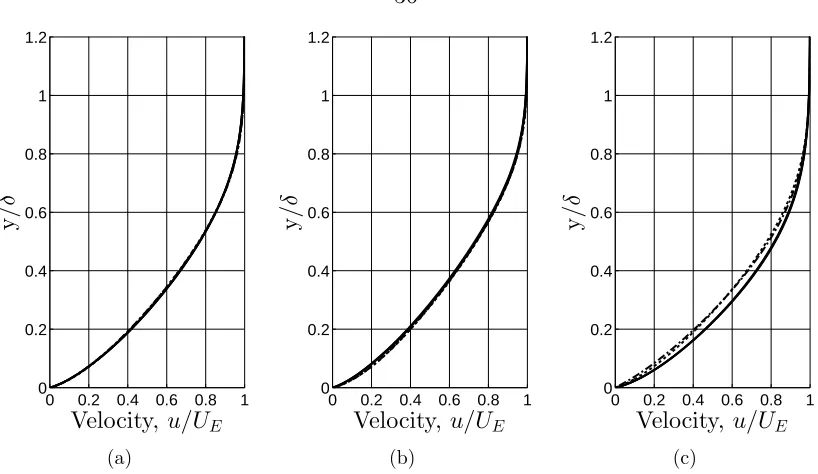
2.8 Example Velocity Profiles . . . 36
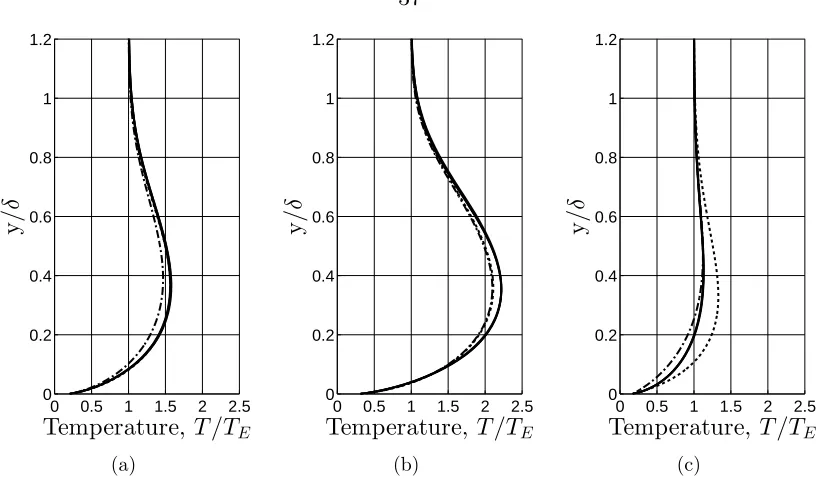
2.9 Example Temperature Profiles. . . 37
2.10 Evolution of Mass Fractions . . . 38
2.11 Evolution of Temperature . . . 40
2.12 u±a Profiles. . . 42
2.13 Overlay of the Computed Density, Cone, Shock, and Streamlines . . . 45
2.14 Zoomed-in Presentation of Density Contours in Nozzle. . . 45
2.15 Wall-Normal Distance from the Cone vs. the Radius in the Nozzle . . 46
2.16 Examples of Repeatability . . . 48
3.1 Annotated Schematic of the FLDI . . . 55
3.2 Boundary-Layer Thickness and Beam Profile. . . 59
3.3 Bench Test Schematic and Results: Sensitive Region . . . 61
3.4 Bench Test Schematic and Results: Equidistant Acoustic Wave . . . . 62
3.5 Density Eigenfunction and FLDI Probe Volume Sensitivity . . . 63
3.6 Averaged Density Eigenfunction and Response Function . . . 65
3.7 Sensitivity to Wavelength . . . 66
4.1 Sources of Wind-Tunnel Noise . . . 70
4.2 Tunnel Noise Time Traces . . . 72
4.3 Frequency Spectrum of Tunnel Noise Time Traces . . . 73
4.4 Wavelength Spectrum of Tunnel Noise Time Traces . . . 74
4.5 Spectrogram of Tunnel Noise . . . 75
4.6 Single Point FLDI Results Shot 2695 . . . 78
4.7 Single Point FLDI Results Shot 2702 . . . 79
4.8 Single Point FLDI Results Shot 2702 - Zoomed Time Trace . . . 80
4.10 Gas Opacity. . . 86
4.11 Windowed Spectra Shot 2711 . . . 87
4.12 Windowed Spectra Shot 2743 . . . 88
4.13 Narrowband vs. Broadband Disturbance . . . 88
4.14 Cross-Correlations, Shots 2711, 2743 . . . 89
4.15 Spectrograms of Shot 2711. . . 90
4.16 Spectrograms of Shot 2743. . . 91
4.17 Spectra For Shots 2711 and 2743 . . . 92
4.18 Traces and Cross-Correlations, Air, Low Enthalpy . . . 94
4.19 PSD Estimates, Air, Low Enthalpy . . . 96
4.20 Traces and Cross-Correlations, Air, High Enthalpy . . . 97
4.21 PSD Estimates, Air, High Enthalpy . . . 98
4.22 Schlieren Image of Instability in Air . . . 100
4.23 Traces and Cross-Correlations, N2, Low Enthalpy . . . 102
4.24 PSD Estimates, N2, Low Enthalpy . . . 103
4.25 Traces and Cross-Correlations, N2, Medium Enthalpy . . . 104
4.26 PSD Estimates, N2, Medium Enthalpy . . . 105
4.27 Traces and Cross-Correlations, N2, High Enthalpy . . . 106
4.28 PSD Estimates, N2, High Enthalpy . . . 106
4.29 Schlieren Image of Instability in N2 . . . 108
4.30 Traces and Cross-Correlations, CO2 . . . 109
4.31 PSD Estimates, CO2 . . . 110
5.1 Amplification Factor SNR . . . 114
5.2 Experimental Amplification Factor - All Shots . . . 115
5.3 Experimental Amplification Factor - Selected Shots . . . 117
5.4 Amplification Factor Calculation Methodology . . . 119
5.6 Computational-Experimental Comparison, N2 Low Enthalpy . . . 123
5.7 Computational-Experimental Comparison, CO2 . . . 124
5.8 Computational-Experimental Comparison, N2 High Enthalpy . . . 125
5.9 Computational-Experimental Comparison, Air High Enthalpy . . . 127
5.10 UE/(2δ) Scaling . . . 129
List of Tables
1.1 Characteristic Thermo-chemical Energies . . . 16
2.1 Uncertainty in Reservoir Conditions . . . 43
2.2 Uncertainty in Nozzle Conditions . . . 46
2.3 Uncertainty in Edge Conditions . . . 47
2.4 Shot Series Data from Hornung (1992) . . . 47
4.1 Run Conditions - Tunnel Noise . . . 72
4.2 RMS Tunnel Noise . . . 75
4.3 Run Conditions - Single Point FLDI . . . 80
4.4 Single Point Edge Conditions . . . 81
4.5 Double Point Edge Conditions - Dev. . . 86
4.6 Double Point Dev. Boundary Layer Instability Scaling . . . 93
4.7 Double Point Edge Conditions - Dev. . . 93
4.8 Double Point Air Boundary Layer Instability Scaling . . . 99
4.9 Double Point Edge Conditions - N2 . . . 101
4.10 Double Point N2 Boundary Layer Instability Scaling . . . 107
4.11 Double Point Edge Conditions - CO2 . . . 108
4.12 Double Point CO2 Boundary Layer Instability Scaling . . . 111
5.1 Amplification Factor Data Summary . . . 115
A.2 Tunnel Noise Reservoir Conditions . . . 158
A.3 Single Point Tunnel Run Parameters . . . 158
A.4 Single Point Reservoir Conditions . . . 158
A.5 Double Point Tunnel Run Parameters - Dev 1 Air . . . 159
A.6 Double Point Reservoir Conditions - Dev 1 Air . . . 159
A.7 Double Point Tunnel Run Parameters - Dev 1 CO2 . . . 159
A.8 Double Point Reservoir Conditions - Dev 1 CO2 . . . 160
A.9 Double Point Tunnel Run Parameters - Dev 2 Air . . . 160
A.10 Double Point Reservoir Conditions - Dev 2 Air . . . 160
A.11 Double Point Tunnel Run Parameters - Dev 2 CO2 . . . 161
A.12 Double Point Reservoir Conditions - Dev 2 CO2 . . . 161
A.13 Double Point Tunnel Run Parameters - Air . . . 162
A.14 Double Point Reservoir Conditions - Air . . . 162
A.15 Double Point Tunnel Run Parameters - N2 . . . 163
A.16 Double Point Reservoir Conditions - N2 . . . 163
A.17 Double Point Tunnel Run Parameters - CO2 - AR:100 . . . 164
A.18 Double Point Reservoir Conditions - CO2 - AR:100 . . . 164
A.19 Tunnel Noise Nozzle Exit Conditions . . . 165
A.20 Single Point Nozzle Exit Conditions . . . 165
A.21 Double Point Nozzle Exit Conditions - Dev 1 Air . . . 166
A.22 Double Point Nozzle Exit Conditions - Dev 1 CO2 . . . 166
A.23 Double Point Nozzle Exit Conditions - Dev 2 Air . . . 166
A.24 Double Point Nozzle Exit Conditions - Dev 2 CO2 . . . 167
A.25 Double Point Nozzle Exit Conditions - Air . . . 167
A.26 Double Point Nozzle Exit Conditions - N2 . . . 168
A.27 Double Point Nozzle Exit Conditions - CO2 . . . 168
A.29 Double Point Edge Conditions - Dev 1 Air . . . 169
A.30 Double Point Edge Conditions - Dev 1 CO2 . . . 170
A.31 Double Point Edge Conditions - Dev 2 Air . . . 170
A.32 Double Point Edge Conditions - Dev 2 CO2 . . . 171
A.33 Double Point Edge Conditions - Air . . . 171
A.34 Double Point Edge Conditions - N2 . . . 172
A.35 Double Point Edge Conditions - CO2 . . . 172
Chapter 1
Introduction
The study of boundary-layer transition (BLT) on hypersonic vehicles has been a
sub-ject of research for approximately a half century. Such continued support is indicative
of the intricate and potentially rewarding nature of the topic. Knowing the state of
the boundary layer is critical to the design of the vehicle.1 The surface heating rate
and skin friction are several times higher when the boundary layer has transitioned
from laminar to turbulent. The primary design implications are that the thermal
pro-tection system must be more massive and the drag is increased when the boundary
layer is turbulent. The current state of the art is to design a vehicle conservatively
by sizing the thermal protection system over the entire vehicle to meet the
require-ments of turbulent boundary-layer heating rates. This is in large part due to the
lack of a reliable transition location prediction tool. The growth of the disturbances
in the boundary layer that precede transition is poorly understood, particularly at
conditions where gas dissociation and vibrational excitation must be considered. A
clearer understanding of the amplification process of disturbances in the boundary
layer in this flight regime would allow for a more intelligent sizing of thermal
protec-tion systems. In this work, the acoustic boundary-layer instability is characterized
with novel application of optical techniques in the previously unexplored regime where
1Reviews of the influence of BLT on high-speed vehicle design can be found inSchneider(2004),
thermo-chemical effects are important.
1.1
Design Implications of Boundary-Layer
Tran-sition
A case study of such design implications is the apparent weight and cost savings on
the National Aerospace Plane (NASP). The NASP was intended to be a single stage
to orbit vehicle, capable of transporting people by “tak[ing] off from Dulles Airport,
accelerat[ing] up to 25 times the speed of sound, attaining low Earth orbit or flying
to Tokyo within 2 hours”(Reagan, 1986).
The questions surrounding transition prediction were made apparent in a report
from the Defense Science Review Board on the NASP in 1988, “[t]he largest
un-certainty is the location of the point of transition from laminar to turbulent flow.
Estimates range from 20% to 80% along the body span. That degree of uncertainty
significantly affects the flow conditions at the engine inlet, aerodynamic heat transfer
to the structure and skin friction. These in turn affect estimates of engine
perfor-mance, structural heating and drag. The assumption made for the point of transition
can affect the design vehicle gross take off weight by a factor of two or more... In
view of the potential impact of uncertainties in the transition location, this is by
far the single area of greatest technical risk in the aerodynamics of the NASP
pro-gram” (DSB, 1988). Prior to the NASP program’s cancellation in 1993, the Defense
Science Review Board once again named boundary-layer transition as a critical area
of fundamental uncertainty, “[b]oundary layer transition and scramjet performance
cannot be validated in existing ground test facilities...”(DSB, 1992).
With certainty it can be said that BLT was a technical issue for the NASP and
billion USD from FY 1985-1993.2
1.2
Paths to Transition and the Dominant
Mech-anism
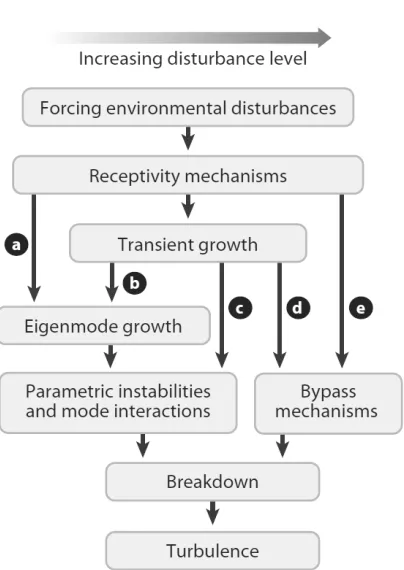
The path to transition in boundary layers is a subtle subject. Reshotko (2008) notes
that “[u]ntil about [1995], the predominant view of laminar-turbulent transition was
centered around the slow linear amplification of exponentially growing (“modal”)
dis-turbances..., preceded by a receptivity process to the disturbance environment and
followed by secondary instabilities, further nonlinearity, and finally a breakdown to
a recognizable turbulent flow.” Reshotko (2008) goes on to say that “[t]his picture
had to be urgently reconsidered in the early 1990s with the emergence of a literature
on transient growth,” which was motivated by the fact that “there are transition
phenomena in flows that are linearly stable.” A flow-chart describing the paths to
turbulence was devised by Morkovin et al. (1994), where focus is placed on
under-standing the subtleties of this process (Fig. 1.1, taken from Fedorov (2011)). In
chapter 9 of Schmid and Henningson (2001) there is a thorough explanation of the
developments on this topic.
For a sharp, slender body in low-speed flight, at zero angle of attack, Tollmien
-Schlichting waves (“T-S waves”) are observed to be of large amplitude prior to
boundary-layer transition; these disturbances were experimentally characterized by
Schubauer and Skramstad (1948). This is in contrast to high-speed boundary layers
on the same vehicle geometry, where a key instability mechanism is the high-frequency
modes discovered byMack (1984). These modes are primarily acoustic in nature, are
always present if the boundary-layer edge Mach number is sufficiently large, and
2The funding figures can be found inSchwelkart(1997), which references the NASP Joint Program
Figure 1.1: Flow-chart describing the paths to turbulence was devised by
Morkovin et al.(1994), taken from Fedorov (2011) with permission.
can be the dominant instability mechanism when the wall temperature is sufficiently
low compared to the recovery temperature. “They belong to the family of trapped
acoustic waves. Owing to the presence of a region of supersonic mean flow relative
to the disturbance phase velocity, the boundary layer behaves as an acoustic
waveg-uide (schematically shown in [Fig. 1.2])” Fedorov (2011). Fedorov (2011) goes on to
provide a thorough explanation of “Path A” in Fig. 1.1 for the case of high-speed
boundary layers, supporting his conclusions of how the disturbances develop with
detailed stability calculations.
Mack termed the dominant higher frequency mode the “second mode,” although
Fedorov and Tumin (2011) suggest “that Mack’s definitions of modes are
inconsis-tent with conventional usage of the term normal modes.” However, most researchers
Figure 1.2: “Acoustic mode in a high-speed boundary layer, whereU(y) is the mean-flow profile, and p(y) is the pressure disturbance profile.” reproduced from Fedorov
(2011) with permission. The sonic line refers to where the local velocity (U(y)) equals the difference between the disturbance phase speed (c) and the local sound speed (a(y)). This is the location of the critical layer, where disturbance amplitudes are typically large Mack (1984), Fedorov(2011).
instability discovered by Mack, and this is the terminology usage in this thesis. The
larger growth rate of the acoustic instability relative to the “T-S waves” is seen in
Fig. 1.3(a). Additionally, it is seen that the second mode of largest growth rate is
two dimensional in nature. This second mode is the subject of study in this work.
In Fig. 1.3(b), a linear stability diagram is shown for an example case in T5. The
stream-wise imaginary wavenumber is shaded for values above 0, and more darkly
for larger values. Note the exceedingly high frequency of the acoustic mode, and the
narrowband at which it is most amplified. The most strongly amplified frequency is
observed to decrease with increasing distance from the tip of the cone; this frequency
is approximately equal to KUE/(2δ), where K is a constant of proportionality, UE
is the edge velocity, and δ is the boundary-layer thickness;3 this scaling is shown in Fig. 1.3(b) as a thin white line. The constant of proportionality (K) for a certain
geometry is a function of (among other things) edge Mach number, because of the
im-plication on disturbance-phase velocity (Fig. 9.1 ofMack(1984)), and boundary-layer
temperature profile, because of the implication on disturbance wave number (Fig. 10.9
3In this work,δrefers toδ
99, where the local velocity in the boundary layer is 99% of the velocity
of Mack (1984)). The theoretical framework for the scaling of the most strongly
am-plified frequency can be found in Mack (1984, 1987); experimental support of this
scaling can be found inKendall (1975),Demetriades (1977) andStetson et al.(1983,
1984, 1989) (among many other reports). This scaling is extended to hypervelocity
conditions in this work.
(a)
Distance (mm)
F
re
q
u
en
cy
(k
H
z)
0 100 200 300 400 500 600 700 800 900 1000 0
500 1000 1500 2000 2500 3000
(b)
Figure 1.3: a: “Effect of Mach number of the maximum spatial amplification rate of the first and second mode waves... Insulated wall, wind-tunnel temperatures”
Mack (1984). At above Mach 4 the acoustic mode, which is two dimensional in nature, dominates the first mode. b: Example linear stability diagram computed from PSE-Chem for flow over a 5 degree half-angle cone, as in shot 2789 in T5. The stream-wise imaginary wavenumber is shaded for unstable values, and more darkly for more unstable values. The KUE/(2δ) scaling of the most amplified frequency is
shown as a thin white line, where K is a constant of proportionality that can range from 0.6-1.1.
1.3
Geometrical Acoustic Motivation
4In this section the acoustic instability is examined with a geometrical acoustic
ap-proach. The propagation of acoustic waves within the boundary layer is profoundly
4
influenced by the velocity and sound speed gradients created by the action of viscosity
and heat conduction within the layer. These gradients form a waveguide that may
trap acoustic waves and provide a mechanism for the formation of large amplitude
disturbances. This suggests that geometrical acoustic analysis of these waveguides
can provide insights into the potential for boundary-layer acoustic instability. Here,
we outline the basics of geometric acoustics, apply the ray-tracing technique to
ex-ample problems, and then to high-speed boundary layers. The refractive behavior of
different high-speed boundary-layer profiles is compared.
The approach follows the classical ray-tracing approach to geometrical acoustics
in which the propagation of a wave-front is calculated by computing the paths (rays)
along which a point on the wave-front moves (Pierce,1989,Thompson,1972). From a
physical point of view, geometrical acoustics is a high-frequency approximation that
is valid when: 1) the wavelengths are small compared to the geometrical features
in the flow, in this case the thickness of the boundary layer; 2) the amplitude and
front curvature do not vary too rapidly along the wave-front; 3) cusps or folds
(caus-tics) do not form in the wave-front. In high-speed boundary-layer profiles, the most
amplified acoustic wavelength is known to be approximately 2 boundary-layer
thick-nesses (Mack,1984) and caustics are known to form (G. A. Kriegsmann and E. L. Reiss)
so we acknowledge from the outset that our results may be limited in quantitative
applicability and will be more qualitative in nature.
The rate of change of the position of a point xp on the wave-front can be written
as,
dxpi
dt =nic+vi =vray,i (1.1)
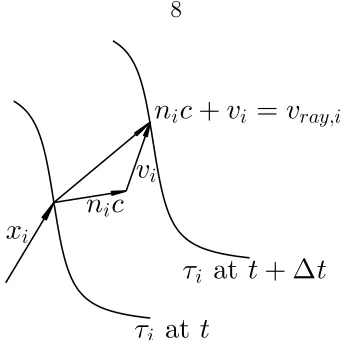
where vi is the local velocity, cis the local sound speed, and ni is the unit normal to
the wave-front τi (Fig.1.4). The speed of the wave-front normal to itself (c+nivi) is
in general different than the magnitude of the ray velocity |nic+vi|. The evolution of
x
in
ic
v
in
ic
+
v
i=
v
ray,iτ
iat
t
τ
iat
t
+
∆
t
Figure 1.4: Vector addition to find the velocity of the rays.
(1989) is used where the wave-front is described in terms of the wave-slowness vector
(si =▽τi),
dxi
dt = c2s
i
Ω +vi, (1.2a)
dsi
dt =− Ω
c dc dxi
− 3
X
j=1 sj
dvj
dxi
, (1.2b)
where,
Ω = 1−visi, (1.3a)
si =
ni
c+nivi
. (1.3b)
1.3.1
Example Problems
Solutions to two example problems are presented here to provide basic insight into
geometric acoustics as well as to test our numerical methods. The first test problem
is an adaptation from the work ofGoodman and Duykers (1962). Analytic solutions
for ray paths are found for a quiescent gas with a parabolic sound speed profile of
the form c = c0 +α2y2, with 1/c2 = (1/c20)(1−y2/L2), and L =
p
example presented here,c0 = 340 m/s, α=
p
c0/10, and a rigid boundary at y= 0 is imposed. The solution for a ray path with initial angle of inclination to the horizontal
θ0, is
y/L= sinθ0sin (x/(Lcosθ0)). (1.4)
This solution (solid line) and results from numerically integrating Eqs. 1.2 (circular
markers) are shown to agree favorably in Fig. 1.5. In this scenario, sx is a constant,
per Eq. 1.2b. To calculate the point at which acoustic rays are refracted back to the
surface, it is recognized that the ray direction is parallel to the unit normal, n, when horizontal (Pierce, 1989), and from Eq 1.3b,
sx =
cosθ0 c0+ cosθ0vx0
=ch+vxh, (1.5)
where the subscript 0 indicates the local value at ray origin, and the subscript h indicates the local value where the ray is horizontal. Using this observation, the
wall-normal distance where the ray is refracted back to the surface can be obtained
algebraically. The predicted height (dashed line) shows favorable agreement with the
analytic and numerical results in Fig. 1.5. Note that the acoustic rays are refracted
towards a sound speed minimum, consistent with the vertical component of Eq.1.2b.
The second test problem is ray-tracing through the Sound Fixing and Ranging
(SOFAR) channel, as previously computed by Munk (1974), who assumed that the
sound speed in the ocean, c, varies as c=c(y) =c1(1 +ǫ(η(y) +e−η(y) −1)), due to temperature and density gradients, where c1 = 1.492 km/s, ǫ = 0.0074, η = η(y) = (z−z1)/(z1/2), and z1 = 1.3 km. Numerical integration of Eqs. 1.2 with this sound speed profile gives reasonable visual agreement with Munk’s results, although precise
quantitative comparison is not possible (Fig. 1.6). Acoustic rays are observed to be
1 1.5 2 0 0.2 0.4 0.6 0.8 1 c/c0 y / L
0
0.5
1
1.5
2
2.5
3
0
0.2
0.4
0.6
0.8
1
x/
(
π
L
cos(
θ
0))
Figure 1.5: A slight modification to the problem posed by Goodman and Duykers
(1962), with the analytical solution (solid line), numerical integration (circular mark-ers), and predicted turning height (dashed line) showing good agreement. Initial angle of inclination of acoustic ray to the surface: θ0 = 30◦,60◦. The sound speed profile is plotted on the left.
1.48 1.5 1.52 1.54 0 1 2 3 4 c (km/s) D is ta n ce (k m )
0 10 20 30 40 50
0 1 2 3 4 -12 -8 -4 0 4 8 12 Distance (km)
Figure 1.6: Replication of the case done byMunk(1974), tracing acoustic rays through the SOFAR channel. The ordinate marks depth from the ocean surface, and the initial angle of the ray to the horizontal is denoted in degrees by a number overlaid on the line.
1.3.2
High-Speed Boundary Layers
Geometric acoustic implications for a selection of high-speed boundary-layer profiles
are presented in this section. Boundary-layer profiles are computed using the
sim-ilarity solution for a laminar, compressible, perfect-gas flow on a flat plate (White,
2006). It was noted in the previous section that acoustic rays tend to be refracted
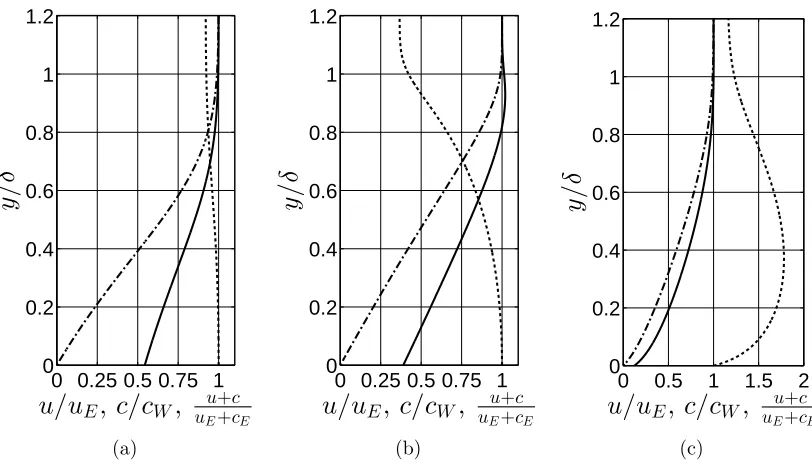
towards sound speed minima. The mean flow of the boundary layer modifies this and
to illustrate a range of u+cprofiles that are possible.
0 0.25 0.5 0.75 1 0
0.2 0.4 0.6 0.8 1 1.2
y
/
δ
u/u
E,
c/c
W,
uEu++ccE(a)
0 0.25 0.5 0.75 1 0
0.2 0.4 0.6 0.8 1 1.2
y
/
δ
u/u
E,
c/c
W,
uEu++ccE(b)
0 0.5 1 1.5 2
0 0.2 0.4 0.6 0.8 1 1.2
y
/
δ
u/u
E,
c/c
W,
uEu++ccE(c)
Figure 1.7: a: Boundary-layer profile forME = 1, γ = 7/5,TW =Tad. b:
Boundary-layer profile for ME = 6, γ = 7/5,TW =Tad. c: Boundary-layer profile for ME = 6,
γ = 7/5,TW =Tad/10. Each velocity profile (u/uE) is normalized by the edge value
(dash-dot). Each sound speed profile c/cW is normalized by the value at the wall
(dashed). Each combined profile (u+c)/(uE +cE) is normalized by the edge values
(solid).
Using Eq. 1.5, and assuming that the flow is locally parallel, the maximum angle
that is refracted back to the surface can be found. We postulate that the larger this
angle, the more unstable the boundary layer due to the larger amount of acoustic
energy trapped within the layer. The maximum angle of inclination is computed
for rays originating at the surface of the plate for a range of Mach numbers (ME =
0.25−8) with an adiabatic wall and three different ratios of specific heats in Fig.1.8(a).
The maximum angle increases with increasing Mach number, reaching a constant
value for ME ≥ 5. Wall temperature ratio (TW/Tad, where Tad is the adiabatic wall
temperature) is another important parameter in determining the maximum initial
angle of inclination for rays originating at the surface of the plate (Fig. 1.8(b)); at
wall normal distance of the origin of the acoustic ray is varied for an adiabatic plate
withME = 6. Fewer rays are trapped as the ray origin is translated from the surface.
The results in Figs. 1.8(a),1.8(b), and1.8(c)do not change with Rex, where xis the
distance from the leading edge, because the flow field is assumed to be locally parallel
and the boundary-layer profiles are self-similar.
The non-parallel nature of the flow field can be included by interpolating the
velocity and sound speed profiles calculated from the similarity solution for a certain
range of Rex and solving Eqs.1.2. In Fig.1.9, ray traces originating from the surface
of an adiabatic flat plate withME = 1 andγ = 7/5 with an initial angle of inclination
of θ0 = 56◦,57◦,58◦ are observed to bracket the value predicted in Fig. 1.8(a). The edge Mach number is increased to 6 for the rays in Fig. 1.10 and ray traces with an
initial angle of inclination of θ0 = 67◦,68◦,69◦ bracket the maximum value predicted in Fig. 1.8(a). Changing the boundary condition at the wall to TW =Tad/10 should
increase the maximum initial angle of inclination per Fig.1.8(b). This is reflected in
0 1 2 3 4 5 6 7 8 30 35 40 45 50 55 60 65 70 75 80
γ= 6/5
γ= 7/5
γ= 5/3
Edge Mach Number: ME
In cl in a ti o n to p la te : θ0 (a)
10−2 10−1 100 101
30 35 40 45 50 55 60 65 70 75 80 85 90
Wall Temperature Ratio: TW/Tad
In cl in a ti o n to p la te : θ0
γ = 6/5
γ = 7/5
γ = 5/3
(b)
0 0.25 0.5 0.75 1
0 10 20 30 40 50 60 70 80 γ=6/5 γ=5/3 γ=7/5
Distance from wall: y/δ
In cl in a ti o n to p la te : θ0 (c)
Figure 1.8: a: Largest angle of inclination to the plate of acoustic ray that is refracted back to the surface, ME = 0.25−8,γ = 6/5,7/5,5/3,TW =Tad. b: Largest angle of
inclination to the plate of acoustic ray that is refracted back to the surface, ME = 6,
γ = 6/5,7/5,5/3, TW = KTad, where K is varied between 10−2 and 5. c: Largest
angle of inclination to the plate of acoustic ray that is refracted back to the surface at different wall normal origins, ME = 6, γ = 6/5,7/5,5/3,TW =Tad.
300 320 340 360 380 400 420 440
0 2 4 6 8
δ
99 x (mm) y (m m )50 60 70 80 90 100 110 120 130 140 150 160 0
1 2 3 4 5
6
δ
99
x (mm)
y
(m
m
)
Figure 1.10: Ray traces for ME = 6, γ = 7/5, TW = Tad, with θ0 = 67◦,68◦,69◦ at Rex0 = 1×10⁵.
50 55 60 65 70 75 80
0 0.5 1 1.5 2
δ
99x (mm)
y
(m
m
)
1.3.3
Summary
Ray-tracing in high-speed boundary layers has been used to explore the potential for
acoustic energy trapping as function of edge Mach number, wall temperature ratio,
and thermodynamic parameters. We proposed a figure of merit for acoustic energy
trapping as the critical angle of inclination for rays originating in the boundary that
are trapped, i.e., these rays always stay within the boundary layer. Using this concept,
we find that an increasing amount of acoustic energy is trapped with increasing edge
Mach number (ME), and decreasing wall temperature ratio (TW/Tad). These trends
agree qualitatively with the results of high-speed boundary-layer stability calculation
by Mack (1984).
1.4
Motivation For Hypervelocity Instability Study
“High-enthalpy” or “hypervelocity” fluid-mechanics research is the study of
high-speed flow fields “that are both hypersonic and high velocity, rather than merely
hypersonic” (Stalker, 1989). The term “hypersonic” generally refers to flows with a
characteristic Mach number of greater than five, but the term “high velocity” is more
relative. Following Hornung (1993), we estimate the ordered-kinetic energy of the
free-stream gas flowing over a vehicle moving at U∞ as U∞2/2; so, a vehicle moving at 3 km/s or 6 km/s results in ordered kinetic energies of 4.5 MJ/kg or 18 MJ/kg,
respectively. These large ordered kinetic energies can be of the same order as the
characteristic thermo-chemical energy scales in a flow-field of interest; for example,
the characteristic energies of dissociation (D) and vibrational excitation (Eν) for N2,
O2, and CO2 are listed in Table 1.1.5 When the free-stream ordered kinetic energy
is a significant fraction of the characteristic energy of dissociation or vibration, these
5The tabulated thermo-chemical data is adapted fromMcQuarrie(2000). For CO
2, the reaction
CO2 → CO + 12O2, and the lowest energy doubly degenerate mode of vibrational excitation are
effects can be present in the flow-field.
Table 1.1: Characteristic thermo-chemical energies
DN2 DO2 DCO2 EνN2 EνO2 EνCO2 33.6 MJ/kg 15.4 MJ/kg 6.3 MJ/kg 1000 kJ/kg 590 kJ/kg 180 kJ/kg
For blunt-body flows, dissociation of the free-stream gas can occur, which can
result in lower temperature and higher density than if the gas were thermo-chemically
frozen. This can change the shockwave shape and stand-off distance over a vehicle,
which can change the surface pressure distribution and heat-flux.
An essential aspect of studying hypersonic slender-body boundary-layer instability
at high enthalpy is characterizing the energy exchange between the thermo-chemical
and fluid-mechanical processes. These effects are termed “high-enthalpy effects” on
boundary layers. Thermo-chemical processes are only relevant at high-enthalpy
con-ditions where the ordered kinetic energy of the flow is high enough so that chemical
reactions and relaxation processes occur. If the energy is high enough, and if the
fluid-mechanical and thermo-chemical processes proceed at comparable time scales,
then energy exchange may occur.
Of particular interest is the exchange of energy between the high-frequency
acous-tic instability in a hypersonic boundary layer and molecular vibrational relaxation
processes. For certain conditions, the time scale of the instability which goes as the
edge velocity on twice the boundary-layer thickness (f ≈ UE/(2δ)) is of the order
1 MHz. Vibrational relaxation processes can be of this time scale at conditions in a
hypersonic boundary layer, so energy exchange may occur, and the instability could
be damped.
1.4.1
Energy Exchange and pdV Work
In a non-equilibrium gas, the sound speed is not unique because the thermodynamic
s(p, ρ, q), where q is a non-equilibrium variable (Vincenti and Kruger, 1965). The frozen sound speed (a2
f = (∂p/∂ρ)s,q) is evaluated with q fixed, and the equilibrium
sound speed (a2
e = (∂p/∂ρ)s,q∗) is evaluated with the non-equilibrium variableq =q∗
at its value if the gas were in local equilibrium. The ratio of frozen sound speed
to equilibrium sound speed (af/ae) is a measure of the capacity of a gas to absorb
acoustic energy.
Following section 4 of chapter 8 inVincenti and Kruger(1965), a model of a piston
harmonically oscillating in a constant area duct occupied by a non-equilibrium gas
can be used as an example of how acoustic waves may be damped by an exchange of
energy with the gas. An indication of the absorption of acoustic energy can be shown
on a P-v diagram. P-v cycles of an acoustic wave oscillating at angular frequency ω with the time scale of relaxation τ show that an ellipse of finite width is traced when the pressure and density of the gas are out of phase (Fig. 1.12(a)). If the
sound-speed ratio (af/ae) is fixed at a number that is larger than unity, and the time
scale matching is varied, the ellipse thickness varies with the time scale (ωτ), and is
thickest when the scale is of order 1. The ellipse thickness indicates the possibility
of pdV work, which may be interpreted as an exchange of energy from the acoustic wave to the internal energy of the gas; the broader the ellipse, the greater the energy
exchange. Qualitatively, two requirements for energy exchange are evident: 1) the
time scales of relaxation and acoustic wave oscillation must be similar, and 2) the gas
must have sufficient internal vibrational or rotational energy so that energy exchange
−1 −0.75 −0.5 −0.25 0 0.25 0.5 0.75 1 −1 −0.75 −0.5 −0.25 0 0.25 0.5 0.75 1
Specific Volume (%)
P re ss u re (% )
(af/ae)2= 1.00,ωτ= 1.0
(af/ae)2= 1.09,ωτ= 1.0
(a)
−1 −0.75 −0.5 −0.25 0 0.25 0.5 0.75 1 −1 −0.75 −0.5 −0.25 0 0.25 0.5 0.75 1
Specific Volume (%)
P re ss u re (% )
(af/ae)2= 1.09,ωτ ≈0
(af/ae)2= 1.09,ωτ = 1.0
(af/ae)2= 1.09,ωτ ≈∞
(b)
Figure 1.12: a: P-v cycles of an acoustic wave with a time scale match (ωτ = 1), with different ratios of sound speed (af/ae) b: for a fixed sound-speed ratio (af/ae), P-v
cycles for disparate time-scale ratios (ω/τ). This illustrates the two requirements for pdV energy exchange: 1) the time scales of relaxation and acoustic wave oscillation must be similar, and 2) the gas must have sufficient internal energy so that energy exchange is possible.
1.4.2
Simple Acoustic-Wave Attenuation Model
A simple acoustic-wave attenuation model is introduced in this subsection. Following
the development inPierce(1989) andThompson(1972), the absorption coefficientαa
for a gas where there is a small contribution to the heat capacity from the vibrational
degree of freedom (cv,i ≪cp)can be written as,
αa=αc+ X
i
αr,i, (1.6a)
αc =
µω2 2ρLa3f
4 3+
γf −1
Pr
, (1.6b)
αr,i =
π(γf −1)cv,i
λcp
ωτi
1 + (ωτi)2
. (1.6c)
Here, αc is the classic absorption coefficient due to viscous and thermal attenuation,
µ is the viscosity, ρL is the mean local density, af is the frozen sound speed, γf
is the frozen ratio of specific heats, and Pr is the Prandtl number. Additionally,
are the wavelength and angular frequency of the acoustic wave, respectively; cv,i is
the constant-volume specific heat contribution from a relaxation process i (e.g. the vibrational mode of N2), and cp is the equilibrium constant-pressure specific heat.
The classic absorption coefficient result is from Stokes and Kirchhoff, so it is
termed SK attenuation (Thompson, 1972). Also inThompson (1972), the SK
atten-uation results are supported by summarized experimental data up to a time scale
where the collision rate becomes comparable; the scale µω/P = 0.1 is suggested, where µ is the local viscosity, ω is the angular frequency of the disturbance, and P is the local pressure. This implies that the SK attenuation coefficient can be used to
≈5 MHz for conditions in a typical boundary layer during a T5 test.
10−2 10−1 100 101 102 10−2
10−1 100
ωτi
λ
αr,
i
/
(
λ
αr,
i
)m
a
x
(a)
101−1 100 101
1.02 1.04 1.06 1.08 1.1
T /Θv
(
af
/a
e
)
2
(b)
Figure 1.13: a: The absorption coefficient for a single relaxation process normalized by its maximum value illustrating the time scale dependence. b: The ratio of frozen to equilibrium sound speed as a function of the ratio of the temperature (T) to characteristic vibrational temperature (Θv) for a linear polyatomic molecule with a
single non-degenerate relaxing vibrational degree of freedom.
From Eq. 1.6c it is clear that the absorption coefficient due to a relaxation
pro-cess is highly time scale dependent, this is highlighted in Fig. 1.13(a). Additionally,
the frozen to equilibrium sound-speed ratio (af/ae) is an indicator of the magnitude
of (λαr,i)max. For a chemically frozen gas, this is a function of the extent to which
lin-ear polyatomic molecule with a single non-degenerate relaxing vibrational degree of
freedom is highlighted in Fig. 1.13(b).
The absorption coefficient for CO2 is of particular interest because there is a
doubly-degenerate vibrational mode at moderate characteristic temperature, Θv =
960 K; this is relatively low compared with the characteristic temperatures of
vibra-tion for N2 and O2, which are 3374 K and 2260 K, respectively. The implication is
that CO2 has a relatively high capacity to attenuate high-frequency waves, possibly
even those in the boundary layer of a high-speed vehicle. The assumption that the
contribution to the specific heat capacity from the vibrational degree of freedom is
small (cv,i ≪cp) is not valid in the temperature ranges discussed here. For this
rea-son, the wavenumber is found from the dispersion relation for a relaxing gas given as
Eq. 10-8.7 in Pierce (1989), and the imaginary portion is reported as the absorption
coefficient.
An example absorption coefficient curve (Fig.1.14(a)) highlights the relative
spec-trum of attenuation due to SK dissipation and vibrational relaxation for CO2 at
P = 25 kPa, T = 1500 K. These results show attenuation of≈5-30% per wavelength over a large frequency band. This is a large value for the absorption coefficient when
compared with that of N2 for the same conditions (Fig. 1.14(b)).
In these calculations, the relaxation rates for CO2 and N2 are taken fromCamac
(1966) and Millikan and White (1963), respectively. In Camac (1966), it is observed
that all four vibration modes relax at the same rate, and the data are summarized
along with eight other references where vibrational relaxation data were reported
at lower temperatures. Gaydon and Hurle (1963) caution that “[t]he relaxation of
carbon dioxide is very sensitive to the presence of impurities,” which can effectively
reduce the relaxation time. The thermodynamic data were calculated using
statisti-cal mechanics, as in McQuarrie (2000). The thermodynamic properties are checked
104 105 106 10−2
10−1 100
Frequency (Hz)
λ
α
Vibration Thermal-Viscous Sum
(a)
104 105 106
10−3 10−2 10−1 100
Frequency (Hz)
λ
α
(b)
Figure 1.14: a: Absorption coefficient for CO2 atP = 25 kPa,T = 1500 K. The solid line represents the total absorption coefficient, which is the sum of the viscous-thermal term (dotted line), and the term due to the vibrational relaxation (dash-dot line). b: Absorption coefficient for N2 (dotted line) and CO2 (solid line) at P = 25 kPa, T = 1500 K.
in McBride et al. (2002) using Cantera (Goodwin, 2003). The viscosity is evaluated
from curve fits as in Blottner et al. (1971).
1.5
Hypervelocity Transition in T5
Boundary-layer stability and transition in high-enthalpy facilities has been studied
extensively for 20 years in the T5 hypervelocity shock tunnel. Germain (1993) and
Germain and Hornung(1997) conducted a series of transition experiments on a sharp
5 degree half-angle cone at zero angle of attack in the T5 hypervelocity shock
tun-nel. Transition Reynolds number was measured for a range of free-stream
condi-tions and gasses. The transition Reynolds number was determined by noting the
location of departure of laminar heating rates. The surface heating rates were
mea-sured by heat-transfer gauges constructed of type E thermocouples (manufactured by
Medtherm Corporation) that were mounted flush to the surface. Germainfound that
the transition Reynolds number increases with increasing reservoir enthalpy, when
with lower dissociation and vibrational energies. Additionally, resonantly enhanced
shadowgraphy was used to characterize the flow structures. Based on these results,
Germain and Hornung proposed that the dominant instability mechanism was the
Tollmien-Schlichting mode in those experiments.
Transition and stability work on a sharp 5 degree half-angle cone in T5 continued
in the 1990’s, as reported in Adam (1997) and Adam and Hornung (1997). They
too note that transition Reynolds number increases as the reservoir enthalpy is
in-creased, and this effect is more pronounced in CO2 than in air. Adam then used the
tabulated transition Reynolds numbers based on reference temperature and found
the results to be “within striking distance” of Re-entry F free-flight data reported in
Wright and Zoby(1977). Adam also used BLIMPK6 to compute the similar
non-equilibrium boundary-layer profiles on the cone to understand the extent to which the
frictional heating affected the thermo-chemical properties of the boundary layer, i.e.,
quantifying the dissociation level of different gases at different condition as a function
of distance along the cone surface.
Boundary-layer stability control research then followed in T5, as reported in
Rasheed(2001) andRasheed et al.(2002). In that work, researchers used a novel
pas-sive scheme to damp the acoustic instability in a hypervelocity boundary layer on a
five degree half-angle cone. Half of the surface of the test article was allocated to serve
as a smooth control, and the opposing half was an ultrasonically absorptive surface.
The transition Reynolds number on the smooth surface was consistent with previous
work, while the half with the ultrasonic absorptive surface exhibited significant
in-creases in transition Reynolds number. Because the passive boundary-layer instability
control scheme was aimed at damping the acoustic instability, and the scheme proved
effective in increasing the transition Reynolds number, one might conclude that the
most unstable mode is acoustic in nature, not the viscous or Tollmien-Schlichting
6BLIMPK stands for Boundary Layer Integral Matrix Procedure with Kinetics, and more
mode as suggested inGermain (1993) and Germain and Hornung(1997).
Fujii(2001) andFujii and Hornung(2003) investigated attachment line
boundary-layer transition on a swept cylinder in T5. Most relevant to the present work were
the efforts made to quantify the role of energy exchange between the boundary-layer
instability and the fluid, which is described in detail in Fujii and Hornung (2001).
They proposed that if the time scale of a relaxation process in gas is nearly matched
to the time scale of the acoustic instability in the boundary layer, significant energy
may be scrubbed from the instability. This removal of energy from the boundary-layer
instability would ultimately manifest itself as an increase in boundary-layer transition
Reynolds number. Quantitative results for absorption were computed from a model
of high-frequency sound waves propagating through a relaxing gas.
Further boundary-layer instability control research has continued in T5, as
re-ported inLeyva et al.(2009a,b) andJewell et al.(2011,2012,2013). In this research,
the ultimate goal is to increase the transition Reynolds number in a test gas by
intro-ducing a different gas with lower dissociation and vibrational energies than the test
gas. By introducing a gas into the boundary layer that has thermo-chemical
prop-erties which may attenuate acoustic waves, the researchers suggest that the acoustic
instability will be damped, and the transition Reynolds number will be increased.
1.6
Project Scope and Outline
The disturbances preceding boundary-layer transition on a slender body at
hyperve-locity flight conditions are characterized in this work. A sharp five-degree half-angle
cone at zero angle of attack is used as the test article because of the canonical nature
of the geometry. Ground testing was performed in the T5 hypervelocity free-piston
driven reflected-shock tunnel to enable the study of thermo-chemical/fluid-dynamic
In chapter 2, operation of the T5 facility is described; the test procedure and
calculation of run conditions are presented with examples and estimates of error. In
chapter 3, the focused laser differential interferometry technique (FLDI) is used to
measure the hypervelocity boundary-layer disturbances and is characterized. In
chap-ter 4, results from the application of the FLDI technique to T5 flows are presented;
tunnel noise and boundary-layer disturbance spectra are highlighted. The results of
experiments where narrowband boundary-layer disturbances were observed at two
Chapter 2
Facility and Run Conditions
The test facility and method of calculating the run conditions are described in this
chapter. The test procedure is described in detail, noting alterations to past efforts.
The run conditions are calculated in three stages, the reservoir, the nozzle, and then
the mean flow over the cone. The propagation of error in these calculations is
esti-mated. Comments are made on the repeatability of T5 tunnel operation. Example
profiles are provided throughout this chapter for context.
2.1
Facility and Test Procedure
All measurements are made in T5, the free-piston driven reflected-shock tunnel at the
California Institute of Technology (Fig. 2.1). It is the fifth in a series of shock tunnels
designed to simulate high-enthalpy real gas effects on aerodynamics of vehicles flying
at hypervelocity speeds through the atmosphere. More information regarding the
capabilities of T5 can be found in Hornung (1992).
An experiment is conducted as follows: a 120 kg aluminum piston is loaded into
the compression tube/secondary reservoir junction. A secondary diaphragm (mylar,
127µm thick) is inserted at the nozzle throat at the end of the shock tube near the test section and a primary diaphragm (stainless steel, 7-10 mm thick) is inserted at the
Figure 2.1: A schematic of T5 with a blown up view of each of the major sections.
tube are evacuated. The shock tube is filled with the test gas (in the present study,
air, CO2, or N2 to 20-150 kPa), the compression tube is filled with a He/Ar mixture
to≈45-150 kPa and the secondary reservoir is filled with air to≈2-11 MPa. The air
in the secondary reservoir is released, driving the piston into the compression tube.
This piston motion adiabatically compresses the driver gas of the shock tunnel to the
rupture pressure of the primary diaphragm (≈ 20-120 MPa). Following the primary
diaphragm rupture, a shock wave propagates in the shock tube, is reflected off the
end wall, breaking the secondary diaphragm and re-processing the test gas. The test
gas is then at high temperature (≈ 2000-9000 K) and pressure (≈ 15-80 MPa) with
negligible velocity, and is then expanded through a converging-diverging contoured
nozzle to ≈ Mach 5.5 in the test section.
Throughout the testing campaign for this work, it became apparent that there
was opportunity to improve the quality of the flow over the model. Improvement was
made by using higher quality gas to fill the shock tube and by cleaning the shock
tube more thoroughly between experiments. The quality of the gas used to fill the
shock tube, and the shock tube cleaning procedure were fixed after shot 2760 because
procedure was concurrent with the conclusion of the development phase of the project.
A more thorough explanation and examples of inconsistent and consistent
instability-measurement results are found in section 4.3.1.
2.2
Reservoir Conditions Calculation
Initial shock tube pressureP1, measured primary shock speedUS, and reservoir
pres-sure PR, are used to compute the reservoir conditions for each shot. The primary
shock speed and initial shock tube pressure are used to calculate the thermodynamic
state of the gas after being processed by the primary and reflected-shock waves,
assuming thermo-chemical equilibrium. The gas pressure behind the reflected-shock
wave is changed isentropically, assuming chemical-thermodynamic equilibrium, to the
measured reservoir pressure to account for the weak expansion or compression waves
that are reflected between the contact surface and the shock tube end.
Thermo-chemical calculations are performed using Cantera (Goodwin, 2003) with the Shock
and Detonation Toolbox (Browne et al.,2006). The appropriate thermodynamic data
are found in the literature (Gordon and McBride, 1999, McBride et al., 2002). The
reservoir conditions for each experiment are tabulated in section A.1.
An example from shot 2789 shows the reservoir pressure time traces from the north
and south gauges1 in Fig 2.2(a). The mean between the gauges of the time-average
during the steady pressure period is shown in the text box along with the standard
deviation which serves as an estimate of error in the measurement.
An X-t diagram for shot 2789 is shown as Fig.2.2(b). The pressure traces of the four stations in the shock tube and the reservoir are plotted at their spatial locations.
The shock speed is calculated by dividing the transit distance by the transit time. The
shock speed between station 4 and the reservoir transducer is not reported because
1
the reservoir pressure tap is not designed for accurate time of arrival measurements.
The shock speed between stations 3 and 4 is used for the thermo-chemical equilibrium
calculations because it is estimated by X-tdiagram that this location corresponds to the steady portion of the test gas slug (B´elanger, 1993).
0 0.5 1 1.5 2 2.5
0 10 20 30 40 50 60 70 ¯
PR= 56.4±1.8 MPa
Time (ms) R es er vo ir P re ss u re , PR (M P a ) (a) 0 2 4 6 8 10 12 −3 −2.5 −2 −1.5 −1 −0.5 0 0.5 S T E n d W a ll
US=4.19 km/s
US=3.85 km/s
US=3.49 km/s
PST1 PST2 PST3 PST4 PR
Distance from End Wall(m)
T im e (m s) (b)
Figure 2.2: Left: Example reservoir pressure trace from shot 2789. In the reservoir pressure trace, the north gauge’s trace is black; the south gauge’s trace is gray. Right: X-t diagram showing the propagation of the incident shock of speed US, as well as
pressure traces at 5 stations along the shock tube from shot 2789.
2.3
Nozzle Calculation
The steady expansion through the contoured nozzle (outline in Fig. 2.3) from the
reservoir to the free-stream is modeled by the axisymmetric, reacting Navier-Stokes
equations as described in by Candler (2005), Johnson (2000), and Wagnild (2012).
The translational and rotational degrees of freedom are assumed to be in equilibrium.
The vibrational degree of freedom is allowed to deviate with equilibrium with the
translational/rotational modes. The boundary layer on the nozzle wall is assumed to
be turbulent and modeled by one equation as in Spalart and Allmaras (1992) with
the Catrisa and Aupoix (2000) compressibility correction. The grid is generated by
−100 0 100 200 300 400 500 600 700 800 900 0
50 100 150
r
(m
m
)
x (mm)
Figure 2.3: An outline of the T5 contoured nozzle of area ratio 100.
2.3.1
Nozzle Freezing Examples
The term nozzle freezing is used to indicate when a chemical-thermodynamic
reac-tion rate is not high enough to match the characteristic time scale in the nozzle.
Typically, reaction rates are a strong function of temperature, and reactions cease if
the temperature drops too rapidly, hence the term freezing. This is a known issue
in ground-testing because the gas at the exit of the nozzle can be partially
disso-ciated and vibrationally excited relative to the desired free-stream condition that
corresponds to a free-flight condition. This issue and others pertaining to high-speed
ground-testing are discussed in broader context inStalker(1989) andHornung(1993).
The aim of the subsequent discussion is to give quantitative examples of the
freez-ing effect by showfreez-ing the computed evolution of the translational/rotational
temper-ature (Tt/r), the vibrational temperature (Tv),2 and the chemical composition along
the centerline in the nozzle when the test gas is air, CO2, and N2 at nominally
sim-ilar reservoir conditions (reservoir enthalpy hR ≈9 MJ/kg, and reservoir pressure
PR ≈17 MPa)3.
For air as the test gas, the translation/rotational and vibrational temperatures
do not have a discernible difference from each other, but are elevated relative to a
free-flight condition (Fig. 2.4(a)). NO and O are frozen downstream of the location
2
The vibrational temperature (Tv), is a figure that defines the quantity of energy that excites
the vibrational degree of freedom. This is not to be confused with the characteristic temperature of vibration, Θv = hν/kb, whereh is Planck’s constant, kb is Boltzmann’s constant, and ν is the
frequency of the oscillator.
3
A/A∗=10, reducing the amount of O
2 and N2 present at the nozzle exit (Fig.2.4(b)),
where A/A∗ is the area ratio with respect to the area at the nozzle throat, A∗.
100 101 102
0 0.2 0.4 0.6 0.8 1
Area Ratio
T
/
TR
Tt/r, Tv
(a)
100 101 102
10−2 10−1 100
Area Ratio
M
a
ss
F
ra
ct
io
n
N2
O2
NO
O
(b)
Figure 2.4: Air shot (2767). Labels are placed at the nozzle exit (area ratio 100), the other end of each line segment represents the value at the reservoir (area ra-tio 9). The area rara-tio of 1 denotes the converging-diverging nozzle throat. Left: Translation/rotational temperature Tt/r and vibrational temperature Tv for air. The
subscript R denotes the value at the reservoir. Right: Species recombination in the nozzle for air.
To assess the effect of the dissociation products of air being frozen in the flow,
the difference in free-stream enthalpy and velocity is chosen to differentiate between
the gas in its computed thermo-chemical non-equilibrium state (Fig. 2.4(b)) with a
comparable equilibrium state. Cantera is used to compute the equilibrium
thermo-chemical state of the gas at the same free-stream temperature and pressure. At that
temperature and pressure, the air is nearly totally recombined (yN O <0.02%)4, and
the free-stream enthalpy is 625 kJ/kg lower (≈ 7% of the reservoir enthalpy, hR),
resulting in an increase in velocity of 160 m/s (4%).
With CO2 as the test gas, the translation/rotational and vibrational temperatures
also do not have a discernible difference from each other, but are elevated relative to
a free-flight condition (Fig. 2.5(a)). CO and O2 concentrations are chemically frozen
downstream of the locationA/A∗=10 at levels substantially higher than equilibrium
4y
at the nozzle exit, reducing the amount of CO2 in the test gas(Fig. 2.5(b)). The
energy required to dissociate CO2 is lower than for O2 and N2 (quantitative values
of relative dissociation levels can be found for all conditions in section A.1). Because
it does not have correspondingly higher recombination rates, CO2 experiments tend
to have more free-stream dissociation than air or N2 experiments at similar reservoir
conditions. Comparing CO2 experiments relative to air experiments for similar
reser-voir conditions, the gas at the nozzle exit is of lower velocity and lower Mach number
because it is hotter and more dissociated.
100 101 102
0 0.2 0.4 0.6 0.8 1
Area Ratio
T
/
TR
Tt/r, Tv
(a)
100 101 102
10−2 10−1 100
Area Ratio
M
a
ss
F
ra
ct
io
n
CO2
O2
CO
(b)
Figure 2.5: CO2 shot (2791). Labels are placed at the nozzle exit (area ratio 100), the other end of each line segment represents the value at the reservoir (area ratio 9). The area ratio of 1 denotes the converging-diverging nozzle throat. Left: Trans-lation/rotational temperature Tt/r and vibrational temperature Tv for CO2. The subscript R denotes the value at the reservoir. Right: Species recombination in the nozzle for air. The unlabeled line in (b) is the species O.
Dissociation products of CO2 being frozen in the flow also cause a difference in
free-stream enthalpy and velocity between the gas in its computed thermo-chemical
non-equilibrium state (Fig. 2.5(b)) and a corresponding equilibrium state. At the
same free-stream temperature and pressure, but in thermo-chemical equilibrium, the
CO2 is nearly totally recombined (99.8%), and the free-stream enthalpy is 2.4 MJ/kg
lower (≈ 27% of hR), resulting in an increase in velocity of 700 m/s (22.5%). This
than for air or N2 shots.
With N2 as the test gas, the translation/rotational and vibrational temperatures
do have a discernible difference from each other, and are elevated relative to an
equilibrium condition at the nozzle exit (Fig. 2.6(a)). N2 has a higher dissociation
energy relative to air and CO2, and is high relative to the reservoir enthalpy in this
example, so there is almost no N at the nozzle exit (Fig. 2.6(b)). Comparing N2
shots to air shots, the gas at the nozzle exit is colder, less dissociated, and has higher
velocity and higher Mach number.
100 101 102
0 0.2 0.4 0.6 0.8 1
Area Ratio
T
/
TR
Tv
Tt/r
(a)
100 101 102
10−2 10−1 100
Area Ratio
M
a
ss
F
ra
ct
io
n
N2
(b)
Figure 2.6: N2 shot (2773). Labels are placed at the nozzle exit (area ratio 100), the other end of each line segment represents the value at the reservoir (area ra-tio 9). The area rara-tio of 1 denotes the converging-diverging nozzle throat. Left: Translation/rotational temperature Tt/r and vibrational temperatureTv for N2. The subscript R denotes the value at the reservoir. Right: Species recombination in the nozzle for air. Labels are placed at the nozzle exit, the other end of each line segment represents the value at the reservoir. The unlabeled line in (b) is the species N.
An estimate of the loss in free-stream velocity for shot 2773 due to the
freez-ing of the N2 in a partially vibrationally excited state can be estimated by
follow-ing Vincenti and Kruger(1965). Neglecting contributions from electronic effects, the
mass-specific internal energy can be written as
e=RT2∂lnQ ∂T =RT
2
t/r
∂lnQt
∂Tt/r
+RTt/r2 ∂lnQr ∂Tt/r
+RTv2∂lnQv ∂Tv
whereQis the partition function, which for the translational (subscript t), rotational (subscript r), and vibrational (subscript (v) degrees of freedom are
Qt=
2πmkTt/r
h2
3/2
V, (2.2a)
Qr =Tt/r/Θr, (2.2b)
Qv =
1
1−exp(−Θv/Tv)
, (2.2c)
where Tt/r is the translational/rotational temperature, Tv is the vibrational
temper-ature, m is the mass of N2, k is Boltzmann’s constant, and h is Planck’s constant. This results in the internal energy
e= 3
2RTt/r+RTt/r+
Θv/Tv
exp(Θv/Tv)−1
RTv. (2.3)
For shot 2773, Tt/r = 804 K so the contribution to the internal energy is 597 kJ/kg,
and Tv = 3163 K so the contribution is 525 kJ/kg. If we assume that the vibrational
temperature were to relax to the translational temperature, Tv = 804 K, the
contri-bution to the internal energy would be 15 kJ/kg. To assess what effect this has on
the free-stream velocity the free-stream mass-specific enthalpy,h=e+p/ρ, is written as
h= 7
2RTt/r+
Θv/Tv
exp(Θv/Tv)−1
RTv. (2.4)
The free-stream enthalpies of the gas when vibrationally excited and in
thermody-namic equilibrium are 1.4 MJ/kg and 850 kJ/kg, respectively. The total enthalpy
2.4
Cone Mean Flow Calculation
The mean flow over the cone is computed by the reacting, axisymmetric
Navier-Stokes equations with a structured grid, and is part of the STABL software suite
which uses a data-parallel lower-upper relaxation (DPLR) method, as described by
Wright et al.(1996),Johnson(2000) andJohnson et al.(1998). For each experiment,
the computed mean flow