Volume 2007, Article ID 87136,10pages doi:10.1155/2007/87136
Research Article
Dynamic Bandwidth Allocation Based on Online Traffic
Prediction for Real-Time MPEG-4 Video Streams
Yao Liang and Mei Han
Department of Electrical and Computer Engineering, Advanced Research Institute, Virginia Polytechnic Institute and State University, Arlington, VA 22203, USA
Received 12 August 2005; Revised 15 April 2006; Accepted 4 June 2006
Recommended by Ming-Ting Sun
The distinct characteristics of variable bit rate (VBR) video traffic and its quality of service (QoS) constraints have posed a unique challenge on network resource allocation and management for future integrated networks. Dynamic bandwidth allocation at-tempts to adaptively allocate resources to capture the burstiness of VBR video traffic, and therefore could potentially increase network utilization substantially while still satisfying the desired QoS requirements. We focus on prediction-based dynamic band-width allocation. In this context, the multiresolution learning neural-network-based traffic predictor is rigorously examined. A well-known-heuristic based approach RED-VBR scheme is used as a baseline for performance evaluation. Simulations using real-world MPEG-4 VBR video traces are conducted, and a comprehensive performance metrics is presented. In addition, a new con-cept of renegotiation control is introduced and a novel renegotiation control algorithm based on binary exponential backoff(BEB) is proposed to efficiently reduce renegotiation frequency.
Copyright © 2007 Hindawi Publishing Corporation. All rights reserved.
1. INTRODUCTION
Variable bit rate (VBR) video traffic, generated from di-verse multimedia applications, is expected to be a signifi-cant portion of traffic in future integrated services networks. VBR videos require a sophisticated network resource allo-cation and management (NRAM) mechanism to support their strict delay and loss requirements. Due to the nature that VBR videos typically exhibit burstiness over multiple time scales [3, 4], it poses a unique challenge to the de-sign of NRAM mechanism to achieve high overall network utilization, while still preserving the desired quality of ser-vice (QoS) requirements. The challenge is essential partic-ularly for real-time VBR video transmission in which the traffic trace is unknown in advance. Clearly, any static allo-cating bandwidth (i.e., alloallo-cating exactly once for the entire video transmission session) for real-time VBR video streams would result in either inefficient utilization of bandwidth due to over allocation of resource or insufficient to support the required QoS due to the under allocation of resource. Dynamic bandwidth allocation attempts to adaptively allo-cate resources to capture the burstiness of VBR video traf-fic, and hence could be particularly promising for real-time VBR video transmissions [2,5,6]. One fundamental issue
in any dynamic bandwidth allocation mechanism is how to sense the traffic dynamics in advance in order to determine the resource needs. One approach is to devise some heuris-ticmethod to estimate the future traffic characteristics, such as RED-VBR scheme [2]. The other approach, called pre-dictiveorprediction-baseddynamic bandwidth allocation, is to develop more sophisticated online network traffic predic-tor as a critical component in dynamic bandwidth alloca-tion scheme to predict the future traffic [1,5,6]. Predictive dynamic bandwidth allocation introduces more complexity due to the additional complexity of online network traffic predictor, in the hope of being able to capture more accu-rately the dynamics of VBR video traffic and therefore to im-prove the performance. Yet, another technique to address ef-ficient VBR video transmission is smoothing (e.g., [7,8]).
traffic prediction up to hundreds of frames into the future, but the performance of MRL-NN traffic predictor was eval-uated in terms of normalized mean square error (NMSE) not in a network setting. Wu et al. [6] investigated dy-namic resource allocation through video content and traf-fic statistics, but under the assumption of a simplified ser-vice model/policy. Chiruvolu et al. [10] focused on alloca-tion algorithm at ATM cell level, while Yoo et al. [11] fo-cused on bandwidth allocation criteria rather than traffic prediction. Although a number of concrete predictive dy-namic bandwidth allocation methods exist, little research has been conducted on predictive dynamic bandwidth alloca-tion with arealisticservice policy. The simplified service pol-icy adopted in the previous studies (e.g., [6,12]) assumes that any video source will be blocked whenever its band-width renegotiation is rejected, which is impractical. This motivates our work. A long-term VBR video traffic predic-tor is certainly desirable in such a study, because single-frame-ahead network traffic predictors (e.g., [5,9,10,12]) would result in too frequent bandwidth renegotiations and thus the heavy reallocation control overhead which might eventually eliminate all merits that could be obtained from online traffic prediction. To this end, MRL-NN traffic pre-dictor developed in [1] is employed and examined. Unlike the existing work [1,5,6,9–11] which was performed us-ing MPEG-1 or MPEG-2 video traces, we investigate real-world MPEG-4 video traces which have not been studied in dynamic bandwidth allocation. MPEG-4 video traffic might provide unique challenges to online traffic prediction and predictive dynamic bandwidth allocation. As noted in [13], the autocorrelation functions for MPEG-4 traces have more significant long-range dependencies (LRDs) than those for the similar MPEG-1 traces, and signals with significant LRD are typically more difficult to predict. To carefully investigate the strength and limitation of predictive dynamic bandwidth allocation approach, RED-VBR scheme [2], a well-known heuristic dynamic bandwidth allocation, is used as a baseline for the performance evaluation. By applyingrealisticservice policy (described inSection 5.2), we are able to present our simulation results using more comprehensive performance metrics of utilization/delay, drop rate and renegotiation ternal, as opposed to utilization/delay, and renegotiation in-ternal used in the previous studies [6,12]. This way, we are able to provide new insight which has not been available yet. Another unique contribution of this work is to introduce a new concept and method of renegotiation controlin pre-dictive dynamic bandwidth allocation architecture. Renego-tiation control is about to handle the reissue of renegoRenego-tiation request whenever the previous renegotiation request fails due to lack of resource. A novel renegotiation control algorithm is proposed based on binary exponential backoff(BEB). Our simulation shows that the proposed renegotiation control al-gorithm can significantly reduce the renegotiation frequency. The rest of the paper is organized as follows.Section 2 de-scribes the general architecture of predictive dynamic band-width allocation.Section 3briefly reviews MRL-NN traffic predictor [1]. InSection 4, renegotiation control algorithm based on BEB is proposed.Section 5presents our empirical
study with careful analysis, and provides new insight. Con-clusions and future work are given inSection 6.
2. PREDICTIVE DYNAMIC BANDWIDTH ALLOCATION
A general architecture of predictive dynamic bandwidth al-location can be illustrated as inFigure 1, in which the com-ponent of renegotiation control is newly proposed in this pa-per and will be discussed inSection 4. The other components shown inFigure 1are briefly described as follows.
(1) Extraction of traffic statistics/video content of VBR video streams
This is preprocessing for the online traffic prediction. Diff er-ent types of preprocessing are required for the differer-ent ap-proaches of online traffic prediction. For example, with video traffic-based predictor, some simple traffic statistics will be calculated as the input for the predictor, while with video content-based predictor, some sophisticated video content analysis technique will be performed to extract content fea-tures as the input for the predictor. Therefore, the complexity of this component is largely dependent upon the approach used for the online traffic prediction.
(2) Online traffic predictor
This is a critical component of any predictive dynamic band-width allocation schemes. In principle, three types of on-line traffic predictors are currently available: traffic-based ap-proach (e.g., [1,5,9]), video-content-based approach [12], and a combination of the above two [6].
(3) VBR traffic descriptor computation
The traffic descriptor computation is based on the traffic model to be used for VBR video streams, such as determin-istic bounding interval-length dependent (D-BIND) model [14], leaky bucket model [15] and so forth, and traffic de-scriptor attempts to describe and capture the characteristics of VBR video streams as accurately as possible.
(4) Segmentation and future resource determination
Source 1 Source 2
. . . SourceN
Source 1 Source 2
. . . SourceN VBR video
streams
VBR video streams
Scheduling, policing
Dynamic bandwidth allocation
Extract traffic statistics / video content of the VBR streams
Online traffic predictor
Compute traffic descriptor
Outgoing buffer
Network
¯Segmentation
¯Determine future resource needs
Renegotiation control Renegotiation
requests Accept/reject Reallocation control
Figure1: Dynamic bandwidth allocation architecture.
(5) Reallocation control
This is to determine, based on the traffic model/descriptor used, whether the requested resource is honored or rejected due to the availability of resource. Connection admission control can also be consolidated into this component. Once the requested resource is honored, the resource reservation for the corresponding VBR video streams should be up-dated to reflect this new change. It also signals the schedul-ing and/or policschedul-ing to be updated accordschedul-ingly. The overall updated resource reservation will be used in the connection admission control later to determine if a new connection can be admitted.
3. ONLINE NETWORK TRAFFIC PREDICTOR
Aimed at maximizing the merit of prediction-based dy-namic resource allocation, online VBR video traffic predic-tion has attracted a lot of attenpredic-tion. Most of the existing work (e.g., [5,9,10,12]) only considered one-frame-ahead (i.e., single-step-ahead) traffic prediction due to the diffi-culty of highly burst, nonlinear, and self-similar nature of the VBR video traffic. In contrast, MRL-NN traffic predic-tor is for long-term VBR video traffic prediction [1], and is a three-layer feedforward neural network (NN) using mul-tiresolution learning paradigm [16]. The inputs of the traf-fic predictor are the recent and current frame sizes and the output of the predictor is the predicted next frame size in the future. With iterated multistep prediction method, the predictor can predict as many frames into the future as needed. The multiresolution learning paradigm attempts to exploit the correlation structures in video stream traffic at
multiple resolution levels by first decomposing the original training traffic and approximating the traffic at different lev-els of detail, and then training the neural network traffic pre-dictor from the coarsest resolution level to the finest resolu-tion level during the learning process. Multiresoluresolu-tion anal-ysis in wavelet theory is employed as a mathematical tool to decompose and approximate the original training traffic data for the MRL-NN traffic predictor. The MRL-NN traffic pre-dictor is adopted in this predictive dynamic bandwidth allo-cation study.
Our online MRL-NN traffic predictor has structure 24-5-1, indicating a dimension of 24 for input layer, 5 hidden neu-rons with typical sigmoid activation function in the hidden layer, and one linear output neuron in the output layer. The choice of 24 input dimensions is to cover one or a few full size of group of picture (GOP) to readily capture traffic dynamics in a GOP and some dynamics between GOPs in video traffic. The chosen 24-5-1 structure is mainly empirical. With the multiresolution learning paradigm, three-resolution learn-ing process is employed to construct the online traffic pre-dictor, as an ordered sequence of learning/training activi-ties A1(r1) → A2(r2) → A3(r3), whereA1(r1) represents a training activity for network traffic predictor using traffic data representationr1at the coarsest resolution level, while
A3(r3) represents a training activity at the finest resolution level of the original traffic datar3. The first training activity
the futureMconsecutive video frames iteratively. HereMis the look-ahead window size for the predicted future frames. Toward the end of each current window, online traffic pre-diction is activated for every admitted VBR video stream to produce the traffic prediction for the nextMframes. In this study, we use fixed look-ahead prediction window size M
(e.g., M = 48). Note that, as the admitted video streams proceed, the accuracy of the online traffic predictor will be gradually degraded. To overcome this, a periodical online up-dating of traffic predictor is necessary to maintain prediction accuracy. In our simulations, the traffic predictor is updated (e.g., slightly retrained) after every 10 800 frames (i.e., 7.2 minutes). It is an advantage of the MRL-NN traffic predic-tor that only the finest resolution learning is conducted for updating [1], as the fast dynamics of video traffic is more associated with the finest resolution. Thus, the traffic predic-tor’s updating is much faster than its initial training.
4. RENEGOTIATION CONTROL
When a renegotiation request is issued for any video trans-mission session, it will be checked immediately by realloca-tion control to verify if there is sufficient resource to meet the request. If the renegotiated resource can be accommodated, the renegotiation request is accepted, and otherwise is re-jected. Currently, whenever a renegotiation request fails due to lack of resource, a dynamic bandwidth allocation scheme is simply to reissue the renegotiation requestconsecutivelyat the next frame time (e.g., RED-VBR). Given a frame rate f
(frame/sec.), any two consecutive renegotiation requests are only at one frame time 1/ f apart. Although this approach tries to explore the statistical multiplexing gain (SMG) at fine resolution level, it could unnecessarily introduce a lot of renegotiation and control overhead due to potential consec-utive renegotiation failures when the system lacks resource. In view of this, we introduce a new concept and method, re-ferred to as renegotiation control, into dynamic bandwidth allocation architecture (as illustrated inFigure 1). The idea of the proposed renegotiation control is to avoid consecutive renegotiation requests after the previous renegotiation fail-ure, by exponentially slowing down the process of reissuing renegotiations when the system is undergoing resource in-sufficiency. In this regard, the current aggressive (frame-by-frame) practice of re-renegotiations can be viewed as a de-fault renegotiation control method. Inspired by the success of binary exponential backoff(BEB) algorithm in Ethernet and IEEE 802.11 distributed coordination function (DCF) for wireless local area networks, we believe that BEB can also naturally fit in the renegotiation control situation identified above. Thus, a BEB-based renegotiation control algorithm is proposed as inAlgorithm 1, and is evaluated through simu-lations inSection 5.
5. EMPIRICAL STUDY
Before we present our empirical study, we will briefly discuss the traffic descriptor used, the formalization of network link utilization computation, and the RED-VBR scheme which is
used as baseline for performance evaluation in our empirical study. (See [2,14] for more details.)
5.1. Traffic descriptor, link utilization, and RED-VBR
5.1.1. Traffic descriptor
VBR video traffic descriptors describe the characteristics of VBR video traffic in integrated services networks with the use of countable parameters. Among available VBR video traffic descriptors, D-BIND-model-based traffic descriptor [14] is aimed to capture the traffic burstiness over differ-ent time scales. The D-BIND model has been widely stud-ied and demonstrated in heuristic dynamic bandwidth allo-cation, such as RED-VBR scheme [2]. Therefore, D-BIND descriptor is adopted in our study. LetA[τ,τ+t] denote the cumulative bits generated by a source arriving in an interval ranging fromτtoτ+1, the so-called empirical envelopB∗(t), the tightest time-invariant bound over the interval, is
B∗(t)=sup
τ>0A
[τ,τ+t] ∀t >0. (1)
The D-BIND traffic model [14] characterizes the arrival traf-fic with a set of rate-interval pairs RT = {(rk,tk) | k = 1, 2,. . .,P}, where rk = qk/tk, the bounding rate over any internal of lengthtk, andqk is the maximum total number of bits over any interval of lengthtk. HerePis the dimension of D-BIND traffic descriptor. Therefore, the traffic constraint functionBRTof the D-BIND traffic model is
BRT=rktk+
rktk−rk−1tk−1
tk−tk−1
t−tk, tk−1≤t≤tk, (2)
with the assumption ofBRT(0) = 0 att0 = 0. For a video sequence with M frames, the tightest D-BIND traffic
con-straint function BR∗T can be constructed by the consecutive
Mrate-interval pairs (i.e.,P =M). The relationship among the cumulative arrival functionA(0,t), the empirical enve-lopeB∗(t), the tightest D-BIND traffic constraint function B∗RT(t), and the general D-BIND traffic constraint function
BRT(t) is illustrated inFigure 2(see [14] for more details).
5.1.2. Network link utilization
Letddenote delay bound. Assume that the maximum capac-ityQmaxof network buffer is sufficiently large for all possible delay bounds in the study. For a first-come-first-serve (FCFS) queuing policy, the upper bound on delay for all connections is computed as
d= 1
Cmaxt∈tk
0,
N
j=1
BRjT(t) +QL(t)−Ct
,
j=1, 2,. . .,N,QL(0)=0, (3)
whereCis the capacity of the outgoing link,N is the max-imum number of connected video streams at delay bound
Notation: F: the number of consecutive renegotiation rejections;
Delay: the total time (number of frames) to be delayed for the next renegotiation;
M: the look-ahead window size of predicted frames; (f1,f2,. . .,fM): Mconsecutive frame sizes;
flag: FAILURE/SUCCESS, the indication of renegotiation failure/success;
w: the number of frames being waited before issuing the next renegotiation request.
Initialization:
F←0;w←0;Delay←0;
Renegotiation Control:
if(w≥Delay)then
forj←1tonumber-of-admitted-streamsdo
Predict the nextMframes (f1,f2,. . .,fM) for streamj;
Update streamj’s traffic descriptor based on the (f1,f2,. . .,fM); end for
flag←Renegotiation Request();
if(flag=SUCCESS)then F←0;w←0;Delay←0;
else
F←F+ 1;w←0;
Delay←Randomly choose an integer from [0, 2F−1];
Delay←min (Delay,M);
end if end if Video Transmissions:
while(outgoing buffer =∅)
Transmit the video frame from the head of the outgoing buffer;
if(F >0)then w←w+ 1;
end if end while
Algorithm1: A BEB-based renegotiation control algorithm.
tk
tk 1
Time interval qk
qk 1
C
u
m
ulati
ve
bits
BRT(t) B
RT(t)
B( t) A(0,t)
Figure2: Illustration of traffic constraint functions.
a function of delay boundd, can be defined as follows:
u(d)=
N
i=1Ri
1−drop rate(d)
C , (4)
whereRiis theith video sources ultimate average rate, and drop rate(d) is the overall average drop rate at delay boundd.
5.1.3. RED-VBR scheme
RED-VBR [2] is used as a baseline to evaluate the perfor-mance of predictive dynamic bandwidth allocation. RED-VBR is a renegotiated RED-VBR service and uses D-BIND traffic descriptor. Two parametersαandβare used in RED-VBR to determine resource renegotiation. When D-BIND traffic de-scriptor indicates that the currently measured bandwidth ex-ceeds the reserved resource, a renegotiation takes place, and it will reserve a new amount of bandwidth by multiplying the currently measured value by a factorα(α >1). When D-BIND traffic descriptor indicates that the currently measured bandwidth is consistently less than the reserved resource by a factorβ(β <1), the currently reserved resource level will be lowered to release some resource, and any release renegotia-tion will be always successful. The choice of (α,β) then im-pacts the tradeoffbetween average of renegotiation frequency and the overall network link utilization [2]. The largerαand smallerβwill result in smaller renegotiation frequency but at the expense of decreased network utilization. Typical values of (α,β) are, for example, (1.1, 0.9) and (1.3, 0.7).
5.2. Service policy
simulation method seems similar to that in [6,12], one es-sentialdistinction is the different service policies used. It was assumed in [6,12], for simplicity, that once a renegotiation request for more bandwidth from a video source is rejected, that video source will be completely blocked (i.e., stopped) until its resource request is finally satisfied later. This ser-vice policy is, however, impractical. In contrast, we assume that when a request of a video source for more bandwidth is rejected, that video source will not be blocked but (shaped instead) will continuously transmit with its previously allo-cated bandwidth. Clearly, the service policy we adopted is more realistic. It also allows us to observe and study video data drop rate under each dynamic bandwidth allocation scheme in addition to link utilization and renegotiation in-terval, which has not been reported in literature yet. When D-BIND traffic descriptor is used, R-VBR service could be deterministic atsegment level (a segment is an interval be-tween any two consecutive renegotiation points) but would be stochastic at connectionsessionlevel due to the possibil-ity of bandwidth renegotiation failures. Once a renegotiation request fails, bit drop becomes not only possible but also im-portant with the realistic service policy adopted in our study, but would not occur with the simplified service policy as-sumed in [6, 12]. This insight explains why the drop rate was not considered in the previous studies (e.g., [6,12]). As a result of adopting the realistic service policy, we are able to present a comprehensive network performance metrics as utilization/delay, drop rate, and renegotiation interval in our empirical study. This approach would enable us to systemat-ically investigate and better understand the fundamental as-pects of prediction-based dynamic resource allocation. Note that as admission control is not a focus of this work, admis-sion is simply considered as a usual bandwidth renegotiation, with which if the requested bandwidth resource cannot be satisfied the video source is declined, otherwise the source is admitted. More sophisticated admission control will be a future work.
5.3. MPEG-4 video traces and simulation setup
MPEG-4 provides very efficient video coding covering a wide range from low bit rates for wireless communications to high bit rates for high-quality levels. In our work, two real-world MPEG-41VBR video traces are used: moviesMr. Bean(high quality) andRobin Hood(low quality) [17]. The resolution of display is 176 pels (width)×144 pels (height). Frame rate is 25 frames/s. The GOP of the video traces is IBBPBBPBBPBB. For high-quality encoding, the quantization parameters for I frames, P frames, and B frames were fixed at 4, while for low-quality encoding, the quantization parameters were fixed at 10 for I frames, 14 for P frames, and 18 for B frames. Mean bit rates are 0.58 Mb/s forMr. Bean(high quality) and 0.19 Mb/s forRobin Hood(low quality), respectively. More details about the video traces can be found in [17]. The simulation has been carried out on 40 000 frames of each video trace (ap-proximately 26 minutes). For the experiments for each video
1MPEG-4 Part2.
trace, multiple video sources are generated through random starting points of the video trace. The link capacity C = 45 Mb/s for high-qualityMr. Bean, andC=11 Mb/s for low-qualityRobin Hood, respectively. For our prediction-based R-VBR, we have the following.
(i) A traffic predictor is applied to each VBR video stream. (ii) For simplicity, a fixed sizeMof look-ahead prediction window is adopted, with which a basic fixed renego-tiation interval ofM frames is used for any admit-ted video stream for renegotiation request. That is, for each admitted video stream, its online traffic predictor periodically predicts nextMframes at the end of each current prediction window. However, whenever the admission of a new video source into the network takes place, the online prediction will be made immediately or based on the renegotiation control algorithm. The bounding rates of D-BIND traffic descriptor are up-dated accordingly based on new prediction of the next look-aheadMframes. If any updated traffic
descrip-tor indicates a demand of the incoming traffic of a video source exceeding or falling below its currently al-located bandwidth resource, a renegotiation request is issued. Note that renegotiation for bandwidth release will be always satisfied. In our prediction-based R-VBR scheme, if any admitted video stream’s bounding rates are updated, the bounding rates of D-BIND de-scriptors for the other admitted video streams will be updated simultaneously also to ensure that the band-width reallocation for all video streams is based on the most updated predictions.
(iii) The prediction window sizeMis chosen as 48 frames forRobin Hoodand as 36 frames forMr. Bean, which equals to their D-BIND window size used in RED-VBR scheme, respectively, in our study.
(iv) Two renegotiation methods are tested with prediction-based R-VBR scheme. One is the commonly used default method which keeps renegotiating consecu-tively at the next frame time (i.e., frame-by-frame) whenever the previous renegotiation request has failed [2]. The other method is based on the renegotiation control algorithm proposed inSection 4.
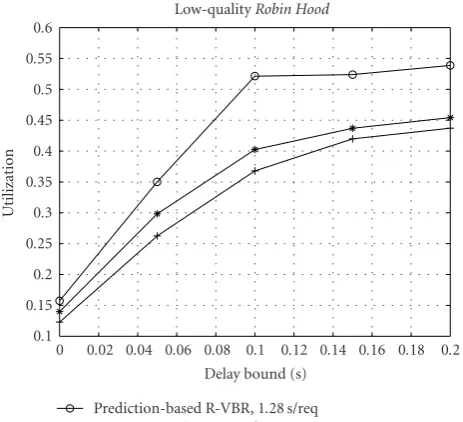
5.4. Results and analysis
0.2 0.18 0.16 0.14 0.12 0.1 0.08 0.06 0.04 0.02 0
Delay bound (s) 0.1
0.15 0.2 0.25 0.3 0.35 0.4 0.45 0.5 0.55 0.6
U
tilization
Low-qualityRobin Hood
Prediction-based R-VBR, 1.28 s/req RED-VBR withα=1.1,β=0.9, 0.52 s/req RED-VBR withα=1.3,β=0.7, 1.47 s/req
Figure 3: Comparison between online prediction-based R-VBR
scheme and RED-VBR scheme forRobin Hood.
0.2 0.18 0.16 0.14 0.12 0.1 0.08 0.06 0.04 0.02 0
Delay bound (s) 0.2
0.25 0.3 0.35 0.4 0.45 0.5 0.55 0.6 0.65 0.7
U
tilization
High-qualityMr. Bean
Prediction-based R-VBR, 1.11 s/req RED-VBR withα=1.1,β=0.9, 0.65 s/req RED-VBR withα=1.3,β=0.7, 1.77 s/req
Figure 4: Comparison between online prediction-based R-VBR
scheme and RED-VBR scheme forMr. Bean.
(α=1.3,β=0.7), that is, 1.47 second and 1.77 second, re-spectively, and that of RED-VBR (α = 1.1,β = 0.9) that is, 0.52 second and 0.65 second, respectively. This clearly in-dicates that the performance gain of the prediction-based R-VBR is beyond the adjustment of parametersαandβof RED-VBR.
Table 1shows the average drop rates for both schemes. While higher, the average drop rate of the prediction-based
R-VBR is still below 1%, which should well satisfy a wide range of real-time video applications. RED-VBR achieves a lower bit drop rate at the expense of significant lower net-work utilization. RED-VBR may be used to provide the video service with a very low (close to zero) drop rate. Prediction-based R-VBR can achieve around 20% utilization improve-ment with an average drop rate less than about 1%.Table 1 also lists the number of video streams accommodated into the network during our simulation. Clearly, the link uti-lization gains are due to the fact that the prediction-based R-VBR can accommodate significantly more simultaneous VBR video streams given the same link capacity. This indi-cates that prediction-based R-VBR can exploit SMG signifi-cantly better and utilize link capacity more efficiently.
It would be interesting to see the performance of the two approaches when they both accommodate the same number of video streams. To this end, we further conduct simula-tions with a different setup where the blocking probability for RED-VBR is increased until it accommodates the same number of video streams as those for the prediction-based R-VBR (i.e., both should have similar link utilization).Table 2 lists the performance results for both video traces. It is inter-esting to see that the average renegotiation interval for RED-VBR is dramatically reduced and much smaller than that of our prediction-based R-VBR (i.e., only about 1/3 forRobin Hood, and less than 1/2 forMr. Bean, resp.).
To illustrate the limitation of single-step-ahead (i.e., single-frame-ahead) traffic prediction approach in dy-namic bandwidth allocation, we further conduct simula-tions to compare the predictive dynamic bandwidth allo-cation schemes based on single-step-ahead predictor (SSP) with those based on the MRL-NN traffic predictor and RED-VBR. Our approach is to create aperfectSSP with zero pre-diction error in the simulations. Thus, a dynamic bandwidth allocation scheme based on the perfect SSP yields the perfor-mance upper bound for any possible SSPs. MovieMr. Bean (high quality) is used in this experiment. The simulation setup is the same as that described inSection 5.3. Note that the prediction window size forMr. Beanis 36, indicating that the employed MRL-NN traffic predictor is a 36-frame-ahead predictor. The simulation results are listed inTable 3. While the dynamic bandwidth allocation based on the perfect SSP can yield slightly better utilization performance compared to RED-VBR, its renegotiation interval is dramatically re-duced to 0.04 second. Notice that the lapse of 0.04 second is one frame time given the frame rate of the video trace be-ing 25 fps. This is not surprisbe-ing because with sbe-ingle-frame- single-frame-ahead traffic prediction, next frame has to be predicted for every frame. Accordingly, the dynamic bandwidth allocation has to be renegotiated for every frame time.
Table1: Comparison of bit drop rate and the number of video streams accommodated.
Video trace Delay
Average bit drop rate Number of video streams accommodated
bound (s)
RED-VBR RED-VBR Prediction- RED-VBR RED-VBR Prediction-(α=1.1, (α=1.3, based (α=1.1, (α=1.3, based
β=0.9) β=0.7) R-VBR β=0.9) β=0.7) R-VBR
Robin Hood
0 0.01% 0 0.09% 8 7 9
0.05 0 0 0.13% 17 15 20
0.1 0.16% 0.07% 0.93% 23 21 30
0.15 0.27% 0.20% 0.82% 25 24 30
0.2 0.32% 0.25% 0.91% 26 25 31
Mr. Bean
0 0 0 0.63% 18 15 27
0.05 0.05% 0 0.26% 34 30 38
0.1 0.14% 0.02% 0.68% 37 35 44
0.15 0.17% 0.06% 0.97% 39 37 47
0.2 0.16% 0.08% 0.96% 40 38 48
Table2: Performance comparisons of the prediction-based R-VBR versus RED-VBR with comparable network utilization.
Video trace Delay
RED-VBR (α=1.1,β=0.9) Prediction-based R-VBR without BEB
bound (s)
Average
Utilization Average Average Utilization Average drop rate (%) renegotiation drop rate (%) renegotiation
(%) interval (s) (%) interval (s)
Robin Hood
0.05 0.13 35 0.326 0.13 35 1.073
0.10 0.93 52 0.323 0.93 52 1.279
0.15 0.82 52 0.431 0.82 52 1.349
0.20 0.91 54 0.439 0.91 54 1.279
Mr. Bean
0.05 0.23 53 0.536 0.27 53 1.257
0.10 0.61 61 0.467 0.68 61 1.107
0.15 0.89 65 0.446 0.97 65 1.071
0.20 0.90 66 0.450 0.97 66 1.080
that commonly used default method. This is because that the BEB-based renegotiation control algorithm will not in-tend to explore as much fine resolution SMG as the aggres-sive default method which keeps renegotiatingconsecutively frame-by-frame until success. Nevertheless, its utilization is still consistently and significantly better than that of RED-VBR (α = 1.1, β = 0.9). A unique gain of the proposed renegotiation control algorithm is to greatly reduce further the renegotiation frequency as shown inTable 4, and in ad-dition, the lower average bit drop rate is also achieved. The dramatically reduced renegotiation frequency means the sig-nificant reduction of the overhead of traffic prediction, rene-gotiation computation and bandwidth reallocation control, compensated to the slightly decreased link utilization. There-fore, the proposed renegotiation control algorithm is favor-able for better overall performance.
6. CONCLUSIONS
The key contributions of our work are (1) noting that a re-alistic service policy in trace-driven simulation for dynamic
Table3: R-VBR performance comparisons among perfect single-step-ahead prediction (SSP) based scheme, multistep-ahead prediction MRL-NN based scheme, and RED-VBR scheme.
Performance Delay
Schemes
metrics bound (s) R-VBR with
R-VBR with RED-VBR
perfect SSP MRL-NN (α=1.1, predictor β=0.9)
Utilization
0 27.9% 37.4% 25.1%
0.05 48.8% 52.9% 47.5%
0.1 53.0% 61.0% 51.6%
0.15 55.7% 64.9% 54.4%
0.2 57.1% 66.3% 55.8%
Drop rate
0 0.02% 0.63% 0.01%
0.05 0.10% 0.27% 0.05%
0.1 0.19% 0.68% 0.14%
0.15 0.22% 0.97% 0.17%
0.2 0.22% 0.97% 0.16%
Renegotiation interval (s)
0 0.04 1.03 0.66
0.05 0.04 1.26 0.65
0.1 0.04 1.11 0.66
0.15 0.04 1.07 0.64
0.2 0.04 1.08 0.64
0.2 0.18 0.16 0.14 0.12 0.1 0.08 0.06 0.04 0.02 0
Delay bound (s) 0.25
0.3 0.35 0.4 0.45 0.5 0.55 0.6 0.65 0.7
U
tilization
High-qualityMr. Bean
Prediction-based R-VBR without BEB Prediction-based R-VBR with BEB RED-VBR withα=1.1,β=0.9
Figure5: Effect of the BEB-based renegotiation control algorithm
forMr. Bean. (The performance of RED-VBR is also plotted to il-lustrate the minimal impact of the link utilization with BEB-based approach.)
renegotiation failures, which is important for reducing rene-gotiation overhead. Although this study is conducted using R-VBR as a research vehicle, the insights and methodology
0.2 0.18 0.16 0.14 0.12 0.1 0.08 0.06 0.04 0.02 0
Delay bound (s) 0.1
0.15 0.2 0.25 0.3 0.35 0.4 0.45 0.5 0.55 0.6
U
tilization
Low-qualityRobin Hood
Prediction-based R-VBR without BEB Prediction-based R-VBR with BEB RED-VBR withα=1.1,β=0.9
Figure6: Effect of the BEB-based renegotiation control algorithm
forRobin Hood. (The performance of RED-VBR is also plotted to illustrate the minimal impact of the link utilization with BEB-based approach.)
Table4: Effect of BEB-based renegotiation control algorithm on renegotiation interval and bit drop rate.
Video trace
Using BEB-based
Average Average renegotiation drop rate renegotiation
control interval (s)
Robin Hood No 0.58% 1.18
Yes 0.37% 1.81
Mr. Bean No 0.70% 1.11
Yes 0.52% 1.37
prediction-based R-CBR, as well as implementing real exper-imental system to conduct subjective comparison.
REFERENCES
[1] Y. Liang, “Real-time VBR video traffic prediction for dynamic bandwidth allocation,” IEEE Transactions on Systems, Man, and Cybernetics—Part C: Applications and Reviews, vol. 34, no. 1, pp. 32–47, 2004, (special issue on technologies that pro-mote computational intelligence, openness and programma-bility in networks and Internet services—part III).
[2] H. Zhang and E. W. Knightly, “RED-VBR: a renegotiation-based approach to support delay-sensitive VBR video,” Mul-timedia Systems, vol. 5, no. 3, pp. 164–176, 1997.
[3] M. W. Garrett and W. Willinger, “Analysis, modeling and gen-eration of self-similar VBR video traffic,” inProceedings of the ACM SIGCOMM Conference on Communications Architec-tures, Protocols and Applications, pp. 269–280, London, UK, August-September 1994.
[4] E. P. Rathgeb, “Modeling and performance comparison of policing mechanisms for ATM networks,”IEEE Journal on Se-lected Areas in Communications, vol. 9, no. 3, pp. 325–334, 1991.
[5] S. Chong, S. Li, and J. Ghosh, “Predictive dynamic band-width allocation for efficient transport of real-time VBR video over ATM,”IEEE Journal on Selected Areas in Communications, vol. 13, no. 1, pp. 12–23, 1995.
[6] M. Wu, R. A. Joyce, H.-S. Wong, L. Guan, and S.-Y. Kung, “Dynamic resource allocation via video content and short-term traffic statistics,”IEEE Transactions on Multimedia, vol. 3, no. 2, pp. 186–199, 2001.
[7] J.-Y. Le Boudec and O. Verscheure, “Optimal smoothing for guaranteed service,”IEEE/ACM Transactions on Networking, vol. 8, no. 6, pp. 689–696, 2000.
[8] J. Rexford, S. Sen, J. Dey, et al., “Online smoothing of live, variable-bit-rate video,” inProceedings of the IEEE Interna-tional Workshop on Network and Operating System Support for Digital Audio and Video (NOSSDAV ’97), pp. 235–243, St. Louis, Mo, USA, May 1997.
[9] A. M. Adas, “Using adaptive linear prediction to support real-time VBR video under RCBR network service model,” IEEE/ACM Transactions on Networking, vol. 6, no. 5, pp. 635– 644, 1998.
[10] G. Chiruvolu, R. Sankar, and N. Ranganathan, “VBR video traffic management using a predictor-based architecture,” Computer Communications, vol. 23, no. 1, pp. 62–70, 2000. [11] S.-J. Yoo, K.-S. Kwak, and M. Kim, “Predictive and
measurement-based dynamic resource management and QoS control for videos,”Computer Communications, vol. 26, no. 14, pp. 1651–1661, 2003.
[12] P. Bocheck and S.-F. Chang, “Content-based VBR traffic mod-eling and its application to dynamic network resource allo-cation,” Res. Rep. 48c-98-20, Columbia University, New York, NY, USA, 1998.
[13] A. Bhattacharya, A. G. Parlos, and A. F. Atiya, “Prediction of MPEG-coded video source traffic using recurrent neural net-works,”IEEE Transactions on Signal Processing, vol. 51, no. 8, pp. 2177–2190, 2003.
[14] E. W. Knightly and H. Zhang, “D-BIND: an accurate traf-fic model for providing QoS guarantees to VBR traffic,” IEEE/ACM Transactions on Networking, vol. 5, no. 2, pp. 219– 231, 1997.
[15] R. L. Cruz, “A calculus for network delay—I: network elements in isolation,”IEEE Transactions on Information Theory, vol. 37, no. 1, pp. 114–131, 1991.
[16] Y. Liang and E. W. Page, “Multiresolution learning paradigm and signal prediction,”IEEE Transactions on Signal Processing, vol. 45, no. 11, pp. 2858–2864, 1997.
[17] F. H. P. Fitzek and M. Reisslein, “MPEG-4 and H.263 video traces for network performance evaluation,” IEEE Network, vol. 15, no. 6, pp. 40–54, 2001, (MPEG-4 traces,http://trace. eas.asu.edu/TRACE/trace.html).
Yao Liangreceived his B.S. degree in puter engineering and M.S. degree in com-puter science from Xi’an Jiaotong Univer-sity, Xi’an, China. He received his Ph.D. degree in computer science from Clem-son University, ClemClem-son, SC, in 1997. He is currently an Assistant Professor in the Bradley Department of Electrical and Com-puter Engineering, Virginia Polytechnic In-stitute and State University. His research
in-terests include machine learning, neural networks, data mining, adaptive network control, multimedia networking, sensor net-works and data management systems, and distributed and com-plex systems. Prior to joining Virginia Tech, he was a Technical Staff Member in Alcatel USA, Raleigh, NC, from 1997 to 2001. He is a Senior Member of the IEEE, and was a Member of the IEEE Signal Processing Society Machine Learning Technical Committee from 2003 to 2005. He has published numerous papers in refreed jour-nals and international conferences proceedings.
Mei Han did receive the B.S. degree in electrical and electronic engineering from the University of Electronic Science and Technology of China (UESTC), Chengdu, China, in 1995, and the M.S. degree in elec-trical and computer engineering from Vir-ginia Polytechnic Institute and State Univer-sity (Virginia Tech), Alexandria, Virginia, in 2005. She was a Marketing Engineer from 1995 to 1999 and a Design Engineer from