Volume 2006, Article ID 65901, Pages1–16 DOI 10.1155/ASP/2006/65901
Source Depth Estimation Using a Horizontal
Array by Matched-Mode Processing in the
Frequency-Wavenumber Domain
Barbara Nicolas, J ´er ˆome I. Mars, and Jean-Louis Lacoume
Laboratoire des Images et des Signaux, 961 Rue de la Houille Blanche, 38 402 Saint Martin d’H`eres Cedex, BP 46, France
Received 20 June 2005; Revised 18 October 2005; Accepted 31 October 2005
Recommended for Publication by Joe C. Chen
In shallow water environments, matched-field processing (MFP) and matched-mode processing (MMP) are proven techniques for doing source localization. In these environments, the acoustic field propagates at long range as depth-dependent modes. Given a knowledge of the modes, it is possible to estimate source depth. In MMP, the pressure field is typically sampled over depth with a vertical line array (VLA) in order to extract the mode amplitudes. In this paper, we focus on horizontal line arrays (HLA) as they are generally more practical for at sea applications. Considering an impulsive low-frequency source (1–100 Hz) in a shallow
water environment (100–400 m), we propose an efficient method to estimate source depth by modal decomposition of the pressure
field recorded on an HLA of sensors. Mode amplitudes are estimated using the frequency-wavenumber transform, which is the 2D Fourier transform of a time-distance section. We first study the robustness of the presented method against noise and against environmental mismatches on simulated data. Then, the method is applied both to at sea and laboratory data. We also show that the source depth estimation is drastically improved by incorporating the sign of the mode amplitudes.
Copyright © 2006 Hindawi Publishing Corporation. All rights reserved.
1. INTRODUCTION
Passive source localization in shallow water environments has been studied for many decades in underwater acoustics as many sources of interest are present in the ocean: marine mammals, fish, and submarines. These sources emit acoustic waves at different frequencies and localization methods must be adapted to these frequencies. In this paper, we focus on ultra low-frequency waves (1–100 Hz) which correspond to frequencies emitted by marine mammals or submarines and we estimate source depth.
Beamforming techniques are not suitable for localization in shallow water environments because they do not consider multipath arrivals and complexity of ocean acoustic chan-nels. Matched-field processing (MFP) and matched-mode processing (MMP) constitute, then, alternatives to localize underwater sources.
First proposed by Bucker [1], matched-field processing has been studied extensively in the literature [2–5]. MFP can be seen as a generalized beamforming method which in-corporates spatial complexity of acoustic fields in an ocean waveguide. For each source location, the acoustic field re-ceived on an array of sensors is simulated. This field is then
compared to the pressure field recorded on a real array, us-ing an objective function, which is often defined as the cor-relation function between real and simulated pressure fields (Bartlett correlator). An overview of these methods is given in [6]. The main drawback of MFP methods is their sensitiv-ity to environmental mismatch due to the use of the global acoustic field.
Matched-mode processing [7–9] is less sensitive to envi-ronmental mismatches. This approach uses the property of modal propagation in shallow water waveguides (which has also been extensively used in geoacoustic inversion [10,11]) and estimates source depth using mode amplitudes (also called mode excitation factors) extracted from real data. Contrary to MFP, matched-mode processing only extracts information about the source location in the pressure field (whereas MFP uses the entire pressure field), which reduces its sensitivity to environmental mismatches. MMP is typi-cally applied to narrow band signals using a vertical line array (VLA) of sensors to extract mode amplitudes.
Source −
→u r −→u
z
zs
z
Depth
0 r Distance
Receiver
D
− →
kr − →
kz −→k
Density:ρ1
Velocity:V1
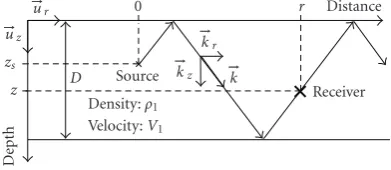
Figure1: Perfect waveguide.
VLA matched-mode methods cannot be used in this case (as recorded data do not sample the pressure field in depth), so we develop a new method to extract mode amplitudes. Lots of work have been done in geoacoustic inversion to ex-tract mode amplitudes using wavenumbers [12,13]. In this paper, we develop a simple method to extract mode ampli-tude. These amplitudes are extracted by modal filtering in the frequency-wavenumber plane (f−kplane) where modes are separated.
After a brief presentation of guided propagation in a shal-low water environment and classical matched-mode process-ing, we develop a matched-mode method of source depth estimation based on the frequency-wavenumber transform. A study of robustness against noise and against environ-mental mismatch is made. Finally, we validate the proposed method on two real data sets: the first one was recorded in the North Sea where the source depth was roughly known. The second data set was recorded during ultrasonic experiments performed at the Marine Physical Laboratory (SCRIPPS-San Diego) in a perfectly known environment, which allows us to study the error on source depth estimation. We also study the influence of the sign of modal excitation factors and show that its knowledge improves source depth estimation. A fu-ture work would consist in estimating this sign on a sea data.
2. MODES IN AN OCEANIC WAVEGUIDE
AND MATCHED-MODE PROCESSING
2.1. Normal modes in an oceanic waveguide
In shallow water environments and for low-frequency waves, the acoustic field can be modeled using normal mode theory. For the sake of simplicity, let us consider a perfect waveguide (Figure 1) made of a homogeneous layer of fluid between perfectly reflecting boundaries at depth 0 (surface) andD
(sea bottom). The water layer is characterized by a velocity
V1 and a densityρ1. The study is presented for an
omnidi-rectional harmonic point source, with a frequency f located at depthzsand at range 0, but results are similar for a
broad-band source.
Acoustic pressureP(r,z,t) received atM(r,z) can be ex-pressed byP(r,z,t)=p(r,z) exp(2iπ f t), wherep(r,z) satis-fies the Helmholtz equation [14] and is, at long range, a sum of modes:
p(r,z)=A
+∞
m=1
ψm
zs
ψm(z)
exp−2iπkrmr
krmr
, (1)
0 1−1 0 1−1 0 1
0
zs1 zs2
100 200
Sour
ce
d
epth,
zs
Mode 1 Mode 2 Mode 3
zs1=0.2D zs2=0.4D
(a)
−1 0 1−1 0 1
0
zs1
zs2
100
200
Sour
ce
d
epth,
zs
Mode 4 Mode 5
zs1=0.2D zs2=0.4D
(b)
Figure2: Mode amplitudes (for modes 1 to 5) in a perfect
waveg-uide and examples for two different source depths:zs1 =0.2Dand
zs2=0.4D.
withAa constant. By homogeneity with the temporal fre-quency f,kis defined as a spatial frequencyk = f /V1and
is the inverse of the wavelength (for the sake of simplic-ity, krm, the horizontal spatial frequency will be called the
wavenumber in the following even if there is a factor 2π be-tween wavenumber and spatial frequency). The wavenumber spectrum of the modes is discrete and each mode is associ-ated with a unique wavenumber. The mode amplitudeψm,
also called mode excitation factor, is a function of the source depthzs:
ψm
zs
=
2
Dsin
2πkzmzs
, (2)
withkzm=(2m−1)/4D.Figure 2represents these mode
am-plitudes, normalized between−1 and 1, as a function of the source depth for a perfect waveguide (D=200 m). Two ex-amples at different source depths:zs1 = 0.2D(circles) and zs2=0.4D(squares) are presented.
This short study of propagation in shallow water waveg-uides shows that mode amplitude is a function of the source depthzs. Matched-mode processing (MMP) use this
2.2. Classical matched-mode processing (MMP)
Matched-mode processing (MMP) methods are widely used to localize underwater sources in shallow water environ-ments. These methods estimate source depth [7], distance source receiver [16], or these two parameters jointly [8,9, 17].
To estimate the source depth, matched-mode methods capitalize on the dependence of the mode amplitudes on the source depth. By comparing a set of mode amplitudes ex-tracted from real data to a model, it is possible to determine the source depth. Typically, theoretical mode amplitudes are obtained using propagation equations in a perfect waveguide [7,8] or a normal mode model [17]. Then, the source depth is estimated by matching predicted mode amplitudes to mea-sured mode amplitudes, using a contrast function.
Most classical MMP methods use a vertical line array (VLA) of hydrophones to extract the mode excitation factors. In this case, the recorded signal can be expressed as a lin-ear matrix with one term linked to mode functions at the re-ceiver and one term associated to the source location (which contains mode amplitudes). Then, using the orthogonality of the modes [7], information on source location can be ex-tracted.
It is often more convenient in practice to work using hor-izontal geometry arrays. For example, sensors placed hori-zontally along the sea bottom, because they remain station-ary, can be left to record continuously for long periods of time. This is not always possible with a vertical array of sen-sors as vertical arrays are sometimes free floating and move all the time.
This leads to a problem that has not been studied: can we perform MMP using a horizontal line array (HLA) of sen-sors? The expression of the recorded signal do not lead to a simple extraction of the source information, and mode exci-tation factors cannot be extracted using the same approach (which is based on the vertical sampling of the data). In this paper, we propose an alternative method, based on the frequency-wavenumber transform (f −k), to achieve mode amplitude extraction using a horizontal line array of sensors.
3. MATCHED-MODE PROCESSING IN THE
FREQUENCY-WAVENUMBER DOMAIN
3.1. Motivation and frequency-wavenumber transform
Let us consider an omnidirectional point source at depth
z = zsand ranger = 0 which radiates a broadband signal
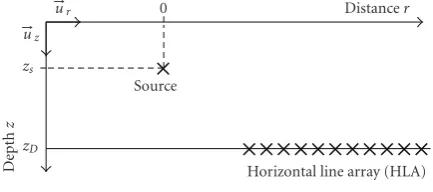
in a shallow water waveguide. The acoustic field is sampled by a horizontal line array (HLA) of hydrophones placed on the sea bottom (at depthz=zD).Figure 3presents the
envi-ronmental configuration and the source-array geometry. To perform mode extraction from the recorded signals, frequency-wavenumber domain is used because modes are isolated in this plane. The frequency-wavenumber represen-tationPf k(kr,zD,f), also called f −ktransform, is the 2D
Fourier transform of a sectionP(r,zD,t) in timetand
dis-tancerat a given depthzD. This representation, function of
− →u r − →u z
Source
zs
zD
Depth
z
0 Distancer
Horizontal line array (HLA)
Figure3: Experimental configuration.
the frequencyf and wavenumberkr, is complex but typically
only its modulus is used. The expression of the f −k trans-form, is then
Pf k
kr,zD,f
=
t
rP
r,zD,t
exp−2iπf t−krr
dt dr. (3)
As we use an HLA of sensors, it is possible to build the
f −ktransform of the recorded data. We consider a white broadband source and use the study of the propagation in a perfect waveguide (Section 2.1). Details of the transforma-tion and hypothesis are given in the Appendix. Then, the the-oretical f −ktransform of the data recorded at long range, after range normalization, and on an infinite HLA, is
Pf k
kr,zD,f
=B
+∞
m=1
ψm
zs
ψm
zD
δkr−krm
, (4)
where B is a constant. In the case of a long HLA, the ex-pression (4) remains a valid approximation of the f −k
transform. The energy is located on the dispersion curves (kr=krm) of the modes. At each frequency, the wavenumber
spectrum of the modes is discrete (cf.Section 2.1). The dis-persion curves, representing the modes, are separated in the
f−kdomain [15]. As a result, and using the fact that the HLA is located on the sea bottom (which involves|ψm(zD)| =1),
the f −ktransform is
Pf k
kr,f
≈B
+∞
m=1
ψm zsδ
kr−krm
. (5)
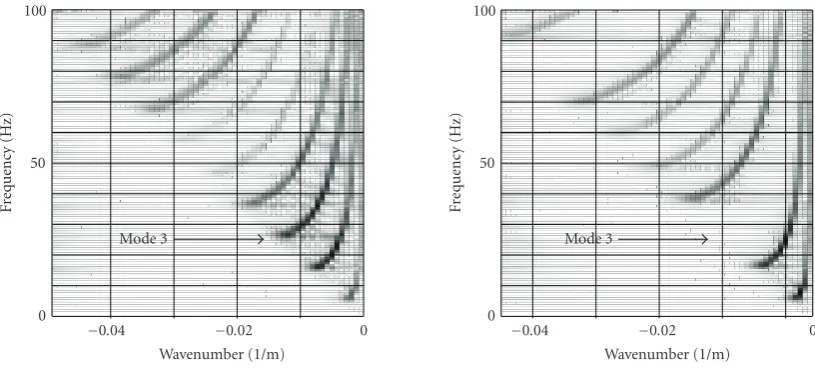
Amplitude of the f −ktransform along a mode disper-sive curve only depends on the mode excitation factor mod-ulus. Using these curves, it will be possible to extract mode excitation factors.Figure 4shows two examples off −k rep-resentations simulated in a perfect waveguide for two diff er-ent source depthszs1 =0.2Dandzs2 =0.4D. For the source
at 0.4D(right), mode 3 is not excited, whereas it is for the source located at 0.2D(left), which is consistent with propa-gation theory (Figure 2).
In a range-independent Pekeris waveguide (Figure 5) made of a homogeneous fluid layer (velocityV1, densityρ1,
depthD) overlying a homogeneous fluid half space (velocity
V2, densityρ2) with no attenuation, results are almost
100
50
0
Fre
q
u
en
cy
(H
z)
−0.04 −0.02 0
Wavenumber (1/m) Mode 3
100
50
0
Fre
q
u
en
cy
(H
z)
−0.04 −0.02 0
Wavenumber (1/m) Mode 3
Figure4:f−krepresentations in a perfect waveguide for a simulated source located at two different depths: 0.2D(left) and 0.4D(right).
Distance Water depth:
D
Velocity:V1
Density:ρ1 Water
Velocity:V2
Density:ρ2 Sediment layer
Depth
Figure5: Pekeris waveguide.
a function of the frequency. As a result, the estimated mode amplitude is a mean excitation factor along each dispersion curve. Moreover, mode excitation factors at the bottom in-terface are not exactly unite and will slightly modify the es-timation of the mode amplitudes at the source. These phe-nomena will not affect the results of the proposed method as the theoretical mode amplitudes will be extracted by the same method.
3.2. Mode excitation factors and depth estimation
3.2.1. Mode excitation factors estimation (or modal filtering)
The first step of MMP using an HLA consists in extract-ing mode excitation factors. In geoacoustic inversion, many methods have been developed and applied to extract mode amplitude using a wavenumber transform [10,12,13,18]. In this paper, the extraction is performed by mask filtering in the f −kplane, which allows a simple extraction as long as the environment is known. We can note that if the environ-ment is unknown, geoacoustic parameters can be estimated on the f −krepresentation [15]. To extract modes, it is nec-essary to find, in the f −kplane, areas where modes exist. Using propagation theory in a Pekeris waveguide, which is a realistic and simple model for shallow water environments,
these areas, called dispersion curves, are defined by
tan 2πD
f2 m V1−k
2
rm−
m−1
2
π
=ρ1
krmV1/ fm
2
−V1/V2
2
ρ2
1−krmV1/ fm
2 ,
(6)
where fm is the frequency of the modemandkrmits
hori-zontal wavenumber. To build masks, we also have to take into account theV1velocity correction (a classical preprocessing
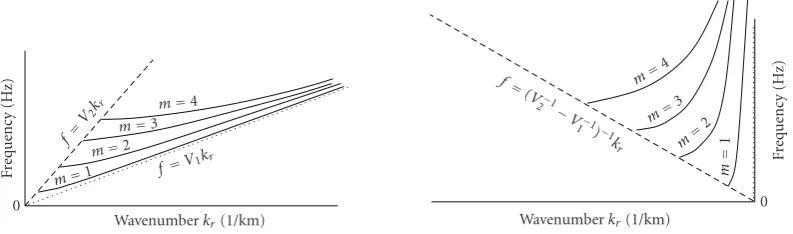
in seismic) which modifies f −krepresentation to provide anf−krepresentation without spatial aliasing. It consists in applying a time correction along the distance axisr. In prac-tice, the recorded signal of each sensor is time shifted so that the direct wave, whose velocity is V1, impinges all the
sen-sors at the same time. The consequence of this processing in the f −kplane is that one pointM =(f,kr) is shifted to M=(f,kr−f /V1).
Figure 6shows the theoretical f −krepresentation in a Pekeris waveguide before (left) and after (right)V1velocity
correction [15].
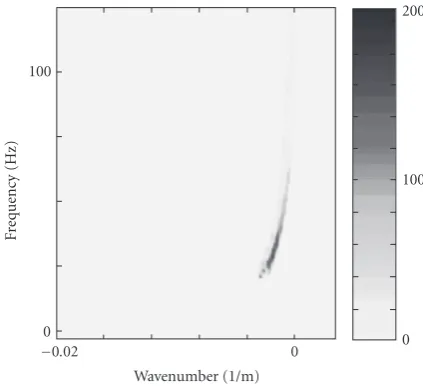
After this correction, using (6), and assuming that geoa-coustic parameters (velocities, densities, and water depth) are known, we can build a binary mask of the dispersion curve of each mode in the f −kplane.Figure 7presents this the-oretical curve for mode 3 in a Pekeris waveguide defined by
V1=1520 m/s,V2=1875 m/s, andD=130 m.
Fre
q
u
en
cy
(H
z)
f= V2k
r m=4
m=3 m=2 m=1 f =
V1kr
0
Wavenumberkr(1/km)
f= (V−
1
2 −
V−1
1 )−
1 kr
Fre
q
u
en
cy
(H
z)
m=
4
m=3
m=
2
m
=
1
0 Wavenumberkr(1/km)
Figure6: Theoreticalf−krepresentation in a Pekeris waveguide before (left) and after (right)V1velocity correction.
100
0
Fre
q
u
en
cy
(H
z)
−0.02 0
Wavenumber (1/m)
Figure7: Dispersion curve of mode 3 in the f −k domain after
V1 velocity correction for a Pekeris waveguide:D =130 m,V1 =
1520 m/s, andV2=1875 m/s.
be extracted even if the environment is not perfectly known. Dilation factor is chosen usingf−krepresentation of the real data, but source depth estimation is not sensitive to it, as long as it is large enough to extract all the mode from the f −k
representation and small enough to extract only one mode. After dilation, the binary mask used to extract mode 3 in the Pekeris waveguide presented below is shown inFigure 8.
For each mode, a dilated mask is built and the f −k
transform is multiplied by this mask to extract the concerned mode. Figure 9 shows the f −k transform of a real sec-tion recorded on an HLA in an oceanic waveguide (which can be modeled by a Pekeris waveguide with D = 130 m,
V1 = 1520 m/s, and V2 = 1875 m/s). After mask filtering
of mode 3, the filtered f −k representation is plotted in Figure 10.
For each modem, the mean of the f −krepresentation on the mask gives an estimation of the mean excitation fac-tor modulus cm of this mode. We can note that as we use
modulus of the f −ktransform, only mode excitation fac-tor modulus is estimated (without its sign), but for the sake
100
0
Fre
q
u
en
cy
(H
z)
−0.02 0
Wavenumber (1/m)
Figure8: Binary mask used to extract mode 3 in thef−kdomain
for a Pekeris waveguide: D = 130 m,V1 = 1520 m/s, andV2 =
1875 m/s afterV1velocity correction (black=1, white=0).
of simplicity, it will be called mode excitation factor in the following. Then, to compare real and simulated mode exci-tation factors, a normalization is made using the closure re-lationship between modes:
m c2
m
zs
=1. (7)
At this step, normalized mode excitation factors cmreal have
been extracted from the f−krepresentation of the real data. We can note that the number of extracted modes is deter-mined by the band of the source signal.
3.2.2. Depth estimation
Once mode excitation factorscmrealare extracted for real data,
100
0
Fre
q
u
en
cy
(H
z)
−0.02 0
Wavenumber (1/m)
200
100
0
Figure9:f−krepresentation of the recorded data.
100
0
Fre
q
u
en
cy
(H
z)
−0.02 0
Wavenumber (1/m)
200
100
0
Figure10: Mode 3 extracted from f −krepresentation by mask filtering.
Simulated fields are obtained using a finite-difference algo-rithm, developed by Virieux, which models propagation of P and SV waves in heterogeneous media [19]. Simulations are made in an environment close to the real environment (environment identification is performed using [15, 20]). Then, simulated mode amplitudescmsimuare extracted using
the method presented above (mask filtering).
The last step, to compare measured and simulated mode amplitudes, consists in maximizing the contrast function de-fined by
G=10 log10 nm
modes
cmsimu−cmreal
2
(8)
withnm the number of modes. Then the estimated source
depth is given by the depth maximizing the contrast function
G.
3.3. Summary of the proposed method and discussion To summarize the proposed method, we describe the differ-ent steps in the chronological order:
(i) V1velocity correction on the real data: this
pre-proc-essing provide an f −krepresentation without spatial aliasing and involves mode separation in thef −k do-main,
(ii) mask building in thef −kplane,
(iii) mode excitation factors estimation on real data (cmreal),
(iv) simulation of the propagation for different source depths in an environment close to the real environ-ment,
(v) mode excitation factors estimation on simulated data (cmsimu),
(vi) computation of the contrast functionG, using real and simulated mode excitation factors.
Discussion
The main difference between classical MMP and the pro-posed method is that firstly mode extraction is performed using a horizontal line array. Extraction is based on the frequency-wavenumber transform of the recorded data and on mask filtering. Secondly, another specificity of the method is that masks are built to take into account environmental mismatches, so that the method could be applied on real data for which environment knowledge can be partial. Besides, the presented method is different from classical MMP as the-oretical mode amplitudes are extracted from finite difference simulations using the method applied on real data, whereas classical MMP usually use theoretical amplitudes obtained using propagation equations in a perfect waveguide or nor-mal mode models.
4. SENSITIVITY TO NOISE AND TO ENVIRONMENTAL MISMATCH
In this section, MMP in the f −kdomain is applied on sim-ulated data to estimate sensitivity to noise and robustness against environmental mismatch of the method.
4.1. Sensitivity to noise
To study robustness against noise, simulations are made in an oceanic waveguide using a finite-difference algorithm mod-eling P-SV waves propagation in heterogeneous media [19]. The environment is made of a homogeneous water layer (D = 200 m) overlying a homogeneous solid half space. ρ
30 20 10 0 −10 −20
Sour
ce
amplitude
0 0.1 0.2 0.3
Time (s) (a)
50 0 −50 −100
Sour
ce
sp
ect
rum
(dB)
10 20 30 40 50 60 70 80 90 100 Frequency (Hz)
(b)
Figure11: Source signal and its spectrum.
V1=1500 m/s
ρ1=1 D=200 mSource
zs
Distancer
V2=2000 m/s
Vs2=1000 m/s ρ2=3
Receivers 20 m
Depth
z
Figure12: Experimental context.
On each simulation, independent Gaussian white noises are added on each sensor. For each signal-to-noise ratio, SNR, (12 dB, 3 dB, and 0 dB), we simulate the propagation of 90 sources located at different depths in the waveguide (every 2 m from 10 m to 180 m). Source depth is estimated using the method described above and compared to real source depth. Let us consider the example of a source located atzs =
130 m, the contrast functionGfor different SNR is plotted inFigure 13. For a high SNR (12 dB—solid line),Gpresents a maximum for the simulated depth of 130 m. In this case, source depth estimation is perfect (zs=130 m) and the
dif-ference between the maximum and other local maxima is greater than 23 dB. As SNR decreases, the maximum of the
Gdecreases too, and becomes closer to other local maxima. For an SNR of 0 dB (dashed line), source depth estimation gives an erroneous result:zs=98 m. These errors are due to
the fact that mode amplitudes are sinusoidal functions: as a result, some depths are “close,” in term of mode amplitudes modulus, particularly when the SNR is low (which involves that mode amplitudes are not estimated precisely).
Considering all the simulations, it is possible to study the robustness of the method against noise. Tables1,2, and 3 present, respectively, the errors on source depth estimation
90 80 70 60 50 40 30 20
C
o
nt
ra
st
function
G
(dB)
0 20 40 60 80 100 120 140 160 180 Source depth (m)
SNR=12 dB SNR=3 dB SNR=0 dB
Figure13: Contrast function for a source located atzs=130 m for
different SNR: 12 dB, 3 dB, and 0 dB.
Table1: SNR=12 dB: error on source depth estimation.
SNR=12 dB
Estimation error between Percentages of estimations
0–2 m 98%
2–4 m 2%
+ 0%
Table2: SNR=3 dB: error on source depth estimation.
SNR=3 dB
Estimation error between Percentages of estimations
0–2 m 61%
2–4 m 12%
4–6 m 6%
6–10 m 7%
+ 14%
for 3 different SNRs: 12 dB, 3 dB, and 0 dB. For a high SNR (12 dB), source depth is estimated with an error less than 2 m for all simulated depths. If the SNR decreases to 3 dB, only 61% of the estimations are made with an error less than 2 m but there are still 79% of the estimations with an error smaller than 6 m. When the SNR is low (0 dB), source depth estimation is not correct (43% of the estimations presents an error greater than 6 m) as mode amplitudes cannot be esti-mated with an acceptable precision.
Table3: SNR=0 dB: error on source depth estimation.
SNR=0 dB
Estimation error between Percentages of estimations
0–2 m 42%
2–4 m 10%
4–6 m 5%
6–10 m 9%
+ 34%
100 90 80 70 60 50 40 30 20
C
o
nt
ra
st
function
G
(dB)
0 20 40 60 80 100 120 140 160 180 Source depth (m)
zs
Figure14: Contrast functionG(dB) for a source located atzs = 40 m with an error on the water depth of 2%.
4.2. Sensitivity to environmental mismatches
Sensitivity to environmental mismatches of MMP methods is a crucial issue and has been studied in the case of a vertical line array [21,22]. To study the robustness of the proposed method, we present here the example of a particular environ-mental mismatch: error on water depth estimation for data recorded on a horizontal line array.
The recorded data are simulated in an oceanic waveguide made of a homogeneous water layer (D = 196 m,ρ1 = 1,
V1=1500 m/s) and a homogeneous solid half space (ρ2=3,
V2 = 2000 m/s,Vs2 =1000 m/s). The experimental
config-uration is: an underwater source at depthzz =40 m and an
HLA of 120 sensors placed on the sea bottom (spacing be-tween two hydrophones is 20 m).
We suppose that water depth is not exactly known: es-timated water depth is 200 m instead of 196 m. As a result, all the simulations made to extract theoretical mode ampli-tudes are realized with this estimated water depth. Error be-tween real and estimated water depth has been chosen from mean errors made on environment identification in [15]. In-deed, using the method proposed in [15,23], we note that for a water depth between 100 and 300 m, the error on wa-ter depth estimation is less than 2%. To study the robust-ness of the method to this environmental mismatch, we ap-ply the proposed method and compare real and estimated source depths.Figure 14presents the contrast functionG, the
8 4 0
Er
ro
r
o
n
depth
estimation
(m)
50 100 150
Source depth (m)
Figure15: Error on source depth estimation with an error on the water depth of 4 m.
estimated source depth is 42 m. Source depth estimation is correct as the error between real and estimated source depths is only 2 m.
Same experiments have been made for other source depths: for each source depth, error on source depth estima-tion is plotted inFigure 15. The method is robust to this en-vironmental mismatch as error on source depth estimation is less than 4 m.
In this paper, we present in detail robustness of the method against a particular environmental mismatch. Some other works have been made to study robustness against er-ror on water layer velocity or on bottom velocity. For these environmental mismatches, the method provides satisfactory depth estimations: for example, we introduce a gradient ve-locity (from 1530 m/s at the surface to 1500 m/s at 40 m in a 200 m waveguide), the water depth is estimated assuming that this gradient is unknown. On 10 estimations (source depth between 20 and 160 m), the estimation error remains less than 2 m.
As a result, we can note that this method of MMP in the frequency-wavenumber domain is robust to some environ-mental mismatches (error on water depth, water layer veloc-ity, bottom velocity). This robustness is mainly due to the mask dilation in the f −k domain which allows us to take into account differences between real and simulated disper-sive curves.
5. APPLICATION ON REAL DATA
After robustness against noise and environmental mis-matches studies, we apply the method described inSection 3 on two sets of real data. The first set has been recorded in the North Sea in an environment close to a Pekeris waveguide. On these data, source depth is estimated but it is not possi-ble to estimate the estimation error as source depth was not precisely known during the survey.
For the second set, we performed ultrasonic experiments in a perfectly known environment: a waveguide made of a layer of water overlying a layer of steel. In this case, we apply the presented method and compare estimated and real source depths.
5.1. North Sea data
Shot 1 Shot 2 Shot 3 Shot 4 25 m
Hydrophone
Figure16: North Sea data: source-array geometry.
25 m
Hydro 4 Hydro 3 Hydro 2 Hydro 1
Figure17: North Sea data: equivalent geometry.
making one shot every 25 m. The receiver is a hydrophone placed on the sea bottom. As environment is range indepen-dent, this geometry creates synthetic aperture and is equiva-lent to that presented inFigure 17. Pressure field is recorded on a synthetic antenna of 240 hydrophones, which will allows us to use the method described above. Initial data are time corrected with velocityV1 = 1520 m/s, results in the
time-distance domain are plotted inFigure 18. On this figure, we can see different waves (reflected, refracted) but modes can-not be isolated. Then, data recorded between 2 and 6 km in range are used to compute the frequency-wavenumber trans-form (Figure 19) and 7 modes can be identified on thef −k
transform.
Then, binary masks in the f −k plane are built us-ing Pekeris theory (Figure 20) and geoacoustic parameters are estimated by [15]V1 = 1520 m/s,V2 = 1875 m/s, and
D=130 m. 7 modes are extracted from thef−k representa-tion of the real data (Figure 21shows extraction of modes 1, 2, 3, and 4), and mode excitation factors are estimated (Figure 22-solid line).
Simulations are made in an environment similar to the real environment (identification is made using [15]) and mode excitation factors are extracted on each simulation: Figure 22shows examples of mode amplitudes for two dif-ferent simulated source depths:zs = 19 m andzs = 70 m.
For the source located atzs=70 m, real and simulated mode
amplitudes are very different whereas they are close for the simulated source located atzs=19 m. Then, to estimate the
source depth, the contrast functionG, which compares real and simulated mode amplitudes is computed (Figure 23) and its maximum gives us an estimated source depth of
zs=19 m. (9)
We do not have the exact value of the source depth but as the source was an airgun, its depth was between 10 and 20 m which is consistent with the estimated source depth.
6
4
2 0
Distanc
e
(km)
0 1
Time (s)
Figure 18: North Sea data: time-distance representation of the
recorded data afterV1velocity correction.
100
0
Fre
q
u
en
cy
(H
z)
−0.02 0
Wavenumber (1/m)
200
100
0
Figure19: North Sea data: frequency-wavenumber representation.
100
0
Fre
q
u
en
cy
(H
z)
−0.02 0
Wavenumber (1/m)
100
0
Fre
q
u
en
cy
(H
z)
−0.02 0
Wavenumber (1/m)
200
100
0
(a)
100
0
Fre
q
u
en
cy
(H
z)
−0.02 0
Wavenumber (1/m)
200
100
0
(b)
100
0
Fre
q
u
en
cy
(H
z)
−0.02 0
Wavenumber (1/m)
200
100
0
(c)
100
0
Fre
q
u
en
cy
(H
z)
−0.02 0
Wavenumber (1/m)
200
100
0
(d)
Figure21: North Sea data: modes 1, 2, 3, and 4 extracted from real data in the f −kplane; (a) mode 1, (b) mode 2, (c) mode 3, and (d) mode 4.
5.2. Ultrasonic experiments
As we want to estimate error on source depth estimation, the proposed method is applied on ultrasonic data recorded in a perfectly known environment and source-array geome-try. Experiments have been performed at the Marine Physical Laboratory (SCRIPPS Institution of Oceanography, La Jolla), in collaboration with Dr. P. Roux.
Ultrasonic experiments in tanks are often used in under-water acoustics as they emulate shallow under-water waveguides: in-deed, by multiplying the frequency by a factorx, distances are divided by the same factor. As acoustic and elastic prop-agation properties are not affected by this scaling down, it is possible to achieve “oceanic experiments” in a simple tank. In this section, we will first present the experimental context. Then source depth will be estimated on many recorded data
and compared to real source depth. Finally, we will demon-strate that using mode amplitudes with their sign, instead of mode amplitudes modulus, drastically improves source depth estimation.
5.2.1. Experimental context
0.6
0.4
0.2
M
o
des
ex
citation
fact
o
rs
1 2 3 4 5 6 7
Mode number Real data
Simulated source: 19 m Simulated source: 70 m
Figure22: North Sea data: mode excitation factors extracted from
real data and from two simulated data atzs=19 m andzs=70 m.
60 55 50 45 40 35 30
C
o
nt
ra
st
function
(dB)
0 20 40 60 80 100 120
Source depth (m) 19 m
Figure23: North Sea data: contrast functionG(dB) as a function of the simulated source depth.
result, modal filtering method in the frequency-wavenumber plane can be applied to the recorded data if we take into ac-count this property.
As the length of the tank is 1 m, we choose a scaling factor of 104 to simulate an oceanic propagation of 10 km. In the
following, we will talk about “reduced scales” for distances in the tank and “oceanic scales” for equivalent distances in an oceanic environment. The water depth is 266 m in oceanic scale.
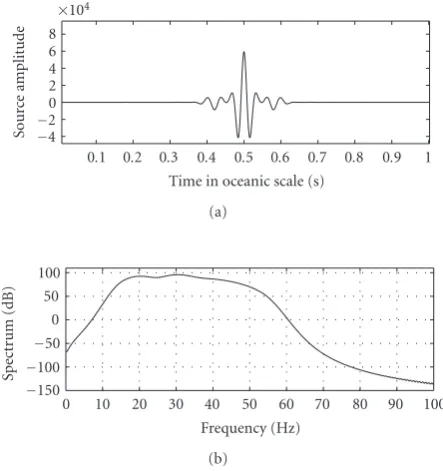
The source
A point-like ultrasonic source is located on one side of the waveguide, in the water layer. We want to emit a white sig-nal in the band 100–500 kHz in reduced scale (10–50 Hz in oceanic scale). Considering the band of the transducer, it is
×104
8 6 4 2 0 −2 −4
Sour
ce
amplitude
0.1 0.2 0.3 0.4 0.5 0.6 0.7 0.8 0.9 1 Time in oceanic scale (s)
(a)
100 50 0 −50 −100 −150
Spect
rum
(dB)
0 10 20 30 40 50 60 70 80 90 100 Frequency (Hz)
(b)
Figure24: Ultrasonic experiments: equivalent source signal (a) and energy spectrum (b).
Table4: Ultrasonic experiments: source-array geometry.
In reduced scale In oceanic scale
Spacing between receivers 1 mm 10 m
Distance source first receiver 400 mm 4 km
Distance source last receiver 913 mm 9, 13 km
necessary to use three different source signals. Each signal is a chirp, as it permits to emit a powerful signal, in the band:
(i) band 1: 100–300 kHz, (ii) band 2: 250–350 kHz, (iii) band 3: 300–500 kHz.
The drawback of using a chirp is its duration. To solve this problem, we realize the cross-correlation between each recorded signal and the source signal. Indeed, this is equiva-lent to have emitted the auto-correlation of the source signal, which is shorter in time. Besides, as the guide is time in-variant, the emission of the three signals is equivalent to the emission of their sum. As a result, the equivalent emit-ted signal is the sum of the three chirp auto-correlations (Figure 24), which is white in the band 100–500 kHz in re-duced scale (10–50 Hz in oceanic scale).
The source is mobile along the depth axiszand several recordings are made for different source depths.
The receiver
×102
40 45 50 55 60 65 70 75 80 85 90
Distanc
e
(m)
2.5 3 3.5 4 4.5 5 5.5 6 6.5 Time (s)
Figure25: Ultrasonic experiments: recorded section afterV1
veloc-ity correction for a source located atzs=70 m.
60 50 40 30 20 10 0
Fre
q
u
en
cy
(H
z)
−0.12 −0.1 −0.08 −0.06 −0.04 −0.02 0 Wavenumber (1/m)
1 0.9 0.8 0.7 0.6 0.5 0.4 0.3 0.2 0.1 0
Figure26: Ultrasonic experiments: binary masks of the modes in
thef−kplane.
400 mm in reduced scale (4 km in oceanic scale) from the source. Spacing between two elements of the HLA is 1 mm in reduced scale (10 m in oceanic scale).Table 4summarizes the source-array geometry in reduced and oceanic scales.
For the sake of simplicity, quantities will be given in oceanic scale in the following. As the source is moving, it is possible to record several sets of data. 22 experiments are made for different source depthszs: from 30 m to 240 m. We
first present the example of a source located atzs=70 m and
then study results obtained for other source depths.
5.2.2. Example: source located atzs=70m
(a) The first step consists in applying aV1velocity correction
to the recorded data. The water layer velocity is knownV1=
1487 m/s, and the recorded section, after velocity correction, is shown inFigure 25.
60 50 40 30 20 10 0
Fre
q
u
en
cy
(H
z)
−80 −60 −40 −20 0 20 40 60 80 Angle (degrees)
1 0.9 0.8 0.7 0.6 0.5 0.4 0.3 0.2 0.1
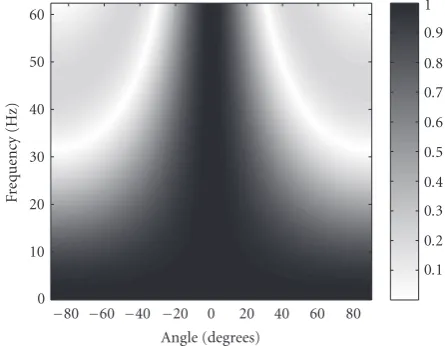
Figure27: Ultrasonic experiments: source directivity as a function of incident angle and frequency.
(b) Then, binary masks are built in the f −kplane. As mentioned above, the ultrasonic waveguide, made of water and steel, is close to a Pekeris waveguide with steel shear-wave velocity (which is 2780 m/s) for bottom layer velocity. Thus, it is still possible to build masks in the f −k plane using
V1=1487 m/s,V2=2780 m/s, andD=266 m (Figure 26).
(c) Binary masks are used to extract mode amplitudes on real data. As the previous study was made for an omnidirec-tional source, which is not the case here, it is necessary to correct source directivity effect before mask filtering.
The source can be considered as an infinite line in the perpendicular direction to the plane of propagation and has a size a = 15 m in the direction z. Its directivity function
F(θ,f), plotted inFigure 27, can be expressed as a function of incident angleθand frequencyf by
F(θ,f)=sinc
πa f V1
sinθ. (10)
Thus, applying the function 1/F(θ,f), we compensate source directivity. This function is computed only for points where modes exist, that is, on masks in the f −kplane. On these regions the directivity functionF(θ,f) is never equal to zero.
f −ktransform of the recorded data after source directivity correction is shown inFigure 28. On this representation, we extract mode amplitudes by mask filtering.
(d) Then, simulations are made in an environment close to the real environment. Geoacoustic parameters are esti-mated using [15,24]. As the source height is 15 m, we com-pute simulations for sources between 10 and 240 m every 10 m, and on each simulation, mode excitation factors are extracted by mask filtering.
(e) Finally, the contrast functionGis computed (Figure 29) and source depth is estimated:
60 50 40 30 20 10 0
Fre
q
u
en
cy
(H
z)
−12 −10 −8 −6 −4 −2 0 ×10−3
Wavenumber (1/m )
×105
4 3.5 3 2.5 2 1.5 1 0.5 0
Figure28: Ultrasonic experiments: f −ktransform after source directivity correction.
36 34 32 30 28 26 24 22 20 18
C
o
nt
ra
st
function
G
(dB)
0 50 100 150 200 250
Depth (m) 70 m
Figure29: Ultrasonic experiments: contrast functionGfor a source
located atzs=70 m.
5.2.3. Results analysis
As environment and source location were perfectly known, it is possible to study error on source depth estimation on the different experiments. Considering source height, source depth estimation is correct if estimation error is less than or equal to 10 m.Table 5 shows results obtained for diff er-ent source depths: the method gives satisfactory results for 15 source depths on 22. These results have been studied in detail in [23] to explain estimation errors.
To improve source depth estimation, we propose to use mode excitation factors with their sign (instead of mode ex-citation factors modulus). Indeed, some source depths can be “close” in term of mode amplitudes modulus and using the sign of these coefficients will permit to separate these source depths.
Table5: Ultrasonic experiments: error on source depth estimation for the 22 experiments without using sign of mode amplitudes.
Estimation error Source depth
Inferior to 10 m 40, 70, 80, 90, 100, 110, 140, 210, and 240 m
Equal to 10 m 30, 50, 60, 120, 200, and 220 m
Superior to 10 m 130, 150, 160, 170, 180, 190, and 230 m
0
50
100
150
200
250
Depth
(m)
−0.6 −0.4 −0.2 0 0.2 0.4 0.6 Mode excitation factor
Real data Simulated data
Figure30: Ultrasonic experiments: mode 6 amplitude modulus for real and simulated data.
5.2.4. Sign of mode excitation factors
Mode amplitudes with their signs carry more information than their modulus, but sign of these coefficients cannot be easily extracted from f −krepresentation. In our case, it is possible to extract sign of mode amplitudes as we recorded signals for many source depths in the guide. This extraction is made [23], and we study the influence of this sign of source depth estimation. Figures30and31show, respectively, mode 6 amplitude modulus and mode 6 amplitude with sign, for real and simulated data and for all source depths.
Using the sign of mode amplitudes is useful as they are si-nusoidal functions: as a result, the “frequency” of these func-tions are divided by two when the sign is known and there are fewer depths that are “close” to each other. The conse-quence on contrast function is that the maximum is further from other local maxima:Figure 32shows contrast functions obtained for a source located atzs =70 m using mode
am-plitudes modulus and mode amam-plitudes with their signs. As a result, source depth estimation is improved using the sign of mode amplitudes.
Results obtained using mode amplitudes with their signs are shown inTable 6for all the sets of data. In this case, 21 source depth estimations on 22 are correct, which constitutes a great improvement of the method.
0
50
100
150
200
250
Depth
(m)
−0.6 −0.4 −0.2 0 0.2 0.4 0.6 Mode excitation factor
Real data Simulated data
Figure31: Ultrasonic experiments: mode 6 amplitude for real and simulated data.
35
30
25
20
15
10
C
o
nt
ra
st
function
(dB)
0 50 100 150 200 250
Depth (m) 70 m
Mode amplitudes Mode amplitudes modulus
Figure32: Ultrasonic experiments: contrast functionGfor a source
located atzs=70 m using sign of mode amplitudes and using mode
amplitudes modulus.
must be developed. In this case, localization by MMP using an HLA is drastically improved and gives satisfactory results.
CONCLUSION
Matched-mode processing methods are widely used to local-ize underwater sources. These methods, developed for un-derwater sources in shallow water environments, typically used a vertical line array of sensors to achieve mode ampli-tudes extraction and source localization. In the case of a hori-zontal line array, which can be more appropriate for practical applications, these methods cannot be applied.
Table6: Ultrasonic experiments: error on source depth estimation for the 22 experiments using sign of mode amplitudes.
Estimation error Source depth
Inferior to 10 m 30, 60, 70, 80, 90, 100, 110, 120, 130, 140
150, 160, 170, 200, 210, and 240 m
Equal to 10 m 40, 50, 180, 190, and 220 m
Superior to 10 m 230 m
In this paper, we propose an original and simple method, based on the frequency-wavenumber transform to extract mode amplitudes and achieve matched-mode processing to estimate source depth. This method has been described and its robustness against noise and some environmental mis-matches (error on water depth, water layer velocity, bottom velocity) has been studied. Then, we validated it on several real data. The first set of data, recorded in the North Sea, allows us to show that MMP in the frequency-wavenumber plane gives satisfactory results in a real environment close to a Pekeris waveguide. The second set of data are ultrasonic data, recorded in a tank. For this one, we estimate error on source depth estimation as the environment was perfectly known. Moreover, we show on these data that the use of mode ampli-tudes sign can improve source depth estimation. A method to extract this sign on at sea data (for which we do not possess sources at many different depths) should be developed in the future to improve source depth estimation.
APPENDIX
A. FREQUENCY-WAVENUMBER TRANSFORM
IN A PERFECT WAVEGUIDE
Let us consider a monochromatic source (with angular fre-quencyω=2π f) at depthzsin a perfect waveguide. Pressure
recorded atM(r,z) can be expressed, at long range, by
P(r,z,t)=A
+∞
m=1
ψm
zs
ψm(z)
exp−2iπkrmr
krmr
exp(2iπ f t), (A.1)
whereAis a constant. For a broadband source (with spec-trumS(f)), this expression becomes
P(r,z,t)=A
+∞
m=1
ψm
zs
ψm(z)
×
ν
exp−2iπkrmr
krmr S
(ν) exp(2iπνt)dν, (A.2)
wherekrm=krm(ν). Then, frequency-wavenumber transform
(at depthzD) can be expressed by
Pf k
kr,zD,f
= r tP r,zD,t
exp−2πif t−krr
dt dr
=A
+∞
m=1
ψm zs ψm zD × r ν t
exp−2iπkrmr
krmr S
(ν) exp(2iπνt)
∗exp(−2iπ f t) exp2iπkrr
dt dνdr.
(A.3)
Then, taking into account normalization performed on the data along the distancer, we obtain
Pf k
kr,zD,f
=A
+∞
m=1
ψm zs ψm zD × r ν
texp(2iπνt) exp(−2iπ f t)
∗S(ν) exp−2iπkrm−kr
rdt dνdr.
(A.4)
Integration over t and r, using the definition of the delta function yields
Pf k
kr,zD,f
=A
+∞
m=1
ψm zs ψm zD S(f)
rexp
−2iπkrm−kr
rdr.
(A.5)
At this step, we have to study the antenna length. If we con-sider a finite HLA, then expression of the integral is a sinc function. In our case, and for the sake of simplicity, we con-sider an infinite antenna, and f −ktransform is
Pf k
kr,zD,f
=A
+∞
m=1
ψm zs ψm zD
S(f)δkrm−kr
. (A.6)
To conclude, if the source has a constant spectrumS, which is the case in our study, we obtain (4)
Pf k
kr,zD,f
=B
+∞
m=1
ψm zs ψm zD
δkr−krm
,
(A.7)
whereB=A∗Sis a constant.
ACKNOWLEDGMENTS
The authors thank Dr. P. Roux and Pr. W. A. Kuper-man at Marine Physical Laboratory (SCRIPPS Institution of Oceanography, San Diego) for the ultrasonic experiments
and Compagnie G´en´erale de G´eophysique for providing at sea data. Most of the computations presented in this paper were performed at the Service Commun de Calcul Intensif de l’Observatoire de Grenoble (SCCI) using the modeling soft-ware of J. Virieux and S. Operto (Laboratoire G´eosciences Azur, Nice). This work has been partially supported by the D´el´egation G´en´erale pour l’Armement (DGA) and followed by D. Fattaccioli.
REFERENCES
[1] H. P. Bucker, “Use of calculated sound fields and matched-field
detection to locate sound sources in shallow water,”The
Jour-nal of the Acoustical Society of America, vol. 59, no. 2, pp. 368– 373, 1976.
[2] D. F. Gingras, “Robust broadband matched-field processing:
performance in shallow water,”IEEE Journal of Oceanic
Engi-neering, vol. 18, no. 3, pp. 253–264, 1993.
[3] R. K. Brienzo and W. S. Hodgkiss, “Broadband matched-field
processing,”The Journal of the Acoustical Society of America,
vol. 94, no. 5, pp. 2821–2831, 1993.
[4] J. A. Fawcett, M. L. Yeremy, and N. R. Chapman, “Matched-field source localization in a range-dependent environment,”
The Journal of the Acoustical Society of America, vol. 99, no. 1, pp. 272–282, 1996.
[5] C. W. Bogart and T. C. Yang, “Source localization with
hor-izontal arrays in shallow water: spatial sampling and eff
ec-tive aperture,”The Journal of the Acoustical Society of America,
vol. 96, no. 3, pp. 1677–1686, 1994.
[6] A. B. Baggeroer, W. A. Kuperman, and P. N. Mikhalevsky, “An
overview of matched field methods in ocean acoustics,”IEEE
Journal of Oceanic Engineering, vol. 18, no. 4, pp. 401–424, 1993.
[7] E. C. Shang, “Source depth estimation in waveguides,”The
Journal of the Acoustical Society of America, vol. 77, no. 4, pp. 1413–1418, 1985.
[8] T. C. Yang, “A method of range and depth estimation by modal
decomposition,”The Journal of the Acoustical Society of
Amer-ica, vol. 82, no. 5, pp. 1736–1745, 1987.
[9] C. W. Bogart and T. C. Yang, “Comparative performance of matched-mode and matched-field localization in a
range-dependent environment,”The Journal of the Acoustical Society
of America, vol. 92, no. 4, part 1, pp. 2051–2068, 1992. [10] J. F. Lynch, S. D. Rajan, and G. V. Frisk, “A comparison of
broadband and narrow-band modal inversions for bottom geoacoustic properties at a site near Corpus Christi, Texas,”
The Journal of the Acoustical Society of America, vol. 89, no. 2, pp. 648–665, 1991.
[11] G. R. Potty, J. H. Miller, J. F. Lynch, and K. B. Smith, “Tomo-graphic inversion for sediment parameters in shallow water,”
The Journal of the Acoustical Society of America, vol. 108, no. 3, pp. 973–986, 2000.
[12] G. V. Frisk and J. F. Lynch, “Shallow water waveguide
char-acterization using the Hankel transform,”The Journal of the
Acoustical Society of America, vol. 76, no. 1, pp. 205–216, 1984. [13] S. D. Rajan, J. F. Lynch, and G. V. Frisk, “Perturbative inver-sion methods for obtaining bottom geoacoustic parameters in
shallow water,”The Journal of the Acoustical Society of America,
vol. 82, no. 3, pp. 998–1017, 1987.
[14] I. Tolstoy and C. S. Clay,Ocean Acoustics, AIP Press, New York,
NY, USA, 1987.
IEEE Journal of Oceanic Engineering, vol. 28, no. 3, pp. 494– 501, 2003.
[16] E. C. Shang, C. S. Clay, and Y. Y. Wang, “Passive harmonic
source ranging in waveguides by using mode filter,”The
Jour-nal of the Acoustical Society of America, vol. 78, no. 1, pp. 172– 175, 1985.
[17] G. R. Wilson, R. A. Koch, and P. J. Vidmar, “Matched mode
localization,”The Journal of the Acoustical Society of America,
vol. 84, no. 1, pp. 310–320, 1988.
[18] R. T. Kessel, “Extracting modal wave numbers from data
col-lected in range-dependent environments,”The Journal of the
Acoustical Society of America, vol. 104, no. 1, pp. 156–162, 1998.
[19] J. Virieux, “P-SV wave propagation in heterogeneous media:
velocity-stress finite-difference method,”Geophysics, vol. 51,
no. 4, pp. 889–901, 1986.
[20] J.-L. Mari, G. Arens, D. Chapellier, and P. Gaudiani,
Geo-physics of Reservoir and Civil Engineering, Editions Technip, Paris, France, 1999.
[21] S. M. Jesus, “Normal-mode matching localization in shallow
water: environmental and system effects,”The Journal of the
Acoustical Society of America, vol. 90, no. 4, pp. 2034–2041, 1991.
[22] N. E. Collison and S. E. Dosso, “Regularized matched-mode
processing for source localization,”The Journal of the
Acousti-cal Society of America, vol. 107, no. 6, pp. 3089–3100, 2000. [23] B. Nicolas, “Identification du milieu oc´eanique et localisation
de source en ultra basse fr´equence (1-100 Hz),” Ph.D. disser-tation, INPG, Grenoble, France, 2004.
[24] R. C. Weast,Handbook of Chemistry and Physics, CRC Press,
Boca Raton, Fla, USA, 1984.
Barbara Nicolasgraduated from the Ecole Nationale Sup´erieure des Ing´enieurs Elec-triciens de Grenoble, France, and received the M.S. and Ph.D. degrees in signal pro-cessing from the National Polytechnic In-stitute of Grenoble (INPG), France, respec-tively, in 2001 and 2004. In 2005, she began a postdoctoral appointment at the French Atomic Energy Commission (C.E.A.) in medical imaging. Her research interests
in-clude geoacoustic inversion and localization in underwater acous-tics and medical imaging.
J´erˆome I. Mars received the M.S. degree in 1986 in goephysics from the Joseph Fourier University, Grenoble, France, and the Ph.D. in signal processing in 1988 from the National Polytechnic Institute of Greno-ble, France. From 1989 to 1992, he was a postdoctoral researcher at the Centre des Ph´enom´enes Al´eatoires et G´eophysiques, Grenoble, France. From 1992 to 1995, he was a Visiting Lecturer and Scientist in the
Materials Sciences and Mineral Engineering Department, Univer-sity of California, Berkeley. He is currently a Professor in signal pro-cessing at the National Polytechnic Institute of Grenoble (INPG) and he works for the Laboratoire des Images et des Signaux. His research interests include seismic and acoustic signal processing, wavefield separation methods, time-frequency time-scale charac-terization, and applied geophysics.
Jean-Louis Lacoume graduated from the Ecole Normale Sup´erieure, Paris, France, as a certified teacher in 1964 and as a Doc-teur d’´etat in 1969. He was a Lecturer in physics at Orsay University, Orsay, France, from 1964 to 1967 and in geophysics at Paris VI University from 1969 to1972. He has been a Professor at the National Polytech-nic Institute of Grenoble (INPG), France, since 1972 where he studied waves physics