An Efficient SF-ISF Approach for the Slepian-Wolf
Source Coding Problem
Zhenyu Tu
Department of Electrical and Computer Engineering, Lehigh University, Bethlehem, PA 18105, USA Email:[email protected]
Jing Li (Tiffany)
Department of Electrical and Computer Engineering, Lehigh University, Bethlehem, PA 18105, USA Email:[email protected]
Rick S. Blum
Department of Electrical and Computer Engineering, Lehigh University, Bethlehem, PA 18105, USA Email:[email protected]
Received 1 October 2003; Revised 15 October 2004
A simple but powerful scheme exploiting the binning concept for asymmetric lossless distributed source coding is proposed. The novelty in the proposed scheme is the introduction of asyndrome former(SF) in the source encoder and aninverse syndrome former (ISF) in the source decoder to efficiently exploit an existing linear channel code without the need to modify the code structure or the decoding strategy. For most channel codes, the construction of SF-ISF pairs is a light task. For parallelly and serially concate-nated codes and particularly parallel and serial turbo codes where this appears less obvious, an efficient way for constructing linear complexity SF-ISF pairs is demonstrated. It is shown that the proposed SF-ISF approach is simple, provenly optimal, and generally applicable to any linear channel code. Simulation using conventional and asymmetric turbo codes demonstrates a compression rate that is only 0.06 bit/symbol from the theoretical limit, which is among the best results reported so far.
Keywords and phrases:distributed source coding, compression with side information at the decoder, Slepian-Wolf coding, code binning, serially concatenated convolutional codes, parallelly concatenated convolutional codes.
1. INTRODUCTION
The challenging nature of multiuser communication prob-lems [1] has been recognized for decades and many of these problems still remain unsolved. Among them is the distributed source coding (DSC) problem, also known as distributed compression or Slepian-Wolf source cod-ing, where two or more statistically correlated information sources are separately encoded/compressed and jointly de-coded/decompressed. Having its root in network informa-tion theory, distributed source coding is tightly related to a wealth of information and communication problems and applications including, for example, the dirty paper coding, watermarking and data mining, multielement broadcasting problem and multiple description coding. The recent heat in sensor networks has further aroused a renewed interest in DSC, since it allows the intersensor correlation to be ex-ploited in compression without expensive intersensor com-munication.
including coset codes [6], lattice codes [7,8], low density parity check (LDPC) codes (e.g., [9,10,11,12,13,14]) and (convolutional) turbo codes (e.g., [15,16,17,18,19,20]). Most of these formulations are rooted back to the binning idea, except for turbo codes where code binning has not been explicitly exploited.
While LDPC codes are also capacity-approaching chan-nel codes, turbo codes have certain advantages. First, a turbo encoder is cheap to implement, thus appealing to applica-tions like sensor networks where the computation on the transmitter side (i.e., sensor nodes) needs to be minimized. Second, turbo codes perform remarkably on a variety of channel models. Since the key to efficient DSC is to find a powerful channel code for the virtual transmission channel, where the virtual channel is specified by the source corre-lation (will be discussed in more detail inSection 2), turbo codes are therefore a good choice for a number of sources with different source correlations. An LDPC code, on the other side, would require specific design or optimization of the degree profile in order for it to match to the channel. Third, the code rate and length of a turbo code can be easily changed (e.g., through puncturing), making it possible for adaptiveDSC using rate compatible turbo codes. Such flex-ibility is not readily available with random LDPC codes or other linear block codes.
Among the existing turbo DSC formulations, Garcia-Frias and Zhao were the first to propose an interesting turbo scheme where two sources were separately encoded and jointly decoded in an interwoven way akin to a four-branch turbo code [15]. A similar scheme that works for asymmet-ric compression was independently devised by Aaron and Girod [16]. In [17], Bajcsy and Mitran proposed yet another parallel turbo structure based on finite-state machine codes. The scheme was later extended to a serial turbo structure in [19]. Perhaps the only scheme that has implicitly explored the binning concept is that proposed by Liveris, Xiong, and Georghiades [18]. This also appears to be the only provenly optimal DSC scheme based on turbo codes.
One major reason why the binning approach has not been popular with turbo codes lies in the difficulty of con-structing bins for turbo codes. While codewords are easily “binned” for coset codes and block codes (e.g., via the par-ity check matrix), the random interleaver in the turbo code makes the code space intractable, precluding the possibility to spell out its parity check matrix. Another reason that has possibly prevented the full exploitation of the binning idea is the lack of a general source decoding approach. In theory, only a codebook that specifies the mapping (e.g., the bins) is needed; in practice, a practically implementable source en-coder and particularly a practically implementable source de-coder are also needed. The latter, however, has not been well studied except for LDPC codes. We note that for LDPC codes, due to the unique characteristics in the code structure and the decoding algorithm, a syndrome sequence (i.e., the com-pressed sequence, seeSection 2) can be easily incorporated in the message-passing decoding, making source decoding a natural extension of channel decoding [9,10,11,12,13]. However, for many other codes including turbo codes, it has
not been entirely clear how to optimally exploit a syndrome sequence in the decoding approach.
The purpose of this paper is to investigate asymmetric DSC using the binning idea for binary linear channel codes in general, and parallel and serial turbo codes in particular. The focus is on the code design for practical DSC solutions that are efficient, optimal, and general. Our contributions are summarized as follows.
(1) We present the structure of a pair of universal source encoder and source decoder that are generally applicable to any linear channel code. While the idea is implicit in the bin-ning concept [2,8], we give an explicit presentation with a rigorous proof of its validity for binary memoryless sources. As will be discussed in Section 3, the proposed source en-coder and source deen-coder explore the concept of syndrome former (SF) andinverse syndrome former(ISF), and are ef-ficient as well as provenly optimal for binary memoryless sources. This thus represents a simple and universal frame-work that allows an existing powerful linear channel code to be readily exploited in DSC without the burden of re-designing the code or finding a matching encoding/decoding strategy. With this framework, the only task that is left to implement the DSC solution is to construct a valid SF-ISF pair, which, for many channel codes, are a pretty light and straightforward task.
(2) For parallelly and serially concatenated codes (PCC/SCC) where the SF-ISF construction appears tricky due to the random interleaver, we demonstrate an efficient and systematic way to handle it. Instead of deriving the SF-ISF pair in an overall closed form (which seems to pose un-solvable complexity problems), the proposed construction cleverly exploits the sub-SFs and sub-ISFs of the compo-nent codes in a way similar to the way concatenated code is built from its component codes [20]. The SF-ISF pairs for both parallelly and serially concatenated codes have a com-plexity of the order of that of the component codes, and can be conveniently implemented using linear sequential cir-cuits. For illustrative purpose, the discussion will proceed with parallelly and serially concatenated convolutional codes (PCCC/SCCC), or parallel and serial turbo codes, as the il-lustrating example. However, the applicability of the pro-posed method goes beyond the context of concatenated con-volutional codes. As addressed inSection 5, other concate-nated structures, including block turbo codes (BTC) [21], can readily adopt the same SF-ISF formulation.
(3) Through the proposition of the SF-ISF formulation and the general source encoder/decoder structure, we have demonstrated the first provenly optimal turbo-DSC formu-lation thatexplicitlyexploits the binning scheme. Compared to the approach in [22], which is also provenly optimal but which requires constructing a source encoding trellis with parallel branches, a source decoding trellis with time-varying stages, and a matching (time-varying) decoding algorithm, the proposed one is simpler and more general.
R2
H(Y)
H(Y|X)
H(X|Y) H(X) R1
A
B
Achievable rate region
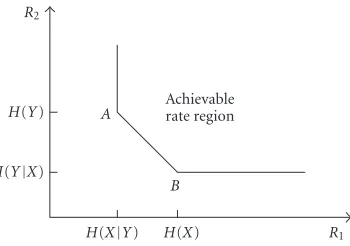
Figure1: Rate region for noiseless DSC.
as 0.06 bit/symbol from the theoretical limit for binary sym-metric sources (BSS), which is among the best results re-ported so far.
The remainder of the paper is organized as follows.
Section 2 formulates the DSC problem and introduces the binning concept. Section 3presents the structure of a uni-versal source encoder and a source decoder with a rigorous proof of its validity.Section 4discusses in detail the construc-tion for SF-ISF pairs for parallelly and serially concatenated codes and in particular parallel and serial turbo codes. Sec-tion5and6discuss the optimality and performance of the proposed SF-ISF approach for binary symmetric sources. Fi-nally,Section 7provides the concluding remarks.
2. BACKGROUND
2.1. Achievable rate region for DSC
We first formulate the setting for discussion. Consider two correlated binary memoryless sources X and Y encoded by separate encoders and decoded by a joint decoder. The achievable rate region is given by the Slepian-Wolf bound-ary [2]:
R1≥H
X|Y, R2≥H
Y|X, R1+R2≥H
X,Y,
(1)
whereR1andR2are the compression rates for sourcesXand
Y, respectively. A typical illustration is given inFigure 1. For most cases of practical interest, zero-error DSC is possible only asymptotically [24]. For discrete memory-less sources of uniform distribution, corner points on the Slepian-Wolf boundary can be achieved by considering one source (e.g.,Y) as the side information (SI) to the decoder (e.g., available to the decoder via a conventional entropy compression method) and compressing the other (i.e.,X) to its conditional entropy (H(X|Y)). This is known as asym-metric compression (seeFigure 2). The line connecting the corner points can be achieved through time sharing or code partitioning [12,13]. (Unless otherwise stated, the discussion in the sequel focuses on binary sources and all the arithmetics are taken inGF(2).)
y z
x Source
encoder decoderSource ˆ
x
Figure2: Asymmetric DSC can be equivalently viewed as a channel coding problem with side information at decoder.
2.2. The binning concept
First introduced in [2], code binning is one of the most im-portant ideas in distributed source coding. A thorough dis-cussion on the binning concept and related issues can be found in [8]. Below, we provide a concise summary of this useful concept.
As the name suggests, the fundamental idea about code binning is to group sequences into bins subject to certain re-quirements or constraints. The information-theoretical jus-tification for the idea is to use 2nH(X,Y) jointly typical
se-quences to describe sources (Xn,Yn), where the sequences are placed in 2nH(X|Y) disjoint bins each containing 2nH(Y)
sequences. Clearly, nH(X|Y) bits are needed to specify a bin and nH(Y) bits to specify a particular sequence in the bin. From the practical point of view regarding algorith-mic design, code binning consists essentially of dividing the entire codeword space of a linear channel code into disjoint subspaces (i.e., bins) such that the same distance property is preserved in each bin. For an (n,k) binary lin-ear channel code, source sequences of lengthn are viewed as the virtual codewords (not necessarily the valid code-words of the channel code). The entire codeword space, Xn = {0, 1}n, can be evenly divided into 2n−k bins/cosets with codewords having the same syndrome grouped in the same bin. It can be easily verified that the distance require-ment is satisfied due to the geometric uniformity of a lin-ear channel code. Naturally, the 2n−k syndrome sequences can be used to index the bins. Hence, by transmitting the lengthn−ksyndrome sequence Sn−kinstead of the length nsource sequenceXn, a compression rate ofn : (n−k) is achieved. At the decoder, the syndrome sequence Sn−k and the decoder side informationYn (i.e., the other sourceYn which is viewed as a noisy version ofXndue to its correla-tion withXn) will be used to identify the original data se-quence. The binning concept as well as the practical bin-ning approach using linear channel codes are illustrated in
Figure 3.
nH(Y) bits
nH(X|Y) bits
2nH(Y) Codewords/bin
2
nH
(
X
|
Y
)bins
. . .
· · ·
(a) Side informationY
Sy
ndr
ome
2kcodewords/bin
2
n
−
kbins .
. .
· · ·
(b)
Figure3: (a) Illustration of the binning concept. (b) Illustration of the algebraic binning approach using linear channel codes.
3. A UNIVERSAL SOURCE ENCODER
AND SOURCE DECODER
The above binning concept has specified the codebook, that is, the mapping between the source sequences to the com-pressed sequences, but sheds little insight on the implemen-tation of a source encoder and particularly a source decoder. Below, we present the structure of a universal source en-coder and source deen-coder that practically and optimally im-plements the binning concept for memoryless binary sym-metric sources [25].
Before we proceed, we first introduce the concept of syn-drome former and inverse synsyn-drome former, which are es-sentially functions that map the codeword space {Xn} to the syndrome space {Sn−k}and vice versa. Specifically, the role of the syndrome former is, for a given source sequence or a codeword in a bin, to find its associated syndrome se-quence or bin index, and the role of the inverse syndrome former is, for a given syndrome sequence or a bin index, to find anarbitrary source sequence that belongs to that par-ticular coset or bin (we term the output of the ISF as the “auxiliary sequence”). It should be noted that the SF-ISF pair is not unique for a given (n,k) linear channel code. For a valid SF, that is, valid bin-index assignment, as long as the all-zero syndrome sequence is assigned to the bin that con-tains all the valid codewords, the rest of the assignment can be arbitrary. Hence, there can be as many as (2n−k −1)! valid syndrome formers. For each syndrome former, there can be up to 2k matching inverse syndrome formers, each producing a different set of auxiliary sequences. We note that any valid pair of SF and ISF can be used in the source
en-coder and the source deen-coder that we present below, but the complexity for constructing different SF-ISF pairs may vary.
(i) Source encoder: as illustrated inFigure 4, the source encoder is simply a syndrome former that maps a source sequenceXnto a syndrome sequenceSn−k. (ii) Source decoder: the source decoder inFigure 4
con-sists of a matching inverse syndrome former and the original channel decoder. The auxiliary sequence at the output of the ISF is first subtracted from the side infor-mationYn, whose result is then fed into the channel decoder to perform the conventional channel decod-ing. If the channel code is sufficiently powerful, then the output of the channel decoder, when added back to the auxiliary sequence, will almost surely recover the original source sequenceXn.
Proof of the validity. The validity of the above source encoder follows directly from the definition of the syndrome former. The validity of the above source decoder is warranted by the fact that the same distance property is preserved in all bins. LetXnandYndenote two binary, memoryless sources with correlation P(Yn|Xn) = (P(Y|X))n. The virtual transmis-sion channel as specified byP(Yn|Xn) can be viewed as a dis-crete memoryless channel:Y=X⊕Z, whereZis the additive binary memoryless noiseP(Z)=P(Y|X).
Letc(s) denote a codewordcwith syndrome sequences. Assume that x = c1(s1) is the source sequence to be
com-pressed. The encoder will finds1and sends it to the decoder.
The decoder has side informationy, wherey = x⊕z. Upon receiving s1, the ISF will find an arbitrary sequence,
sayc2(s1) from the coset ofs1. Notice that the subtraction of
the auxiliary sequencec2 from the side informationy, that
is,y⊕c2, forms a noisy codeword (with respect to the virtual
transmission channel), since
y⊕c2(s1)=x⊕z⊕c2(s1) = c1(s1)⊕c2(s1)
some valid codewordc3(0)
⊕z. (2)
Hence, if the channel code is sufficiently powerful, that is, capacity-approaching on the virtual channel, it can re-cover the valid codewordc3(0) with a vanishing error
prob-ability . Since c3(0) = y⊕c2(s1)⊕z = x+c2, adding
back the auxiliary sequencec2yields the original sequencex.
Clearly, the probability that the data sequencexis not loss-lessly recovered is the probability that the channel decoder fails to correctly decodec3(0), which equals → 0. It then
follows that data sequences can be decoded with a vanish-ing distortion usvanish-ing the above source decoder (and source encoder).
4. CONSTRUCTION OF THE SYNDROME FORMER AND
THE INVERSE SYNDROME FORMER
x
SF s
Channel ISF c2(s)
Encoder y
Decoder Turbo decoder
ˆ x
Figure4: The structure of the universal source encoder and source decoder for asymmetric DSC.
process: (i) to choose a good channel code with the appropri-ate code rappropri-ate and sufficient error correction capability for the virtual channel, and (ii) to construct a pair of valid SF and ISF for this code. The former could certainly make use of the rich results and findings developed in the channel coding re-search. Here, we focus on the latter issue.
For linear block codes where the code structure is well defined by the parity check matrices, SF-ISF construction is a straightforward task. For example, the parity check matrix and its left inverse can be used as a valid pair of syndrome former and inverse syndrome former. For con-volutional codes, this is as convenient, although the pro-cess is less well known [26]. The real difficulty lies in the class of concatenated codes which are formed from compo-nent block/convolutional codes and random interleavers and which happen to include many powerful channel codes, such as convolutional turbo codes and block turbo codes. In the-ory, a concatenated code can still be treated, in a loose sense, as a linear block code and, hence, a closed-form parity check matrix still exists and can be used as a syndrome former. In practice, however, to derive such a parity check matrix is pro-hibitively complex, if not impossible.
In searching for practical SF-ISF solutions for concate-nated codes, we have found a clever way to get around the random interleaver problem. The key idea is to adopt the same/similar parallel or serial structure as a concatenated code built from its component codes, and to construct the SF-ISF pair from the sub-SF-ISF pairs accordingly. In addi-tion, we have found that by exploiting a specific type of sub-SF-ISF pair (with certain properties), the construction can be further simplified.
Below, we take (convolutional) turbo codes as an illus-trating example and discuss in detail the proposed construc-tion method. To start, we first introduce the SF-ISF con-struction for (component) convolutional codes, and then proceed to parallel turbo codes [20] and lastly serial turbo codes.
4.1. SF-ISF construction for convolutional codes In his 1992 paper on trellis shaping [26], Forney described a simple way to construct syndrome formers and inverse syn-drome formers for convolutional codes. For a ratek/nbinary linear convolutional code withk×ngenerator matrixG, it is shown that the SF can be implemented using ann/(n−k) linear sequential circuit specified by ann×(n−k) transfer
matrixHT with rank (n−k) such that
GHT=0
k×(n−k), (3)
where0k×(n−k)is thek×(n−k) all-zero matrix. Clearly, the
constraint in (3) makes sure that all valid codewords are as-sociated with the all-zero syndrome 0n−k and that length-n codewords/sequences have the same syndrome if and only if they belong to the same coset. (It should be noted that the generator matrix of a binary convolutional code considered here is formed of generator polynomials in the D domain and, hence, is different from the{0, 1}generator matrix of a linear block code.)
Similar to the case of linear block codes, the inverse syn-drome former, (H−1)T, can be obtained by taking the left
in-verse of the syndrome former, that is,
(H−1)THT =In−k, (4)
whereIn−kis an identity matrix with rankn−k.
As mentioned before, the SF-ISF pair is not unique for a given code. In fact, any linear sequential circuit having the required number of inputs and outputs and meeting the con-straints of (3) and (4) represents a valid construction for SF and ISF, but the complexity varies.
As an example, consider a rate 1/2 recursive systematic convolutional (RSC) code with generator matrixG=[1, (1 + D2)/(1 +D+D2)]. A simple SF-ISF construction can take the
form of
SF :HT=
1 +D2
1 +D+D2
,
ISF :H−1T =[1 +D,D].
(5)
Another equally simple construction is given by
SF :HT=
1 +D2
1 +D+D2
1
, (6)
ISF :H−1T=[0, 1]. (7)
u
D D
x1
x2
(a)
x1
x2
D D
s
(b) 0
s
x1
x2
(c)
Figure5: A rate 1/2 RSC code with generator matrixG=[1, (1 +
D2)/(1 +D+D2)] and its SF and ISF. (a) The encoder. (b) The linear
sequential circuit implementation of a valid syndrome formerHT=
[(1 +D2)/(1 +D+D2), 1]T. (c) The matching inverse syndrome
former (H−1)T =[0, 1].
4.2. SF-ISF construction for parallel turbo codes Consider a typical parallel turbo code formed from two com-ponent RSC codes connected by a random interleaver. Let R1 = k/n1,R2 = k/n2,G1 = [Ik,P1], and G2 = [Ik,P2]
denote the code rates and the generator matrices of the first and the second component RSC code, respectively, whereIk is thek×kidentity matrix for generatingksystematic bits, andP1andP2arek×(n1−k) andk×(n2−k) matrices for
generating (n1−k) and (n2−k) parity check bits of the first
branch and second branch. Since the systematic bits from the second branch are a scrambled version of those from the first branch, they are not transmitted. Hence, the overall code rate is given byR=k/(n1+n2−k)=R1R2/(R1+R2−R1R2).
Letxdenote a source sequence to be compressed. Since it is viewed as a virtual codeword of this parallel turbo code, it consists of three parts: the systematic bits from the first branch,xs, the parity bits from the first branch,x1, and the
parity bits from the second branch,x2. Clearly, these three
segments can form two virtual subcodewords, [xs,x1] for the
first component code and [π(xs),x2] for the second
compo-nent code, whereπ(·) denotes the interleaving operation. On the other hand, the length (n1+n2−2k) syndrome sequence
of the turbo code can also be decomposed into two subsyn-drome sequences:s1(of length (n1−k)) for the first
compo-nent code, ands2(of length (n2−k)) for the second
com-ponent code. This observation leads to the natural idea of constructing the SF and the ISF of the turbo code by con-catenating those of the component codes.
Following the discussion in the previous subsection, it is easy to obtain a valid pair of SF and ISF for each of the component RSC codes. Specifically, we limit the choice to the
x1
xs H1T s1
π
x2 H2T s2
s=[s1,s2]
(a) s1
s2
(H1−1)T (H2−1)T
0 x1 x2
0
[0,x1,x2]
(b)
Figure6: (a) The proposed SF for a general parallel turbo code. (b) The matching ISF. Note that both of the sub-ISFs, (H1−1)Tand
(H2−1)T, need to be zero forcing, and the interleaver between the two
sub-SFs is the same interleaver that is used in the turbo code.
zero-forcing SF-ISF pair for both component codes:
SF 1 :H1T =
P1
I
n1×(n1−k) ,
ISF 1 :H−1 1
T
=[0,I](n1−k)×n1,
SF 2 :H2T =
P2
I
n2×(n2−k) ,
ISF 2 :H−1 2
T
=[0,I](n2−k)×n2.
(8)
These sub-SFs and ISFs are then used to form the overall SF and ISF for the parallel turbo code, whose structures is shown inFigure 6.
It is easy to show that this construction is both valid and efficient. For the syndrome former, with every (n1+n2−k)
data bits (a virtual turbo codeword) at the input,H1T pro-duces (n1−k) subsyndrome bits andH2Tproduces (n2−k)
subsyndrome bits, which combined form a length (n1+n2−
2k) syndrome sequence at the output. Further, codewords in the same coset are mapped to the same syndrome sequence and a valid turbo codeword is always mapped to the all-zero syndrome sequence. Hence, this represents a valid SF formu-lation which can be efficiently implemented using linear se-quential circuits.
pair of sub-ISFs will beinterleaver dependent, one needs to find a general rule to guide a possible “match.” At first sight, these subtasks appear difficult to solve. However, a deeper in-vestigation reveals that the zero-forcing sub-ISFs can fulfill both requirements simultaneously. Since the all-zero system-atic bits are invariant regardless of what interleaver is used, zero-forcing sub-ISFs thus offer a simple solution to solve the potential “mismatching” problem for all interleavers!
4.3. SF-ISF construction for serial turbo codes
Serial turbo codes, as an extension to parallel turbo codes, have exhibited equally remarkable error correcting perfor-mance. Before proceeding to discuss their SF-ISF construc-tion, we note that a serial turbo code, or more generally a se-rially concatenated code, needs to have a recursive inner code in order to achieve interleaving gain1[27]. Here we focus on
serial turbo codes whose inner codes are both recursive and systematic. Again, the key is to exploit the sub-SF-ISF pairs of the component codes.
While the general idea is the same, the case of serial turbo codes is slightly more difficult, especially the construction of the inverse syndrome former. We consider a serial turbo code formed of an outer convolutional code (not necessar-ily recursive nor systematic) with rate Ro = k/noand gen-erator matrixGo, a random interleaver (denoted asπ), and an inner RSC code with rateRi =no/nand generator ma-trix Gi = [I,P], where I is an identity matrix. The over-all code rate is R = k/n = RoRi. For a block of k data bits, this serial turbo code produces a codeword of nbits. Hence, the corresponding syndrome sequence needs to con-tain n−k = (n−no) + (no−k) bits. This suggests that a syndrome sequence s may be formed from two disjoint parts: a subsyndrome sequence of length (n−no) from the in-ner code, denoted assi, and a complementary part of length (no−k) from the outer code, denoted asso.
Consider a source sequence x of length n to be com-pressed to its syndrome sequences=[so,si]. For the (n,no) inner recursive systematic convolutional code, the entire se-quencexcan be viewed as a codeword that is formed from a lengthno“systematic” part,xs, and a length (n−no) “parity” part,xp. According to what we have discussed about convo-lutional codes, the entire sequencexcan thus be fed into the sub-SF of the inner code to generatesi. For the outer code, note that only the systematic partxsis relevant, that is,xsis the codeword of the outer code. Hence,xs, after deinterleav-ing, can be fed into the sub-SF of the outer code to generate
so. The combination ofsiandsothus completes the entire syndrome sequence. The overall structure of the SF for the serial turbo code is illustrated inFigure 7a.
The construction of a matching ISF is less obvious. We first present the structure before explaining why it works. As illustrated inFigure 7b, a valid ISF that matches to the above
1To be precise, a serially concatenated code needs to have an inner code
which is recursive, an outer code (not necessarily recursive) which has a min-imum distance of at least three, and a random interleaver between them in order to achieve interleaving gain on codeword error rate [27].
SF consists of four parts: the sub-ISFs of the outer and the inner component code, (Ho−1)T and (Hi−1)T, the random interleaver,π, and the (sub-) encoder of the inner code,Gi. Similar to the case of parallel turbo codes, the interleaver is the same interleaver that is used in the serial turbo code, and the sub-ISF of the inner RSC code is a zero-forcing one: that is, (Hi−1)T=[0,J], whereJis a square matrix.
Below, we prove its validity by showing that the output of this ISF (i.e. the virtual codeword), when fed into the SF in
Figure 7a, will yield the original syndrome sequence. Math-ematically, this is to show that, for a given sequencexin the codeword space, wherex=[xs,xp]=ISF([so,si]), we have
SFxs,xp=⇒[sosi], (9)
where the notationSF(a)⇒bdenotes that the SF will pro-ducebat the output foraat the input. Similar notations will also be used forISF(·),Hi−1(·) and the like.
Notice that [xs,xp]=[xs,xp]⊕[xs,xp] (seeFigure 7b). By the linearity of the syndrome former, we have
SFxs,xp=SFxs,xp⊕SFxs,xp. (10)
Since [xsxp] is a valid codeword of the inner codeGi, the sub-syndrome former (Hi)Twill map it to the all-zero syndrome sequence, that is,
HT i
xs,xp=⇒0. (11)
SinceHiTand (Hi−1)T are a valid SF-ISF pair, we have
HT
i xs,xp=HiT
(H−1
i )T(si)
=⇒si. (12)
Gathering (10), (11) and (12), we have
HT
i xs,xp=⇒si. (13)
On the other side, sincexsis an all-zero vector,xsis iden-tical toxs. SinceGiis a systematic encoder, we can see from
Figure 7bthat
xs=xs=w =π(w)=πH−1
o Tso, (14)
that is,xsis precisely the interleaved version of the output from the sub-ISF (H−1
o )T for which the input isso. Hence, passingxsinto the deinterleaver and subsequently the sub-SF HT
o will reproduceso. This is exactly what the upper branch of the SF inFigure 7aperforms:
HT o
π−1x
s=HoT
π−1πH−1
o T
so=⇒so. (15)
Comparing (13) and (14) with the SF structure in
xs
xp
π−1 HT
o so
HT
i si
(a)
so (H−1
o )T w π w˜ Gi
ˆ
xs
ˆ
xp [xs,xp]
si (H−1
i )T
0 ¯
xp
(b)
Figure7: (a) The proposed SF for a general serial turbo code with an RSC inner code. (b) The matching ISF. Note that the inner sub-ISF, (Hi−1)T, needs to be zero forcing.
5. COMMENTS ON THE PROPOSED SF-ISF APPROACH
The proposed SF-ISF approach provides a method for the di-rect exploitation of the binning idea discussed inSection 2. For memoryless binary symmetric sources, the approach is clearly optimal, as is guaranteed by the intrinsic optimality of the binning concept [2]. It is worth noting that this op-timality holds for infinite block sizes as well as finite block sizes. (A constructive example demonstrating the optimality of the binning approach for finite block sizes can be found in [6].)
The construction of the syndrome former and the inverse syndrome former we demonstrated is simple and general. All operations involved are linear and reside in the binary do-main, thus allowing cheap and efficient implementation us-ing linear sequential circuits.
Besides simplicity and optimality, a particularly nice fea-ture about the proposed SF-ISF scheme is its direct use of an existing (powerful) channel code. This allows the rich results available in the literature on channel codes to serve immedi-ately and directly the DSC problem at hand. For example, a turbo code that is known to perform close to the capacity on BSC channels will also perform close to the theoretical limit for the DSC problem with binary “BSC-correlated” sources (i.e., P(X = Y) = p). Using a stronger component code (one that has a longer memory size and/or a better generator matrix) or simply increasing the codeword length (i.e., ex-ploiting the interleaving gain of the turbo code) will achieve a better compression rate. In addition to conventional binary turbo codes, asymmetric turbo codes (which employ a dif-ferent component code at each branch) (e.g., [23]) and non-binary turbo codes, which are shown to yield better perfor-mances, can also be exploited for capacity-approaching DSC. The last comment is on the generality of the proposed approach. Clearly, the proposed source encoder and source decoder are applicable to any binary linear channel code.
The proposed SF-ISF formulation has further paved the way for concatenated codes, breaking the tricky task of construct-ing the overall SF and ISF to a much simpler one of find-ing only the relevant sub-SFs and sub-ISFs of the compo-nent codes. This allows many powerful serially and parallelly concatenated codes to be readily exploited in DSC. In addi-tion to the aforediscussed case of parallel and serial turbo codes, block turbo codes, also known as turbo product codes or, simply, product codes, are another good example. Prod-uct codes are formed of arrays of codewords from linear block codes (i.e. component codes) in a multidimensional fashion [21]. Depending on whether there are “parity-on-parity” bits, a 2-dimensional product code can be equiva-lently viewed as a serial (i.e., with “parity-on-parity”) or a parallel (i.e., without “parity-on-parity”) concatenation of the row code and the column code. Since the component codes of a product code are typically (simple) systematic lin-ear block codes such as Reed-Solomon codes, BCH codes, Hamming codes, and single-parity check codes, sub-SFs and sub-ISFs are easy to construct. Further, since many product codes can be efficiently decoded on binary symmetric chan-nels (BSC), for example, using the majority logic algorithm or the binary bit-flipping algorithm, they can potentially find great application in distributed compression where sources are binary and BSC correlated. To the best of the authors’ knowledge, this is the only work thus far that has provided a DSC formulation for product codes.
6. SIMULATIONS
Despite the theoretical optimality of the proposed SF-ISF ap-proach, computer simulations are needed to provide a true evaluation of its performance. In this section, we present the results of the proposed approach using rate-1/3 paral-lel turbo codes and rate-1/4 serial turbo codes. Appropriate clip-values are also used in the simulation to avoid numerical overflows and/or downflows in decoding.
The 8-state parallel turbo code considered has the same component codes as those in [15,18]:G1=G2=[1, (1 +D+
D2+D3)/(1 +D2+D3)]. A length 104S-random interleaver
with a spreading factor 17 and a length 103S-random
inter-leaver with a spreading factor 11 are used in the code, and 10 decoding iterations are performed before the turbo decoder outputs its estimates.
Table 1lists the simulation results wherenπdenotes the interleaver length. The interleaving gain can be easily seen from the table. If a normalized distortion of 10−6 is
con-sidered near-lossless, then this parallel turbo coding scheme with an interleaver length 104can work for BSC-correlated
sources with a correlation ofP(X =Y)= p=0.145. Since the compression rate is 2/3, there is a gap of only 2/3−
Table1: Performance of the proposed SF-ISF scheme using parallel turbo codes.
Crossover prob. Distortion
p nπ=103 nπ=104
0.10 0 0
0.11 1.5×10⁻⁶ 0
0.14 8.0×10⁻⁴ 0
0.145 4.0×10⁻³ 6.7×10⁻⁷
0.155 3.5×10⁻² 4.2×10⁻³
In addition to conventional binary turbo codes, asym-metric turbo codes which employ a different component code at each branch are also tested for capacity-approaching DSC. Asymmetric turbo codes bear certain advantages in joint optimizing the performance at both the water-fall re-gion and the error floor rere-gion [23]. We simulated the NP16-P16 (nonprimitive 16-state and primitive 16-state) turbo code in [23], whereG1=[1, (1 +D4)/(1 +D+D2+D3+D4)]
andG2=[1, (1 +D+D2+D4)/(1 +D3+D4)]. A length 104
S-random interleaver with a spreading factor 17 is applied and 15 turbo decoding iterations are performed. Simulation results show that the proposed scheme provides a distortion of 3.4×10⁻⁷whenp=0.15. This translates to a gap of only
about 0.06 bit/symbol from the theoretical limit.
For the proposed SF-ISF scheme with serial turbo codes, we simulated a rate 1/4 serial turbo code whose outer code and inner code are given by generator matricesGo=[1, (1 + D+D2+D3)/(1 +D2+D3)] andG
i=[1, 1/(1 +D)], respec-tively. A length 2×10³S-random interleaver with a spreading
factor 15 and a length 2×10⁴ S-random interleaver with a
spreading factor 40 are used, and 10 decoding iterations are performed. The results are shown inTable 2. At a normalized distortion of 10−6, we see that this serial turbo coding scheme
with an interleaver size 2×10⁴can work for BSC-correlated
sources of p =0.174. The gap from the theoretical limit is only 1−R−H(p)=1−3/4−H(0.174)=0.08 bit/symbol, which is again among the best results reported so far. For ex-ample, the DSC scheme using a rate 1/3 serial turbo code proposed in [19] has a gap of around 0.12 bit/symbol to the theoretical limit. The serial turbo code therein used specifi-cally designed component codes, a length 105S-random
in-terleaver with a spreading factor of 35, and 20 decoding iter-ations [19].
7. CONCLUSION
This paper considers asymmetric compression for noise-less distributed source coding. An efficient SF-ISF approach is proposed to exploit the binning idea for linear channel codes in general and concatenated codes in particular. For binary symmetric sources, the proposed approach is shown to be simple and optimal. Simulation using serial and paral-lel turbo codes demonstrates compression rates that are very close to the theoretical limit. In light of the large amount of literature that exists on powerful linear channel codes and particularly capacity-approaching concatenated codes, the
Table2: Performance of the proposed SF-ISF scheme using serial turbo codes.
nπ=2×10³
p Distortion 0.13 1.6×10⁻⁵
0.15 3.3×10⁻⁵
0.16 9.0×10⁻⁵ 0.165 5.0×10⁻⁴
nπ=2×10⁴
p Distortion 0.17 7.6×10⁻⁷ 0.174 8.6×10⁻⁷
0.176 1.6×10⁻⁵ 0.178 3.5×10⁻⁴
proposed approach has provided a useful and general frame-work that enables these channel codes to be optimally and efficiently exploited in distributed source coding.
While the discussion in the paper has demonstrated the efficiency of the proposed scheme, many interesting prob-lems remain to be solved. For example, instead of revoking to time sharing, is there an optimal way to perform sym-metric DSC to achieve a rate-versus-load balance? The works of [12,13,15] have certainly shed useful insight, but how about a general linear channel code? Notice that most of the works thus far have focused on uniform sources, but nonuniform sources are not uncommon in reality. For exam-ple, many binary images (e.g., facsimile images) may have a source distribution as biased asp0=0.96 andp1=0.04 [28].
For most communication and signal processing problems, nonuniform sources are not a concern since entropy com-pression can be performed to balance the source distribu-tion prior to the intended task. For distributed source coding, however, such a preprocess will either ruin the intersource correlation or make the correlation analytically intractable and, hence, is not possible. It has been shown in [28] that for nonuniform sources, the conventional algebraic binning ap-proach that uses the fixed-length syndrome sequences as the bin indexes is no longer optimal, and that a better approach should use variable-length bin indexes. Are there other and hopefully better approaches? Nonbinary sources are also in-teresting [29]. Will we employ nonbinary codes like turbo codes over GF(q) or over rings, or are binary codes suffi -cient? How about adaptive DSC? Can we make use of punc-tured turbo codes and/or rate-compatible turbo codes with the proposed approach? How to construct IS-ISF pairs for punctured codes? These are only a few of the many interest-ing issues that need attention.
ACKNOWLEDGMENTS
REFERENCES
[1] A. D. Wyner, “Recent results in the Shannon theory,” IEEE Trans. Inform. Theory, vol. 20, no. 1, pp. 2–10, 1974. [2] D. Slepian and J. K. Wolf, “Noiseless coding of correlated
in-formation sources,” IEEE Trans. Inform. Theory, vol. 19, no. 4, pp. 471–480, 1973.
[3] Y. Oohama and T. S. Han, “Universal coding for the Slepian-Wolf data compression system and the strong converse the-orem,” IEEE Trans. Inform. Theory, vol. 40, no. 6, pp. 1908– 1919, 1994.
[4] A. Wyner, “On source coding with side information at the decoder,”IEEE Trans. Inform. Theory, vol. 21, no. 3, pp. 294– 300, 1975.
[5] S. Shamai and S. Verd ´u, “Capacity of channels with side infor-mation,” European Transactions on Telecommunications, vol. 6, no. 5, pp. 587–600, 1995.
[6] S. S. Pradhan and K. Ramchandran, “Distributed source cod-ing uscod-ing syndromes (DISCUS): design and construction,” IEEE Tran. Inform. Theory, vol. 49, no. 3, pp. 626–643, 2003. [7] S. Servetto, “Quantization with side information: lattice
codes, asymptotics, and applications in wireless networks,” submitted to IEEE Trans. Inform. Theory, 2002.
[8] R. Zamir, S. Shamai, and U. Erez, “Nested linear/lattice codes for structured multiterminal binning,” IEEE Trans. Inform. Theory, vol. 48, no. 6, pp. 1250–1276, 2002.
[9] A. Liveris, Z. Xiong, and C. N. Georghiades, “Compression of binary sources with side information at the decoder using LDPC codes,” IEEE Commun. Lett., vol. 6, no. 10, pp. 440– 442, 2002.
[10] G. Caire, S. Shamai, and S. Verd ´u, “A new data compression algorithm for sources with memory based on error correcting codes,” inProc. IEEE Information Theory Workshop, pp. 291– 295, Paris, France, March 2003.
[11] J. Muramatsu, T. Uyematsu, and T. Wadayama, “Low den-sity parity check matrices for coding of correlated sources,” inProc. IEEE International Symposium on Information Theory (ISIT ’03), pp. 173–176, Yokohama, Japan, June 2003. [12] D. Schonberg, K. Ramchandran, and S. S. Pradhan,
“Dis-tributed code constructions for the entire Slepian-Wolf rate region for arbitrarily correlated sources,” inProc. IEEE Data Compression Conference (DCC ’04), pp. 292–301, Snowbird, Utah, USA, March 2004.
[13] V. Stankovic, A. D. Liveris, Z. Xiong, and C. N. Georghiades, “Design of Slepian-Wolf codes by channel code partitioning,” inProc. IEEE Data Compression Conference (DCC ’04), pp. 302–311, Snowbird, Utah, USA, March 2004.
[14] R. Hu, R. Viswanathan, and J. Li, “A new coding scheme for the noisy-channel Slepian-Wolf problem: Separate design and joint decoding,” inProc. IEEE Global Telecommunications Conference (GLOBECOM ’04), vol. 1, pp. 51–55, Dallas, Tex, USA, November 2004.
[15] J. Garcia-Frias and Y. Zhao, “Compression of correlated bi-nary sources using turbo codes,”IEEE Commun. Lett., vol. 5, no. 10, pp. 417–419, 2001.
[16] A. Aaron and B. Girod, “Compression with side informa-tion using turbo codes,” inProc. IEEE Data Compression Con-ference (DCC ’02), pp. 252–261, Snowbird, Utah, USA, April 2002.
[17] J. Bajcsy and P. Mitran, “Coding for the Slepian-Wolf prob-lem with turbo codes,” inProc. IEEE Global Telecommuni-cations Conference (GLOBECOM ’01), vol. 2, pp. 1400–1404, San Antonio, Tex, USA, November 2001.
[18] A. D. Liveris, Z. Xiong, and C. N. Georghiades, “Distributed compression of binary sources using conventional parallel
and serial concatenated convolutional codes,” inProc. IEEE Data Compression Conference (DCC ’03), pp. 193–202, Snow-bird, Utah, USA, March 2003.
[19] I. Deslauriers and J. Bajcsy, “Serial turbo coding for data com-pression and the Slepian-Wolf problem,” inProc. IEEE Infor-mation Theory Workshop, pp. 296–299, Paris, France, March 2003.
[20] Z. Tu, J. Li, and R. Blum, “Compression of a binary source with side information using parallelly concatenated convolu-tional codes,” inProc. IEEE Global Telecommunications Con-ference (GLOBECOM ’04), vol. 1, pp. 46–50, Dallas, Tex, USA, November 2004.
[21] R. M. Pyndiah, “Near-optimum decoding of product codes: block turbo codes,” IEEE Trans. Commun., vol. 46, no. 8, pp. 1003–1010, 1998.
[22] A. Liveris, Z. Xiong, and C. N. Georghiades, “Compression of binary sources with side information using low-density parity-check codes,” inProc. IEEE Global Telecommunications Conference (GLOBECOM ’02), vol. 2, pp. 1300–1304, Novem-ber 2002.
[23] O. Y. Takeshita, O. M. Collins, P. C. Massey, and D. J. Costello Jr., “A note on asymmetric turbo-codes,”IEEE Com-mun. Lett., vol. 3, no. 3, pp. 69–71, March 1999.
[24] I. Csiszar, “Linear codes for sources and source networks: er-ror exponents, universal coding,”IEEE Trans. Inform. Theory, vol. 28, no. 4, pp. 585–592, 1982.
[25] J. Li, Z. Tu, and R. S. Blum, “How optimal is algebraic binning approach: a case study of the turbo-binning scheme,” inProc. 38th Annual Conference on Information Sciences and Systems (CISS ’04), Princeton, NJ, March 2004.
[26] G. D. Forney Jr., “Trellis shaping,”IEEE Trans. Inform. Theory, vol. 38, no. 2, pp. 281–300, 1992.
[27] S. Benedetto, D. Divsalar, G. Montorsi, and F. Pollara, “Serial concatenation of interleaved codes: performance analysis, de-sign, and iterative decoding,”IEEE Trans. Inform. Theory, vol. 44, no. 3, pp. 909–926, 1998.
[28] J. Li, Z. Tu, and R. Blum, “Slepian-Wolf coding for nonuni-form sources using turbo codes,” inProc. IEEE Data Com-pression Conference (DCC ’04), pp. 312–321, Snowbird, Utah, USA, March 2004.
[29] Y. Zhao and J. Garcia-Frias, “Joint estimation and data com-pression of correlated non-binary sources using punctured turbo codes,” inProc. 36th Annual Conference on Information Sciences and Systems (CISS ’02), Princeton, NJ, USA, March 2002.
Zhenyu Tureceived the B.S. degree in elec-trical engineering from Nanchang Univer-sity, Jiangxi, China, in 1998, and the M.S. degree in circuits & systems from Bei-jing University of Posts & Telecommunica-tions, Beijing, China, in 2001. He was with Huawei Technologies Co., Shenzhen, China in the summer of 2001. In the summer of 2004, he was a summer intern at the Inter-Digital Communication Corporation
Jing Li (Tiffany)received the B.S. in com-puter science from Peking University, Bei-jing, China, in 1997 and the M.E. and the Ph.D. in electrical engineering from Texas A&M University, College Station, Texas, in 1999 and 2002, respectively. She worked with Seagate Research Laboratory and Ty-coTelecommunications Laboratory in the Summer of 2000 and 2001, respectively. Since January 2003, she has been a member
of the faculty of the Electrical Engineering Department at Lehigh University, Bethlehem, Pennsylvania. Her research interests fall in the general area of communication and network systems, with em-phasis on algorithm design and analysis, forward error correction coding, source-channel coding, cooperative networks, and signal processing for data storage and optical systems. She is the recipi-ent of the Texas A&M University Ethel Ashworth-Tsutsui Memorial Award for Research (2001) and the JW Van Dyke Memorial Award for Academic Excellence (2001), the Peking University Outstand-ing Honors Science Student Award (1996), the Chinese Academy of Science Striving Scholarship (1994–1997), and the Zhejiang Province Zhang Pen-Xi Memorial Scholarship (1993). She was also the national finalist and the third-place prize winner in Chinese Mathematics Olympiad in 1993. She is currently an associate edi-tor for IEEE Communications Letters.
Rick S. Blumreceived the B.S. in electri-cal engineering from the Pennsylvania State University in 1984 and the M.S. and Ph.D. in electrical engineering from the Univer-sity of Pennsylvania in 1987 and 1991, re-spectively. From 1984 to 1991 he was a member of technical staffat General Elec-tric Aerospace in Valley Forge, Pennsylva-nia and he graduated from GE’s Advanced Course in Engineering. Since 1991, he has