UNIVERSITY OF EAST LONDON
Educational Legacy: Using Q-Methodology
to Elicit Stakeholder Perceptions within a
Deliberative Process
Neil Herrington ([email protected])
Educational Legacy: Using Q-Methodology to Elicit
Stakeholder Perceptions within a Deliberative Process
Neil Herrington Cass School of Education and Communities,
University of East London
Introduction
Whilst only being a relative recent addition to Olympic discourse (MacRury, 2011), the term ‘legacy’ emerges from the literature as a multi-dimensional concept. The Olympic Charter (International Olympic Committee, 2011) makes it clear that a ‘positive’ legacy for a Games is a key concern for the IOC. There are a number of reasons for this, amongst them being as a means to justify expense and as a way of encouraging other cities and nations to bid for future events (Gratton and Preuss, 2008; Poynter, 2009). The IOC uses the term ‘legacy’ to encompass the sports facilities and public works turned over to communities and/or sports organisations after the Games (Preuss, 2007). However, the wider literature gives consideration to aspects of legacy including: sport infrastructure, regeneration and additional
employment, these sitting alongside socially unjust displacements and increases in property prices (Cashman, 2006; Lenskyj, 2000; Lenskyj, 2002; Moragas, Kennett and Puig, 2003; O'Brien, 2006; Preuss, 2004; Ritchie and Aitkin, 1984). There is thus a tension in discussions about legacy, even when, ostensibly, people are giving consideration to the same phenomenon. These tensions mean that legacy qualifies as a ‘wicked problem’: a term coined by Rittel and Webber (1973) for those areas of policy which are characterised by scientific uncertainties and high stakes, where there are multiple perspectives on the nature of the problem and on the nature of the
solution.
Investigating ‘Wicked Problems’
information and solve problems” (Bobrow and Dryzek, 1987, p83). While there are a number of interventions that allow such an examination (Baker and Jeffares, 2013), an increasing number of commentators, for example Cuppen (2013), Niemeyer et al (2013) and Gaynor (2013) are using Q methodology in their policy studies.
Q methodology was devised and developed by William Stephenson during the 1930s (Stephenson, 1935; Stephenson, 1936a; Stephenson, 1936b). Stephenson sought to bring a scientific framework to bear on the elusiveness of subjectivity through the development of an holistic methodological approach. This lead to an approach where:
Any list of heterogeneous measurements or estimates can be arranged in an order of some kind, or in a scale...[in terms of]their...significance for the individual, they may be held to be made homogenous with respect to that individual (Stephenson, 1936b, p346).
In effect, study participants actively rank order a set of stimulus items, the so-called ‘Q set’. This is carried out from a first person perspective using ‘psychological significance’ as the unit of quantification (Burt and Stephenson, 1939; Watts and Stenner, 2012).
Interviews Literature review
Workshops Focus Groups
Concourse Pilot P set
Pi
lo
t
Q Set P-Set
Q Sort Factor
extraction
Factor rotation
Interpretation Fig 1: Summary of the Q methodology process
Exploring Perceptions of Legacy
The ‘Q set’ for this study was formed from a concourse generated by literature and document review and a range of focus groups and interviews. A series of pilot studies led to some 57 separate statements (these are attached as appendix 1) which the study participants were asked to rank order in the Q sort. Participants assigned each item of the Q set to a ranking position within a quasi-normal distribution along a simple face valid dimension, defined by a condition of instruction to arrange the statements on the grid along a continuum ranging from ‘strongly disagree’ (-5) to ‘strongly agree’ (+5).
certain perspectives, it is not about generalising to the whole population (Brown, 1980), thus a Q study requires sufficient participants:
to establish the existence of a factor for the purposes of comparing one factor with another. What proportion of the population belongs to one factor rather than another is a wholly different matter and one about which Q technique...is not concerned (Brown, 1980, p192).
In these terms there are no strict guidelines on the size of the participant group. Stainton-Rogers (1995) indicates that between 30 and 60 is adequate, and Watts and Stenner (2012) offer the advice that the P set size should be less than the size of the Q set. In this study, a Q set of fifty seven statements, the generation of which is described above, were used in a Q sort, described below, that was carried out by a P set of thirty six participants. These participants came from 3 broad groups: secondary school pupils; secondary school teachers; and informal educators, consultants and advisers.
Analysing the Q Sort
Within this study the statistical analysis of the Q sort was carried out using
‘PQMethod’ (Schmolck, 2002). This software offers a range of options both in terms of factor extraction and factor rotation. This study used centroid factor analysis with the factor’s eigenvalue (EV) being used to guide the decision about how many factors to extract. Each Q sort is inter-correlated with every other sort and this generates a correlation matrix (Brown, 1980; Watts and Stenner, 2012) which indicates the extent of the relationship between any two Q sorts. The matrix as a whole describes the relationships between all Q sorts and hence the variability within the study, the so-called study variance. This overall variance can be subdivided into three
sub-categories of variance: common variance; specific variance; and error variance (Kline, 1994). The first describes the amount of variance within the Q sort that is common to the group; the second refers to the variance attributable to individual Q sorts; and the latter to those random errors inherent in any methodology. The degree to which each individual Q sort exemplifies a given factor’s pattern is termed the factor loading (Watts and Stenner, 2012). The development, through factor extraction and rotation, of a series of viewpoints is the start of the process of interpretation. These viewpoints are prepared by a weighted average of all of the individual Q sorts that load
the perspectives discussed here are presented below) for each of the factors. Thus “a Q factor is not merely a composite of statements but a new generalisation arising from and cutting across individual Q sorts, linking their separate meanings and
summarising their communality” (McKeown, 1980, p423). It is from this appreciation of the array that the penportraits presented below were written.
Factor analysis aims to account for the maximum amount of variation possible by looking for “sizeable portions of common or shared meaning that are present in the data” (Watts and Stenner, 2012, p.98). Having identified a pattern that constitutes a factor, the portion of common variance that gives rise to that factor is removed. This leaves behind a table of residual variations within which the analysis looks for the next pattern of common meaning and extracts this as a factor. This process continues until all common variance has been removed from the correlation matrix.
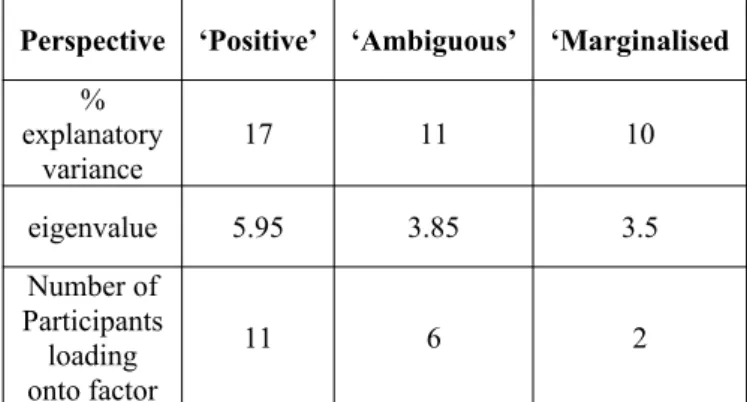
Both the variance and the EV indicate the strength of a particular factor in terms of its potential to explain the variation in the correlation matrix. Within this study three of the perspectives that emerged were used as the basis of the deliberative discussion held with the key informants described below: these perspectives have been termed: ‘positive’, ‘ambiguous’ and ‘marginalised’. The eigenvalues and the percentage of explanatory variance for each of these perspectives are presented in table 1 below. The subsequent sections begin with the penportrait that was presented to the key informants and the statement array which characterised the factor being considered.
Perspective ‘Positive’ ‘Ambiguous’ ‘Marginalised
% explanatory
variance
17 11 10
eigenvalue 5.95 3.85 3.5 Number of
Participants loading onto factor
11 6 2
Table 1: % explanatory variance and calculated eigenvalue for the rotated factor matrix
‘Positive’
lasting legacy of sports facilities and promoting sports education. They also felt that the Games would encourage interest in local volunteering and would raise the self-esteem of local people.
‘Ambiguous’
This perspective, whilst also being generally positive was a little ambivalent in some areas. For example, some doubt was expressed about the use of the facilities subsequent to the Games; there was little belief that the Cultural Olympiad would lead to any long term development of the cultural life of the area; nor that the legacy would see health benefits for the community.
‘Marginalised’
-5 -4 -3 -2 -1 0 +1 +2 +3 +4 +5
6 18* 5** 28 23 4 2 15 10 27 1
The Games will do little to promote
sport education
The Games won’t lead to any health benefits
for the community
Those not directly involved in the Games will feel left
out
The Games will lead to a huge public debt
The Games will inspire people across the country to develop sustainable lifestyles
The Games will inspire community development
The Games will help to develop an understanding of other
cultures
Schools should be using the developments
around the Games to inform their lessons
The Games will provide a lasting legacy of sports
facilities
The local community must be able to access the Olympic Park facilities after the Games
are over
The Games will provide opportunities
to be involved with people from all over
the world
25** 21 8 31 29 9 20 19 12* 35 3
The Games will produce facilities which will not be used after the
Games have finished
The Cultural Olympiad will exclude
local people
The voices of local people are being
ignored
Only certain subjects will be able to use the theme of the Games in
their lessons
There will be opportunities for people like me to make a direct contribution to the
Games
The Games will encourage people to
gain a greater knowledge about their
local area
Young people should be involved in deciding what is included within the Cultural Olympiad
The Games will encourage young people to take part in
local volunteering activity
The Games will lead to an increase in mass participation in sporting
activities
The Games will give people opportunities to work with people they wouldn’t normally
meet
The Games are an event of national significance
47* 36 22 32 30 11 34 39 14 40 7
The Games are a
waste of money The involvement ofyoung people and schools will only be at
a superficial level
The Cultural Olympiad will not
lead to any long-term benefits to our
cultural life
The Olympic Park will be disconnected from
the surrounding communities
Education will be a key strand in the legacy of
the Games
The Games have diverted money from
community projects
It is important that school pupils are able
to attend events
The Games will give the people of East London more
self-esteem
The Games are not just
about elite athletes People are excited about theevent The Games willinspire a new generation of athletes
56 24** 57 33 13 38 41 17 42
The legacy programme has been thought about in terms of the whole
country
The Games will use volunteers as cheap
labour
The Games won’t lead to any sustainable jobs
The construction of the Olympic park has caused the destruction
of public spaces
The Games will lead to a greater understanding
of culture in the younger generation
The Games provides educational opportunities for
cross-curricular work
The Games will highlight the good points of East London
The Games will help the regeneration of the area
The Games will bring people into this part of the city
49 43 46 16 44 53 26*
There will be affordable homes in
the Olympic Park
The Games will contribute to the enhancement of the natural environment.
The Games will widen the horizons of the local communities
The Games will help to connect young people with the UK’s artistic
communities
The Games will act as a catalyst for change
eg transport infrastructure for longer term benefit
The Games will raise the job aspirations of
young people
There will be an increase in personal involvement
in activities, sport and volunteering
50 52 48 45 37
The Olympic Park will give people contact with the natural world
The legacy programme has been thought about in terms of the whole
region
The Olympic Park will be a model for future
projects in terms of sustainable development
The Games will increase community
cohesion
The Games will be a useful resource for
schools.
55 54 51
Local people will be ‘priced out’ of their own area after 2012
The Games will raise awareness of disability
issues
The Games will transform the heart of
East London
5 -4 -3 -2 -1 0 +1 +2 +3 +4 +5
6 13 9 14 12 4 8 1 7 15** 3
The Games will do little to promote sport
education
The Games will lead to a greater understanding of culture in the younger
generation
The Games will encourage people to
gain a greater knowledge about their
local area
The Games are not just
about elite athletes The Games will lead toan increase in mass participation in sporting
activities
The Games will inspire community development
The voices of local
people are being ignored The Games will provideopportunities to be involved with people from all over the world
The Games will inspire a new generation of
athletes
Schools should be using the developments around the Games to
inform their lessons
The Games are an event of national significance
23 16 19 21 18 5 24 2 11 17 27
The Games will inspire people across the country to develop sustainable lifestyles
The Games will help to connect young people with the UK’s artistic
communities
The Games will encourage young people
to take part in local volunteering activity
The Cultural Olympiad will exclude local
people
The Games won’t lead to any health benefits
for the community
Those not directly involved in the Games
will feel left out
The Games will use volunteers as cheap
labour
The Games will help to develop an understanding of other
cultures
The Games have diverted money from
community projects
The Games will help the
regeneration of the area must be able to accessThe local community the Olympic Park facilities after the Games
are over
29* 56 30 41 33 31* 25 10 38 20 28
There will be opportunities for people like me to make a direct contribution to the
Games
The legacy programme has been thought about in terms of the whole
country
Education will be a key strand in the legacy of
the Games
The Games will highlight the good points of East London
The construction of the Olympic park has caused the destruction
of public spaces
Only certain subjects will be able to use the theme of the Games in
their lessons
The Games will produce facilities which will not be used after the Games
have finished
The Games will provide a lasting legacy of sports
facilities
The Games provides educational opportunities for
cross-curricular work
Young people should be involved in deciding what is included within the Cultural Olympiad
The Games will lead to a huge public debt
57 47 45 35 39 26 22 44 34
The Games won’t lead
to any sustainable jobs The Games are a wasteof money The Games will increasecommunity cohesion people opportunities toThe Games will give work with people they wouldn’t normally meet
The Games will give the people of East London
more self-esteem
There will be an increase in personal
involvement in activities, sport and volunteering
The Cultural Olympiad will not lead to any long-term benefits to
our cultural life
The Games will act as a catalyst for change eg transport infrastructure for longer term benefit
It is important that school pupils are able to
attend events
53 50 40 42 32 37 51
The Games will raise the job aspirations of
young people
The Olympic Park will give people contact with the natural world
People are excited about
the event people into this part ofThe Games will bring the city
The Olympic Park will be disconnected from
the surrounding communities
The Games will be a useful resource for
schools.
The Games will transform the heart of
East London
52 46 48 36 43*
The legacy programme has been thought about in terms of the whole
region
The Games will widen the horizons of the local
communities
The Olympic Park will be a model for future
projects in terms of sustainable development
The involvement of young people and schools will only be at a
superficial level
The Games will contribute to the enhancement of the natural environment.
54 55 49
The Games will raise awareness of disability
issues
Local people will be ‘priced out’ of their own
area after 2012
There will be affordable homes in the Olympic
Park
-5 -4 -3 -2 -1 0 +1 +2 +3 +4 +5
6 4 29 18 5 2 8 10 7 1 17
The Games will do little to promote sport
education
The Games will inspire community development
There will be opportunities for people like me to make a direct contribution to the
Games
The Games won’t lead to any health benefits
for the community
Those not directly involved in the Games
will feel left out
The Games will help to develop an understanding of other
cultures
The voices of local
people are being ignored a lasting legacy of sportsThe Games will provide facilities
The Games will inspire a new generation of
athletes
The Games will provide opportunities to be involved with people from all over the world
The Games will help the regeneration of the area
43 14 31 19 12 9 11 24 20 3 27
The Games will contribute to the enhancement of the natural environment.
The Games are not just about elite athletes
Only certain subjects will be able to use the theme of the Games in
their lessons
The Games will encourage young people
to take part in local volunteering activity
The Games will lead to an increase in mass participation in sporting
activities
The Games will encourage people to
gain a greater knowledge about their
local area
The Games have diverted money from
community projects
The Games will use volunteers as cheap
labour
Young people should be involved in deciding what is included within
the Cultural Olympiad
The Games are an event of national significance
The local community must be able to access the Olympic Park facilities after the Games
are over
50 47 37** 25 16 13 15 36 41 28 33*
The Olympic Park will give people contact with the natural world
The Games are a waste
of money The Games will be auseful resource for schools.
The Games will produce facilities which will not be used after the Games
have finished
The Games will help to connect young people with the UK’s artistic
communities
The Games will lead to a greater understanding of culture in the younger
generation
Schools should be using the developments around the Games to inform their lessons
The involvement of young people and schools will only be at a
superficial level
The Games will highlight the good points of East London
The Games will lead to
a huge public debt Olympic park has causedThe construction of the the destruction of public
spaces
49 46 30 23 26 21 38 42 34
There will be affordable homes in the Olympic
Park
The Games will widen the horizons of the local
communities
Education will be a key strand in the legacy of
the Games
The Games will inspire people across the country to develop sustainable lifestyles
There will be an increase in personal
involvement in activities, sport and volunteering
The Cultural Olympiad will exclude local
people
The Games provides educational opportunities for
cross-curricular work
The Games will bring people into this part of
the city
It is important that school pupils are able to
attend events
53 55 32 35 22 40 51
The Games will raise the job aspirations of
young people
Local people will be ‘priced out’ of their own
area after 2012
The Olympic Park will be disconnected from
the surrounding communities
The Games will give people opportunities to
work with people they wouldn’t normally meet
The Cultural Olympiad will not lead to any long-term benefits to
our cultural life
People are excited about
the event transform the heart ofThe Games will East London
56 39 52 48 44
The legacy programme has been thought about in terms of the whole
country
The Games will give the people of East London
more self-esteem
The legacy programme has been thought about in terms of the whole
region
The Olympic Park will be a model for future
projects in terms of sustainable development
The Games will act as a catalyst for change eg transport infrastructure for longer term benefit
45 54 57
The Games will increase community cohesion
The Games will raise awareness of disability
issues
The Games won’t lead to any sustainable jobs
Key informant interviews
The penportraits presented above were used as a stimulus item within an interview schedule used during the summer of 2013 when ten interviews were undertaken with key informants. Purposive sampling (Opie, 2004; Bryman, 2004; Cohen et al 2007) was employed with the possible informants being selected through saturation of a matrix which required coverage of national, regional and local positions and of roles with overarching responsibilities for Games-related developments (including
education) and of those with responsibilities for educational projects, both within formal and informal educational organisations. The participants are presented in the table below
Pseudonym Position Matrix position
Jon Principal and Chief Executive of a further education college in one of the host boroughs London December 2006-present
Local education Peter Executive Director for Regeneration and
Community Partnership London Legacy Development Corporation 2011-present Chief Executive Leaside Regeneration Limited 2002-2011
Regional overarching
Jane Olympic Developments Manager East
London Borough Local overarching Simon
Chief Executive at Lee Valley Regional Park Authority
Regional Overarching Nigel
Executive Director Fundamental
Architectural Inclusion Local education Michael
Head of Podium since 2012;
Communications and Media Manager Podium 2009-2012
National education
Geoff Director, Policy and Partnerships at Legacy Trust UK
National overarching James
Director 2012 Office University of East London
Responding to the Perspectives
It was felt asking the key informants to respond to the perspectives indicated by the
penportratits would allow an exploration of the subtle modalities (Bourdieu, 1977) in
the relationships between the psychological significance (Burt and Stephenson, 1939;
Watts and Stenner, 2012) of each statement concerning potential legacy, developing a
coherence across the multiple potential legacy outcomes. There is an
acknowledgement in the literature (Preuss, 2007; Searle, 2002) that the ‘event
structures’ under consideration can be viewed from multiple , sometimes conflicting
perspectives. The emergent factors reflect, at an operant level, the significance that
participants loading onto that factor assign to each statement about legacy.
Each of the key informants was asked to respond to the penportrait of the perspective.
The reactions and responses to the penportraits of the factors are discussed below.
This was done in an attempt to gauge the effectiveness of such penportraits in
stimulating a deliberative dialogue about the implications of the perspectives for
legacy.
Responding to the ‘Positive’ Perspective
When faced with this largely positive perspective the key informants were happy to
accept it as being in accord with their own view, seeing it as “a perspective that I
share” and being “certainly what we see”. However, some of the key points within
the penportrait prompted some discussion. For example, Jane felt that the prominence
of sport education in this perspective was “a misconception” and then went on to
describe her beliefs about the role of the Olympics in the gaining “an understanding of
engaging with the penportrait to discuss the way in which the hopes made explicit in
such “reporting” has an effect on the way in which government engages with legacy.
As such a perspective indicates that there is a “clear hope and expectation” that the
legacy promises would be delivered upon; for example, Jon felt that the government
“backtracked” on withdrawing funding from school sport, “being shamed into putting
the resource back.” It was interesting to note that several of the informants, for
example Peter and Michael engaged with the penportrait by drawing on specific
examples or by quoting from research that their organisation had undertaken: “there
are more sports clubs...we have worked hard to keep the links into the Park as active
as we can”; “74% of the respondents said that they expected increased sport
participation to be of benefit.” There is a subtle contrast between this positive support
for a positive perspective and the way in which Jane offered an example around sports
facilities: “[the borough] only has one swimming pool, so promoting something like
swimming is only going to frustrate people”; and used the perspective as a way to
discuss her views about the importance of the Games in developing an “understanding
[of] London’s place in the world.” In general the key informants were “heartened” by
the positive regard for the Games that the perspective revealed, with the caveats that
this might not be the perspective if the study was carried out in “another part of the
country,” or “in a few years' time.” Two of the key informants, James and Jess,
engaged minimally with the perspective offered. James simply stated that he “was
happy with that” and Jess “couldn’t agree more.” It is worthy to note that Jess also
wished to add to the perspective, saying that the Games had “developed initiatives”
there is a tendency to accept the positive and to extrapolate personal experience into
the perspective of others.
Responding to the ‘Ambiguous’ Perspective
This perspective was met by a variety of responses. Jan said that it was “difficult to
take a perspective only one year afterwards.” Others saw this as a “fair point” and
agreed “with the sense of there needing to be a question” asked about legacy with
people having “the right to be concerned and to raise those concerns.”
A number of informants responded to specific concerns implied within the
perspective. For example Jon, offering up some facts about the legacy use of the
stadia, stated that he thought that “people have already been proved wrong about the
venues”, whilst Simon used the penportrait to engage with the concern and to try to
understand it:
we've always been mindful ... that the public's engagement with these wonderful iconic venues has been through the Olympics and elite athletes. So some people don't make the connection between the Olympic Games and the athletes and day to day use by people like themselves.
The point here being that, even if the concern is known to be unfounded, with some
informants seeing this perspective as “wrong”, there is still a concern which needs to
be addressed. This might be at a level of simple reassurance, for example Jane and
Michael drew on data and anecdotes that were available to them. It might be, as in
Simon’s case that a level of insight into the concern needs to be forthcoming before it
can be addressed. However, this is not a view that was universally shared. Jess for
would like to be able “to sit across the table and have a discussion with whoever those
observations were from to be able to understand where they got that opinion from.”
This indicates a lack of understanding of the nature of the Q sort, where the
perspective develops from the positions taken by each of the participants, rather than
that of a few individuals.
Although the perspective of the factor reflects the views expressed in 2009, it was
interesting to note a level of agreement between a number of the key informants about
the Cultural Olympiad subsequent to the Games. For example Jon struggling “to
quote any very specific outcomes” and Peter feeling that East London had been
“passed by”. The way in which these views were elicited by the interaction between
the key informant and the perspective is indicative of the way in which this approach
might be used in future developments. The concerns raised in 2009 seem to have
manifested in 2012, and although it would be over-claiming to state that the
perspective, if presented earlier, might have helped to overcome this, it does show the
potential for the perspectives to set up dialectics. However, it should be noted that
this might not have been forthcoming if there wasn’t the benefit of hindsight, as even
with the time lag there was some defensiveness; Jess expressed a view that research
produces results that “may not be a fair reflection of the discussion.” This indicates
that the nature of the perspective and the research that produced it was not properly
explained as a way of avoiding giving a “stage” for the expression of individual
“opinion” and enabling a dialogue with a wider constituency.
Geoff did offer the insight that, whilst accepting the “fairness” of the comments
within the perspective, perhaps the Games “weren't there to tackle those issues.” This
perspectives developed through the Q-sort show the type of expectations that need to
be managed.
Responding to the ‘Marginalised’ Perspective
The participants loading onto this factor essentially felt marginalised by the
developments around the Games, believed that spending on the Games diverted
money from community projects and that public space was destroyed in the
construction of the Park. The presentation of the penportrait elicited some level of
“surprise” from a number of the key informants. The reaction of the informants to
this perspective varied from Simon’s view that “one can't question those feelings” to
Peter’s statement that the “point is just wrong.” Michael stated that he “never really
encountered that” view, which is not too surprising given the likely self-selecting
group that ‘Podium’ worked with.
Jon, while being somewhat taken aback by the perspective, even a little hurt because
of the work that was put in to “make sure that people didn’t feel marginalised,”
acknowledged that “if that’s how people felt, that’s how they felt” and thought that it
might be worth having some discussion with students about “how they feel” now.
A number of informants, for example Jon, Peter, Jane and James, dismissed this
factor’s perspective on the destruction of public space, having little “sympathy” with
this position and stating that “the Olympic Park was not public space”, it was
“industrial” “people went to work there”. Peter is interested “in where people get
these views from,” something reflected in Nigel’s observation that views on
disruption caused by wider regeneration were often blamed on Games-related
people will frame their engagement. It is, therefore, interesting to note the internal
dialogues that certain informants engaged in as a response to the perspective. For
example, James went from an initial description of the perspective as being “bollocks”
to an acknowledgement that “allotments had been lost,” to a realisation that the
feeling might have come about as “you can create a sense of displacement by standing
outside the electrified fence and think you're not being let in for six years.”
There was a general acknowledgment that the developments were “a massive
upheaval for East London” with a number, for example Simon, justifying this by
stating that “what we've got to remind ourselves is that the period … of there being a
deficit in terms of provision” will be “paid back.” This is particularly relevant in
terms of those loading onto this factor who are all school students for whom the
length of the “inconvenience” coincided with a sizeable portion of their youth.
Informants were keen to talk about how they were working “to draw” communities
into the space and were interested “as the Park opens up” to see how this engagement
would develop. The perspective presented seemed to encourage an exploration of the
term public space. Jane, for example recollected taking youth groups to Canary
Wharf and them being asked to move on as it is “privately owned”. She was
somewhat concerned that this will also happen with the Olympic Park, with “security
guards that are judging them … and asking them to move on” working against the
“opportunity” of using the Park. Geoff had some insight into how this would lead to a
sense of marginalisation:
even if the “truth” is that public space was not destroyed. This insight forms a point
of departure for dialogue which the response of other informants did not offer. Jan,
for example, had a “gut reaction” that the perspective was to be expected as “any
large, major event” will have “opposition” as it “impacts upon daily lives and
individuals who may not have an interest in what it can offer.” There is also a slightly
dismissive tone in the argument that James put forward that “there are some people
who are romantically attached to the notion of decayed urban landscape.” This tone
will exacerbate the already difficult task of “consulting with young people” when as
Jane points out “you want to say well that's not really how it works. But you also
want to listen to their views.”
When confronted with this perspective a number of informants told stories about how
it’s all going to be alright. Michael for example countered by relating the “very
successful” ‘Get Set’ programme and how it was “popular” with schools and colleges.
James used arguments around the remediation of the land “the waterways were filthy
… the velodrome is piled on top of the former West Ham Municipal Tip now it’s a
nice place with plants.”
The fact that this perspective was met with “surprise” and elicited stories of how
young people feel “the facilities are there for them” and were able to “give their
feedback” on various legacy projects makes the point that certain perspectives are
being missed or dismissed.
Conclusion
Using a deliberative approach (Niemeyer et al 2013), basing a dialogue around the
some interesting insights into the view of the key informants, it was also possible to
note some issues that need to be addressed in the future development of such a
deliberative approach. For example, there is a need to better explain the nature of the
Q sort and what this means in terms of the penportrait that is presented as the stimulus
to dialogue. There is also a need to build a dynamic engagement with the concourse
to fine tune the perspectives of participants as the dialogue develops over time.
Whilst there was a generally warm regard for the Games, there were underlying
feelings of marginalisation expressed by the factors, and indications of a lack of
engagement with the opportunities that the Games might provide. To some extent this
might be a function of the transient nature of the Games, but seeing this as an event
rather than as part of a process will limit the way in which legacy is accessed. There
is a need to be able to localise this global event. In order to do this, there needs to be
a mechanism which enables the multiple experiences and backgrounds of stakeholders
to be taken into account; allowing a more sophisticated understanding of the
relationship between programmes, participants and local communities.
This paper makes a case for utilising a different approach, that of Q methodology, for
the exploration of such perspectives, and contends that this approach would act as a
useful adjunct to existing planning and evaluation tools if used in a deliberative
manner. This approach means that evaluation becomes an important tool in informing
the planning, preparation and delivery of the event and its legacies and not merely
something that captures effects and impacts. By introducing a wider perspective
through Q methodology the potential to be aware of grievances and viewpoints is
increased. Such an approach has the advantage of locating the event more
within the educational environment, analysing at each level and then integrating each
analysis for the environment as a whole. Beames and Atencio (2008) have pointed
out that the effectiveness of intervention depends on the way in which they are
situated within the local. Whilst the exoticism of the Games is important in
generating excitement; the local contextualisation is what will lead to the sustained
legacy.
References
Baker, R and Jeffares, S (2013) Introduction to the special issue: public policy
Operant Subjectivity 36 (2), pp69-72
Beames, S. and Atenico, M. (2008) 'Building social capital through outdoor
education'. Journal of Adventure Education and Outdoor Learning, 8(2), pp. 99-112. Bobrow, D. and Dryzek, J.(1987) Policy analysis by design Pittsburgh, PA:
University of Pittsburgh Press
No Statement No Statement
1 The Games will provide opportunities to be involved with people from all over the world
16 The Games will help to connect young people with the UK’s artistic communities 2 The Games will help to develop an understanding of other
cultures 17 The Games will help the regeneration of the area
3 The Games are an event of national significance 18 The Games won’t lead to any health benefits for the community
4 The Games will inspire community development 19 The Games will encourage young people to take part in local volunteering activity 5 Those not directly involved in the Games will feel left out 20 Young people should be involved in deciding what is included within the Cultural
Olympiad
6 The Games will do little to promote sport education 21 The Cultural Olympiad will exclude local people
7 The Games will inspire a new generation of athletes 22 The Cultural Olympiad will not lead to any long-term benefits to our cultural life 8 The voices of local people are being ignored 23 The Games will inspire people across the country to develop sustainable lifestyles 9 The Games will encourage people to gain a greater knowledge
about their local area 24 The Games will use volunteers as cheap labour
10 The Games will provide a lasting legacy of sports facilities 25 The Games will produce facilities which will not be used after the Games have finished 11 The Games have diverted money from community projects 26 There will be an increase in personal involvement in activities, sport and volunteering 12 The Games will lead to an increase in mass participation in
sporting activities
27 The local community must be able to access the Olympic Park facilities after the Games are over
13 The Games will lead to a greater understanding of culture in the
younger generation 28 The Games will lead to a huge public debt
14 The Games are not just about elite athletes 29 There will be opportunities for people like me to make a direct contribution to the Games
15 Schools should be using the developments around the Games to
inform their lessons 30 Education will be a key strand in the legacy of the Games
No Statement No Statement
31 Only certain subjects will be able to use the theme of the Games in their lessons
46 The Games will widen the horizons of the local communities 32 The Olympic Park will be disconnected from the surrounding
communities 47 The Games are a waste of money 33 The construction of the Olympic park has caused the destruction
of public spaces 48 The Olympic Park will be a model for future projects in terms of sustainabledevelopment 34 It is important that school pupils are able to attend events 49 There will be affordable homes in the Olympic Park
35 The Games will give people opportunities to work with people
they wouldn’t normally meet 50 The Olympic Park will give people contact with the natural world 36 The involvement of young people and schools will only be at a
superficial level 51 The Games will transform the heart of East London
37 The Games will be a useful resource for schools. 52 The legacy programme has been thought about in terms of the whole region 38 The Games provides educational opportunities for
cross-curricular work
53 The Games will raise the job aspirations of young people 39 The Games will give the people of East London more
self-esteem 54 The Games will raise awareness of disability issues
40 People are excited about the event 55 Local people will be ‘priced out’ of their own area after 2012
41 The Games will highlight the good points of East London 56 The legacy programme has been thought about in terms of the whole country 42 The Games will bring people into this part of the city 57 The Games won’t lead to any sustainable jobs
43 The Games will contribute to the enhancement of the natural environment.
44 The Games will act as a catalyst for change eg transport infrastructure for longer term benefit