A BAYESIAN QUANTITATIVE NONDESTRUCTIVE EVALUATION
(Q-NDE) APPROACH TO ESTIMATING REMAINING USEFUL
LIFE OF AGING PRESSURE VESSELS AND PIPING
Jeffrey T. Fong1, William F. Guthrie2, N. Alan Heckert3, and James J. Fillibe4
1 Physicist, Applied & Computational Mathematics Division, NIST, Gaithersburg, MD ([email protected]) 2 Mathematical Statistician, Statistical Engineering Division, NIST, Gaithersburg, MD
3 Mathematical Statistician, Statistical Engineering Division, NIST, Gaithersburg, MD 4 Mathematical Statistician, Statistical Engineering Division, NIST, Gaithersburg, MD
ABSTRACT
In this paper, we address a generic problem of estimating the remaining useful life of an aging structure by a Bayesian quantitative nondestructive evaluation (Q-NDE) approach, where the key emphasis is in first obtaining as much as possible the relevant information on the current material properties of the aging structure, and then applying the NDE-based information as input to a stochastic multiple-crack-growth fatigue life model with judgment-based a priori assumption of crack length distributions (Bayesian). A numerical example using synthetic NDE data for a typical class of high strength steel pressure vessels or piping is presented to illustrate the novel approach.
INTRODUCTION
One of the most pressing needs of the nuclear power plant (NPP) industry is the ability to estimate with confidence the remaining useful life of an aging structure. In a summary of an OCED report by Lokhov (2012), he stated that
“ . . . in nearly all cases the continued operation of NPPs for at least 10 more years is profitable even taking into account the additional costs of post-Fukushima modifications.
“Projections of nuclear generating capacity to 2030 show that some 160 reactors globally could be retired in the next 10 years on the basis of their original design lifetimes. Without life extensions, nuclear capacity would thus fall dramatically in the next decade.”
In a recent article in the online digest named “NUCLEAR ENERGY INSIDER,” Deign (2013) noted that
“ . . . plant owners have to prove to the regulator that their facilities can run safely over the proposed lifetime extension.
“ . . . long term operation looks set to dominate the nuclear agenda over the next ten years and beyond as the bulk of power plants worldwide near the end of their original operating lives.”
almost impossible to assess the material properties and microstructural state of an aging structure while it is still operating as part of a huge system that cannot be dis-assembled at will.
Fortunately, significant advances in the NDE industry over the last half century and in the use of computer technology to model and quantify the detection, location, and sizing of all types of flaws and cracks, provided us the means to gather critical information about the material properties and the microstructural state of almost any structure or component, be it new or aging. This, in turn, creates an opportunity to estimate, with statistical rigor, the remaining useful life of an aging structure, because the evidence gathered is structure-specific, much like the blood test data on an individual seeking the help of a doctor to diagnose a health complaint.
The purpose of this paper is to present a computational and crack-based approach that was recently reported by Fong, et al. (2012), where NDE-based tests were used to obtain as much as possible the relevant information on the current state of an aging structure, and the NDE data were used as input to a stochastic multiple-crack-growth fatigue life model (see, e.g., Fong, et al (2009)) that is coupled with judgment-based a priori assumptions, i.e., Bayesian, for all of the measured crack length distributions. We will also present in this paper a numerical example using synthetic NDE data to illustrate the novel approach. A brief discussion of the significance and limitations of this approach is given at the end of this paper.
A STOCHASTIC LOCAL THEORY OF FATIGUE BASED ON A SINGLE CRACK
Following the notation introduced in a book by Dowling (1999), Fong, Marcal, Hedden, Chao, and Lam (2009) formulated a stochastic local theory of fatigue based on the classical crack-growth fatigue formula of Paris (1964, 1972) as follows:
da/dN = C
o(
K )
m,
(1)
and
(2)
where in Eq. (2), Nif is the number of cycles to failure and all of the constants therein are assumed to be available from laboratory tests using specimens of new structure such as a pressure vessel or piping (PVP). For aging PVP, those constants are expected to change, but it is almost impossible to obtain them without disturbing existing operating conditions. To circumvent this difficulty, Fong, et al. (2009) introduced a measurable quantity from NDE approach as follows:
(3)
and
(4)
on the theory of error propagation, Fong, et al. (2009) developed a stochastic single-crack theory and obtained a formula for the variance of Nif as follows:
(5)
where ai is the initial crack length. Both ai and Qi,m as well as their variances can be estimated from NDE data.
A STOCHASTIC LOCAL THEORY OF FATIGUE BASED ON MULTIPLE CRACKS
Since, in reality, the cracked state of an aging component is more likely to exhibit multiple cracks, Fong, et al. (2012) generalized the single-crack-growth theory to a multi-crack-growth (MCG) theory as shown in the following 4 equations:
j = a f,j / ai,j , (6)
j’ = (
j 1 - m/2 – 1 ) / ( 1 - m/2 ) , (7)
Nif,j = j’ * ai / Qij,m , (8) and
s.d.(Nif,j ) = ( j’ * ai / Qij,m2 ) * s.d.(Qij,m ) , (9)
where they have introduced in Eq. (9) a simplification of Eq. (5) by dropping the term involving the variance of ai . The index j denotes the I.D. of a crack in a J-crack region with j = 1, 2, …, J.
A BAYESIAN APPROACH TO ESTIMATING FATIGUE LIFE OF AGING STRUCTURES VIA A NUMERICAL EXAMPLE
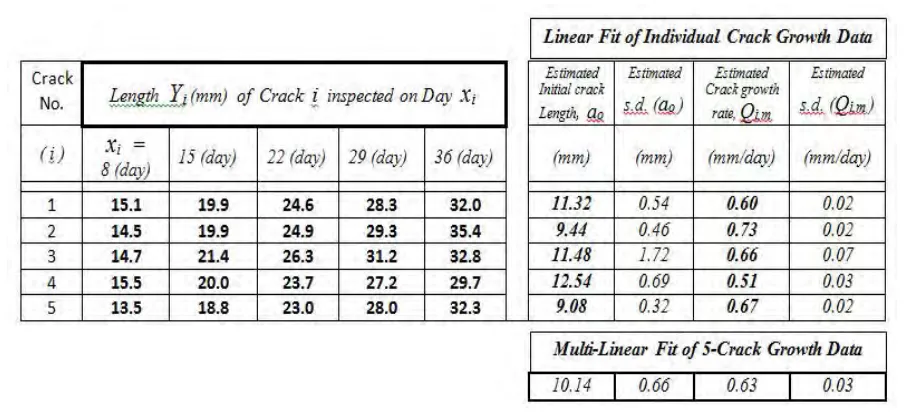
The formulation of a multi-crack-growth (MCG) theory by Fong, et al. (2012) paved the way for us to use the powerful Bayesian statistical method for NDE data analysis, because the method allowed us to use prior knowledge of the likely distributions of the crack length and crack-growth-rate data to iterate for the best estimation and to validate the model to assure that it provides a reasonable description of the variation in the observed data.
Table 1: A set of synthetic Multiple Crack Growth Data and Results of Linear Fits.
Table 2. A typical output file from running a WinBUGS code for an example of MCG Theory.
In other words,
ai = 10.14 mm., and, standard deviation of ai, or, sd (ai ) = 2.09 mm. Qi,m = 0.63 mm/day, and sd ( Qi,m ) = 0.064 mm/day.
SIGNIFICANCE AND LIMITATIONS OF THE STOCHASTIC MCG MODEL
The results cited in Eqs. (5) through (9) for a multi-crack-growth (MCG) theory are significant, as compared with the classical deterministic fatigue crack growth theory of Eq. (2), because of the simplicity of the model (with fewer parameters), the customization of current knowledge of the damaged state (in terms of its local nature), and an ability to estimate remaining life with an uncertainty quantification in sync with the reliability of the in-situ NDE monitoring process.
Both the single-crack-growth theory of Eqs. (4) and (5), and the MCG theory of Eqs. (6) to (9) have at least two serious limitations that need to be addressed, namely, the assumption of a constant m (a material property parameter), and a lack of attention to the variation in stress levels encountered by each crack. Fortunately, with our current advances in statistical and computational methods, neither limitation is insurmountable.
CONCLUSION
The results presented in this paper provide engineers with a new tool in managing the structural integrity of aging structures or components using the best available NDE methods of in-situ monitoring. We have demonstrated via a numerical example that a prior knowledge of an estimated mean final crack length is not critical in estimating the mean useful life of a new or aging component. Secondly, we showed with a numerical example that a computational algorithm exists to estimate the mean and standard deviation of both the initial crack length and the crack-growth-rate for the cracks found in a multiple-crack region
.
In addition, the results in this paper provide an approach to highlighting the concerns expressed by Doctor and Anderson (2010) on the role of NDE uncertainty in fatigue life models as shown below:
“. . . Risk-informed In-service Inspection (RI-ISI) . . . relies heavily on the reliability of NDE . . . to detect sources of expected degradation. NDE contains significant uncertainties and RI-ISI programs need to address and accommodate this factor.”
DISCLAIMER
Certain commercial equipment, instruments, materials, or computer software are identified in this paper in order to specify the experimental or computational procedure adequately. Such identification is not intended to imply recommendation or endorsement by the National Institute of Standards and Technology, nor is it intended to imply that the materials, equipment, or software identified are necessarily the best available for the purpose.
REFERENCES
Deign, J. (2013), “Long-term operations set to dominate nuclear agenda,” Nuclear Energy Insider: Operations & Maintenance, May 8, 2013, http://analysis.nuclearenergyinsider.com .
Doctor, S. R., and Anderson, M. (2010), “Uncertainties in NDE Reliability and Impact on RI-ISI,” Proc. ASME Pressure Vessels & Piping Conference, July 26-30, 2010, Bellevue, Washington, U.S.A., Paper PVP2010-25798, New York, NY: ASME.
Dowling, N. E. (1999), Mechanical Behavior of Materials, 2nd ed., Prentice Hall.
Fong, J. T., Heckert, N. A., and Filliben, J. J. (2012), “A Stochastic and Local Theory of Fatigue for Aging Pressure Vessels and Piping,” Proc. 3rd International Symposium on Structural Integrity (ISSI), Oct. 31 – Nov. 2, 2012, Jinan University, Jinan, Shandong, China, published by the East China University of Science and Technology Press, Shanghai, China, 19-31.
Ku, H. H. (1966), “Notes on the Use of Propagation of Error Formulas,” Journal of Research of the National Bureau of Standards – C. Engineering and Instrumentation, 70C (4), 263-273.
Lokhov, A. (2012), The Economics of Long-term Operation of Nuclear Power Plants, OECD Nuclear Energy Agency Report.
Lunn, D. J., Thomas, A., Best, N, and Spiegelhalter, D. (2000), “WINBUGS – A Bayesian Modeling Framework: Concepts, Structure, and Extensibility,” Statistics and Computing, 10, 325-337.
Paris, P. C. (1964), “The Fracture Mechanics Approach to Fatigue,” in Proc. Symposium on Fatigue – An Interdisciplinary Approach, J. J. Burke, et al. (Eds.), 10th Sagamore Army Materials Research Conf., Syracuse University Press, Syracuse, NY, 107-127.