R E S E A R C H
Open Access
Texture-adaptive image colorization framework
Michal Kawulok
*and Bogdan Smolka
Abstract
In this paper we present how to exploit the textural information to improve scribble-based image colorization. Although many methods have been already proposed for coloring grayscale images based on a set of color scribbles inserted by a user, very few of them take into account textural properties. We demonstrate that the textural information can be extremely helpful for this purpose and it may greatly simplify the colorization process. First, based on a scribbled image we determine the most discriminative textural features using linear discriminant analysis. This makes it possible to boost the initial scribbles by adjoining the regions having similar textural properties. After that, we determine the color propagation paths and compute chrominance of every pixel in the image. For the propagation process we used two competing path cost metrics which are dynamically selected for every scribble. Using these metrics it is possible to efficiently propagate chrominance both over smooth and rough image regions. Texture-based scribble boosting followed by competitive color propagation is the main
contribution of the work reported here. Extensive experimental validation documented in this paper demonstrates that image colorization can be substantially improved using the proposed technique.
Keywords:image colorization, textural properties, distance transform, linear discriminant analysis
1 Introduction
Color images are usually perceived as definitely more attractive and appealing than their grayscale versions. Therefore, a lot of efforts are often engaged into image colorization, which is a process of adding colors to monochromatic images or videos. First attempts in 1920s were fully manual, performed for every individual shot on the film print. The colorization process was computerized in 1970s by Wilson Markle and Christian Portilla. Its most famous application was colorization of the Apollo mission footage. The first well-known mono-chrome film colorization was that of Casablanca in 1980s. Although it was widely criticized at that time, colorization of old movies appeared desired in the mass culture world and many films have been converted into color versions since then. Apart from enhancing visual attractiveness of monochrome photographs or videos whose color versions are not available, image coloriza-tion has found many other applicacoloriza-tions like marking regions of interest in medical images, interior design, or make-up simulators.
Using the recent methods an image can be colorized based on color scribbles which are propagated over the whole image surface. Although the existing techniques work well for colorizing plain areas, they fail for rough, textured regions. This is because the color is propagated from the scribbles following an assumption that pixels of similar luminance should have similar chrominance. This explains why the existing algorithms and available commercial solutions occur to be inefficient when a highly textured regions are to be colorized. In some cases, even large image regions expected to have uni-form chrominance should be precisely annotated with the scribbles to avoid artifacts. The final colorization result often depends on the scribbles’shape and exact position. Hence, although the image is automatically colorized after adding the scribbles, drawing them is often a tedious task itself.
In the work reported here we have focused on how to reduce density and precision of the scribbles, in order to simplify the colorization process. More specifically, we have investigated how the textural information can be exploited to achieve this goal. As a result, based on our earlier works [1,2] we propose a double-level method, consisting of scribble boostingfollowed by surface-speci-fic competitive color propagation. A very important property of the method is that at both levels it is * Correspondence: [email protected]
Faculty of Automatic Control, Electronics and Computer Science, Silesian University of Technology, Akademicka 16, 44-100 Gliwice, Poland
adapted to the textures which appear in the image and are marked by the scribbles.
The first-level works by extracting thediscriminative textural features(DTF) which make distinction between the textures covered by different scribbles [1]. DTF are obtained usinglinear discriminant analysis(LDA) per-formed over simple image statistics computed locally. After that, the scribbles are boosted by adjoining the regions which have similar textural features. DTF are determined independently for every image to maximize the discriminative power between the textures covered by different scribbles. This makes the method adaptive to every scribbled image.
At the second level, the boosted scribbles serve as the source for the color propagation. The propagation paths are obtained using Dijkstra algorithm by minimizing local pixel distance integrated along the path. In con-ventional techniques [3] the local pixel distance is pro-portional to a luminance difference. This works correctly for colorization of plain areas, but fails for tex-tured surface. Therefore, we adapt the distance to the textural properties of the region where the scribble is placed. Our experiments indicated that this double-level approach make it possible to limit the necessary human assistance and facilitates the colorization process.
The paper is organized as follows. In Section 2, a gen-eral literature overview is presented. Then, in Section 3, the baseline techniques used in the proposed method are outlined. The main contribution of the reported work is presented in the following two sections. In Sec-tion 4, competitive color propagaSec-tion is described, and in Section 5, we present the texture-based scribble boosting technique. Finally, the obtained colorization results are shown and discussed in Section 6, and the conclusions are presented in Section 7.
2 Related work
The first method of adding colors to the image was pro-posed by Gonzalez and Woods [4] in a form of lumi-nance keying. It operates based on a function which maps every luminance level into color space. Obviously, the whole color space cannot be covered in this way without increasing manual input from the user. Welsh et al. [5] proposed a method of color transfer which col-orizes a grayscale image based on a given reference color image. This method matches pixels based on their luminance and standard deviation in 5 × 5 neighbor-hood, which serves as a basic textural feature. Every pixel in the colorized image is assigned the best match-ing pixel from the source image and its chrominance is transferred. The matching process can be performed automatically, but it gives better results with user assis-tance. This method was improved by Lipowezky [6], who proposed to extend the textural features.
Sykora et al. [7] proposed an unsupervised method for image colorization by example, which at first matches similar image feature points to predict their color. After that, the color is spread all over the image by probabilis-tic relaxation. Horiuchi [8] proposed an iterative prob-abilistic relaxation, in which a user defines colors for selected grayscale values, based on which the image is colorized. Furthermore, Horiuchi [9] proposed a method for texture colorization which defines pixel similarity based on their Euclidean distance and difference in luminance values. Hence, even if two neighboring pixels differ much in luminance, which is often observed for textured regions, their similarity will be high due to low Euclidean distance. This approach works better for col-orizing textures than the earlier methods, but it does not perform any analysis of textural features.
Many methods are focused on using prior information delivered by a user in a form of manually added color scribbles. Levin et al. [10] formulated an optimization problem based on an assumption that neighboring pixels of similar intensity should have similar color values under the limitation that the colors indicated in the scribbles remain the same. Yatziv and Sapiro [3] pro-posed a method for determining propagation paths in the image by minimizing geodesic distances from every scrib-ble. Based on the distances from each scribble, pixel color is obtained by blending scribble chrominances. In other works, the color is also propagated from scribbles with probabilistic distance transform [11], using cellular auto-maton [12] or by random walks with restart [13].
During our earlier research, we also exploited scribble-based image colorization. First, we proposed modified color propagation paths and we improved the chromi-nance blending procedure [2]. This method was suitable for colorizing the details having strong gradients, but still required high scribble coverage. Later, we proposed to use textural features as a domain for color propagation [1], which made it possible to colorize larger areas using small scribble coverage. However, the main drawback of that approach lies in the precision. At the boundaries of regions having different texture, the pixels were often misclassified which resulted in observing unnatural arti-facts. In the work reported here, we have modified the procedure for obtaining the textural features and pro-posed the scribble boosting technique, which eliminates the main drawbacks of these earlier algorithms.
3 Color propagation paths and chrominance blending
In order to colorize a monochromatic imageYbased on a set ofninitial scribbles {Si},i = 1,...,n, frst it is neces-sary to determine the propagation paths from each scribble to every pixel in the image. A path from a pixel
(t): [0, l]® Z2, which maps a positiontin the path to the pixel coordinate. The position is an integer ranging from 0 for the path beginning (p(0) =x) to lfor its end (p(l) = y). Also, ifp(i) = aandp(i+1) =b, thenaandb
are neighboring pixels. The paths should be determined, so as to minimize a number of expected chrominance changes along the path. Hence, in the image they should follow the objects having uniform chrominance. Also, any two pixels inside a region that is supposed to have uniform chrominance are expected to be connected with a path which should not leave this region.
3.1 Propagation paths optimization
The propagation paths from a scribble to every pixel are determined by minimizing atotal path cost:
C(p) = l−1
i=0
ρ{p(i),p(i+ 1)}, (1)
whereris alocal dissimilarity measure between two neighboring pixels andlis the path length. The minimi-zation is performed using Dijkstra algorithm [14] in the following way:
1. A priority queueQis initialized with all scribbled pixels.
2. Distance array Dwhich covers all image pixels is created. Every pixel q Î Qis assigned a zero dis-tance (D(q Î Q) = 0) and all remaining pixels are initialized with an infinite distance.
3. A pixel q, for which the distanceD(q) is minimal in Q, is popped fromQand for each of its 7 neigh-bors Ni(q) (excluding the source) two actions are performed:
(a) Local distance r(q, s) between q and its neighborsis calculated to find a total cost of ps, i.e.,C(ps) =C(q) +r(q,s).
(b) IfC(ps) <D(s), the distanceD(s) is updated, s
is enqueued in Q, and the pixel s is associated with a new pathps.
4. If the queue is empty, the algorithm terminates. Otherwise, step (3) is repeated.
The path route depends mainly on how the local costs are computed. Following the conventional approach [3], the local cost is obtained by projecting the luminance gradient onto a line, tangent to the path direction. This means that the cost is proportional to the difference in luminance between the neighboring pixels.
3.2 Chrominance blending
Chrominance of each pixel is determined based on the propagation paths from every scribble. Its value is com-puted as a weighted mean of scribbles’colors with the
weights obtained as a function of the total path cost. Usually two or three strongest components are taken into account, which provides a good visual effect of smooth color transitions. The final color value v(x) of a pixelxis obtained as
v(x) =Y(x)
iviwi(x)
iwi(x)
(2)
where vi is the chrominance of an ith scribble andwi
(x) is its weight in pixelx. We use YCrCb color space and calculate color values separately forCrandCb chan-nels. The weights are obtained as
wi(x) = (Ci(x) + 1)−2, (3)
where Ci(x) is the total path cost fromith scribble to pixelx. In our earlier work [2], we justify that it is bene-ficial to use modified cost Cb
i(x) for the blending
instead of the original path cost, computed as
Cbi(x) = l
σi
Ci(x) +αl, (4)
wheresiisith scribble strength normalized from 0 to
1,ais a topological penalty, andrindicates the original path cost. By default the topological penalty was set to
a= 0.02 and the scribble strengthsi= 1; this parameter
gives the user possibility to indicate how far the scribble is supposed to propagate. This is particularly important when an image is intended to be colorized using few scribbles. In such a case the scribble strength should be decreased for the scribbles which indicate tiny details and therefore should not propagate much.
4 Competitive propagation paths
using the conventional methods. In practice, this means that the scribbles would not propagate well in such a region, and as a result it must be annotated with many scribbles.
When a scribble is placed in rough area, it is better to follow high gradients without much cost. It is similar to the intelligent scissors [15] for interactive image seg-mentation. This algorithm joins a starting point and a mouse pointer with a path, which is sticky to the stron-gest gradient. Local cost between two neighboring pixels depends on the Laplacian zero-crossings, gradient mag-nitude and direction. Basically, the cost is lower if the path follows the gradient direction and the gradient magnitude of the path pixels is high.
4.1 Local distance metrics
Following the presented analysis, we identified two ways of calculating the local distances which are individually appropriate for homogenous and highly textured regions. We called them respectively:plain distanceand
gradient-sticky distance.
Plain distance is similar to those used in other well-established methods. Its aim is to minimize intensity changes along the path and it is calculated as:
ρp(x,y) = 1−exp(−|Y(x)−Y(y)|/hp), (5)
where hpis a normalization factor, set experimentally to 30. This distance is suitable for determining paths in uniform regions whose texture is not characterized by strong gradients.
However, for objects whose texture is not smooth, the paths cannot be found correctly in this way.
Furthermore, the distance grows rapidly when high gra-dients are crossed, which affects the result of chromi-nance blending. Therefore, in such cases the distance should be inversely proportional to the gradient strength, so that the path is sticky to high gradients. Hence, we take into account the propagation direction to decrease the cost if the path follows an edge. We defne agradient-sticky distanceas:
ρg(x,y) = 1−exp
−
1
hg|∇Y(y)|(cosβ+ 1)
, (6)
whereb is an angle between the gradient vector iny
and propagation direction fromxtoy. Factorhgwas set to 0.5.
Propagation paths obtained by minimizing these two distances integrated along the path, as well as the con-ventional distance metric defined by Yatziv [3], are pre-sented in Figures 1 and 2. Figure 1 shows the paths propagated from scribbles placed over highly textured regions (hair and tree). In the background, a gradient magnitude image is presented for the upper row and original image for the tree in the bottom row. It may be noticed that in (c) the paths are sticky to the gradient directions, while in (a, b) they prefer smooth areas. Moreover, in the bottom row (a, b) the left part of the tree is accessed by the paths which first leave the tree region, go round the tree through the sky region, and enter the tree region again from the opposite side. This is a good illustration of the traveler’s problem described at the beginning of this section. As a result, the left region of the tree would be influenced by scribbles annotated over the sky.
a) b) c)
Figure 2 presents propagation paths to a selected pixel of a human hair, reached from two different scribbles added to hair and skin region. The total path cost is depicted in this figure. The path leading from the hair scribble should not leave the hair region which is obtained only using the gradient-sticky distance (c). However, the path leading from the skin scribble is cor-rect only for plain distances (a, b). In case of the gradi-ent-sticky distance, the path crosses an eye which is definitely incorrect.
This example clearly shows that the distance type used for determining a path should depend on the properties of a texture which is to be colorized. This choice may be left to a user who adds the scribbles. However, in our method we intend to decrease the time-consuming interaction, so we provide automatic selection following acompetitive approach. For every scribble we start the propagation algorithm with both types of paths and for each pixel we select that kind of a path, for which the distance is smaller. Hence, for harsh surfaces the gradi-ent paths usually prevail, while on smooth areas the plain paths propagate better. This selection can be done either separately for every starting pixel or for a whole scribble. In our experiments, we found the latter approach performing better.
Competitive propagation can be effective only if the competing metrics are well balanced. Otherwise, one would dominate the other. Exponential distance defini-tion in (5) and (6) normalizes plain and gradient-sticky distances. A proper balance between them is achieved using appropriate values of the normalization factorshg
and hp. It is worth observing that the propagation is performed for small values of the local distances, where the dependence is close to linear.
5 Texture-based image colorization
Competitive propagation paths presented in Section 4 allow for efficient colorization despite of strong
gradients that are often observed in textured regions. This makes it possible to colorize such image areas using just a few scribbles, similarly as in case of smooth regions. However, this technique does not extract the underlying textural features, so the propagation paths can easily cross boundaries between different textures. It is worth noting that regions of uniform texture quite often have similar chrominance, and chrominance boundaries may be determined based on the textural features. Unfortunately, this is neglected by many exist-ing techniques, which assume that the chrominance boundaries are correlated exclusively with the luminance changes. Following this assumption, the raw pixel values in luminance channel are used as the color propagation domain [3,16].
In this section, we focus on how to exploit the tex-tural features for image colorization. At first, we deter-mine which textural features are most discriminating between the scribbles to obtain appropriate color propa-gation domain, adapted to the specific conditions. Sub-sequently, we allow the scribbles to conquer the regions of similar texture, without defining the exact color boundaries (the precision at the boundaries is unsatis-factory). After this procedure, which we call scribble boosting, we perform the competitive propagation as described earlier in this paper.
5.1 Discriminative textural features
Various methods have been reported on texture-based image segmentation [17], including Haralick features [18], local binary patterns [19], wavelets [20], or filter banks [21]. It is worth noting that the considered case is not identical to the widely investigated segmentation task. Here, the aim is to define a suitable domain for color propagation. Among the existing colorization methods, textural features have been exploited for color transfer [5,6]. However, only simple texture descriptors are used there, which may be helpful in some cases, but
a) b) c)
C(p) = 0.35 C(p) = 4.6 C(p) = 1.14
C(p) = 0.16 C(p) = 1.38 C(p) = 1.53
does not guarantee the distinctiveness between the regions marked with different scribbles.
The color propagation domain should induce low costs between pixels belonging to a single scribble. On the other hand, the cost should be high, when the path crosses a boundary between areas marked with different scribbles. It is therefore important to find such image properties that would be uniform within a single scrib-ble and different between the scribscrib-bles. In the work reported here, we select the distinctive properties for every scribbled image using LDA. It is performed over a set of simple image features extracted from pixels which belong to the scribbles. In this way we obtain the color propagation domain which is dynamically conformed to every specific case.
5.1.1 Linear discriminant analysis
Linear discriminant analysis [22] is a supervised statisti-cal feature extraction method frequently used in machine learning. It finds a subspace defined by the most discriminative directions within a given training set ofM-dimensional vectors classified into K classes. The analysis is performed first by computing two covar-iance matrices: within-class scatter matrix SW=Ki=1
uk∈Ki(uk−μi)(uk−μi) T
, and
between-class scatter matrix SB=
K
i=1(μi−μ)(μi−μ)T, where μis a mean vector of the training set and μi is a mean
vector of the ith class (termed Ki). Subsequently, the matrix S=S−W1SB is subjected to the eigen
decomposi-tionS =FΛFT, where Λ= diag(l1,...,lM) is the matrix
with the ordered eigenvalues along the diagonal and F = [u1|... |uM] is the matrix with the correspondingly
ordered eigenvectors as columns. The eigenvectors form the orthogonal basis of the feature space. Originally, the feature space hasM dimensions, but only those asso-ciated with the highest eigenvalues have strong discrimi-native power, while the remaining can be rejected. In this way the dimensionality is reduced from M to m, wherem<M.
After having built the m-dimensional feature space, the feature vectors are obtained by projecting the origi-nal vectors u onto the feature space: ν = FT u. The similarity between the feature vectors is computed based on their Euclidean distance in the feature space.
5.1.2 LDA for texture analysis
In order to determine the discriminative features, first we calculatebasic image featuresfrom every pixel. They are composed of: (a) luminance, (b) gradient intensity, (c) local binary pattern, (d) mean value and (e) standard deviation computed in many kernels of different size, (f) the difference between maximum and minimum values in the kernels, and (g) the pixel value in the median fil-tered image. The basic features (d)-(g) were obtained for
five kernel sizes ranging from 3 × 3 to 11 × 11. Hence, every pixel x is described by anM-dimensional basic feature vectorux (M = 23 in the presented case). The feature vectors of the scribble pixels are subsequently subject to LDA. Every scribble forms a separate class, so the analysis determines the most discriminative features between the scribbles for a given image. The feature vectors (v) obtained using LDA are further termed
dis-criminative textural features (DTF). The distance
between any two feature vectorsv1 and v2 in the DTF
space is computed as:
dDTF= m
i=1
(v1i−v2i)2. (7)
During our experiments, we observed that for the majority of analyzed cases it is sufficient to reduce the dimensionality of DTF vectors to m= 2. Also, we limit the number of the input vectors in each class to 100 so as to reduce the LDA training time. If a scribble con-tains more pixels, 100 of them are randomly selected. We have not observed any noticeable difference in the outcome compared to using all the scribble pixels, while the training time is definitely shorter.
5.2 DTF-based color propagation domain
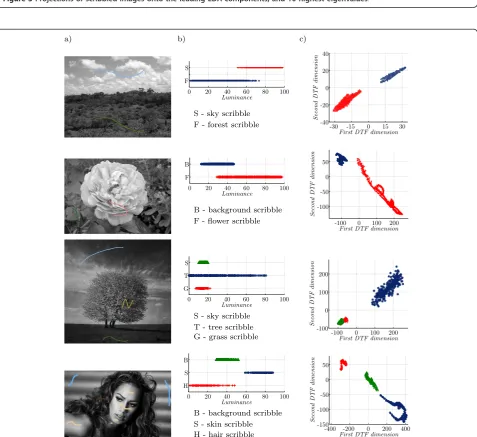
After training, a projection matrix F is obtained and every pixel in the image is projected onto m -dimen-sional DTF space. Examples of three scribbled images and their projection onto three leading LDA compo-nents are shown in Figure 3. They represent the most discriminative textural features and the eigenvalues asso-ciated with them are given underneath. It may be observed that these projections differentiate well between the areas marked with the scribbles. Also, 10 highest eigenvalues obtained for every image are plotted in the figure (rightmost column). The values on the ver-tical axis are given in relation to the highest eigenvalue.
0 2 0.4 0.6 0.8 1
0 0.2 0.4 0.6 0.8 1
1 2 3 4 5 6 7 8 9 10
Eigenvalue
a) λ1= 1361 λ2= 946 λ3= 263
0 2 0.4 0.6 0.81
0 0.2 0.4 0.6 0.81
1 2 3 4 5 6 7 8 9 10
Eigenvalue
b) λ1= 758 λ2= 569 λ3= 335
0 2 0.4 0.6 0.8 1
0 0.2 0.4 0.6 0.8 1
1 2 3 4 5 6 7 8 9 10
Eigenvalue
c) λ1= 965 λ2= 727 λ3= 488
Figure 3Projections of scribbled images onto the leading LDA components, and 10 highest eigenvalues.
a) b) c)
0 20 40 60 80 100 F
S
Luminance
S - sky scribble
F - forest scribble -40-30 -15 0 15 30 -20
0 20 40
First DTF dimension
Second DTF dimension
0 20 40 60 80 100 F
B
Luminance
B - background scribble
F - flower scribble -100 0 100 200
-100 -50 0 50
First DTF dimension
Second DTF dimension
0 20 40 60 80 100 G
T S
Luminance
S - sky scribble T - tree scribble
G - grass scribble -100 0 100 200
-100 0 100 200
First DTF dimension
Second DTF dimension
0 20 40 60 80 100
H S B
Luminance
B - background scribble S - skin scribble
H - hair scribble -400 -200 0 200 400
-150 -100 -50 0 50
First DTF dimension
Second DTF dimension
(G–red) scribbles in the tree image are overlapping each other even in the DTF subspace, but they both are well separated from the tree class. Although the achieved result is not perfect, it appeared sufficient to colorize the image properly as presented later in this section. For the last image, the three classes, i.e., “skin” (S–blue),
“background” (B–green), and “hair” (H–red) are well separated.
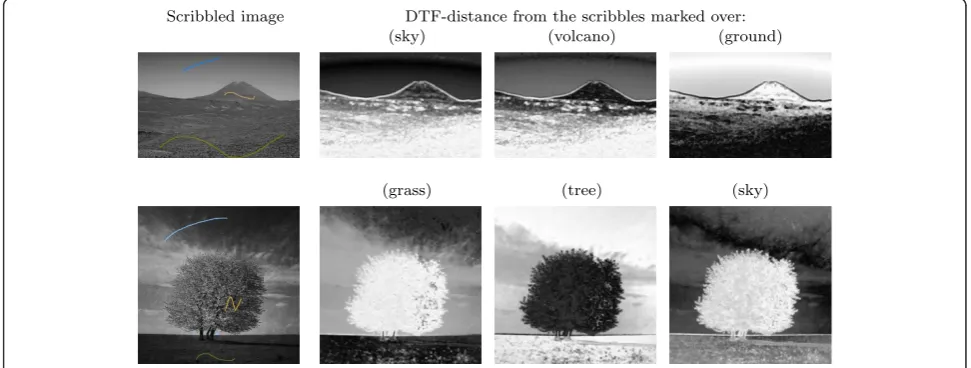
For every scribble, a mean DTF feature vector is obtained and its DTF-distancedDTF(7) to every pixel in the image is computed in the DTF space. In this way, a DTF-distance mapdiis obtained for everyith scribble. Examples of the DTF-distance maps generated for two images are presented in Figure 5. Darker shade indicates smaller distance, i.e., greater similarity to the source scribble. It is clear from the Figure that the DTF-dis-tance maps better differentiate between the scribbled regions than the original images themselves.
Potentially, the distance maps could be used directly for chrominance blending. In such a case, to obtain an
ith weight for a pixel x, the distance in DTF spacedi(x) could be used instead of the total path costCi(x) in (3). However, such approach does not beneft from pixels location and their geometrical distance from the scrib-bles. Also, continuity of the regions would not be guar-anteed in this way. The DTF-distance maps can be used directly for some other applications, e.g., color transfer or video colorization, but here we found it better to treat them as a domain for color propagation. The local cost rfrom pixel xtoy equals they pixel value in the DTF-distance map (r(x, y) =di(y)). For example, it can be concluded from Figure 5 (grass) that the upper-right sky region is texturally similar to the grass. This results from the overlapping in the DTF subspace observed ear-lier in Figure 4. Fortunately, these regions are located far
from each other, which can be utilized using the propa-gation strategy. In this way these regions can be prop-erly colorized, which would not be achieved using the distance maps directly for blending.
The propagation paths are determined so that they follow the texture similar to that covered by the source scribble. This is contrary to FIVC approach, with which the path is determined to minimize the luminance changes. An example of a difference between these two alternative approaches is given in Figure 6. It shows the propagation paths leading from a scribble to a selected pixel obtained using two methods. The paths deter-mined using our method (b) do not leave the striped area, which makes it possible to colorize the image cor-rectly (c). The paths obtained using a conventional method (d) show that the textural information is not taken into account during the propagation. This results in wrong colorization outcomes (e).
5.3 Scribble boosting
The method presented earlier in this section makes it possible to implement a complete colorization system; however, it has a serious drawback concerned with the precision. Although the regions having different texture are properly classified and separated in the DTF sub-space, pixels lying at the region boundaries may be mis-classified. The size of such misclassified areas depends on the kernel dimensions used for obtaining the basic textural features. This results in observing small halos at the region boundaries, which decreases the reality of the colorized images. Examples of these artifacts are pre-sented in Figure 7.
If an image is densely annotated with scribbles, such effects are usually not observed using conventional methods. Following this observation, we decided to use
Scribbled image DTF-distance from the scribbles marked over: (sky) (volcano) (ground)
(grass) (tree) (sky)
the DTF-based propagation to significantly enlarge (boost) the original scribbles, so that they cover the inner parts of the regions having similar texture without defining their boundaries. After that, the image with boosted scribbles is subject to the competitive propaga-tion procedure presented in Secpropaga-tion 4.
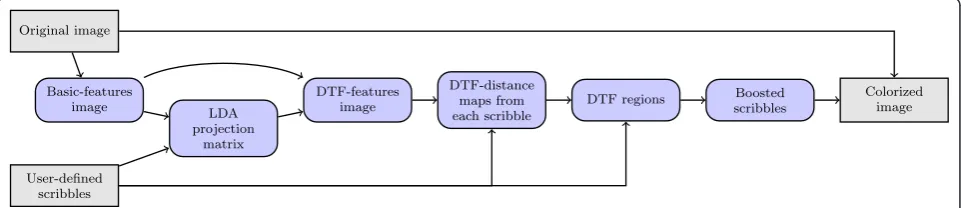
A flowchart of the proposed colorization method is given in Figure 8, and examples of resulting images obtained at subsequent steps of the procedure are demonstrated in Figure 9. The process consists of the following steps:
1. Basic textural features are extracted from every pixel in the original image as explained in Section 5.1.2. This operation creates anM-channel basic fea-tures image.
2. Each scribble forms an individual class of the basic feature vectors, extracted from the pixels cov-ered by that scribble. This establishes a classified train set for LDA, which generates the projection matrix during training.
3. Based on the LDA projection matrix, the basic feature image is transformed into a DTF-features image.
4. A distance map in the DTF domain is obtained for every scribble as described in Section 5.2, using Equation (7).
5. Optimal paths from each scribble to every pixel in the image are determined using the DTF-distance maps. Here, we found it better to compute the total path cost as a maximal DTF-distance encountered
on the path. Hence, the total path cost is obtained
as Cboost(p) =i=0...(maxl−1){d(p(i))}. In this way the image is divided into mutually exclusive DTF regions, in which the individual scribbles win. 6. Every DTF region conquered by an individual scribble is shrunk using distance transform from the region’s boundary. The shrinking margin size is determined based on an average length of the paths leading from the scribble to the boundary (¯lb).
Dur-ing our experiments we set it to 0.75 0.75¯lb, and we
additionally provide that the original scribbles remain untouched after the shrinking. The shrunk regions are treated as the boosted scribbles for com-petitive propagation.
7. Competitive colorization is performed from the boosted scribbles (as outlined in Section 4). This operation generates the final colorized image.
Texture-based scribble boosting greatly facilitates the colorization of large image regions of uniform texture which are expected to obtain common chrominance. However, tiny image details are usually annotated with scribbles of specific colors which should not propagate far. Moreover, taking them into account for DTF com-putation may affect the discrimination power of the obtained feature space. Therefore, we allow the user to decide which scribbles are supposed to propagate only in their close neighborhood. We do not consider them for scribble boosting, and we also apply decreased scrib-ble strength for them (e.g.,si= 0.1). Although it may be
a) b) c) d) e)
Figure 6Scribbled images (a), propagation paths and colorized image obtained using our (b, c) and Yatziv’s approach (d, e).
Original image
Basic-features image
User-defined scribbles
LDA projection
matrix
DTF-features image
DTF-distance maps from each scribble
DTF regions Boosted scribbles
Colorized image
Figure 8Flowchart of the proposed scribble boosting method.
Scribbled images
DTF-distance maps from every scribble
DTF regions before shrinking
Boosted scribbles
Result obtained after competitive colorization from boosted scribbles
argued that this increases the user interaction, the over-all gain attributed to the proposed technique is definitely beneficial.
6 Experimental validation
Experimental validation of the proposed colorization fra-mework was focused on two main aspects. First, we investigated how sensitive the method is to amount and density of the scribbles. Then, we evaluated the obtained colorization result for a group of images, on the basis of mean opinion score (MOS). We compared the proposed method with two well-established colorization techni-ques: (1) Colorization using optimization (CUO) pro-posed by Levin [10] and (2) Fast image and video colorization (FIVC) proposed by Yatziv [3]. The first one is published in the form of MATLAB code and for the latter we used our implementation.
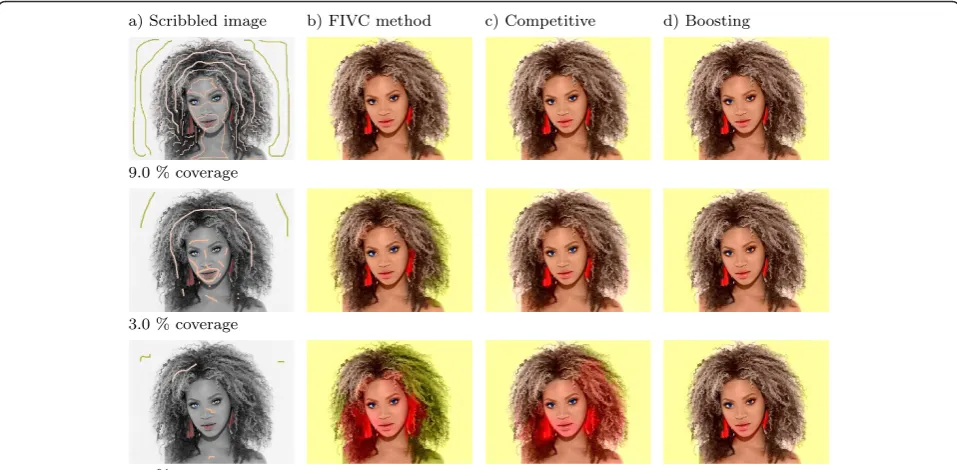
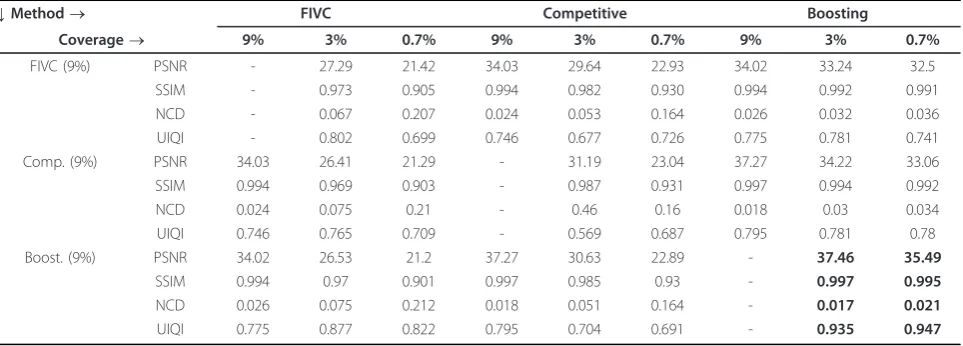
In Figures 10 and 11, we present two images colorized based on three scribble sets of different coverage (i.e., area covered by the scribbles expressed as percentage of the whole image area). The images were colorized using three methods, namely: (1) FIVC [3], (2) competitive image colorization [2], and (3) the proposed method. To provide fair comparison, we applied the blending weights to the FIVC method as well, as it is outlined in Section 3.2. The similarity measures between the obtained images are documented in Tables 1 and 2. Here, the images colorized using the highest scribble coverage (9 and 5.8%, accordingly) are compared with all the other images. We measured the similarity using
Peak Signal-to-Noise Ratio (PSNR), Structural Similarity Index (SSIM) [23], Normalized Color Distance (NCD) [24], and Universal Image Quality Index (UIQI) [25].
It may be observed that for large scribble coverage, three investigated methods deliver very similar outcome (top row in the Figures), and the differences are hardly visible, which is confirmed by the quantitative results. However, for smaller coverage, the images obtained using these methods differ significantly. It may be seen that both visually and quantitatively FIVC method is the most sensitive to the scribble coverage and it fails to colorize the images correctly for fewer scribbles. Com-petitive image colorization has higher stability, making it possible to colorize the image based on medium scribble coverage. However, it is only the proposed boosting technique which is very little dependent on the density and precision of the scribbles. Here, the colorized images are almost identical regardless of the scribble coverage, as it can be seen in the rightmost column in the Figures. Also, the similarity scores (highlighted in the tables) are very high between these images. It may be therefore concluded that using the proposed scribble boosting technique, it is possible to colorize images even from sparse scribble sets.
We have demonstrated that the scribble boosting does not depend much on the scribble coverage, making it possible to colorize images using small amount of scrib-bles. Furthermore, we have also investigated whether the location of scribbles may affect the colorization result. Figure 12 presents two images colorized from two
a) Scribbled image b) FIVC method c) Competitive d) Boosting
9.0 % coverage
3.0 % coverage
0.7 % coverage
alternative sparse scribble sets. Although the scribbles supposed to colorize larger areas of uniform texture were positioned in different locations (upper row), it is hardly possible to spot any visual differences in the obtained results (bottom row). This is also indicated by high similarity scores presented in the Figure. Basically, it can be concluded that the scribble boosting is insensi-tive to changes in scribble location.
It is worth noting that the aim of image colorization is to achieve plausible visual impression on a human observer, and it is the visual effect which should deter-mine how good an algorithm is. As it is difficult to
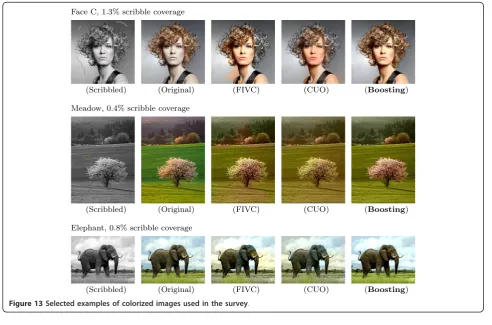
measure visual attractiveness, we presented a group of 34 images to 38 observers. They were asked to rate the quality and naturalness of the images (scaled from 1 to 10). Thus, we obtained mean opinion scores (MOS) which are demonstrated in Table 3. Some examples of the images presented during this survey, as well as the scribbled grayscale images, are shown in Figure 13. All images used for the survey can be viewed at http://sun. aei.polsl.pl/~mkawulok/boosting/survey.pdf. The rest of images colorized using the proposed technique are shown in Figure 14. For the majority of cases the origi-nal color versions were available, and they were also
a) Scribbled image b) FIVC method c) Competitive d) Boosting
5.8 % coverage
1.8 % coverage
0.8 % coverage
Figure 11Landscape image colorized using diferent methods based on three levels of scribble coverage.
Table 1 Similarity scores between the images presented in Figure 10
↓Method® FIVC Competitive Boosting
Coverage® 9% 3% 0.7% 9% 3% 0.7% 9% 3% 0.7%
FIVC (9%) PSNR - 27.29 21.42 34.03 29.64 22.93 34.02 33.24 32.5 SSIM - 0.973 0.905 0.994 0.982 0.930 0.994 0.992 0.991 NCD - 0.067 0.207 0.024 0.053 0.164 0.026 0.032 0.036 UIQI - 0.802 0.699 0.746 0.677 0.726 0.775 0.781 0.741 Comp. (9%) PSNR 34.03 26.41 21.29 - 31.19 23.04 37.27 34.22 33.06 SSIM 0.994 0.969 0.903 - 0.987 0.931 0.997 0.994 0.992
NCD 0.024 0.075 0.21 - 0.46 0.16 0.018 0.03 0.034
UIQI 0.746 0.765 0.709 - 0.569 0.687 0.795 0.781 0.78 Boost. (9%) PSNR 34.02 26.53 21.2 37.27 30.63 22.89 - 37.46 35.49
SSIM 0.994 0.97 0.901 0.997 0.985 0.93 - 0.997 0.995
NCD 0.026 0.075 0.212 0.018 0.051 0.164 - 0.017 0.021
UIQI 0.775 0.877 0.822 0.795 0.704 0.691 - 0.935 0.947
presented to the observers in order to establish the reference level. It may be noticed that the colorized images differ much from the originals. This is because the scribbles do not indicate all the details, and in some cases the chrominance assigned to a scribble is different from the chrominance in the original image. Moreover, the chrominance variance is much higher in the origi-nals, while the colorized images inherit only a mixture of the chrominance values assigned to the scribbles. This disadvantage may be overcome by assigning a color palette to every scribble instead of a single chrominance, analogously to the luminance keying [4]. Despite of that, the colorized images scores were quite close to those obtained by the originals, and even higher in some cases. This was mainly due to the fact that the area con-quered by the individual scribbles appears correct and natural using the proposed scribble boosting. Although these rates are lower than for the originals, they are
definitely better than those obtained for the alternative conventional techniques.
7 Conclusions and future work
This paper presents a new method for image coloriza-tion which utilizes local textural features. We have demonstrated that texture is a powerful source of infor-mation that supports the colorization process. The pro-posed scribble boosting technique increases the original scribbles on the basis of discriminant textural features. This facilitates interactive image colorization, and decreases the required density and precision of the scribbles. DTF are determined for every individual image using linear discriminant analysis, which makes the method adaptive to local conditions.
The method can be further extended and used for color transfer and video colorization. Once the DTF space is created for a given image, it may be applied to
0.7 % coverage 0.64 % coverage 0.84 % coverage 0.67 % coverage
PSNR=38.69, SSIM=0.9978 PSNR=54.71, SSIM=0.9999 NCD=0.0121, UIQI=0.9891 NCD=0.0005, UIQI=0.9994
Figure 12Images colorized using two alternative scribble locations (for small scribble coverage).
Table 2 Similarity scores between the images presented in Figure 11
↓Method® FIVC Competitive Boosting
Coverage® 5.8% 1.8% 0.8% 5.8% 1.8% 0.8% 5.8% 1.8% 0.8%
FIVC (5.8%) PSNR - 27.55 25.07 30.26 30.46 28.45 37.6 36.51 36.51 SSIM - 0.942 0.919 0.966 0.963 0.949 0.987 0.985 0.985 NCD - 0.069 0.102 0.03 0.035 0.054 0.013 0.022 0.022 UIQI - 0.891 0.874 0.92 0.917 0.901 0.937 0.938 0.937 Comp. (5.8%) PSNR 30.26 28.86 25.73 - 37.45 31.01 30.45 30.78 30.79 SSIM 0.966 0.965 0.941 - 0.992 0.975 0.975 0.976 0.976
NCD 0.03 0.053 0.086 - 0.014 0.034 0.022 0.03 0.03
UIQI 0.92 0.927 0.9 - 0.961 0.941 0.954 0.953 0.953
Boost. (5.8%) PSNR 37.6 27.12 24.74 30.45 30.81 28.41 - 40.00 39.97
SSIM 0.987 0.944 0.919 0.975 0.971 0.954 - 0.996 0.996
NCD 0.013 0.068 0.101 0.022 0.028 0.049 - 0.015 0.015
UIQI 0.937 0.91 0.885 0.954 0.948 0.926 - 0.975 0.975
any other image having similar contents. This extension will be explored during our future works.
Acknowledgements
This work has been supported by the Polish Ministry of Science and Higher Education under R&D grant no. N N516 374736 from the Science Budget 2009-2011.
Competing interests
The authors declare that they have no competing interests.
Received: 1 April 2011 Accepted: 10 November 2011 Published: 10 November 2011
References
1. M Kawulok, J Kawulok, B Smolka, Textural features for scribble-based image colorization, inComputer Recognition Systems 4, Advances in Intelligent and
Face C, 1.3% scribble coverage
(Scribbled) (Original) (FIVC) (CUO) (Boosting) Meadow, 0.4% scribble coverage
(Scribbled) (Original) (FIVC) (CUO) (Boosting) Elephant, 0.8% scribble coverage
(Scribbled) (Original) (FIVC) (CUO) (Boosting)
Figure 13Selected examples of colorized images used in the survey.
Flower Tree Face A Face B Face D Forest
Figure 14Examples of images used in the survey, colorized using scribble boosting.
Table 3 Mean opinion scores obtained for original and colorized images
Original image
FIVC method
CUO method
Scribble boosting
Elephant 8.91 ± 1.26 3.39 ± 2.12 3.26 ± 1.78 7.97 ± 1.29 Face A 7.76 ± 1.78 4.91 ± 1.75 4.38 ± 1.99 7.53 ± 1.73 Face B 8.44 ± 1.85 2.03 ± 1.17 2.24 ± 1.65 4.15 ± 2.05 Face C 5.82 ± 2.26 4.09 ± 2.17 4.24 ± 1.99 7.41 ± 1.99 Face D - 5.47 ± 2.03 6.18 ± 2.11 6.97 ± 1.93 Flower 8.91 ± 1.56 4.21 ± 2.12 3.71 ± 1.99 8.03 ± 1.88 Forest 8.56 ± 1.88 4.97 ± 1.88 3.88 ± 2.23 7.44 ± 1.62 Meadow 8.24 ± 1.72 4.71 ± 1.99 5.74 ± 1.96 6.94 ± 1.92 Tree - 3.06 ± 1.52 3.82 ± 1.66 4.82 ± 1.95
Soft Computing, vol. 95, ed. by R Burduk, M Kurzynski, M Wozniak, and A Zolnierek (Springer, Berlin, 2011), pp. 269–278
2. M Kawulok, B Smolka, Competitive image colorization, inIEEE ICIP, IEEE, Hong Kong, pp. 405–408 (2010)
3. L Yatziv, G Sapiro, Fast image and video colorization using chrominance blending. IEEE Trans Image Proc.15(5), 1120–1129 (2006)
4. R Gonzalez, R Woods,Digital Image Processing, (Addison Wesley Publishing, Boston, 1987)
5. T Welsh, M Ashikhmin, K Mueller, Transferring color to greyscale images. ACM Trans Graph (TOG).21(3), 277–280 (2002)
6. U Lipowezky, Grayscale aerial and space image colorization using texture classifcation. Pattern Rec Lett.27(4), 275–286 (2006). doi:10.1016/j. patrec.2005.08.009
7. D Sykora, J Burianek, J Zara, Unsupervised colorization of black-and-white cartoons, inSIGGRAPH, ACM, Los Angeles, California, pp. 121–127 (2004) 8. T Horiuchi, Colorization algorithm using probabilistic relaxation. Image Vis
Comput.22(3), 197–202 (2004). doi:10.1016/j.imavis.2003.08.004 9. T Horiuchi, H Kotera, Colorization for monochrome image with texture, in
Proceedings of 13th Color Imaging Conference, IS&T, Scottsdale, Arizona, pp. 245–250 (2005)
10. A Levin, D Lischinski, Y Weiss, Colorization using optimization, inSIGGRAPH, ACM, Los Angeles, California, pp. 689–694 (2004)
11. P Lagodzinski, B Smolka, Digital image colorization based on probabilistic distance transform, inELMAR, 2008, vol. 2. (IEEE, Zadar, Croatia, 2008), pp. 495–498
12. V Konushin, V Vezhnevets, Interactive image colorization and recoloring based on coupled map lattices, GraphiCon, (GraphiCon, Novosibirsk Akademgorodok, Russia, 2006), pp. 231–234
13. T Kim, K Lee, S Lee, Edge-preserving colorization using data-driven random walks with restart, IEEE ICIP, (IEEE, Cairo, Egypt, 2009), pp. 1661–1664 14. L Ikonen, P Toivanen, Distance and nearest neighbor transforms on
gray-level surfaces. Pattern Rec. Lett.28(5), 604–612 (2007). doi:10.1016/j. patrec.2006.10.010
15. E Mortensen, W Barrett, Interactive segmentation with intelligent scissors. Graph Models Image Proc.60(5), 349–384 (1998). doi:10.1006/ gmip.1998.0480
16. J Heu, D Hyun, C Kim, S Lee, Image and video colorization based on prioritized source propagation, inIEEE ICIP, IEEE, Cairo, Egypt, pp. 465–468 (2009)
17. J Zhang, S Lazebnik, C Schmid, Local features and kernels for classifcation of texture and object categories: a comprehensive study. Int J Comput Vis. 73, 213–238 (2007). doi:10.1007/s11263-006-9794-4
18. RM Haralick, Statistical and structural approaches to texture. Proc IEEE.67(5), 786–804 (1979)
19. T Ojala, M Pietikäinen, T Mäenpää, Multiresolution gray-scale and rotation invariant texture classifcation with local binary patterns. IEEE Trans Pattern Anal Mach Intell.24(7), 971–987 (2002). doi:10.1109/TPAMI.2002.1017623 20. J Portilla, E Simoncelli, A parametric texture model based on joint statistics
of complex wavelet coefficients. Int J Comput Vis.40(1), 49–71 (2000). doi:10.1023/A:1026553619983
21. M Varma, A Zisserman, A statistical approach to texture classifcation from single images. Int J Comput Vis.62, 61–81 (2005)
22. G Seber,Multivariate Observations, (Wiley, New York, 1984)
23. Z Wang, A Bovik, HR Sheikh, EP Simoncelli, Image quality assessment: from error visibility to structural similarity. IEEE Trans Image Process.13(4), 600–612 (2004). doi:10.1109/TIP.2003.819861
24. R Lukac, K Plataniotis, D Hatzinakos, M Aleksic, A novel cost efective demosaicing approach. IEEE Trans Consum Electron.50(1), 256–261 (2004). doi:10.1109/TCE.2004.1277871
25. Z Wang, A Bovik, A universal image quality index. IEEE Signal Process Lett. 9(3), 81–84 (2002). doi:10.1109/97.995823
doi:10.1186/1687-6180-2011-99
Cite this article as:Kawulok and Smolka:Texture-adaptive image
colorization framework.EURASIP Journal on Advances in Signal Processing
20112011:99.
Submit your manuscript to a
journal and benefi t from:
7Convenient online submission
7Rigorous peer review
7Immediate publication on acceptance
7Open access: articles freely available online
7High visibility within the fi eld
7Retaining the copyright to your article
, plain distance (b), and gradient-sticky distance (c).](https://thumb-us.123doks.com/thumbv2/123dok_us/1144632.1143614/4.595.59.539.495.713/figure-propagation-determined-distance-defined-distance-gradient-distance.webp)
, plain distance (b), and gradient-stickydistance (c).](https://thumb-us.123doks.com/thumbv2/123dok_us/1144632.1143614/5.595.60.541.89.235/figure-reached-obtained-distance-defined-distance-gradient-stickydistance.webp)