A preliminary version of this paper appears in TCC 2016-A. This is the full version appearing as IACR ePrint Archive Report 2015/703.
Point-Function Obfuscation:
A Framework and Generic Constructions
Mihir Bellare1 Igors Stepanovs2
March 2016
Abstract
We give a definitional framework for point-function obfuscation in which security is parame-terized by a class of algorithms we call target generators. Existing and new notions are captured and explained as corresponding to different choices of this class. This leads to an elegant ques-tion: Is it possible to provide a generic construction, meaning one that takes an arbitrary class of target generators and returns a point-function obfuscator secure for it? We answer this in the affirmative with three generic constructions, the first based on indistinguishability obfuscation, the second on deterministic public-key encryption and the third on universal computational extractors. By exploiting known constructions of the primitives assumed, we obtain new point-function obfuscators, including many under standard assumptions. We end with a broader look that relates different known and possible notions of point function obfuscation to each other and to ours.
1
Department of Computer Science & Engineering, University of California San Diego, 9500 Gilman Drive, La Jolla, California 92093, USA. Email: [email protected]. URL:http://cseweb.ucsd.edu/~mihir/. Supported in part by NSF grants CNS-1116800, CNS-1228890 and CNS-1526801. This work was done in part while the author was visiting the Simons Institute for the Theory of Computing, supported by the Simons Foundation and by the DIMACS/Simons Collaboration in Cryptography through NSF grant CNS-1523467.
2
Contents
1 Introduction 2
1.1 Background . . . 2
1.2 Contributions in brief . . . 3
1.3 Definitional framework . . . 3
1.4 Generic constructions . . . 4
1.5 Alternative notions and relations between notions . . . 6
1.6 Discussion and further related work . . . 6
2 Notation and standard definitions 7 3 Point-function obfuscation framework 9 4 (d)iO for multi-circuit samplers 12 5 Generic constructions of PO 14 5.1 PO from iO . . . 14
5.2 PO from DPKE . . . 16
5.3 PO from UCE . . . 18
6 Alternative security notions for PO 21
1
Introduction
In the theory of point-function obfuscation (PO), there are many different goals and definitions. It is (at least to us) hard territory to navigate. Meanwhile, there are few constructions, and the ones that exist use strong assumptions. We try to bring some structure and unity to this area via a parameterized definitional framework, generic constructions and relations between definitions.
1.1 Background
A point function with target k ∈ {0,1}∗ is the circuit Ik that on input k′ ∈ {0,1}|k| returns 1 if
k′ =kand 0 otherwise. A point-function obfuscatorObftakes inputIk and returns another circuit
P that is functionally equivalent to Ik, meaning on input k′ ∈ {0,1}|k| it also returns 1 if k′ = k
and 0 otherwise. Security requires that P hides k. We now discuss prior security definitions and constructions.
Definitions.Security definitions of point-function obfuscation show consideration of many differ-ent issues and use differdiffer-ent styles. Both definitions that allow auxiliary information [23, 35, 29, 14, 42, 21, 20] and ones that don’t [23, 27, 41, 51, 25, 26, 6] have been considered. Sometimes security pertains only to a single target point [23, 27, 51, 35, 29, 20], other times it consider many simulta-neous target points [41, 25, 11, 26, 14, 6, 42, 22]. Some definitions are simulation-based, splitting up into average-case [23, 27, 29, 26, 6] and worst-case [41, 51, 35, 25, 11, 14, 42]. (Simulation-based definitions can be further customized in a number of ways [50], some of which we discuss in Sec-tion 6.) Some definiSec-tions are indistinguishability based, with different formalizaSec-tions in [23] and in [14, 42, 20, 21, 22]. Indistinguishability-based definitions require some kind of unpredictability of the target point, and there are variants here, for example whether the condition should be for polynomial-time or unbounded adversaries, and with negligible or sub-exponential advantage. And this list is not complete.
While many issues have been considered, the consideration has not been systematic, in the following sense. Think of issues (for example whether or not auxiliary information is present, one target or many, polynomial-time or unbounded predictability adversaries in the context of an indistinguishability-based definition, ...) as dimensions or axes in a multi-dimensional space. Then definitions in the literature can be seen as capturing some points in this space. But there is no systematic attempt to look in some unified way at all the points in this space. This is what we will attempt to do.
assumption called Assumption 2.1 in their paper, that it achieves security with targets that are hard to predict given the auxiliary information. BP [14] explain that Assumption 2.1 asks for (a weak form of) extractability, making it a strong assumption in light of the impossibility of related extractable primitives [13]. DKL [29] use a novel assumption they call LSN to give a construction for targets that are exponentially hard to predict given the auxiliary information. BHK [6] give a construction for statistically hard to predict targets and no auxiliary information based on a multi-key version of their UCE assumption. There are simple constructions in the ROM [41].
In summary, there are few constructions and those that exist use strong and sometimes novel assumptions. Also, each construction achieves a different variant of the goal, and it is hard to visualize, or say in a concise way, what has been done. The framework that we now discuss provides language to do this.
1.2 Contributions in brief
We pick one, simple indistinguishability-based definitional template. Using this, we provide a framework parameterized by a class X of objects we call target generators, giving a definition of what it means for a point-function obfuscator to be IND[X] secure. This allows us to recover and explain different notions in the literature as each corresponding to a choice of X, and also obtain many natural new ones, points in the above-mentioned multi-dimensional space that had not been explicitly considered.
This taxonomy leads to a compelling and general new question: Is it possible to find a generic construction, meaning a compiler that given an arbitrary X returns a point-function obfuscator secure relative to it? We answer this in the affirmative by providing three such generic constructions. As a consequence we obtain new constructions for both old and new forms of PO.
We then step back to consider other definitions of PO. These include existing simulation and indistinguishability style notions, as well as a new, semantic security style definition emanating from a connection to DPKE (Deterministic Public-Key Encryption) [3]. We formulate these also in a parameterized framework and then provide relations (implications and separations) between these notions and our IND notion.
We now look at these three contributions in more detail.
1.3 Definitional framework
Recall that a point-function obfuscator Obf takes input Ik and returns another circuit P that is
functionally equivalent to Ik. Security requires that P hides k. We define a target generator X
as a polynomial-time algorithm that on input the security parameter returns a vector k of target points together with auxiliary information a. We measure security of a candidate point-function obfuscatorObfrelative toX. To do this, we associate to an adversaryAits advantageAdvindObf,X,A(·) in guessing the challenge bit b in the following game. We run X to get (k, a). We let P be the vector obtained by independently obfuscating Ik for each of the targets k from k (b = 1) or by
obfuscating the same number of random, independent targets (b= 0). The input toA isPand a. Now we letXbe a class (set) of target generatorsXand say that obfuscatorObfis IND[X]-secure if AdvindObf,X,A(·) is negligible for all polynomial timeA and allX∈X. Our definition of IND security is an extended, parameterized version of security definitions used for point-function obfuscation in [14, 42, 20, 21, 22]. See Section 3 for a formal definition.
capture specific restrictions, and by intersecting classes we can combine them, allowing us to speak precisely yet concisely about different variant notions that are unified in this way.
IND[X]-security is not achievable for all X. For example, X could pick k[1] to be the string of all zeroes, and the adversary could test whether or not P returns 1 on input that string. The minimal requirement for security is that the target points produced by X are unpredictable given a. In Section 3 we formalize a prediction game and advantage so that we can define the classes Xcup,Xseup and Xsup of computationally, sub-exponentially and statistically unpredictable target generators. We let Xq(·) denote the class of target generators outputting q(·) target points and Xε the class of target generators that produce no auxiliary information. (Formally it is the empty string.)
The framework allows us to capture prior goals in compact way. IND[Xcup∩Xε∩X1] is plain point-function obfuscation [23, 27, 41, 51], where there is just one target point, no auxiliary infor-mation, and unpredictability is computational. IND[Xcup∩X1] is AIPO [23, 35, 14, 20], where there is again one target point, but auxiliary information is now present, while unpredictability continues to be computational. IND[Xcup] is composable AIPO [25, 14], where there are many arbitrarily correlated target points, auxiliary information is present, and unpredictability is computational. DKL [29] achieve IND[Xsup∩X1], where there is a single target that is statistically hard to predict given the auxiliary information. BHK [6] achieve IND[Xsup∩Xε], where there are multiple targets, unpredictability is statistical, and there is no auxiliary information. Other prior notions can be captured in similar ways, and many natural new notions emerge as well.
1.4 Generic constructions
As we saw above, constructions so far have been ad hoc, targeting different security goals and using strong, novel assumptions to achieve them. The above framework allows us to frame a compelling question, namely whether there are generic constructions. By this we mean that we are handed an arbitrary class X of target generators and asked to craft an obfuscator that is IND[X]-secure. If we can do this, we can, in one step, obtain constructions for a wide variety of forms of PO, not only ones considered in the past, but also new ones.
We provide three such generic constructions. The first is based on indistinguishability obfusca-tion, the second on deterministic public-key encryption and the third on (multi-key) UCE.
One natural objection at this point is that we know that IND[X] is not achievable for some choices ofX. For example, assuming iO, this is true forX=Xcup, meaning composable PO. (This follows by combining [20, 24].) So how can our constructions achieve IND[X] for any given X? In fact, they do, and this, interestingly, yields new negative results, ruling out the primitives we start from for those particular values ofX. We will explain further below.
PO from iO. The emergence of candidate constructions for iO (indistinguishability obfuscation) [33, 46, 12, 34] raised a natural hope, namely that one could obtain PO from iO. But this has not happened. Despite the many powerful applications of iO, constructing point-function obfuscation from it has surprisingly evaded effort.
We show that iO plus a OWF yields PO. More precisely, for any class of target generators X we show iO + OWF[X]⇒IND[X]: Given iO and a family of functions that is one-way relative toX as defined in Section 5.1 we can construct an obfuscator that is IND[X]-secure. The construction, result and proof are in Section 5.1. The idea is that to obfuscate Ik we pick at random a key fk
the proof in a manner similar to [9]. We will need it for circuits that differ only on one input, and in this case the result of BCP [16] says that an iO-secure obfuscator is also diO-secure, so the assumption remains iO. As part of the proof we state and prove a lemma reducing (d)iO on polynomially-many, related circuits to the usual single-circuit case. We note that to guarantee the usual (perfect) correctness condition of a PO, we require the OWF to be injective.
We highlight the simplest case of this result as still being novel and of interest. Namely, given iO and an ordinary injective OWF, we achieve plain point-function obfuscation, IND[Xcup∩Xε∩X1] in our notation. Previous constructions have been under assumptions that at this point seem less accepted than iO, and Wee [51] gives various arguments as to why this goal is hard under standard assumptions. Also on the negative side, combining our result with [20, 24] allows us, under iO, to rule out OWF[Xcup] (one-way functions secure for polynomially-many correlated inputs that are computationally unpredictable in the presence of auxiliary information), at least in the injective case.
PO from DPKE.Deterministic public key encryption (DPKE) [3] was motivated by applications to efficient searchable encryption [3]. It cannot provide IND-CPA security. Instead, BBO [3] provide a definition of a goal called PRIV which captures the best-possible security that encryption can provide subject to being deterministic. At this point many constructions of DPKE are known for various variant goals [3, 15, 4, 17, 32, 5, 52, 54, 48, 44, 40].
We show how to leverage these for point-function obfuscation via our second generic construc-tion. We show that PRIV1[X] ⇒ IND[X]. That is, given a deterministic public-key encryption scheme that is PRIV1 secure relative to Xwe can build a point-function obfuscator secure relative to the same class in a simple and natural way. Namely to obfuscateIkwe pick at random a public
key pk and the associated secret key sk for the DPKE scheme and let c be the encryption of k under pk. The point-function obfuscation is the circuit C that hardwires pk, c and on input k′, returns 1 if the encryption ofk′ underpk equalsc, and 0 otherwise. The fact that the encryption is deterministic is used crucially to define the circuit. (The latter must be deterministic.) The secret keysk is discarded and not used in the construction. We note that we only require security of the DPKE scheme for a single message (PRIV1) so the negative result of Wichs [53] does not apply. The construction, result and proof are in Section 5.2.
From the LTDF-based DPKE scheme of BFO [15] and LTDFs from [47, 31, 52, 37, 55] we now get IND[Xsup∩Xε∩X1]-secure obfuscators under a large number of standard assumptions. We also get IND[Xseup∩X1]-secure obfuscators under the DLIN, Subgroup Indistinguishability and LWE assumptions via [17, 54, 52]. On the negative side we can rule out PRIV1[Xcup]-secure DPKE under iO via [20, 24].
PO from UCE.UCE [6] is a class of assumptions on function families crafted to allow instantiation of random oracles in certain settings. UCE security is parameterized so that we have UCE[S] security of a family of functions for different choices of classes S of algorithms called sources. The parameterization is necessary because security is not achievable for the class of all sources. Different applications rely on UCE relative to different classes of sources [6, 18, 21, 43, 5, 28].
is valid as far as we know for many choices ofX, yielding new constructions.
1.5 Alternative notions and relations between notions
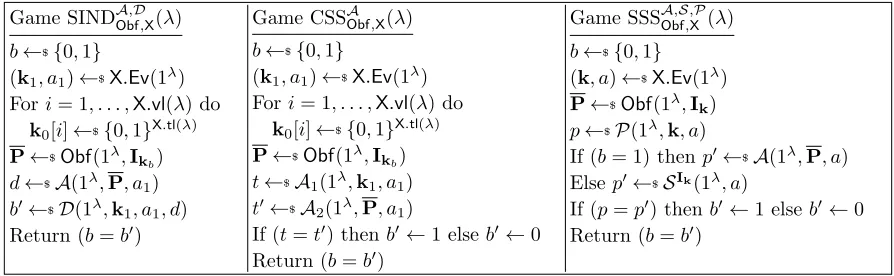
Above, we fixed one, basic definitional template, which we called IND, and then parameterized it by classes X of target generators to get notions IND[X]. However, there are other possible choices for the basic template, some emanating from the literature, and others from the definitional similarity of PO with DPKE. We consider parameterized versions of some of these and relate them to each other and to IND. Specifically we define and consider the following (see Section 6 for formal definitions):
• SIM[X] and SSS[X]: (Simulation) Canetti [23] defined a security notion for point-function ob-fuscation called oracle simulatability, which can be thought as a special case (pertaining to point-functions) of the VBB security that was later defined by Barak et al [2]. Definitions of this style were subsequently used in many other papers [41, 51, 35, 25, 29, 14, 42]. With SIM[X] and SSS[X] we give X-parameterized versions of the worst-case and average-case simulation-based security definitions, respectively.
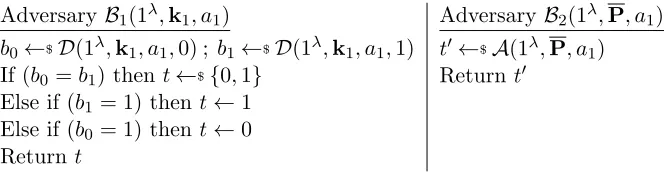
• SIND[X]: (Strong Indistinguishability) Recall that in IND[X], the adversary decision bit is pro-duced as a function of the vectorPof obfuscated point functions and the auxiliary information a. In SIND[X], this bit is not the final decision, but is passed to another adversary who produces the final decision based on it and the target vector itself. This is a parameterized version of the definition of [23].
• CSS[X]: (Comparison-based semantic security) This is an analogue of comparision based se-mantic security for boolean functions for DPKE [4] in which the adversary needs to compute some predicate on the target vector and auxiliary information.
Fig. 9 shows the relations between five parameterized notions of PO, namely the four above and our original IND[X].
1.6 Discussion and further related work
In concurrent and independent work, BM3 [22] take first steps towards a parameterized defini-tion for point-funcdefini-tion obfuscadefini-tion, with separate definidefini-tions for the basic and composable cases. They also show that injective mUCE-secure function families for strongly unpredictable sources making one oracle query per key implies composable AIPO (both for computational and statistical unpredictability), which is a special case of our mUCE result.
Multi-bit auxiliary-input point-function obfuscation (MB-AIPO) [25, 11, 42] allows one to ob-fuscate the circuit Ik,m that on input k′ returns m if k = k′ and ⊥ otherwise, where k, m are
strings. CD [25] show that composable AIPO implies MB-AIPO. MB-AIPO was subsequently used in BP [14] and MH [42]. BM1 [20] show that if iO is possible then MB-AIPO is not. MB-AIPO seems to be quite a bit stronger than AIPO itself and in particular this result does not rule out AIPO.
In Section 5.1 we define OWF[X], one-wayness of a function family relative to a class of target generators, the targets here being the inputs to the OWF. We note that OWF[Xsup∩Xε] (inputs are statistically unpredictable and there is no auxiliary information) is the notion of a one-way correlation intractable hash (CIH) function family as per GOR [36].
require that decryption in the DPKE scheme is polynomial-time, CIH function families meeting the corresponding notions suffice as well.
A connection that does not seem to have been explicitly made and pursued is that definitionally, there is little to no difference between PO and deterministic public-key encryption (DPKE) [3, 4, 17] or other forms of entropic security [30, 36]. Existing systematic and in-depth consideration of DPKE definitions and relations between them [4, 17] can be exploited to obtain new semantic-security formalizations of PO and also to obtain definitional relations.
2
Notation and standard definitions
Notation.We denote byλ∈Nthe security parameter and by 1λ its unary representation. We letε denote the empty string. Ifsis an integer thenPads(C) denotes circuit C padded to have sizes. We
say that circuits C0,C1 are equivalent, written C0 ≡C1, if they agree on all inputs. Ifxis a vector then|x|denotes the number of its coordinates andx[i] denotes itsi-th coordinate. We writex∈x as shorthand forx∈ {x[1], . . . ,x[|x|]}. IfXis a finite set, we letx←$X denote picking an element of X uniformly at random and assigning it to x. Algorithms may be randomized unless otherwise indicated. Running time is worst case. “PT” stands for “polynomial-time,” whether for randomized algorithms or deterministic ones. If A is an algorithm, we let y ← A(x1, . . .;r) denote running A with random coinsr on inputsx1, . . .and assigning the output toy. We lety←$A(x1, . . .) be the result of pickingr at random and lettingy←A(x1, . . .;r). We let [A(x1, . . .)] denote the set of all possible outputs of A when invoked with inputs x1, . . .. We say thatf: N→ Ris negligible if for every positive polynomial p, there exists λp ∈ N such thatf(λ) <1/p(λ) for all λ > λp. We use
the code based game playing framework of [8]. (See Fig. 3 for an example.) By GA(λ) we denote the event that the execution of game G with adversary A and security parameterλ results in the game returning true.
Obfuscators. An obfuscator is a PT algorithm Obf that on input 1λ and a circuit C returns a circuit C. If C is an n-vector of circuits then Obf(1λ,C) denotes the vector (Obf(1λ,C[1]), . . . ,
Obf(1λ,C[n])) formed by applying Obf independently to each coordinate of C. The correctness conditionof obfuscatorObfrequires that for every circuit C, everyλ∈Nand every C∈[Obf(1λ,C)] we have C ≡ C (meaning C(x) = C(x) for all x). We also call the latter a perfect correctness condition and we require that it holds for all obfuscators. We consider various notions of security for obfuscators, namely indistinguishability obfuscation and variants of point-function obfuscation, including AIPO.
Game DIFFDS(λ)
(C0,C1,aux)←$S(1λ)
x←$D(C0,C1,aux)
Return (C0(x)̸= C1(x))
Game IOOObf,S(λ)
b←${0,1}
(C0,C1,aux)←$S(1λ)
C←$Obf(1λ,Cb)
b′←$O(1λ,C,aux)
Return (b=b′)
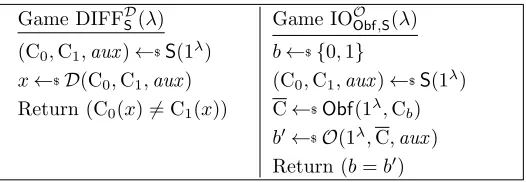
Figure 1: Games defining difference-security of circuit samplerSand iO-security of obfuscatorObf relative to circuit samplerS.
We say that a circuit sampler S is difference secure if AdvdiffS,D(·) is negligible for every PT adversaryD, whereAdvdiffS,D(λ) = Pr[DIFFDS(λ)] and game DIFFDS(λ) is defined in Fig. 1. Difference security ofSmeans that given C0,C1,aux it is hard to find an input on which the circuits differ [2, 16, 1]. Let Sdiff be the class of all difference-secure circuit samplers. We say that circuit samplerS produces d-differing circuits, where d: N→N, if for allλ∈N circuits C0 and C1 differ on at most d(λ) inputs with an overwhelming probability over (C0,C1,aux)←$S(1λ). LetS
diff(d) be the class of all difference-secure circuit samplers that produce d-differing circuits, so that Seq ⊆Sdiff(d) ⊆ Sdiff. The interest of this definition is the following result of BCP [16] that we use:
Proposition 2.1 If d is a polynomial then any Seq-secure circuit obfuscator is also an Sdiff(d) -secure circuit obfuscator.
Function families. A family of functionsF specifies the following. PT key generation algorithm
F.Kg takes 1λ to return a key fk ∈ {0,1}F.kl(λ), where F.kl: N → N is the key length function associated to F. Deterministic, PT evaluation algorithm F.Ev takes 1λ, key fk ∈ [F.Kg(1λ)] and an input x ∈ {0,1}F.il(λ) to return an output F.Ev(1λ,fk, x) ∈ {0,1}F.ol(λ), where F.il,F.ol: N→N are the input and output length functions associated to F, respectively. We say thatF is injective if the function F.Ev(1λ,fk,·): {0,1}F.il(λ) → {0,1}F.ol(λ) is injective for every λ ∈ N and every
fk ∈ [F.Kg(1λ)]. Notions of security for function families that we use are mUCE and OWF, the latter defined in Section 5.1.
UCE framework.We recall the Universal Computational Extractor (UCE) framework of BHK [6]. We will use what BHK call the multi-key version of UCE (mUCE). It is an extension of the more commonly used UCE notion for a single key, meaning that it implies the latter. Meanwhile, no implications in the other direction (from single-key to multi-key) are known. BM3 [22] propose a multi-key UCE construction in the standard model, whereas BHK [7] and Mittelbach [45] propose constructions in the ROM.
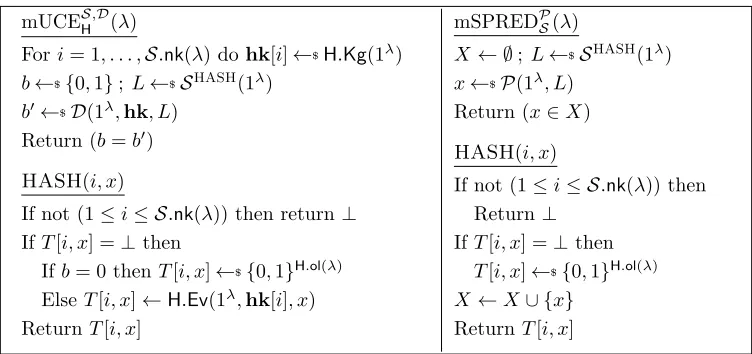
Let Hbe a family of functions. Let S be an adversary called the source and D an adversary called the distinguisher. Consider game mUCESH,D(λ) in the left panel of Fig. 2. Associated to
mUCESH,D(λ)
Fori= 1, . . . ,S.nk(λ) dohk[i]←$H.Kg(1λ)
b←${0,1}; L←$SHASH(1λ)
b′←$D(1λ,hk, L)
Return (b=b′)
HASH(i, x)
If not (1≤i≤ S.nk(λ)) then return⊥
IfT[i, x] =⊥then
Ifb= 0 then T[i, x]←${0,1}H.ol(λ)
ElseT[i, x]←H.Ev(1λ,hk[i], x) ReturnT[i, x]
mSPREDPS(λ)
X ← ∅; L←$SHASH(1λ)
x←$P(1λ, L)
Return (x∈X)
HASH(i, x)
If not (1≤i≤ S.nk(λ)) then Return⊥
IfT[i, x] =⊥then T[i, x]←${0,1}H.ol(λ)
X ←X∪ {x} ReturnT[i, x]
Figure 2: Games defining mUCE security of function family Hand unpredictability of sourceS.
(set) of sources, we say that His mUCE[S]-secure if AdvHm,-Suce,D(·) is negligible for all sources S ∈S and all PT distinguishersD.
It is easy to see that mUCE[S]-security is not achievable ifS is the class of all PT sources [6]. To obtain meaningful notions of security, BHK [6] impose restrictions on the source. A central restriction is unpredictability. A source is unpredictable if it is hard to guess the source’s HASH queries even given the leakage, in the random case of the mUCE game. Formally, let S be a source and P an adversary called a predictor and consider game mSPREDPS(λ) in Fig. 2. For λ∈Nwe letAdvmS,-Pspred(λ) = Pr[mSPREDPS(λ)]. We say thatS is computationally unpredictable if AdvmS,-Pspred(·) is negligible for all PT predictorsP, and letScupbe the class of all PT computationally unpredictable sources. We say that S is statistically unpredictable ifAdvmS,-Pspred(·) is negligible for all (not necessarily PT) predictors P, and let Ssup ⊆ Scup be the class of all PT statistically unpredictable sources. We say that S is sub-exponentially unpredictable if there is an ϵ >0 such that for any PT predictor P there is aλP such that AdvmS,-Pspred(λ)≤ 2−λϵ for all λ≥ λP, and let Sseup ⊆Scup be the class of all PT sub-exponentially unpredictable sources.
BFM [18] show that UCE-framework security notions (both single-key and multi-key) are not achievable forScupassuming that indistinguishability obfuscation exists. This has lead applications to impose further restrictions on the source by using either Ssup or subsets of Scup. Assumptions based on Ssup, introduced in [6, 18], at this point seem to be viable. In order to restrict the computational case, one can consider split sources as defined in BHK [6]. Such sources can leak information about oracle queries and answers separately, but not together. We letSsplt denote the class of split sources. Another way to restrict a source is by limiting the number of queries it can make. LetSn,q be the class of sourcesS such thatS.nk(·)≤n(·) andS makes at mostq(·) queries to each key. In particularS1,1 is the class of sources that use only one key and make only one query to it.
3
Point-function obfuscation framework
Game INDAObf,X(λ)
b←${0,1}
(k1, a1)←$X.Ev(1λ)
Fori= 1, . . . ,X.vl(λ) do k0[i]←${0,1}X.tl(λ)
P←$Obf(1λ,Ik b)
b′←$A(1λ,P, a1)
Return (b=b′)
Game PREDQX(λ)
(k, a)←$X.Ev(1λ)
k←$Q(1λ, a)
Return (∃i : k[i] =k)
Game TRIVAX(λ)
b←${0,1}
(k1, a1)←$X.Ev(1λ)
Fori= 1, . . . ,X.vl(λ) do k0[i]←${0,1}X.tl(λ)
b′←$A(1λ,kb, a1)
Return (b=b′)
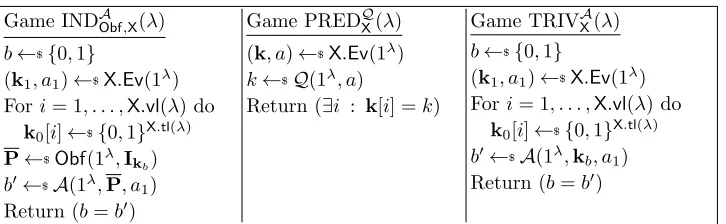
Figure 3: Games defining IND security of point-function obfuscatorObfrelative to target generator X, unpredictabilty of target generatorX and triviality of target generatorX.
security of a point-obfuscator by a class of algorithms we call target generators. Different notions of point obfuscation then correspond to different choices of this class. We start by defining target generators.
Target generators.Atarget generator Xspecifies a PT algorithmX.Evthat takes 1λ to return a target vector k and auxiliary information a∈ {0,1}∗. The entries of k are the targets, each of lengthX.tl(λ), and the vector itself has lengthX.vl(λ), whereX.tl,X.vl:N→Nare the target length and target-vector length functions associated to X, respectively.
Point-function obfuscation.Ifkis a bit-string thenIk: {0,1}|k|→ {0,1}denotes a canonical
representation of the circuit that on input k′ ∈ {0,1}|k| returns 1 if k =k′ and 0 otherwise. It is assumed that givenIk, one can computekin time linear in |k|. A circuit C is called apoint circuit
if there is a k, called the circuit target, such that C≡Ik. Ifk is ann-vector of strings then we let
Ik= (Ik[1], . . . ,Ik[n]).
Let Obf be an obfuscator, as defined in Section 2. Its correctness condition guarantees that on input 1λ,Ik, it returns a point circuit with target k, which is the condition for calling it a
point-function obfuscator. We say thatObf has target length Obf.tl: N→ Nif its correctness condition is only required on inputsIk withk∈ {0,1}Obf.tl(λ).
Security of point-function obfuscation. We now define security of point-function obfusca-tor relative to a class of target generaobfusca-tors. We will then consider various choices of these classes.
Consider game IND of Fig. 3 associated to a point-function obfuscatorObf, a target generator Xand an adversaryA, such thatObf.tl=X.tl. Forλ∈NletAdvindObf,X,A(λ) = 2 Pr[INDAObf,X(λ)]−1. The game generates a target vector k1 and corresponding auxiliary information a1 via X. It also samples a target vectork0 uniformly at random, containingX.vl(λ) elements each of lengthX.tl(λ). It then obfuscates the targets in the challenge vector kb via Obf to produce P which, as per
our notation, will be the vector (Obf(1λ,Ikb[1]), . . . ,Obf(1
λ,I
kb[X.vl(λ)])) formed by independently
obfuscating the targets in the target vector. Given P and a1, adversary A outputs a bit b′, and wins the game if this equals b, meaning it guesses whether the target vector that was obfuscated was the one corresponding to auxiliary information a1 or one independent of it.
Classes of target generators.One important (and necessary) condition on a target generator is unpredictability. To define this, consider game PRED of Fig. 3 associated to X and a predictor adversary Q. For λ ∈ N let AdvpredX,Q(λ) = Pr[PREDQX(λ)]. The game generates a target vector k and associated auxiliary informationa. The adversaryQgetsaand wins if it can predict any entry of the vectork.
The first dimension along which point-function obfuscators are classified is the type of un-predictability, encompassing two sub-dimensions: the success probability of predictors (may be required to be negligible or sub-exponential) and their computational power (PT and computation-ally unbounded are the popular choices, but one could also consider sub-exponential time). Some relevant classes are the following:
— Xcup — Class of computationally unpredictable target generators —X∈Xcup ifAdvpredX,Q(·) is negligible for all PT predictor adversaries Q.
— Xseup — Class of sub-exponentially unpredictable target generators — X ∈ Xseup if there exists 0 < ϵ < 1 such that for every PT predictor adversary Q there is a λQ such that AdvpredX,Q(λ)≤2−λϵ for allλ≥λQ.
— Xsup — Class of statistically unpredictable target generators — X ∈ Xsup if AdvpredX,Q(·) is negligible for all (even computationally unbounded) predictor adversariesQ.
Another dimension is the number of target points in the target vector, to capture which, for any polynomial q: N→N, we let
— Xq(·)— Class of generators producingq(·) target points —X∈Xq(·)ifX.vl=q. An important special case isq(·) = 1.
Another important dimension is auxiliary information, which may be present or absent (the latter, formally means it is the empty string), to capture which we let
— Xε — Class of generators with no auxiliary information — X ∈ Xε if a = ε for all (k, a) ∈ [X.Ev(1λ)] and all λ∈N.
We can recover notions from the literature as follows:
— IND[Xcup∩Xε∩X1] — This is basic point-function obfuscation, secure for a single compu-tationally unpredictable target point, and no auxiliary information is allowed. It is achieved in [23, 27, 41, 51].
— IND[Xcup∩X1] — This is AIPO [23, 35, 14, 20], secure for a single computationally unpre-dictable target point in the presence of auxiliary information. It is achieved under the AI-DHI assumption by Canetti [23], and using the extended construction of Wee [51] by BP [14]. — IND[Xcup] — This is composable AIPO [25, 14], meaning that it is secure for arbitrarily many
correlated target points that are computationally unpredictable in the presence of auxiliary information. BM1 [20] showed that this notion cannot co-exit with iO in the presence of OWFs.
— IND[Xsup∩Xε] — This is composable point-function obfuscation with no auxiliary informa-tion allowed [41, 42], secure for arbitrarily many correlated target points that are statistically unpredictable. It is achieved from mUCE[Ssup] in BHK [6].
Game MDIFFDS(λ)
(C0,C1,aux)←$S(1λ)
x←$D(C0,C1,aux)
Return (∃i : C0[i](x)̸=C1[i](x))
Game MIOOObf,S(λ)
b←${0,1}
(C0,C1,aux)←$S(1λ)
C←$Obf(1λ,Cb)
b′←$O(1λ,C,aux)
Return (b=b′)
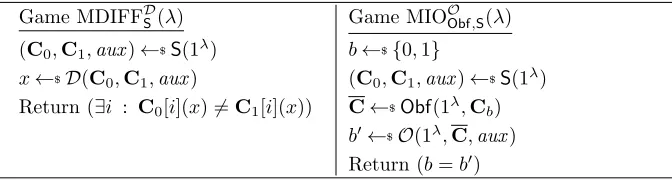
Figure 4: Games defining difference-security of multi-circuit samplerSand iO-security of obfuscator Obf relative to multi-circuit sampler S.
Triviality theorem. The IND[X] definition has the peculiar property of trivializing for some choices ofX. For example, letXbe a target generator that returns a vector of random, independent targets and auxiliary informationa=εthe empty string. Then any point-function obfuscatorObf is IND[{X}]-secure. This is true because game IND in this case samples k0,k1 from the same distribution and the information provided to the adversaryAis thus independent of the challenge bit. Before discussing and assessing what this means for the definition, we provide a general triviality theorem that characterizes for what choices ofX this phenomenon happens.
Consider game TRIV of Fig. 3 associated to a target generator X and an adversary A. For λ∈ N let AdvtrivX,A(λ) = 2 Pr[TRIVAX(λ)]−1. We say that X is trivial if AdvtrivX,A(·) is negligible for every PT A. An example of trivial X is the one given above. Let Xtriv be the class of all trivial target generators, and say that a classXis trivial ifX⊆Xtriv. The proof of the following triviality theorem follows directly from the definitions of games IND and TRIV and is omitted.
Theorem 3.1 Let X⊆Xtriv be a class of target generators. Let Obf be any point-function obfus-cator. Then Obf is IND[X]-secure.
This can be viewed as a defect of the IND definition, but whether or not this is true is debatable. The IND definition has been successfully employed in applications [14, 21]. In these cases,X=Xcup∩ X1, a class to which Theorem 3.1 does not apply. This indicates that the classes of target generators arising in applications are naturally not trivial. And the constructions we give in Section 5 cover such non-trivial classes. Thus we are on the whole unsure whether or not Theorem 3.1 should be viewed as a definitional weakness. In Section 6 we will provide alternative security definitions for PO that avoid this type of triviality theorem and are meaningful for all choices of target generators. But if an application can be obtained via IND, then it seems preferable, since this definition is simpler and easier to use and, from Section 5, we have more constructions for it.
4
(d)iO for multi-circuit samplers
Game Gℓ
(C0,C1,auxm)←$Sm(1λ) ; n←S.vl(λ)
Fori= 1, . . . , ℓdoC[i]←$Obf(1λ,C0[i])
Fori=ℓ+ 1, . . . , ndoC[i]←$Obf(1λ,C1[i])
b′←$Om(1λ,C,auxm) ; Return (b′= 1)
Figure 5: Games for proof of Lemma 4.1.
iO for multi-circuit samplers.A multi-circuit sampler is a PT algorithmSwith an associated circuit-vector length functionS.vl:N→N. AlgorithmS on input 1λ returns a triple (C0,C1,aux) where aux is a string and C0,C1 are circuit vectors of length S.vl(λ), such that circuits C0[i] and C1[i] are of the same size, number of inputs and number of outputs for everyi∈ {1, . . . ,S.vl(λ)}.
Consider game MIO of Fig. 4 associated to an obfuscator Obf, a multi-circuit samplerSand an adversaryO. Forλ∈NletAdvmObf-io,S,O(λ) = 2 Pr[MIOOObf,S(λ)]−1. LetS be a class of multi-circuit samplers. We say that Obf is S-secure if AdvObfm-io,S,O(·) is negligible for every multi-circuit sampler S∈S and every PT adversaryO.
Consider game MDIFF of Fig. 4 associated to a multi-circuit samplerSand an adversaryD. For λ∈NletAdvmS,-Ddiff(λ) = Pr[MDIFFDS(λ)]. We say that a multi-circuit samplerSis difference secure ifAdvmS,-Ddiff(·) is negligible for every PT adversary D. LetSm-diff be the class of all difference-secure multi-circuit samplers and let d: N→N. We say that multi-circuit samplerS producesd-differing circuits if circuits C0[i] and C1[i] differ on at most d(λ) inputs with an overwhelming probability over (C0,C1,aux)∈[S(1λ)], for allλ∈Nand alli∈ {1, . . . ,S.vl(λ)}. LetSm-diff(d) be the class of all difference-secure multi-circuit samplers that produce d-differing circuits.
Lemma 4.1 Let d: N → N. Let Obf be an Sdiff(d)-secure obfuscator. Then Obf is also an Sm-diff(d)-secure obfuscator.
Proof of Lemma 4.1: LetSm∈Sm-diff(d) be a multi-circuit sampler. LetOm be a PT adversary. Let λ∈N and n=S.vl(λ). Consider the games Gℓ of Fig. 5 for ℓ∈ {0, . . . , n}. By construction,
we have
Pr[G0] = Pr[MIOOObfm,Sm(λ)|b= 1
]
and Pr[Gn] = Pr
[
MIOOObfm,Sm(λ)|b= 0
] .
It follows that AdvmObf-io,Sm,Om(λ) = Pr[G0]−Pr[Gn] =
∑n
i=1(Pr[Gi−1]−Pr[Gi]). We will show that this sum is bounded by a negligible function, therefore proving the lemma. We construct a circuit samplerSs and a PT adversaryOs as follows:
Circuit Sampler Ss(1λ) n←S.vl(λ) ; ℓ←${1, . . . , n} (C0,C1,auxm)←$Sm(1λ)
For i= 1, . . . , ℓ−1 do C[i]←$Obf(1λ,C0[i]) For i=ℓ+ 1, . . . , n do C[i]←$Obf(1λ,C1[i]) Cl←C[1], . . . ,C[ℓ−1] ; Cr←C[ℓ+ 1], . . . ,C[n]
e←${0,1}; auxs ←(Cl,Cr, e,auxm) Return (C0[ℓ],C1[ℓ],auxs)
Adversary Os(1λ,C,auxs) (Cl,Cr, e,auxm)←auxs
C←(Cl,C,Cr)
e′←$Om(1λ,C,auxm) If (e=e′) then return 1 Else return 0
Let ℓbe the value sampled by Ss in game IOOObfs ,Ss(λ). For anyi∈ {1, . . . , n} we have Pr[Gi−1]−
Pr[Gi] = Pr
[
AdvioObf,Ss,Os(λ) : ℓ=i
]
Game OWFFF,X(λ)
(k, a)←$X.Ev(1λ)
Fori= 1, . . . ,X.vl(λ) do
fk[i]←$F.Kg(1λ)
y[i]←F.Ev(1λ,fk[i],k[i]) k←$F(1λ,fk,y, a)
Return (∃i : F.Ev(1λ,fk[i], k) =y[i])
Game PRIV1ADPKE,X(λ)
b←${0,1}; (k1, a)←$X.Ev(1λ)
Fori= 1, . . . ,X.vl(λ) do
k0[i]←${0,1}DPKE.ml(λ)
(pk[i],sk[i])←$DPKE.Kg(1λ)
c[i]←DPKE.Enc(1λ,pk[i],kb[i]) b′←$A(1λ,pk,c, a) ; Return (b=b′)
Figure 6: Games defining one-wayness of function family F relative to target generator X and PRIV1-security of deterministic public-key encryption scheme DPKE relative to target generator X.
We will now prove thatAdvioObf,Ss,Os(λ) is negligible by showing thatSs∈Sdiff(d). Sincen=S.vl(λ)
is a polynomial, it will follow that the above sum is negligible. Given a PT adversary Ds we construct a PT adversaryDm such thatAdvmSm-diff,Dm(λ)≥AdvdiffSs,Ds(λ).
AdversaryDm(1λ,C0,C1,auxm) n←S.vl(λ) ; ℓ←${1, . . . , n}
Fori= 1, . . . , ℓ−1 doC[i]←$Obf(1λ,C0[i]) Fori=ℓ+ 1, . . . , ndo C[i]←$Obf(1λ,C1[i])
e←${0,1}; Cl←C[1], . . . ,C[ℓ−1] ; Cr←C[ℓ+ 1], . . . ,C[n] auxs ←(C
l,Cr, e,auxm) ;x←$Ds(C0[ℓ],C1[ℓ],auxs) ; Returnx
Now, Ss∈Sdiff(d) follows from the assumption thatSm ∈Sm-diff(d), which concludes the proof.
5
Generic constructions of PO
Prior constructions have targeted IND[X] for specific choices ofX in ad hoc ways and used non-standard assumptions. In this section we provide constructions that are generic. This means they take an arbitrary, given classXof target generators and return a point-function obfuscator that is IND[X]-secure.
5.1 PO from iO
OWFs.Consider game OWF of Fig. 6 associated to a function familyF, a target generatorXwith
X.tl=F.il, and an adversary F. Forλ∈Nlet AdvFowf,X,F(λ) = Pr[OWFFF,X(λ)]. Let X be a class of target generators with target length F.il. Let X1ur be the target generator with X1ur.vl(·) = 1 and X1ur.tl=F.il, where the target is sampled from a uniform distribution and the auxiliary information is always empty, meaninga=ε. We say thatF is OWF[X]-secure if AdvowfF,X,F(·) is negligible for all PT adversariesF and allX∈X∪{X1ur}. Relevant classesXare the same as for PO. The standard notion of a OWF is recovered asX=∅, meaning thatF is secure only with respect to X1ur.
Games G0, G1
b←${0,1}; (k1, a1)←$X.Ev(1λ)
Fori= 1, . . . ,X.vl(λ) do
k0[i]←${0,1}X.tl(λ); fk[i]←$F.Kg(1λ) ; y[i]←F.Ev(1λ,fk[i],kb[i])
P[i]←$Obfio(C1
1λ,fk[i],y[i]) // G0
P[i]←$Obfio(Pads(λ)(C2)) // G1
b′←$A(1λ,P, a1) ; Return (b=b′)
Circuit C1
1λ,fk,y(k)
If (y=F.Ev(1λ,fk, k)) then return 1 Else return 0
Circuit C2(k)
Return 0
Figure 7: Games for proof of Theorem 5.1.
chosen for each evaluation and auxiliary inputs may be present. We stress that we require only one-wayness; we do not require extractability. The latter is a much stronger assumption [13].
We now show that indistinguishability obfuscation can be used to build a IND[X]-secure point-function obfuscator for an arbitrary target generator class X from any OWF[X]-secure function family.
Construction. Let F be a family of functions. Let Obfio be an obfuscator. We construct a point-function obfuscatorObf withObf.tl=F.ilas follows:
Algorithm Obf(1λ,Ik)
fk←$F.Kg(1λ) ; y←F.Ev(1λ,fk, k) P←$Obfio(C1λ,fk,y) ; Return P
Circuit C1λ,fk,y(k′)
If (y=F.Ev(1λ,fk, k′)) then return 1 Else return 0
Theorem 5.1 Let F be an injective family of functions. LetX be a class of target generators with target lengthF.il. Assume thatF isOWF[X]-secure. LetObfio be an indistinguishability obfuscator. Then Obf constructed above from F and Obfio is aIND[X]-secure point-function obfuscator.
Proof of Theorem 5.1: The injectivity of Fimplies thatObf satisfies the correctness condition of a point-function obfuscator. We now prove security.
LetX∈Xbe a target generator. LetAbe a PT adversary. Consider the games and the associated circuits of Fig. 7, where s is defined as follows. For any λ let s(λ) be a polynomial upper bound on max(|C11λ,fk,y|), where the maximum is over all fk ∈[F.Kg(1λ)] and y ∈ {0,1}F.ol(λ). Lines not
annotated with comments are common to all games.
Game G0 is equivalent to INDAObf,X(λ). The inputs to adversary A in game G1 do not depend on the challenge bitb, so we have Pr[G1] = 1/2. It follows that
AdvindObf,X,A(λ) = 2·Pr[G0]−1 = 2·(Pr[G0]−Pr[G1]).
The first equality holds by the definition of IND, and the second equality holds because of Pr[G1] = 1/2. We now show that Pr[G0]−Pr[G1] is negligible, meaning that AdvindObf,X,A(·) is also negligible. This proves the the theorem.
Multi-circuit Sampler S(1λ) d←${0,1}; (k1, a1)←$X.Ev(1λ) For i= 1, . . . ,X.vl(λ) do
k0[i]←${0,1}X.tl(λ)
fk[i]←$F.Kg(1λ) ; y[i]←F.Ev(1λ,fk[i],kd[i]) C1[i]←C11λ,fk[i],y[i];C0[i]←Pads(λ)(C2) aux ←(d, a1) ; Return (C0,C1,aux)
AdversaryO(1λ,C,aux) (d, a1)←aux
d′←$A(1λ,C, a1) If (d=d′) then return 1 Else return 0
We have Pr[G0]−Pr[G1] = AdvmObf-ioio,S,O(λ) by construction. Next, we show that S ∈ Sm-diff(1). According to Proposition 2.1 (the result of BCP [16]), any indistinguishability obfuscator is also an Sdiff(1)-secure obfuscator. And according to Lemma 4.1, any Sdiff(1)-secure obfuscator is an Sm-diff(1)-secure obfuscator. It follows that AdvmObf-ioio,S,O(·) is negligible by the iO-security of Obfio. Let Xur be the target generator with Xur.vl=X.vl and Xur.tl=F.il, where the targets are sampled independently, from a uniform distribution and auxiliary information is alwaysa=ε. Given any PT difference adversaryDagainst multi-circuit samplerS, we build PT adversariesF0 andF1 against the OWF-security of Frelative to target generatorsXur and X, respectively. The constructions are as follows:
Adversary F0(1λ,fk,y, a) d←0 ; (k1, a1)←$X.Ev(1λ) For i= 1, . . . ,|y|do
C1[i]←C11λ,fk[i],y[i]
C0[i]←Pads(λ)(C2)
aux ←(d, a1) ; x←$D(C1,C0,aux) Return x
AdversaryF1(1λ,fk,y, a)
d←1
Fori= 1, . . . ,|y|do C1[i]←C11λ,fk[i],y[i]
C0[i]←Pads(λ)(C2)
aux ←(d, a) ; x←$D(C1,C0,aux) Return x
Letddenote the value sampled by multi-circuit sampler S in game MDIFFDS(λ). Then we have Pr[ MDIFFDS(λ)|d= 0 ] = Pr[OWFF0
F,Xur(λ)],
Pr[ MDIFFDS(λ)|d= 1 ] = Pr[OWFF1 F,X(λ)]. and AdvmS,-Ddiff(λ) = 12(AdvowfF,Xur,F
0(λ) + Adv owf
F,X,F1(λ)). Note that OWF[X]-security of F requires that AdvowfF,X1ur,F(λ) is negligible for all PT adversaries F. One can use the latter with a standard
hybrid argument to further prove thatAdvowfF,Xur,F
0(λ) is also negligible for all PT adversariesF0. It follows that the multi-circuit sampler S is difference-secure. The injectivity of F also implies that S produces 1-differing circuits. Therefore,S∈Sm-diff(1).
5.2 PO from DPKE
DPKE. A deterministic public-key encryption scheme DPKE [3] specifies the following. PT key generation algorithmDPKE.Kgtakes 1λto return a public encryption keypkand a secret decryption
key sk. Deterministic PT encryption algorithm DPKE.Enc takes 1λ, pk and a plaintext message k ∈ {0,1}DPKE.ml(λ) to return a ciphertext c, where DPKE.ml: N → N is the message length function associated to DPKE. Deterministic decryption algorithm DPKE.Dec takes 1λ, sk, c to
return plaintext message k. We do not require the decryption algorithm to be PT but we do require decryption correctness, namely that for all λ ∈ N, all (pk,sk) ∈ [DPKE.Kg(1λ)] and all k∈ {0,1}DPKE.ml(λ) we have DPKE.Dec(1λ,sk,DPKE.Enc(1λ,pk, k)) =k.
Now consider game PRIV1 of Fig. 6 associated to a deterministic public-key encryption scheme DPKE, a target generator X satisfying X.tl = DPKE.ml, and an adversary A. For λ ∈ N let Advpriv1DPKE,X,A(λ) = 2 Pr[PRIV1ADPKE,X(λ)]−1. If X is a class of target generators then we say that DPKE is PRIV1[X]-secure ifAdvpriv1DPKE,X,A(·) is negligible for all PT adversariesA and allX∈X.
This definition reflects what BBO [3] call the multi-user setting where there are many, inde-pendent public keys. However, in our case, only a single message is encrypted under each key. The single-key version of this is called PRIV1 in the literature, so we retained the name in moving to the multi-user setting. The definition is in the indistinguishability style of [4, 15] rather than the semantic security style of [3]. These definitions however did not allow auxiliary inputs. We are allowing those following BS [17]. Finally, while prior definitions require unpredictability of the message distribution, ours is simply parameterized by the latter. Prior definitions are captured as special cases, meaning they can be recovered as PRIV1[X] for some choice of X.
Construction. Let DPKE be a deterministic public-key encryption scheme. We construct an obfuscator Obf withObf.tl=DPKE.mlas follows:
AlgorithmObf(1λ,Ik)
(pk,sk)←$DPKE.Kg(1λ)
c←DPKE.Enc(1λ,pk, k) ; Return C
1λ,pk,c
Circuit C1λ,pk,c(k)
If (DPKE.Enc(1λ,pk, k) =c) Then return 1 else return 0
The construction is simple. To obfuscateIk we pick a new key pair for the deterministic public-key
encryption scheme and return a circuit that embeds the public keypkas well as the encryptioncof the target pointk. The circuit, given a candidate target pointk′, re-encrypts it under the embedded public keypkand checks that the ciphertext so obtained matches the embedded ciphertextc. Note that the determinism of DPKE.Enc is used crucially to ensure that the circuit is deterministic. For randomized encryption, one cannot check that a message corresponds to a ciphertext by re-encryption. The secret keysk is discarded and not used in the construction, but its existence will guarantee correctness of the point-function obfuscator.
Result. We show that this is a generic construction. Namely, a point-function obfuscator for a given classXof target generators can be obtained if we have a deterministic public-key encryption scheme secure for the same class.
Theorem 5.2 Let DPKE be a deterministic public-key encryption scheme and X a class of target generators such that X.tl=DPKE.ml for all X ∈X. Assume DPKE is PRIV1[X]-secure. Let Obf
be as defined above. Then Obf is a IND[X]-secure point-function obfuscator.
Let X ∈X be a target generator with X.tl=DPKE.ml. Let A be PT adversary against the IND security ofObf relative toX. We construct a PT adversaryBagainst the PRIV1 security of DPKE relative toX as follows:
AdversaryB(1λ,pk,c, a)
Fori= 1, . . . ,|c|do P[i]←C1λ,pk[i],c[i]
b′←$A(1λ,P, a) ; Return b′
Circuit C1λ,pk,c(k)
If (DPKE.Enc(1λ,pk, k) =c)
Then return 1 else return 0
We haveAdvpriv1DPKE,X,B(λ) =AdvindObf,X,A(λ) by construction. Hence, for any X∈X the IND-security of Obf relative toXfollows from the assumed PRIV1-security of DPKE relative toX.
In applying Theorem 5.2 to get point function obfuscators, the first case of interest isX=Xsup∩ Xε∩X1. In this case, PRIV1[X]-secure deterministic public-key encryption is a standard form of the latter for which many constructions are known. The central construction, due to BFO [15], is from lossy trapdoor functions (LTDFs). But the latter can be built from a wide variety of standard assumptions [47, 31, 52, 37, 55]. Thus we get IND[Xsup∩Xε∩X1]-secure point-function obfuscators under the same assumptions. The second case of interest is X =Xseup∩X1. Unlike in the first case, there is now auxiliary information, but it leaves the targets sub-exponentially unpredictable. Constructions of PRIV1[X]-secure deterministic public-key encryption are known under standard assumptions including DLIN, Subgroup Indistinguishability and LWE [17, 54, 52]. Accordingly we get IND[Xseup∩X1]-secure point-function obfuscators under the same assumptions. BH [5] obtain PRIV-secure DPKE from UCE[Ssup], which via Theorem 5.2 yields IND[Xsup ∩Xε∩X1] under UCE[Ssup].
Theorem 5.2 also yields negative results. Assume iO exists. Then we know that there do not exist point function obfuscators that are IND[Xcup]-secure [20, 24]. Theorem 5.2 then implies that there also do not exist deterministic public-key encryption schemes that are PRIV1[Xcup]-secure.
CIH function families as per GOR [36] do not seem to have a unique associated security notion. Rather the authors discuss a few choices. Our parameterized PRIV definitions above apply to function families as well and can be viewed as providing more security notions for CIH function families. These function families can also be used in our PO construction above as long as they are injective.
5.3 PO from UCE
Our next generic construction is based on UCE, a class of assumptions on function families from [6]. We use the multi-key version of the UCE assumption, denoted mUCE. As before we aim to provide point-function obfuscation secure for any given class of target generators. We are able to do this with mUCE by associating to the class of target generators a class of sources. The existence of an mUCE-secure function family relative to the latter suffices to construct a point-function obfuscator secure relative to the former.
Construction. Let H be a family of functions. Associate to it a point-function obfuscator Obf defined as follows. Let Obf.tl=H.il, and
AlgorithmObf(1λ,Ik)
hk←$H.Kg(1λ) ; y←H.Ev(1λ,hk, k) Return C1λ,hk,y
Circuit C1λ,hk,y(k′)
y′ ←H.Ev(1λ,hk, k′)
If (y=y′) then return 1 else return 0
The construction is simple and natural. The point-function obfuscation of Ik is a circuit that
Source classes.To state the result, we need a few definitions. Associate to a target generatorX a source SX defined as follows:
Source SX(1λ)
d←${0,1}; (k1, a1)←$X.Ev(1λ)
Fori= 1, . . . ,X.vl(λ) do k0[i]←${0,1}X.tl(λ) Fori= 1, . . . ,X.vl(λ) do y[i]←$HASH(i,kd[i]) L←((d, a1),y) ; ReturnL
whereHASHis a hash oracle that is provided toSX in mUCE security game. The number of keys for this source is SX.nk = X.vl, the number of points in the target vector. Now let X be a class of target generators and let SX ={ SX : X ∈X} be the corresponding class of sources. We will show that the construction above is IND[X]-secure assumingHis mUCE[SX]-secure. To appreciate what this provides we now discuss the assumption further.
Assumptions in the UCE framework are very sensitive to the class of sources for which security is assumed. Accordingly one tries to restrict sources in different ways. In this regard SX ={ SX : X ∈X} has some good attributes as we now discuss, referring to definitions of classes of mUCE sources recalled in Section 2.
The first attribute is that the sources in SX are what BHK [6] call “split,” so that SX ⊆ Ssplt. “Split” means that the leakage is a function of the oracle queries and answers separately, but not both together. (Above, (d, a1) depends only on the oracle queries, and y depends only on the answers.) The second attribute is that the sources make only one query per key. (In particular when there is only one target point, the source makes only one query overall.) That is, SX ⊆ Sn,1 if S.nk(·) ≤ n(·) for all S ∈ SX. The third attribute is that the source class inherits the unpredictability properties of the target generator class. Thus if X ⊆ Xcup then SX ⊆Scup consists of computationally unpredictable sources; ifX⊆Xsup thenSX ⊆Ssup consists of statistically unpredictable sources; and if X ⊆Xseup then SX ⊆ Sseup consists of sources that are sub-exponentially unpredictable.
We warn that mUCE[SX]-security is not achievable for all choices ofX. The value of our result is that it is entirely general, reducing IND security for a givenX to a question of mUCE security for a related class of sources, and we can then investigate the latter separately. In this way we get many new constructions.
Result. The following theorem shows that our construction above provides secure point-function obfuscation in a very general and modular way, namely the point-function obfuscator is secure relative to a class of target generators if His mUCE-secure relative to the corresponding class of sources. After stating and proving this general result we will look at some special cases of interest.
Theorem 5.3 Let Hbe an injective family of functions. LetX be a class of target generators such that X.tl=H.il for allX∈X. Assume His mUCE[SX]-secure. Let Obf be as defined above. Then
Obf is a IND[X]-secure point-function obfuscator.
Function family H is assumed to be injective in order to meet the perfect correctness condition of a point-function obfuscator, and it is not important for security. In Appendix A we show that non-injective mUCE is sufficient to construct a point-function obfuscator that satisfies a relaxed correctness condition and achieves the same security as above.
Proof of Theorem 5.3: Correctness of the obfuscator follows from the assumed injectivity ofH, meaning that the output ofObf(1λ,Ik) is always a point circuit with target k. We now prove that