Scholarship@Western
Scholarship@Western
Electronic Thesis and Dissertation Repository
4-20-2011 12:00 AM
Heuristics, Concepts, and Cognitive Architecture: Toward
Heuristics, Concepts, and Cognitive Architecture: Toward
Understanding How The Mind Works
Understanding How The Mind Works
Sheldon J. Chow
The University of Western Ontario Supervisor
Dr. Christopher Viger
The University of Western Ontario Graduate Program in Philosophy
A thesis submitted in partial fulfillment of the requirements for the degree in Doctor of Philosophy
© Sheldon J. Chow 2011
Follow this and additional works at: https://ir.lib.uwo.ca/etd
Part of the Philosophy of Mind Commons
Recommended Citation Recommended Citation
Chow, Sheldon J., "Heuristics, Concepts, and Cognitive Architecture: Toward Understanding How The Mind Works" (2011). Electronic Thesis and Dissertation Repository. 128.
https://ir.lib.uwo.ca/etd/128
This Dissertation/Thesis is brought to you for free and open access by Scholarship@Western. It has been accepted for inclusion in Electronic Thesis and Dissertation Repository by an authorized administrator of
(Spine title: Heuristics, Concepts, and Cognitive Architecture)
(Thesis format: Monograph)
by
Sheldon Chow
Graduate Program in Philosophy
A thesis submitted in partial fulfillment
of the requirements for the degree of
Doctor of Philosophy
The School of Graduate and Postdoctoral Studies
The University of Western Ontario
London, Ontario, Canada
c
CERTIFICATE OF EXAMINATION
Supervisor:
. . . . Dr. Christopher Viger
Supervisory Committee:
. . . . Dr. Robert Stainton
Examiners:
. . . . Dr. John Nicholas
. . . . Dr. Benjamin Hill
. . . . Dr. Bertram Gawronski
. . . . Dr. Richard Samuels
The thesis by
Sheldon Joseph Chow
entitled:
Heuristics, Concepts, and Cognitive Architecture: Toward Understanding How The Mind Works
is accepted in partial fulfillment of the requirements for the degree of
Doctor of Philosophy
. . . . Date
. . . .
Chair of the Thesis Examination Board
Heuristics are often invoked in the philosophical, psychological, and cognitive science liter-atures to describe or explain methodological techniques or “shortcut” mental operations that help in inference, decision-making, and problem-solving. Yet there has been surprisingly little philosophical work done on the nature of heuristics and heuristic reasoning, and a close inspec-tion of the way(s) in which “heuristic” is used throughout the literature reveals a vagueness and uncertainty with respect to what heuristics are and their role in cognition. This dissertation seeks to remedy this situation by motivating philosophical inquiry into heuristics and heuristic reasoning, and then advancing a theory of how heuristics operate in cognition. I develop a positive working characterization of heuristics that is coherent and robust enough to account for a broad range of phenomena in reasoning and inference, and makes sense of empirical data in a systematic way. I then illustrate the work this characterization does by considering the sorts of problems that many philosophers believe heuristics solve, namely those resulting from the so-called frame problem. Considering the frame problem motivates the need to gain a better understanding of how heuristics work and the cognitive structures over which they oper-ate. I develop a general theory of cognition which I argue underwrites the heuristic operations that concern this dissertation. I argue that heuristics operate over highly organized systems of knowledge, and I offer a cognitive architecture to accommodate this view. I then provide an account of the systems of knowledge that heuristics are supposed to operate over, in which I suggest that such systems of knowledge are concepts. The upshot, then, is that heuristics oper-ate over concepts. I argue, however, that heuristics do not operoper-ate over conceptual content, but over metainformational relations between activated and primed concepts and their contents. Fi-nally, to show that my thesis is empirically adequate, I consider empirical evidence on heuristic reasoning and argue that my account of heuristics explains the data.
Keywords: Heuristics; concepts; mental representation; cognition; cognitive architecture; relevance; the frame problem; reasoning; inference
I would like to thank Chris Viger, my supervisor, for all our discussions and for all his com-ments, suggestions, and general guidance as I wrote and worked through this dissertation. Because of him I was able to improve and sharpen my ideas and writing, and he was a tremen-dous help in turning a rough and vague idea about heuristics into the present work. I would also like to thank Rob Stainton for his help throughout the writing process. Further, although he probably doesn’t know it, John Woods was an influential figure in my undergrad, and he got me interested in heuristics and humans as satisficing agents. So I extend sincere thanks to him for in some sense initiating my work. Barry Hoffmaster was also instrumental in initiating some of my ideas—it was after taking a class of his in my PhD program that I first realized that there wasn’t an agreed-upon account of heuristics. Many thanks also go to my examina-tion committee for their insightful quesexamina-tions, suggesexamina-tions, and general input: John Nicholas, Ben Hill, Bertram Gawronski, and Richard Samuels. Finally, but not least, I thank my loving partner, Janet, who continues to support me and put up with me, even as I went through grad school and wrote this dissertation, and spent long days in front of my computer instead of by her side.∞
Certificate of Examination ii
Abstract iii
Acknowledgements iv
List of Figures 1
1 Introduction 2
1.1 Dissertation outline . . . 3
1.2 Computational cognition . . . 8
1.3 Philosophy in cognitive science . . . 9
2 Characterizing “Heuristic” 13 2.1 Why we need an appropriate characterization of “heuristic” . . . 16
2.2 Abuses of “heuristic” . . . 18
2.2.1 Heuristics vs. guaranteed correct outcomes . . . 19
2.2.2 Heuristics vs. optimization . . . 28
2.2.3 Inherent normativity? . . . 32
2.3 Uses of “heuristic” . . . 34
2.3.1 Processes of discovery: P´olya . . . 36
2.3.2 Information processing theory: Simon . . . 37
2.3.3 Heuristics and biases: Kahneman and Tversky . . . 40
2.3.4 Fast and frugal heuristics: Gigerenzer . . . 42
2.3.5 Other uses . . . 45
2.4 A positive characterization . . . 47
2.4.1 Some distinctions . . . 49
2.4.1.1 Stimulus-response vs. heuristics . . . 49
2.4.1.2 Computational vs. cognitive heuristics . . . 52
2.4.1.3 Perceptual vs. cognitive heuristics . . . 52
2.4.1.4 Methodological vs. inferential heuristics . . . 53
2.4.2 Characterizing cognitive heuristics . . . 57
2.4.2.1 Heuristics as rules of thumb . . . 59
2.4.2.2 Beyond rules of thumb: exploiting information . . . 69
2.5 Concluding remarks . . . 72
3.1.1 The many guises of the frame problem . . . 78
3.1.2 The heuristic solution . . . 84
3.2 Toward a general architecture . . . 94
3.3 Informationally rich structures: k-systems . . . 101
3.4 Exploiting informational richness . . . 108
3.4.1 High information load cognition . . . 109
3.4.2 Exploiting k-systems, but still frugal . . . 117
3.5 Concluding remarks . . . 121
4 Concepts, Heuristics, and Relevance 124 4.1 Concepts and representation . . . 127
4.1.1 Perceptual symbol systems . . . 127
4.1.2 The file metaphor . . . 134
4.2 A theory of richer concepts . . . 138
4.2.1 Conceptual content and associations . . . 138
4.2.2 A critique of the PSS theory of concepts . . . 143
4.2.2.1 Integrating linguistic information . . . 146
4.2.2.2 Affording connections between concepts . . . 151
4.2.3 Putting it together . . . 154
4.3 From k-systems to concepts . . . 162
4.3.1 What this means for heuristics . . . 166
4.4 How heuristics work: Informational relations and higher-order operations . . . 169
4.5 Concluding remarks . . . 180
5 How Heuristics Work: Considering Empirical Evidence 182 5.1 Heuristics and biases . . . 183
5.1.1 Availability . . . 186
5.1.2 Representativeness . . . 190
5.1.2.1 The Linda problem . . . 192
5.1.2.2 The Dick problem . . . 197
5.1.2.3 The cab problem . . . 199
5.2 Fast and frugal heuristics . . . 205
5.2.1 The Recognition heuristic . . . 206
5.2.2 Take the Best . . . 213
5.3 General remarks . . . 221
6 Relevance and the epistemological relevance problem 223 6.1 The epistemological relevance problem . . . 225
6.2 Relevance . . . 228
6.2.1 Sperber and Wilson’s Relevance Theory . . . 228
6.2.2 Relevance in light of the foregoing theory of concepts and cognition . . 233
6.3 Do heuristics determine relevance? . . . 239
6.4 Concluding remarks . . . 246
Curriculum Vitae 256
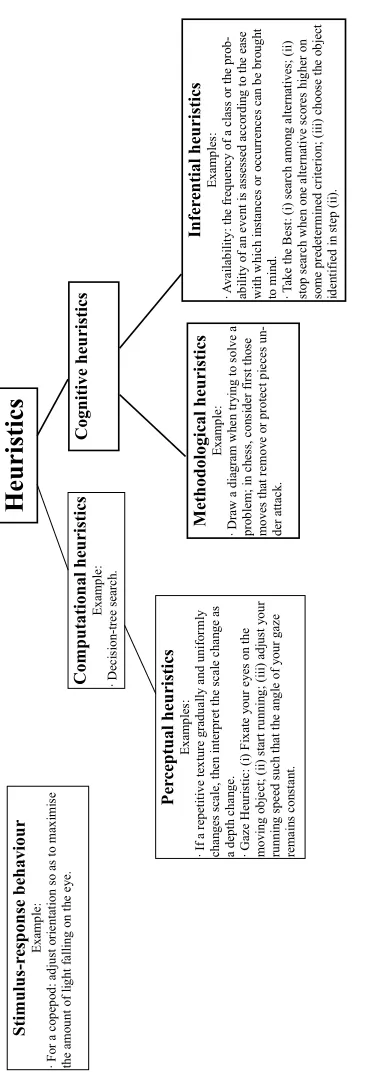
2.1 Classifying heuristics . . . 58
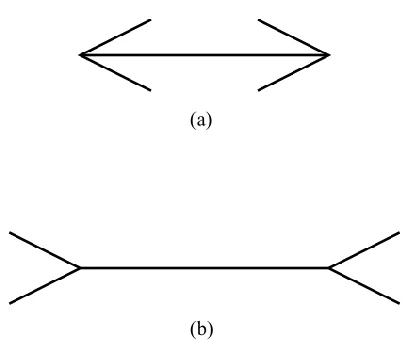
3.1 The M¨uller-Lyer Illusion. (a) appears shorter than (b), although the lines are the same length; and (a) continues to appear shorter than (b) despiteknowing
that the lines are of equal length. The visual system is therefore said to be encapsulated with respect to the belief that the lines are of equal length. . . 85
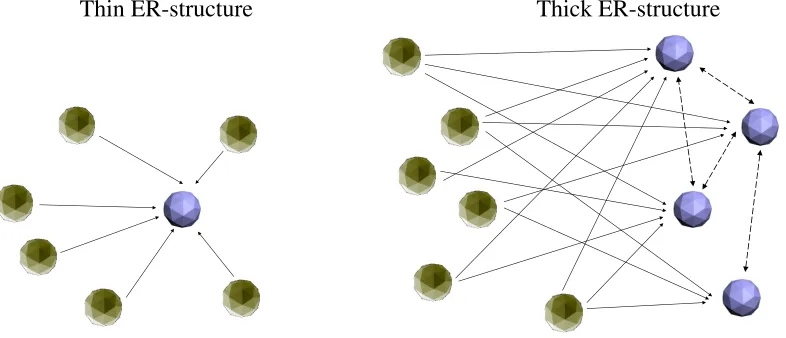
4.1 Simplified representation ofthinandthickER-structures. The nodes represent richly structured activated and primed concepts, and the arrows represent in-ward/outward connections. The concepts bearing the inward connections are deemed pertinent to the task at hand. With respect to the thick ER-structure represented, the concepts on the left constitute a set of reference concepts that bear multiple outward connections to the pertinent concepts on the right. . . 173
5.1 A graphical representation of the cab problem expressed in terms of natural frequencies. . . 203 5.2 Representation of an ER-structure arising from Goldstein and Gigerenzer’s
(1999) task of predicting which of two cities is larger. My claim is that Take the Best operates over a structure like the one presented here. . . 218
Introduction
1.1
Dissertation outline
As its subtitle suggests, this dissertation is an investigation into how the mind works.
How-ever, its goal is not as lofty as attempting to describe how the mind worksin toto. Rather, this
dissertation investigates only a specific aspect of how the mind works, namely how heuristics
operate in cognition. Heuristics are generally understood as effective shortcut rules or
proce-dures that require little cognitive resources to be deployed. In this dissertation, I argue that
heuristics are ways to exploit the organization of mental concepts, and it is this that makes
heuristics powerful shortcut procedures. More specifically, I do four things in this dissertation:
(i) I motivate philosophical inquiry into heuristic reasoning and develop a characterization of
“heuristic” that serves the practical interests of philosophy and cognitive science; (ii) I describe
a cognitive architecture that I argue facilitates heuristic operations; (iii) I draw implications for
a related and important philosophical problem, namely the so-called frame problem; and (iv) I
illustrate how my thesis is empirically adequate.
Chapter 2 is solely devoted to task (i). Interest in heuristics in cognitive science exploded in
the advent of the computational theory of mind, which encouraged a specific understanding of
what is required of computational cognition: Feasible computation requires computationally
tractable operations, and heuristics appear to be the perfect candidates to provide them. Yet,
a survey of contemporary philosophical and cognitive science literatures reveals that different
authors employ “heuristic” in ways that deviate from one another, and are sometimes
incon-sistent with one another. Given its widespread use in cognitive science, it is striking that there
does not appear to be a consensus on what phenomena “heuristics” or “heuristic processes”
refer to. In response, this dissertation considers a number of accounts found in the literature.
The most common accounts of “heuristic” assert something to the effect that “heuristics are
processes that do not guarantee correct outcomes”, or “heuristics are operations that do not
op-timize”. These accounts, however, are merely perfunctory, and I find them to be unsatisfactory
since the contexts in which there exist processes or operations that guarantee correct outcomes
accounts of “heuristic”, including the influential accounts of George P´olya (1957), Herbert
Simon (e.g., Simon, 1957; Simon & Newell, 1958; Simon, Newell, Minsky, & Feigenbaum,
1967), Daniel Kahneman and Amos Tversky (e.g., Kahneman, Slovic, & Tversky, 1982a),
and Gerd Gigerenzer (e.g., Gigerenzer, Todd, & the ABC Research Group, 1999). These
re-searchers are not univocal with respect to how they characterize “heuristic”, but considering
them allows me to draw a number of distinctions between different kinds of heuristics.
Specif-ically, I distinguish between computational, perceptual, and cognitive heuristics; and between
methodological and inferential heuristics. These distinctions allow me to hone in on a cluster
of notions that is consistent with the influential positive accounts found in the literature, and
which puts me in a position to develop a working characterization of “heuristic” of my own:
Heuristics are cognitive procedures that satisfice (i.e., set a reachable aspiration level
rela-tive to the goals of the agent), and that require little cognirela-tive resources for their recruitment
and execution; they operate by exploiting informational structures. This working definition is
developed with the aim of being coherent and robust enough to account for a broad range of
phenomena in reasoning and inference. To the extent that my account is successful, we will
better understand how the mind works and how heuristics fit within the conceptual structure of
cognitive science.
Chapter 3 addresses tasks (ii) and (iii). Having a working definition of heuristics, I illustrate
the work it does for us. I begin by considering a problem that many philosophers believe
heuristics solve, namely the frame problem. However, in order to appreciate the role heuristics
are supposed to have in solving the frame problem, we must gain an understanding of how
heuristics work in cognition and the structures they operate over.
Generally understood, the frame problem is the problem of determining which of a
poten-tially infinite number of beliefs are relevant to the task at hand. However, the frame problem
actually constitutes a set of closely related problems. I expound various aspects of the frame
problem and discuss their bearing on this dissertation. We will see that the controversy has to
cogni-tion.
Jerry Fodor (1983, 1987, 2000) believes that the frame problem (generally understood) is
intractable, and therefore detrimental to computational cognitive science. Yet, since
heuris-tics are generally understood to ensure computational tractability, heurisheuris-tics are often invoked
to circumvent the frame problem. Philosophers such as Peter Carruthers (2006a, 2006c) and
Richard Samuels (2005, forthcoming) suggest that heuristics can serve as techniques that pick
out computationally feasible subsets of information to be brought to bear on cognitive tasks. I
contend, however, that merely pointing to heuristics to circumvent the frame problem reveals
a misunderstanding of the problem. For the frame problem is not only a problem of
explain-ing how computationally feasible subsets of information can be brought to bear on cognitive
tasks, it is also a problem of explaining the reasonable levels of success that humans enjoy in
determining what information is relevant to cognitive tasks; circumscribing what information
is to be considered in a computationally tractable way does not necessarily ensure that what
gets considered is in fact relevant.
I then proceed to investigate the kind of cognitive architecture that is able to facilitate
heuristic processes. I argue that heuristics operate within domain-general cognition by
exploit-ing informationally rich, specialized systems of knowledge. Heuristics can thus be fast and
frugal processes in virtue of these epistemic structures (what I call k-systems), since the
lat-ter shoulder much of the informational burden of computational cognition. If it turns out that
the assumptions about cognitive architecture which underlie my account of heuristics help in
solving, or otherwise circumventing, the frame problem, that is reason to suppose that those
assumptions are plausible.
In chapter 4, I continue with task (iii). An analysis reveals that concepts are the cognitive
structures that fulfill the role of k-systems. Nevertheless, the understanding of the nature of
concepts I adopt is unlike many of the common philosophical theories. Rather, it is an
adap-tation of a theory envisioned by psychologist Lawrence Barsalou (1999, 2008b, 2009).
in perception rather than nonperceptual cognition or a “language of thought” hypothesis. The
language of thought hypothesis claims that thought consists of the tokening of representations
in a mental language (“Mentalese”), which possesses a productive and combinatorial syntax
(as well as a semantics) to which cognitive operations are sensitive. Thus, following Alan
Tur-ing’s (1936-7) idea of computation, the language of thought hypothesis postulates that thinking
consists in syntactic operations defined over Mentalese representations. Barsalou, on the other
hand, departs from this hypothesis by claiming that concepts are not amodal, formal
represen-tations, but are partly constituted by collections of neural patterns in the perceptual centres of
the brain that were originally activated upon perceiving instances of referents picked out by the
concepts.
I show how Barsalou’s theory of concepts is closely related to a view that many
philoso-phers, psychologists, and cognitive scientists have converged on, namely the file model of
cognition. According to the file model, concepts are mental “files” that contain collections of
information about the entities in their extension. Barsalou’s theory of concepts may be
under-stood as a psychologically and biologically plausible account of how concepts exhibit the kind
of structure and organization envisioned by the file model. As I show, however, Barsalou’s
theory is not wholly compatible with the file model. I therefore offer a critical assessment of
each account, which leads to certain modifications and qualifications. The result is a reconciled
and more robust theory of concepts:Concepts are highly organized collections of linguistically
coded and perceptual information. This theory of concepts will not be fully defended, for it is
beyond the scope of this dissertation to offer such a defense. However, since my proposed
cog-nitive architecture enables us to model heuristic cognition, my reliance on Barsalou’s model
is justified insofar as we are able to explain a wide range of phenomena (which, again, is a
general aim of this dissertation).
What my theory of concepts and cognitive architecture implies for heuristic cognition is that
the informational content of our concepts is organized in such a way that there exist patterns of
guide and constrain heuristic operations. More precisely, I argue that heuristics do not operate
over conceptual content; rather, they operate over the higher-order structural relations that exist
between activated and primed concepts and their content. Such higher-order structural relations
embody metainformation about the concepts in question, and this is what enables heuristics to
be computationally frugal.
In chapter 5 I turn to task (iv). I illustrate how the account of heuristics developed to this
point explains some of the empirical data in the psychological literature. Although the literature
on heuristic reasoning is vast, I take up some of the evidence provided by the leaders in this kind
of research, namely that provided by Kahneman and Tversky, and Gigerenzer. Specifically, I
discuss two of Kahneman and Tversky’s most developed heuristics (Representativeness and
Availability) and two of Gigerenzer’s most developed heuristics (the Recognition heuristic and
Take the Best). I illustrate that the empirical data for each of these purported heuristics can
be understood as arising from cognitive operations over inherent relations within and between
one’s concepts and their content. This serves as additional support for my thesis. In addition,
this suggests that further empirical investigation can reveal the extent to which my thesis is
correct: Once the content of and relations between one’s concepts is determined, we can make
predictions about what heuristics one will employ and what inferences or judgments one will
thereby make.
Chapter 6 is the concluding chapter in which I return to an aspect of task (iii) that I have
left unaddressed, namely how relevance is determined in cognition. In addressing this matter,
I discuss what relevance is, and expound an influential theory developed by Daniel Sperber
and Deirdre Wilson (1982, 1986/1995). I offer a reinterpretation of Sperber and Wilson’s
theory within the framework of cognition developed in this dissertation. This enables me to
assess the role of heuristics in making determinations of relevance, as well as to explain the
reasonable levels of success exhibited by humans in judging what is and is not relevant in their
cognitive tasks. I then argue that our conceptual wherewithal predetermines what I call de
the extant relations between activated and primed concepts and their content. I conclude that
humans do not actually solve the problem ofdeterminingrelevance; and so heuristic solutions
as traditionally conceived to this problemipso factoare empty. However, I go on to suggest that
my thesis offers a more substantial understanding of how we pick out what is relevant in our
cognitive tasks: de facto relevance happens to reflect, in robust but fallible ways, what really
is relevant to the task at hand. Heuristics, operating over the informational relations among
concepts, thus bring to bear an appropriate subset of (mostly) relevant beliefs on our cognitive
tasks.
1.2
Computational cognition
I should take the time here to point out that throughout this dissertation I will be assuming,
minimally, that the mind is an information processor. More specifically, I will be assuming
that the mind is a computer, though I do not commit to classical computationalism. Indeed, the
theory of concepts I advance in this dissertation runs contrary to the classical computationalism
of the language of thought hypothesis. Nevertheless, I intend to leave open the matter of
whether and the extent to which classical computationalism holds for cognition generally.
I will be advancing a central systems view of cognition which understands the mind to
possess a holistic system, wherein there is free flow of conceptual information and wherein
any conceptual information can bear on any other (to be discussed in chapter 3). Although I
will not be arguing the matter here, I assume that the massive modularity hypothesis—i.e., the
hypothesis that the mind is largely or completely composed of a large collection of
individ-ual, domain-specific computational systems (modules)—is incompatible with my thesis (and
moreover, that it is in fact wrong). However, my thesis is amenable to Fodor’s (1983) view that
the mind is comprised of a central system in addition to a number of domain-specific,
informa-tionally encapsulated, input-output modules dedicated to peripheral functions, such as vision
1.3
Philosophy in cognitive science
Some philosophers might consider some of the work done in this dissertation as not falling
under the heading of philosophy. Of course, I do not believe that I am guilty of not doing
philosophy. I do, however, believe that the kind of work undertaken in this dissertation may
be mistakenly thought of as not being philosophy because the role of philosophy vis-`a-vis
cognitive science is not well understood. The confusion about the role of philosophy vis-`a-vis
cognitive science is no doubt partly attributable to cognitive science being a relatively young
field of study, still without a standard doctrine. Yet it seems that philosophy has always had a
rather uncertain role as a discipline of cognitive science (Bechtel, 2010; Brook, 2004).
To clarify the role of philosophy vis-`a-vis cognitive science, Andrew Brook (2004)
distin-guishes philosophy incognitive science from philosophy of cognitive science. According to
Brook, philosophy of cognitive science is a branch of philosophy of science proper, as it seeks
to investigate how scientists do cognitive science. As such, philosophy of cognitive science is
better understood (by philosophers and cognitive scientists) than philosophy in cognitive
sci-ence. Philosophy in cognitive science, on the other hand, is the philosophical investigation of
issues concerning human cognition, such as mind and language, which are also studied
empir-ically by psychology, linguistics, and other sciences. It is thus philosophy in cognitive science
that is poorly understood.
However, William Bechtel (2010) has identified two ways in which philosophers have
con-tributed to (and continue to contribute to) what Brook calls philosophy in cognitive science:
Philosophers have informed and advanced work on the mind-body problem, or in its most
con-temporary incarnation, the problem of consciousness; and philosophers have offered
philosoph-ical treatments of mental representation, in terms of intentionality as well as representational
function. In the present dissertation, I believe I have contributed to philosophy in cognitive
science in the latter respect. Although I largely ignore issues pertaining to intentionality
(al-though see chapter 4, section 4.2.2.1), I discuss the nature of concepts and representations in
disser-tation contributes to philosophy in cognitive science in more ways than that. The work I do in
this dissertation is philosophy, and so does not aim to offer new data, but it is an empirically
informed philosophy, drawing on work from empirical disciplines in cognitive science
(espe-cially psychology, but also research from artificial intelligence and computer programming, as
well as some from evolutionary anthropology). And I believe that this is how philosophy in
cognitive science must be undertaken. So-called “armchair” philosophy is now found to be
inadequate in many respects. We are at a time in which there are plenty of new and exciting
advances in the brain sciences. If anything, empirical data must be understood to constrain
philosophical inquiry. Indeed, what is found empirically to be the case should take precedence
over conceptual consistency argued from the armchair. But a more positive consequence is that
the constraining-relation can guide philosophical investigations. In this latter respect, however,
there is potential for a mutual constraining-relation—as empirical work guides philosophical
investigation, philosophical investigation can in turn potentially constrain empirical
investiga-tion. This, according to Daniel Dennett (2009), is how cognitive science can progress.
In light of these considerations, one might say that in this dissertation I adopt anaturalized
philosophy of mind, which in many ways departs from the traditional approach to the
phi-losophy of mind. Philosophers of mind have always discussed the nature of the mind and its
functions, but as the special sciences of cognition developed (psychology, linguistics,
neuro-science, etc.), the topics that were/are of interest to philosophers were/are seen by scientists to
bear little relevance to their empirical investigations. Indeed, “classic” philosophical problems
about the mind are often met today with a dismissive attitude (Bechtel, 2010; Brook, 2004;
Dennett, 2009). For example, philosophers of mind have often appealed to drawn out thought
experiments to argue for substantive conclusions about our concepts. Yet as Bechtel (2010)
re-marks, “In the context of cognitive science, with its ingenious research programs challenging
the notion of fixed concepts, the ensuing philosophical arguments often seem beside the point”
(p. 358).
and have a central role in cognitive science. The approach that a naturalized philosophy of
mind takes is inspired by W. V. O. Quine’s (1969) idea of a naturalized epistemology. Quine’s
proposal was to situate epistemology within the empirical program of psychology, while still
addressing fundamental questions about knowledge and how it is acquired. In his own words
from a widely quoted passage: “Epistemology, or something like it, simply falls into place as a
chapter of psychology and hence of natural science. . . . But a conspicuous difference between
old epistemology and the epistemological enterprise in this new psychological setting is that
we can now make free use of empirical psychology” (pp. 82-83).
Quine’s view that we should replace traditional epistemology with psychology is not widely
accepted by contemporary epistemologists,1 and even Quine’s (1990) later views were more
moderate (R. Feldman, 2008). Nevertheless, there is at least a kernel of wisdom in Quine’s
naturalized epistemology that can be applied to how we approach the philosophy of mind. A
naturalized philosophy of mind benefits from the empirical research undertaken by the special
sciences by aiming to offer conclusions that have a direct bearing on the practice of cognitive
science. As Bechtel (2010) puts it,
a naturalized philosophy of mind would become the philosophy of cognitive sci-ence and draw upon results in cognitive scisci-ence as well as its own inquiries to probe the nature of mental phenomena. . . . One might recognize philosophical discussions conducted in a naturalistic manner not as arcane intellectual exercises, but as theoretical and methodological contributions to cognitive science. As a bonus, unlike other sciences subjected to philosophical inquiry, cognitive science offers a two-way street: Its theoretical frameworks and findings are a resource philosophers can draw upon to add nuance and techniques to their own subsequent inquiries. (pp. 358-359)2
In this light, philosophy can contribute to and advance cognitive science by developing
theoretical frameworks for investigating and explaining specific cognitive phenomena. This is
1In his famous criticism of Quine, for instance, Jaegwon Kim (1988) points out that to adopt Quine’s natu-ralized epistemology would be to abandon traditional epistemology altogether. For, as Kim argues, traditional epistemology is interested in the epistemic support between our sensory experiences (our basic evidence) and our beliefs about the world, and this involves questions pertaining to rationality, justification, and knowledge. What Quine recommends, however, is to ignore such matters of epistemic support and investigate instead the causal connections between our sensory experiences and our beliefs.
what I aimed to achieve through this dissertation, as I offer a theoretical framework concerning
the architecture of cognition and the nature of concepts in order to explain how heuristics
work. In this way, I take Dennett’s advice: “If philosophers aren’t to do the sort of refutation
by counter-example and reductio ad absurdum that their training prepares them for, what is the
alternative? To take on the burden of working out an implication or two that is actually testable,
Characterizing “Heuristic”
A quick survey of contemporary philosophical and cognitive science literatures reveals that
“heuristic” and its cognates are often used to label certain methods or procedures that guide
in-ference and judgment in problem-solving and decision-making. In more specific terms,
heuris-tics are commonly understood to be shortcut procedures that lead to results that may not be
optimal but are in some sense “good enough”. However, taking shortcuts carries risks. Though
heuristics are understood to generally produce satisfactory outcomes, they are not failsafe
pro-cedures, and thus they can result in errors or mistakes. But it is a trade-off: heuristics forego
optimal outcomes in favour of computational economy. Procedures that ensure correct or
op-timal outcomes are typically complex and difficult to carry out, whereas heuristics offer a way
to avoid such a computational burden—they are, after all, supposed to be shortcuts.
Since heuristics are believed to economize, and since heuristics generally produce
satisfac-tory outcomes, it is received wisdom that heuristics are a stock commodity in human cognition.
Yet a close inspection of the literature reveals that different authors employ “heuristic” in ways
that deviate from one another, and are sometimes inconsistent with one another. Given its
widespread use in philosophy and cognitive science, it is striking to see that there does not
appear to be a consensus on what phenomena “heuristics” or “heuristic processes” refer to. At
the same time, however, defining precisely what heuristics are is a difficult task; as Jonathan
St.B.T. Evans (2009) remarks, “The term ‘heuristic’ is deeply ambiguous” (p. 36). Since the
term is used in diverse ways in different disciplines, and its meaning has evolved over the years
(Gigerenzer & Todd, 1999), it is hard to pinpoint what “heuristic” exactly refers to. Indeed,
it may very well not express a single, unified concept. Nevertheless, we might settle for a
characterization broad enough to satisfy most of its uses, or at least some of the interesting
ones.
In this chapter, we will be introduced to a number of different meanings assigned to
“heuris-tic”. I will examine these meanings with an aim to develop a working characterization of my
own. I begin, in section 1, by briefly motivating the need for an appropriate understanding
the literature. It is important that we begin by considering these negative characterizations,
since many authors often appear to place too much emphasis on what heuristics fail to do. The
most common definitions assert something to the effect of “heuristics are processes that do not
guarantee correct outcomes” or “heuristics are operations that do not optimize”. These types of
definitions tell us what heuristicsdo notdo, but they do not really tell us anything about what
heuristicsdodo for us; in fact, as I shall argue, in certain contexts these definitions do not tell
us anything interesting at all. By analyzing these negative definitions, my aim is to get clear
on why we need a positive characterization of heuristics, as well as what an adequate, positive
characterization needs to be in order to get a decent grasp on what heuristics are and their role
in cognition.
Before offering my own positive characterization, however, I discuss some influential
ac-counts of heuristics in section 3. In particular, I discuss those offered by George P´olya, Herbert
Simon, Daniel Kahneman and Amos Tversky, and Gerd Gigerenzer. These authors are not
univocal with respect to how they characterize “heuristic”, but considering their accounts will
allow me to hone in on the positive elements offered by them. In section 4, I synthesize these
positive contributions. I draw a number of distinctions between different kinds of heuristics,
and then develop my working definition of the sorts of heuristics that are believed to be
em-ployed in human cognition. My goal is to offer an account of heuristics that is coherent and
robust enough to account for a broad range of phenomena in reasoning and inference,1and thus
makes sense of empirical data in a systematic way.2 As we work through this chapter, it will
become obvious that the other accounts I survey—both positive and negative—do not provide
these benefits.
1In light of certain ambiguities with the terms “coherent” and “robust”, it should be understood that when I employ these terms throughout this dissertation I mean them, as I say, in the sense of consistently accounting for, or being applicable to, a broad range of phenomena.
2.1
Why we need an appropriate characterization of
“heuris-tic”
Given its widespread use within (and without) philosophy and cognitive science, it is intriguing
that there is little concern for a fully developed characterization of “heuristic”. The lack of a
developed characterization of the notion is disconcerting in two ways. First, since heuristics
have rapidly made their way as central tenets in theories in cognitive science, we might expect
something that approaches a refined and robust explication of what is meant by “heuristic”.
But, as far as I can tell, no one has produced such an explication. If cognitive science is
in-deed a science, then careful consideration should be taken to delimit heuristicsquaentities of
scientific theories. To put it another way, if cognitive science is in the business of discovering
and studying the kinds within its domain, pains should be taken to appropriately characterize
these kinds (Carruthers, 2006a; Pylyshyn, 1999), among which heuristics are included. For
example, the dual-processes theory of cognition, which lately has been gaining popularity (and
to be briefly discussed below), invokes heuristics to explain certain kinds of cognitive
pro-cesses, namely what is known as “type 1” processes (see e.g., Wason & Evans, 1975; J. Evans
& Over, 1996; J. Evans, 2009). Other psychological theories, such as that propounded by
the heuristics and biases program (also to be discussed below), are based on the presumption
that many of our judgments follow from a small set of basic heuristics (e.g., Kahneman et al.,
1982a). Furthermore, heuristics are sometimes invoked to suggest ways to circumvent
prob-lems of determining what, of all the available information, should be considered in a cognitive
task (Carruthers, 2006a, 2006c; Samuels, 2005, forthcoming)—a problem known as the frame
problem (to be discussed in chapter 3). Being clear on what phenomena are picked out by
“heuristic” should be of concern to both scientists and philosophers who wish to make sense
of, and even adopt, such theories of cognition.
Secondly, many arguments—descriptive and normative—are made on the premise that
heuristics are ubiquitous in human cognition. Such arguments try to decide the extent to which
it is rational to do so. But vagueness (or, in the best case, ambiguity) in the concepts employed
by a theory will be inherited by any arguments based on the theory. Unclarity in what
heuris-tics are in the first place therefore impedes progress on matters involving the purported uses
and abuses of heuristics in judgment, inference, and decision-making. In the face of vagueness
(or ambiguity) in concepts, the arguments concerning human reasoning may very well lack a
sufficient basis to be decisive. For instance, both the heuristics and biases research program
and the fast and frugal heuristics research program (again, to be discussed below) assert that
heuristics are pervasive in human cognition and have a substantial role in our judgment and
decision-making. But if we do not know what cognitive processes “heuristics” refer to, then it
is unclear whether and to what extent purported heuristics have a role in our cognitive lives.
In-deed, it is sometimes hard to understand what claims are exactly being made by these research
programs (cf. Samuels, Stich, & Faucher, 2004). Furthermore, there has been a long-standing
debate between those who believe that heuristic strategies are or can be rational, and those
who believe that rationality resides in the dictates of some normative theory which heuristic
strategies do not meet (see e.g., Simon, 1957; Gigerenzer, 1996; Kahneman & Tversky, 1996;
Samuels, Stich, & Bishop, 2002). But once again, if it is unclear what either party means by
“heuristic” or “heuristic process”, then it is equally unclear what the force of the arguments
from either side of the debate is, or precisely what is being claimed.3
These two problems act as barriers that inhibit the advancement of research on cognition.
To overcome these barriers, we need an account of heuristics that is coherent and robust enough
to plausibly fit a natural kind,4 on the one hand, as well as to provide clarity in the objects of
3It is instructive to note that Samuels et al. (2002) argue that the debate—which they dub the “rationality
wars”—is not really much of a debate at all, since upon close inspection both parties actually agree: heuristics can sometime produce good outcomes, but can also lead to systematic errors, depending on the context. Thus, it must be recognized, I think, that much of the debate may very well stem from both sides not being clear on what heuristics are in the first place.
study, on the other. To the extent that an account of heuristics is successful with respect to
these tasks, we will better understand how the mind works and how heuristics fit within the
conceptual structure of cognitive science. As we shall see, the working definition of “heuristic”
offered in this chapter will be developed such that these conditions are satisfied.
2.2
Abuses of “heuristic”
Some authors attempt to make clear their intended meaning of the word “heuristic”. Other
researchers, however, do not even bother to provide a simple definition, taking its meaning
to be intuitive or obvious, when in fact it is not (cf. Simon’s remarks below). Indeed, it is
not uncommon for a book to be missing “heuristic” from its index, despite of the fact that
the term was mentioned throughout.5 Nevertheless, those authors who do provide definitions
almost always offer simple, merely perfunctory definitions, without any concern for whether
the implicated concept is coherent or robust. What I intend to do now is critically assess these
definitions of “heuristic”. My target will be negative definitions that characterize heuristics in
terms of what they fail to do, while ignoring any detailed explication of their positive aspects.
I will argue that such negative definitions do not provide an adequate understanding of what
heuristics are, especially within the context of practical, real-world problems—problems that
are of interest to cognitive science. More specifically, I will show that the definitions do not
apply sensibly to a range of important cases. Considering these negative definitions will thus
motivate the need for a positive characterization of heuristics. We will also get a clearer idea
of what an adequate, positive characterization needs to be if heuristics are to be interesting and
meaningful kinds within our theories of cognition.
refer to this view when I speak of natural kinds. According to Samuels, this is the most plausible view of natural kinds, and the view that comports best with cognitive science research on cognitive architecture, and I tend to agree (at least with the last part).
2.2.1
Heuristics vs. guaranteed correct outcomes
A common feature among almost all perfunctory accounts of heuristics is that they are
neg-atively defined (cf. Fodor, 2008, p. 116). A heuristic is thus understood to be deficient or
inadequate in some respect. Indeed, it is not uncommon to happen upon a definition that states
that heuristics are procedures that can produce good outcomes but do not guarantee correct
so-lutions (e.g., Dunbar, 1998) or do not always work (e.g., Fodor, 2008). At other times one finds
heuristics contrasted with algorithms (e.g., Richardson, 1998). Algorithm here is not meant as
a “procedure determined by a set of instructions that specify, at each moment, precisely what
is to be done next” (Simon et al., 1967, p. 18). If the latter were the case then the
heuristic-algorithm distinction6 would be meaningless for computer programming and artificial
intelli-gence (AI) research, as well as for human cognition provided that one subscribes to a version
of the computational theory of mind (CTM). Rather, in this context, algorithms are understood
as procedures that, when applied properly, invariably produce correct outcomes; hence,
heuris-tics are conceived simply as procedures thatdo not invariably produce correct outcomes. In
one textbook on cognition, it is claimed that a “hallmark” of a heuristic approach to solving a
problem is that “It will work part of the time or for part of the answer, but it is very unlikely to
furnish the complete, accurate answer” (Ashcraft, 2002, p. 465). Thus, in these sorts of
defi-nitions we find a distinction between heuristic processes and processes that are guaranteed to
produce correct answers or outcomes. I will refer to these latter as guaranteed-correct-outcome
(GCO) procedures.
Consider an example. In The Language of Thought, Jerry Fodor (1975) observes that a
failsafe method of understanding the message of a given utterance is to compute the
gram-matical relations exhibited by the sentence expressed by the utterance. He observes, however,
that although people presumably can infer messages in this way, they demonstrably often do
not. “What apparently happens,” Fodor claims, “is that grammatical relations are computed
only when all else fails. There exist heuristic procedures for sentence recognition which, in
effect, ignore grammatical relations and infer messages directly from lexical content,
accept-ing, thereby, the penalties of fallibility” (pp. 167-168). He asks us to consider sentences with
self-embeddings, such as “The boy the girl the man knew wanted to marry left in a huff”. With
enough time, patience, and insight into its grammatical structure, one is able to work out the
meaning of this sentence: The girl, whom the man knew, wanted to marry the boy who left in
a huff. We might notice, however, that this meaning is not easy to come to. Yet if we compare
“The boy the girl the man knew wanted to marry left in a huff” with the similarly structured
sentence “The boat the sailor the dog bit built sank”, we find the meaning of latter sentence
more transparent. According to Fodor, what seems to be going on is that the message intended
by “The boat the sailor the dog bit built sank” is inferred from background knowledge
consid-erations, such as that boats typically sink (but not dogs or sailors), that sailors typically build
boats (but not dogs), that it is more common to hear about dogs biting (as opposed to sailors),
and that it is more likely that a sailor would be bitten than a boat. This kind of analysis
sug-gests the plausibility of assigning a meaning to a sentence (like the one in question) without
engaging a syntactic structural description.
What Fodor’s remarks illustrate is a distinction between the sorts of mechanical
computa-tions that guarantee right answers (i.e., GCO procedures) from the sorts of shortcut procedures
(i.e., heuristics) that avoid having to undertake those mechanical computations.
In short, the computational load associated with the solution of a class of problems can sometimes be reduced by opting for problem-solving procedures that work only most of the time. Reliability is wagered for efficiency in such cases, but there are usually ways of hedging the bet. Typically, heuristic procedures are tried first; relatively slower, but relatively algorithmic, procedures are ‘called’ when the heuristics fail. The way of marshaling the available computational resources can often provide the optimal trade-offbetween the speed of computation and the probability of getting the right results. (pp. 166-167)
This sort of characterization of heuristics is not surprising in light of the fact that there is
typically a risk of suffering negative consequences for cutting corners or taking shortcuts. As
Fodor remarks, “one can often get away with less than strict compliance with such requirements
166). Yet it is not the intended purpose of heuristics to make mistakes, but rather to offer
a method of solving a problem that achieves computational economy. As Fodor understands
them, heuristics avoid certain computations within the representational or conceptual structures
of cognition (at least with respect to understanding sentences). In later chapters, we shall see
how important it is for heuristics to avoid computations within conceptual structures. The
present point, however, is that heuristics offer a way to cut down on the computations needed
to arrive at a desired outcome. In addition, as intimated by Fodor and as it is often claimed,
heuristics are able to deliver reasonable answers or solutions by exploiting the right information
in the right circumstances.
Acknowledging the benefits afforded by heuristic procedures is very important in
under-standing the nature of heuristics. For we would hesitate to call a procedure that invariably
leads to disaster a heuristic procedure; nor would we want to call a procedure that is irrelevant
to the task at hand a heuristic procedure. Yet such procedures very certainly would not
guaran-tee correct outcomes. Therefore, what heuristics fail to achieve (viz. reliably getting the right
results) should rightly be thought of as a corollaryof a definition of “heuristic”, rather than
made to be an essential feature.
Nevertheless, notice from Fodor’s remarks that the benefits offered by heuristics are always
contrasted with associated “penalties” or risks—whatever good heuristics do, they do not
al-ways get things right. In this way, Fodor provides a particularly clear example of the attitude
toward heuristics that typically leads to negatively characterizing them in terms of what they
fail to do, or what they do not achieve. This type of definition can be summed up as follows.
H1 Although heuristics can provide certain benefits, they are procedures that do not guarantee correct outcomes.
I will discuss how heuristics “can provide certain benefits” in more detail when I offer my
positive characterization below. For now, however, I will focus on the “do not guarantee correct
outcomes” part of this definition. In particular, I shall address the extent to which the claim that
central part of a definition of heuristics. My argument will be that such a claim, by itself, does
not do the work that we ought to expect from a definition of heuristics, hence affirming the
comment recently made that what heuristics fail to achieve should be understood as a corollary
of our definition rather than as an essential feature.
GCO procedures are essentially formal operations. This is exhibited, for instance, by the
grammatical computations that generate the meaning of sentences. But the paradigm of GCO
procedures are the formal operations of mathematics or logic. For example, applying the rules
of division will guarantee that you will arrive at the correct answer to a given division
prob-lem of arithmetic; constructing truth-tables will guarantee a correct determination of whether
a given set of propositions is consistent; applying the basic axioms of probability theory to a
given chance set-up will guarantee a correct determination of chances or objective
probabili-ties.7 In general, GCO procedures necessitate the right answers, when applied correctly. Again,
in contrast to these GCO procedures, heuristics are supposed to be procedures that efficiently
produce outcomes or answers that may be good enough for one’s purposes, and that may very
well be correct, but will notguaranteethat they will be correct. For example, randomly
select-ing a limited subset of a set of propositions and simply lookselect-ing at its members to see if any
contradicts any other is a heuristic process to check the consistency of the superset of
proposi-tions; another heuristic process is to roughly estimate probabilities based on remembered past
experiences.
GCO procedures exist for problem tasks other than those proposed in logic or mathematics,
as we saw with respect to Fodor’s example. But there are other problem tasks in addition to
these that admit GCO procedures. Suppose your lamp does not light when you switch it on, and
you want to determine whether it needs to be replaced. Here is an algorithm that will guarantee
a correct determination: First, (i) check to see if the lamp is plugged in; if so, then (ii) check to
see if the bulb needs replacing (e.g., by testing it in another lamp that is known to be working);
if not, then (iii) ensure that the power outlet is working properly; if so, then (iv) infer that the
lamp needs to be replaced. Of course, it might be easier and less time consuming to simply rely
on a heuristic that assumes that the lamp needs replacing if it is plugged in but does not light
when switched on. There are even algorithms for playing tic-tac-toe which guarantee either a
win or draw (Crowley & Siegler, 1993). Yet most people do not know of these GCO
tic-tac-toe algorithms, and use instead certain heuristics, such as “Always start in the centre square”
(Dunbar, 1998).
So far we have considered a small number of contexts in which there exist GCO
algo-rithms, as well as procedures that do not guarantee correct outcomes but may approximate
good outcomes, or at least produce satisfactory outcomes insofar as certain goals are met (e.g.,
computational efficiency); and these latter procedures we are calling “heuristic”. Within these
contexts H1 makes perfect sense. However, these contexts do not represent all possible, or
indeed common, circumstances. Of concern is the extent to which H1 is usefully applicable
within contexts that are of practical interest to cognitive science, namely typical real-world
contexts.
As we have observed, H1 is applicable in the paradigm case when there exists a known,
possible, feasible GCO procedure for a given problem. But H1 is also applicable when there
exists a known, possible GCO procedure that is not feasible, as when the GCO procedure
cannot be practically performed by a human (or even machine) because it is too complex, or
too time-consuming, or too taxing on cognitive (computational) resources. In this situation,
there can very well be procedures that do not guarantee correct outcomes, but can lead to good
or useful outcomes, and we might call such procedures heuristic. H1 can remain applicable
even when there is not a known GCO procedure for a given problem task, so long as there can
exist a GCO procedurein principle. This is the case for more complex tasks such as making a
good move in chess. Chess is a finite game and has a finite number of possible positions, and
there will be in principle a GCO procedure to determine the best move(s) at a given point in a
that would guarantee the best outcome. Heuristics are therefore theonlyviable procedures for
chess (Richardson, 1998). Again, these heuristics do not guarantee the best outcome, or even
a good outcome—one may lose the game in the end—but they are believed to generally result
in good outcomes.
Notice, however, that the problems for which H1 is usefully applicable are allwell-defined
problems. Well-defined problems are problems that have discrete states and goals that are,
or can be in principle, known and understood. In other words, well-defined problems have
well-defined problem-spaces.8 Chess, tic-tac-toe, and problems in math and logic, all have
well-defined problem-spaces. This feature is especially conducive to generating algorithms
that guarantee correct outcomes. For not only are the goals of these problems understood and
known to be correct outcomes—that is, we know precisely what a correct outcome is—but
one can identify definite and discrete steps by which to navigate the problem space, getting
from one state to the next, so as to ultimately reach the goal state. This is what is meant by
a problem’s having a GCO procedure in principle—if the states and goals of a problem are
well-defined, then there will exist some procedure that will guarantee a correct outcome, even
if this requires exhaustive search of the problem-space.9
Nevertheless, even when we are engaged in solving well-defined problems, it is almost
always the case that the only alternative for us is to use heuristics in the sense of H1. The
reasons are epistemological: cognitive limitations or time constraints prevent us from carrying
out a GCO procedure, or there is just no known correct solution or no known GCO procedure
(notwithstanding that these may exist in principle, which is an ontological issue). Indeed,
the well-defined problems for which there are known GCO procedures are very few as it is
(Richardson, 1998). In this light, then, we can understand heuristics as procedures that do not
8A problem-space is an abstract representation of a problem consisting of discrete states, a goal state, and can include operators that determine how to get from one state to another. See below for further discussion.
guarantee correct solutions, but it seems to allow too much in. It is sort of like definingterminal
velocityas “A velocity slower than that of light”. Everything of interest with respect to terminal
velocities (i.e., macro-sized objects) travels slower than the speed of light. Similarly, (nearly)
everything of interest with respect to heuristic procedures (i.e., real-world cognition) does not
guarantee correct solutions. Thus, on this reading, we come to an important problem for H1:
the widespread claim that much of human cognition is heuristic appears uninteresting if not
trivially true, since much of our cognition cannot be anything but heuristic. I will call this the
triviality problem.
What makes matters worse, real-world problems are rarely well-defined. Instead, we
usu-ally findill-defined problems in the real-world, which have undefined or indeterminate states
and/or goals; the problem-spaces for ill-defined problems therefore cannot be completely, or
sometimes even adequately, known, understood, or characterized. Ill-defined problems include
problems such as deciding whether to take a job offer, coming up with a feasible policy to
reduce carbon emissions, and solving a murder case. Because of their very nature, ill-defined
problems preclude the possibility of GCO procedures: The goals of these problems are often
sufficiently undefined such that it is unknown what a “correct” outcome would be, and thisipso
factomakes it impossible to generate any kind of process that would guarantee a correct
out-come. Moreover, even if an ill-defined problem has a sufficiently defined goal, such as finding
the murderer in a murder case, the means by which one would proceed to achieve this goal
would still be uncertain since the mediating states can still remain indeterminate, or we would
be unable to evaluate the steps taken. Solving a murder case thus has an ill-defined solution
space since it is often difficult, if not impossible, to tell whether the work one does on the case
brings one closer to or further from solving the case. It is important to note here that the matter
is not epistemological like the concerns mentioned above of not knowing or not being able to
perform GCO procedures. Rather, the matter here is ontological—there simply does not exist
a GCO for many ill-defined problems.
prob-lems, much less processes that guarantee correct outcomes, what sense can be made of the
claim made by H1, viz. that heuristics are procedures that do not guarantee a correct
solu-tion? If ill-defined problems do not allow for the evaluation of intermediate steps toward a
goal, and therefore in principle cannot have GCO procedures, then any and all procedures for
ill-defined problems are heuristic by definition. This is just another version of the triviality
problem identified above. The situation would not be so bad if it were not the case that the
ma-jority of real-world problems humans face are ill-defined and characteristically lack certainty.
However, we do not live in a tic-tac-toe world—for most of our problems, it is impossible to
determine what would count as steps toward a correct outcome, and nothing is guaranteed to
produce any given outcome. The strategies we employ when dealing with these real-world,
ill-defined problems will necessarily be heuristic. And, in fact, the situation appears to be worse.
For if there is no way to evaluate intermediate steps toward a goal, then no sense can be made
of heuristics being satisfactory, reasonable, or “good enough” solutions. That is, we would
not know what would make a heuristic solution satisfactory, reasonable, or “good enough” in
ill-defined contexts.
A possibility worth considering is that a deeper functional analysis of heuristics might
have it such that certain heuristics represent ill-defined problems as well-defined ones. That
is, a heuristic process might simplify a complex, ill-defined problem to a manageable and
well-defined problem. If this is the case, then it would make sense to claim that heuristics
are processes that do not guarantee correct outcomes, for they would be working within the
confines of well-defined problems for which there are in principle GCO procedures. This is
certainly a possibility, and many contemporary decision researchers agree that much of human
reasoning involves search and manipulation of problem-spaces (Dunbar, 1998).10 However,
problems with this functional analysis arise when we consider the fact that there are no such
things as correct outcomes, and ipso facto no GCO procedures, for simplifying ill-defined
problems or representing them as well-defined problems. Again, this is a fact about ill-defined
problems generally. That is, representing an ill-defined problem as a well-defined problem
is itself an ill-defined problem. Thus, the H1 definition is rendered effectively useless with
respect to this functional analysis since there is no GCO algorithm with which to contrast
heuristic procedures.
I suppose that it may be possible that some independent, non-heuristic process is
respon-sible for representing ill-defined problems as well-defined problems, and then heuristics are
employed within these well-defined problems (hence, maintaining the useful applicability of
H1). But the problem of simplifying ill-defined problems goes deeper. Given the detail and
complexity of ill-defined problems, there will be any number of ways to carve them up into
problem-spaces consisting of discrete states and goals. Consider, for instance, a simple, though
ill-defined, problem of deciding whether to go for a picnic. What states should the
problem-space consist of, and what would be the goal state? Should there only be two states, (i)go for
a picnicand (ii)not go for a picnic? Or should the problem-space consist of (i)go for a picnic,
(ii) not go for a picnic, but go to a restaurant instead, and (iii) not go for a picnic, but stay
in instead? I need not belabour the issue here of how difficult it is to formulate an ill-defined
problem as a well-defined one.11 The point is that the difficulties in representing ill-defined
problems as well-defined problems suggest that there is not a clear-cut case for simplifying
ill-defined problems. This is not to say that we never simplify ill-defined problems; in fact,
we probably do this often with certain circumscribed ill-defined problems. Of course, whether
and to what extent people actually represent ill-defined problems as well-defined problems is
an empirical issue. But unless evidence would show that representing ill-defined problems as
well-defined ones is universal, or nearly so, there is still a large class of problems for which
it makes it trivial to speak of heuristics as processes that do not guarantee correct outcomes.
However, as I want to maintain and as certain researchers demonstrate, heuristics are
interest-ing strategies within this large class of problems. Thus, the issue here is not really the triviality
problem, but what I will call a range problem—H1 does not apply sensibly to an interesting
range of cases.
The range problem indicates that we must seek a different understanding of heuristics than
what is given by H1. This is not to say, however, that heuristics are not procedures that do not
guarantee correct outcomes. As we shall see, there is a cogent understanding of “heuristic”
from which this follows (i.e., as a corollary). But an adequate and robust characterization of
“heuristic” must offer more than a negative definition with respect to GCO algorithms, and
indeed more than what H1provides.
2.2.2
Heuristics vs. optimization
There is another negative definition of “heuristic” that is not as explicitly stated in the
litera-ture as H1, but is implicitly suggested by some authors (e.g., Carruthers, 2006a; Fodor, 2008;
Gigerenzer & Goldstein, 1996; Simon, 1957). It is this:
H2 Although heuristics can provide certain benefits, they are procedures that do not optimize/maximize.
Most of what I said against defining heuristics as H1can be appliedmutatis mutandisto defining
heuristics as H2. But some further remarks are in order.12
The idea that heuristics are to be contradistinguished from procedures that optimize/maximize
(herein simply as optimize) is associated with the rational decision theory that was developed
in the mid-twentieth century by economists and other theorists such as John von Neumann and
Oskar Morgenstern (1944), and L. Jimmie Savage (1954). According to this theory, a rational
agent will optimize, that is find and perform the best act available. The “best” act here
tradi-tionally refers to that which maximizes expected utility. If an agent is faced with a problem for
which there is a GCO, optimizing will just be carrying out the GCO procedure.13 And this will
be the case even if there is no known GCO procedure (though there exists one in principle) or
it is impossible to perform the GCO procedure. This is because the rational decision theory
idealizes decision problems and agents, and as such real-life human agents are either believed
to strive to act as an ideal agent, or nonetheless placed under normative demands to do so.
What makes defining heuristics as procedures that do not optimize different from defining
them as procedures that do not guarantee correct outcomes—what makes H2 different from
H1—has to do with the procedures from which they are being negatively contradistinguished.
Optimization procedures do not aim at guaranteeing correct outcomes, but at maximizing some
value, traditionally utility. Optimization procedures take into account problems for which there
are in principlenoGCOs or GCO procedures, and thereby provide richer decision methods. For
problems that do not afford correct solutions, there may nonetheless be some unit of desire that
one wants to optimize, and so there may be an optimization strategy that can be applied. The
upshot, then, is that if it is only maintained that heuristics are procedures that do not guarantee
correct outcomes (H1), then an optimizing procedure can qualify as heuristic, so long as this is
not a GCO procedure. But this possibility is blocked by H2.
Understanding heuristics to be procedures that do not optimize is a view inspired by Herbert
Simon’s notion of satisficing. Satisficing procedures are procedures that do not aim to meet
the standards of rational decision theory (or any theory of rationality that is governed by the
dictates of logic and probability theory), but instead aim to meet some aspiration level that is
in some sense “good enough” relative to the desires, interests, and goals of the agent. (More on
this below.) As Simon initially made apparent, satisficing procedures reduce problem-spaces
and make decisions or choices without complicated computations. Thus, as procedures that
do not optimize, heuristics are supposed to pick out a more general class of procedures. More
specifically, the class of procedures picked out is supposed to consist of those that generally
conserve time and cognitive resources at the expense of an optimized outcome. As we saw