Available Online atwww.ijcsmc.com
International Journal of Computer Science and Mobile Computing
A Monthly Journal of Computer Science and Information Technology
ISSN 2320–088X
IMPACT FACTOR: 6.017IJCSMC, Vol. 6, Issue. 12, December 2017, pg.84 – 90
PCA AND CENSUS TRANSFORM
BASED FINGERPRINT RECOGNITION
WITH HIGH ACCEPTANCE RATIO
Swati Sharma
1, Prof. Anshuj Jain
2, Prof. Bharti Chourasia
31
Department of EC, Scope College of Engineering, Bhopal
2
Department of EC, Scope College of Engineering, Bhopal
3
Department of EC, Scope College of Engineering, Bhopal
1
[email protected]; 2 [email protected]; 3 [email protected]
ABSTRACT: Biometric techniques of authentication have been well known for the personal identification and have been in the great demand. Biometric method identifies persons by their physiological or behavioral characteristics such as fingerprint, face, retina, etc. Fingerprint recognition is one of the most used techniques among them. Fingerprint matching means matching of two fingerprints with fingerprint feature like ridge, minutia and other features of two fingerprint images. Fingerprint matching based on minutia pairings are use some time. But this technique is not very efficient for recognizing the low quality fingerprints. To overcome this problem, some researchers suggest the correlation technique which provides better result. Uses of correlation based methods are increasing today in the field of biometrics as it provides better results. The objective of this paper is to analyze the fingerprint verification techniques by extracting the features of fingerprints and enhance the fingerprint using image processing techniques to improve the matching percentage. The proposed method based on the PCA and census transform (CT) for fingerprint identification. In this method all the features of the fingerprint is enhance and used for the matching. CT is used for fingerprint feature extraction and PCA is used for fingerprint matching. For show the effectiveness also compared the results with the existing methods available in the literature andcalculate the all the parameters like Acceptance Ratio (AR), Rejection Ratio (RR), False Matching Ratio (FMR), and False Non Matching Ratio (FMNR).
I. INTRODUCTION
In daily life touch things every day: a coffee cup, a car door, a computer keyboard. Each time people do, it is likely that people leave behind their unique signature—fingerprints. No two people have exactly same fingerprints. Even identical twins, with identical DNA, have various fingerprints. This uniqueness allows fingerprints to be used in all sorts of ways, including for background checks, biometric security, mass disaster identification, & of course, in criminal situations. Human fingerprint recognitionis one of most well-known biometrics, & it is by far most used biometric solution for authentication on computerized systems. Reasons for human fingerprint recognition being so popular are ease of acquisition, established use & acceptance when compared to other biometrics. Presently, fingerprints being a biometric feature are most widely used for commercial purpose in offices and various departments for personal identification. A fingerprint pattern contains structures like loops, bridge, bifurcations and characterized by set of ridgelines that often flow in parallel, but intersect and terminate at some points. The uniqueness is determined by the local ridge characteristic and their relationships. However, most automatic systems for fingerprint matching are based on minutiae matching. Further, in the acquired fingerprints from crime locations or during any biometric image acquisition process, brightness consistency in corresponding regions cannot be assured. Therefore, in most approaches there is a difficulty in distinguishing between patterns of various structures at the alternate boundaries inside a fingerprint. This causes erroneous match score and the performance of the matcher degrades. In this paper proposed a new correlation based model which is tolerant to such brightness inconsistency and also fast as it requires minimal pre-processing steps with respect to existing approaches.
II. METHDOLOGY
PROPOSED WORK FLOW
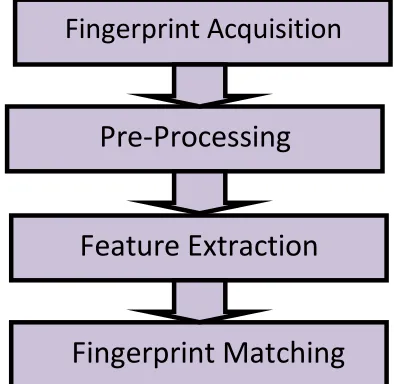
The proposed design has four major parts
Database & Fingerprint Acquisition
Pre-Processing
Feature Extraction
Fingerprint Matching
Figure 1: dataflow for system design
Database & Fingerprint Acquisition: In this work FVC2004 DB3 fingerprint standard database has been used, and Fingerprint Acquisition can be done by fingerprint sensors.
Fingerprint Acquisition
Fingerprint Matching
Feature Extraction
Pre-Processing: Census Transform is been used for pre-processing. Pre processing is the method which is used before matching.
Feature Extraction: The output of census transform contains features of fingerprint. This is called feature extraction.
Fingerprint Matching: It is done with the help of PCA method. PCA is used for fingerprint matching.
PROPOSED MODEL
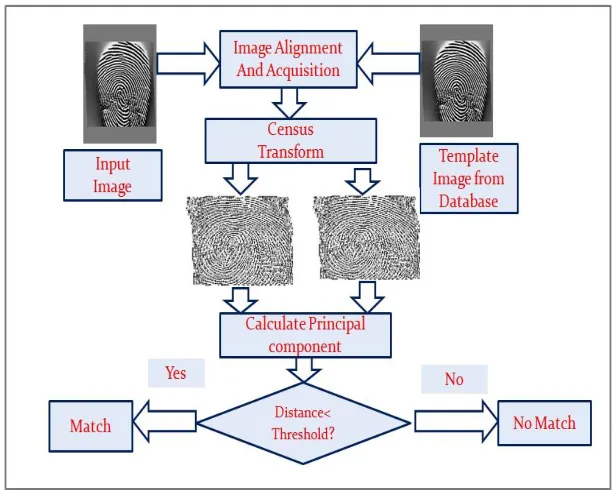
In the proposed model, initially, a database is to be formed consisting of fingerprint images from various source and the desired portions like ridges, central loops, whorls and arch, patterns are extracted from the sample images. However, compression algorithms can be employed to minimize the space complexity as it is required to store huge number of fingerprint images for reference purpose during fingerprint matching. In our approach we align and extract the input images to a desired dimension such that they are in accordance with the database image dimension. As the proposed method is a subset of correlation based template matching method the alignment and region selection plays a vital part in matching and thus care should be taken to properly calibrate the input image based on the region of interest. The flowchart describing the matching process is given in Fig.2.
Figure 2: proposed model for fingerprint matching
III. SIMULATION RESULT
Table 1 PERCENTAGE MATCH SCORES COMPARISON
Finger Hamming Score based percent Match (101_1)
PCA based present Match (101-1)
Finger Hamming Score based percent match (102_1)
PCA based present Match (102-1)
101_1 100% 100% 102_1 100% 100%
101_2 56.36% 90.02% 102_2 52.63% 70.12%
101_3 44.51% 65.73% 102_3 42.31% 98.274%
101_4 46.31% 75.31% 102_4 41.47% 60.61%
101_5 34.71% 79.32% 102_5 35.03% 64.73%
101_6 34.8% 65.5% 102_6 34.93% 36.67%
101_7 34.34% 57.04% 102_7 33.78% 66.93%
101_8 35.19% 27.79% 102_8 34.62% 40.39%
In order to calculate the False Match Rate (FMR) and False Non Match Rate (FNMR) of DB3 database we have calculated the Acceptance Ratio (A.R.) and Rejection ratio (R.R.) of the whole database based on match scores as depicted in Table I. N.M. Chaudhari and B.V. Pwar in [9] have considered threshold for match as 30%. Souvik Kundu, Baidyanath Ray [1] have considered threshold for match 35%. In this proposed method threshold is considered 55%. But the result is more than 55% show the effectiveness of proposed work.
PARAMETERS
In this proposed work four parameters are calculated and analysis. These parameters are given below-
ACCEPTANCE RATIO (AR): Acceptance Ratio is called AR. In term of fingerprint matching acceptance ratio is calculated by total matched fingerprint is divided by the total attempts and total is multiplied by the 100.
AR= 100*(total Matched / total attempt)
REJECTION RATIO (RR): Rejection Ratio is called RR. In terms of fingerprint matching rejection ratio is calculated by the total non matched fingerprint is divided by the total attempts and total is multiplied by the 100.
RR= 100*(total Non Matched / total attempt)
Table II below depicts the comparative data of A.R. and R.R. of DB3 database between existing and the proposed method.
TABLE II ACCEPTANCE RATIO (A.R.) AND REJECTION RATIO (R.R)
Hamming score based method
Proposed work
Finger Hamming Score Based A.R.
Hamming Score Based R.R.
PCA based A.R.
Figure 3 below depicts the comparative results of A.R. and R.R in graphical form.
Figure 3: Acceptance Ratio and Rejection Ratio
FALSE MATCHIMG RATIO: False matching ratio is called false acceptance ratio. False acceptance rate also called FAR. In terms of fingerprint matching false matching ratio is calculated by the total matched or total accept fingerprint divided by the total overall attempts of database.
FMR= total accept / total attempts.
FALSE NON MATCHING RATIO: False non matching ratio is called the false rejection ratio. The false rejection rate is also called FRR. In terms of fingerprint matching false non matching ratio is calculated by the total non matched or total rejected fingerprint divided by the total overall attempts of database.
FNMR= total reject / total attempts
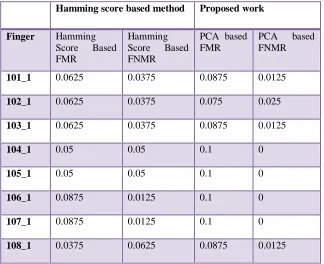
The FMR and FNMR of DB3 database is calculated and the result is compared with the existing data [1] as depicted in the Table III below.
0 20 40 60 80 100 120
101_1 102_1 103_1 104_1 105_1 106_1 107_1 108_1 109_1 110_1 AR
RR
102_1 62.5 37.5 75 25
103_1 62.5 37.5 87.5 12.5
104_1 50 50 100 0
105_1 50 50 100 0
106_1 87.5 12.5 100 0
107_1 87.5 12.5 100 0
TABLE III FMR AND FNMR FOR DB3 DATABASE
Figure 4 below depicts the comparative results of F.M.R. and F.N.M.R in graphical form
.
Figure 4: False Matching Ratio and False Non Matching Ratio
IV. CONCLUSION
In proposed work PCA and census transform (CT) is used for fingerprint matching. The combination of these two methods gives better result and better performance. The match score comparison; Acceptance Ratio (AR), Rejection Ratios (RR); False Matching Ratio (FMR) and False Non Matching Ratio (FNMR) for DB3 database is given in the table I, table II and table III respectively which depicts the effectiveness of the proposed method in fingerprint identification system. In this paper DB3 database is used for fingerprint recognition, which is available in public domain. In proposed work compare the original, accurate or full fingerprint of the person with the other fingerprints
0 0.02 0.04 0.06 0.08 0.1 0.12
101_1 102_1 103_1 104_1 105_1 106_1 107_1 108_1 109_1 110_1 FMR
FNMR Hamming score based method Proposed work
Finger Hamming Score Based FMR
Hamming Score Based FNMR
PCA based FMR
PCA based FNMR
101_1 0.0625 0.0375 0.0875 0.0125
102_1 0.0625 0.0375 0.075 0.025
103_1 0.0625 0.0375 0.0875 0.0125
104_1 0.05 0.05 0.1 0
105_1 0.05 0.05 0.1 0
106_1 0.0875 0.0125 0.1 0
107_1 0.0875 0.0125 0.1 0
of the same person but which is not proper, not good or not complete. Census transform is used for feature extraction of fingerprint. The Principal Component Analysis (PCA) method is used to calculate the principal component of the fingerprint images. Principal Components are the direction where most of the data is spread out. The Principal Component of any image is never changed if the image is reversed or rotate or damaged. Because of this reason PCA method give much accurate result. The hamming score based method used the threshold value 35% and other method which is minutia based recognition available in literature used the threshold value 30%. In proposed work use the threshold value more than 55% but the mostly result is greater than that. So this method is providing much better result as compare the other methods.
REFERENCES
[1] Souvik Kundu, Baidyanath Ray, ―New Hamming Score Based Correlation Method for Fingerprint Identification‖, 2015 6th International Conference on Computers and Devices for Communication (CODEC) Institute of Radio Physics & Electronics, University of Calcutta, December 16-18, IEEE 2015
[2] Ishan Bhardwaj, Narendra D. Londhe, Sunil K. Kopparapu, ―Feature Selection for Novel Fingerprint Dynamics Biometric Technique based on PCA‖, 2016 Intl. Conference on Advances in Computing, Communications and Informatics (ICACCI),IEEE, September 21-24, 2016, Jaipur, India
[3] Alessandra A. Paulino, , Jianjiang Feng, Anil K. Jain, ―Latent fingerprint Matching Using Descriptor-Based Hough Transform‖, IEEE TRANSACTIONS ON INFORMATION FORENSICS & SECURITY, VOL. 8, NO. 1, January 2015 page 31-45
[4] Xuanbin Si, Jianjiang Feng, Jie Zhou, & Yuxuan Luo, ‖Detection & Rectification of Distorted Fingerprints‖, IEEE TRANSACTIONS ON PATTERN study & MACHINE INTELLIGENCE, VOL. 37, NO. 3, March 2015, page 555-568
[5] J. Li, S. Tulyakov and V. Govindaraju, ―Improved Local Correlation Method for Fingerprint Matching,‖ Computing and Networking (CANDAR), 2014 Second International Symposium on Year: 2014, pp. 560-562. [6] Fanglin Chen, Xiaolin Huang, Jie Zhou, ―Hierarchical Minutiae Matching for Fingerprint and Palm print Identification‖, IEEE TRANSACTIONS ON IMAGE PROCESSING, VOL. 22, NO. 12, December 2013 page 4964-4971
[7] Feng Liu, David Zhang, Changjiang Song, & Guangming Lu, ―Touch less Multitier Fingerprint Acquisition & Mosaic king,‖ IEEE TRANSACTIONS ON INSTRUMENTATION & MEASUREMENT, VOL. 62, NO. 9, September 2013 page 2492-2502
[8] Carsten Gottschlich, ―Curved-Region-Based Ridge Frequency Estimation & Curved Gabor Filters for Fingerprint Image Enhancement.‖ IEEE TRANSACTIONS ON IMAGE PROCESSING, VOL. 21, NO. 4, April 2012, page 2220-2227
[9] N.M. Chaudhari and B.V. Pwar, ―Experimental Analysis of Fingerprint Techniques: Variance and ROC,‖ Indian Journal of Science and Technology Vol. 3, No. 5, pp.598- 601, May 2010
[10] R. Cappelli, M. Ferrara, & D. Maltoni, ―Minutia cylinder-code: A new representation & matching technique for fingerprint recognition,‖ IEEE Trans. Pattern Anal. Mach. Intel., vol. 32 no. 12, pp. 2128–2141, December 2010. [11] D. K. Karna, S. Agarwal and S. Nikam, ―Normalized Cross-Correlation Based Fingerprint Matching,‖ Computer Graphics, Imaging and Visualization, 2008. CGIV'08. Fifth International Conference on, IEEE, pp. 229-232, August 2008.