
A Review on Various Interactive CAPTCHA
Techniques Concerning Web Security
Deepika Rajpal
M.Tech Scholar, SIRTS, BhopalAbhigyan Tiwari
Assistant Professor, SIRTS, BhopalABSTRACT: Turing test is a process of determining the involvement of robot in attacking the web security services and segregate them among humans. This test is commonly useful for web based application in the form of CAPTCHA (Completely Automated Public Turing Test to tell Computer and Human Apart) to prevent from unwanted activities, automated access and the harms caused by the robots. CAPTCHA is tentatively very useful in the form of deformed text, mathematical, OTP (One Time Password), Audio, 3D, Graphical and Gaming CAPTCHA. Gaming CAPTCHA is one of the highly secured CAPTCHAs which is trending now. Most of the gaming CAPTCHA are based on simple logics where user can solve it by dragging object to the target position and some are often difficult to solve even by a human due to the difficulty level. A CAPTCHA should be as easier as human can solve within few seconds that would be almost impossible to solve by robot. A system is required which is able to provide better level of accuracy as compare to the existing CAPTCHAs. A system requires an intellectual effort from user to solve the given query. The proposed system will be able to provide such credentials in which some logical moves will be required that can be easily solved by human but it is not possible to score correct moves by robot. Proposed game possess highly graphical interface with attractive interaction which can inspire user to solve CAPTCHA without any annoyance. The motive of this paper is to review the existing CAPTCHA techniques in the field of web security services and provide best level of security that cannot be cracked and able to replace the existing systems.
Keywords: Gaming CAPTCHA, Web Security, Robot, Motion, Artificial Problem.
I.
INTRODUCTION
1.1 Introduction of Present Systems
Fig. 1.1.1 CAPTCHAs
There are so many CAPTCHA technique exist and let it be more precise in literature survey.
II.
LITERATURE SURVEY
2.1 Review on existing systems:
Fig. 2.1.2 3D Motion CAPTCHA [2]
Ibrahim et al. (2009) proposed a system which is just a step ahead of 3D animation CAPTCHA but somewhere allied to it. In this technique, a color cube will appear, containing different alphabets on all the faces with distinct background colors. To solve this CAPTCHA, visitor needs to rotate the cube and identify all the characters along with their respective color backgrounds. This paper proposed an impressive technique of CAPTCHA but it consumes more time along with confusing color combinations. The proposed system might be violating by using some intelligent machine by color detection as well as character recognition. So, the system which has been proposed wouldn’t be an appropriate approach for Turing test.
Fig. 2.1.4 3D cubic CAPTCHA [3]
Aadhirai et al. (2012) [4] proposed a CAPTCHA which is smart enough to differentiate a human and a robot. The proposed technique will show an image of real world and user will be asked to find out an object, according to their distance from the centered object. For example, here in the CAPTCHA mentioned below in the figure, user asked to find out an object which is farthest from the construction worker. This can be possible to observe by human only. But sometimes, it is often confusing for a user to find an object due to the perplexing picture which encloses many objects with hazy appearance. So the proposed technique is not considered as a best technique for CAPTCHA.
Fig. 2.1.5 Distance based CAPTCHA [4]
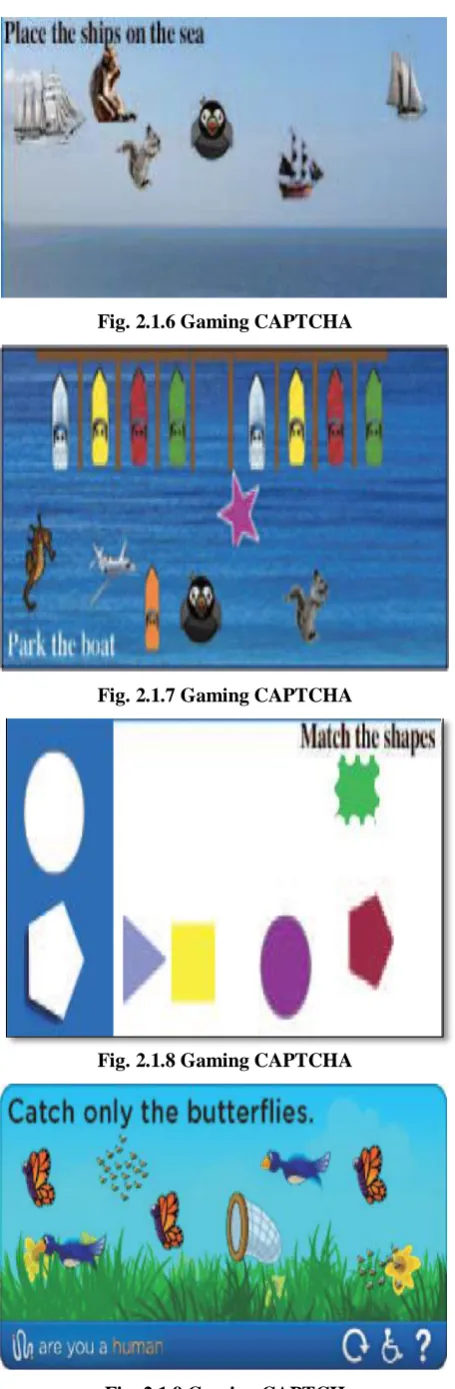
Fig. 2.1.7 Gaming CAPTCHA
Fig. 2.1.8 Gaming CAPTCHA
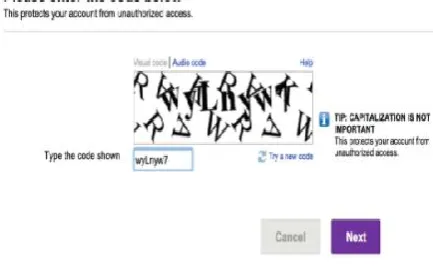
some renowned organizations like Google, Yahoo, and Facebook etc is reCAPTCHA. Method used in this CAPTCHA is like an example in the figure shown below which consists of two different words taken from old text book and to prove your identity, user needs to recognize those two words and write it on the given text box. This technique can be cracked by an intelligently trained neural network system and OCR. This CAPTCHA is time consuming and challenging at times that could be annoying for a user.
Fig. 2.1.10 reCAPTCHA [6]
Fig. 2.1.12 Finger guessing game CAPTCHA [7]
Nitisha et al. (2016) proposed AJigJax CAPTCHA, a type of puzzle game and categorized the technique in two different level i.e. CAPTCHA level 1 (CL1) and CAPTCHA level 2 (CL2). If a server registered with the CL1 CAPTCHA security shown in fig 2.1.13, the appeared CAPTCHA has shown an image of alphanumeric string and place the shuffled tiles of same string below the image. User has to arrange those tiles in a manner shown in the image. CAPTCHA categorized under CL2 contains two stages i.e. registration and login with two challenges. One is pass point challenge shown in fig 2.1.14, where user needs to select an area on the image during registration process and keep in mind. Second task is to create a string of alphanumeric characters using virtual keyboard shown in fig 2.1.15 and memorize it. While login, user needs to recall those pass point and generated alphanumeric string. The whole process might be secure enough for the server but for an individual user, the progression of the system is time taking and complicated which may annoying users.
Fig. 2.1.13 AJigJax CL1 CAPTCHA with 5 characters [8]
Fig. 2.1.15 Authorized CAPTCHA Challenge [8]
S. Ashok Kumaret al. (2017) proposed a system which is based on mini games which are designed using HTML5 and
Java Script. There are four different games were designed in this project. These games are fundamentally web based. The application designed in HTML and JAVA script are web based and their coding can easily be extracted because of its availability in URL (Uniform Resource Locator) due to which web attacks can affect the security premises.
Fig. 2.1.16 Bird Shooting [9]
III.
CONCLUSION
During the survey of the systems which have been proposed till now, it has been observed that every system has different form of CAPTCHA to secure the server but the techniques proposed so far are lacking somewhere. Some systems are often simple to recognize and get affected by web attacks and others are much difficult to solve even for human. Gaming CAPTCHAs are based on simple logic which does not possess the better security systems. To replace the existing illogical gaming CAPTCHA, an intellectual CAPTCHA is required in the form of game with high level of interaction that can provide better level of accuracy.
IV.
FUTURE SCOPE
The security level of CAPTCHA can be enhanced in future by turning it more intellectual and based on artificial intelligence problem which require mental ability to solve the CAPTCHA. CAPTCHA should be easy, effective, logical and non-breakable that can be solved by human but almost impossible for robots. Thus the gaming CAPTCHA is on trending way through which an intellectual CAPTCHA can be designed.
REFERENCES
[1] JingSong Cui, LiJing Wang, JingTing Mei, Da Zhang, Xia Wang, Yang Peng, WuZhou Zhang, “CAPTCHA Design Based on Moving Object Recognition Problem” in IEEE 2009.
[2] Jing-Song Cui, Jing-Ting Mei, Xia Wang, Da Zhang, Wu-Zhou Zhang , “A CAPTCHA Implementation Based on 3D Animation” in International Conference on Multimedia Information Networking and Security of IEEE 2009.
[3] Ibrahim FurkanInce, YucelBatu Salman, Mustafa ErenYildirim and Tae-Cheon Yang, “Execution Time Prediction For 3D Interactive CAPTCHA By Keystroke Level Model” in Fourth International Conference on Computer Sciences and Convergence Information Technology of IEEE 2009.
[4] Aadhirai R, Sathish Kumar P J and Vishnupriya S, “Image CAPTCHA: Based on Human Understanding of Real
World Distances” Proceedings of 4th International Conference on Intelligent Human Computer Interaction, IEEE 2012.
[5] Song Gao, Manar Mohamed, Nitesh Saxena and Cheng cui Zhang, “Gaming the Game: Defeating a game
CAPTCHA with efficient and robust hybrid attacks” in IEEE 2014.
[6] Seyed Mohammad Reza1, Saadat Beheshti2 and Panos Liatsis3, “How Humans Can Help Computers to Solve an Artificial Problem survey”, international conference, IEEE 2015.
[7] Cao Lei, “Image CAPTCHA Technology Research Based On The Mechanism Of Finger-Guessing Game”, Third
International Conference, IEEE 2015.
[8] Nitisha Payal1 and Rama Krishna Challa2, “AJIGJAX: A Hybrid Image Based Model for CAPTCHA/CaRP”, IEEE 2016.
[9] S. Ashok Kumar1, N. Ram Kumar2, S. Prakash3 and K Sangeetha4, “Gamification of Internet Security by Next
![Fig. 2.1.3 3D cubic CAPTCHA [3]](https://thumb-us.123doks.com/thumbv2/123dok_us/1900663.1248764/3.595.161.436.164.349/fig-d-cubic-captcha.webp)
![Fig. 2.1.4 3D cubic CAPTCHA [3]](https://thumb-us.123doks.com/thumbv2/123dok_us/1900663.1248764/4.595.188.408.348.654/fig-d-cubic-captcha.webp)
![Fig. 2.1.10 reCAPTCHA [6]](https://thumb-us.123doks.com/thumbv2/123dok_us/1900663.1248764/6.595.199.396.381.712/fig-recaptcha.webp)
![Fig. 2.1.14 Pass-Point Challenge [8]](https://thumb-us.123doks.com/thumbv2/123dok_us/1900663.1248764/7.595.204.390.62.364/fig-pass-point-challenge.webp)
![Fig. 2.1.17 Duck Hunt [9]](https://thumb-us.123doks.com/thumbv2/123dok_us/1900663.1248764/8.595.184.410.190.320/fig-duck-hunt.webp)
![Fig. 2.1.19 Drag-and-Drop [9]](https://thumb-us.123doks.com/thumbv2/123dok_us/1900663.1248764/9.595.191.402.60.219/fig-drag-and-drop.webp)