by
Laercio Evandro Ferracioli da Silva
A Thesis submitted in fulfilment of the requirements for the degree of
Doctor of Philosophy in
University of London
Department of Science Education Institute of Education University of London
Abstract
In recent years, research in students' conceptions about the physical world has revealed that when children reach the age of schooling they have already developed their own knowledge about the physical world which is sometimes rather different from the accepted scientific knowledge taught in schools. This thesis aims at investigating possible structures of commonsense reasoning about reversibility related to processes of interest to Science presented by students from two age-groups, 13/14 year old and 16/17 year old.
The study has a theoretical framework based upon the scientific view of reversibility mainly related to Thermodynamics. It is also related to a conceptual, commonsense and developmental perspective taken from the literature, where reversibility is connected with different concepts such as causation, action, and conservation. Therefore, based upon this framework some very basic questions were asked to students about a selected number of phenomena.
The empirical data was collected with the use of questionnaires. The sample consisted of two different age/instructional groups of students from England, Chile and Brazil. Factor Analysis was used to analyse the quantitative data. The qualitative data was analysed using a systemic network in which students' answers could be categorised.
The main result of the quantitative analysis was a common three dimensional factor space of explanation for all groups with the dimensions relating to the ways in which the processes could be seen. They are respectively the contrast between 'can happen and cannot happen', 'needs an action and happens by itself, and 'has a goal and has no goal'. Phenomena can be located in this common space, but their position may vary for different age/instructional groups and for groups from different countries. The results of the qualitative analysis give a more detailed description of the way students see the reversibility of the processes and lend support to the quantitative results.
acquire a life of their own.
Werner Heisenberg
To my father, for his determination (in memorium), To my mother, for her perseverance,
To my brother, for his passion for life, To my sister, for her love.
I wish to express my gratitude to Professor Jon Michael Ogborn, the supervisor of this thesis, for his invaluable assistance and encouragement and personal help throughout the course of this work, which belongs to him as well. Should I also thank him for being able to learn from his experience from life and professionalism, and that 'life' is not a spontaneous process as it might seem to be.
I am greatly indebted to Monica Pereira dos Santos, Compadre Wagner, Brother Edmundo and Carmen Gata for their friendship, support and encouragement as well as for their unconditional personal and emotional help, without which I could not have survived.
I am also grateful to a group of friends for their help on different occasions, just to mention a few Isabel Martins, Maria José Benzanilla, Gwenn Edwards, Joel Castro, Clive Ellul, Gillian Nicholls, Fabio Sampaio. But I am grateful to all my colleagues at the research student group as well as the staff of the Science Education Department of the Institute of Education.
My deepest gratitude is to the informants of this research and to school teachers and directors who helped me during the data collection, specially to D. Judith Pereira de Castro.
Departamento de Fisica da Universidade Federal do Espirito Santo is gratefully acknowledged for granting me leave of absence to carry out this project.
CNPq (Brazilian Research Council) is gratefully acknowledged for financial support.
Contents
Abstract ii
Acknowledgements
Contents vi
List of Figures xvi
List of Tables xix
1 Introduction
1.1 The Context of the Research 21
1.2 The Organisation of the Thesis 23
2 Reversibility: A Scientific Perspective
2.1 System, Surrounding, Universe 25
2.2 Macroscopic Views of Mechanics and Thermodynamics 27
2.3 Thermodynamic Equilibrium 27
2.4 Process and Quasi-static Process 28
2.5 The First Law: Energy, Heat and Work 28
2.7 Reversibility and Irreversibility 31 2.8 Spontaneity, Equilibrium, and Reversibility 32
2.9 Entropy 33
2.10 Entropy and 'Quality of Energy' 34
2.11 Entropy and the Direction of Time 34
2.12 Time-Reversible Processes 35
2.13 Entropy and Disorder: a Microscopic View of Thermodynamics 36
2.14 Order Out of Disorder 37
2.15 Time's Arrow 39
3 Review of Literature
3.1 Introduction 40
3.2 Studies in a Descriptive Perspective 42
3.2.1 Reversibility 43
3.2.2 Matter and its Transformations 44
3.2.2.1 Nature of Matter 44
3.2.2.2 State of Matter 46
3.2.2.3 Transformation of Matter 47
3.2.2.4 Chemical Changes 48
3.2.2.5 Physical Changes 50
3.2.2.6 Bio-Chemical Phenomena 51
3.2.3 Scientific Concepts 53
3.2.3.1 Energy 53
3.2.3.2 Heat and Temperature 54
3.2.3.3 Second Law of Thermodynamics and Entropy 55
3.2.3.4 Chemical Equilibrium 55
3.3 Studies in the Commonsense Forms of Reasoning Perspective 56
3.3.1 The Role of Action and Cause 57
3.3.2 Explanation 60
3.3.2.1 Ontology, Causation and Explanation 60 3.3.2.2 The Experiential Gestalt of Causation. 62
3.3.2.3 Linear Causal Reasoning 63
3.3.2.4 Symbolic Knowledge and Life-World Knowledge 64 3.3.2.5 Teleological and Anthropomorphic Reasoning
(Explanations). 65
Contents - 8
3.4 Studies in the Developmental Psychology Perspective 67
3.4.1 Stavy's Studies 67
3.4.2 Bar's Studies 70
3.4.3 Shultz and Coddington's Study 73
4 The Conception of the Study
4.1 The Choice of Problem 75
4.1.1 The Context of the Study 75
4.1.2 Possible Kinds of Questions to be Raised 77 4.1.3 Relationship Between Different Ways of Thinking about
Reversibility 78
4.1.4 Research Questions 81
4.2 The Empirical Work 81
4.2.1 The Pilot Study 82
4.2.1.1 The Choice of Phenomena 82
4.2.1.2 Methodology 83
4.2.1.3 The Instrument 84
4.2.1.4 The Sample and Administration 89
5 Pilot Study - Factor Analysis: A Space of Explanation
5.1 Introduction 91
5.2 Factor Analysis 92
5.2.1 Representations of Phrases in the Factor Space 93
5.3 Interpretation of the Factors 97
5.3.1 Factor I: Can Happen vs. Cannot Happen 98 5.3.2 Factor II: Happens by Itself vs. Needs an Action 99 5.3.3 Factor III: Teleology - Goal vs. No Goal 100
5.3.4 Factor N: Relaxation 100
5.4 Interpretation of the Correlations between Factors 101 5.5 Inspecting the Interpretation of the Factor Solution 102 5.5.1 Events along the dimension I: Cannot Happen vs. Can happen 102 5.5.2 Events along the dimension II: Happens by itself vs.
Needs an action 104
5.6 Characterisation of Events According to the Fourth Factor: Relaxation 107
5.7 Summary of Factor Space 110
5.7.1 Summary of the Interpretation of the Factor Solution 110 5.7.2 Summary of the Results concerning the Description of Events 111
6 Pilot Study
-
Description of Events6.1 Introduction 112
6.2 Cluster Analysis 113
6.3 Analysis of the Action/Cause Responses 115
6.3.1 A systemic network for analysing the responses 115 6.3.2 The Events: how the students describe them 117 6.3.2.1 PENDULUM - 'a pendulum stops swinging' 117
6.3.2.2 SLOPE - 'a ball rolls down' 117
6.3.2.3 TANK - 'the water flows out' 117 6.3.2.4 PENCIL - Q1 - 'a pencil is worn out' 118 6.3.2.5 TEA - 'a cup of tea becomes cold' 118 6.3.2.6 CHAMPAGNE - 'the champagne goes flat' 119
6.3.2.7 BOMB - 'a bomb explodes' 119
6.3.2.8 CAR - 'a car rusts away' 119
6.3.2.9 BATTERY - 'a car battery runs down' 120
6.3.2.10 PLANT - 'a plant grows' 120
6.3.2.11 WATCH - Q1 - 'the time goes by' 121 6.3.2.12 WHEEL - 'a rotating wheel stops turning' 121 6.3.2.13 JACK IN THE BOX - 'a "jack in the box" jumps' 122
6.3.2.14 EGG - 'an egg is broken' 122
6.3.2.15 PENCIL - Q2 - 'a pencil is worn out' 122 6.3.2.16 ICE-CREAM - 'an ice-cream melts' 123 6.3.2.17 PUDDLE - 'water in a puddle evaporates' 123 6.3.2.18 CANDLE - 'a candle burns away' 124 6.3.2.19 ALKA-SELTZFR - 'an alka-seltzer tablet dissolves' 124 6.3.2.20 MAGNET - 'a magnet attracts nails' 125 6.3.2.21 BOY/MAN - 'a man grows old' 125 6.3.2.22 WATCH - Q2 - 'the time goes by' 125 6.3.3 Reversibility: the description of the events 127 6.3.3.1 Natural process reversed by an action 128 6.3.3.2 Natural process triggered by an action and reversed
Contents - 10
6.3.3.3 Natural process with natural reverse 128 6.3.3.4 Non natural process triggered by an action reversed
by an action 129
6.3.3.5 Irreversible natural processes 129
6.3.3.6 Irreversible processes 129
6.4 The Clusters according to Actions and Causes 129 6.4.1 First Cluster: Happens by itself, ruled by some causal law 130
6.4.2 Second Cluster: Unlikely to happen 130
6.4.3 Third Cluster: Possible, but difficult to reverse 131
6.4.4 Fourth Cluster: Happens by itself 131
6.4.5 Fifth Cluster: Non natural reversal caused by action 131 6.4.6 Sixth Cluster: Happens naturally due to a planned action 132 6.4.7 Seventh Cluster: Happen with difficulty due to an action
taken with a goal 133
6.4.8 Eighth Cluster: Unlikely to happen or possible reversal for a
purpose 133
6.5 The factor space, the cluster analysis and the action/cause 134 6.6 Analysis of the Questions related to Changes/No Changes 134 6.7 The Analysis of the Question: Is there only one way to go from A to B? 136
7 The Description of the Main Study
7.1 The Questions 137
7.1.1 The Phrases in the Question in the Form of a Grid 138
7.1.1.1 The Number of Phrases 138
7.1.1.2 The Changes 139
7.2 The Events 140
7.3 The Questionnaires for the Main Study 141
7.3.1 The Portuguese and the Spanish Versions of the Questionnaires 142
7.4 The Sample and Administration 143
7.4.1 The English Samples 144
7.4.2 The Chilean Samples 145
8 Main Study - A Common Space of Explanation
8.1 Introduction 147
8.2 Factor Analysis by Groups 148
8.3 Factor Analysis of Groups Combined 151
8.3.1 Interpretation of the Factor Solution 152 8.3.1.1 Dimension I: Does Not Happen vs. Happens 152 8.3.1.2 Dimension II: Happens by Itself vs. Needs an Action 153 8.3.1.3 Dimension III: Goal/Law-like vs. No Goal 154 8.3.2 Inspecting the Interpretation of the Factor Solution 155
8.3.2.1 Events along dimension I 155
8.3.2.2 Events along dimension II 159
8.3.2.3 Events along the dimension III 165 8.3.3 How each group see the events in the Common Factor Space 165 8.3.3.1 English 13/14 year old Group 168 8.3.3.2 English 16/17 year old Group 169 8.3.3.3 Chilean 13/14 year old Group 171 8.3.3.4 Chilean 16/17 year old Group 172 8.3.3.5 Brazilian 16/17 year old Group 173
8.4 Summary of Factor Space 174
8.4.1 Summary of the Interpretation of the Factor Solution
for the Groups Combined 174
8.4.2 Summary of the Results concerning each Group 175 8.4.3 Summary of the Results concerning the Description of Events 176
9 Main Study - The Events: How They are Described
9.1 The Procedure of Analysis 178
9.1.1 Analysis of the Action/Cause Questions 178
9.1.2 The Plot of Events 179
9.1.3 Frequencies of Replies to the Phrases of Question 2 180
9.2 Description of Events 180
9.2.1 PENDULUM - 'a pendulum stops swinging' 180
9.2.1.1 Forwards 180
9.2.1.2 Backwards 181
Contents - 12
9.2.2 ICE-CREAM - 'an ice-cream melts' 184
9.2.2.1 Forwards 184
9.2.2.2 Backwards 185
9.2.2.3 Reversibility 187
9.2.3 PUDDLE - 'water in a puddle evaporates' 187
9.2.3.1 Forwards 187
9.2.3.2 Backwards 190
9.2.3.3 Reversibility 191
9.2.4 CAR - 'a car rusts away' 191
9.2.4.1 Forwards 191
9.2.4.2 Backwards 194
9.2.4.3 Reversibility 195
9.2.5 BOY/MAN - 'a man grows old' 195
9.2.5.1 Forwards 195
9.2.5.2 Backwards 195
9.2.5.3 Reversibility 198
9.2.6 FALLING BALL - 'the ball falls and bounces back up' 198
9.2.6.1 Forwards 198
9.2.6.2 Backwards 201
9.2.6.3 Reversibility 201
9.2.7 SEE-SAW - 'the see-saw is tilted a little' 202
9.2.7.1 Forwards 202
9.2.7.2 Backwards 205
9.2.7.3 Reversibility 205
9.2.8 SLOPE - 'a ball rolls down' 206
9.2.8.1 Forwards 206
9.2.8.2 Backwards 206
9.2.8.3 Reversibility 209
9.2.9 TEA - 'a cup of tea becomes cold' 209
9.2.9.1 Forwards 209
9.2.9.2 Backwards 210
9.2.9.3 Reversibility 212
9.2.10 CHAMPAGNE - 'the champagne goes flat' 212
9.2.10.1 Forwards 212
9.2.10.2 Backwards 215
9.2.11 CANDLE - 'a candle burns away' 215
9.2.11.1 Forwards 215
9.2.11.2 Backwards 218
9.2.11.3 Reversibility 218
9.2.12 PLANT - 'a plant grows' 219
9.2.12.1 Forwards 219
9.2.12.2 Backwards 220
9.2.12.3 Reversibility 223
9.2.13 SWING - 'the swing comes back' 223
9.2.13.1 Forwards 223
9.2.13.2 Backwards 226
9.2.13.3 Reversibility 226
9.2.14 SPRING - 'the spring is stretched a little' 226
9.2.14.1 Forwards 226
9.2.14.2 Backwards 228
9.2.14.3 Reversibility 230
9.3 Summary of Description of Events 230
9.4 Action: what is the role played by action in the process? 233 9.4.1 Events happening forwards: the envisaging of events involving
action 233
9.4.1.1 The Subject: the First Agent 233 9.4.1.2 The Implicit Action of "Natural Causal Agents" 234 9.4.2 Events happening backwards: reversibility through an action 234 9.4.3 Forwards and Backwards: how the whole phenomenon is
described 235
9.4.3.1 Reversible Natural Process 235
9.4.3.2 Natural Process reversed through an action 236 9.4.3.3 Natural process triggered by an action, reversed
through an action which triggers a natural process 236 9.4.3.4 Non-Natural Process Reversed through an Action 236 9.4.3.5 Irreversible natural process 237
9.5 The whole-part view 237
9.6 Action, Cause, and Effect: when they are the same 238 9.7 The Event Happening Forward and Backward: How they are Located
Contents - 14
10 Discussion and Conclusions
10.1 Is it possible to find a description of the basic elements which people
use in their everyday life, to reason about reversibility? 240 10.2 What are the different ways of reasoning about reversing a process? 242 10.3 What is the relation between commonsense reasoning and
scientific reasoning? 244
10.3.1 What is the relation between a scientific typology of process
and commonsense groupings? 244
10.3.2 Commonsense and Scientific Reasoning: How processes are
described. 247
10.4 What is the role played by action in reasoning about reversibility? 249 10.4.1 Action: The Reversible Element in Commonsense Reasoning
about Reversibility 249
10.4.2 Is it possible to model reversibility in terms of action? 252 10.5 What is the role played by conservation in reasoning about reversibility:
to what extent does reversibility involve something being 'conserved'? 253
10.5.1 Conservation as Constraint 253
10.5.2 Conservation as What stays the same' 254
10.5.3 Conservation as 'naturalness' 255
10.5.4 Reversibility and Conservation 256
10.6 How can the way students reason about processes and their
reversibility be related to the review of literature? 256 10.7 If a description of the way people reason about processes and their
reversibility is possible, what would be the implications for the
teaching of scientific ideas about reversibility? 259
10.8 Design and Methodology 261
10.9 Group Differences 262
10.10 Further Research 263
10.10.1 Commonsense Reasoning Related Research 263
10.10.2 Teaching-Related Research 264
10.11 Final Remark 265
Appendix A: The Questionnaires for the Pilot Study 276
Appendix B: Statistical Techniques 323
Appendix C: Statistical Summary of the Factor Analysis 327
Appendix D: Cluster Analysis for Events for the Pilot Study 331
Appendix E: The Questionnaires for the Main Study 346
Appendix F: Statistical Summaries for the Main Study: Factor Analysis by Groups 377
Appendix G: Interpretation of Factor Analysis by Groups of the Main Study 388
List of Figures
Figure 2.1 - The Kelvin-Plank statement denies the possibility of converting 30
Figure 2.2 - The Clausius statement denies the possibility of heat flowing 31
Figure 3.1 - Scheme for the Literature Review 41
Figure 3.2 - Relationship between the Two Domains (Solomon, 1985, p347) 65
Figure 4.1 - Network expressing the structure of phrases of the question in the
form of a grid for the pilot study 87
Figure 5.1 - Factor Space of the Pilot Study: Dimension I vs. Dimension II 94
Figure 5.2 - Factor Space of the Pilot Study: Dimension I vs. Dimension III 95
Figure 5.3 - Factor Space of the Pilot Study: Dimension II vs. Dimension HI 96
Figure 5.4 - Frequencies of Replies for phrases with high loadings on Dimension I 103 Figure 5.5 - Frequencies of Replies for phrases with high loadings on Dimension II 105 Figure 5.6 - Frequencies of Replies for phrases with high loadings on Dimension III 108 Figure 5.7 - Frequencies of Replies for phrases with high loadings on Dimension IV 110
Figure 6.1 - The network for analysing the action/cause answers 116
Figure 6.2 - Network for analysing the change/no change questions 136
Figure 8.1 - Factor Space with phrases represented as vectors 153
Figure 8.2 - Frequencies of Replies for phrases with high loafing on Dimension I 156
Figure 8.3 - Frequencies of Replies for phrases with high loafing on Dimension II 160
Figure 8.4 - Frequencies of Replies for phrases with high loafing on Dimension III 166
Figure 8.5 - The events in the common factor space for the English 13/14 group 169
Figure 8.6- The events in the common factor space for the English 16/17 group 170
Figure 8.7 - The events in the common factor space for the Chilean 13/14 group 171
Figure 8.8 - The events in the common factor space for the Chilean 16/17 group 172
Figure 8.9 - The events in the common factor space for the Brazilian 16/17 group 173
Figure 9.1 - The network for analysing the action/cause responses 179
Figure 9.2 - Plot of the events Pendulum AB and Pendulum BA 182
Figure 9.3 - Frequencies of replies to each phrase for each group for the events
Pendulum AB and Pendulum BA 183
Figure 9.4 - Plot of the events Ice-Cream AB and Ice-Cream BA 185
Figure 9.5 - Frequencies of replies to each phrase for each group for the events
Ice-Cream AB and Ice-Cream BA 186
Figure 9.6 - Plot of the events Puddle AB and Puddle BA 188
Figure 9.7 - Frequencies of replies to each phrase for each group for the events
Puddle AB and Puddle BA 189
Figure 9.8 - Plot of the events Car AB and Car BA 192
Figure 9.9 - Frequencies of replies to each phrase for each group for the events
Car AB and Car BA 193
Figure 9.10 - Plot of the events Boy/Man AB and Boy/Man BA 196
Figure 9.11 - Frequencies of replies to each phrase for each group for the events
Boy/Man AB and Boy/Man BA 197
Figure 9.12 - Plot of the events Falling Ball AB and Falling Ball BA 199
Figure 9.13 - Frequencies of replies to each phrase for each group for the events
Falling Ball AB and Falling Ball BA 200
Figure 9.14 - Plot of the events See-Saw AB and See-Saw BA 203
Figure 9.15 - Frequencies of replies to each phrase for each group for the events
See-Saw AB and See-Saw BA 204
Figure 9.16 - Plot of the events Slope AB and Slope BA 207
Figure 9.17 - Frequencies of replies to each phrase for each group for the events
Slope AB and Slope BA 208
Figure 9.18 - Plot of the events Tea AB and Tea BA 210
Figure 9.19 - Frequencies of replies to each phrase for each group for the events
Tea AB and Tea BA 211
List of Figures - 18
Figure 9.21 - Frequencies of replies to each phrase for each group for the events
Champagne AB and Champagne BA 214
Figure 9.22 - Plot of the events Candle AB and Candle BA 216
Figure 9.23 - Frequencies of replies to each phrase for each group for the events
Candle AB and Candle BA 217
Figure 9.24 - Plot of the events Plant AB and Plant BA 220
Figure 9.25 - Frequencies of replies to each phrase for each group for the events
Plant AB and Plant BA 221
Figure 9.26 - Plot of the events Swing AB and Swing BA 224
Figure 9.27 - Frequencies of replies to each phrase for each group for the events
Swing AB and Swing BA 225
Figure 9.28 - Plot of the events Spring AB and Spring BA 228
Figure 9.29 - Frequencies of replies to each phrase for each group for the events
Spring AB and Spring BA 229
Figure 10.1 - Ways of reasoning about reversing a process 243
Figure 10.2 - Action as the Reversible Element in Commonsense Reasoning about
Reversibility 249
Figure 10.3 - Cause and Effect in Chain 250
Table 3.1 - Problems description according to the concepts investigated (Bar, 1991) 71
Table 3.2 - Result of the Factor Analysis (Bar, 1991) 71
Table 4.1 - Description of the Phenomena for the Pilot Study 83
Table 4.2 - Categorisation of Phrases for Questionnaires of the Pilot Study 88
Table 4.3 - Phenomena selected for the two questionnaires 89
Table 4.4 - The Sample of the Pilot Study 90
Table 5.1 - Oblique Solution Primary Pattern Matrix-Orthotran/Varimax-Pilot Study 97
Table 6.1 - Clusters of Events based upon Factors Scores 114
Table 6.2 - Summary of the description of events in both questionnaires 126
Table 6.3 - Events in the First Cluster and Summary of Description 130
Table 6.4 - Events in the Second Cluster and Summary of Description 130
Table 6.5 - Events in the Third Cluster and Summary of Description 131
Table 6.6 - Events in the Fourth Cluster and Summary of Description 131
Table 6.7 - Events in the Fifth Cluster and Summary of Description 132
Table 6.8 - Events in the Sixth Cluster and Summary of Description 132
Table 6.9 - Events in the Seventh Cluster and Summary of Description 133
Table 6.10 - Events in the Eighth Cluster and Summary of Description 133
Table 7.1 - Classification of the phrases based on the analysis of the Pilot Study 138
Table 7.2 - Categorisation of Phrases for the Main Study, according to the network
List of Table - 20
Table 7.3 - Description of the phenomena for the Main Study 142
Table 7.4 - Phenomena selected for the two questionnaires 143
Table 7.5 - Summary of the Samples of the Main Study 144
Table 7.6 - English Sample - 13/14 year old 145
Table 7.7 - English Sample - 16/17 year old 145
Table 7.8 - Chilean Sample - 13/14 year old 145
Table 7.9 - Chilean Sample - 16/17 year old 146
Table 7.10 - Brazilian Sample - 16/17 year old 146
Table 8.1 - Summary of the Interpretation of the Three Dimensions for all Groups
Independently 150
Table 8.2 - Oblique Solution Reference Structure-Orthotran/Varimax - Main Study 151
Table 9.1 - Summary of the description of the events in both questionnaires 231
Table 9.2 - Overall summary of the description of the events 232
Table 9.3 - Summary of the Description of Events 238
Table 10.1 - Groupings of Processes in Commonsense Reasoning 244
Table 10.2 - Scientific Typology of Processes 245
Table 10.3 - Summary of the Categorisation of Events according to the
Introduction
1.1 The Context of the Research
In recent years, many studies have dealt with the content of students' ideas in science. A number of studies have demonstrated that when children reach school age they have already developed their own knowledge about the physical world, and often this knowledge is rather different from the accepted scientific knowledge taught at school (e.g. Driver and Easley, 1978). Therefore, when asked to explain any phenomenon in nature, students use this knowledge to construct their own explanation about the world.
Chapter 1 - Introduction - 22
Within this view, a specific focus is on the understanding of people's knowledge about things in Science, in terms of commonsense forms of reasoning, to attempt to look at fundamental categories of thought. In this context, commonsense reasoning is understood as ordinary, everyday, unreflective, practical reasoning about things which are mostly seen as obvious (Ogborn, 1989).
The objective of these studies is to understand processes or modes of reasoning about entities and events, which also happen to have a different description in Science. Some focused on relating peoples' knowledge of the physical world to underlying forms of commonsense reasoning about objects and events in this world (Whitelock, 1991; Mariani and Ogborn 1991, 1993). Commonsense knowledge of the physical world is characterised as essentially the way one experiences and senses this world and supported by forms of reasoning which are seen as able to be described in terms of some fundamental dimensions of commonsense reasoning.
The present research is carried out within this last perspective. This research does not concern students' understanding of specific scientific concepts, rather it focuses on the way they reason about processes in terms of their commonsense knowledge about the physical world. The focus is on commonsense reasoning about processes and the way they are thought of as reversible or not.
In contrast to the commonsense perspective, in the scientific view processes (and their reversibility) are explained in terms of clear definitions delimiting in which way any phenomenon in nature can happen. From the thermodynamic account, through the statement of the Second Law of Thermodynamics, any process regarded as natural or spontaneous is irreversible; that is, the reverse of a natural process does not happen naturally. Thus the two accounts of reversibility need to be understood in relation to one another, identifying their differences and similarities, and seeking to understand the origin of the commonsense view.
Therefore, taking into account these four views, the basic proposal of this research is to investigate whether it is possible to find a description of the basic elements which students use in their everyday life, to reason about processes and their reversibility and to try to give an account of the relationship between commonsense reasoning and scientific reasoning in this area. If this description is possible, another aspect will be to see what would be its implications for the teaching of the scientific ideas about reversibility.
1.2 The Organisation of the Thesis
The thesis is presented in ten chapters as described below.
Chapter 2 gives an account of reversibility from a scientific view. The emphasis is on equilibrium thermodynamics, with a short discussion of non-equilibrium thermodynamics, which is required for a discussion of the reasons why commonsense and scientific reasoning about reversibility differ.
Chapter 3 presents a review of literature focusing on studies about students' conceptions within three different views: a descriptive perspective, where instances of specific conceptions held by students are reported; a commonsense forms of reasoning perspective, where studies also focus attention on attempting to explain regularities presented in students' responses in terms of underlying commonsense forms of reasoning; and a developmental psychology perspective, where the results are discussed within this view.
Chapter 4 describes the conception of the research, in terms of the four different foci outlined in Chapter 2 and Chapter 3: thermodynamic, conceptual, commonsense and developmental, from which the research questions have arisen. This chapter also describes the design of the empirical work for an exploratory pilot study.
In Chapters 5 and 6 the results of the exploratory pilot study are presented. In Chapter 5 the quantitative analysis is described, and Chapter 6 presents the qualitative analysis.
Chapter 1 - Introduction - 24
Chatters 8 and 9 describe the results of the main study following a similar procedure used for describing the pilot study in Chapters 5 and 6.
Reversibility: A Scientific Perspective
The purpose of this chapter is to give a scientific account of the concept of reversibility. The focus is mainly on the equilibrium thermodynamics standpoint, including a short discussion of non-equilibrium thermodynamics.
2.1 System, Surrounding, Universe
The study of thermodynamics or mechanical phenomena starts with a separation of the region of interest in order to have a clear idea of what is to be analysed. That part which is set aside in the imagination and on which the attention is focused is called the system and everything outside this region which has a direct connection or influence on its behaviour is known as the surroundings. The system and its surroundings together are called the
universe. Once a system has been chosen the next step is to describe it in terms of
quantities that will be helpful in discussing the behaviour of the system or its interactions with the surroundings or both, and these quantities need to be chosen according to the kind of analysis to be made. In general there are two points of view that may be adopted: the macroscopic and the microscopic point of view.
Chapter 2
-
Reversibility: A Scientific Perspective - 26• They do not involve any special assumptions concerning the structure of matter; • Only a few quantities are needed;
• They are suggested more or less by some of our sense perceptions; • They can in general be directly measured.
That is, the macroscopic description of a system involves the specification of a few fundamental measurable properties of the system.
On the other hand, on the microscopic view the quantities chosen refer to properties of individual elements that make up the system and involve the following characteristics:
• Assumptions are made concerning the structure of matter; • Many quantities must be specified;
• The quantities specified are not directly suggested by our sense perception; • These quantities cannot in general be directly measured.
These two points of view are related in the sense that when both are applied to the same system, they must agree in the end. The relation between them lies in the fact that the few directly measurable properties whose specification constitutes the macroscopic description are really averages over a period of time of a large number of microscopic characteristics.
Consider the macroscopic quantity pressure for instance: pressure is a property that is perceived by our senses; we can feel the effects of pressure. And besides, pressure was experienced, measured and used long before physicists had reason to believe in the existence of molecular impacts which explain pressure as the average rate of change of momentum due to all the molecular collisions made on a unit of area. If, by any chance, the molecular theory changes in the future, the phenomenon of pressure will still remain to be accounted for, though it may at some level change its meanings.
Herein lies the important distinction between the macroscopic and microscopic points of view: the microscopic view goes further than our senses, it postulates the existence of molecules, their motion, collisions, etc. We can never be sure that the assumptions are justified until we have compared some deduction based on these assumptions with observations or deductions based on the macroscopic view.
2.2 Macroscopic Views of Mechanics and Thermodynamics
In the macroscopic views of mechanics and thermodynamics, there is a fundamental difference in relation to the aspects on which the attention is focused. In the mechanics of a rigid body, only the external aspects of the rigid body are considered. The position of its centre of mass is specified with reference to coordinate axes at a particular time. Position and time and a combination of both, velocity, constitute some of the macroscopic quantities used in mechanics and are called mechanical coordinates. The mechanical coordinates serve to determine the external or mechanical energy of the rigid body with reference to the coordinate axes. It is the purpose of mechanics to find such relations between these coordinates and the time as are consistent with some basic laws of motion. The equations of motion, in classical mechanics, are symmetrical with respect to time. If the sign of 't' is reversed, the equations still hold. Thus a purely mechanical system is perfectly reversible (strictly speaking, when all the forces derive from potentials).
In Thermodynamics, however, attention is directed to the interior of a system. A macroscopic point of view is adopted, but only those macroscopic quantities which are related to the internal state of a system are considered. It is the function of experiment to determine the quantities that are necessary and sufficient for such a purpose. Macroscopic quantities related to the internal state of a system are called thermodynamic coordinates. Such coordinates serve to determine the internal energy of a system. It is the purpose of thermodynamics to find general relations among the thermodynamic coordinates that are consistent with the fundamental laws of thermodynamics. Thermodynamic processes are not in general reversible.
2.3 Thermodynamic Equilibrium
When a system is left to itself its properties will, in general, change with time. For instance, if there are variations in pressure or elastic stress within the system, parts of the system may move, or may expand or contract. If there is dissipation, then eventually these motions, expansions, or contractions will cease and when this has happened we say that the system is in mechanical equilibrium.
Chapter 2 - Reversibility: A Scientific Perspective - 28
Thermal equilibrium exists when there is no spontaneous change in the coordinates of a
system in mechanical and chemical equilibrium. In thermal equilibrium, all parts of a system are at the same temperature, and if it is in thermal contact with the surroundings, then its temperature is the same as that of the surroundings.
When the conditions for all these three types of equilibrium are satisfied, the system is said to be in a state of thermodynamic equilibrium and can be described in terms of thermodynamics coordinates referring to the system as a whole. By definition, there is no tendency for any change of state of the system to occur.
States of thermodynamic equilibrium can be described in terms of macroscopic coordinates that do not involve time. Thermodynamics tells us about some characteristics of the system and how they are related to various of its properties, but it does not explicitly state anything about the time variation of these properties (in contrast to the equations of mechanics and electromagnetism).
2.4 Process and Quasi-static Process
When the state of a system changes, either spontaneously or through interaction with the surroundings, in general the system will pass through non-equilibrium states. However, if it is desired during a process to describe every state of a system by means of thermodynamic coordinates referring to the system as a whole, the process must not be brought about by great variations from equilibrium. We have to conceive an ideal situation in which at every instant the system departs only infinitesimally from a equilibrium state. A process performed in this ideal way is said to be quasi
-
static. Such a process is reversible,in the thermodynamic sense. An infinitesimal departure from equilibrium can just as well be in one direction as the opposite.
2.5 The First Law: Energy, Heat and Work
The comprehension of the nature of heat and work as processes, not entities is the basis of the First Law of Thermodynamics, which lays down that energy is always conserved in a physical process. That it is energy which is conserved, not heat, was the essential result of the work of Mayer, Joule and Kelvin in the last century.
and something colder. So, it is important to realise that heat is not a form of energy: heat is
the name given to energy being transferred under a temperature gradient.
The same is true of work. Work is what is done when it is needed to change the energy of an object by means that do not involve temperature differences. Thus, lifting a weight from the floor and moving a car to the top of a hill involve work. Like heat, work is not a form of energy: work is the name given to energy being transferred other than under a
temperature gradient.
Therefore, when it is said 'heat is converted into work', in a steam engine, for example, it has to be understood that this is an informal way of saying 'energy is transferred from a source by heating and some is then transferred by doing work', with work simply meaning a more useful and organised mode of transferring energy.
2.6 The Second Law: The Statement of Nature's Asymmetry
From the standpoint of the First Law, the consequences of a flow of energy into a system from a hot reservoir may be identical with those of the performance of the same quantity of work done on the system. In both cases, the internal energy of the system is increased by the same amount. However, there is law which discriminates these cases by stating a distinction between these two kinds of energy transfer: the Second Law of Thermodynamics.
There are different ways of stating this law. One formal statement, known as the Kelvin-Planck statement of the Second Law, says:
No process is possible in which the sole result is the absorption of heat from a reservoir and its complete conversion into work
This is the recognition of an asymmetry of Nature. In other words it states that it is
impossible to 'convert heat completely into work', but it says nothing about the conversion
of work into heat. There is no constraint on the latter process: work may be completely
'converted into heat' without there being any other discernible change. That is, energy
hot res ervoir
Chapter 2 - Reversibility: A Scientific Perspective - 30
Figure 2.1 - The Kelvin-Plank statement denies the possibility of converting
a given quantity of heat completely into work without other changes occurring else where
Another way of stating the Second Law known as the Clausius statement is:
No process is possible in which the sole result is the transfer of energy from a cooler to a hotter body
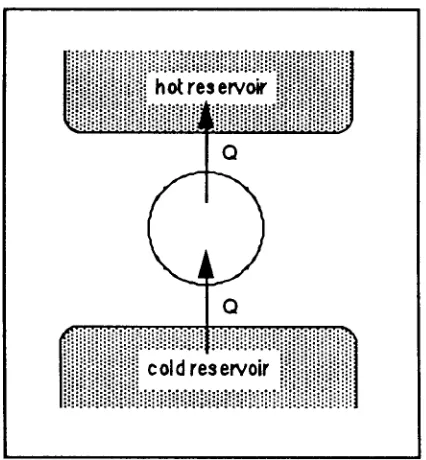
That is, the natural direction of heat flow is always from the higher to the lower temperature. The law does not prevent us from causing such a flow in the 'unnatural' direction if changes take place elsewhere in the Universe. Therefore, the Second Law specifies the unnatural, but does not forbid us to bring about the unnatural by means of a
natural change elsewhere. Figure 2.2 shows a graphical representation of the Clausius
statement.
Thus the two statements affirm a fundamental asymmetry in Nature, but in different ways. In the Kelvin statement the asymmetry is between work and heat, while the Clausius statement implies an asymmetry in the direction of natural change. Either statement is the basis for describing all natural changes.
Therefore, the combination of the first and the second laws says that although the total
quantity of energy must be conserved in any process, the distribution of that energy
of res ervoir
cold reservoir
Figure 2.2 - The Clausius statement denies the possibility of heat flowing
spontaneously from a cold body to a hotter one
2.7 Reversibility and Irreversibility
Regarding what has already been said, a reversible process is one that is performed in such a way that, at the conclusion of the process, both the system and the surroundings may be restored to their initial states, without producing any changes in the rest of the universe.
In general, natural processes do not satisfy this condition because firstly thermodynamic equilibrium is not satisfied, and secondly dissipative effects are present.
The Second Law allows reversible natural processes, but the existence of these features means that this is an ideal case only, because except in the ideal case the exact amounts of work and/or heat involved during the process are undefined due to the fact that the exact path followed to reach the final state is not known.
The ideal case, as mentioned before, is a quasi-static process. If the process is quasi-static, the system passes through states of thermodynamic equilibrium, which may be traversed just as well in one direction as in the opposite direction; and if there are no dissipative effects, all the work done by the system during the performance of a process in one direction can be returned to the system during the reverse process.
Chapter 2 - Reversibility: A Scientific Perspective - 32
implies equilibrium and reversible processes are defined as constituting a continuous series of equilibrium states.
The concept of a reversible process in thermodynamics resembles the idealising assumptions made so often in mechanics, such as weightless strings, frictionless pulleys and point masses (Zemansky, 1968).
2.8 Spontaneity, Equilibrium, and Reversibility
Explosions are examples of rapid, spontaneous process. However a process need not be as rapid as an explosion to be spontaneous. A spontaneous process is one that will proceed on its own without interaction with the rest of the universe. In a strict sense spontaneity has nothing to do with time. A thermodynamically spontaneous reaction is one that will occur on its own, even if requires virtually forever to do so. Thermodynamics answers the question, 'Will the process occur, eventually?', while to answer the question 'How soon will it occur?' we must turn to kinetics.
If a system undergoes a spontaneous change in its internal structure, such as a chemical reaction, there might exist a situation when the process has a tendency to occur in one direction and in the reverse, and eventually the synthesis is produced exactly as fast as the decomposition giving the appearance of change having ceased, although the processes still occur at the molecular level. This condition of balance between two opposing reactions is called chemical equilibrium. Moreover, a reaction that is at equilibrium is a reversible
reaction. Therefore, chemical equilibrium emerges as a dynamic concept in contrast with
the mechanical static concept.
In a system such as N2-H2-NH3 2 at equilibrium, the change in pressure, temperature, or concentration of one component required to alter the relative rate of reactions in one direction and in the reverse are infinitesimally small. Just as the lightest weight can tip a balance in mechanical equilibrium, so the smallest change can affect a system in chemical equilibrium. This is why the term 'reversible' is applied to such situations. As Dickerson et al. say 'a fingertip touch cannot halt a falling boulder, and an infinitesimal change in pressure, temperature, concentration, or any other variable cannot halt the explosion of H2
and C12 or the less spectacular reaction of N2 and H2 before the equilibrium is reached'3. Such chemical systems are not at equilibrium, their processes are irreversible.
In summary, an equilibrium process is reversible, and a non-equilibrium or spontaneous process is irreversible.
2.9 Entropy
Just as the First Law leads to the introduction of a property of systems, energy, which determines what states a system can reach, the Second Law also has an associated quantity, entropy, related not to whether one state of a system is accessible from another, but whether it is spontaneously accessible.
Entropy is defined so that its value never decreases. The direction of spontaneous change is from a state with low entropy to a state of high entropy. This idea can be expressed through the Entropy Principle, which is also another statement of the Second Law:
natural changes occur in the direction of increasing total entropy
The difference of entropy between two states is defined as:
Difference of Entropy = (heat transferred reversibly) /temperature
Heating is an energy transfer in which atoms increase their chaotic thermal motion; if a lot of energy is transferred as heat a lot of chaos is generated. This is consistent with heat transferred appearing in the numerator of this expression. Energy can also be transferred reversibly as work, but this has no effect on the entropy because it creates no turmoil, hence the entropy change is defined in terms of energy transferred as heat, not as work. The temperature appears in the denominator because there will be a greater proportionate increase of chaotic turmoil when the same quantity of energy is transferred at low temperatures - when there is little thermal motion present - than at high - when there is already much thermal turmoil. As Atkins says, 'a sneeze in a library creates much more additional turmoil than a sneeze in a busy street'4.
Thus, the introduction of the concept of entropy gives a convenient way of expressing the
3 R. Dickerson, H. Gray & G. Haight (1978) Chemical Principles. London: W.A.Benjamin. p.113.
4P. W. Atkins (1989) Time and Dispersal: The Second Law. in Flood,R. & Lockwood,M. (Eds.) The
Chapter 2 - Reversibility: A Scientific Perspective - 34
asymmetry in Nature, with its underlying tendency towards chaos and energy dispersion.
2.10 Entropy and 'Quality of Energy'
Because the total entropy never decreases, a system with low entropy is valuable, because in passing to a state of higher entropy, it can be made to produce desirable changes - such as driving machinery. This is sometimes expressed by saying that a system with low entropy has a high 'quality of energy'.
Thus, when fossil fuels, such as coal, are burnt, the supply of energy does not decrease. In this sense, there can be never a energy crisis, because the energy of the world is forever the same. We are on the verge of an entropy crisis, rather, because every time that a lump of coal is burnt the entropy of the world increases, which means energy is becoming less available (Ogborn, 1990).
So, in this sense, what it is necessary to do is not to conserve energy, for Nature does that automatically, but to care about its quality. In other words, we have to find better ways of using energy so as to avoid a large production of entropy.
2.11 Entropy and the Direction of Time
Thermodynamics gives us some insight into the nature of time, even though its equations contain no reference to time as a variable.
The phenomena described by the equations of thermodynamics are inescapably part of the temporal flow of natural process and thermodynamics gives conditions for how the states of a system must succeed each other. By taking the succession of states of a system to be the same as the temporal sequence of nature, we gain a relation between time and natural processes. Therefore, we can elucidate the parallelism between the temporal flow of our everyday experience and the particular succession of states that is prescribed in terms of thermodynamics.
Regarding the Entropy Principle, the increase of entropy is a signpost indicating the direction of time: entropy increases in direction of the future, not of the past. This is the recognition of another aspect of the asymmetry of Nature: asymmetry in time.
entropy as giving us a direction of "time's arrow"5. He used this expression to express the one-way property of time, which has no analogue in space, and indicates the direction of the progressive increase of the random element in Nature.
2.12 Time-Reversible Processes
In systems that contain only a relatively small number of elements, in some cases only one, their description is given in relation to the behaviour of every entity of the system. An oscillating pendulum, an electromagnetic wave, or the planets of the solar system would be examples of such a system.
Some of the basic equations which describe individual entities are Laws of Motion, in either their relativistic or non relativistic form, Maxwell's equations for electromagnetic fields, and Schrodinger's equation for the wave-amplitude of individual particles. These and other of the basic physical equations, have the property of being 'time-reversible'. This means they describe phenomena in a way that they may equally well occur either in one direction or in reverse, depending on the reversing of the initial conditions. These time reversible equations describe behaviour which is physically possible for either positive or increasingly negative values of the variable time.
In contrast, Thermodynamics deals with macroscopic large-scale systems which are constituted of many particles. The basic observables like temperature and pressure, result from average effects of many millions of particles, that is, thermodynamic properties are defined only in relation to aggregates of many particles. Moreover, the Second Law says that natural changes occur in the direction of increasing total entropy or declining quality of energy, which means, as has been said before, an asymmetry in time. Therefore, the Second Law states that natural changes are not time-reversible: heat must always flow from hot bodies to cold bodies, even when we reverse time in the equations that control the motion and behaviour of individual particles.
For the sake of illustration, if heat is considered as an agitation of particles, when energy is transferred from a hot body to a cooler one, the hotter the particles, the more agitated is their motion. The agitation itself is governed by the laws of particle physics and is in principle time-reversible, but the diffusion and spread of agitation, from hot to cold regions is governed by the Second Law, which is not reversible. Single particles are time-reversible, but systems of particles are not. It is like hanging a picture on a wall: 'if you
Chapter 2 - Reversibility: A Scientific Perspective - 36
look only at the dabs of paint, you will not know which way to hang it; you have to look at large areas of a picture to determine whether it is right way up'6.
Thus, the Entropy Principle provides us with an arrow of time, whereas the behaviour of individual particles has no arrow of time. This fact produces a paradox, seen among others by Poincare. A macroscopic thermodynamic system, whose change is irreversible, is composed of particles whose detailed motions are to be understood as perfectly reversible.
A first level of solution of this paradox was provided by Ludwig E. Boltzmann (1844-1906) who attempted to recover the arrow of time in terms of atomic and molecular behaviour.
2.13 Entropy and Disorder: a Microscopic View of Thermodynamics
Following in Maxwell's footsteps, Boltzmann was the first to give a fundamental physical law - the Second Law - a statistical interpretation, using probability theory.
Boltzmann realised that the asymmetry in time imposed by the Entropy Principle could be interpreted as the expression of a growing molecular disorder, and proposed a definition for entropy in terms of the degree of order of the particles of the system, which is equivalent to that obtained from the thermal definition. The equation S = k In W expresses this idea in a quantitative form, where the proportionality factor k is a universal constant, known as Boltzmann's constant, and W the 'thermodynamic probability'.
On the left side of this equation, we have the entropy which is the classical signpost of spontaneous changes. On the right side, we have a quantity which is related to order, because its meaning can be interpreted as the answer to the question: 'in how many ways can the inside of a system be arranged without an external observer being aware that arrangements have occurred?'7. Thus, S stands firmly in the world of classical thermodynamics, the world of experience, while W stands in the world of atoms, the world of underlying mechanisms.
In order to understand W, we can think of a gas composed of a large number of particles, in a flask. At thermodynamic equilibrium the temperature and the pressure are uniform for any macroscopic volume of the gas. However, there are lots of different microstates, arrangements, or "complexions", of the individual gas molecules which would give the
6E. Harrison (1989) Cosmology, the Science of the Universe. Cambridge: Cambridge Press. p.141.
same macrostate. In other words, there are lots of different combinations of position and motion for the molecules that would give the same values of the thermodynamic coordinates, and the number of these possibilities, for a given macrostate, is the thermodynamic probability W. Moreover, the larger the number of particles, the greater the possible number of complexions corresponding to different distributions, and in general, the lower the value of W, the higher the degree of ordering.
Therefore, in this interpretation the increase of entropy becomes a statement about increase of disorder. An increase in entropy is an increase in the thermodynamic probability - W. Thus we can say that, the natural tendency of a system is toward disorder, and the equilibrium state is the state of maximum W.
Difference in entropy now appears as a measure of the probability of a system being in a specific macrostate, with respect to a different macrostate of the same system.
However, although the equilibrium state is overwhelmingly the most probable, as compared with any state substantially far from equilibrium, there is nevertheless a nonvanishing probability for any possible macrostate. This means that although we can expect changes in the system to be towards the equilibrium state, they do not have to be, because the possibility for fluctuations in an opposite direction remains.
Large fluctuations, which could lead an isolated macrosystem to a decreasing entropy, have only theoretical interest, due to their extremely small probability. But, if we consider microsystems composed of a few particles, fluctuations from the most probable state become physically important. It may even be that fluctuations of this kind play an important role in biological phenomena, as sources of mutations and hence of species variation and evolution. These are not inconsistent with the Entropy principle, indeed they rely on its very mechanism.
2.14 Order Out of Disorder
The remarks so far belong to the theory of equilibrium thermodynamics - i.e. to processes analysed as quasi-static. From this perspective, it appears to be difficult to account for the
creation of order, which visibly occurs, in processes of life, but also in, for instance,
thunderstorms. This is the realm of non-equilibrium thermodynamics. Only the briefest
account of it will be given here.
Chapter 2 - Reversibility: A Scientific Perspective - 38
the entropy of a system must increase. Nothing prevents a decrease in entropy of one part, at the expense of a larger increase elsewhere. Such an effect occurs every time ice cubes are frozen in a refrigerator.
New phenomena appear when a system is far from equilibrium. An example is a pan of water on a stove. Convection currents in the water will appear when the flow of energy through the system is large enough. Such convection currents are a form of macroscopic order, created by the (larger) generation of entropy due to the flame below the water. A storm is of course in essence a similar phenomenon (Ogborn, 1990).
Nature however creates order in even more spectacular ways. The Earth receives photons of sunlight at about 6000K, and re-radiates them as infra-red photons at about 300K, thus providing a continual and large increase of entropy at its surface. This increase is used to 'pay for' the decrease in entropy involved in many biological processes. Perhaps the most important of these is photo-synthesis, in which carbon dioxide and water are used to manufacture carbohydrates such as sugar and cellulose (Atkins, 1987). Thus plants appear to defy the Second Law, whereas in fact they exploit it.
Finally, and (as it will turn out) most relevantly for this thesis, we need to account for the ability of human (and other animals) to make actions. To a person, it appears that actions, such as lifting a weight, can be spontaneously achieved. Thus human action seems to lie outside the world as described by thermodynamics. Indeed many science books present it as such: the initial conditions of a system are presented implicitly as being able to be set as required, without thermodynamic constraints.
So, how is human action achieved? Nature has evolved a system in which the molecule adenosine tri-phosphate (ATP) is synthesised from low entropy foods. By losing one phosphate group, which becomes tightly bonded to other molecules, energy is released, in a mechanism which enables muscle fibres to contract (Atkins, 1987). The metabolism of low entropy food creates enough entropy for the reformation of the ATP molecules, a process which itself decreases entropy. Thus, because our bodies maintain themselves in a
steady state (including a supply of ATP) far from equilibrium, by the continual processing
of food, we gain the psychological impression of being 'ready for anything'.
plants (and animals that ate plants) which previously 'ate' sunlight. What our food gives us is negative entropy or free energy, as was first clearly recognised by Schrodinger in his 1944 book "What is Life?".
2.15 Time's Arrow
These facts give "time's arrow" a psychological dimension. We are aware of the growth of plants and of animals, and of ageing. But these are slow processes, and on short time scales, the world and ourselves appear rather constant, maintaining themselves rather than changing. Thus we simultaneously have a feeling of the direction of time, and tend to see it as not affecting us.
Also, because we can act, we can often restore something to its original state after it has changed. This presents the world to us as reversible in this special sense. Our actions are capable of reducing disorder, and we are unaware of the compensating additional disorder they create.
The purpose of this scientific account is to establish one part of the context of the study, which itself does not concern students' understanding of this scientific account. It will be seen that students' everyday, non-scientific ideas can be partially understood from the scientific perspective. In particular, their ideas have a strong relationship to the possibility
of action, a basic feature of living organisms (amongst whom students belong), as
3
Review of Literature
The purpose of this review is not only to give an account of the most relevant studies and researches about students' conceptions which have the concept of reversibility as the main topic, but also to trace the indirect relationship of reversibility to studies which do not have it as an explicit object of study.
3.1 Introduction
The present research has its origin in the study of the concept of reversibility within a thermodynamic view linked to the Second Law of Thermodynamics, but takes a commonsense perspective, where the focus is on the way people think of the reversing of processes in terms of their commonsense knowledge about the physical world characterised essentially as based upon their own everyday experience. The idea is to study people's commonsense reasoning about processes and the way they are thought of as reversible or not.
Students' Conceptions
Descriptive Perspective
Reversibility Matter and its
Transformations Scientific Concepts
Commonsense Forms of Reasonig
Perspective
Role of Action and Cause Explanations
Developmental Psychology Perspective
Action Causation Reversiaility Conservation
Prototypes for Reasoning about Reversibility
Necessity
Contingency
Causation
Action
Teleology
Therefore, in order to broaden this review of literature, studies about different concepts which have any sort of connection with the concept of reversibility are also included. In addition studies about students' conceptions with a focus on forms of reasoning are included to provide material for thinking about how to analyse commonsense reasoning.
The studies reviewed are analysed according to the scheme shown in Figure 3.1.
Figure 3.1 - Scheme for the Literature Review
In this scheme studies of students' conceptions are classified in three main categories:
Chapter 3 - Review of Literature - 42
• studies carried out at a different level of investigation, where the studies focus attention on trying to explain the regularities which seem to be present in students' responses in terms of underlying commonsense forms of reasoning;
• studies carried out on a psychological basis, where the results are discussed within a developmental psychology perspective.
These three categories together concern different aspects of students' conceptions within which we can seek forms of reasoning relevant to thinking about reversibility, labelled in figure 3.1 'prototypes for reasoning about reversibility'. These prototypes are possible ways people may use, consciously or not, to understand the reversing of a process.
The basic idea of these prototypes comes from the way that any event can be thought of as happening in nature, and they are connected with the ideas of necessity and contingency. Necessity is related to the idea that an event can be thought of as unavoidable, i.e., something that either must happen or must not happen. Contingency is related to the idea that an event can be thought of as possible to happen, i.e., something that might or might
not happen.
Taking into account these two basic prototypes, and studies focusing on underlying forms of reasoning and developmental psychology, some other prototypes are considered:
causation, action, and teleology. Causation refers both to regular causes, as opposed to
chance, and the presence of some agent of cause. Action refers to the way the agency of causation may be modelled on human actions. Teleology is related to the idea that an event may happen due to some purpose.
These are no more than broad categories to guide the collection and analysis of data.
3.2 Studies in a Descriptive Perspective
The studies included in this section are classified under three headings representing different kinds of results:
• reversibility;
The category reversibility comprises studies which describe results explicitly related to the concept of reversibility; the category matter and its transformations includes studies related to students' conceptions of the nature of matter and its transformations; the category scientific concepts is concerned with studies of students' conceptions about scientific concepts such as energy, which have connections to reversibility.
3.2.1 Reversibility
Duit and Kesidou (1988) aimed to find out whether several years of physics instruction had provided students with the necessary conceptions to understand irreversibility and whether ideas of irreversibility had formed through 'traditional' instruction. Therefore, clinical interviews based on the discussion of equalisation of temperature through a heat exchange process were carried out with sixteen year old students who had already studied Physics for four years in a traditional way. They report that 'if our preliminary findings are confirmed we have to conclude that students very often do not achieve a sound physics framework to understand irreversibility during several years of physics instruction'. This conclusion was based on the outcome that a remarkable number of students thought that a certain temperature difference may arise after temperature equalisation.
Johnstone et al. (1977b) describe a study on misconceptions in school thermodynamics with pupils (16-17 year old) who had just completed studies related to chemical equilibrium. They report that students confused the descriptive (rates) and prescriptive (thermodynamics) meanings of reversibility: most students could understand that a reaction may proceed forwards or backwards although the simultaneous occurrence of forward and reverse reactions at equal rates was not very well understood, 'while the significance of thermodynamic reversibility in that it prescribes how a reaction is to be operated is lost to most students'. Moreover, the concept of entropy is confounded with the concept of kinetic energy and is described in terms of disorder.
Chapter 3 - Review of Literature - 44
now destroyed, they can't return to their initial form', or 'there is a change and what comes out of this change can't return to the initial condition'.
Stavy (19900 describes the acquisition of conservation of matter by students aged from 9 to 15. Students were tested for their ability to recognise weight conservation as well as reversibility of physical processes. She reports that until the age of 12 specific perceptual input from the task dramatically influences students' responses to the conservation of weight tasks but not to the reversibility of the process tasks. Moreover, students who recognised weight conservation were not always aware of the reversibility of the process, a outcome that contradicts some piagetian fmdings.
As mentioned before, the review of literature on students' thinking about physical processes showed that few articles report explicit results related to the concept of reversibility. However, from the few articles described in this section, it is possible to see that there are studies of reversibility connected with different areas such as chemical processes and cognitive processes. This provides a reason for broadening this review, with specific sections on such themes.
3.2.2 Matter and its Transformations
A comprehensive way of analysing these articles is to have in mind a macroscopic and a microscopic view of the nature of matter. The way students conceive matter should relate to how they explain some phenomena, because it relates to very basic ontological questions about the world around us, such as, 'What is the nature of matter?, 'What is a substance?, 'What is the nature of space?'. Consequently, one could believe that it influences the way the students think about reversibility of phenomena.
When thinking about the nature of matter, one can consider its transformations - physical and chemical changes - and the possibilities of reversing such transformations. From a scientific standpoint these ideas are related to the particulate theory of matter and encompass concepts such as state of matter, change of the state of matter, conservation of matter, chemical reaction, chemical equilibrium, which in fact are the concepts usually investigated.
3.2.2.1 Nature of Matter
studies recently published. He reports that matter is conceived as continuous and static, leaving no room for the idea that two substances in contact can react with each other so that the original substances cease to exist and new ones are formed. The original substances simply exist in contact, but each one separately. Therefore, according to him, when explaining changes, pupils use models that imply that each substance is changed under the influence of an external agent, and he proposes five categories of explanation or 'transformation models' - disappearance, displacement, modification, transmutation, and chemical interaction - into which the students' answers can be classified. The two main issues to be noted are that, underlying these categories are the ideas of action and
conservation: conservation of properties/identity, conservation of amount of matter,
conservation of weight. In the category of disappearance, conservation is not considered at all, while the others express a conservation reasoning. Yet, in all of them the necessity of an external action to cause the transformation is observed, although in some cases no comment is made upon the idea of who or what takes this action.
Another attribute of the conception of matter reported is that macro-properties are projected onto the micro-world, such as, that atoms and molecules have the same properties as those of the substances - 'phosphorus is yellow, so phosphorus atoms are yellow', 'a soft substances cannot be made of hard molecules'. In this case, conservation also seems to be a relevant issue because after a transformation has occurred, substances are modified with respect to certain properties, but that the identity of the substance is conserved, such as the case of rust, which is perceived as iron with some of its properties altered.