Available Online atwww.ijcsmc.com
International Journal of Computer Science and Mobile Computing
A Monthly Journal of Computer Science and Information Technology
ISSN 2320–088X
IJCSMC, Vol. 3, Issue. 3, March 2014, pg.1045 – 1051
RESEARCH ARTICLE
Digital Watermarking of Wavelet
Transforms Based on Coding and
Decoding Techniques
Mrs. Rashmi Soni
1, Prof. M.K.Gupta
2¹Research Scholar, Department of Computer Science & Engineering
AISECT University, Bhopal, M.P., India
²Professor, Department of Electronics Communication & Engineering, MANIT, Bhopal & Research Supervisor, AISECT University, Bhopal, M.P., India
1
[email protected]; 2 [email protected]
Abstract—Digital watermarking is the most important technology in today’s world, to avoid illegal copying of data. This technique can be applied to audio, video, text or images. This paper surveys the features and concepts pertaining to the various watermarking techniques such as DCT, DWT and purpose of digital watermarking & image watermarking. The sudden increase in watermarking interest is most likely due to the increase in concern over copyright protection of content copyright-protected digital contents are easily recorded and distributed due to: occurrence of high-capacity digital recording devices & the explosive growth in using Internet.The watermark carries information about the object in which it is hidden.
Keywords— Copyright protection; Digital watermarking; DCT; DWT; Information hiding; image watermarking
I. INTRODUCTION
permanently embedded in the data and remains present within the data after any decryption process.
The term “digital watermarking” was first appeared in 1994, when obsborne presented two watermarking techniques to hide the watermark data in the images [8]. The success of the Internet, cost-effective and popular digital recording and storage devices, and the promise of higher bandwidth and quality of service for both wired and wireless networks have made it possible to create, replicate, transmit, and distribute digital content in an effortless way. The protection and enforcement of intellectual property rights for digital media has become an important issue [9]. Digital watermarking is that technology that provides and ensures security, data authentication and copyright protection to the digital media.
The hiding information (data) is done with in digital audio, images and video files. Embedding information so that it cannot be visually perceived is information hiding. Two major issues to hide information are:- i) To protect it from malicious use, that is to protect intellectual property rights(IPR) ii) Because we do not want any one to even know about its existence that is to avoid observation by unintended recipient “Security through obscurity”
Different way to hide the information:- i) Digital Signature ii) Copyright Label iii) Digital watermark.
Digital watermarking - is the process that embeds data called a watermark into a multimedia object such that watermark can be detected or extracted later to make an declaration about the object. Object may be an image or audio or video.
A. Purpose of Watermarking
The purposes of watermarking are as follows:-
a. Copyright Protection
Here the owner wants to check for illegal copies of the works b. Fingerprinting
Mainly used for hidden serial numbers. It enables the intellectual property owner to find
which customer has broken the license agreement.
c. Copy Control
In this case the copyright owner wants to control the terms of use in their work Example: DVD protection (Copy once, Copy many, No copy)
d. Broadcast Monitoring
To monitor when and whether content is transmitted over broadcast channels, such as TV or radio(Verify advertising broadcasts, Verify royalty payments, Catching instant piracy) e. Data Authentication
The Watermark is used to detect modification applied to cover work Example: Checking for fraud passport photographs
B. Digital Watermarking techniques
These are mainly as follows:-
a. Text-based Watermarking
This uses Line shift coding, word shift coding, feature coding b. Image Watermarking:-These are mainly
Watermark design (meaningful watermark)
c. Audio Watermarking d. Video Watermarking e. 3D Watermarking
C. Image Watermarking techniques
a. Spatial-domain techniques:- These are of two categories
Least-Significant Bit (LSB) technique: The given image contains pixels these
pixels are indicated by the 8-bit sequence, the watermarks are linked two the last, bit of selected pixels of the original image, its used to hide the information and attackers could not destroy the information.
SSM-Modulation-Based Technique: These technique are applied in the water
marking algorithms with an linked information and attached to the original image with pseudo noise signal, its modulated by the watermark.
b. Transform-domain techniques:-These are mainly
DCT-based
DFT-based
Wavelet-based
Other transforms
c. Compressed stream-domain techniques
Watermarking MPEG bit streams
d. Spatial-domain watermarks
Watermark embedded in lower order bit planes
Transparent mark
Visually pleasing, not robust to compression
e. Transform-domain watermarks
Watermark added to frequency coefficients
Watermark location and strength based on perceptual rules
f. Watermark insertion based on utilizing formal HVS model in order to provide the
strongest watermark while guaranteeing transparency.
II. METHOD APPLIED
Watermarking can occur in DCT-based compressed video (MPEG1, MPEG2, MPEG4, etc) some disadvantages of DCT are as follows:-
a. The need to have the original image to be able to detect the watermark.
b. Since the DCT transform is based on the whole image, the transform does not allow for any local spatial control of the watermark.
c. Does not provide a maximum use of the human visual system
In this paper DWT technique is used resulting in IDWT technique when watermark is inserted.
A. DWT TECHNIQUE
In case of DWT technique the original image is further divided into watermarked image in blocks and again resulted image in further more blocks as this technique can convert watermark of dimensions eg:1D or 2D and also uses a pyramid structure. Wavelet Transform is a modern technique commonly used in digital image processing, compression, watermarking etc. The transforms are based on small waves, called wavelet, of varying frequency and limited duration. The wavelet transform decomposes the image into three spatial directions, i.e. horizontal, vertical and diagonal. Hence wavelets reflect the properties of HVS more accurately. Magnitude of DWT coefficients is larger in the lowest bands (LL) at each level of decomposition and is smaller for other bands (HH, LH, and HL).
The Discrete Wavelet Transform (DWT) is currently used in a wide variety of signal processing applications, such as in audio and video compression, removal of noise in audio, and the simulation of wireless antenna distribution. Wavelets have their energy concentrated in time and are well suited for the analysis of transient, time-varying signals. Since most of the real life signals encountered are time varying in nature, the Wavelet Transform suits many applications very well [1]. One of the main challenges of the watermarking problem is to achieve a better tradeoff between robustness and perceptivity. Robustness can be achieved by increasing the strength of the embedded watermark, but the visible distortion would be increased as well [5]. However, DWT is much preferred because it provides both a simultaneous spatial localization and a frequency spread of the watermark within the host image [6]. The basic idea of discrete wavelet transform in image process is to multi-differentiated decompose the image into sub-image of different spatial domain and independent frequencies [7].
The larger the magnitude of the wavelet coefficient the more significant it is. Watermark detection at lower resolutions is computationally effective because at every successive resolution level there are few frequency bands involved. Wavelet coded image is a multi-resolution description of image. Hence an image can be shown at different levels of resolution and can be sequentially processed from low resolution to high resolution.[4]
Using DWT coefficients, the original signal can be reconstructed. This process is called the inverse DWT (IDWT).The DWT and IDWT for two dimensional images z[p,q] can be defined by:
DWTq [DWTp[y [p,q]]].
An image can be decomposed into a pyramid structure with different band information such
as: HH, LH, LL and HL frequency bands
Watermarking in the DWT domain:
III.ENCODING &DECODING
Encoding and decoding scheme is as follows:-
a. De-compose an image into several bands with a pyramid structure.
b. Add the watermark message.
c. Then, we take the two dimensional IDWT of the modified DWT coefficients.
d. The decoding will be done by applying the inverse procedure
A. Encoding
a. Calculating the DWT coefficients x[p,q]
b. The message is a Gaussian noise G[p,q]: with mean 0 and variance 1.
x [p,q] = x[p,q]+α (x[p,q])2 G[p,q] --- (1)
control the level of watermarking
Square2 indicates amplifications of the large coefficients.
It’s unable to change the DWT coefficients at the lowest resolution. c. Now taking the two dimensional IDWT of the:
modified DWT coefficients
unchanged DWT coefficients at the lowest resolution.
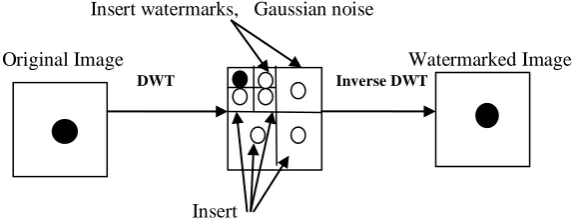
In figure 1 encoding is performed by two images are shown original image and watermarked image by which DWT and IDWT is performed by inserting watermarks.
Insert watermarks, Gaussian noise
Original Image Watermarked Image
DWT InverseDWT
Insert
watermark, Gaussian noise
Fig. 1 Encoding of original and watermarked image
d. For the resultant image to fit within the 0 to 255 integer values:
ŷ [p,q]=[255 y[p,q]-minp,q ( y[p,q]) / max p,q( y[p,q]-minp,q(y[p,q]))]--- (2)
e. This is resultant watermark image.
B. Decoding
additional sub-bands LL2,LH2,HL2 and HH2 and so on until a peak appears in the cross correlations. Otherwise, the signature can not be detected.
a. The watermark is extracted, using the host image, by applying the inverse procedure
at each resolution level to obtain an estimate of the watermark.
b. The estimates for each resolution level are averaged to produce an overall estimate of
the watermark.
c. Provides a simultaneous spatial localization and frequency spread of the watermark
within the host image.
d. In addition, the watermark merging process is adaptive as it depends on the local
image characteristics at each resolution level.
e. Robust as it embeds the watermark more strongly into more salient components of
the image.[3] [4]
In figure 2 decoding is performed by two images are shown original image and watermarked image by which DWT is used by sub bands HL,LH & HH which results in cross correlation with the watermark.
DWT
Cross correlation
with the Watermarked Image Watermark
DWT
Original Image
Fig. 2 Decoding of original and watermarked image
C. The Human Visual System
According to HVS method the mark is added with respect to the human visual system:
a. Multi-resolution wavelet decomposition of both the host image and the watermark.
b. When an image undergoes a wavelet decomposition, its components are separated
into bands of approximately equal bandwidth on a logarithmic scale much as the retina of the eye splits an image into several components.
c. It is, therefore, expected that use of the DWT will allow the independent processing
of the resulting components much like the human eye.
d. The frequency-domain techniques mainly used for watermarking of the human visual
system are better captured by the spectral coefficients. The transforms are broadly categorized in two ways:
Discrete Cosine Transformation (DCT)
Discrete Wavelet Transformation (DWT)
These are mainly used by HVS to identify original image and watermarked image. HL1
LH1 HH1
HL1
This is a new approach of watermarking in wavelet domain where human visual system (HVS) characteristics are exploited to hide the watermark [10]. The watermark to be embedded was a pseudo-random sequence which was adaptively added to the DWT coefficients of three largest detail sub-bands. The detection was achieved by measuring the correlation between the watermarked coefficients and the watermarking code. The most important feature of this technique was that the watermark embedding was performed pixel by pixel considering the texture and the luminance content of all the image sub-bands. Also, the watermarking energy can be kept so high that even a small portion of the image is sufficient to correctly guess the embedded code.
IV.CONCLUSION
In this paper we discussed about digital watermarking technique, wavelet domain techniques DWT & DCT which are used for watermarking ,performs exceptionally well in terms of robustness, pay load capacity, image operations and imperceptibility.DWT technique is better than DCT for watermarked image which provides a simultaneous spatial localization and frequency spread of the watermark within the host image.Watermark insertion based on utilizing formal HVS model in order to provide the strongest watermark extraction while guaranteeing transparency & robustness, with no much degradation of image quality.
REFERENCES
[1] Cox, J. Kilian, F. T. Leighton, and T. Shamoon, “Secure spread spectrum watermarking for multimedia”,
IEEE Trans. on Image Processing, 6(12):1673–1687, 1997
[2] http://www.watermarkingworld.org
[3] J. Fridrich, “Robust Bit Extraction from Images”, in Proceedings of IEEE International Conference of Multimedia Computing and Systems (ICMCS’99), Vol. 2, pp. 536-540, 1999.
[4]. http://www.rowan.edu/wavelet.
[5] Evelyn Brannock, Michael Weeks, Robert Harrison, Computer Science Department Georgia State University “Watermarking with Wavelets: Simplicity Leads to Robustness”, Southeast on, IEEE, pages 587 – 592, 3-6 April 2008.
[6] G. Bouridane. A, M. K. Ibrahim, “Digital Image Watermarking Using Balanced Multi wavelets”, IEEE Transaction on Signal Processing 54(4), pp. 1519-1536, 2006.
[7] Cox, I.J.; Miller, M.L.; Bloom, J.A., “Digital Watermarking”, Morgan Kaufmann, 2001.
[8] R.G. Schyndel, A. Tirkel, and C.F Osborne, “A Digital Watermark”, Proceedings of IEEE International conference on Image Processing, ICIP-1994, pp. 86-90, 1994.
[9] Christine I. Podilchuk, Edward J. Delp, “Digital watermarking: Algorithms and applications”, IEEE Signal processing Magazine, July 2001.
[10] M. Barni, F. Bartolini, and A. Piva, “Improved Wavelet-Based Watermarking Through Pixel-Wise