Western University Western University
Scholarship@Western
Scholarship@Western
Electronic Thesis and Dissertation Repository
7-28-2011 12:00 AM
Diagnostic Checking, Time Series and Regression
Diagnostic Checking, Time Series and Regression
Esam Mahdi
The University of Western Ontario Supervisor
A.I. McLeod
The University of Western Ontario
Graduate Program in Statistics and Actuarial Sciences
A thesis submitted in partial fulfillment of the requirements for the degree in Doctor of Philosophy
© Esam Mahdi 2011
Follow this and additional works at: https://ir.lib.uwo.ca/etd
Part of the Applied Statistics Commons, Longitudinal Data Analysis and Time Series Commons, and the Multivariate Analysis Commons
Recommended Citation Recommended Citation
Mahdi, Esam, "Diagnostic Checking, Time Series and Regression" (2011). Electronic Thesis and Dissertation Repository. 244.
https://ir.lib.uwo.ca/etd/244
This Dissertation/Thesis is brought to you for free and open access by Scholarship@Western. It has been accepted for inclusion in Electronic Thesis and Dissertation Repository by an authorized administrator of
DIAGNOSTIC CHECKING, TIME SERIES AND REGRESSION
(Spine title: Diagnostic Checking, Time Series and Regression)
(Thesis format: Integrated-Article)
by
Esam Mahdi
Graduate Program in
Statistics
A thesis submitted in partial fulfillment of the requirements for the degree of
Doctor of Philosophy
The School of Graduate and Postdoctoral Studies The University of Western Ontario
London, Ontario, Canada
ABSTRACT
In this thesis, a new univariate-multivariate portmanteau test is derived. The
proposed test statistic can be used for diagnostic checking ARMA , VAR , FGN ,
GARCH , and TAR time series models as well as for checking randomness of series
and goodness-of-fit VAR models with stable Paretian errors. The asymptotic
distri-bution of the test statistic is derived as well as a chi-square approximation. However,
the Monte-Carlo test is recommended unless the series is very long. Extensive
sim-ulation experiments demonstrate the usefulness of this test and its improved power
performance compared to widely used previous multivariate portmanteau diagnostic
check.
The contributed R package portes is also introduced. This package can utilize
multi-core CPUs often found in modern personal computers as well as a computer
cluster or grid. The proposed package includes the most important univariate and
multivariate diagnostic portmanteau tests with the new test statistic given in this
thesis. It is also useful for simulating univariate/multivariate data from nonseasonal
ARIMA /VARIMA process with finite or infinite variances, testing for stationarity and
invertibility, and estimating parameters from stable distributions. Many illustrative
applications are given.
In this thesis, it has been shown that the classical ordinary least squares regression
may produce smaller p-values than it should due to the lack of statistical independency
in the fitted model which may invalidate the statistical inferences. The Poincar´e plots
are suggested to check for such hidden positive correlations.
KEY WORDS: Diagnostic check, Portmanteau test, Monte-Carlo significance test,
Residual autocorrelation function, VARMA models, FGN models, GARCH models,
ACKNOWLEDGEMENTS
I reserve my greatest appreciation for my thesis supervisor, Professor A.I. McLeod,
for suggesting the research topics, his extremely helpful guidance, encouragement and
patience throughout the course of my research work. I would like also to thank my
thesis examiners, Professors Rogemar Mamon, Serge B. Provest, John Knight, and
Yulia Gel for all helpful comments and suggestions. Finally, I would like to thank my
CONTENTS
ABSTRACT iii
ACKNOWLEDGEMENTS iv
LIST OF TABLES vii
LIST OF FIGURES ix
INTRODUCTION 1
1 IMPROVED MULTIVARIATE PORTMANTEAU TEST 5
1.1 INTRODUCTION . . . 5
1.1.1 Multivariate portmanteau tests . . . 6
1.1.2 Univariate generalized variance portmanteau test . . . 8
1.2 NEW MULTIVARIATE PORTMANTEAU TEST . . . 10
1.2.1 Asymptotic distribution and approximation . . . 12
1.2.2 Monte-Carlo significance test . . . 16
1.3 SIMULATION RESULTS . . . 19
1.3.1 Comparison of type 1 error rates . . . 19
1.3.2 Power comparisons . . . 21
1.4 ILLUSTRATIVE APPLICATIONS . . . 26
1.4.1 IBM and S&P index . . . 26
1.4.2 Investment, income and consumption time series . . . 26
2 PORTMANTEAU TESTS FOR TIME SERIES MODELS: R
PACK-AGE portes 35
2.1 INTRODUCTION . . . 35
2.2 THE MAIN FUNCTION: portest . . . 38
2.2.1 Monte-Carlo goodness-of-fit test . . . 39
2.2.2 Monte-Carlo testing for randomness . . . 43
2.2.3 Asymptotic distribution significance test . . . 45
2.3 COMPUTATION PORTMANTEAU TESTS. . . 46
2.3.1 Box and Pierce portmanteau tests . . . 46
2.3.2 Ljung and Box portmanteau tests . . . 47
2.3.3 Hosking portmanteau tests . . . 47
2.3.4 Li and McLeod portmanteau tests . . . 48
2.3.5 Generalized variance portmanteau test . . . 49
2.4 APPLICATIONS . . . 51
2.4.1 Canadian Lynx trappings data. . . 51
2.4.2 Monthly simple returns of the CRSP value-weighted index data 54 2.4.3 Monthly log stock returns of intel corporation data . . . 56
2.4.4 U.S. inflation data . . . 58
2.4.5 Nile annual minima data . . . 60
2.4.6 Canadian labor market data . . . 61
2.4.7 Prey data . . . 63
2.5 SOME USEFUL FUNCTIONS . . . 64
2.5.1 Stationary and invertibility of VARMA models. . . 64
2.5.2 Simulation from nonseasonal ARMA or VARMA models . . . 67
2.5.3 Fit parameters to stable distribution . . . 73
2.6 CONCLUDING REMARKS . . . 74
3 POINCAR´E PLOTS AND REGRESSION WITH HIDDEN COR-RELATIONS 79 3.1 INTRODUCTION . . . 79
3.2 ILLUSTRATIVE EXAMPLES. . . 81
3.2.1 Simulated data with hidden correlations . . . 81
3.2.2 Generalized linear modeling example . . . 83
3.2.3 Loess fitting example . . . 84
3.3 LINEAR REGRESSION MODEL . . . 88
3.4 SIMULATION RESULTS . . . 91
3.5 CONCLUDING REMARKS . . . 99
3.6 FUTURE WORK . . . 99
LIST OF TABLES
1.1 The empirical 1% and 5% significance levels, in percent, comparing approximation, aχ2b, and Monte-Carlo, MC, for the portmanteau test
statisticDm. . . 20
1.2 Empirical power in percent comparison ofDm and ˜Qm for nominal 1% and 5% tests. 104 simulations with N = 103. . . 25
1.3 IBM and S&P 500 Index Data. aχ2b: approximation. MC: Monte-CarloN = 103. NA: not applicable. The p-values are in percent. The ∗ indicates a p-value less than 0.1%. . . 27
1.4 Trivariate West German Macroeconomic Series. aχ2b: approximation. MC: Monte-Carlo using 103 replications. The p-values are in percent and ∗ indicates a p-value less than 0.1%. . . 27
1.5 The residuals of the fitted VAR(2) model on West German Macroeco-nomic series are tested for heteroscedastic effects. aχ2b: approximation. MC: Monte-Carlo using 103 replications. The p-values are in percent and ∗ indicates a p-value less than 0.1%. . . 28
2.1 CPU time in seconds. The R functions FitAR(), ar(), arima(), arima0(), Arima(), and auto.arima() are used to fit the AR (1) model to univariate time series of lengths n = 100,500,1000 and the portest() function is applied on the fitted model based on 103 repli-cations of Monte-Carlo test. nslaves denotes the number of CPU’s are used. . . 43
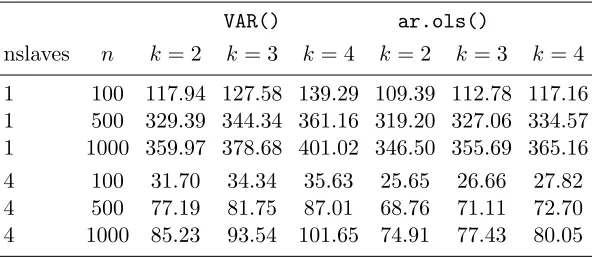
2.2 CPU time in seconds. TheR functions VAR() and ar.ols()are used to fit the VAR (1) model to series of lengths n = 100,500,1000 with dimensionsk= 2,3,4.Theportest()function is applied on the fitted model based on 103 replications of Monte-Carlo test. nslaves denotes the number of CPU’s are used. . . 43
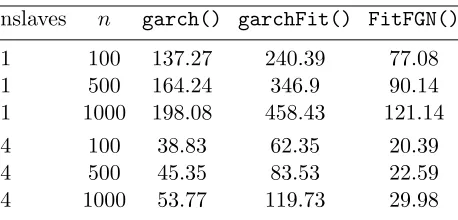
2.3 CPU time in seconds. Univariate time series of lengthsn= 100,500,1000 are generated from normal process andRfunctionsgarch()and garch-Fit() are used to fit the GARCH (1,1) model, whereas the function FitFGN() is used to fit FGN model. The portest() function is ap-plied on the fitted model based on 103 replications of Monte-Carlo test. nslaves denotes the number of CPU’s are used. . . 44
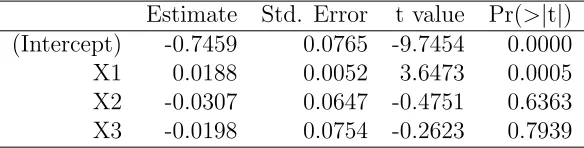
3.1 Classical ordinary least squares model (OLS). . . 81
3.2 Generalized least squares model (GLS) with exact covariance. . . 82
3.4 Distance vector generated fromU(0,1); k=1, range = 3, 6, 9, and n=60. . 94
3.5 Distance vector generated fromN(0,1); k=1, range = 3, 6, 9, and n = 90. 95
3.6 Distance vector generated fromN(0,1); k=2, range = 3, 6, 9, and n=30. 96
LIST OF FIGURES
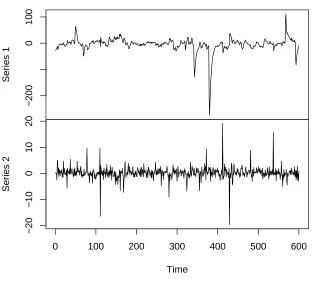
2.1 A simulated time series of example 2.5.2.2. . . 71
2.2 A simulated time series of example 2.5.2.3. . . 72
3.1 Poincar´e plot of the residuals from OLS fitted model with a loess smooth. 82
3.2 Poincar´e plot of the residuals from GLS fitted model with a loess smooth. 83
3.3 Poincar´e plot of deviance residuals in the logistic regression of low birth weight on 9 explanatory variables and 8 parametric bootstrap simulations. 85
3.4 Residual dependency plot of residuals vs. age. . . 86
3.5 Residuals plot in the robust loess fit of Cleveland (1993, section 3.6) to the polarization data.. . . 87
3.6 Poincar´e plot of residuals in the robust loess fit to the polarization data. . 87
INTRODUCTION
After identification and estimation of the parameters in a fitted model, the
good-ness of fit test is the next most important step for testing the selected model. In time
series analysis, we assume that the series is stationary with white noise innovations.
This implies that a good fitted model must produce residuals that are approximately
uncorrelated in time. Box and Pierce(1970) show that the asymptotic distribution of
the residual autocorrelations can be utilized to check the validity of this assumption
under the ARMA models. They introduced to the literature the overall
goodness-of-fit test on the residuals autocorrelations up to lag m. This test statistic is called
portmanteau test. Since then there evolves many literature on portmanteau tests
for ARMA and GARCH models (Ljung and Box, 1978; McLeod and Li, 1983; Peˇna
and Rodriguez, 2002; Rodr´ıguez and Ruiz, 2005; Peˇna and Rodriguez, 2006). The
portmanteau test is extended to the multivariate VARMA models by Chitturi (1974,
1976); Hosking (1980); Li and McLeod (1981); Francq and Ra¨ısi (2007) and to the
MGARCH models by (Li and Mak,1994;Ling and Li,1997). Lin and McLeod(2006)
introduce the Monte-Carlo portmanteau test and show that this test provides a test
with the correct size. They show that the Monte-Carlo version ofPeˇna and Rodriguez
(2002) is often more powerful than its competitors. Lin and McLeod(2008) extends
the Monte-Carlo test ofPeˇna and Rodriguez(2002) to the ARMA models with stable
Paretian errors.
In Chapter 1 of this thesis we introduce a new univariate-multivariate
portman-teau test based on the approximation chi-square distribution and the Monte-Carlo
procedures. The new test statistic may be considered an extension of the univariate
(2006,2008). Simulation experiments demonstrate that the proposed test statistic is
the most powerful test with the correct size.
In Chapter 2, the portmanteau tests for time series models, portes, R package
is introduced. The Simple Network of Workstations, snow, R package for parallel
computing is implemented in this package. Many applications with this package are
given.
In Chapter 3, the Poincar´e plots are suggested as a tool for checking the
possi-bility of lack of statistical independence in the observations due to positive hidden
correlations. It is found via simulations that the test statistics based on the classical
ordinary least squares regression may overstate the significance level due to lack of
REFERENCES
Box, G. and Pierce, D. (1970). Distribution of residual autocorrelation in autoregressive-integrated moving average time series models. Journal of Ameri-can Statistical Association 65(332), 1509–1526.
Chitturi, R. V. (1974). Distribution of residual autocorrelations in multiple autore-gressive schemes.Journal of the American Statistical Association 69(348), 928–934.
Chitturi, R. V. (1976). Distribution of multivariate white noise autocorrelations.
Journal of the American Statistical Association 71(353), 223–226.
Francq, C. and Ra¨ısi, H. (2007). Multivariate portmanteau test for autoregressive models with uncorrelated but nonindependent errors.Journal of Time Series Anal-ysis 28(3), 454–470.
Hosking, J. R. M. (1980). The multivariate portmanteau statistic. Journal of Amer-ican Statistical Association 75(371), 602–607.
Li, W. K. and Mak, T. K. (1994). On the squared residual autocorrelations in non linear time series with conditional heteroskedasticity. The Journal of Time Series Analysis 15, 627–636.
Li, W. K. and McLeod, A. I. (1981). Distribution of the residual autocorrelation in multivariate arma time series models. Journal of the Royal Statistical Society, Series B 43(2), 231–239.
Lin, J.-W. and McLeod, A. I. (2006). Improved Peˇna-Rodr´ıguez portmanteau test.
Computational Statistics and Data Analysis 51(3), 1731–1738.
Lin, J.-W. and McLeod, A. I. (2008). Portmanteau tests for ARMA models with infinite variance. Journal of Time Series Analysis 29(3), 600–617.
Ling, S. and Li, W. K. (1997). Diagnostic checking of nonlinear multivariate time series with multivariate ARCH errors. Journal of Time Series Analysis 18(5), 447–464.
Ljung, G. M. and Box, G. E. P. (1978). On a measure of lack of fit in time series models. Biometrika 65, 297–303.
Peˇna, D. and Rodr´ıguez, J. (2002). A powerful portmanteau test of lack of test for time series. Journal of American Statistical Association 97(458), 601–610.
Peˇna, D. and Rodr´ıguez, J. (2006). The log of the determinant of the autocorrelation matrix for testing goodness of fit in time series. Journal of Statistical Planning and Inference 8(136), 2706–2718.
IMPROVED MULTIVARIATE PORTMANTEAU TEST
Chapter 1
IMPROVED MULTIVARIATE PORTMANTEAU TEST
1.1
INTRODUCTION
The VARMA (p, q) model for ak-dimensional mean zero time seriesZt = (Z1,t, . . . , Zk,t)0
can be written as
Φ(B)Zt =Θ(B)at, (1.1)
where Φ(B) = Ik−Φ1B− · · · −ΦpBp,Θ(B) = Ik −Θ1B− · · · −ΘqBq, Ik is
the identity matrix of order k, the coefficient matrices are, Φ` = (φi,j,`)k×k, ` =
1, . . . , p; Θ` = (θi,j,`)k×k, ` = 1, . . . , q and B is the backshift operator on t. Let
β= (vecΦ1, . . . ,vecΦp,vecΘ1, . . . ,vecΘq) be the vector of true parameters, where
vec denotes the matrix vectorization function. We assume that an efficient estimation
algorithm such as maximum likelihood is used to produce the corresponding estimate
ˆ
β so that ˆβ −β = Op(n−1/2). The white noise process, at = (a1,t, . . . , ak,t)0, is
assumed independent normal with mean zero and covariance matrix, E(ata0t−`) =
δ`Γ0, whereΓ0 is the innovation covariance matrix andδ` = 1 or 0 according as` = 0
or `6= 0. The assumption of normality may be relaxed to that of strong white noise
so that at, t = 1, . . . , n are assumed to be independent and identically distributed
with mean zero and constant covariance matrix, Γ0. The model is assumed to be
stationary, invertible, and identifiable (Box et al., 2008, §14.2). After fitting this
model to a series of length n, the residuals, aˆt = (ˆa1,t, . . . ,ˆak,t)0, t = 1, . . . , n may
noise, that is, to test the null hypothesis that
H0 :Γ` = 0, `= 1, . . . , m, (1.2)
where Γ` = Cov{at,at−`} and m is chosen large enough to cover all lags, `, of
interest. Several versions of the multivariate portmanteau test have been developed
for this purpose (Li, 2004).
In the next two subsections, brief reviews are given of previous multivariate
port-manteau tests as well as the univariate versions of the generalized variance test of
Peˇna and Rodriguez (2002, 2006). In Section 1.2, the multivariate extension of the
generalized variance test ofPeˇna and Rodriguez(2002) is discussed and its asymptotic
distribution is derived. As in the univariate case (Peˇna and Rodriguez,2002, Equation
9), it is shown in Equation 1.18 that the stronger the multivariate autocorrelation,
the smaller the generalized variance. A chi-square approximation is suggested but for
most purposes it is recommended to use the Monte-Carlo testing procedure that is
described in Section 1.2.2. Simulation experiments in Section 1.3, demonstrate the
improvement in power over the widely used previous multivariate portmanteau test.
Illustrative applications are discussed in Section 1.4.
1.1.1 Multivariate portmanteau tests
The portmanteau test statistics, Qm and ˜Qm and others, discussed in this section are
all asymptotically χ2
k2(m−p−q) asn → ∞. It is also assumed that m > p+q is fixed and that m large enough so that Theorem 5 in Li and McLeod (1981) holds.
Hosking (1980) defined the residual autocorrelation matrix,
ˆ
where ˆΓ` = n−1Pn
t=`+1aˆtaˆ0t−`,Γˆ−` = ˆΓ0`, ` ≥ 0 and Lˆ is the lower triangular Cholesky decomposition of ˆΓ−01. The multivariate portmanteau test statistic may be
written,
Qm =n
m X
`=1 ˆ
r`0( ˆR−01⊗Rˆ−01) ˆr`, (1.4)
where ˆr` = vec ˆR0` is a row vector of length k2 formed by stacking the rows of ˆR`,⊗
is the Kronecker product, and m represents the number of lags being tested. In the
univariate case,Qm is identical to Box-Pierce portmanteau statistic (Box and Pierce,
1970) and both statistics are asymptotically χ2
k2(m−p−q) (Hosking, 1980, 1981a).
Li and McLeod (1981) defined,
ˆ
R(`†) = (ˆri,j(`))k×k, (1.5)
where ˆri,j(`) = ˆγi,j(`)/q(ˆγi,i(0)ˆγj,j(0)),i, j = 1, . . . , k, ˆγi,j(`) =n−1Pn
t=`+1aˆi,tˆaj,t−`, ˆ
γi,j(−`) = ˆγj,i(`), ` ≥ 0. Replacing ˆR by ˆR(†) in Equation 1.4, another
portman-teau test statisticQ(m†)is obtained. The null distribution ofQ(m†)is also asymptotically
χ2
k2(m−p−q). The definition of residual autocorrelations used in Equation1.3is equiv-alent to the residual autocorrelations in Equation 1.5 if the residuals used Equation
1.5, ˆat, are replaced by the standardized residuals, Lˆ0aˆt.
Chitturi (1974) defined the residual autocorrelation matrix at lag `,
ˆ
R(`‡) = ˆΓ`Γˆ−01, (1.6)
and another portmanteau test statistic Q(m‡) is obtained by replacing ˆR by ˆR(‡) in
Equation 1.4, and its null distribution is also asymptotically χ2
Hosking (1981a) noted thatQm =Qm(†)=Q(m‡) and the portmanteau test statistic
may be expressed simply in terms of the residual autocovariances,
Qm =n
m X
`=1
tr ( ˆΓ0`Γˆ−01Γˆ`Γˆ−01), (1.7)
where tr (·) denotes trace of a matrix. The multivariate portmanteau test statistic
is equivalent to a test based on the Lagrange multiplier (Hosking, 1981b; Poskitt and
Tremayne,1982).
Hosking (1980) and Li and McLeod(1981) suggested modified versions of Qm so
that the expected value of the modified portmanteau statistic under the null
hypoth-esis is equal tok2(m−p−q) +Op(1/n) and showed that both of these modifications
are satisfactory whennandmare large enough. Simulation experiments suggest that
both these modified portmanteau tests work about equally well (Li, 2004,§3).
The modified portmanteau test of Hosking (1980) is given by,
˜
Qm=n2
m X
`=1 ˆ
r`0( ˆR−01⊗Rˆ−01) ˆr`/(n−`). (1.8)
In the univariate time series, the ˜Qmtest statistic approximately equal the Ljung-Box
statistic (Ljung and Box, 1978) and both statistics are asymptotically χ2
k2(m−p−q) (Hosking, 1980, 1981a).
1.1.2 Univariate generalized variance portmanteau test
Peˇna and Rodriguez (2002) proposed a univariate portmanteau test statistic,
ˆ
Dm =n
1− |Rˆm | 1/m
, (1.9)
m+ 1,
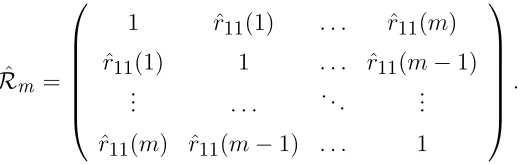
ˆ Rm =
1 rˆ11(1) . . . rˆ11(m)
ˆ
r11(1) 1 . . . ˆr11(m−1)
..
. . . .. ...
ˆ
r11(m) ˆr11(m−1) . . . 1
. (1.10)
Peˇna and Rodriguez(2002) derived the asymptotic distribution of ˆDm as gamma
using the standardized values of residual autocorrelations. Li (2004, §2.7) noted
several interesting interpretations for this statistic. It was shown in simulation
ex-periments (Peˇna and Rodriguez, 2002) that the ˆDm statistic had better power than
the test ofLjung and Box (1978) in many situations. One problem noted by Lin and
McLeod(2006) is that the test statistic ˆDm may not exist because, with the modified
version of the residual autocorrelations used, the residual autocorrelation sequence is
not always positive-definite or even non-negative definite. Furthermore, the size of
the test may not be accurate due to the asymptotic approximation (Li, 2004, p. 19).
To overcome these difficulties Lin and McLeod(2006) suggested using a Monte-Carlo
significance test and demonstrated that this approach provides a test with the correct
size and is often more powerful than the usual Ljung-Box test (Lin and McLeod,2006,
Table 6).
Peˇna and Rodriguez (2006) suggested taking the log of the (m+ 1)th root of the
determinant in Equation 1.10,
˜
Dm =−n(m+ 1)−1log|Rmˆ | (1.11)
and they derived a gamma distribution approximation for this test statistic.
In the portmanteau tests based on the asymptotic distribution (Ljung and Box,
1978; Peˇna and Rodriguez, 2002, 2006) not only is the size of the test inaccurate if
lags, is not large enough as well. The Monte-Carlo significance test approach does not
require any such assumption about m and has much better finite-sample properties
than tests based on the asymptotic distribution.
1.2
NEW MULTIVARIATE PORTMANTEAU TEST
The univariate residual autocorrelations in the Toeplitz matrix in Equation 1.10 are
replaced by, Rˆ`, `= 1, . . . , m in Equation 1.3,
ˆ
Rm =
Ik Rˆ1 . . . Rˆm
ˆ
R10 Ik . . . Rˆm−1
..
. . . .. ...
ˆ
R0m Rˆ0m−1 . . . Ik
, (1.12)
where Ik = ˆR0. The proposed multivariate portmanteau test statistic is
Dm =−nlog|Rˆm|. (1.13)
From Hadamard’s inequality for the determinant of a positive definite matrix,
|Rˆm| ≤ 1. When there is no significant autocorrelation in the residuals, ˆR` =
Op(n−
1
2) so ˆRm is approximately block diagonal and hence |Rˆm| ≈1.
On the other hand, when there is autocorrelation present, |Rˆm| will be expected
to be smaller than 1. To see this we repeatedly apply the formula for the determinant
of a partitioned matrix (Seber, 2008, §14.1),
|Rˆm|= m Y
`=1
|Ik−Rˆ(`)Rˆ−`−11Rˆ0(`) |, (1.14)
where ˆR(`)= [ ˆR1 :· · ·: ˆR`] is the k-by-`kblock partitioned matrix. Then ˆΣ` =Ik−
ˆ
order`is fit toLˆ0aˆt using the previous` values (Reinsel,1997, Equation 3.15). Thus,
Equation 1.14 is a direct multivariate generalization of the well known univariate
decomposition of generalized variance into the product of the one-step ahead variances
of the linear minimum-mean-square error predictors (McLeod, 1977, p. 532),
|Rmˆ |= m Y
`=1 ˆ
σ2`, (1.15)
where ˆσ`2 is the mean-square error for a fitted linear predictor of order`. In this case,
R`2 = 1−σˆ`2, where R2` is the square of the multiple correlation for the order ` linear
predictor, and so (Peˇna and Rodriguez,2002, Equation 7),
|Rˆm |= m Y
`=1
(1−R`2). (1.16)
In the multivariate case,
ˆ
η`2 = 1− |Ik−Rˆ(`)Rˆ−`−11Rˆ0(`)| (1.17)
is the proportion of the generalized variance that is accounted for by a linear predictor
of order `. From Equations 1.14 and 1.17, the corresponding multivariate equivalent
of Equation 1.16 is
|Rˆm|= m Y
`=1
(1−ηˆ2`). (1.18)
It follows from Equation 1.18 that |Rˆm|<1 and that the smaller the value of |Rˆm|,
the more strongly autocorrelated the normalized residuals, Lˆ0aˆt, are.
Using the Chitturi (1974) multivariate residual autocorrelations, Equation 1.6,
the correlation matrix corresponding to Equation 2.10, ˆR(m‡), is defined by the block
matrix with (i, j)-block, ˆR(i−‡)j for i, j = 1, . . . , m+ 1. This matrix is not symmetric
Multivariate autocorrelations are often defined as in Equation1.5(Box et al.,2008,
Equation 14.1.2). Using this definition, the residual autocorrelation matrix may be
written,
ˆ
R(`†)=Dˆ−1/2Γˆ`Dˆ−1/2, (1.19)
whereDˆ−1/2 = diag (ˆγ1−,11/2(0), . . . ,γˆk,k−1/2(0)). The correlation matrix corresponding
to Equation 2.10 obtained by replacing ˆR` by ˆR`(†) may be denoted by ˆR(`†) and the
corresponding generalized variance portmanteau statistic, |Rˆ(m†) |. A similar
decom-position as given in Equation1.18shows that small values|Rˆ(m†) |correspond to
posi-tive autocorrelation. On the other hand, when there is no autocorrelation present, the
off-block diagonal entries in the matrix ˆR(m†)areOp(n−1/2). So,|Rˆ(m†) |≈|Rˆ(0†)|m+1.
When the innovation variance matrix,Γ0, has large off-diagonal elements,|Rˆ(0†) |<1.
Hence again | Rˆ(m†) |=Op(rm) for some r ∈(0,1). So, in both cases, autocorrelation
or no autocorrelation, | Rˆ(m†) | tends to be small provided the innovation covariance
matrix is not diagonal. Numerical experiments confirmed that the test using D(m†)
and Dm are essentially equivalent when Γ0 is diagonal but in the non-diagonal case,
D(m†) does not provide a useful test.
1.2.1 Asymptotic distribution and approximation
In this section, the asymptotic distribution forDm in Equation1.13is derived and an
approximation to this distribution is suggested. Since, as shown in Lin and McLeod
(2006, Figure 2) in the univariate case by simulation, the actual finite-sample
distri-bution for Dm converges slowly, the asymptotic distribution for Dm is not expected
to be of much use in diagnostic checking multivariate time series models unless n is
very large.
P∞
i=0ΨiBi and Π(B) = Θ(B)−1 = P∞i=0ΠiBi are matrix power series such that the elements Ψi and Πi converge exponentially to zero as i→ ∞. Define
G=
G0 0 . . . 0
G1 G0 . . . 0
..
. ... . .. ...
Gm−1 Gm−2 . . . Gm−p
, (1.20) and H =
H0 0 . . . 0
H1 H0 . . . 0
..
. ... . .. ...
Hm−1 Hm−2 . . . Hm−q
, (1.21)
where Gr=P∞i=0Γ0Ψ0i⊗Πr−i and Hr =Γ0⊗Πr.
Theorem 1. Assume that the model specified in Equation 1.1 has independent and
identically distributed innovations with mean zero and constant covariance matrix.
The model is fit to a series of length n using an n−1/2-consistent algorithm. After
obtaining the residuals defined in Equation1.3 and the test statistic, Dm, in Equation
1.13, Dm is asymptotically distributed as
k2m X
i=1
λiχ21,i,
where χ21,i, i = 1, . . . , k2m are independent χ21 random variables and λ1, . . . , λk2m
are the eigenvalues of (Ik2−Q)M, where M is k2m×k2m diagonal matrix
M =
mIk2 O . . . O
O (m−1)Ik2 . . . O
..
. ... . .. ...
O O . . . Ik2
and
Q=X(X0W−1X)−1X0W−1 (1.23)
is an idempotent matrix with rank k2(p+q), X is defined as k2m×k2(p+q) matrix
(G−H), and W =Im⊗Γ0 ⊗Γ0 is positive-definite symmetric.
Proof. From the decomposition in Equation 1.14, it follows that,
−nlog|Rˆm|=−n m X
`=1
log |Ik−A` |, (1.24)
where A` = ˆR(`)Rˆ−`−11Rˆ0(`). Using the fact that|Ik−A` |=Qk
i=1(1−λi(`)), where
0< λi(`)<1 are the eigenvalues of A`, ` = 1, . . . , m,
−nlog|Rˆm|=−n m X
`=1 k X
i=1
log(1−λi(`)). (1.25)
Expanding log(1−λi(`)) =−P∞
r=1r−1λri(`) and tr (A`) = Pki=1λi(`),
Dm =n m X
`=1
tr (A`) +Op(n−1). (1.26)
One can verify that
tr (A1) = tr ( ˆR01Rˆ1)
tr (A2)≈ tr ( ˆR01Rˆ1) + tr ( ˆR02Rˆ2) ..
.
tr (Am)≈ tr ( ˆR01Rˆ1) +. . .+ tr ( ˆR0mRˆm),
(1.27)
so that,
Dm ≈n m X
`=1
Using the commutative property of trace,
Dm ≈n m X
`=1
(m−`+ 1) tr ( ˆΓ0`Γˆ0−1Γˆ`Γˆ−01). (1.29)
It follows from Neudecker (1969, Equation 2.12),
Dm ≈n m X
`=1
(m−`+ 1)( vec ˆΓ`)0( ˆΓ0−1⊗Γˆ−01) vec ˆΓ`,
=n( vec ˆΓ)0(Im⊗Γˆ0−1 ⊗Γˆ−01)M( vec ˆΓ),
(1.30)
where vec ˆΓ= ( vec ˆΓ1. . . vec ˆΓm) is k2m×1 column vector and M is k2m×k2m
diagonal matrix defined in Equation 1.22.
Hosking (1980, Theorem 1) showed that
√
n vec ˆΓ∼Nk2m(0,(Ik2m−Q)W), (1.31)
whereW−1 can be replaced by a consistent estimator ˆW−1 =Im⊗Γˆ−01⊗Γˆ−01, and
Qis the idempotent matrix of rank k2(p+q) in Equation 1.23.
From the theorem on quadratic forms given by Box (1954, Theorem 2.1), and
Equations 1.30, 1.31, the asymptotic distribution ofDm is given by,
Dm → k2m
X
i=1
λiχ21, (1.32)
where → stands for convergence in distribution as n→ ∞ and λ1, . . . , λk2m are the
eigenvalues of (Ik2m−Q)M.
1.2.1.1 Approximation
The upper percentiles of the cumulative distribution function in Equation1.32 could
(2006, Table 2) showed that the convergence to the asymptotic distribution is very
slow. In the case of large-samples, an approximation based on Box (1954, Theorem
3.1) works well. Using this result, the test statistic in Equation 1.32 can be
approx-imated by aχ2b, where a and b are chosen to make the first two moments agree with
those of exact distribution of Dm. Hence, a = Pλ2i/Pλi and b = (Pλi)2/Pλ2i,
where,
k2m X
i=1
λi = tr [(Ik2m−Q)M],
k2m X
i=1
λ2i = tr [(Ik2m−Q)M(Ik2m−Q)M].
(1.33)
When p = q = 0, a = (2m+ 1)/3 and b = 1.5k2m(m+ 1)/(2m + 1). In the
VARMA (p, q) case, one degree of freedom is lost for each parameter so Dm is
ap-proximately distributed as aχ2b, where
a= 2m+ 1
3 ,
b= 3k
2m(m+ 1)
2(2m+ 1) −k
2(p+q).
(1.34)
1.2.2 Monte-Carlo significance test
Monte-Carlo significance tests, originally suggested by George Barnard (Barnard,
1963), are feasible for many small-sample problems (Marriott,1979) and with modern
computing facilities these types of tests are increasingly feasible for larger samples and
more complex problems (Dufour and Khalaf,2001). For a pure significance test with
no nuisance parameters, as is the case, for example, for simply testing a time series for
randomness, the accuracy of the Monte-Carlo procedure depends only on the number
of simulations (Dufour, 2006, Proposition 2.1).
and Dufour (2006, Proposition 5.1) has shown that, provided consistent estimators
are used, Monte-Carlo tests remain asymptotically valid. Since we assume n−1/2
-consistent estimators are used, the requirements for Dufour (2006, Proposition 5.1)
are met.
Simulations for Dm in the univariate case (Lin and McLeod, 2006, Table 3) as
well as our simulations for the multivariate case in Section 1.3.1, suggest the impact
of nuisance parameters is negligible. The p-value for all of the portmanteau test
statistics presented in this paper may be obtained using the Monte-Carlo method
outlined below. We use the statistic Dm in the description but ˜Qm could be used
instead.
Step 1: Set N, the number of simulations. Usually, N ← 1000 but smaller values
may be used if necessary. By choosingN large enough, an accurate estimate of
the p-value may be obtained.
Step 2: After fitting the model and obtaining the residuals, compute the
portman-teau test statistic for lag m or possibly a set of lags such as ` = 1, . . . , m,
where m ≥ 1. Typically m is chosen large enough to allow for possible
high-order autocorrelations. Denote the observed value of the test statistics by
D(`o), ` = 1, . . . , m.
Step 3: For eachi= 1, . . . , N, simulate the fitted model, refit it, obtain the residuals
from this model, compute the test statistic,D(`i), `= 1, . . . , m.
Step 4: For each `, `= 1, . . . , m, the estimated p-value is given by,
ˆ
p= #{D (i) ` ≥D
(o)
` , i= 1,2, . . . , N}+ 1
The approximate 95% margin of error for the p-value is, 1.96ppˆ(1−ˆp)/N.
The above algorithm is simply a restatement of the Monte-Carlo testing algorithm
given by Lin and McLeod (2006, §3) for the univariate case. Lin and McLeod (2006,
Table 3) demonstrate that the Monte-Carlo testing procedure has the correct size for
an AR (1) and this is verified for some VAR (1) models in Section 1.3.1.
Remark 1. In the Monte-Carlo test procedure it is assumed that the innovations
used in our simulations in Step 3 are normally distributed but any distribution with
constant covariance matrix could be used. In particular, using the empirical joint
distribution is equivalent to bootstrapping the multivariate residuals. Using
boot-strapped residuals is implemented in our software (Mahdi and McLeod, 2011).
Remark 2. A limitation of the Monte-Carlo diagnostic check is the assumption of
constant variance. Many financial time series exhibit conditional heteroscedasticity.
In practice this means that our test may overstate the significance level (Duchesne and
Lalancette, 2003). This means that when used for constructing a VAR or VARMA
model, the final fitted model may not be as parsimonious as a model developed using
a portmanteau test which takes into account conditional heteroscedasticity (Francq
and Ra¨ısi, 2007; Duchesne, 2006). Our Monte-Carlo portmanteau test can also be
used to test for the presence of multivariate conditional heteroscedasticity simply
by replacing the residuals by squared or absolute residuals. An illustration of this
procedure is given later in Section1.4.2.
Remark 3. Francq and Ra¨ısi (2007) discuss a more general asymptotic multivariate
portmanteau diagnostic test that is valid assuming only that the innovations are
uncorrelated. This test requires a large sample though.
Remark 4. Lin and McLeod (2008) discuss the Monte-Carlo portmanteau test for
(2008) for infinite-variance ARMA has been extended to the multivariate case as well
and is available in our R package (Mahdi and McLeod, 2011).
1.3
SIMULATION RESULTS
The purpose of our simulations is to demonstrate the improved power as well as the
correct size of the Monte-Carlo (MC) test usingDm. We also compare the empirical
Type 1 error rates for the aχ2b-approximation discussed in Section 1.2.1.1.
1.3.1 Comparison of type 1 error rates
The empirical error rates have been evaluated under the Gaussian bivariate VAR (1)
process Zt =ΦiZt−1+at, i= 1, . . . ,4 for the portmanteau test statistic Dm using
the MC and aχ2b-approximation to evaluate the p-value. The covariance matrix of
at has unit variances and covariance 1/2 and the coefficient matrices are taken from
Hosking (1980) and Li and McLeod (1981),
Φ1 = 0.9 0.1 −0.6 0.4
!
,Φ2 = −1.5 1.2 −0.9 0.5
!
,Φ3 = 0.4 0.1
−1.0 0.5
!
,Φ4 = 0.3 0.5 0.0 0.3
!
.
The empirical error 1% and 5% rates are shown in Table 1.1. For each entry in
Table 1.1, 103 simulations were done. The MC test also usedN = 103.
The 95% confidence interval assuming a 5% rejection rate for each test is (3.6,6.4).
At the 5% rejection rate, there are 17 entries outside this interval with the aχ2b
ap-proximation and only one 1 with the Monte-Carlo test. In conclusion, size-distortion
with the Monte-Carlo test appears to be negligible but is sometimes present when the
aχ2b approximation is used.
In Section 1.4, we found that there is a much larger discrepancy between the
α= 1% α= 5%
n= 100 n= 200 n= 500 n= 100 n= 200 n= 500
m aχ2b MC aχ2b MC aχ2b MC aχ2b MC aχ2b MC aχ2b MC
Φ1
5 1.2 0.8 1.2 0.9 1.0 0.7 5.9 4.6 5.1 4.7 4.8 4.8 10 1.2 0.7 1.0 0.8 0.8 0.9 5.2 4.5 4.4 5.2 3.7 4.2 15 1.3 0.7 1.1 0.7 0.8 0.9 5.7 5.4 4.5 4.4 3.6 3.8 20 1.6 0.7 1.1 0.7 0.8 0.9 6.8 5.8 4.8 4.0 3.8 3.8 25 2.0 0.8 1.2 0.7 0.9 0.8 7.8 4.9 5.3 4.1 4.0 4.0 30 2.5 1.1 1.4 0.7 0.9 0.8 9.0 4.8 5.8 3.7 4.4 4.1 Φ2
5 0.9 0.9 0.8 1.2 0.7 1.0 4.7 4.8 4.0 4.8 3.5 4.7 10 1.0 0.7 0.9 1.3 0.6 1.4 4.8 3.8 3.8 4.0 3.5 4.8 15 1.2 1.0 1.0 0.8 0.7 1.5 5.7 3.9 4.3 3.9 3.6 5.0 20 1.7 0.8 1.0 0.8 0.7 1.2 6.9 4.2 4.9 4.2 3.8 4.8 25 2.0 0.7 1.0 0.7 0.7 1.0 8.2 4.0 5.3 3.9 4.1 5.3 30 2.4 0.7 1.3 0.6 0.7 1.0 9.5 4.3 5.8 4.0 4.5 5.4 Φ3
5 0.7 0.9 0.9 1.2 0.6 1.0 4.0 4.6 3.6 5.7 3.2 5.2 10 1.0 0.7 0.8 1.5 0.7 0.8 4.5 4.8 3.8 6.5 3.1 5.3 15 1.1 0.9 0.8 0.8 0.6 1.0 5.1 4.2 4.1 6.3 3.3 5.1 20 1.5 0.9 0.9 0.7 0.7 1.3 6.6 4.3 4.6 6.2 3.6 5.2 25 1.9 0.9 1.0 0.7 0.8 1.0 7.7 4.5 5.3 5.4 4.0 5.3 30 2.3 0.8 1.2 0.8 0.8 1.3 9.0 4.2 5.9 5.5 4.3 5.0 Φ4
5 0.6 0.8 0.6 1.1 0.5 1.0 2.9 4.3 2.6 4.7 2.5 5.2 10 0.8 0.8 0.7 1.1 0.6 1.0 3.9 4.6 3.2 4.9 3.0 4.5 15 1.0 0.9 0.9 1.0 0.6 1.0 4.9 4.1 3.9 4.6 3.2 5.0 20 1.3 1.2 0.9 1.0 0.7 1.0 6.1 4.4 4.5 5.3 3.6 4.9 25 1.8 0.9 1.1 1.0 0.7 1.0 7.3 3.9 5.0 5.0 3.9 4.8 30 2.2 1.0 1.3 1.0 0.8 0.9 8.7 3.9 5.6 5.2 4.3 4.7
1.3.2 Power comparisons
Only Monte-Carlo significance tests are used to compare the empirical power of 1%
and 5% level tests with ˜Qm and Dm. Possible size-distortion sometimes makes power
comparisons between asymptotic tests and Monte-Carlo tests invalid. In our
compar-isons, VAR models are fitted to various multivariate models. The power of diagnostic
tests using Dm versus ˜Qm are compared using simulation. In all comparisons, the
p-values were evaluated using the Monte-Carlo (MC) method withN = 103. We
con-sider a VAR (1) model fitted to simulated data generated from eight VARMA models
selected from well-known textbooks as cited below.
Model 1
L¨utkepohl (2005, p. 17).
"
Z1,t
Z2,t
# − " 0.5 0.1 0.4 0.5 # "
Z1,t−1
Z2,t−1
# − " 0 0 0.3 0 # "
Z1,t−2
Z2,t−2
#
=
"
a1,t
a2,t
#
Γ0 = 1.00 0.71 0.71 1.00
!
Model 2
Brockwell and Davis (1991, p. 428).
"
Z1,t
Z2,t
# − " 0.7 0 0 0.6 # "
Z1,t−1
Z2,t−1
#
=
"
a1,t
a2,t
# − " 0.5 0.6 −0.7 0.8 # "
a1,t−1
a2,t−1
#
Γ0 =
1.00 0.71
0.71 2.00
Model 3
Reinsel (1997, p. 81).
"
Z1,t
Z2,t
# − " 1.2 −0.5 0.6 0.3 # "
Z1,t−1
Z2,t−1
#
=
"
a1,t
a2,t
# − " −0.6 0.3 0.3 0.6 # "
a1,t−1
a2,t−1
#
Γ0 =
1.00 0.50
0.50 1.25
!
Model 4
Tsay [2005 2nd ed, p. 371].
"
Z1,t
Z2,t
# − " 0.8 −2 0 0 # "
Z1,t−1
Z2,t−1
#
=
"
a1,t
a2,t
# − " −0.5 0 0 0 # "
a1,t−1
a2,t−1
#
Γ0 = 1.00 0.71 0.71 1.00
!
Model 5
Reinsel (1997, p. 25).
"
Z1,t
Z2,t
#
=
"
a1,t
a2,t
# − " 0.8 0.7 −0.4 0.6 # "
a1,t−1
a2,t−1
#
Γ0 = 4 1 1 2
Model 6
Tsay [2005 2nd ed, p. 350].
"
Z1,t
Z2,t
#
=
"
a1,t
a2,t
# − " 0.2 0.3 −0.6 1.1 # "
a1,t−1
a2,t−1
#
Γ0 =
2 1
1 1
!
Model 7
L¨utkepohl (2005, p. 445).
"
Z1,t
Z2,t
# − " 0.5 0.1 0.4 0.5 # "
Z1,t−1
Z2,t−1
# − " 0 0 0.25 0 # "
Z1,t−2
Z2,t−2
#
=
"
a1,t
a2,t
# − " 0.6 0.2 0 0.3 # "
a1,t−1
a2,t−1
#
Γ0 = 1.0 0.3 0.3 1.0
!
Model 8
Z1,t
Z2,t
Z3,t
−
0.4 0.3 −0.6
0.0 0.8 0.4
0.3 0.0 0.0
Z1,t−1
Z2,t−1
Z3,t−1
=
a1,t
a2,t
a3,t
−
0.7 0.0 0.0
0.1 0.2 0.0
−0.4 0.5 −0.1
a1,t−1
a2,t−1
a3,t−1
Γ0 =
1.0 0.5 0.4
0.5 1.0 0.7
0.4 0.7 1.0
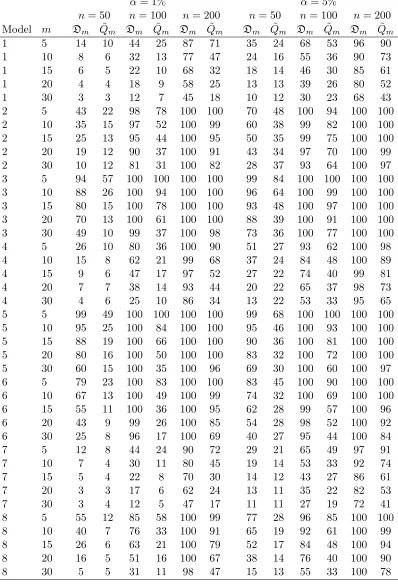
The power of the portmanteau statisticsDmand ˜Qmfor nominal 1% and 5% tests
using the MC test are shown in Table1.2. The power is evaluated for 104 simulations
for each parameter setting and N = 103 is used in the MC algorithm. It is clear
from Table 1.2 that the Dm test is often substantially more powerful than the ˜Qm.
Only whenn = 50 andm= 30 is the ˜Qm test more powerful and this only occurs for
α= 1% α= 5%
n= 50 n= 100 n= 200 n= 50 n= 100 n= 200 Model m Dm Q˜m Dm Q˜m Dm Q˜m Dm Q˜m Dm Q˜m Dm Q˜m
1 5 14 10 44 25 87 71 35 24 68 53 96 90
1 10 8 6 32 13 77 47 24 16 55 36 90 73
1 15 6 5 22 10 68 32 18 14 46 30 85 61
1 20 4 4 18 9 58 25 13 13 39 26 80 52
1 30 3 3 12 7 45 18 10 12 30 23 68 43
2 5 43 22 98 78 100 100 70 48 100 94 100 100 2 10 35 15 97 52 100 99 60 38 99 82 100 100 2 15 25 13 95 44 100 95 50 35 99 75 100 100 2 20 19 12 90 37 100 91 43 34 97 70 100 99 2 30 10 12 81 31 100 82 28 37 93 64 100 97 3 5 94 57 100 100 100 100 99 84 100 100 100 100 3 10 88 26 100 94 100 100 96 64 100 99 100 100 3 15 80 15 100 78 100 100 93 48 100 97 100 100 3 20 70 13 100 61 100 100 88 39 100 91 100 100 3 30 49 10 99 37 100 98 73 36 100 77 100 100
4 5 26 10 80 36 100 90 51 27 93 62 100 98
4 10 15 8 62 21 99 68 37 24 84 48 100 89
4 15 9 6 47 17 97 52 27 22 74 40 99 81
4 20 7 7 38 14 93 44 20 22 65 37 98 73
4 30 4 6 25 10 86 34 13 22 53 33 95 65
5 5 99 49 100 100 100 100 99 68 100 100 100 100 5 10 95 25 100 84 100 100 95 46 100 93 100 100 5 15 88 19 100 66 100 100 90 36 100 81 100 100 5 20 80 16 100 50 100 100 83 32 100 72 100 100 5 30 60 15 100 35 100 96 69 30 100 60 100 97 6 5 79 23 100 83 100 100 83 45 100 90 100 100 6 10 67 13 100 49 100 99 74 32 100 69 100 100 6 15 55 11 100 36 100 95 62 28 99 57 100 96
6 20 43 9 99 26 100 85 54 28 98 52 100 92
6 30 25 8 96 17 100 69 40 27 95 44 100 84
7 5 12 8 44 24 90 72 29 21 65 49 97 91
7 10 7 4 30 11 80 45 19 14 53 33 92 74
7 15 5 4 22 8 70 30 14 12 43 27 86 61
7 20 3 3 17 6 62 24 13 11 35 22 82 53
7 30 3 4 12 5 47 17 11 11 27 19 72 41
8 5 55 12 85 58 100 99 77 28 96 85 100 100
8 10 40 7 76 33 100 91 65 19 92 61 100 99
8 15 26 6 63 21 100 79 52 17 84 48 100 94
8 20 16 5 51 16 100 67 38 14 76 40 100 90
8 30 5 5 31 11 98 47 15 13 55 33 100 78
1.4
ILLUSTRATIVE APPLICATIONS
1.4.1 IBM and S&P index
Tsay (2010, Chapter 8) uses the portmanteau diagnostic test in constructing a VAR
model for the monthly log returns of IBM stock and the S&P 500 index for January
1926 to December 2008. So here, n = 996. Univariate analysis for both of these
series indicates the presence of conditional heteroscedasticity (Tsay, 2010, p. 408)
but for forecasting purposes, we may consider a VAR model rather than a more
complex VAR/GARCH model (Weiss,1984;Francq and Ra¨ısi,2007). The AIC selects
a VAR(5) model. We found that the BIC selects a VAR(1) model. Table1.3compares
the p-values for the portmanteau tests for the VAR(p) for p= 1,3,5.
These portmanteau tests suggest that the VAR(5) is adequate and that the VAR(1)
and VAR(3) both exhibit lack of fit. The VAR(4) is not shown but the results for
this model are similar to the VAR(3). As noted in Remark 2, the presence of
condi-tional heteroscedasticity means that the p-values in Table 1.3 are too small and this
implies that, possibly, a lower order model than the VAR(5) may be adequate. This
possibility could be investigated using the multivariate portmanteau test of Francq
and Ra¨ısi (2007).
Table 1.3 also shows that aχ2b approximation for the p-value of Dm is inaccurate
whereas for ˜Qm the asymptotic approximation agrees quite well with the Monte-Carlo
result.
1.4.2 Investment, income and consumption time series
The trivariate quarterly time series, 1960–1982, of West German investment, income,
and consumption was discussed by L¨utkepohl (2005, §3.2.3). For this series, n = 92
VAR(1) VAR(3) VAR(5)
aχ2b MC aχ2b MC aχ2b MC
m Dm Q˜m Dm Q˜m Dm Q˜m Dm Q˜m Dm Q˜m Dm Q˜m
5 0.2 * * * 10.4 0.6 1.7 0.6 NA NA 91.2 89.9
10 0.1 0.3 * 0.2 13.5 6.1 2.8 4.0 77.4 50.3 59.4 50.2
15 0.3 2.1 * 2.2 20.4 22.3 6.4 22.1 84.0 61.2 63.1 61.4
20 0.2 * * * 15.4 2.6 5.0 2.2 71.8 11.3 45.2 9.9
25 0.1 * * * 8.7 1.1 2.3 0.7 53.0 7.6 27.5 7.1
30 0.2 * * * 7.3 2.7 2.3 2.2 46.2 13.7 23.3 12.0
Table 1.3: IBM and S&P 500 Index Data. aχ2b: approximation. MC: Monte-Carlo N = 103. NA: not applicable. The p-values are in percent. The ∗indicates a p-value less than 0.1%.
differences. Using the AIC, L¨utkepohl (2005, Table 4.5) selected a VAR (2) for this
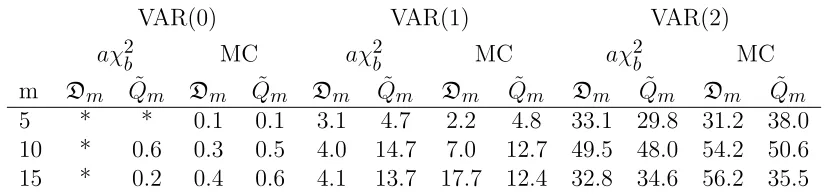
data. Only lags m = 5,10,15 are used in the diagnostic checks since n is relatively
short. All diagnostic tests reject simple randomness, VAR (0). The Monte-Carlo tests
for VAR (1) suggests model inadequacy at lag 5. Table1.4 supports the choice of the
VAR (2) model.
VAR(0) VAR(1) VAR(2)
aχ2b MC aχ2b MC aχ2b MC
m Dm Q˜m Dm Q˜m Dm Q˜m Dm Q˜m Dm Q˜m Dm Q˜m
5 * * 0.1 0.1 3.1 4.7 2.2 4.8 33.1 29.8 31.2 38.0
10 * 0.6 0.3 0.5 4.0 14.7 7.0 12.7 49.5 48.0 54.2 50.6 15 * 0.2 0.4 0.6 4.1 13.7 17.7 12.4 32.8 34.6 56.2 35.5
Table 1.4: Trivariate West German Macroeconomic Series. aχ2b: approximation. MC: Monte-Carlo using 103 replications. The p-values are in percent and∗ indicates a p-value less than 0.1%.
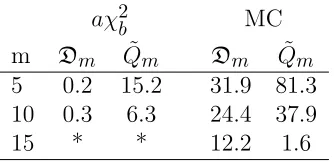
As pointed out in Remark 2, we may test for multivariate heteroscedasticity by
using the squared residuals and Table 1.5 gives the p-values with this test for the
approximation for ˜Qm are quite inaccurate. Based on the Monte-Carlo tests there is
little evidence to reject that null hypothesis of constant variance.
aχ2b MC
m Dm Q˜m Dm Q˜m
5 0.2 15.2 31.9 81.3
10 0.3 6.3 24.4 37.9
15 * * 12.2 1.6
1.5
CONCLUDING REMARKS
Box et al.(2008) stress the importance of constructing an adequate and parsimonious
model in which the residuals pass a suitable portmanteau diagnostic check. In
fore-casting experiments with monthly riverflow time series, Noakes et al. (1985) found
that simply using a criterion such as the AIC or BIC may provide a model that either
does not pass a suitable diagnostic check for randomness of the residuals or that may
have more parameters than necessary. Monthly riverflow time series models chosen
with the fewest number of parameters that pass the portmanteau diagnostic check
for periodic autocorrelation (McLeod, 1994) tend to produce better one-step ahead
forecasts (Noakes et al.,1985). McLeod(1993) suggested formulating the principle of
parsimony as an optimization problem: minimize model complexity subject to model
adequacy. In any case, in the overall approach suggested many years ago and
pre-sented in their recent book (Box et al., 2008), portmanteau diagnostic checks play a
crucial role in constructing time series models.
In Section1.2.2, Remark 2, it was pointed out the Monte-Carlo test withDm may
also be useful in diagnostic checking for multivariate conditional heteroscedasticity
when used with squared or absolute residuals. This test is implemented in Mahdi
and McLeod (2011). There is an extensive literature on testing residuals in AR and
ARMA models for conditional heteroscedasticity (Ling and Li, 1997; Duchesne and
Lalancette,2003;Duchesne,2004;Rodr´ıguez and Ruiz,2005;Duchesne,2006;
Chabot-Hall and Duchesne,2008). The power study presented Section 1.3.2suggests that the
Dm with squared or absolute residuals may be useful. Peˇna and Rodriguez (2002)
also suggested that using squared-residuals with their generalized-variance
portman-teau test would outperform the usual diagnostic check (McLeod and Li,1983). Other
omnibus portmanteau test such as Dm or ˜Qm when these alternatives hold. For
ex-ample,Rodr´ıguez and Ruiz(2005) developed a diagnostic check for heteroscedasticity
for the case of small autocorrelations.
The multivariate portmanteau diagnostic test developed by Francq and Ra¨ısi
(2007) does not require independent and identically innovations but only uncorrelated
innovations. This test would be appropriate for the bivariate example in Section1.4.1.
Scripts for reproducing all tables in this paper are available with our freely
avail-able software (Mahdi and McLeod, 2011). This package can utilize multicore CPUs
often found in modern personal computers as well as a computer cluster or grid
(Schmidberger et al., 2009). On a modern eight core personal computer, the
com-putations for Tables 1.4 and 1.5 take about one minute. Table 1.3 takes about six
minutes due to the longer series length and increased number of lags. The simulations
REFERENCES
Barnard, G. A. (1963). Discussion of ”The spectral analysis of point processes” by M. S. Bartlett. Journal of the Royal Statistical Society, B 25, 264–296.
Box, G. (1954). Some theorems on quadratic forms applied in the study of analysis of variance problems, I. effect of inequality of variance in the one-way classification.
The Annals of Mathematical Statistics 25(2), 290–302.
Box, G. and Pierce, D. (1970). Distribution of residual autocorrelation in autoregressive-integrated moving average time series models. Journal of Ameri-can Statistical Association 65(332), 1509–1526.
Box G., Jenkins G., and Reinsel, G. C. (2008). Time Series Analysis: Forecasting and Control (4th ed.). New York: Wiley.
Brockwell, P. J. and Davis, R. A.(1991). Time series: Theory and Methods (2nd ed.). New York: Springer-Verlag.
Chabot-Hall, D. and Duchesne, P. (2008). Diagnostic checking of multivariate nonlin-ear time series models with martingale difference errors. Statistics and Probability Letters 78(8), 997–1005.
Chitturi, R. V. (1974). Distribution of residual autocorrelations in multiple autore-gressive schemes.Journal of the American Statistical Association 69(348), 928–934.
Chitturi, R. V. (1976). Distribution of multivariate white noise autocorrelations.
Journal of the American Statistical Association 71(353), 223–226.
Duchesne, P. (2004). On robust testing for conditional heteroscedasticity in time series models. Computational Statistics and Data Analysis 46, 227–256.
Duchesne, P. (2006). Testing for multivariate autoregressive conditional heteroskedas-ticity using wavelets. Computational Statistics and Data Analysis 51(353), 2142– 2163.
Duchesne, P. and Lalancette, S. (2003). On testing for multivariate ARCH effects in vector time series models. The Canadian Journal of Statistics 31(3), 275–292.
Dufour, J.-M. and Khalaf, L. (2001). Monte-Carlo test methods in econometrics. In B. Baltagi (Ed.),Companion to Theoretical Econometrics, Chapter 23, pp. 494–519. Oxford: Blackwell.
Francq, C. and Ra¨ısi, H. (2007). Multivariate portmanteau test for autoregressive models with uncorrelated but nonindependent errors.Journal of Time Series Anal-ysis 28(3), 454–470.
Hosking, J. R. M. (1980). The multivariate portmanteau statistic. Journal of Amer-ican Statistical Association 75(371), 602–607.
Hosking, J. R. M. (1981a). Equivalent forms of the multivariate portmanteau statistic.
Journal of the Royal Statistical Society, Series B 43(2), 261–262.
Hosking, J. R. M. (1981b). Lagrange-multiplier tests of multivariate time-series mod-els. Journal of the Royal Statistical Society. Series B (Methodological) 43(2), 219– 230.
Imhof, J. P.(1961). Computing the distribution of quadratic forms in normal variables.
Biometrika 48, 419–426.
Li, W. K. (2004). Diagnostic checks in time series. New York: Chapman and Hall/CRC.
Li, W. K. and McLeod, A. I. (1981). Distribution of the residual autocorrelation in multivariate arma time series models. Journal of the Royal Statistical Society, Series B 43(2), 231–239.
Lin, J.-W. and McLeod, A. I. (2006). Improved Peˇna-Rodr´ıguez portmanteau test.
Computational Statistics and Data Analysis 51(3), 1731–1738.
Lin, J.-W. and McLeod, A. I. (2008). Portmanteau tests for ARMA models with infinite variance. Journal of Time Series Analysis 29(3), 600–617.
Ling, S. and Li, W. K. (1997). Diagnostic checking of nonlinear multivariate time series with multivariate ARCH errors. Journal of Time Series Analysis 18(5), 447–464.
Ljung, G. M. and Box, G. E. P. (1978). On a measure of lack of fit in time series models. Biometrika 65, 297–303.
L¨utkepohl, H. (2005). New Introduction to multiple time series analysis. New York: Springer-Verlag.
Marriott, F. H. C. (1979). Barnard’s Monte Carlo tests: How many simulations?
Applied Statistics 28(1), 75–77.
McLeod, A. I. (1977). Improved Box-Jenkins estimators. Biometrika 64(3), pp. 531–534.
McLeod, A. I. (1993). Parsimony, model adequacy and periodic correlation in fore-casting time series. International Statistical Review 61(3), 387–393.
McLeod, A. I. (1994). Diagnostic checking periodic autoregression models with ap-plication. The Journal of Time Series Analysis 15(3), 221–233. Addendum, JTSA 16, 647–648.
McLeod, A. I. and Li, W. K. (1983). Diagnostic checking ARMA time series models using squared-residual autocorrelations. The Journal of Time Series Analysis 4, 269–273.
Neudecker, H. (1969). Some theorems on matrix differentiation with special reference to kronecker matrix products.Journal of American Statistical Association 64(327), 953–962.
Noakes, D. J., McLeod, A. I., and Hipel, K. W. (1985). Forecasting seasonal hydro-logical time series. The International Journal of Forecasting 1(1), 179–190.
Peˇna, D. and Rodr´ıguez, J. (2002). A powerful portmanteau test of lack of test for time series. Journal of American Statistical Association 97(458), 601–610.
Peˇna, D. and Rodr´ıguez, J. (2006). The log of the determinant of the autocorrelation matrix for testing goodness of fit in time series. Journal of Statistical Planning and Inference 8(136), 2706–2718.
Poskitt, D. S. and Tremayne, A. R. (1982). Diagnostic tests for multiple time series models. Annals of Statistics 6(1), 114–120.
Reinsel, G. C. (1997). Elements of multivariate time series analysis (2nd ed.). New York: Springer-Verlag.
Reinsel, G. C., Basu, S. and Yap, S. F. (1992). Maximum likelihood estimators in the multivariate autoregressive moving average model from a generalized least squares viewpoint. Journal of Time Series Analysis 13(2), 133–145.
Schmidberger, M., Morgan, M., Eddelbuettel, D., Yu, H., Tierney, L., and Mansmann, U. (2009). State of the art in parallel computing with R. Journal of Statistical Software 31(1), 1–27.
Seber, G. A. F. (2008). A matrix handbook for statisticians. New York: Wiley.
Tsay, R. S. (2010). Analysis of financial time series (3rd ed.). (2nd ed. 2005). New York: Wiley.
PORTMANTEAU TESTS FOR TIME SERIES MODELS: R PACKAGE portes
Chapter 2
PORTMANTEAU TESTS FOR TIME SERIES MODELS:
R PACKAGE portes
2.1
INTRODUCTION
The multivariate vector integrated autoregressive moving average, VARIMA (p,d, q),
model with mean vectorµand deterministic equationa+btfor ak-dimensional time
series Zt = (Z1,t, . . . , Zk,t)0 can be written as
Φ(B)D(B)(Zt−µ) = a+bt+Θ(B)et, (2.1)
whereΦ(B)=Ik−Φ1B− · · · −ΦpBp,Θ(B)=Ik−Θ1B− · · · −ΘqBq andIk is a
k×kidentity matrix,Φ` = (φij,`)k×k, Θ` = (θij,`)k×kare coefficient matrices, andB
is a backshift operator such asBjZt =Zt−j. D(B)= diag [(1−B)d1, . . . ,(1−B)dk]
is a diagonal k ×k matrix, where d = (d1, . . . , dk), di ≥ 0. This states that each
individual series Zi, i = 1, . . . , k is differenced di times to reduce to a stationary
VARMA (p, q) series. It is assumed that the VARMA model is stationary, invertible,
and identifiable (Reinsel, 1997; Box et al., 2008). The coefficients a and b represent
the constant drift and the deterministic time trend respectively and the white noise
process et = (e1,t, . . . , ek,t)0 is assumed to be uncorrelated in time with mean zero;
that is, E(et) = 0 and E(ete0t−`) = Γ0δ`, where Γ0 is the k ×k positive definite
variance covariance matrix and δ` is the usual Kronecker delta with unity at ` = 0
In univariate time series, i.e. when k = 1, the model in Equation 2.1 reduces to
be an integrated autoregressive moving average, ARIMA (p, d, q), model
φ(B)D(B)(Zt−µ) = a+bt+θ(B)et, (2.2)
whereaand b, are the drift and the trend terms respectively,φ(B) = 1−φ1B− · · · −
φpBp, θ(B) = 1−θ1B− · · · −θqBq,D(B) = dis the differencing order, and et is the
white noise series with mean zero and variance σ2 (Hannan, 1969; Pfaff, 2006; Box
et al., 2008).
After fitting the ARIMA or VARIMA model using efficient estimators, the
resid-uals, ˆei,t where i = 1, . . . , k and t = 1, . . . , n can be obtained. We may then use
portmanteau goodness-of-fit test to test the adequacy of the fitted model by checking
whether the residuals are approximately white noise (Li,2004).
The most popular portmanteau tests that were introduced by Box and Pierce
(1970); Ljung and Box (1978); Hosking (1980); Li and McLeod (1981), with a new
portmanteau generalized variance test based on the determinant of the
standard-ized multivariate residual autocorrelations (Peˇna and Rodriguez,2002, 2006;Lin and
McLeod,2006; Mahdi and McLeod, 2011) are implemented in theR package portes.
In addition, the portmanteau tests for nonlinear structure in time series as proposed
byMcLeod and Li(1983) and for Fractional Gaussian Noise, FGN , stochastic model
(McLeod et al., 2007b) that possesses long memory, are also implemented in this
package. Adler et al.(1998) studied ARMA models with identical and independent
in-novations from stable distribution with infinite variances andLin and McLeod(2008)
developed a generalized variance portmanteau test for such models using Monte-Carlo
techniques and this test is also included in this package. Any other fitted model, such
proposed package (Cryer and Chan, 2010). Brief descriptions for different
portman-teau tests are given in Section 2.3.
The concern of using the portmanteau tests is that the accuracy of the asymptotic
distributions requires n and m large, where n denotes the length of the series and
m is the lag time value. The development of powerful computers, specially those
with multicore systems, in which the R packages Rmpi (Yu, 2002) and snow (
Tier-ney et al., 2011) work efficiently with parallel computing, has made Monte-Carlo
tests more affordable and recommended in such cases as simulation experiments show
that the Monte-Carlo tests are usually more accurate and powerful than asymptotic
distributions (Lin and McLeod, 2006; Mahdi and McLeod,2011).
In Sections 2.2 and 2.4 we describe the main function, portest(), with some
illustrative applications explaining the Monte-Carlo version of Peˇna and Rodriguez
(2002); Mahdi and McLeod (2011) portmanteau test with implementation to snow
package. This function can be used for testing whiteness of series as well as for
testing adequacy of fitted ARMA and VARMA models with finite or infinite variances,
GARCH effects, FGN models, or any other fitted model. To reproduce the results in
these sections, one should install the packagesfGarch,FGN,snow,TSA, andvars, on
a computer with a minimum requirement of dual core. These packages are available
from the ComprehensiveR Archive Network website, CRAN.
R> library("fGarch")
R> library("FGN")
R> library("snow")
R> library("vars")
The proposedR package portes is developed so one can simulate time series from
or infinite variance from stable distribution (see Section 2.5.2). The simulated data
may has a deterministic constant drift and time trend term with non-zero mean.
It can be used for testing stationarity and invertibility and for estimating stable
parameters of data from stable distribution. The package portes is available from
the Comprehensive R Archive Network, CRAN, at http://CRAN.R-project.org/
package=portes version 1.08 and can be installed in the usual ways and is ready to
use after typing
R> library("portes")
2.2
THE MAIN FUNCTION: portest
In this section we describe the main function, portest(). This function implements
the portmanteau test statistics as given in Box and Pierce (1970); Ljung and Box
(1978); Hosking (1980); Li and McLeod (1981); McLeod and Li (1983) with a new
portmanteau test statistic based on the determinant of the standardized univariate
or multivariate residual autocorrelations (Peˇna and Rodriguez, 2002, 2006; Lin and
McLeod,2006,2008;Mahdi and McLeod,2011). The p-values can be evaluated using
the Monte-Carlo techniques and the approximate asymptotic chi-square distribution.
The syntax of portest() is listed below:
portest(obj,lags=seq(5,30,5),order=0,test=c("gvtest","BoxPierce",
"LjungBox","Hosking","LiMcLeod"),MonteCarlo=TRUE,nslaves=1,
NREP=1000,InfiniteVarianceQ=FALSE,SquaredQ=FALSE,
2.2.1 Monte-Carlo goodness-of-fit test
The minimal required input of the function portest() is portest(obj). By
select-ing this argument, the generalized variance portmanteau statistic, gvtest(), that is
described in Section 2.3.5 will be implemented using the Monte-Carlo approach with
one thousand replications on a single CPU at lags 5, 10, 15, 20, 25, and 30.
As an illustrative example, consider the univariate series DEXCAUS. Data is
avail-able from ourRPackageportesand refer to daily Canada/US foreign exchanges rates
from January 04, 1971 to September 05, 1996. A complete description of the data can
be retrieved simply by typing ?DEXCAUSinR session. In this example, theportest()
function implements the Monte-Carlo version of the statistic gvtest with 103
repli-cations using a single CPU and test for randomness of returns. The results suggest
that the returnsseries behaves like random series. With respect to computer time,
the CPU time equals to 49.61 seconds to get the output of this example.
R> data("DEXCAUS")
R> returns <- log(DEXCAUS[-1]/DEXCAUS[-length(DEXCAUS)])
R> portest(returns)
Lags Statistic df p-value
5 5.726436 4.090909 0.2237762
10 12.002784 7.857143 0.1478521
15 16.798015 11.612903 0.1598402
20 20.847948 15.365854 0.1718282
25 23.805231 19.117647 0.2227772
30 27.248101 22.868852 0.2477522
For the Monte-Carlo significance test, the function portest()with an objectobj