Research
Web exclusive Research
Are you SURE?
Assessing patient decisional conflict with a 4-item screening test
France Légaré
MD PhD CCMF FCMFStephen Kearing
MScKate Clay
MA RNSusie Gagnon
MADenis D’Amours
MDMichel Rousseau
PhDAnnette O’Connor
RNPhDAbstrAct
ObJEctIVE
To assess the reliability and validity of the 4-item SURE (Sure of myself; Understand information; Risk-benefit ratio; Encouragement) screening test for decisional conflict in patients.DEsIGN
Cross-sectional study.sEttING
Four family medicine groups in Quebec and 1 rural academic medical centre in New Hampshire.PArtIcIPANts
One hundred twenty-three French-speaking pregnant women considering prenatal screening for Down syndrome and 1474 English-speaking patients referred to watch condition-specific video decision aids.MAIN OUtcOME MEAsUrEs
Cronbach α was used to assess the reliability of SURE. A factorial analysis was performed to assess its unidimensionality. The Pearson correlation coefficient was computed between SURE and the Decisional Conflict Scale to assess concurrent validation. A t test procedure comparing the SURE scores of patients who had made decisions with the scores of those who had not was used to assess construct validation.rEsULts
Among the 123 French-speaking pregnant women, 105 (85%) scored 4 out of 4 (no decisional conflict); 10 (8%) scored 3 (≤ 3 indicates decisional conflict); 7 (6%) scored 2; and 1 (1%) scored 1. Among the 1474English-speaking treatment-option patients, 981 (67%) scored 4 out of 4; 272 (18%) scored 3; 147 (10%) scored 2; 54 (4%) scored 1; and 20 (1%) scored 0. The reliability of SURE was moderate (Cronbach α of 0.54 in French-speaking pregnant women and 0.65 in treatment-option patients). In the group of pregnant women, 2 factors accounted for 72% of the variance. In the treatment-option group, 1 factor accounted for 49% of the variance. In the group of pregnant women, SURE correlated negatively with the Decisional Conflict Scale
(r = -0.46; P < .0001); and in the group of treatment-option patients, it discriminated between those who had made a choice for a treatment and those who had not (P < .0001).
cONcLUsION
The SURE screening test shows promise for screening for decisional conflict in both French- and English-speaking patients; however, future studies should assess its performance in a broader group of patients.EDItOr’s kEy POINts
•
Decisional conflict refers to a patient’s uncertainty
about the course of action to take when the choices
involve risk, loss, regret, or a challenge to personal
life values.
•
The 4-item SURE (Sure of myself; Understand
information; Risk-benefit ratio; Encouragement)
screening test was developed to help health
profes-sionals identify patients with clinically significant
decisional conflict as quickly as possible.
•
Results of this study indicate that the SURE
screening test has acceptable psychometric
proper-ties and is suitable for screening for decisional
con-flict in patients facing clinical decisions in primary
care. As such, the tool can improve how decisions
are made in family medicine, benefiting patient
out-comes as a result.
Recherche
Exclusivement sur le web
Êtes-vous « SURE »?
Évaluer le conflit décisionnel chez les patients à
l’aide d’un test de dépistage en 4 volets
France Légaré
MD PhD CCMF FCMFStephen Kearing
MScKate Clay
MA RNSusie Gagnon
MADenis D’Amours
MDMichel Rousseau
PhDAnnette O’Connor
RNPhDrÉsUMÉ
ObJEctIF
Évaluer la fiabilité et la validité du test SURE servant à dépister le conflit décisionnel chez les patients (SURE est l’acronyme en anglais pour : sûr de soi; comprendre l’information; rapport risques-avantages;encouragement).
tyPE D’ÉtUDE
Étude transversale.cONtEXtE
Quatre groupes de médecine familiale au Québec et un centre médical universitaire rural au New Hampshire.PArtIcIPANts
Groupe de 123 femmes enceintes francophones envisageant le dépistage du syndrome de Down et 1 474 patients anglophones référés pour visionner une vidéo sur l’aide à la décision liée à leur maladie.PrINcIPAUX PArAMÈtrEs ÉtUDIÉs
On a utilisé le coefficient α de Cronbach pour évaluer la fiabilité de SURE. On a effectué une analyse factorielle pour mesurer son unidimensionnalité. On a calculé le coefficient de corrélation de Pearson entre SURE et l’Échelle du conflit décisionnel pour évaluer la validation concurrente. Pour évaluer la validation du construct, on a effectué un test t comparant les résultats SURE des patients qui avaient pris leur décision avec ceux des personnes qui ne l’avaient pas prise.rÉsULtAts
Parmi les 123 femmes enceintes francophones, 105 (85 %) ont eu des résultats de 4 sur 4 (aucun conflit décisionnel); 10 (8 %) ont eu un résultat de 3 (≤ 3 indique un conflit décisionnel); 7 (6 %) ont eu 2; et 1 (1 %) a eu un résultat de 1. Parmi les 1 474 patients anglophones du groupe envisageant les options de traitement, 981 (67 %) ont eu des résultats de 4 sur 4; 272 (18 %) ont eu 3; 147 (10 %) ont eu 2; 54 (4 %) ont eu 1; et 20 (1 %) ont eu 0. La fiabilité de SURE était modérée (α de Cronbach de 0,54 chez les femmes enceintes francophones et de 0,65 chez les patients du groupe des options de traitement). Dans le groupe des femmes enceintes, une part de 72 % de la variation était attribuable à 2 facteurs.Dans le groupe des options de traitement, 1 facteur expliquait 49 % de la variation. Dans le groupe des femmes enceintes, il y avait une corrélation négative entre SURE et l’Échelle du conflit décisionnel (r = -0,46;
P < ,0001); dans le groupe des options de traitement, le test faisait une distinction entre ceux qui avaient fait un choix de traitement et ceux qui n’avaient pas décidé (P < ,0001).
cONcLUsION
Le test de dépistage SURE est prometteur pour évaluer le conflit décisionnel chez les patientes francophones et les patients anglophones; par contre, les études futures devraient mesurer son efficacité dans un groupe plus large de patients.POINts DE rEPÈrE DU rÉDActEUr
•
Le conflit décisionnel désigne l’incertitude des
patients entourant la marche à suivre quand leurs
choix comportent des risques, une perte, un regret
éventuel ou un conflit avec des valeurs de vie
per-sonnelles.
•
Le test de dépistage en 4 volets SURE (sûr de soi;
comprendre l’information; rapport
risques-avan-tages; encouragement) a été conçu pour aider les
professionnels de la santé à identifier aussitôt que
possible les patients qui vivent un conflit
déci-sionnel important sur le plan clinique.
•
Les résultats de cette étude indiquent que les
pro-priétés psychométriques du test de dépistage SURE
sont acceptables et que ce test convient dans le
dépistage du conflit décisionnel chez les patients
aux prises avec des décisions cliniques en soins
pri-maires. Comme tel, l’outil peut améliorer la façon
dont les décisions sont prises en médecine familiale
et, par conséquent, les résultats chez les patients.
Cet article a fait l’objet d’une révision par des pairs.
Research
Are you SURE?
M
ost primary health care decisions occur in con-texts of uncertainty. Because the probability of risks and benefits in a population cannot be directly attributed at the individual level, uncertainty is inevitable when making decisions in family medicine. In a study of shared decision making in primary care, 54% of 924 patients who had made decisions with their doc-tors stated that they were uncertain about which option was best.1 It is clear from this that both familyphysi-cians and their patients must manage uncertainty when making clinical decisions.2
Decisional conflict refers to an individual’s percep-tion of uncertainty about the course of acpercep-tion to take when the choices involve risk, loss, regret, or a chal-lenge to personal life values.3 In lay terms, it indicates
an individual’s level of comfort with a decision.4 The
Decisional Conflict Scale (DCS)4 is a unique
research-oriented tool that assesses decisional conflict in patients. Unlike the Physician Reaction to Uncertainty scale5 and
the Ambiguity Aversion Medical scale,6 which were
developed to assess the actors’ predisposition to uncer-tainty (a trait), the DCS assesses individual perceptions of uncertainty about which course of action to take (a state). The DCS counts 16 items and has been translated and validated in Dutch,7 French,8 and Spanish.9 The DCS
scores correlate with scores for patient knowledge, treat-ment and screening intentions,4 and decisional regret,10
as well as the patient’s blaming of his or her doctor for a negative outcome.11 Physicians can use the DCS
to reduce the downstream effects of unresolved deci-sional conflict by evaluating decideci-sional conflict in their patients and providing appropriate support.12 However,
the time required to administer the DCS discourages its use.13 For that reason, we sought to develop a tool that
would help health professionals identify patients with clinically significant decisional conflict as quickly as pos-sible. We accordingly developed the 4-item SURE (Sure of myself; Understand information; Risk-benefit ratio; Encouragement) screening test for decisional conflict in patients and used a 2-step process to assess its reliabil-ity and validreliabil-ity.
MEtHODs
Creating the 4-item SURE test
We based our selection of the 4 items on core concepts of the Ottawa Decision Support Framework, which are relevant at all stages of decision making: feeling uncer-tain, feeling informed, feeling clear about values, and feeling supported in decision making.14 A fifth core
con-cept (ie, the perceived effectiveness of the choice made) was not applicable to all stages of decision making. The wording of the French and the English questions was developed concurrently and framed in a positive manner
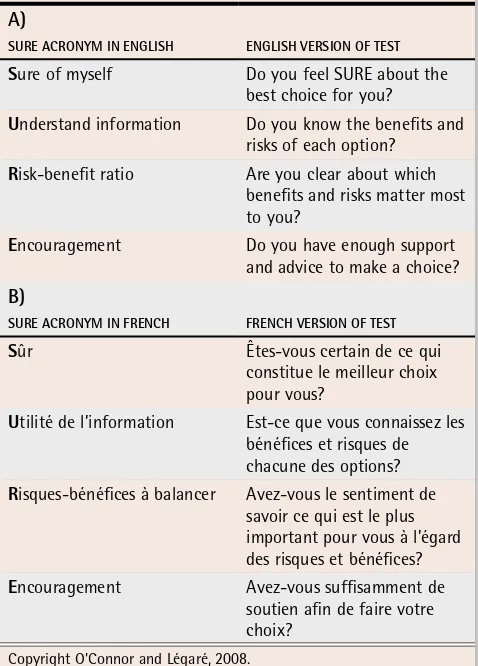
to match the acronym SURE. The resulting 4-item test was field-tested with experts and graduate students tak-ing clinical courses in decision support. Table 1 shows the French and English versions of the 4-item SURE screening test.
Clinical setting, study participants,
and data collection
Between April 2007 and December 2008, 2 distinct data-collection processes were performed in a stepwise approach, using convenience samples. The first group of consecutive patients consisted of French-speaking preg-nant women who were considering prenatal screening for Down syndrome; they were recruited from 4 family medicine groups in Quebec city. Women were eligible if they were between the ages of 18 and 34 years, had no family history of genetic disorders, had not experi-enced pregnancies in which fetuses had suffered from genetic disorders, and were between 8 and 12 weeks pregnant. Women whose pregnancies were at risk were excluded. Patients were told that the study aimed at describing shared decision making in the context of prenatal screening. After their first routine prenatal
table 1
. The SURE test:
A) English and B) French
versions. A response of yes scores 1 and a response of no
scores 0; a score of
<
4 is a positive result for decisional
conflict.
A)
SURE ACRONyM iN ENGLiSh ENGLiSh vERSiON OF TEST
sure of myself Do you feel SURE about the best choice for you?
Understand information Do you know the benefits and risks of each option?
risk-benefit ratio Are you clear about which benefits and risks matter most to you?
Encouragement Do you have enough support and advice to make a choice?
B)
SURE ACRONyM iN FRENCh FRENCh vERSiON OF TEST
sûr Êtes-vous certain de ce qui constitue le meilleur choix pour vous?
Utilité de l’information Est-ce que vous connaissez les bénéfices et risques de chacune des options?
risques-bénéfices à balancer Avez-vous le sentiment de savoir ce qui est le plus important pour vous à l’égard des risques et bénéfices?
Encouragement Avez-vous suffisamment de soutien afin de faire votre choix?
consultations, the women provided sociodemographic information and completed a self-administered 16-item DCS. Each item was measured on a 5-point Likert scale (1 = strongly agree and 5 = strongly disagree). The women also completed the self-administered 4-item SURE test (Table 1) with 2 response categories: yes (score = 1) and no (score = 0).
The second group consisted of consecutive English-speaking patients at a rural academic medical insti-tution (ie, the Dartmouth Hitchcock Medical Center in New Hampshire) who were referred to watch condition-specific video decision aids as part of their standard process of care. The conditions addressed by the videos were chronic low back pain, spinal steno-sis, herniated disk, hip osteoarthritis, knee osteoarth-ritis, prostate cancer treatments, early-stage breast cancer surgery, and breast reconstruction after can-cer. The video for each condition provided information about treatment options, discussed the potential bene-fits and risks of each option, invited the viewer to con-sider the values he or she associated with each option, and reviewed the importance of patient involvement in decision making. After watching the video decision aids, study participants completed a self-administered ques-tionnaire, which included the 4-item SURE questions. They did not complete the 16-item DCS.
Data processing and analysis
In both groups of patients, we performed descriptive data analyses and assessed the internal reliability of the SURE test by computing Cronbach α. The tetrachoric correlation coefficient was used to assess item-to-item correlations and the Pearson correlation coefficient was used to assess item-to-total correlations. Because deci-sional conflict is a state rather than a trait, it was not appropriate to assess intrarater reliability over time. Also, as the SURE test is a self-administered instrument, interrater reliability was similarly irrelevant. Factor analysis was performed using the principal compon-ents analysis method for factor extraction, with varimax orthogonal rotation. The number of factors retained was based on the minimum eigenvalue of 1 criterion.
In the group of French-speaking pregnant women, we computed the mean DCS score by adding the values for all items, dividing the sum by 16, and multiplying the product by 25. The DCS scores ranged from 0 (no deci-sional conflict) to 100 (high decideci-sional conflict). Previous research shows that women whose scores exceed 37.5 experience clinically significant decisional conflict.4
Totals of the SURE test were computed by adding the response scores of the 4 questions. We then assessed the criterion validity of the SURE test with the DCS by using a Pearson correlation coefficient—the hypothesis being that SURE scores would correlate negatively with DCS scores. (A perfect score on the SURE test indicates no decisional conflict; while a high score on the DCS
indicates high decisional conflict.) In the group of treat-ment-option patients, treatment intentions were dichot-omized (ie, those who made a choice about treatment versus those who were unsure about treatment), and SURE items were summarized as the frequency (per-centage) of endorsed responses. Construct validity by extreme groups was assessed using a t test proced-ure—the hypothesis being that SURE would discrimin-ate between patients who made choices of treatment and patients who did not. All calculations were per-formed using Statistical Analysis System version 9.1. Patients were not compensated financially. The study was approved by the institutional review boards of the institutions where data collection took place.
rEsULts
Participant characteristics
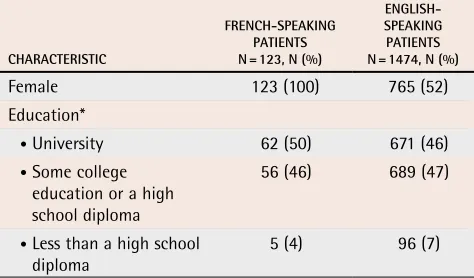
We approached 180 French-speaking pregnant women registered at family medicine clinics in Quebec and requested their participation. Of these women, 21 were ineligible and 11 declined to participate. Of the 148 women recruited (response rate of 82%), 141 completed the DCS and 123 completed the SURE test. Table 2 sum-marizes participants’ sociodemographic characteristics. Of the 141 participants who completed the DCS, 7 pre-sented clinically significant decisional conflict. Of the 123 participants who completed the SURE test, 105 (85%) scored 4 out of 4, 10 (8%) scored 3, 7 (6%) scored 2, and 1 (1%) scored 1.
The English-speaking patients in the treatment-option group were systematically distributed video decision aids and SURE questionnaires. A total of 1474 patients (34%) completed and returned the questionnaire. Of these 1474 patients, 981 (67%) patients scored 4 out of 4; 272 (18%) scored 3; 147 (10%) scored 2; 54 (4%)
table 2
. Patient characteristics:
Mean (SD) age was
28.6 (3.51) years for French-speaking pregnant patients
in Quebec and 59.3 (13.2) years for English-speaking
patients facing treatment decisions in New Hampshire.
ChARACTERiSTiC
FRENCh-SPEAKiNG PATiENTS N = 123, N (%)
ENGLiSh-SPEAKiNG PATiENTS N = 1474, N (%)
Female 123 (100) 765 (52) Education*
• University 62 (50) 671 (46) • Some college
education or a high school diploma
56 (46) 689 (47)
• Less than a high school
diploma 5 (4) 96 (7)
Research
Are you SURE?
scored 1; and 20 (1%) scored 0 (Figure 1). Table 3 sum-marizes patients’ yes responses to the 4-item SURE questions.
Reliability of SURE
The internal reliability of SURE was moderate (Cronbach α was 0.54 in French-speaking pregnant women and 0.65 in English-speaking treatment-option patients). In the group of pregnant women, removing
1 item (ie, support) produced a higher value (Cronbach
α = 0.61). In the group of treatment-option patients, all item-to-item correlations were positive and ranged from 0.46 to 0.71. Item-to-total correlation results are presented in Table 4. In pregnant women, 1 item (ie, support) was negatively correlated with 2 items (ie, knowledge and values) and was poorly correlated with the total score. This item showed no variance in this group of respondents.
table 3
. Percentage of participants responding yes to each of the 4-item SURE questions, by condition
yES RESPONSES, %
PATiENTS AND CONDiTiONS N SURE OF MySELF iNFORMATiONUNDERSTAND RiSK-BENEFiT RATiO ENCOURAGEMENT
French-speaking pregnant women, N = 123
• Prenatal screening 123 87 98 94 98 English-speaking treatment-option patients, N = 1474
• Hip osteoarthritis 160 80 99 95 94 • Knee osteoarthritis 292 75 98 95 90
• Herniated disk 177 76 99 93 93 • Spinal stenosis 295 71 95 90 84 • Chronic back pain 171 75 89 89 80
• Prostate cancer 204 59 96 90 77 • Breast cancer reconstruction 86 74 97 93 86 • Early-stage breast cancer surgery 89 60 96 87 84
Figure 1.
The SURE scores of patients in the treatment-option group (N=1474) and the proportion of them
who had made and not made treatment choices
NO
. OF P
ATIENTS
1000
800
600
400
200
0
SURE SCORE*
0 35% 1 2 3 4
65%
46%
54%
41%
59%
34%
66%
4% 96%
Proportion who had not made choices Proportion who had made choices
Concurrent and construct validation
As expected, in the group of French-speaking preg-nant women, the SURE score correlated negatively with the DCS score (r = -0.46; P < .0001). Also as expected, in the English-speaking treatment-option group, patients who had not made choices about treatment (n = 225) had lower mean (SD) SURE scores than those who had (n = 1249) (2.6 [1.0] vs 3.6 [0.8], respectively; P < .0001). More specifically, among the treatment-option patients who scored 4 on the SURE test, only 4% had not made treatment choices compared with 34% of patients who had scored 3, 41% of patients who had scored 2, 46% of patients who had scored 1, and 35% of patients who had scored 0 (Figure 1).
A factorial analysis of the SURE test in the group of pregnant women indicated that 2 factors accounted for 72% of the variance. Three items (ie, knowledge, value, and certainty) loaded under 1 factor. The other item (ie, support) loaded under the second factor. As expected, in the treatment-option group, 1 factor accounted for 49% of the variance.
DIscUssION
Our findings suggest that the SURE test has acceptable psychometric properties and is suitable for screening for decisional conflict in French- and English-speaking patients facing clinical decisions in primary care. As such, the tool can improve how decisions are made in family medicine, benefiting patient outcomes as a result. We expect this phenomenon to occur in a 2-step process.
First, to the best of our knowledge, SURE is the only clinically oriented instrument that helps phy-sicians identify patients experiencing clinically sig-nificant decisional conflict. In developing the 4-item test, our team drew inspiration from the 4-item CAGE questionnaire (Have you ever felt that you should cut
down on your drinking? Have people annoyed you by criticizing your drinking? Have you ever felt bad or
guilty about your drinking? Have you ever had a drink first thing in the morning to steady your nerves or to get rid of a hangover [eye-opener]?) used for screen-ing for alcohol abuse in clinical practice.15 The
litera-ture reports that CAGE’s short format makes it more attractive to busy clinicians than the longer version
and thereby increases its use.16.17 It is not unlikely
that the 4-item SURE test will act similarly, making clinicians more willing to seek to identify patients experiencing substantial decisional conflict.
Second, the down-stream effects of unresolved clinically significant deci-sional conflict in patients4,10,11 suggest that the use of
SURE in clinical practice has the potential to improve patient outcomes. In the group of French-speaking pregnant women who had consulted with their family physicians, testing revealed that 7 (6%) of them were experiencing clinically significant decisional conflict regarding prenatal screening for Down syndrome. This relatively high incidence suggests real benefits to coup-ling the use of the SURE tool with a decision support system so that positive test results (a score of 3 or less) trigger physicians to help patients make decisions or refer patients to appropriate resources.
Limitations
Notwithstanding the interest of our findings, our study has several limitations. First, we reported on data collections that occurred independently. The draw-backs of this procedure are offset by the fact that it produced a larger sample size with more descriptive data and better evidence of the tool’s acceptability (2 languages and 2 countries) than would otherwise be possible. It also allowed us to assess the tool’s relevance in different clinical situations. Second, in the group of French-speaking pregnant women, we observed a less-than-optimal value of Cronbach α
and could not confirm SURE’s unidimensionality. This suggests that there might be a need to modify 1 item (ie, support). However, it is possible that the lack of variance in the SURE scores (most individuals had perfect scores) might have contributed to this obser-vation, as the magnitude of a reliability coefficient is highly dependent on the homogeneity of subjects in a group. Thus, it is possible that we underestimated the true reliability of the SURE test. For this reason, it is important that future studies assess the perfor-mance of SURE in groups with a larger proportion of patients experiencing clinically significant decisional conflict.
Conclusion
Results from this study suggest that the SURE test is suitable for screening for decisional conflict in French- and English-speaking patients with a variety of health conditions. Future research should assess the perfor-mance of the SURE test with a more diverse group of patients.
table 4.
item-to-total Pearson correlation coefficient results for the 2 participant groups
CORRELATiON wiTh TOTAL
PARTiCiPANT GROUP SURE OF MySELF iNFORMATiONUNDERSTAND RiSK-BENEFiT RATiO ENCOURAGEMENT
French-speaking pregnant women, N = 123 0.47 0.32 0.59 0.07 English-speaking treatment-option patients,
N = 1474
Research
Are you SURE?
Dr Légaré is a Full Professor in the Department of Family Medicine at Laval University in Quebec city, Que, and Canada and Tier 2 Canada Research Chair in Implementation of Shared Decision Making in Primary Care. Mr Kearing is a research consultant and Mrs Clay is a decision support coach at the Dartmouth Institute for Health Policy and Clinical Practice in New Hampshire. Mrs Gagnon
is a research assistant at the CHUQ Research Centre at the Hôpital St-François d’Assise in Quebec city. Drs D’Amours and Rousseau are professors in the Department of Family Medicine at Laval University. Dr O’Connor is a Distinguished Professor in the School of Nursing at the University of Ottawa in Ontario.
Contributors
All authors contributed to concept and design of the study; data gathering, analysis, and interpretation; and preparing the manuscript for submission.
Competing interests
None declared
Correspondence
Dr France Légaré, CHUQ Research Centre, Hôpital St-François d’Assise, 10 rue de l’Espinay, Quebec city, QC G1L 3L5; telephone 418 525-4351; e-mail [email protected]
References
1. Légaré F. Implementation of the Ottawa Decision Support Framework in five family practice teaching units: an exploratory trial [dissertation]. Ottawa, ON: University of Ottawa; 2005.
2. Pimlott N. Managing uncertainty [Letters]. Can Fam Physician 2007;53:1000. 3. Carpenito LJ. Nursing diagnosis: application to clinical practice. 8th edition.
Philadelphia, PA: Lippincot Williams and Wilkins; 2000.
4. O’Connor AM. Validation of a decisional conflict scale. Med Decis Making
1995;15(1):25-30.
5. Gerrity MS, White KP, DeVellis RF, Dittus RS. Physicians’ reactions to uncer-tainty: refining the constructs and scales. Motiv Emot 1995;19(3):175-91. 6. Han PK, Moser RP, Klein WM. Perceived ambiguity about cancer prevention
recommendations: relationship to perceptions of cancer preventability, risk, and worry. J Health Commun 2006;11(Suppl 1):51-69.
7. Koedoot N, Molenaar S, Oosterveld P, Bakker P, de Graeff A, Nooy M, et al. The decisional conflict scale: further validation in two samples of Dutch oncology patients. Patient EducCouns 2001;45(3):187-93.
8. Mancini J, Santin G, Chabal F, Julian-Reynier C. Cross-cultural validation of the Decisional Conflict Scale in a sample of French patients. Qual Life Res
2006;15(6):1063-8.
9. Piette JD, Lange I, Issel M, Campos S, Bustamante C, Sapag J, et al. Use of telephone care in a cardiovascular disease management programme for type 2 diabetes patients in Santiago, Chile. Chronic Illn 2006;2(2):87-96.
10. Brehaut JC, O’Connor AM, Wood TJ, Hack TF, Siminoff L, Gordon E, et al. Validation of a decision regret scale. Med Decis Making 2003;23(4):281-92. 11. Gattellari M, Ward JE. Will men attribute fault to their GP for adverse effects
arising from controversial screening tests? An Australian study using scenar-ios about PSA screening. J Med Screen 2004;11(4):165-9.
12. O’Connor AM, Légaré F, Stacey D. Risk communication in practice: the con-tribution of decision aids. BMJ 2003;327(7417):736-40.
13. Légaré F, Graham ID, O’Connor AC, Aubin M, Baillargeon L, Leduc Y, et al. Prediction of health professionals’ intention to screen for decisional conflict in clinical practice. Health Expect 2007;10(4):364-79.
14. O’Connor AM, Tugwell P, Wells GA, Elmslie T, Jolly E, Hollingworth G, et al. A decision aid for women considering hormone therapy after meno-pause: decision support framework and evaluation. Patient Educ Couns
1998;33(3):267-79.
15. Aertgeerts B, Buntinx F, Kester A. The value of the CAGE in screening for alcohol abuse and alcohol dependence in general clinical populations: a diagnostic meta-analysis. J Clin Epidemiol 2004;57(1):30-9.
16. Aertgeerts B, Buntinx F, Ansoms S, Fevery J. Screening properties of ques-tionnaires and laboratory tests for the detection of alcohol abuse or depen-dence in a general practice population. Br J Gen Pract 2001;51(464):206-17. 17. Perdrix A, Decrey H, Pecoud A, Burnand B, Yersin B. Detection of alcohol-ism in the medical office: applicability of the CAGE questionnaire by the practicing physician. Group of Medical Practitioners PMU [article in French].