THE EFFECT O F ABNORMAL CHROMOSOME 10 ON PREFERENTIAL SEGREGATION AND CROSSING OVER IN MAIZE
M. M. RHOADES AND ELLEN DEMPSEY Deparirnent of Botany, Indiana University, Bloomington
Received February 1, 1966
AMONG the more interesting phenomena mcountered in the genetic analysis of organisms with an orthodox or classical type of meiosis are those excep- tional cases where a modification of the processes controlling segregation leads to a nonrandom distribution of the four chromatids of a bivalent to the functional gametes. In such organisms the formation of equal numbers of gametes with the A and a alleles by A a heterozygotes almost invariably occurs. Sometimes the two classes of gametes are equally represented in the gametic population but are not found in equal numbers in the progeny because of gametic selection, differen- tial viability, etc. These complications confuse but do not contradict the 1:l segregation of alternative alleles which underlies Mendelian inheritance. Some organisms, particularly the Hemiptera, have acquired in their evolutionary de- velopment unusual and even bizarre meiotic modifications which clearly deviate from the normal pattern. We are not concerned here with these successful meiotic modifications although it is possible that the information gleaned from the analy- sis of exceptional cases in organisms with orthodox meiosis may reveal how the aberrant systems arose.
SANDLER and NOVITSKI (1957) proposed the term meiotic drive for those situ- ations where unequal production of the two classes of gametes occurs in organ- isms generally having a normal pattern of meiosis. The cytogenetic events at meiosis in maize are of the classical type, but an exception to the rule of a 1: 1
recovery of segregating alleles in the female gametes of heterozygous plants was found some years ago (RHOADES 1942, 1952). Subsequent to these early studies on preferential segregation, we have conducted a series of investigations which constitute the basis of this report. Prcferential segregation in maize is a good ex- ample of me<otic drive.
Evidence will be presented demonstrating ( 1 ) that preferential segregation
990 M. M. RHOADES A N D E. D E M P S E Y
preferential segregation from heteromorphic dyads coming from single and double exchanges is the same, (6) that the K10 chromosome increases recombination values and brings about more intimate synapsis, ( 7 ) that preferential segregation takes place in dyads with a deficient chromatid derived from bridge breakage if the intact chromatid is knobbed and that segregation is random when the normal chromatid is knobless, and finally (8) that the neocentromeres produced by the K l 0 chromosome afford a plausible mechanism for preferential segregation.
Preferential Segregation
Preferential segregation was first found in plants heterozygous for the ab- normal chromosome 10 (KlO/k10) where more than 70% of the functional megaspores received the K10 chromosome ( RHOADES 19412). LONGLEY ( 1945) reported that preferential segregation occurred for both chromosomes 6 and 9 in K10/k10 plants if the two homologues were unlike in knob constitution. For a more detailed study of the effect of the KIO chromosome on preferential segrega- tion of other chromosomes, chromosome 3 was chosen because of the information available on the location of certain loci in the long arm, In the following descrip- tion, cytological and genetical markers in the long arm of chromosome 3 will be cited as being positioned according to a scale where the a n n is considered to be of unit length with the centromere represented as the zero point.
Some strains of maize possess a large heterochromatic knob on chromosome 3 at a position 0.6 of the length of the arm from the centromere. Any chromosome 3 having this knob is designated as K3, those lacking it as k3. A further advantage of this chromosome is that considerable information is available on the physical location of the three loci employed. The glossy-6 (gl,) locus lies in a proximal position in the long arm somewhere between .1 and .25. The amount of crossing over between gl, and the centromere is low, being only 2 to 3%. The liguleless-2 (lg,) locus lies proximal to the knob but is closely linked to it. Lg, serves as an efficient marker in following the knob in segregation studies. The aleurone color factor A , is situated in the distal end of the long ann. It lies between positions .75 and .95 and is almost certainly closer to .95 than to .75 judging from recombi- nation values in our unpublished inversion studies.
I n k3 k3 plants 23 to 25% recombination OCCLU-s between GI and Lg and 36%
between L g and A . As will be shown, the crossover values in these regions are modified by the presence or absence of the knob lying between L g and A . Some undetected double exchanges undoubtedly occur in regions this long but the number of these is not believed to affect the arguments presented. Another reason for selecting these marker genes is that they can all be scored either on the basis
A B N O R M A L CHROMOSOME I O 991
grown progenies suffer in particular the partial loss of plants homozygous for the gl allele.
Nine combinations are possible with two kinds of chromosome 10
(KZO
andkZ0)
and two types of chromosome 3(K3
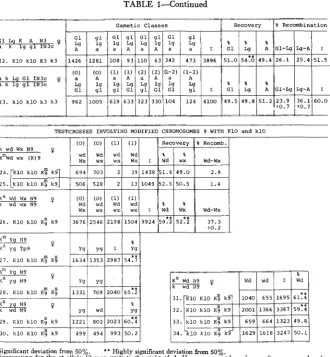
and k3). Segregation data from female testcrosses for eight of these have been obtained (items 1 to 12, Table 1). These data clearly demonstrate that preferential segregation for the chromosome-3 ililleles occurs only in those combinations having heteromorphic chromosomes 3(K? k3).
A
second requirement is the presence of theKZO
chromosome which may be homozygous or heterozygous. In KZOKZO K3
k3 plants the two chromo- somes 10 are randomly segregated but theK3
chromosome is preferentially re- covered; inKZO
kZ0K3
k3 plants both chromosomes undergo preferential segre- gation.Table 1 contains no data from male testcrosses but extensive tests show that random segregation occurs for chromosome 3 loci in K10
kZ0 K3
k3
plants since each of the four chromatids of a tetrad is included in the quartet of microspores. Also listed in Table 1 are data from combinations with structurally modified chromosomes 3 and 9.If preferential segregation depends upon the occurrence of dyads with one knobbed and one knobless chromatid, it is possible to predict the kinds of ex- changes which will lead to preferential segregation at anaphase 11. The types of exchanges giving rise to preferential segregation or to random segregation for the three loci are indicated below. Preferential segregation is indicated by the i- sign and random segregation by the = sign. The GI-Lg segment is region 1 and region 2 is delimited by Lg and A . The dominant alleles are in the knobbed chromosome. The linkage phase, however, is immaterial and preferential segregation occurs for recessive alleles when they are on the knobbed homologue.
Type of Exchange G1 Lg A
None -
+
Single in (1) -
Single in ( 2 ) -
2-strand double
-
3-strand double -
Cstrand double -
- -
-
- --
+
+
+
+
- - - - --
-
- --
-
-
- -As the tabulation above indicates, exchanges in (1 )
,
which result in hetero- morphic dyads, lead to preferential segregation for the Lg and A alleles. The dyads from no-exchange tetrads and those from single exchanges in (2) are homo- morphic and segregation is random for all loci. The double exchanges form heteromorphic dyads but segregation is preferential only for the Lg locus.TABLE 1
Testcross data from ears with different combinations of K10 and k10 with normal and structurally modified chromosomes 3 and 9. The bracketed combinations are sibs
TESTCROSSES INVOLVING S T R U C T U R A U Y NORMAL CHROMOSOMES 3
TESTCROSSES INVOLVING REARRANGED CHROMOSOMES 3 WITH K10 AND k 1 0
G 1 a K L IN3a
G 1 a k :1 IN3a e
1
Lg1
l g1
C1 &I
ABNORMAL CHROMOSOME 1 0 993
( 0 )
w d
Wx
k w d Wx N9 9
K%d w x (R)9
TABLE 1-Continued
( 0 ) (1) (1) Recovery % ~ e c o m b .
Wd w d Wd % %
w x w x Wx C Wd w x Wd-Wx
~
TESTCROSSES INVOLVING MODIFIED CHROMOSOMES 9 WITH K10 and k10
k10 K; k91
694 703 2 39 1438 151.6 49.0 2.9 506 528 2 13 1049 152.5 50.5 1.4
I
26. K10 k10 Kg k9
K S Wd Wx N9 9 ( 0 ) ( 0 ) (1) (1)
k w d w x N9
I
21
E l i d
I
W:I
Wd-WxI I I L I I I I,
3 6 7 6 / 2 5 4 6 1 2 1 9 8 / 1 5 0 4 / 9 9 2 4
1
59*5 5211 37.3.
I
II
ro.2KIA Yy N9
K s y y N9
28. K10 k10 KT Kg Ks yy N9
29. K10 k10 K; k9
30. k10 k10 KZ k9
k w d N9
'
_ _ _ _ -=---
K "
K" y y Tp9
I I
y 4 Y4
1331 709 2040 6 5 1 9 ,
% Y Y w d Y g
**
1221 802 2023 60.4
499 494 993 50.2
---__.
in the knobbed chromatids. Preferential segregation is and should be highest for the Lg allele and that for A should be lower because the double exchanges pre- ferentially segregate Lg but not the A allele. The data show that the percentage of recovery for the Lg allele, close to the knob, is 71.1
%,
a value greater than thatforthe Alocus (61.1%) whichinturnexceeds thatfortheGIallele (51.1%).994 M. M. RHOADES A N D E. DEMPSEY
and they are ignored. Preferential segregation is indicated by the
+
sign and random segregation by the = sign.Type of Exchange GI Lg A
Single between ( C ) -GI
+
+
+
+
Single between Lg-K -
Double in (C) -GI and Lg-A
+
+
Double in Lg-A -
- - -
Double in (C)-GI and GZ-Lg - -
+
(3-strand)+
(3-strand)= (2 and Cstrand) = (2 and &strand)
-
-
Qouble in GI-Lg - -
+
(3-strand)+
(3-strand)= (2 and &strand) = (2 and Cstrand)
-
-
- - -
I t is evident from the above tabulation that undetected double and single cross- overs could affect the recovery of the three dominant alleles. For example, singles in the (C)-GI region and doubles with one in (C)-GI and one in Lg-A result in preferential segregation for the GI locus, which was not the case with any of the detectable crossovers. The consequences of undetected exchanges on recovery of the Lg allele will depend on the relative frequencies of the different crossovers. The percentage of Lg will be reduced by singles in Lg-K, by doubles in Lg-A, and to a lesser extent by doubles in GI-Lg and doubles in (C) -GI
+
GI-Lg. The percentage of Lg will be raised by singles in (C)-GI and doubles in (C)-GI+
Lg-A. The recovery of the A allele will be increased by singles in (C)-GI and singles in Lg-K, but decreased by doubles in ( C ) -GI+
Lg-A and doubles in Lg-A. The other exchanges probably will not greatly affect the frequency of A .Thus, it becomes important to obtain some estimate of the frequencies of these different kinds of crossovers. The amount of crossing over between GI and the centromere is approximately 2 to 3
%
( RHOADES and DEMPSEY, unpublished) and single and double exchanges involving this region should have little effect on the percentage of recovery of the GI allele. The segregation data for the GI locus are consistent with the low level of exchanges proximal to the GI gene. Lg and K are also closely linked (about 1%
recombination, DEMPSEY unpublished) and ex- changes in this segment should be rare. No experimental data are available on the frequency of double exchanges in the Gl-Lg region, but they should not exceed4%. Doubles in the Lg-A segment also should occur with a frequency of 4% or less. It may be concluded that the effect of undetected exchanges on the prefer- ential segregation of alleles borne on the knobbed chromosome will be negligible. Contrary to LONGLEY’S (1945) claim of preferential segregation of the knobbed homologues in k10 k10 plants heterozygous for knobbed chromosomes are the extensive data in Table 1 where segregation is random for heteromorphic chromo- somes 3 in k10 k10 plants.
ABNORMAL CHROMOSOME IO 995
heteromorphic dyads are produced, and it is the knobbed chromatid which segre- gates preferentially at anaphase 11, those loci closer to the knob would undergo a higher degree of preferential segregation than would more distant loci. There is abundant evidence in Table 1 that this is SO.
Reduction
in
crossing ouer by Transposition 9-3: One test of the hypothesis that preferential segregation is dependent upon crossing over is the determination of the ratios of genes in the short arm of chromosome 9 from plants in which the amount of recombination is greatly reduced compared to that in sibs. Such atest was made using a chromosome 9 with a short interstitial segment from the long arm of chromosome 3 transposed into its short arm between the S h and W X loci (Tp9). The presence of the transposed piece reduces the amount of crossing over in the short arm of chromosome 9 to less than one-third the normal amount
( RHOADES 1958 and unpublished). Sib plants of three classes, all heterozygous
for KZO, were obtained. One class was of the constitution Transposition 9/Normal 9(Tp9/N9). The chromosome 9 with the Tp had a small terminal knob
( K ’ )
on 9 s and carried the yellow green-2 ( y g ; ) allele, ‘while the N9 had a much larger knob (K”) and the Yg allele (item Q7, Table 1 ).
The second class of plants was of N9/N9 constitution. One chromosome 9 had the prominent knob and the Y g allele, the other possessing the small knob and the yg allele (item 28, Table 1 ) .The third class had two N9’s, one with the small knob and the yg allele, and the other with the wd mutation (a small terminal deficiency that is allelic to yg2) which is wholly devoid of a knob (item 29, Table 1 )
.
All three classes were hetero- zygous for KZO and had heteromorphic chromosomes 9. Preferential segregation for chromosome 9 is known to occur in KZO k10 plants when the two chromo- somes differ in knob size (KIKUDOME 1959). Studies of preferential segregation were made in the KZO plants. The first two classes were pollinated by yg plants and the ratio of Yg:yg plants obtained. The third class was pollinated by wd pollen and the yg:wd ratio determined. In backcrosses of K” Yg N/Ks yg Tp9plants, in which crossing over is greatly reduced in 9S, the Yg seedlings consti- tuted 54.7% of the offspring. Plants of Kns Yg N9/K8 yg N9 constitution with normal crossing over in 9 s gave 65.2% of Yg plants. Individuals of Ks yg N9/k
wd N9 genotype, again with free crossing over, produced 60.4% yg seedlings. Control data from closely related plants of K8 yg N9/k wd N9 constitution and homozygous for kZO gave 50.2% yg plants (item 30, Table 1 ) .
The data in Table 1 support the hypothesis that formation of heteromorphic dyads via crossing over is an essential antecedent to preferential sergegation. PI-eferential segregation is reduced when crossing over is decreased.
Reduction in crossing ouer by the (R)9 chromosome: Confirmatory evidence was obtained using a rearranged chromosome 9, which almost completely sup- presses crossing over in the short arm. Plants heterozygous for the ( R ) 9 chromo- some and for the wd and wx markers were testcrossed as the female parent. Sib plants with and without KZO were available. As shown in Table 1 (item 25),
996 M. M. RHOADES AND E. DEMPSEY
a knobbed 9 and a knobless 9 (wd) undergo preferential segregation if K10 is present, no marked deviation from a 1 : 1 ratio for W d : wd would be expected in KIO plants containing the (R)9 chromosome if crossing over was a requisite for preferential segregation. On the other hand, the usual percentage of preferential segregation in K9 k9 heterozygotes should occur if preferential segregation of K9 chromatids to the basal megaspore is unrelated to recombination and is due to some intrinsic property of the knobs. The data obtained from both KIO k10 and k l 0 k10 backcrossed individuals (items 24 and 25) show a very close fit to a 1: 1
ratio f o r both the wd and wx loci, while in the plants with normal chromosomes 9 and K10 k10 preferential segregation for the W d allele occurred (item 26, Table 1).
Reduction
in
crossing ouer b y inversion heterozygotes: Substantiating data were also obtained from studies of plants heterozygous f o r three paracentric inversions involving the long arm of chromosome 3. The breakpoints of I n 3 0 are 3L .4 and .95, the breakpoints of In 3b are 3L .25 and .75, while I n 3c involves nearly the whole long arm with the proximal break near the centromere and the distal one near the tip. The knob at .6 is included in the inverted segment of all three inversions. GI, is in the proximal uninverted segment of In 3a while Lg, and A , are included in this inversion. Lg is in the inverted region of In 3b, GI isin the proximal segment, and A is in the distal noninverted segment. All three loci are in the inverted portion of In 3c with the proximal breakpoint between the centromere and G1 and the distal breakpoint beyond the A locus.
The testcrosses of KlO k10 plants singly heterozygous for the three inversions, for the large knob in 3L, and for the GI Lg A loci gave the following percentages of recovery in the megaspores of the alleles carried by the knobbed chromosome 3 (items 16, 18,22, Table 1 )
.
% G1 % Lg % A
In 3 b / N 50.3 51.6 w.7
In ?c/N 51.0 54.0 49.4
-.
In ?a/N 52.4 60.6 59.8
A B N O R M A L C H R O M O S O M E 10 99 7 the left of Lg, heteromorphic dyads result and preferential segregation for Lg is found. Since one of the two exchanges usually separates Lg and
A ,
the A locus shows random segregation (49.4%) while the Lg allele was found in 54.0% of the ovules.Conclusion: All of these experiments have in common a reduction in crossing over ranging from almost complete suppression, as in the (R)9 case, to variable but reduced amounts. The degree of preferential segregation found in the differ- ent combinations is wholly consistent with the hypothesis that the formation of heteromorphic dyads by crossing over between the centromere and knob is an essential prerequisite for preferential segregation.
Preferential Segregation from Different Exchanges
The question next considered is whether or not the degree of preferential segre- gation to the basal megaspore is identical from heteromorphic dyads produced in tetrads with a single exchange between knob and centromere and in those arising from double exchanges with one proximal and one distal to the knob. The answer was obtained from three testcrosses listed in Table 1 (items 3, 4, and 11) involv- ing plants of
KIO KlO or
KiO
k10 Gl LgK
A / g l lgk
a constitution. The K10 population (item5 )
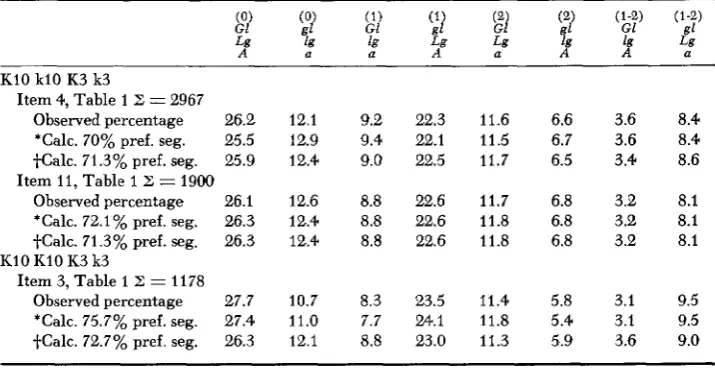
with a total of 8427 individuals was not deemed appropriate for analysis because of the semilethal effect of the segregating et allele which is 12 crossover units distal to A. The population with 2967 plants (item 4 of Table 1 ) is analysed below. A similar analysis was made for the other two populations. The genetic data were translated into tetrad frequencies from the combined totals of the noncrossover classes, the singles in ( l ) , etc., on the assumption of no chromatid interference. The only exchanges considered are singles in (1 ) and (2) and doubles in (1-2). This transformation gave 0.6% no-exchange tetrads, 39.0% with a single exchange in (1) (Gl-Lg), 12.4% "4th a single exchange in (2) ( L g - A ) , and 48.0% with exchanges in (1) and ( 2 ) . The contributions to the complementary crossover and noncrossover chromatid classes expected from these tetrads can be calculated if the degree of preferential segregation can be determined for any complementary pair of crossover classes and the amount found is assumed to hold for all heteromorphic dyads irrespective of their origin.If the fit between the calculated chromatid frequencies and those observed is close, it may be argued that the same amount of preferential segregation occurs in heteromorphic dyads derived from either single o r double exchanges.
998 M. M. RHOADES A N D E. DEMPSEY
changes give rise to heteromorphic dyads composed of singles in (1) and (2). Tetrads with single exchanges in (1) also form heteromorphic dyads and again the assumption of 70% preferential segregation is made in allocating the products to the crossover and noncrossover classes. No-exchange tetrads and those with single exchanges in (U) produce homomorphic dyads and segregation should be random.
Table 2 gives the calculated and observed values for the three populations analyzed. The agreement between the estimated frequencies of the various chro-
matid classes based on the above postulations and those observed is extremely good. The assumptions made appear to be justified and the conclusion is drawn that heteromorphic dyads derived from single exchanges undergo the same degree of preferential segregation as do those from double exchanges.
Since the degree of preferential segregation is the same for single- and double- exchange tetrads, it follows that the ratio of singles in (1) should give estimates of preferential segregation which are similar to those obtained from only double crossovers. There are several ways of arriving at this estimate from singles. The different ways of determining preferential segregation give essentially the same value. This is true for the population analyzed above and also for the other two populations entered in Table 2. A value of 71.4% is obtained for the data of item
4, Table 1, by using the observed genetic ratio of single crossovers in region 1.
The number of knobbed and knobless double crossovers should equal the number of singles coming from double exchanges. When the contribution of the doubles is subtracted from the appropriate single-crossover classes in order to ascertain
TABLE 2
Comparison of observed percentages of chromatid classes with those calculated f rom tetrads on
the assumptions that the degree of preferential segregation is the same in all hetero- morphic dyads and that segregation is random in homomorphic dyads
K10 k10 K3 k3
Item 4, Table 1 Z = 2967
Observedpercentage 26.2 12.1 9.2 22.3 11.6 6.6 3.6 8.4
'Calc. 70% pref. seg. 25.5 12.9 9.4 22.1 11.5 6.7 3.6 8.4
tCalc. 71.3%pref.seg. 25.9 12.4 9.0 22.5 11.7 6.5 3.4 8.6
Observedpercentage 26.1 12.6 8.8 22.6 11.7 6.8 3.2 8.1
*Calc. 72.1% pref. seg. 26.3 12.4 8.8 22.6 11.8 6.8 3.2 8.1
tCalc. 71.3% pref. seg. 26.3 12.4 8.8 22.6 11.8 6.8 3.2 8.1
Item 11, Table 1 Z = 1900
K10 K10 K3 k3
Item 3, Table 1 Z = 11 78
Observedpercentage 27.7 10.7 8.3 23.5 11.4 5.8 3.1 9.5
*Calc. 75.7% pref. seg. 27.4 11.0 7.7 24.1 11.8 5.4 3.1 9.5
tCalc. 72.7% pref. seg. 26.3 12.1 8.8 23.0 11.3 5.9 3.6 9.0
* Preferential segregation based on ratio of double crossovers.
ABNORMAL CHROMOSOME 10 999 the number of crossovers coming only from single exchanges in region 1, the ratio of adjusted singles gives 71 3% preferential segregation. Finally, estimates of single crossovers in (1) can be had from the calculated tetrad frequencies. This method gives 70.8%.
It is of interest that preferential segregation appears to be a little higher in
KlO
KlO
plants than in KZO k10, but the one K10KlO
population is the smallest of the three populations analyzed and sampling errors may be responsible for the difference. However, preferential segregation in KlOKlO
K9k9
(61.4% for W d ) plants is also slightly higher than that inKZO
k10 K9 k9 sibs (59.4%) (items 31, 32, Table 1 ).
The degree of preferential segregation in each of theKlO KlO
POPU-lations is not significantly higher than that in their respective KlO k10 sibs, but it becomes so if the two populations are considered together. It may well be that homozygous
KlO
compounds have a higher level of preferential segregation but the data in hand do not afford a firm conclusion because the difference was only significant at the .05 level.Single exchanges in region 2 produce homomorphic dyads. Random segrega- tion should occur producing equal frequencies of the two complementary cross- over classes. The sums of the observed crossovers in region 2 f o r the three popula- tions are 701 GI L g a and 395 gl lg A . The deviation from 1: 1 is due to the con- tribution of single crossovers in (2) from 3- and 4-strand doubles which lead to preferential segregation. If there is no chromatid interference, the number of knobbed chromatids coming from double exchanges which are single crossovers in region 2 should equal the number of knobbed double-crossover chromatids while the knobless crossovers in (2) and knobless double-crossover chromatids should occur with the same frequency.
I€
the 51 7 g l Lg a and 204 GI 1g A double crossovers are subtracted from the appropriate knobbed and knobless classes of singles in ( 2 ) , the remainders, 184 and 191, represent the crossovers in (2) coming from single-exchange tetrads. Equal numbers are expected and realized. The percentage of preferential segregation from heteromorphic dyads always exceeds that of the recovery of the L g allele (or the knob) in the testcross progeny because tetrads with single exchanges in region 2 and 'with no exchanges result in equal numbers of the L g and lg alleles in the basal megaspore. However, the percentage of preferential segregation from heteromorphic dyads never reaches 100%. Even when heteromorphic dyads are produced, preferential segregation does not occur invariably.1000 M. M. RHOADES A N D E. DEMPSEY
of the data manipulation gave results which were consistent on the assumption of no chromatjd interference.
It can be concluded from the above analysis that heteromorphic dyads derived from single exchanges in ( 1 ) and from doubles in (1 ) and ( 2 ) have the same degree of preferential segregation. However, the available data for chromosome 3
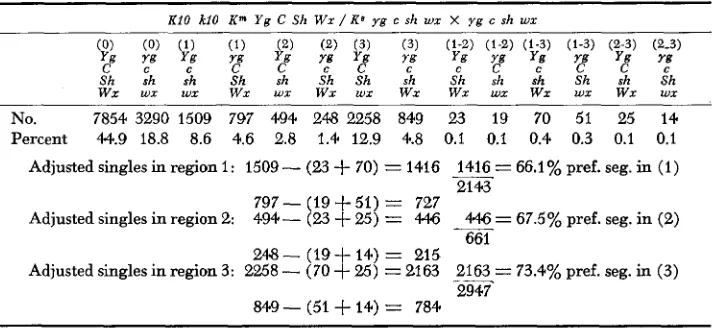
shed no light on the possibility that the position of the exchange may influence the segregation pattern. The critical exchange producing preferential segregation is in region 1. Over 40% recombination occurs in this region in KIO plants, and it is not possible to define the position of exchanges within such a long interval. The magnitude of preferential segregation represents an average value derived from all exchanges and gives no indication of any possible effect of exchange position within this segment. However, tentative conclusions can be reached by analyzing the extensive testcross data on four linked genes in the short arm of chromosome 9 (given in Table 2, KIKUDOME 1959) if the ratio of adjusted com- plementary single crossover chromatids or the ratio of the observed singles is used to determine the amount of preferential segregation following exchanges in each region. The validity of this manipulation has been established above. The esti- mate from singles is preferable to that from doubles because of the low number of double-crossover chromatids.
The results of this analysis, shown in Table 3, reveal a progressive decrease in the degree of preferential segregation. Single exchanges in region 3, which is nearest the centromere, gave 73.4% preferential segregation, those in region 2 and those in region 1, 67.5 and 66.1% respectively. The degree of preferential segregation determined from the ratio of observed singles in each region gave the same seriation. The significance of this observacon is not understood, but a differential accumulation of centromere substance may be involved. If this rela- tionship between exchange position and centromere can be shown to hold for
TABLE 3
Data from Table 2 of Kikudome (1959) on preferential segregation of chromosome 9
KiO kiO K" Y g C Sh Wx / K' y g c sh wx X y g c sh wx
No. 7854 3290 1509 797 4.94 248 2258 849 23 19 70 51 25 14
Percent 44.9 18.8 8.6 4.6 2.8 1.4 12.9 4.8 0.1 0.1 0.4 0.3 0.1 0.1
Adjusted singles in region 1: 1509
-
(23+
70) = 1416E=
66.1% pref. seg. in (1) 2143797-(19+51) = 727
494- (23
+
25) = 446 *= 67.5% pref. seg. in (2) Adjusted singles in region 2:661 248- (19+ 14) = 215
Adjusted singles in region 3: 2258
-
(70+
25) = 2163 2== 73.4% pref. seg. in (3) 2947A B N O R M A L CHROMOSOME 1 0 1001
other chromosomes, it will play an important role in reaching an understanding of the interaction between knobs and centromeres.
Preferential segregation occurs only when heteromorphic dyads are formed, but its degree may vary following exchanges in a specific chromosome segment vvhen differences in knob size exist. KIKUDOME (1959) found that the recovery of the Wd allele vaned from 68.8% in KIO k10 K L 9 / k 9 plants to 59.1% in KIO kI0 Ks99/k9 plants (KL9 is a large terminal knob and K s 9 is a small knob) even though the same amount of recombination took place between the Wd and Wx
loci and equal numbers of heteromorphic dyads were formed. The degree of preferential segregation is influenced by the difference in knob size exhibited by the chromatids of the dyad; the greater the difference, the greater is the degree of preferential segregation.
The Effect of Abnormal Chromosome I O on Crossing Over
That abnormal chromosome 10 ( K I O ) increases crossing over was first reported in 1957 by RHOADES and DEMPSEY. This conclusion has been confirmed by sub- sequent investigations in this laboratory as well as by KIKUDOME (1959). The data given in Table 1 were subjected to an analysis for the effect of KIO on recombination in different kinds of chromosome 3 bivalents. Data from plants with the same genotype, insofar as their constitution for chromosomes 10 and 3 is concerned, were combined. Also grouped together were plants with KIO KIO
and KIO k I 0 because they had the same behaviour in testcrosses. Plants with two knobbed chromosomes 3 ( K 3 K 3 ) and those with two knobless 3’s ( k 3 k 3 )
are designated in Table 4 as homomorphic and those with one knobbed and one knobless chromosomes 3 ( K 3 k 3 ) are labelled heteromorphic. The analysis of the different combinations of the KIO k I 0 , K 3 and k3 chromosomes includes a com- parison of the calculated tetrad ranks, the observed chromatid ranks, and the amount of recombination found for the two marked regions, GI-Lg and Lg-A, in the long arm of chromosome 3.
The comparison of calculated tetrad ranks in plants (with homomorphic chro- mosomes 3 ( K 3 K 3 or k3 k 3 ) discloses that the plants with KIO have more tetrads with double exchanges and slightly more with single exchanges in region 1 but fewer tetrads with single exchanges in (2) and with no exchanges than do kIU K 3 K 3 and k I 0 k3 k3 plants. KIO K 3 K 3 individuals differ from K I O k3 k3 in having fewer single exchanges in (2) and more double-exchange tetrads. The same amount of recombination (37%) in the Lg-A region for the two combina- tions is obtained because the smaller frequency of single exchanges in (2) found in K 3 K 3 plants is almost exactly compensated for by an increase in number of doubles. It is noteworthy that the frequency of recombination between Lg and A is nearly identical in all of the four classes with homomorphic chromosomes 3
1002 M. M. RHOADES AND E. DEMPSEY
0
%
k
2
E
p-
3 3
i!;
3.g
.ti$
ii?
E ?
B P
* - 8 :
2
9 .- q . 3tf
.s
2 Cr8J
2 :
3 :
s 3
Q U
2
$ $
a h
k 0
2 2
- 2
" 2
3 w
'B
.?
$ 3
% %
s
2 s
-h
-
1A B N O R M A L C H R O M O S O M E I O 1003 Percentage increase in recombination
for the GI-Lg region
KIO k3 k3 vs. k10 k 3 k3 KIO K 3 K 3 vs. k I 0 k3 k3 K 1 0 K 3 K 3 vs. k10 K 3 K 3 K 1 0 k3 k3 vs. k10 K 3 K 3
38 61
54
32
Plants heterozygous for the knob on the long arm of chromosome 3 give a somewhat different pattern. As in the homomorphic classes there were more tet- rads with double exchanges, fevver single-exchange tetrads i n (2) and fewer with no exchanges in K10 than in k10 plants. They were unlike in that the bomo- morphic tetrads had more single exchanges in region 1 in KlO than in k10 indi- viduals while in heteromorphic K3
k3
plants equal frequencies of single exchanges in (1) occur inKlO
and k10.The observed amount of recombination for region 2 in k10
k3 k3
plants is con- siderably higher (an increase of 59%) than that in k10K3 k3.
The lower amount inK3 k3
heterozygotes is due to the heterozygous knob located within region 2 which is known to produce asynapsis of the adjacent homologous segments. The decrease in region 12 is, however, accompanied by a compensatory increase (36% ) in the Gl-Lg region. Comparison of recombination values for the Gl-Lg and Lg-Aregions from KIO
K3 k3
andKlO k3
k3 combinations likewise reveals a compensa- tory increase in the Gl-Lg region inK3
k3 plants when the value for the Lg-Ainterval is lowered because of knob heterozygosity. The reduction in the Lg-A
interval in K10
K3
k3
individuals is less than that in k10K3
k3 and it appears that theKlO
chromosome is able to partially overcome the decrease due to knob heterozygosity. It has been o w experience that a decreased amount of recombina- tion in one segment of a chromosome is commonly accompanied by a n increase in adjacent regions of the arm. It is not known whether or not this compensatory increase extends to regions on the other side of the centromere.The same relative proportions of tetrad and chromatid ranks are found in KlO and k10 plants homozygous for In
3 b
as in plants with uninverted chromosomes. The differences in recombination for the two marked regions reflect the changed lengths of these segments. There was a 53% increase in K10 plants for the Gl-Lgregion and a 19% increase in crossing over f o r the Lg-A region. The data for homozygous In 3 b agree in general with those from normal chromosomes 3 which are heteromorphic f o r the knob and need not be discussed further.
1004 M. M. RHOADES A N D E. DEMPSEY
In 3b heterozygotes carrying KIO is four times that in k I 0 sibs (items 15 and 16, Table 1). The only crossover strands ordinarily recovered from exchanges within the inverted segments are those from double exchanges since the crossover chro- matids involved in single exchanges go to form the dicentric bridge and acentric fragment. A minimal estimate of recombination within the loop can be obtained from the percentage of pollen or ovule abortion.
KZO plants heterozygous for
In 3b had approximately 70% more aborted pollen than did k I 0 sibs.The increase in recombination in In 3a heterozygotes induced by the KIO chromosome is particularly instructive because the genetic data for the GI-Lg region are paralleled by cytological observations. Between two and three times as much recombination between GI and Lg is observed in I n 3 a heterozygotes with KIO as in those homozygous for the k10 chromosome (items 17 and 18,
Table 1 )
.
Certain double exchanges with one crossover in the proximal uninverted segment, i n which occur nearly all of the exchanges producing crossovers between GI and Lg, result in anaphase I microsporocytes with an acentric fragment and no dicentric bridge. The frequency of such configurations in KIO plants was three times that found in k I 0 individuals. The increase found in the genetic data is in agreement with that observed cytologically. Further evidence of enhanced re- combination in KIO plants comes from the sixfold increase for the Lg-A region in KIO compared to the value in k I 0 plants.The number of double-crossover chromatids recovered from KIO In 3c hetero- zygotes is five times that in k I 0 individuals. Comparable data on crossover en- hancement have been obtained from translocation studies. There exist data from diverse experiments that are consistent in demonstrating the ability of the KIO chromosome to greatly enhance crossover values in structural heterozygotes. In the case of structural homozygotes for chromosome 3 the enhanced crossover values were in proximal segments, but this localization does not appear to hold for structural heterozygotes. No explanation is offered concerning the localization
of increased crossover values by KIO to the proximal Gl-Lg region of structural homozygotes, but in the case of In 3b heterozygotes the solution is believed to lie in the more intimate pairing of the inverted and normal chromosomes that we have observed in sporocytes with the KIO chromosome (Figure 1 ) , This correla-
tion of the intimacy of pachytene pairing with recombination frequency will be
a b
FIGURE 1.-Pachytene pairing of nomrmal chromosome 3 and an In 3b chromosome. A large knob is present in both chromosomes. The centromere is indicated by an arrow. (a) From a plant carrying normal chromosomes 10. (b) From a plant heterozygous for abnormal chromo- some 10. These camera lucida drawings illustrate the more intimate pairing produced by KIO
A B N O R M A L CHROMOSOME 10 1005
considered in another paper in which o u r present observations and those from other studies will be presented in relation to their bearing on the time and mecha- nism of crossing over.
It was concluded that the enhancement of crossing over by KIO was restricted to the proximal Gl-Lg region in plants with homomorphic chromosomes 3. The Gl-Lg region consists in large part of heterochromatic, deeply staining chromo- meres. Crossing over in kZ0 plants within segments adjacent to the centromere is much lower per unit of pachytene length than is that occurring in euchromatic regions. If the increase in recombination induced by KZO in the proximal regions of chromosome 3 holds for similar regions of other chromosomes of the comple- ment, then the KZ0 chromosome can be utilized to release cryptic genetic vari- ability by promoting genetic exchange in regions which normally tend to be in- herited en bloc. Little is known about the genetic function of heterochromatin in maize but it has been suggested that loci situated therein are of importance in the inheritance of quantitative traits. If true, greater genetic variation should be a consequence of more frequent recombination. The KZO chromosome may prove to be of some value by breaking tight linkages in heterochromatic regions.
Preferential Segregation from Deficient Dyads
In KIO plants with $WO structurally normal chromosomes 3 heterozygous for the knob in the long arm, the knobbed chromatid was preferentially recovered from dyads which were heteromorphic for the knob in approximately 70% of the basal megaspores. In dealing with the In 3a data it is possible to consider the segregation pattern in dyads having one intact chromatid and a deficient one arising from breakage of the AI dicentric bridge produced by crossing over in the inversion loop.
The high amount of ovule abortion in KZO kZ0 In 3a/N3 plants is much greater than that which can be ascribed to 4-strand doubles in the loop. Double bridges are found in only 2% of the microsporocytes and should be of equal frequency in megasporocytes since the amount of crossing over is the same in reciprocal crosses. The data demand that the deficient chromatids arising from breakage of single bridges are often included in the basal megaspores which subsequently abort. This is in contradistinction to the behavior of dicentric bridges from in- version crossing over in Sciara where the two chromatids comprising the bridge ,are excluded from the egg nucleus (CARSON 1946). If the normal chromatids of a deficient dyad, irrespective of whether it is knobbed or not, invariably moved
to the basal pole, there would
be
little ovule abortion. The question remains of the segregation ratio in dyads composed of a deficient chromatid and a normal knobbed one as well as in those having a deficient chromatid and a normal knob- less one.The following conclusions may be tentatively adduced from an analysis of the
1006 M. M. RHOADES A N D E. DEMPSEY
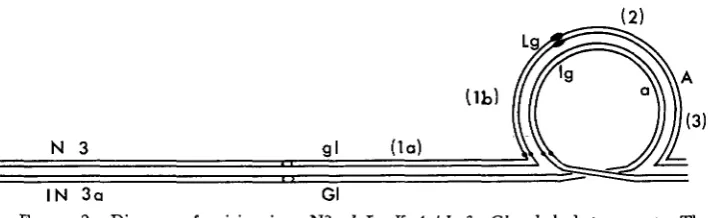
I N 3 a
FIGURE 2.-Diagram of pairing in a N3 g l L g K A /In 3a GL a k lg heterozygote. The crossover regions are designated (la) from gl to the proximal breakpoint of the inversion, (lb) from the proximal breakpoint to Lg, (2) from L g to A, and (3) from A to the distal breakpoint.
appears to hold irrespective or whether or not the deficient chromatid is knobbed or knobless. The same value is found with nondeficient heteromorphic dyads. (2) Random segregation occurs in deficient dyads having a knobless intact chro- matid; this is apparently true regardless of the presence or absence of a knob in the deficient chromatid.
The argument behind the above conclusions is as follows. The GGLg crossovers listed in item 18 of Table 1 (GI Lg A and gl Zg a ) arise from single exchanges in ( l a ) , from 3- and 4-strand doubles in ( l a - l b ) , (la-2), and (la-3), and from 2- and 3-strand doubles in ( l b - 3 ) . The crossover regions mentioned here are identified in Figure 2 in which a heterozygous In 3a bivalent is diagrammed. Dicentric bridges are not produced by single exchanges in ( l a ) but, since hetero- morphic dyads result, 70% of the basal megaspores receive a knobbed chromatid of GI Lg A constitution. All of the %strand doubles in (la-1 b)
,
(1 a-2), and ( 1 a-3) yield one dyad with a dicentric loop, which forms a bridge at AII, and one with two normal chromatids of which one is knobbed and the other knobless. This latter dyad undergoes 70% preferential segregation of the knobbed chromatid. However, both dyads resulting from 4-strand doubles in these regions have one normal and one deficient chromatid. Half of the deficient dyads will contain a normal chromatid with a knob and in these cases 70% preferential segregation of the knobbed over the deficient chromatid is assumed. When the intact chroma- tid is knobless, segregation should be random. In a deficient dyad with an intact knobless chromatid and a knobbed deficient one, the knob derived from the bridge would not have undergone a poleward orientation at AI and it would have no effect in controlling AI1 segregation, which would be random for the two chro- matids. From 4-strand doubles giving such dyads, a ratio of 70 GI Lg A : 50 gZ lg a chromatids should be obtained or 58.3% recovery of the knobbed crossover strand, while the average recovery from combined 3- and 4-strand doubles is 63.6% (70 GL L g A : 40 gZ Zga ) .The 2-strand doubles in (lb-3) form no dicentric bridges and 70% preferential segregation should occur while the %strand doubles give a 70: 50 ratio of GI Lg A to gl Zg a chromatids. The €requency of GI Lg A from all (lb-3) doubles should be 63.6% (i.e., 70:40).
ABNORMAL CHROMOSOME 1 0 1007
1 he assumptions made, produce a ratio of 70 single crossovers with a knob to 40
which are knobless. Doubles in regions (lb-2) and (2-3) do not produce G1 Lg A or gl lg a chromatids, The single exchanges in region l a give 70% preferential segregation. I t follows that the observed percentage of Gl-Lg crossovers with knobbed chromatids should lie between 70% and 63.6%. The 65.5% found is in good accord with the value expected on the basis of the postulated behavior of deficient dyads.
If it be assumed that intact knobbed chromatids invariably were recovered from deficient dyads and that random segregation occurred in deficient dyads with a knobless normal chromatid, an average percentage of recovery of knobbed GI-Lg crossovers would be 68% from double-exchange tetrads. In the single- exchange tetrads, a knob recovery of 70% occurs. The observed percentage of recovery of the knobbed single-crossover chromatids should therefore lie between 68 and 70, depending upon the relative frequencies of single exchanges in ( l a ) and of the appropriate doubles. The 65.5
%
observed is in agreement with the first hypothesis but the demonstration can hardly be said to be rigorous.A similar analysis of the (lb-2) and (2-3) double-crossover chromatids like- wise reveals that a 70: 50 segregation ratio for deficient dyads gives a better fit to the observed frequencies than does a 100:50 ratio. As in the case of the single crossovers in (1 a )
,
these data are best accounted for by the poleward orientation at AI of the knobbed normal chromatids and the persistence of this orientation i3t MII, possibly as a consequence of neocentric activity.The segregation pattern at AI1 does not appear to be affected by the knobbed or knobless constitution of the deficient chromatid derived by breakage of the dicentric bridge. The latter statement holds for deficient dyads with a normal knobless chromatid which give random segregation at AII. Whether or not the deficient chromatid is knobbed or knobless appears to be immaterial.
A small fraction of the duplication-deficiency (Dp Df) chromatids, those com- ing from bridge breakage close to one of the two centromeres, hence not greatly deficient, are able to form viable embryo sacs. The argument for the segregation patterns in deficient dyads was based on the observed frequencies of the comple- mentary crossovers between G1 and Lg. It is essential to determine if an unequal contribution to these classes could come through Dp Df chromosomes which ap- pear to be crossovers in (1 ) . Since single exchanges within the inverted segment are much more numerous than are doubles, only the contribution of single ex- changes to the formation of Dp Df strands will be considered here. The contribu- tion of the comparatively infrequent double exchanges is negligible.
1008 M. M. RHOADES A N D E. DEMPSEY
intact chromatid as its partner and the knobbed strand will be preferentially recovered. Consequently, few if any viable deficient strands from bridge brealr- age with the gl l g a alleles are anticipated.
Single exchanges in region 3, the segment from the A locus to the distal break- point of the inversion, form dicentric bridges carrying the gl L g A Gl alleles in the order listed. Breaks at either end of the bridge between the gl allele and one centric region and between the GI allele and the other centric region produce Dp Df strands of gl L g A GI constitution. Bridge breakage between gl and L g will also give strands with the three dominant alleles. Not being grossly deficient, a portion of these could be recovered and contribute to apparent G1 L g A single crossovers. When breakage occurs between L g and gl or between gl and the centromere, the Dp Df strand will be associated with a knobless normal strand and a few GI L g A Dp Df chromatids may be recovered. The frequency of single exchanges in ( 3 ) cannot be estimated from the present data but it is known to constitute a relatively small portion of the inverted segment ( RHOADES and DEMPSEY 1953). Any contribution of simulated crossovers to region 1 classes from Dp Df chromosomes should have no marked effect on the ratio of the com- plementary GI L g A and gl l g a classes.
One might predict that the knobbed intact chromatid of a deficient dyad should show a higher degree of preferential segregation than the knobbed chromatid of a heteromorphic dyad consisting of two normal chromatids, but according to the analysis presented above, no difference exists. The explanation may lie in the behavior of the deficient chromatid following rupture of the bridge. Each portion of the broken bridge may literally snap back towards its centric region in much the same way as does an elastic fiber under tension which is suddenly severed. Support for this concept comes from BAJER’S (1963) observations of bridge break- age in living cells. After release from the bridge, the dyad would undergo the same degree of preferential orientation as a heteromorphic dyad with two normal chromatids.
A B N O R M A L C H R O M O S O M E 1 0 1009
Neocentromeres and Preferential Segregation
In this section earlier cytological observations on neocentromere formation are reviewed and further cytological studies are presented. The concordance between the preferential segregation of knobbed Chromatids and their neocentric activity is discussed. The hypothesis is advanced which seeks to account for preferential segregation on the basis of polarized orientation due to neocentromeres. Finally, certain discordant observations are considered.
In addition to its ability to induce preferential segregation and to increase recombination, the
KZO chromosome causes the formation of neocentromeres
during the two meiotic divisions ( RHOADES and VILKOMERSON 19412.; RHOADES1952). Cytological observations on neocentromeres in KZO KZO plants are given in the 1952 paper. A brief summary is as follows.
The first meiotic division is in no way exceptional until metaphase I. Bivalents are co-oriented on the spindle in the usual manner with half-spindle fibers, originating from the true centric regions, facing poleward. Normally these fibers effect anaphase movement of the disjoining dyads with the localized centromere region proceeding first to the pole. However, in plants with the KiO chromosome, chromosomal fibers arise from distal portions of certain chromosomes at the time the bivalents are still co-oriented on the spindle at MI. The neocentric regions move pole- ward more rapidly than the true centric regions. The distal ends of the chromatids, instead of
being directed toward the spindl? plate during AI, lead the way in the poleward migration. Chromosomal fibers may arise from one or both of the long arms of each dyad at late metaphase or at early anaphase. When both long arms of the two chromatids of a dyad possess a neocentric region, the chromosomal fibers arising from these centric regions are usually directed towards the same pole.
The ensuing telophase is normal. All four arms of each dyad contract to form a spherical mass of chromatin. The chromonemata uncoil during interphase and early PI1 finds each daughter cell with ten long X-shaped dyads of typical appearance with the two chromatids of each dyad con- joined by the primary centric regi3n. There is no indication of neocentric activity at this time. The onset of MI1 may sometimes occur before the dyads have undergone their usual contraction. Precocious fibers arise near the ends of certain chromatids and these arms are stretched toward the poles before the true centromere region divides. The number of dyads with precocious spindle fibers, judged by the number of arms pulled poleward at MII, varies in different strains. The maximum number in some plants was seven, in others five, etc. Plants with seven knobbed chromosomes had a maximum of seven dyads with arms stretched poleward a t MII. Those with five knobs had five such dyads. A convincing demonstration of the relationship between knobs and neocentromere activity came from the analysis of a plant with homozygous knobs on nine chromosomes (one of these was KIO) and one pair which was knobless. Pachytene studies dis- closed that chromosome 9 was knobless, that chromosomes 2, 4, 5, 6, 7, 8, and 10 were homozy- gous for a knob in their long arms, and that chromosomes 1 and 3 were homozygous for knobs in both their short and long arms. If neocentromeres are formed only at knobbed regions, one dyad at MI1 should have no neocentric activity, seven should have neocentric regions only in their long arms with the short arms behaving normally, and two of the dyads should have neo- centromeres in both their short and long arms. As Figure 3 illustrates, this is precisely the situation observed. The two dyads with the short and long arms of each chromatid extended poleward are clearly two of the longer chromosomes and presumably are chromosomes 1 and 3,
the longest and third longest of the complement. The normal appearing dyad is obviously one of
the smaller chromosomes and it may be assumed to be chromosome 9, the second shortest.
I010 M . M. RHOADES A N D E. DEMPSEY
0
FIGURE 3.-Metaphase I1 in a plant homozygous for abnormal chromosome 10. One dyad (chromosome 9) has no knobs and shows no neocentric activity; seven dyads have knobs in their long arms and these arms are extended poleward; and two dyads (chromosomes 1 and 3) possess knobs inthe long and short arms and neocentromeres are present in both arms.
chromatic knobs. I n other strains we have observed dyads at AI and MI1 with only one arm of the four exhibiting neocentric activity. This is understandable if they arose from a bivalent heterozygous f o r a knob in which an exchange had taken place between the knob and centromere, thus forming heteromorphic dyads consisting of one knobbed and one knobless chromatid. Owing to its neocentric activity, the knob-bearing chromatid comes to lie nearest the pole at the end of anaphase.
The genetical studies prove that segregation is random in KIO plants when the chromosomes of a pair are both knobbed or knobless, that preferential segre- gation depends upon an exchange producing heteromorphic dyads, and that it is the knobbed chromatid which is preferentially recovered in the basal megaspore. Because the genetical results and the cytological observations (even though the latter !were made in microsporocytes) paralleled one another so strikingly, the following working hypothesis was presented ( RHOADES 1952) to account for preferential segregation on the basis of neocentromere formation.
A B N O R M A L CHROMOSOME I O 1011
occur if this orientation persists until the second metaphase so that the knobbed chromatids face the two terminal poles and the knobless chromatids are oriented towards the two inner poles. Accordingly preferential segregation would take place only when there has been an exchange between the knob and the primary centric region in a heterozygous bivalent. It follows that the level of preferential segregation would be directly related to the amount of crossing over in the knob- centromere interval. On this hypothesis it is the orientation of the disjoining dyads at AI which is decisive in determining preferential segregation. The pres- ence or absence of neocentric activity at MI1 is of no consequence since the orientation has been previously established at AI. This view is supported by our studies on deficient dyads where random segregation at MI1 was indicated for heteromorphic dyads in which the deficient knobbed chromatid came from a dicentric bridge.
Earlier observations on the involvement of the primary centric region in neo- centric formation (RHOADES 1952) have been extended. K10 K10 plants were obtained heterozygous for several paracentric inversions. Both the normal and inverted chromosomes were knobbed and in all cases the knob was included within the inversion. Single exchanges in the inverted segment produce a dicen- tric bridge and an acentric fragment which carries the knob. The two chromatids not involved in the exchange are knobbed and neocentric regions arising in them at the knob regions are evident at AI. The behavior of the knobbed acentric frag- ment is instructive. Observations were made with In 7a, In 4a, and In 3a hetero- zygotes. The knobbed acentric fragments pass, often in advance of the rest of the dyads. to one or other of the two poles. The attenuated appearance of their pole- ward ends suggests that they possess chromosomal fibers. In
KlO
KlO
and k10 k10 plants with knobless acentric fragments produced by inversion crossing over, the acentric fragments showed no indication of centric activity at AI. They remained on the spindle plate while the dyads were disjoining. In the second meiotic division the knobbed acentric fragments from all three inversions were never observed to congress onto the MI1 spindle and were found lying at one of the spindle poles. There was no indication of chromosomal fiber formation by the acentric fragments at the second meiotic division. Inasmuch as the knobbed frag- ments were included in the nuclei organized at telophase I, it is not likely that their behavior in the second division can be ascribed to the onset of the degenera- tion typically undergone by lagging acentric fragments. The level of neocentric actirity of knobbed fragments, judged by their movement on the AI spindle relative to that of the normally disjoining dyads, was less inKlO
k10 than in1012 M . M. RHOADES A N D E . DE M P SE Y
able to produce sufficient neocentric activity at AI so the fragment moves pole- ward. The passive behavior of the knobbed fragment in the second meiotic division is interpreted to indicate that no more fiber-forming material is available, having been depleted and not replenished because the knob is no longer associ- ated with a centromere. These observations on behavior of knobbed acentric frag- ments differ from the earlier report on In #a where the AI movement was not seen. In the present, more extensive studies these fragments did migrate to the pole in the first division but manifested no kinetic activity in the second division. In all instances the same conclusion is reached relative to the role of the true centromere in neocentric formation.
A B N O R M A L CHROMOSOME I O 1013
( 3 ) There remain, however, bwo sets of observations more difficult to reconcile. Studies by EMMERLING (1959) on the KO10 chromosome, a modified KlO chromo- some lacking the heterochromatic knob and distal euchromatic segment of K10, gave 52.7% recovery of the KO10 chromosome from KolO/kZO heterozygotes. Reduced neocentric activity in KoZO/Ko10 plants was seen at MI1 (no mention is made of its occurrence at A I ) , but there was little neocentric activity in KolO/k10 MI1 cells. The KO1 0 chromosome induced preferential segregation of hetero- morphic chromosomes 9, but the percentage of recovery of the K9 homologue (53.2%) was much less than the 68.0% from KlO kZ0 K9 k9 plants. The combi- nation KlO P I 0 gave 64.8% recovery of the K10 chromosome. These data are not inconsistent w!th a reduced strength of neocentric activity resulting in reduced preferential segregation. However, her investigations on the K s l 0 chromosome, which lacks the distal euchromatic end and approximately half of the hetero- chromatic knob of KZO, gave anomalous results. Random recovery of K'lO occurred in K s l O / k l 0 heterozygotes, indicating the equivalence of the two chro- mosomes in determining the segregation pattern, but there was only 54.3
%
recovery of the KIO chromosome from KIO/Ks10 plants compared with the 70.2% found in KlO/klO individuals. Additional evidence of the aberrant be- havior of the Ks10 chromosome comes from Ks10 k10 combinations having hetero- morphic chromosomes 9 which gave 53.2% recovery of K9. Thus, the Ks10 chromosome was able to induce a moderate degree of preferential segregation of the knobbed chromosome 9 although itself undergoing random segregation. A
low degree of neocentric activity was observed at MI1 in KsZO/Ks10 sporocytes. Although pachytene studies revealed no structural derangements in the Ks10 chromosome, a reduced transmission (35.2%) of the Ks10 took place through the pollen of KslO/k10 plants while a 1:l male transmission ratio occurred in KOlO/ k10. The Ks10 chromosome should be subjected to further study using marker genes distributed throughout the long arm in order to determine if there is any reduction in crossing over. Perhaps consideration should be given to the fact that P I 0 has a knob derived from a fracture of the KIO knob, and its aberrant be- havior may be due in some unknown way to its lacking the distal portion of the KIO knob. The data on the KO10 chromosome are not in conflict with the neo- centromere hypothesis of preferential segregation, but the K s l 0 observations are difficult to account for on this or any other basis. EMMERLING'S data contain too many ambiguities, as she recognizes, to be decisive in arguing for or against the hypothesis.